

Mars’s Orbit and Extra gum brands just launched “Total Overthink of The Head,” a global campaign that blends internet meme culture with “borrowed nostalgia” to re-engage younger audiences — and it’s a playbook every brand builder should study. This post breaks down the cultural mechanics behind the strategy, why the timing is right, and gives you a step-by-step framework for replicating it with your own brand and budget.
What This Is
The “Total Overthink of The Head” campaign is Mars’s global push to reconnect its gum brands — Orbit and Extra — with younger consumers who grew up with the internet. Per Marketing Dive (March 30, 2026), the campaign mixes meme-native content formats with “borrowed nostalgia,” a deliberate strategy of borrowing the aesthetic warmth of previous decades without requiring the audience to have actually lived through them.
“Borrowed nostalgia” is distinct from traditional nostalgia marketing in a fundamental way. Traditional nostalgia targets people who have a direct memory of the era being invoked — Gen Xers remembering 90s Saturday morning cartoons, Millennials remembering AOL Instant Messenger. Borrowed nostalgia, by contrast, targets audiences who never experienced the original moment but have developed deep emotional connections to its aesthetic through mediated re-exposure: streaming rewatches, YouTube compilations, TikTok aesthetics, Spotify era playlists. Gen Z’s relationship to the 1990s and early 2000s is not memory — it is media. They have absorbed the aesthetic without the biography.
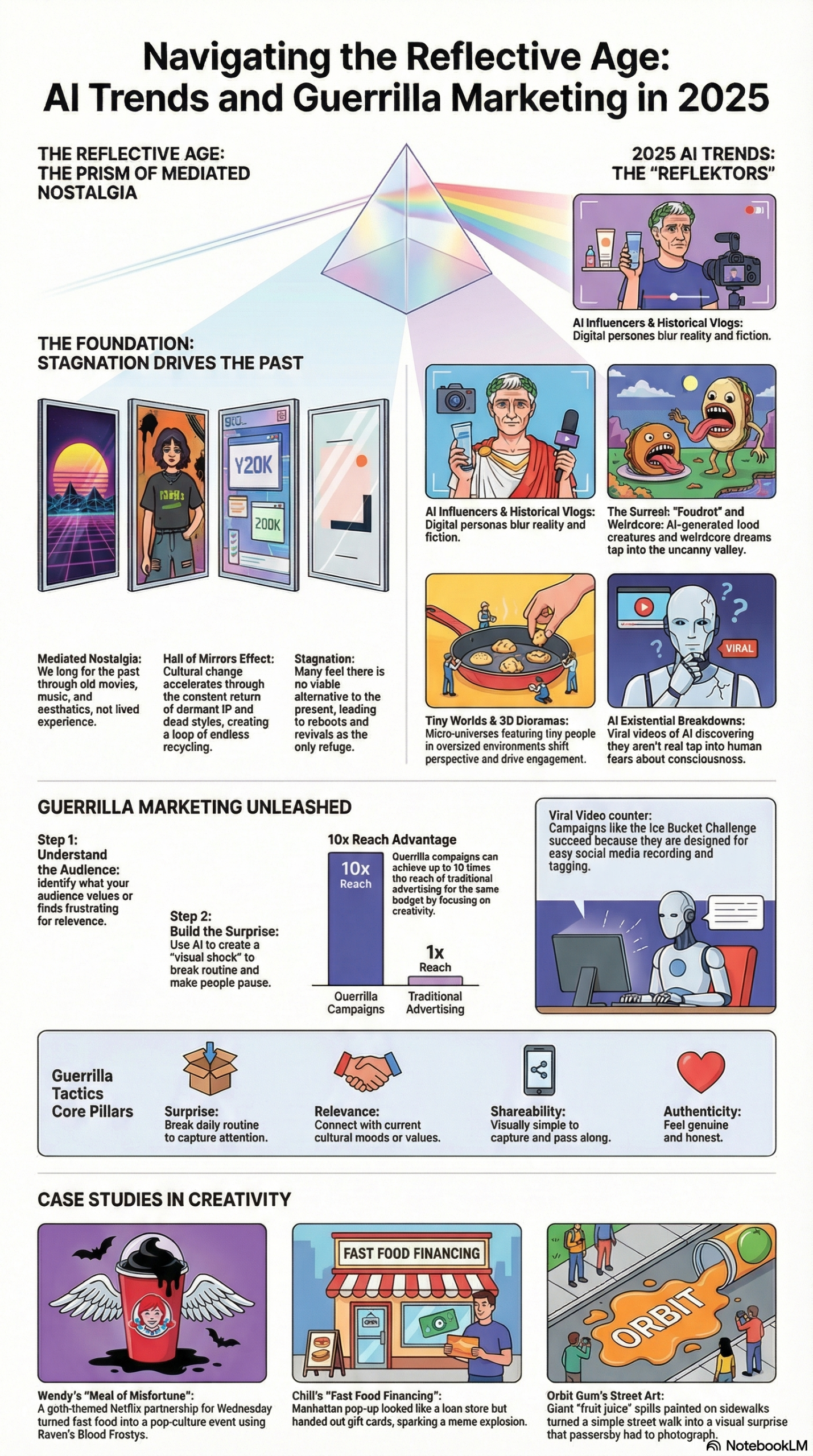
This concept maps directly onto what cultural analysts have described as the “Reflective Age,” documented in the research report: a condition where contemporary media is “caught in a hall of mirrors,” where cultural identity is increasingly indexed to patterns of consumption and social capital is gained through the “recognition” of mediated references. Brands that can insert themselves into that recognition loop — in Orbit and Extra’s case, by associating gum with the carefree, slightly chaotic aesthetic of late 90s/early 2000s pop culture — gain a shortcut to emotional resonance with audiences who love the vibe without the biography.
The campaign name “Total Overthink of The Head” is itself meme-native: the kind of self-aware, slightly absurdist, grammatically loose phrasing that performs well in text-based internet formats and signals cultural fluency to a generation raised on ironic internet humor. Gum is a category with nearly zero functional differentiation at the consumer level. Breath freshness is table stakes. The real battlefield is brand identity, and Mars has identified meme culture and borrowed nostalgia as the two weapons for winning that fight.
The broader cultural context matters here. Per the research report, contemporary culture moves “like a treadmill, characterized by the constant return of ‘dead styles’ and dormant intellectual property.” Reboots and revivals are pervasive. Nostalgia is currency. Mars is positioning Orbit and Extra not just as products but as aesthetic artifacts from an era that younger audiences have already romanticized — a clever strategy for a category that has struggled to maintain relevance as younger consumers increasingly deprioritize gum purchases.
Why It Matters
The Mars campaign signals a broader structural shift in how established CPG brands are approaching Gen Z brand-building. The conventional playbook — celebrity endorsements, 30-second TV spots, aspirational messaging — isn’t just losing effectiveness; it’s actively generating distrust among audiences who are algorithmically trained to detect and reject anything that reads as “ad-like.”
Meme culture as brand infrastructure. Meme formats aren’t just creative vehicles — they’re a shared cultural language with an established grammar of timing, irony, and emotional register. When brands speak that language fluently, they gain credibility. When they speak it poorly — try-hard, delayed, tone-deaf — the backlash is fast, public, and screenshot-immortalized. Mars’s campaign suggests investment in genuine fluency, not surface-level imitation.
Nostalgia without the demographic ceiling. Traditional nostalgia campaigns are constrained by audience age. “Borrowed nostalgia” removes that ceiling entirely. The research report documents how cultural progress now moves with “the constant return of ‘dead styles,'” which means Millennials who lived the 90s and Gen Z who discovered it through TikTok can both be addressed within the same creative framework. This is rare in campaign architecture: a strategy that simultaneously resonates across two multi-decade demographic cohorts.
Lower cost, higher cultural penetration. The research also documents that guerrilla-style campaigns built around shareability and cultural fit can achieve “up to 10 times the reach for the same cost” compared to traditional advertising approaches. A single piece of meme-native content that lands correctly can outperform a multi-million-dollar broadcast buy, particularly in the 18-29 demographic where streaming and social dominate attention.
AI-enabled production parity. The democratization of AI content tools — the research report documents Google Veo 3 and other platforms enabling high-fidelity era-specific visual aesthetics at dramatically reduced cost — means the production barriers to borrowed nostalgia content have collapsed. Small teams can now generate Y2K-aesthetic video content that would have required a full production house in 2020. This changes the competitive dynamics for both established brands and challenger brands attempting to punch above their weight class.
The Data
Here’s how borrowed nostalgia combined with meme marketing compares to traditional nostalgia and standard brand content strategies across key dimensions relevant to practitioners:
| Dimension | Traditional Nostalgia | Standard Brand Content | Borrowed Nostalgia + Memes |
|---|---|---|---|
| Target Audience | People who lived the era | Existing brand customers | Anyone who absorbed the aesthetic |
| Required Budget | High (licensing, talent) | Medium | Low-medium (AI + social) |
| Demographic Range | Narrow (lived experience) | Existing base | Multi-generational (Millennials + Gen Z) |
| Content Shelf Life | Long (evergreen) | Medium | Short (meme lifecycle: 2–6 weeks) |
| Virality Potential | Low (broadcast, passive) | Low-medium | High (shareable, participatory) |
| Production Complexity | High | Medium | Low (AI-assisted era aesthetics) |
| Brand Risk Profile | Low (familiar formats) | Low | Medium (meme fluency required) |
| Primary KPI | Recall scores | Reach/impressions | Engagement, shares, UGC volume |
| Cultural Credibility Signal | Heritage | Authority | Fluency |
Sources: Marketing Dive, NotebookLM research report
The borrowed nostalgia + memes column is where Mars is playing with Orbit and Extra. The production cost is low relative to traditional nostalgia (especially with AI tools), the demographic reach is unusually broad, and the KPIs are social-native — meaning they align with where younger audiences actually live. The trade-off is requiring genuine meme fluency and accepting a shorter content shelf life. That trade-off is worth it for brands willing to operate with a rapid-iteration creative model.
Step-by-Step Tutorial: How to Build a Borrowed Nostalgia + Meme Campaign
This is a practical framework for building a campaign using the same principles Mars deployed with Orbit and Extra. You don’t need their budget. You do need cultural intelligence and a disciplined creative process.
Phase 1: Audience Archaeology (Week 1)
Before writing a single brief, you need to map your target audience’s mediated nostalgia landscape — which aesthetic eras they’re drawn to and why.
Step 1: Run a TikTok and Instagram trends audit.
Search the top hashtags adjacent to your product category combined with nostalgia markers: #90saesthetic, #y2k, #2000svibes, #retrocore, #nostalgiahits. Don’t look at what’s popular in general — look at what’s performing specifically in your demographic and category. For a gum brand, adjacent categories include candy, snacks, convenience retail, and pop culture. Document the top 20 pieces of content by engagement. Note not just what they show, but the visual style, music choices, color grading, caption formats, and comment register. You’re looking for consistent aesthetic clusters, not one-offs.
Step 2: Map the specific era.
Gen Z’s borrowed nostalgia overwhelmingly clusters around two eras: late 90s (1996–2001) and mid-2000s (2004–2008). These decades have been thoroughly re-aestheticized through streaming, TikTok, and Spotify playlists. The research report frames this as “mediated nostalgia” — audiences connecting to “the styles and artifacts of previous decades as seen through media,” not through lived experience. Pinpoint which era your audience’s content skews toward. Don’t try to cover multiple decades simultaneously — pick one era and go deep. Specificity reads as authenticity.
Step 3: Identify your brand’s authentic era touchpoints.
Where does your brand have a genuine connection to that era? For Orbit and Extra, gum had real cultural presence in 2000s pop culture: teen magazines, mall culture, music video cameos, convenience store displays. Your brand’s genuine heritage in a nostalgic era provides an anchor that prevents the campaign from feeling manufactured. Audit your own archive: product packaging from that era, any editorial or cultural placements, advertising from the period. These are your raw materials. If your brand genuinely existed and was being consumed during the era, you have source material for authentic references.
Phase 2: Meme Language Acquisition (Weeks 1–2)
Step 4: Distinguish meme formats from meme references.
The most common brand mistake is referencing memes (“You heard about that thing that’s going viral?”) rather than using meme formats. Meme formats are repeatable structural patterns: the comparison meme, the unexpected outcome, the self-own, the “nobody: / me:” construct, the tier list, the “POV:” scenario. These structures carry the meaning. The specific cultural reference just provides texture. Brands that copy references look like they’re trying to be cool. Brands that master formats actually are.
Step 5: Audit three months of relevant meme format activity.
Use KnowYourMeme and Google Trends to track which formats are in their early growth phase — not yet at saturation. Meme cycles typically run 2–6 weeks from emergence to oversaturation. If you’re building creative in-house with a 4–6 week production cycle, you’ll almost always be deploying into a declining format. The solution is to build a separate rapid-response pipeline alongside your main creative pipeline, with pre-approved brand assets that can be deployed quickly. Document the top 10 active formats, their typical structure, and their emotional register: ironic, sincere, self-deprecating, absurdist, earnest.
Step 6: Write 10 test concepts.
Match your brand’s nostalgic era with active meme formats. For a borrowed nostalgia campaign, the formula is: [current meme format] + [nostalgic era aesthetic] + [authentic brand product moment]. The “Total Overthink of The Head” campaign name suggests Mars is leaning into the anxiety/overthinking meme canon — content that dramatizes social self-consciousness and mental spiraling in a comedic register. This is a strong choice for gum specifically because breath anxiety is a universal, relatable trigger. Write 10 concepts. Discard any that require explanation. Memes must land in three seconds or not at all.
Phase 3: Content Production (Weeks 2–3)
Step 7: Choose your production approach.
You have three options, and AI tools have changed the calculus on all of them:
- Native lo-fi: Shoot on iPhone with era-appropriate filters, music, and aspect ratios. Cheap and authentic but skill-dependent. Best for brands with strong internal creative teams and fast approval cycles.
- AI-assisted production: Use AI video generation tools (the research report documents platforms like Google Veo 3 enabling high-fidelity era-specific aesthetics at scale) to generate visual content with 90s camcorder grain, Y2K CGI aesthetics, or VHS-style color grading from text prompts. Dramatically cuts production cost and timeline. One prompt can produce era-specific content that would have taken a week to produce in 2022.
- Creator collaboration: Partner with micro-creators (50K–500K followers) who already operate authentically in your target nostalgia lane. They bring cultural credibility and audience trust. You sacrifice some creative control but gain authenticity that money can’t buy.
Step 8: Build platform-specific variants.
Each platform has its own meme grammar. TikTok nostalgia content uses different timing, text overlay conventions, and music norms than Instagram Reels, which differs from YouTube Shorts, which differs from X/Twitter. For a global campaign like Mars’s, this means building a content matrix: core concept × platform variant × regional cultural adaptation. At minimum, produce TikTok-native, Instagram-native, and YouTube Shorts-native variants for each core concept. Don’t repurpose — rebuild for each environment.
Step 9: Sound-design specifically for nostalgic triggers.
Sound triggers nostalgia more reliably and quickly than visuals. Music licensing from the target era is typically the most expensive component of a borrowed nostalgia campaign. Before committing budget, run a quick test: produce a version of your content with an AI-generated era-approximate soundtrack and measure engagement against a silent version. If the music is doing significant emotional heavy lifting, invest in licensing. If the visual format is carrying the content, AI-generated era-approximate music may suffice at a fraction of the cost.
Phase 4: Launch and Amplification (Weeks 3–4)
Step 10: Seed with micro-creators before official launch.
Send content to 10–15 micro-creators in your category before the official launch. Don’t brief them extensively — if it requires explanation, it won’t work organically. Watch for genuine versus performative engagement. Genuine: they actually share it to their audience in their own voice. Performative: they post the brand asset exactly as delivered. Genuine engagement is your green light. Performative engagement means the content isn’t landing authentically.
Step 11: Build participation architecture into the launch.
The most successful meme campaigns create participation structures — ways for the audience to remix, respond, or extend the content. For “Total Overthink of The Head,” this might mean launching a template fans can fill with their own overthinking scenarios, or a TikTok duet/stitch format that invites escalating responses. Whatever the mechanic, the goal is to convert passive viewers into content co-creators. Per the research report, content strategies that turn “exclusive” or brand-controlled moments into “communal social moments drive virality more effectively than traditional media buys.”
Step 12: Monitor the meme lifecycle and iterate on a 72-hour cadence.
Establish a rapid monitoring process: track engagement velocity, comment sentiment, and organic remix volume every 72 hours. If a piece is gaining traction, fast-follow with a response piece or escalation that rewards the audience for engaging. If a piece is flat or generating ironic engagement (the audience is mocking rather than participating), pull it immediately. Meme content that misses reads as cringe, and the longer it stays up the worse the brand signal becomes.
Expected Outcomes
A well-executed borrowed nostalgia + meme campaign for a CPG brand should deliver:
– 3–5× baseline engagement rate on social content versus traditional brand posts
– Measurable increase in brand mentions within the 18–29 demographic
– UGC volume indicating organic audience participation in the campaign’s creative framework
– Social listening sentiment shift toward “relatable,” “funny,” and “nostalgic” as primary brand descriptors
Real-World Use Cases
Use Case 1: Legacy CPG Brand Acquiring Gen Z Buyers
Scenario: A snack brand historically targeting 35–50-year-olds needs to expand its buyer base to Gen Z without alienating its existing audience.
Implementation: Audit the product’s cultural presence in the 90s and early 2000s — commercials, product placements, shelf configurations that Gen Z would now encounter as archival media. Use AI video tools to create Y2K-aesthetic content paired with current meme formats: “POV: it’s 2003 and you just found this in your lunchbox.” Partner with 8–12 micro-creators aged 20–26 who already produce nostalgia content natively. Keep existing customers by running the campaign primarily on TikTok and Instagram Reels rather than disrupting traditional channels.
Expected Outcome: Brand becomes associated with Y2K aesthetic; organic share velocity introduces the product to Gen Z social feeds without requiring awareness-stage ad spend. Per the research report, community-centered content activation like this “drives virality more effectively than traditional media buys.”
Use Case 2: DTC Brand Building Meme-Native Presence from Zero
Scenario: A direct-to-consumer beauty brand has a product that works but zero organic social presence. They can’t out-spend established brands on paid advertising.
Implementation: Skip nostalgia entirely and focus purely on meme format fluency first. Identify the meme structure currently dominating their target demographic’s feeds. Produce 3–5 pieces of content per week using format + product moment. No era references needed initially — meme fluency alone builds audience trust and following. Use AI image generation to rapidly prototype 10–15 variations of each concept before committing to production. Once organic reach is established (60–90 days), introduce borrowed nostalgia as a content layer.
Expected Outcome: Consistent meme-native content builds genuine community. The research report documents small businesses now producing “studio-level commercials using JSON prompts and AI video generators, effectively competing with major corporations.”
Use Case 3: Global Brand Adapting a Core Campaign Concept Across Markets
Scenario: A global brand (like Mars) needs a campaign that works across culturally distinct markets — US, UK, Japan, Brazil — without requiring entirely separate creative development for each.
Implementation: Build the campaign around an emotional archetype rather than a specific cultural reference. “Overthinking a social interaction” is a universal human experience that translates across markets. Then overlay regional meme formats and aesthetic specifics for each market: the Japanese execution might lean into different humor registers and visual conventions than the Brazilian version, even though the underlying nostalgic emotional logic is identical. The research report documents that “mediated nostalgia” is a global mechanism — every market has its own version of nostalgized media — which makes this framework unusually portable.
Expected Outcome: Campaign achieves global reach with local resonance, using a smaller total creative budget than building four fully independent campaigns.
Use Case 4: Creative Agency Pitching a Borrowed Nostalgia Campaign to a Skeptical CMO
Scenario: A creative agency wants to pitch a meme + borrowed nostalgia strategy to a client CMO who is unfamiliar with the format and nervous about brand safety.
Implementation: Lead with business outcomes, not creative rationale. Document the reach multiple: the research report notes guerrilla-style culturally fluent campaigns can achieve “up to 10 times the reach for the same cost” of traditional advertising. Present a risk framework that explicitly addresses the meme lifecycle monitoring process and the protocol for pulling content that isn’t landing. The CMO’s primary fear is public embarrassment — address it directly with a clear escalation procedure and example precedents. Show competitor brands that have executed this approach successfully.
Expected Outcome: Client buy-in with clearly defined KPIs, risk thresholds, and monitoring cadence established upfront. Agencies that can bridge the cultural language and the business case language close these briefs faster and with better scope.
Use Case 5: Media Brand Using Borrowed Nostalgia to Extend Archival IP
Scenario: A media brand has archival content that has developed nostalgic cultural status among younger audiences who discovered it through streaming.
Implementation: Don’t reboot — reference with knowing irony. The research report frames this precisely: “reboots and revivals function as ‘cruelly optimistic’ attempts to repair the problems of the present by revising the crises of the past.” The more effective approach is treating your IP as a cultural artifact that the audience already has a relationship with, and creating meme-native content that acknowledges that relationship. The archival footage becomes source material for participatory content, not just a property to be relicensed.
Expected Outcome: Archival IP generates new organic social reach and audience engagement without requiring full reboot production investment. Existing fans feel their relationship with the property is being honored; new audiences discover the IP through its meme presence.
Common Pitfalls
Pitfall 1: Meme format lag.
Brands that deploy a meme format after its cultural peak are immediately read as out-of-touch, and the audience response is merciless. Meme cycles run 2–6 weeks from emergence to saturation. If your production cycle is 4–6 weeks, you will almost always be deploying into a declining format. Fix this by establishing a separate rapid-response content pipeline with pre-approved brand assets — visual identity, fonts, product photography — that creators can assemble into format-specific content quickly, bypassing the full approval cycle.
Pitfall 2: Aesthetic borrowing without cultural grounding.
Slapping a VHS filter on a standard product video is aesthetic borrowing, not borrowed nostalgia. The research report is precise about this: “social capital is gained through the ‘recognition’ of mediated references,” which means your audience knows the source material well enough to identify shallow imitation immediately. Every nostalgic aesthetic choice needs to be internally consistent and researched: the correct font weights, the accurate music era, the right color grading, the culturally accurate situational context. Surface-level nostalgia reads as hollow; specific nostalgia reads as fluent.
Pitfall 3: Brand invisibility in meme content.
Meme-native content is often so engaging that the brand disappears. If people share the content but don’t associate it with the brand, you’ve produced entertainment, not marketing. Every piece of meme content must contain a non-interruptive product moment — a natural context within the meme’s narrative logic where the product appears. For a gum brand, this might be: the character reaches for a piece of Orbit immediately after an awkward moment, without the scene stopping to acknowledge the placement.
Pitfall 4: One-size-fits-all global deployment.
The research report documents how cultural reference systems vary significantly across markets. A meme format that lands cleanly in the US may read as confusing or culturally tone-deaf in Southeast Asia or Southern Europe. Global campaigns require regional creative leads who translate the core concept into locally fluent execution — not just subtitling the US version, but rebuilding the cultural texture for each market.
Pitfall 5: Ignoring the meme lifecycle post-launch.
Ironic engagement — the audience mocking the brand’s attempt at meme fluency — looks similar to authentic engagement in raw metrics but has the opposite brand effect. Raw like and share counts don’t distinguish between “this is great” and “look at this brand embarrassing itself.” Monitor comment sentiment actively, not just aggregate engagement, and have a clear threshold for pulling content that is generating ironic rather than authentic participation.
Expert Tips
Tip 1: Build a weekly meme audit ritual.
Every Monday morning, spend 20 minutes cataloging the top-performing meme formats in your brand’s category across TikTok, Instagram, and X. Track format, emotional register, and estimated lifecycle stage. Over 8–12 weeks, you develop pattern recognition for formats in their early growth window — the only window where deploying the format signals cultural current-ness rather than lag.
Tip 2: Use AI to prototype nostalgic aesthetics before committing to production.
Tools like Google Veo 3, documented in the research report as a primary driver of high-fidelity generative AI content trends, let you test era-specific visual aesthetics rapidly and cheaply. Prompt 10 different aesthetic treatments — 90s camcorder, Y2K digital, VHS rental store, early internet — before committing any production budget. You’ll find which era aesthetic resonates with your specific audience before spending money on production.
Tip 3: Anchor the campaign on emotion, not specific cultural artifact.
The most transportable nostalgic content references a feeling rather than a specific TV show, celebrity, or product. “First day of school anxiety,” “summer boredom that hits different,” “the specific type of excitement before something you’ve been waiting for” — these emotional contexts travel across demographic sub-segments and international markets even when specific cultural references don’t. Emotion is the constant; the aesthetic era is the variable.
Tip 4: Partner with creators who already own the nostalgia lane.
There are robust creator ecosystems built specifically around 90s and early 2000s nostalgia content. These creators have already done years of cultural archaeology and audience-building. Partnering with them isn’t just a media buy — it’s a cultural credibility transfer. Identify creators whose nostalgia content is organic to their channel (not just sponsored posts) and build partnership structures that give them genuine creative latitude within your brand parameters.
Tip 5: Make UGC volume your primary campaign success metric.
The definitive proof that a borrowed nostalgia + meme campaign achieved genuine cultural penetration is that your audience started making their own version of it — without being asked, without incentive, just because the format and aesthetic resonated. Track organic UGC volume (content using your campaign’s aesthetic or concept, not just your branded hashtag) as your north star metric. Reach and impressions measure distribution. UGC measures cultural resonance. For this type of campaign, resonance is the goal.
FAQ
Q: How do I know if my brand can authentically use borrowed nostalgia?
Any brand with a genuine presence in the target nostalgic era has an authentic anchor. If your brand existed and was being actively consumed in the 90s or early 2000s, you have source material — archive it and use it. If your brand is newer, anchor borrowed nostalgia to adjacent cultural moments from those eras: the situations, feelings, and contexts that your product is designed to address, even if your brand didn’t exist then. Per the research report, contemporary nostalgia is about “mediated” experience rather than lived experience, which creates room for brands to participate in the aesthetic without requiring a direct historical presence.
Q: What’s the practical difference between meme marketing and meme-native marketing?
Meme marketing is a brand referencing memes or meme culture (“We heard you like memes!”). Meme-native marketing is a brand producing content that functions as an actual meme — it has the structure, timing, ironic self-awareness, and participatory potential of genuine meme formats. The difference is analogous to someone using foreign language phrases versus someone who speaks that language fluently. The audience detects the difference immediately and responds very differently to each. Invest in understanding format structure before deploying any meme-adjacent content.
Q: How much budget does a borrowed nostalgia meme campaign actually require?
The range is wide and AI has substantially lowered the floor. At the high end, Mars’s global Orbit/Extra campaign involves professional production, music licensing, multi-market distribution, and likely significant creator partnership investment. At the low end, the research report documents small businesses producing “studio-level commercials using JSON prompts and AI video generators, effectively competing with major corporations.” The core investment is cultural intelligence, creative talent, and a disciplined monitoring process — not production budget. Era-specific aesthetics that previously required full production houses can now be generated in hours.
Q: How do I maintain campaign continuity when meme formats have a 2–6 week lifecycle?
Design your campaign architecture around a stable emotional core rather than a single meme format. Mars’s “Total Overthink of The Head” is built around the overthinking emotional archetype, not a single meme structure. That emotional core gives the campaign a 6-month runway. The specific meme format vehicles rotate every 4–6 weeks as the landscape evolves. This approach maintains cultural currency through format evolution while preserving the campaign’s consistent emotional identity.
Q: What’s the most reliable early signal that a borrowed nostalgia campaign is working?
Watch for organic remixing within the first 72 hours of launch. If your audience is creating their own versions of your content — duets, stitches, response videos, their own take on the scenario — the campaign is working at the cultural level. This is more meaningful than high view counts, because views can be bought but remixing cannot. Remixing signals that your content structure has been adopted as a format, which is the ultimate goal of meme-native marketing.
Bottom Line
Mars’s “Total Overthink of The Head” campaign for Orbit and Extra is a clean case study in what successful Gen Z brand-building looks like: genuine meme-format fluency combined with borrowed nostalgia that allows a legacy brand to speak authentically to audiences who know the aesthetic without having lived it. The framework documented in the research report — a “Reflective Age” where cultural identity is mediated, social capital comes from aesthetic recognition, and brands win by inserting themselves into that recognition loop — is the operating environment every CPG marketer is now working within. The tactical playbook is replicable: map your audience’s nostalgia landscape, build meme format fluency into your content process, anchor creative on emotion rather than specific artifact, and deploy AI tools to cut production costs while maintaining era-authentic fidelity. Practitioners who master this combination are positioned to build genuine brand equity with younger audiences at a fraction of what traditional campaign models cost — and that cost-efficiency advantage compounds as AI production tools continue to improve.


0 Comments