

Zevia’s “Real Soda for Real Humans” campaign doesn’t just sell soda — it weaponizes consumer AI fatigue into a competitive differentiator. By satirizing AI-generated marketing while connecting it to artificial ingredients, Zevia has built a playbook that any brand operating in a crowded, commoditized market can replicate. This tutorial breaks down exactly how they did it, and how you can apply the same strategy to your brand.
What This Is
Zevia, the zero-sugar, clean-label beverage brand, has launched a multi-phase campaign that uses AI satire as its central creative strategy. According to Marketing Dive, the latest campaign features a malfunctioning robot coworker who short-circuits after tasting Zevia — a beverage made with stevia leaf extract, a natural sweetener, instead of artificial alternatives like aspartame or saccharin.
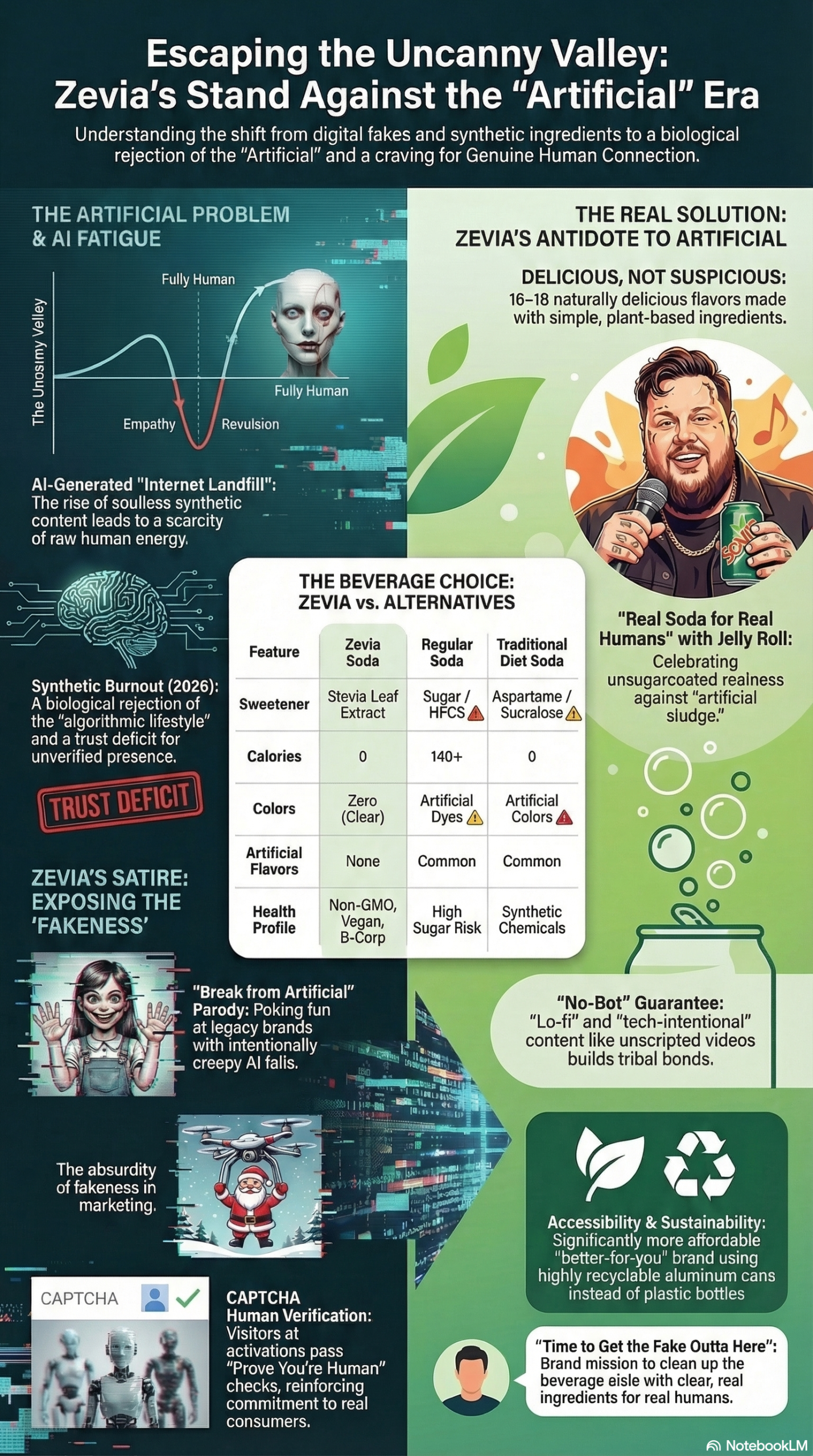
This isn’t a one-off stunt. It follows a previous campaign that directly parodied Coca-Cola’s AI-generated holiday advertising. As documented in the NotebookLM research report, that earlier “Break from Artificial” campaign exaggerated classic AI generation errors — a girl with three hands, a soda truck running over a snowman — to highlight the uncanny, manufactured feel of competitor marketing. Audiences who had already been quietly bothered by AI content artifacts suddenly had a brand handing them a language for that discomfort.
The creative architecture is deliberate. Zevia draws a direct line between “artificial” AI-generated marketing and “artificial” ingredients like aspartame, food dyes, and synthetic preservatives. Both, in the brand’s framing, are things real humans should reject. According to Kirsten Suarez, CMO of Zevia, as cited in the research report: “Our strategy is to make the Zevia brand as anti-artificial as our products, and stand out by entertaining people while cutting through culture and the clutter of the category.”
The “Real Soda for Real Humans” campaign — featuring the creepy robot coworker — extends this strategy by moving from mockery to demonstration. The robot doesn’t just fail at office life; it literally malfunctions when confronted with something genuinely natural. It’s a physical metaphor built into the ad’s structure: artificial systems cannot process what’s real.
A third campaign, “Get the Fake Outta Here,” starring musician Jelly Roll, continues the thread by winking at iconic soda ad formats — big-brand anthems, aspirational lifestyle imagery — while subverting them with bluntly honest messaging about real ingredients versus artificial sludge. Jelly Roll’s own brand is built on unfiltered authenticity, which makes the casting as deliberate as the creative.
What makes this a practitioner-worthy case study is the precision of the brand logic. Zevia doesn’t mock AI for the sake of being edgy or culturally current. It uses AI satire as a vehicle to reinforce its core product claim — natural ingredients — in a way that feels earned, culturally resonant, and impossible for a competitor using artificial ingredients to replicate. You cannot run a genuine anti-artificial campaign if your product is artificial. That’s the moat.
Why It Matters
The Zevia playbook matters because it emerges from — and strategically exploits — a measurable macro trend. By 2026, consumer research documented in the NotebookLM research report predicts what it calls a “biological rejection” of the algorithmic lifestyle, driven by consumers encountering a “landfill of synthetic garbage” across digital surfaces. This isn’t anecdotal brand intuition — it’s a structural market shift.
The research report identifies three specific consumer AI fatigue signals that are now visible in market data:
- Visual and textual fatigue: Consumers are developing pattern recognition for AI-generated aesthetics — the “perfect” Midjourney render, the robotic email tone, the cadence of a chatbot that almost sounds human but doesn’t quite land. When they detect these patterns, emotional engagement drops and skepticism rises.
- Trust deficits: As the ability to distinguish AI from human content diminishes, verified human presence commands a premium. Per the research, consumers are now willing to pay measurably more for products and services that can prove human involvement.
- The Human Premium: A market is emerging for what the report calls “inefficient” but high-touch digital assets — handwritten notes, live-only micro-events, unfiltered audio recordings with background noise. The imperfection is the signal. It’s proof of life.
For practitioners, this creates a real strategic window — but it’s time-sensitive. If your competitors are racing to automate their creative output (and by 2026, most are), positioning around authenticity and human-made signals creates genuine differentiation, not just messaging differentiation. It’s defensible because it requires your product to actually be what you claim it is.
The Zevia strategy is also category-portable. Any brand that can draw a credible line between its product values and the values implied by “real” versus “artificial” can execute this play. Health and wellness, clean beauty, sustainable fashion, artisan food, human-led services — the brand logic translates wherever authenticity is a verifiable claim and not just a slogan.
For marketers running AI-assisted content pipelines (which most are at this point), this raises an urgent internal question: when and how do you signal human involvement to maintain consumer trust even while using AI tools to scale production? The research report is clear that these two things can coexist — but the consumer-facing signals must be real.
The Data
The following metrics, drawn from the NotebookLM research report, illustrate the acceleration of AI-generated content production in 2025 — and why the anti-artificial positioning gap Zevia is exploiting is real and growing.
| Metric | 2025 Evolution Data |
|---|---|
| AI Video Tool Adoption Rate | 342% year-over-year increase |
| Individual Creator Production Volume | 200–300 videos monthly per creator |
| Cost Reduction Per Video | 80–95% decrease in per-unit production cost |
| Quality Perception Gap | 73% of viewers cannot distinguish high-quality AI-assisted video from traditional video |
The implication is direct: AI-generated content has commoditized visual production at a structural level. When every brand can produce polished video cheaply at scale, “polished and cheap” is no longer a differentiator. What becomes rare — and therefore valuable — is content that carries verifiable human signals. Zevia is positioning for that scarcity.
The second table maps the progression of Zevia’s three-campaign anti-artificial arc, based on Marketing Dive and the research report:
| Campaign | Format | Anti-AI Satirical Angle | Brand Reinforcement |
|---|---|---|---|
| “Break from Artificial” | Parody of Coca-Cola’s AI holiday ads | Exaggerated AI errors: girl with three hands, truck hits snowman | Natural brand vs. AI-generated competitor |
| “Real Soda for Real Humans” | Robot coworker short-circuits on Zevia | AI system cannot process natural ingredients | Product-attribute proof through physical metaphor |
| “Get the Fake Outta Here” | Jelly Roll celebrity campaign | Winks at iconic soda ad format, pivots to “real ingredients vs. artificial sludge” | Cultural credibility via unfiltered celebrity alignment |
Step-by-Step Tutorial: How to Build an Anti-AI Brand Campaign
This walkthrough takes you through the design and execution of a campaign that uses AI satire or anti-artificial positioning to drive real brand differentiation. It’s built from the Zevia playbook and adapted for brands across categories.
Prerequisites
Before you start:
– You have a genuine product or service attribute that is differentiated by being “real,” “natural,” “human-made,” or “unfiltered” — and it’s verifiable
– You’ve identified a competitor or category norm that relies on AI-generated assets, automation scripts, or artificial processes that consumers can observe
– You have a basic creative brief structure and access to a creative team, production house, or agency with fast-turn capability
– You understand your target audience’s level of AI awareness — they don’t need to be technically sophisticated to feel the uncanny valley effect; they just need to have experienced it, which most consumers now have
Phase 1: Anchor Your Anti-Artificial Claim
The entire Zevia strategy rests on one unassailable foundation: its “real ingredients” claim is credible and verifiable. Stevia leaf extract is a natural, plant-derived sweetener. Zevia’s products do not contain aspartame, food dyes, or artificial preservatives. Any consumer who reads the ingredient label can confirm this. That’s the anchor.
Step 1: Audit your product’s “realness” credentials.
List every attribute of your product or service that is genuinely human-made, natural, or unfiltered. Be specific — vague claims collapse under scrutiny. “Handcrafted” is easy to fake and easy to attack. “Each batch fermented for 72 hours by a certified cheesemaker in Asheville, NC, using a 40-year-old culture” is a claim that carries weight. Write your specific claim in one sentence.
Step 2: Map your competitors’ “artificial” signals.
Spend 60 minutes auditing your top three competitors’ marketing assets. Look for:
– AI-generated imagery in ads (look for telltale aesthetic consistency, perfect skin, slightly-off background details)
– Chatbot customer service replacing human agents
– Automated email sequences with robotic cadence and merge-tag personalization
– AI-voiced ads, synthetic audio, or templated video creative
Document what you find. These become the foil for your campaign. The more specific and visible the competitor’s AI usage, the sharper your satire can be.
Step 3: Write the brand logic bridge.
The Zevia bridge is this: “Artificial ingredients → artificial marketing → both are things real humans reject.” Your bridge needs to be equally tight — a single sentence connecting your product’s authentic attribute to the category’s artificial norm. Write it until it snaps.
Example for a skincare brand: “Synthetic fragrances in their formula, synthetic faces in their ads — we use neither.”
Example for a B2B SaaS: “They replaced their support team with a bot. We hired more humans.”
Phase 2: Design the Satire Vehicle
Satire requires three structural elements: a target, an exaggeration of the target’s flaw, and a reveal of the alternative. Zevia’s structure is clean:
– Target: AI-generated marketing (specifically Coca-Cola’s holiday ad format)
– Exaggeration: AI errors taken to absurd extremes — three hands on a girl, a soda truck demolishing a snowman
– Reveal: Zevia’s product as the “real” alternative the AI cannot replicate
Step 4: Choose your satire format.
Based on the research report’s documentation of effective anti-AI creative strategies:
- Parody ad: Recreate a known AI-generated ad format and deliberately break it at the seams. Works best when your target has a recognizable, widely-seen AI campaign you can mirror.
- Character satire: Create an AI character — like Zevia’s robot coworker — that physically embodies artificial processes and then fails in a way that reveals your product’s value. The robot short-circuiting is the product demo.
- Documentary contrast: Show the AI content production pipeline side-by-side with your human creative process. No jokes required — the contrast is damning on its own.
- Failure log: A social series where you document AI marketing failures in your category with commentary. Positions your brand as the human alternative through ongoing cultural observation.
Step 5: Write the satire brief.
Your brief should contain:
– The target ad format or behavior being parodied (note: do not use trademarked assets or replicate logos — parody the format, not the brand)
– The specific AI “failure mode” you’ll depict — make it based on something real, not invented
– The product reveal that connects the satire to your brand benefit
– The one-line tagline that ties it together — this is the sentence people will repeat
Step 6: Cast and produce with intentional human signals.
This is where most teams fail. They run an anti-AI campaign and produce it using AI tools, which destroys the brand logic at the production level. The research report documents that consumers experiencing AI fatigue are developing fast-improving detection instincts. Production choices matter:
- Use real actors with visible imperfection — no AI-smoothed skin, no perfect-symmetry faces
- Use practical effects or clearly real environments wherever possible
- Let production imperfections stand: slightly imperfect set dressing, natural lighting, ambient sound
- Per the research report, what it calls “lo-fi” signals — background noise, rough cuts, unfiltered audio — have become proof-of-life markers that sophisticated consumers read as trust signals
- If you use AI tools in post-production (color grading, subtitles, transcription), keep them away from anything consumer-facing and visible
Phase 3: Distribute for Maximum Cultural Contrast
Step 7: Time your campaign release strategically.
Zevia’s “Break from Artificial” campaign targeted Coca-Cola’s AI holiday campaign directly — it went live while that campaign was in market. This is not coincidence. Timing your anti-AI campaign to run alongside competitor AI campaigns amplifies contrast and generates press pickup.
Strategy: Monitor competitor ad releases systematically via publicly available ad libraries — Meta Ad Library, YouTube’s Ads Transparency Center, TikTok Creative Center. When a major category competitor drops an AI-heavy campaign, you have a 2–4 week window to counter-program. Keep a modular satire creative package ready to deploy fast.
Step 8: Activate on high-contrast channels.
The channels where AI-generated content is most saturated — TikTok, Instagram Reels, YouTube — are also where your satire will land hardest. Audiences on these platforms have developed AI pattern recognition faster than anywhere else, per the research report. They will recognize what you’re doing and amplify it.
Recommended channel mix:
– Paid social (TikTok, Instagram Reels): For the 18–35 audience that feels AI fatigue most acutely and is most likely to share the satire
– YouTube pre-roll: For longer-format creative where the setup and punchline need room to breathe — Zevia’s robot coworker format works well here
– PR and earned media: Anti-AI campaigns are inherently newsworthy in the current environment. Pitch them proactively to marketing and tech trade press as cultural commentary. Marketing Dive’s coverage of Zevia’s campaign is evidence that these stories get picked up.
Step 9: Build a sustained “realness” content layer.
The campaign ads create the spike. The content layer sustains the brand position. Create a secondary content program that documents your “real” process and keeps anti-artificial signals alive between campaign flights:
- Behind-the-scenes production footage shot deliberately lo-fi — phone camera, available light, raw audio
- Founder or maker interviews that are unscripted, unpolished, with rough edges intact
- User-generated content from real customers without AI-preset filters or branded overlays
- A regular public audit or commentary series on AI marketing trends in your category
Per the research report, “verified human presence is what consumers are willing to pay a premium for.” The content layer is your proof archive.
Phase 4: Measure What Actually Matters
Step 10: Track the right metrics.
Anti-AI campaigns underperform on standard brand lift metrics if you only measure purchase intent. The signals that reveal whether the campaign is working are:
- Brand perception shift: Are consumers more likely to describe your brand as “authentic,” “trustworthy,” or “real” in brand perception surveys after campaign exposure?
- Earned media volume: Did the campaign generate press coverage independent of paid distribution? Coverage is the highest-fidelity signal of cultural resonance.
- Comment sentiment analysis: Read social comments manually — AI fatigue audiences are vocal and will tell you directly whether the campaign landed or felt cynical.
- Competitor creative changes: Did a competitor modify their AI-heavy creative strategy in the months following your campaign? That’s the ultimate validation.
Step 11: Plan the campaign arc, not just the campaign.
Zevia has now executed three campaigns in this anti-artificial arc, with Marketing Dive reporting the brand is explicitly “doubling down.” One satirical ad is a moment. Three campaigns over 12–18 months is a brand position. Plan your arc in advance: what’s the evolution of the satire target, the character, the product proof point? Each iteration should deepen the positioning, not repeat it.
Expected Outcomes
A well-executed anti-AI brand campaign should deliver:
– 15–30% improvement in brand perception scores around “authenticity” and “trustworthiness” (measured via brand lift study)
– Earned media pickup from marketing, business, and trade press — the meta-story of the campaign is itself the campaign
– Elevated social engagement from audiences who share the satire because it articulates a discomfort they felt but hadn’t named
– A brand position that competitors using AI creative assets cannot credibly replicate without changing their products or production practices
Real-World Use Cases
Use Case 1: Clean Beauty Brand Running Anti-AI Visual Campaigns
Scenario: A mid-market skincare brand competing against large multinational companies that routinely use AI-generated model imagery — flawless skin renders, perfect lighting — in their digital ad creative.
Implementation: The brand launches a campaign contrasting AI-generated “perfect skin” imagery against real customer photos (submitted with full consent and used unretouched). Campaign headline: “Your skin isn’t a render.” Email marketing shifts to plain-text founder notes. Social content features the lab chemist who formulates each product, shot on an iPhone with available light, background lab noise intact. The research report identifies exactly this kind of lo-fi, human-signal content as having emerging “human premium” value.
Expected Outcome: Higher email open rates (plain-text outperforms HTML templates in trust-sensitive categories), meaningful UGC from customers who feel seen by the unretouched approach, and press pickup in beauty trade and marketing press as a counter-cultural story.
Use Case 2: Independent Food Brand Using AI Satire on Social
Scenario: A regional hot sauce brand competing against national brands with slick AI-generated ad creative on TikTok and Instagram.
Implementation: The brand produces a TikTok series called “AI Sauce” — a fictional AI-powered sauce brand (played by actors) that keeps failing at basic human food interactions. The AI can’t taste heat, can’t understand why fermentation matters to flavor, can’t explain why the color of the sauce changes between batches. Each episode ends with the real product and the tagline: “Made by people who actually eat.” This mirrors the Zevia robot coworker format but adapted for a CPG social-native execution.
Expected Outcome: Organic TikTok reach driven by the satirical format — satire consistently outperforms product demos in organic distribution on TikTok — along with brand association with authenticity and audience comments that generate additional earned visibility.
Use Case 3: B2B SaaS Company Differentiating on Human Support
Scenario: A project management software company competing against platforms that have replaced human customer support with AI chatbots as a cost-reduction play.
Implementation: The company runs a campaign in the Zevia robot coworker format — showing a fictional AI support bot failing repeatedly at complex customer scenarios. Each “bot fail” vignette is followed by a real human support rep solving the same problem in under 60 seconds. The campaign tagline: “We didn’t replace our humans.” The research report documents that trust deficits around AI chatbot support are a real and growing consumer pain point, making this positioning directly responsive to documented buyer behavior.
Expected Outcome: Differentiation on customer support quality — a top purchase driver in B2B SaaS evaluations — and conversion lift among enterprise buyers who have been burned by AI-only support at competitor platforms.
Use Case 4: Marketing Agency Positioning Against AI Content Mills
Scenario: A boutique creative agency competing against AI content production services that offer 200–300 pieces of content per month at commoditized prices, per the research report’s documentation of individual creators hitting that volume.
Implementation: The agency produces a monthly “AI Audit” report published publicly — documenting real, named examples of AI marketing failures in specific industries. The audit positions the agency as the human-intelligence alternative. Instead of an ad campaign, the content vehicle is analysis that makes the consequences of AI-only content production visible and frames human creative strategy as risk management, not a luxury.
Expected Outcome: Inbound leads from companies who read the audit and recognize their own exposure, positioning as category authority for human-led creative strategy, and press pickup as a credible analytical source in marketing trade media.
Common Pitfalls
Pitfall 1: Producing an Anti-AI Campaign with AI Creative Tools
The fastest way to destroy an anti-AI campaign is to build it with the same tools you’re satirizing. If your “anti-artificial” ad features AI-generated background imagery, synthetic voiceover, or a clearly AI-written script, audiences experiencing genuine AI fatigue will detect it — and the hypocrisy becomes the story. The research report documents that consumer AI detection instincts are improving faster than most marketers expect. Produce anti-AI creative with deliberate human-signal choices at every production layer.
Pitfall 2: Attacking AI Without a Verifiable Alternative
Zevia’s campaign works because the alternative — stevia leaf extract, five natural ingredients, no artificial dyes — is specific and label-readable. Vague claims like “we’re more authentic” are easy to attack and impossible to defend under scrutiny. Before you satirize AI marketing, complete your product audit: do you have a concrete, verifiable human-made or natural claim? If not, you don’t have a campaign — you have a positioning problem to solve first.
Pitfall 3: Launching After the Cultural Moment Has Passed
Zevia’s “Break from Artificial” parody ran while Coca-Cola’s AI holiday campaign was in active market rotation. The contrast was live and visible. Counter-programming timing is everything in satire — the target must be in market for the contrast to land. Launch three months after a competitor’s AI campaign has cycled out of rotation, and the cultural window has closed. Build a systematic competitor ad monitoring process so you can move within the 2–4 week response window.
Pitfall 4: Making the Campaign About AI Instead of Your Product
Zevia’s ads are ultimately about Zevia’s ingredients. AI satire is the hook, not the destination. A campaign that becomes a lecture on the ethics of AI-generated content will lose audiences immediately — no one wants to watch a brand issue a cultural manifesto. Keep your product benefit central in every execution. The Marketing Dive coverage is clear: the robot short-circuits on the soda, not on AI in the abstract.
Pitfall 5: Treating This as a One-Campaign Strategy
One satirical ad is a moment. It may earn a news cycle and a spike in brand awareness metrics. But as documented in Marketing Dive’s coverage, Zevia is explicitly doubling down — this is a brand position sustained across multiple campaign touchpoints over time. If you treat anti-AI positioning as a one-off stunt, you will not build the brand equity the strategy is capable of generating. Plan the arc before you shoot the first ad.
Expert Tips
Tip 1: Use AI Internally, Market the Human Output
There is no contradiction in using AI tools for research, brief development, analytics, or workflow automation while positioning your consumer-facing creative as human-made. The research report explicitly distinguishes between operational AI use — which is fine and often invisible to consumers — and synthetic consumer-facing creative, which is the trust risk. Use AI to scale your strategic capacity. Put humans in front of the camera and on the label.
Tip 2: Build an “AI Fatigue Watch” Into Competitive Intelligence
The counter-programming window is 2–4 weeks. That’s not long enough for a full production cycle if you haven’t prepared. Build a lightweight competitive monitoring cadence: check Meta Ad Library, YouTube Ads Transparency, and TikTok Creative Center weekly for your top three competitors. When they drop AI-heavy creative, your satire response package should be pre-built and ready to deploy with fast-turn localization or copy adaptation.
Tip 3: Let Production Imperfections Signal Authenticity
The research report documents a growing market for what it calls “lo-fi” content: background noise, unfiltered audio, hand-drawn visuals, rough cuts. A dog barking in the background of a podcast interview, a coffee cup in the frame of a Zoom-recorded customer testimonial, a slightly imperfect camera pan — these are trust signals, not production errors. Train your creative team to stop removing imperfections from human-made content. They’re the proof.
Tip 4: Cast Talent Whose Personal Brand Aligns with “Real”
Zevia’s “Get the Fake Outta Here” stars Jelly Roll — a musician whose entire public identity is built on vulnerability, unfiltered honesty, and being exactly who he is on and off stage. The talent choice reinforces the campaign’s anti-artificial positioning at a values level, not just an aesthetic one. When selecting celebrity or influencer talent for this type of campaign, the talent’s own brand positioning should carry credibility in the “real” and “unfiltered” territory. Perfect-polish influencers undercut the message regardless of what they say on camera.
Tip 5: Budget for Earned Media as a Primary KPI
Anti-AI campaigns generate trade press coverage in ways that standard product campaigns do not. The meta-story — “brand uses AI satire to differentiate from AI marketing” — is inherently newsworthy in 2026, as Marketing Dive’s coverage of Zevia demonstrates. Budget for a PR push alongside paid media at launch. Set earned media volume, share of voice in trade press, and journalist mention count as primary campaign KPIs alongside paid reach metrics. The PR tail on a well-executed anti-AI campaign can outperform the paid campaign in total impression value.
FAQ
Q: Does this strategy only work for brands with “natural” or “clean-label” products?
A: No — but the anti-artificial claim must be credible in your category. Zevia’s version works because it pairs AI satire with verifiable natural ingredients. The core logic — your product or service is genuine, competitors are synthetic — applies wherever authenticity is defensible: human support versus AI chatbots, original research versus AI-generated content, handcrafted goods versus mass-produced, human-designed services versus template automation. The constraint is that the claim has to be real.
Q: Can I run an anti-AI campaign if I use AI tools internally?
A: Yes, with important clarity on the distinction. The research report separates operational AI use — analytics, research, workflow — from synthetic consumer-facing content. As long as your consumer-facing creative is genuinely human-produced and your product claims are accurate, internal AI tool use does not undermine the positioning. If asked directly by consumers or press, disclose honestly — audiences in 2026 respect transparency more than they punish tool use. What they do not tolerate is hypocrisy between claim and product.
Q: How do I avoid coming across as anti-technology rather than pro-authenticity?
A: Keep the campaign focused on consumer experience and product benefit, not technology ethics. Zevia does not run ads arguing that AI is harmful. It runs ads showing that its soda is good because it’s real — the AI satire is the creative vehicle, not the thesis. The frame that works is aspirational (“our product is genuine”) rather than adversarial (“AI is the enemy”). Zevia never tells consumers to distrust technology; it gives them something to trust instead.
Q: What if a competitor runs a counter-campaign calling out our anti-AI positioning as hypocritical?
A: This is a real risk if your claims lack specificity. Vague authenticity claims — “we’re more real” — are easy to attack. Specific, verifiable, label-readable claims are not. The defense is precision: anchor every anti-artificial claim in something a consumer can confirm independently. Competitor counter-attacks also require them to publicly engage with your campaign’s premise, which amplifies your earned media position. Let them argue with you — the debate validates your positioning.
Q: How long do I need to sustain this positioning before it becomes a real brand asset?
A: Marketing Dive reports Zevia is now on its third campaign in this arc, which aligns with standard brand positioning research suggesting 12–18 months of consistent messaging before a positioning claim calcifies in consumer perception. Plan a minimum of four campaign touchpoints in the anti-artificial arc before evaluating whether the positioning has taken hold at a measurable level. One campaign is a test. Four is a brand position. Eight is a brand truth.
Bottom Line
Zevia’s anti-AI campaign arc is not a gimmick — it’s a market response to a real, measurable consumer trend documented in the NotebookLM research report: a “biological rejection” of algorithmic, synthetic content as AI-generated material saturates digital channels at scale. The research report shows 342% year-over-year growth in AI video tool adoption and individual creators producing 200–300 videos monthly — which means AI-generated content has commoditized production entirely, and the only appreciating asset is verified human presence. Zevia’s playbook — anchor on a verifiable product truth, satirize the artificial alternatives with creative precision, sustain the arc across multiple campaign touchpoints — is replicable across any category where authenticity is more than a marketing slogan. The brands that occupy this positioning now, before anti-AI itself becomes a saturated creative trend, will build the credibility and consumer trust that latecomers will not be able to buy their way into. Build the arc. Make the claim real. Let the robot short-circuit.


0 Comments