

At the ANA Media Conference on March 26, 2026, P&G Chief Brand Officer Marc Pritchard declared that marketing has entered a “new epoch” — one defined by extreme media fragmentation, the rise of digital commerce, and AI that lets teams work “better, faster, cheaper and now at scale.” If you run marketing at any level, this is the clearest roadmap yet for what enterprise-grade brand strategy looks like in 2026 — and it is fully replicable without a P&G budget.
What This Is
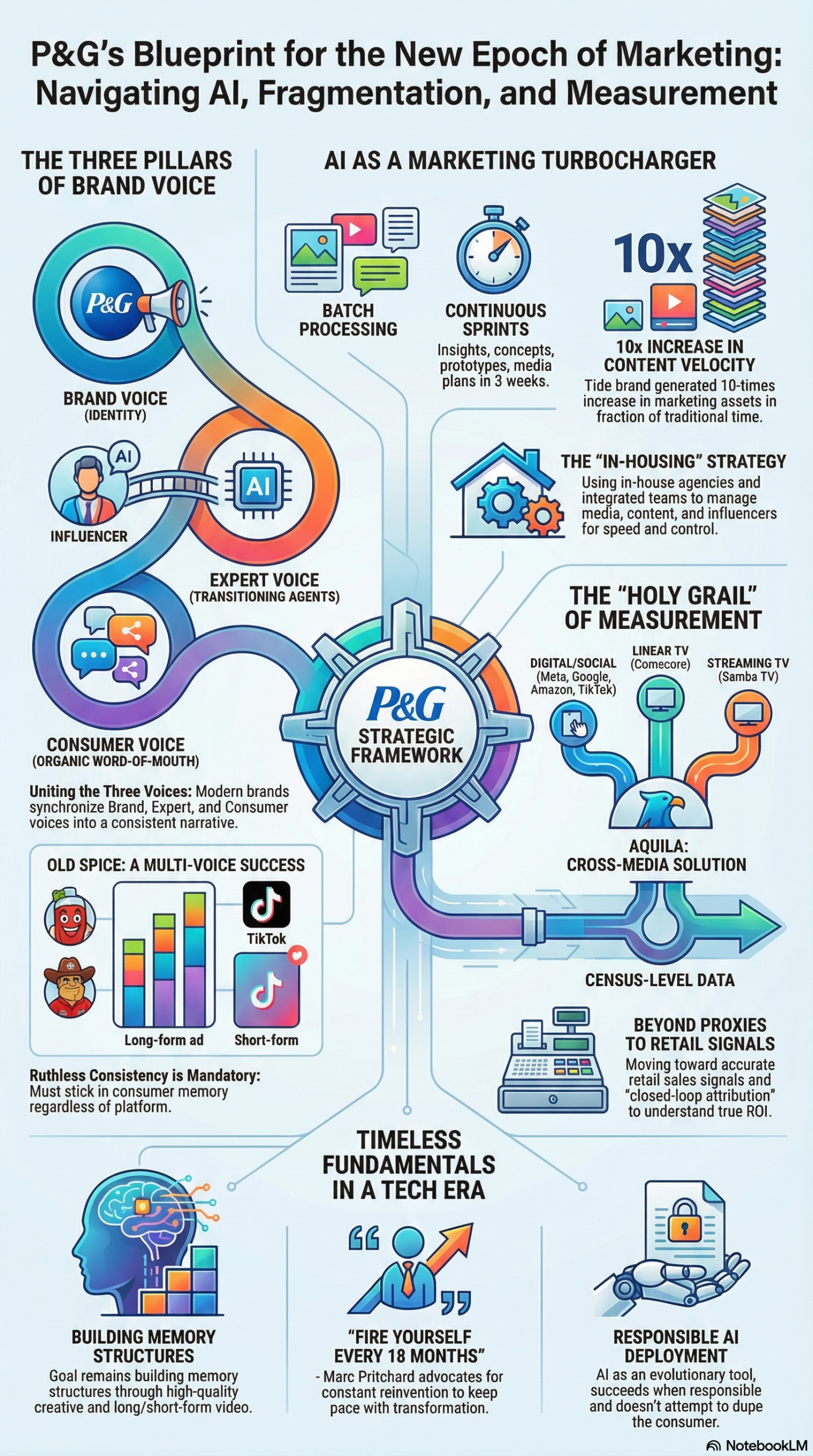
According to the NotebookLM research report compiled from Pritchard’s ANA Media Conference keynote, P&G’s “new epoch” framework rests on three simultaneous shifts happening at the same time:
- Extreme media fragmentation — consumers now build brand memory across short-form video, social platforms, linear TV, streaming, retail media, and in-store touchpoints simultaneously. There is no single dominant channel anymore.
- Digital commerce integration — the line between brand awareness and purchase has collapsed. Campaigns must connect directly to commerce, not just drive awareness that eventually converts somewhere downstream.
- AI as exponential turbocharger — Pritchard frames AI in the same historical lineage as the printing press and the internet. It is not an incremental efficiency gain; it is a structural change to what marketing teams can produce and how fast they can produce it.
What makes Pritchard’s framework actionable is that he draws a hard line between what has not changed and what has changed completely. As he put it: “The fundamentals still matter… Who your consumer is, what your brand stands for, how you come up with insights, ideas and executions so you can connect with them on product packaging, retail communication and value. But how we do that has completely changed.” (NotebookLM research report)
The “how” centers on P&G’s Three-Voice Model — the synchronized deployment of brand voice, expert voice, and consumer voice across every campaign — combined with a shift from batch-based creative production to what Pritchard calls continuous sprints.
The Three-Voice Model works like this. Your brand voice is the controlled messaging your organization produces — the TV spot, the social post, the product page copy. The expert voice historically meant celebrity endorsements but has fully transitioned to influencers, creators, and key opinion leaders (KOLs). Pritchard anticipates this voice will increasingly be augmented or replaced by AI agents in the near future. The consumer voice is scaled word-of-mouth — user-generated content, reviews, organic social sharing — that provides third-party endorsement at scale.
P&G’s Old Spice NFL season campaign illustrates this model in practice. The campaign combined brand mascots (brand voice), NFL players as influencers (expert voice), and TikTok user-generated content (consumer voice), with each element driving toward retail tie-ups at the point of purchase. The goal was not just awareness — it was a closed loop from impression to shelf, all three voices working in unison. (NotebookLM research report)
On the AI side, P&G has moved its fabric care brands — Tide and Gain — from siloed, batch-based campaign production to a sprint model. Using AI tools and data, the team compressed the window from consumer insight discovery to prototype ads and media execution down to three weeks, and in the same window generated a 10-times increase in creative assets. (NotebookLM research report) These are not small editorial improvements; this is an order-of-magnitude change in production velocity.
Organizationally, P&G has restructured to match this pace. Integrated brand teams now work with what Pritchard describes as essentially in-house agencies. P&G has already in-housed its media buying and is currently bringing advertising production, content creation, and KOL management in-house. High-level brand idea development and creative strategy — particularly long-form work that builds lasting memory structures — still flows through agency partners like Wieden+Kennedy. (NotebookLM research report)
Why It Matters
P&G spends roughly $8 billion annually on advertising globally. When Pritchard speaks about what works, the marketing industry pays attention — not because of the budget, but because P&G runs hundreds of brands across every major consumer category, giving them a data set on media performance that no single agency or research firm can replicate.
The specific mechanics Pritchard described at the ANA conference matter to practitioners at every scale for three reasons.
First, the Three-Voice Model solves a real problem most brands get wrong. Most brands treat influencer and UGC programs as addons to their main campaign rather than as parallel distribution channels that need to carry the same core brand assets. Pritchard’s framing — that expert voice and consumer voice are co-equal to brand voice, not subordinate to it — forces a completely different briefing, content, and measurement process.
Second, the sprint model is not just a P&G initiative — it is rapidly becoming table stakes. If your fabric care competitor can go from consumer insight to live media in three weeks and generate 10x the creative volume you produce, running a quarterly campaign cadence becomes a structural disadvantage. The competitive pressure this creates flows downstream to every brand category, not just CPG.
Third, the measurement problem is finally being solved. For years, cross-media measurement has relied on media mix modeling — a statistical proxy that can take months to produce results that are already outdated by the time they arrive. The ANA’s launch of Aquila, a unified measurement unit, represents a direct attempt to solve this with census-level impression data from Meta, Google, Amazon, TikTok, Comscore for linear TV, and Samba TV for streaming — all pointing toward closed-loop attribution tied to actual retail sales signals rather than reach and frequency estimates. For marketing practitioners, this is the tooling shift that unlocks the ability to optimize in-flight rather than post-campaign.
Smaller brands and agencies benefit from this because the framework — Three-Voice synchronization, AI sprint cadence, and closed-loop measurement — does not require P&G’s infrastructure to implement. The tools are available to any brand with a structured approach.
The Data
The following table summarizes P&G’s key operational shifts as described by Pritchard at the ANA Media Conference, sourced from the NotebookLM research report:
| Dimension | Old Model | P&G’s New Model |
|---|---|---|
| Campaign cadence | Batch-based, quarterly or seasonal | Continuous sprints (3-week cycles) |
| Creative volume | Controlled, limited asset set | 10x asset increase via AI tooling |
| Expert voice | Celebrity endorsements | Influencers, creators, KOLs → AI agents |
| Consumer voice | Organic, unmanaged | Scaled UGC integration (e.g., TikTok) |
| Media buying | External agency-managed | In-housed entirely |
| Creative production | External agency-led | Increasingly in-housed; agency for brand ideas |
| Measurement | Media mix modeling (proxies) | Aquila: census-level, closed-loop attribution |
| AI role | Experimental / isolated use cases | Core production infrastructure (“turbocharger”) |
| Commerce integration | Separate from brand campaigns | Embedded in every campaign touchpoint |
The Aquila measurement system specifically brings together:
| Data Source | Coverage |
|---|---|
| Meta | Census-level impression data |
| Census-level impression data | |
| Amazon | Census-level impression data |
| TikTok | Census-level impression data |
| Comscore | Linear TV integration |
| Samba TV | Streaming integration |
| Future goal | Closed-loop retail sales attribution |
Source: NotebookLM research report / ANA Media Conference, March 26, 2026.
Step-by-Step Tutorial: Implementing the P&G Three-Voice + AI Sprint Framework
This is the practical implementation guide for adapting P&G’s new epoch framework at your organization. The steps below are structured for a mid-size brand team or agency with access to standard AI content tools, an influencer/creator network, and at least one paid media platform.
Prerequisites
Before starting, you need:
– A defined brand positioning statement (who your consumer is, what your brand stands for)
– Access to at least one AI content generation tool (for copy, image, or video asset production)
– An influencer or creator network of any size (even a micro-influencer roster of 10-20 works for this model)
– A UGC collection mechanism (TikTok branded hashtag, Instagram stories prompt, email review request, etc.)
– At minimum one paid media platform for measurement (Meta Ads Manager, Google Ads, or Amazon DSP)
Phase 1: Lock Your Brand Assets Before You Sprint (Days 1–3)
The single most important prerequisite for the sprint model is ruthless clarity on your brand assets. Pritchard explicitly stated: “You’ve got to be ruthlessly consistent, and you’ve got to find the things that matter, the brand assets that matter, the ideas that matter.” (NotebookLM research report)
Step 1: Identify your three non-negotiable brand assets. These are the visual and verbal elements that must appear in every execution regardless of channel or voice. Examples: a specific color system, a brand character, a tagline, a sound mark. Write them down. Put them in a brief. Do this before touching any AI tool.
Step 2: Define your core campaign idea in one sentence. Not a tagline — a campaign mechanic that can transfer across long-form TV, a 6-second pre-roll, a TikTok stitch, and an in-store end cap. Old Spice + NFL: “Team up with the mascot.” That one mechanic worked across every format and every voice.
Step 3: Document what success looks like at the commerce layer. Where does the campaign connect to a purchase? Retail media placement? Direct-to-consumer page? Promotional landing page? This connection needs to be mapped before any content is produced, because it determines what call-to-action your expert voice and consumer voice content needs to carry.
Phase 2: Brief Each Voice Separately (Days 3–5)
The Three-Voice Model breaks down when all three voices get the same brief. Brand voice, expert voice, and consumer voice each need their own brief — with shared assets but different execution guidance.
Step 4: Write the Brand Voice brief. This is your traditional creative brief. Target audience, campaign objective, mandatory brand assets, approved copy territories, compliance requirements. This brief produces your hero content: the TV spot, the hero social post, the product detail page content.
Step 5: Write the Expert Voice brief. This brief goes to your influencer or creator partners. It should specify: the brand asset requirements (what must appear), the commerce hook (what link or code to include), the tone latitude (what they can adapt to their authentic voice), and any platform-specific format guidance. Critically: do not over-script creator content. Over-scripted influencer content defeats the purpose of the expert voice.
Step 6: Design the Consumer Voice activation. This is typically a UGC campaign mechanic. A branded hashtag, a challenge format, a review request with a specific prompt, or a community gallery. The consumer voice must be structured enough to capture usable content but open enough to be authentic. For TikTok specifically, a stitch or duet mechanic that piggybacks on your brand or expert voice content tends to generate the highest-quality organic content.
Phase 3: Deploy AI for Sprint Production (Days 5–14)
This is where the speed advantage materializes. P&G’s Tide/Gain team used AI tools and data to move from consumer insights to prototype ads and media execution in three weeks and generated a 10x increase in creative assets. (NotebookLM research report) Here is how to replicate that structure:
Step 7: Generate the creative asset matrix. Using your AI content tool, produce variations of your brand voice hero content across every format your media plan requires. If your media plan includes 6-second pre-roll, 15-second social, 30-second TV equivalent, static social, and carousel — generate all of them from your single hero concept. This is where AI creates the 10x volume gain: one concept, one AI-assisted production run, every format served.
For copy: use an AI writing tool briefed with your campaign idea, your brand voice brief, and specific format constraints (character counts, tone parameters). Review outputs against your brand asset checklist before approving.
For visuals: if your brand uses a consistent visual system (color, typography, photography style), AI image generation or AI-assisted design tools can produce platform-sized variations in minutes. Every output must be reviewed against your three non-negotiable brand assets before publishing.
Step 8: Set up your measurement baseline on Day 1 of live media. Do not wait until the campaign ends to look at data. The sprint model requires in-flight optimization, which means your measurement setup needs to be live from day one. Configure your ad platform’s conversion tracking to the deepest available signal — not just clicks, but add-to-cart, purchase, or whatever retail signal is available. This is the beginning of the closed-loop measurement approach Aquila is designed to scale at the industry level.
Step 9: Establish a weekly data review cadence. In the sprint model, a three-week campaign means you have approximately two weekly review points before the sprint ends. At each review: check which creative variants are generating the lowest cost-per-intended-action, reallocate budget toward those variants, and flag insights that should inform the next sprint brief. The goal is that each sprint generates at least one consumer insight that feeds the next sprint — this is how “continuous” actually works in practice.
Phase 4: Activate and Integrate the Consumer Voice (Days 7–21)
Step 10: Amplify the best organic content. Once your UGC activation is live, monitor for content that naturally combines your brand assets with authentic consumer voice. The best UGC pieces can be amplified via paid promotion — most platforms allow you to boost creator content with their permission. This is the mechanism by which consumer voice scales from organic to paid without losing authenticity.
Step 11: Close the loop between voice channels. Look for moments where your expert voice content is generating consumer voice responses (comments, stitches, duets, shares). Those intersections are where memory structures are being built. Document them. Screenshot them. They become qualitative evidence of the Three-Voice model working that supplements your quantitative measurement.
Phase 5: Sprint Retrospective and Re-brief (Day 21)
Step 12: Run a formal sprint retrospective. Answer these four questions: What consumer insight did this sprint confirm or reveal? Which creative variant performed best and why? Which voice generated the most commerce-connected engagement? What should the next sprint brief contain that the current one did not?
Write the answers into a one-page sprint retrospective document. The next sprint brief builds directly from this document. Over three to four sprints, you will have accumulated a data-backed library of what works for your specific brand — which is more valuable than any media plan that was built on assumptions.
Expected Outcomes: After implementing the Three-Voice + AI Sprint model across two to three sprint cycles (approximately 6-9 weeks), teams typically see: faster creative iteration, higher volume of tested creative variants, more authentic expert voice content (because creators have clearer briefs with more creative latitude), and a measurable improvement in commerce-connected KPIs as you optimize in-flight based on real signal rather than post-campaign models.
Real-World Use Cases
Use Case 1: CPG Brand Launching a New Product Variant
Scenario: A mid-size personal care brand is launching a new scented variant of an existing product. The launch window is six weeks, and the media budget does not support a traditional TV production.
Implementation: The brand team locks three brand assets: the product’s signature color, the brand character, and a “smell test” campaign mechanic borrowed from the hero product line. AI tools produce 24 creative variants across Meta, YouTube pre-roll, and Amazon DSP formats in week one. Five influencers in the beauty and lifestyle space receive an expert voice brief with creative latitude on the “smell test” mechanic. A TikTok hashtag challenge runs in parallel to collect consumer voice content.
Expected Outcome: Within three weeks, the performance data identifies the two best-performing creative variants. Budget shifts to those variants. Influencer content that organically mirrors the brand mechanic gets amplified via paid. The product variant reaches its target sell-through rate within the launch window.
Use Case 2: B2B SaaS Company Scaling Thought Leadership
Scenario: A B2B SaaS company wants to build category authority without a large content team.
Implementation: The company applies the Three-Voice Model by defining brand voice (company blog and LinkedIn posts), expert voice (subject matter expert guest contributors and industry analyst citations), and consumer voice (customer case study quotes and review site testimonials). AI tools help the two-person content team produce three times the volume of on-brand content. A sprint cadence is set to a four-week cycle tied to product feature releases.
Expected Outcome: Increased content volume without increased headcount. Each sprint cycle generates at least one high-performing piece of content that carries through to the next sprint’s amplification plan. Measurement tracks content-attributed pipeline rather than reach and frequency.
Use Case 3: Retail Brand Integrating Commerce into Brand Campaigns
Scenario: A specialty retail brand runs brand campaigns and commerce campaigns separately, with different teams, different agencies, and different measurement frameworks.
Implementation: Using Pritchard’s framework, the brand restructures so every brand campaign carries a commerce hook from the brief stage. The expert voice brief requires influencers to link to a specific product page. Consumer voice UGC is curated and published on the product detail page as social proof. Measurement is configured to track from impression to add-to-cart rather than stopping at click-through.
Expected Outcome: Brand campaign spend begins generating attributable commerce outcomes. Measurement becomes unified rather than siloed across brand and performance teams.
Use Case 4: Agency Building an In-House AI Production Capability for Clients
Scenario: A regional marketing agency wants to offer faster creative production to clients competing with larger brands.
Implementation: The agency builds an internal AI-assisted production workflow using commercially available tools. They develop sprint-based engagement structures (3-4 week sprints) rather than quarterly campaign retainers. Each client gets a locked brand asset document before any sprint begins. The agency presents sprint retrospectives as monthly reports.
Expected Outcome: Faster turnaround, higher creative volume, and data-driven optimization that smaller clients previously could not access. Agency differentiation in a crowded market.
Common Pitfalls
Pitfall 1: Skipping the brand asset lock-in before deploying AI. The biggest failure mode in AI-accelerated production is generating high volumes of content that are inconsistent with each other. AI tools are fast, but they do not automatically maintain brand consistency across outputs. If you have not documented your three non-negotiable brand assets before running your first prompt, you will generate 100 variations of content that confuse rather than reinforce memory structures. Lock the assets first, always.
Pitfall 2: Over-scripting the expert voice. Brands that send influencers a fully scripted post defeat the purpose of the expert voice channel. Consumers follow creators because they trust the creator’s authentic perspective. If the creator’s content sounds exactly like the brand’s ad, it loses the trust transfer that makes expert voice valuable. Brief creators on what must be included (brand assets, commerce hook, compliance disclosures) and leave the rest to their voice.
Pitfall 3: Treating AI-generated content as inherently deceptive. Pritchard addressed consumer anxiety about AI directly: “It’s when it does it in a way that people look at and think you’re trying to dupe [them] in some way, then that’s not going to work.” (NotebookLM research report) AI is a production tool in the same category as CGI and animation. Audiences accept it when it serves the creative idea. They reject it when it feels like a substitute for genuine brand investment.
Pitfall 4: Running sprints without a retrospective. The sprint model generates value through iteration — each cycle should inform the next. Teams that treat each sprint as a standalone campaign lose the compounding benefit. A one-page retrospective after each sprint is non-negotiable.
Pitfall 5: Measuring reach and frequency instead of commerce signals. Pritchard’s point about Aquila is that the industry is moving away from reach and frequency proxies toward closed-loop retail attribution. (NotebookLM research report) If you are still reporting on impressions and click-through rates as your primary KPIs, you are optimizing for the wrong thing. Configure your measurement setup to track as close to a purchase signal as your platform and commerce setup allows.
Expert Tips
Tip 1: Fire yourself (mentally) every 18 months. Pritchard described his personal practice: “I fire myself every 18 months to rehire myself, so I can look at the future with a very objective eye. I probably do that every day now because that’s how rapidly things are going.” (NotebookLM research report) Applied practically: schedule a quarterly strategy review where you approach your current marketing stack and processes as if you were a new hire evaluating them from scratch. What would you change if you had no sunk costs?
Tip 2: Use agency partners for brand ideas, not production execution. P&G’s in-housing model is not a rejection of agencies — it is a reallocation. Wieden+Kennedy still handles high-level brand idea development and long-form creative strategy. The in-house team handles production, media buying, and KOL management. Applied to your organization: use agency partners for the work that requires the deepest strategic thinking. Use AI and in-house capability for the work that requires volume and speed.
Tip 3: Build your consumer voice activation before the campaign goes live. Most brands set up their UGC mechanic after the campaign launches and then wonder why participation is low. The consumer voice activation — hashtag, challenge mechanic, review prompt — should be designed alongside the expert voice brief so that creator content can actively seed the consumer voice channel.
Tip 4: Track creative variant fatigue within sprints. In a high-volume AI-assisted production environment, the risk of ad fatigue is higher because you are serving more impressions across more variants. Set frequency caps per variant and monitor engagement rate decline. A variant that was performing well in week one may be fatiguing by week three. Build rotation into your media setup from day one.
Tip 5: Separate “memory building” content from “commerce activation” content in your measurement model. Pritchard’s framework explicitly covers both — long-form content that builds lasting memory structures (the Wieden+Kennedy brand idea work) and short-form, sprint-based content that drives commerce. Measure them differently. Memory-building content should be evaluated on brand health metrics over time. Commerce activation should be evaluated on closed-loop purchase signals within the sprint window.
FAQ
Q1: Do you need a large budget to implement the AI sprint model?
No. The sprint model’s core advantage — moving from insight to prototype to live media in three weeks — is a process change, not a budget change. The tools required (AI content generation, influencer brief management, paid media platform) are accessible at budgets of any size. The discipline of running weekly data reviews and writing sprint retrospectives costs nothing. P&G’s scale creates a 10x creative volume advantage, but a two-person team running focused sprints will outperform a larger team running quarterly batch campaigns.
Q2: How do you brief influencers under the Three-Voice Model without losing authenticity?
The brief should specify three things only: (1) which brand assets must be visible or mentioned, (2) which commerce hook must be included (link, code, or CTA), and (3) what platform format the content needs to fit. Everything else — tone, format, creative angle — should be left to the creator. The expert voice is valuable precisely because it is not the brand’s voice. Over-briefing destroys that value.
Q3: Is Aquila available to brands outside of ANA membership?
Based on the NotebookLM research report, Aquila was described at the ANA Media Conference as the ANA’s measurement unit, with census-level data from Meta, Google, Amazon, TikTok, Comscore, and Samba TV. The research does not specify availability details beyond ANA members. Brands should contact the ANA directly for access information. The underlying principle — connecting media impressions to retail sales signals — can be approximated using platform-native conversion APIs and retail media measurement tools available independently.
Q4: How do you maintain brand consistency when AI is generating 10x the creative volume?
The answer is the brand asset document described in Phase 1 of the tutorial. Before any AI tool generates a single output, document the non-negotiable visual and verbal elements: the color system, the typography rules, the character or mascot parameters, the copy tone constraints. Every AI output is reviewed against this document before approval. The human review step is what maintains consistency — AI handles speed and volume, humans maintain brand integrity.
Q5: What is the difference between a sprint model and an always-on content calendar?
An always-on calendar is a publishing schedule. A sprint model is a strategic cycle. The sprint model includes a defined objective, a brief, production, live media, data review, and a retrospective — all within a fixed time window (typically two to four weeks). Each sprint informs the next. An always-on calendar publishes content continuously but rarely generates the structured learning loop that makes campaigns progressively more effective. The sprint model is what Pritchard means by “continuous” — not volume, but structured iteration.
Bottom Line
P&G’s new epoch framework is not a forecast — it is an operational manual from the largest advertiser in the world, built on real campaign data across hundreds of brands and billions of impressions. The Three-Voice Model (brand, expert, consumer) combined with AI-powered sprint production and closed-loop measurement addresses the three structural problems every marketer faces in 2026: fragmentation, commerce integration, and production velocity. What makes this framework worth implementing immediately is that none of it requires P&G’s budget — it requires discipline: lock your brand assets, brief each voice separately, sprint in three-week cycles, measure toward purchase signals, and run a retrospective after every sprint. The brands that build this operating rhythm now will have a structural advantage over those still running quarterly batch campaigns. Measurement infrastructure like Aquila signals where the industry is heading — toward attribution systems that eliminate the guesswork that has always made brand investment hard to defend. The marketers who are building toward that future today will be running the most defensible campaigns when it arrives.


0 Comments