

Scotts Miracle-Gro — a $3.6 billion consumer lawn and garden company — has stopped treating gardening as a spring ritual and started treating it as a year-round lifestyle. The company is deploying AI-powered personalization, an influencer network, sports marketing partnerships, and a first-party data loyalty program to stay relevant with customers in January just as much as in May. If you market a seasonal product or run a brand tied to cyclical consumer behavior, this playbook is worth dissecting in detail.
What This Is
Scotts Miracle-Gro (NYSE: SMG) is the global market leader in branded consumer lawn and garden products, commanding roughly 60% market share in its core categories. For decades, the business ran on a familiar seasonal rhythm: consumers bought fertilizer and grass seed in spring, maybe some weed control in summer, and largely disappeared through fall and winter. Marketing was calendar-driven — a heavy push around Easter through Memorial Day, then a gradual wind-down.
That model is breaking. As reported by Marketing Dive on April 1, 2026, Scotts is using a combination of influencer marketing, AI, and sports marketing to become what the brand describes as an “always-on partner for gardeners of all ages.” This is not just a brand repositioning statement — it reflects a structural overhaul of the company’s technology stack, data strategy, and channel mix.
The operational backbone of this evolution is a company-wide digital transformation. Scotts has integrated Google Cloud’s Vertex AI and Gemini generative AI models to build consumer-facing experiences, including an AI-powered “gardening sommelier” — a conversational tool that advises consumers on what to plant, when, and how, year-round. Emily Wahl, Vice President of Information Technology at Scotts, has stated that Google’s generative AI solutions are providing a “real competitive advantage” for the business.
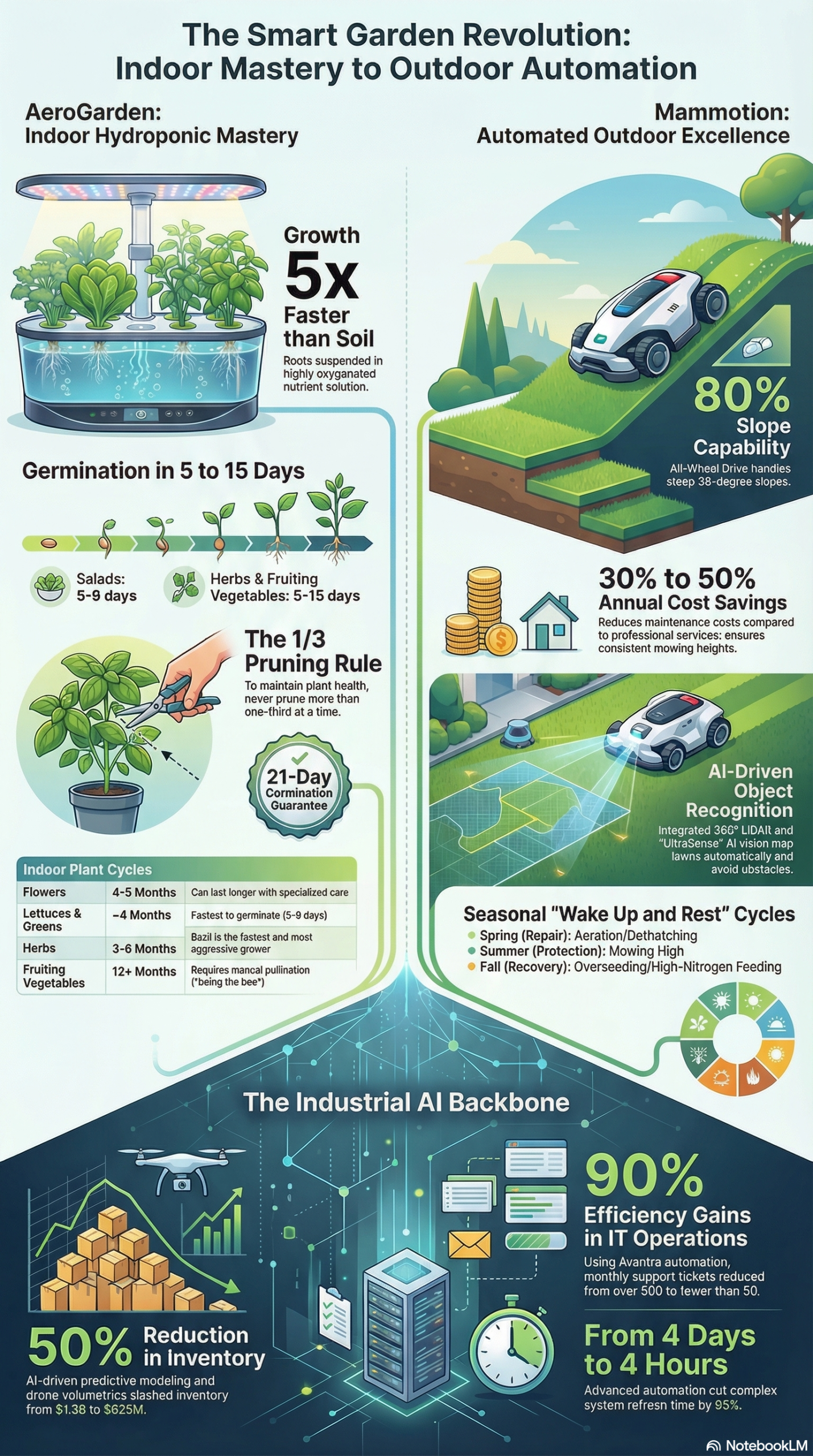
On the product side, the Scotts portfolio has expanded to include indoor growing systems through its AeroGarden brand. AeroGarden uses aeroponic technology — plant roots are suspended in an air gap and bathed in a nutrient-rich, oxygenated solution — which means consumers can grow herbs, vegetables, and flowers indoors 365 days a year regardless of climate or season. The AeroGarden line runs from the 3-pod Sprout at $89.95 up to the 24-pod Farm system at $599.95, giving the brand multiple entry price points to capture customers who would otherwise disengage in the off-season.
The “My Lawn” mobile app rounds out the ecosystem. It delivers personalized push notifications tied to a customer’s specific lawn type, geography, and growth stage — pushing relevant product recommendations and how-to content throughout the year, not just during peak planting windows.
The result is a brand that now has legitimate touchpoints with its customer base across all 12 months: outdoor lawn and garden in warm seasons, indoor hydroponic growing in cold months, AI-powered advice anytime, and loyalty-program engagement year-round.
Why It Matters
If you market a product with a seasonal demand curve, Scotts’s evolution carries a direct lesson: the brands that win long-term are the ones that engineer year-round relevance, not just seasonal spikes.
For brand marketers and content teams, the most actionable insight is the “gardening sommelier” model — an AI layer that transforms a transactional product category into an ongoing advisory relationship. Most brands collect first-party data through loyalty programs and apps but use it only for promotional emails. Scotts is using it to power a conversational AI that delivers personalized, timely guidance. That closes the loop between data collection and genuine engagement.
For e-commerce and retail marketers, the company’s numbers illustrate why omnichannel diversification matters. As documented in the research report, approximately 48% of Scotts’s total revenue in fiscal 2024 came from just two retailers — Home Depot and Lowe’s. Digital sales through Amazon and retail online platforms now exceed 15% of total consumer sales, and the brand is actively expanding its direct-to-consumer channels to reduce retailer concentration risk. Any brand with heavy dependency on a small number of retail partners should treat this as a warning to build out their own channels now, before circumstances force the issue.
For audience growth and demographic expansion, Scotts’s approach to the under-35 market is instructive. The “Let’s Grow” campaign drove a 12% increase in engagement among gardeners under 35 — a cohort that historically viewed gardening as their parents’ hobby. The combination of influencer marketing (authentic, platform-native content), indoor growing products that fit apartment living, and sport-adjacent activations is proving effective at recruiting younger gardeners. The brand is also executing targeted outreach to the Hispanic consumer segment, with a goal of 3% annual sales growth from that audience.
For loyalty program architects, the “Scotts Season Pass” program directly demonstrates ROI. According to the research report, the program has increased customer lifetime value by 18% through personalized app notifications and data-driven marketing. That’s a measurable return on first-party data infrastructure investment.
The broader implication: in any category with seasonal or cyclical demand, the competitive moat is built between seasons — not during them.
The Data
The following table summarizes the key performance metrics from Scotts Miracle-Gro’s ongoing transformation, as documented in the research report:
| Metric | Before Transformation | After Transformation | Source |
|---|---|---|---|
| Inventory Levels | $1.3 billion | $625 million (50% reduction) | Research Report |
| SAP Support Tickets/Month | 500+ | Under 50 (90% reduction) | Research Report |
| SAP System Refresh Time | 4 days | 4 hours | Research Report |
| Legacy SaaS Applications | 7+ platforms | 1 unified (OpenText Core Content) | Research Report |
| SaaS Operating Expense | Baseline | Reduced by $500,000+/year | Research Report |
| Customer Lifetime Value (Loyalty Program) | Baseline | +18% via Season Pass | Research Report |
| Under-35 Gardener Engagement | Baseline | +12% via “Let’s Grow” campaign | Research Report |
| E-Commerce Share of Consumer Sales | <15% | >15% (growing) | Research Report |
| Annual Net Sales (FY2024) | — | $3.6 billion | Research Report |
| Core Category Market Share | — | ~60% | Research Report |
The operational metrics deserve particular attention. A 90% reduction in SAP support tickets and a system refresh that went from four days to four hours are not vanity metrics — they represent the kind of IT infrastructure efficiency that frees up engineering resources to focus on strategic projects like AI personalization and e-commerce growth. The inventory reduction from $1.3B to $625M is equally significant: it was achieved through machine learning and predictive modeling, and it directly impacts free cash flow and the company’s ability to pursue its deleveraging target of getting net leverage below 3.5x adjusted EBITDA by fiscal year 2027.
Step-by-Step Tutorial: Building an Always-On Marketing System for Seasonal Brands
This section walks through the exact strategic framework Scotts Miracle-Gro has implemented — adapted into actionable steps you can apply to any brand with seasonal demand patterns.
Phase 1: Audit Your Seasonal Content Calendar and Close the Gaps
Step 1: Map your current engagement curve.
Pull your website traffic, email open rates, social engagement, and conversion data by month for the past two years. Plot the seasonal peaks and valleys. For most brands in seasonal categories, you’ll see 2-3 months of high engagement and 8-10 months of underperformance. That’s your problem statement — and your opportunity.
Step 2: Identify year-round customer needs.
Scotts recognized that even if consumers don’t buy fertilizer in December, they do have lawn and garden questions in December. They’re thinking about next spring, experimenting with indoor plants, or preparing their space. Map the full customer journey across all 12 months, not just the buying season. Ask: what does our customer need in the off-season, even if they’re not buying?
Step 3: Build a content calendar that fills the gaps.
Create content categories that work in every season: educational how-to content, community and inspiration content (for planning phases), and product content for indoor/year-round categories. Scotts uses AeroGarden to own the indoor growing category during winter months — the product literally creates a year-round use case. Identify whether your portfolio already has year-round products being under-marketed, or whether you need to develop new offerings.
Phase 2: Build a First-Party Data Infrastructure
Step 4: Launch or upgrade a loyalty program.
The “Scotts Season Pass” program is the data engine behind the brand’s personalization capability. The mechanics are straightforward: customers register their lawn type, zip code, planting history, and purchase data in exchange for personalized recommendations and exclusive benefits. The program has delivered an 18% increase in customer lifetime value. If you don’t have a loyalty program, build one. If you do, audit whether you’re actually using the data for personalization — or just for promo emails.
Step 5: Deploy a branded mobile app.
The “My Lawn” app is Scotts’s direct channel to the consumer — independent of retail partners or social algorithms. App-based push notifications can be triggered by real-world data (weather forecasts, seasonal changes, pest reports by region) to deliver timely, relevant messages. For your brand, the app does not need to be complex. Even a lightweight utility app (a planting calendar, a product finder, a seasonal checklist) gives you a direct notification channel and a first-party data collection point that no retailer can take from you.
Step 6: Integrate app data with your CRM and marketing automation stack.
This is where most brands underinvest. Scotts tied its consumer app data into its broader IT infrastructure — ultimately connected to SAP — which enables inventory and demand forecasting to align with consumer behavior signals. For marketers, the immediate benefit is segmentation: customers who open the app in February are different from customers who only engage in April. Treat them differently.
Phase 3: Deploy AI-Powered Personalization
Step 7: Identify your “sommelier” use case.
The AI “gardening sommelier” concept — built on Google Cloud’s Gemini models — is worth unpacking. It’s a conversational AI that functions as a knowledgeable advisor: ask it what to plant in your zone, when to apply fertilizer for your grass type, how to troubleshoot a yellowing AeroGarden pod. The use case works because it’s genuinely useful. Before deploying AI for personalization, define your brand’s version of this: what advice does your customer actually need? Where does expert knowledge create loyalty?
Step 8: Choose the right AI infrastructure.
Scotts partnered with Google Cloud for Vertex AI and Gemini model deployment. For mid-market brands, the options include building on top of existing LLM APIs (OpenAI, Google, Anthropic) or using platform-native AI tools embedded in your marketing stack (HubSpot AI, Salesforce Einstein, etc.). The key decision factors are: how much do you need to customize the model on your own product data, and how tightly does it need to integrate with your existing CRM and e-commerce stack?
Step 9: Train or fine-tune the model on your product knowledge base.
An AI advisor is only as good as its underlying knowledge. Scotts’s gardening sommelier presumably has deep product catalog knowledge, growing zone data, and seasonal schedules built in. For your deployment, prepare a structured knowledge base: product SKUs and use cases, FAQs and support content, seasonal guidance, troubleshooting trees. Feed this into your AI layer as retrieval-augmented generation (RAG) context or fine-tuning data, depending on your platform.
Step 10: Deploy across multiple touchpoints.
The AI layer should not be confined to a single chatbot widget. Think about where personalized guidance is most valuable in the customer journey: on product detail pages (which product is right for me?), in the loyalty app (what should I do in my garden this week?), in email sequences (triggered by purchase history), and in customer support. A consistent AI advisor across channels reinforces the brand as a trusted partner — not just a retailer.
Phase 4: Activate Influencer and Sports Marketing for Audience Expansion
Step 11: Build an influencer tier structure.
The “always-on partner” positioning requires always-on content production. Scotts uses influencers across audience tiers to maintain platform presence year-round without requiring the brand to produce all content internally, as noted in the Marketing Dive source. Build a three-tier structure: a handful of macro-influencers (500K+ followers) for reach and brand awareness, a larger group of mid-tier creators (50K–500K) for category engagement, and a seed program of micro-influencers (5K–50K) for authentic community content. The micro tier is especially effective for gardening, cooking, home improvement, and other hands-on lifestyle categories because authenticity matters more than production value.
Step 12: Brief influencers for seasonal AND off-season content.
This is where most brand influencer programs fail. Brands brief creators heavily for launch season, then go quiet. Scotts has identified that gardening interest does not stop in fall — indoor growing, planning, seed selection, and spring prep content all perform year-round. Brief your influencer network with a 12-month content calendar, not a 3-month one.
Step 13: Integrate sports marketing for broad reach and new audiences.
Sports marketing for a gardening brand might seem counterintuitive, but the logic is sound: sports audiences are large, emotionally engaged, and span demographics that traditional garden marketing might miss. Scotts’s move into sports marketing is a deliberate play for the under-35 audience that the “Let’s Grow” campaign also targeted. For your brand, identify sponsorship properties where your target audience expansion cohort is highly indexed — and where the category fit can be made natural rather than forced.
Expected Outcomes
A brand executing all four phases of this framework should expect:
- A measurable year-round engagement curve rather than a seasonal spike
- Increased customer lifetime value from loyalty and personalization (Scotts benchmarked 18%)
- New audience penetration in demographic segments that were previously unreachable
- Reduced dependency on seasonal promotional spend, replaced by always-on content and AI-driven engagement
- A proprietary first-party data asset that compounds in value over time
Real-World Use Cases
Use Case 1: The Regional Garden Center Chain
Scenario: A regional chain with 40 locations generates 80% of revenue between March and June. After Labor Day, store traffic and online engagement collapse.
Implementation: Launch a loyalty app that collects planting zone and purchase history. Integrate weather API data to trigger personalized fall cleanup checklists and spring planning guides. Build an indoor plant and seed catalog for off-season purchases, with influencer content on indoor growing to drive discovery.
Expected Outcome: 15-25% increase in off-season revenue from indoor plant category and spring pre-orders; 20%+ increase in email engagement from personalized content vs. promotional blasts.
Use Case 2: The Home Improvement Brand Reducing Retailer Dependency
Scenario: A brand with 65% of revenue concentrated in two big-box retail partners wants to build DTC channels before a potential shelf-space loss creates a revenue crisis.
Implementation: Follow the Scotts model — build a branded app, launch a loyalty program, and integrate AI-powered product guidance. Drive consumers from retail touchpoints to the app through QR codes on packaging and post-purchase email sequences. Over 18-24 months, convert retail buyers into direct subscribers.
Expected Outcome: E-commerce share grows from under 10% toward the 15%+ benchmark Scotts has achieved, providing a meaningful buffer against retailer negotiation leverage.
Use Case 3: The CPG Brand Targeting a New Demographic
Scenario: A consumer brand finds that 85% of its buyers are over 45. The brand needs to recruit younger consumers without alienating its core base.
Implementation: Create a distinct content stream through micro-influencer activations that speak to how the category fits a younger lifestyle. Use Instagram Reels, TikTok, and YouTube Shorts for native platform content. Anchor the demographic expansion campaign around a challenge mechanic (similar to the “Let’s Grow” concept) that generates user-created content and social proof. Track under-35 engagement separately from overall campaign metrics.
Expected Outcome: Scotts benchmarked a 12% increase in engagement from under-35 gardeners from this type of campaign. CPG brands with similar demographic skews should target 10-15% engagement growth in the target cohort within 12 months.
Use Case 4: The E-Commerce Brand Building an AI Advisory Experience
Scenario: An online retailer in a complex product category (supplements, skincare, home improvement tools) is struggling with high product return rates and low repeat purchase. Customers don’t know enough to buy confidently.
Implementation: Build a product recommendation AI trained on your SKU catalog, customer reviews, and use-case data. The Scotts “gardening sommelier” model — powered by Google Cloud Gemini — is directly replicable. Deploy it as a chat interface on the product catalog page, in post-purchase onboarding emails, and inside a loyalty app. Frame it as an expert advisor, not a search engine.
Expected Outcome: Reduced return rates (customers who buy the right product return it less), higher average order value (confident customers buy more), and increased repeat purchase driven by ongoing advisory engagement.
Common Pitfalls
1. Building a loyalty program without a personalization engine.
The “Scotts Season Pass” program works because it feeds data into personalized app notifications and AI-driven recommendations. Many brands launch loyalty programs that collect data and then do nothing intelligent with it. If your loyalty emails are purely promotional — discounts and new product announcements — you are not building an engagement moat, just a discount database.
2. Deploying AI personalization on a thin data foundation.
The gardening sommelier is valuable because it has deep product knowledge and consumer context built in. Deploying a generic LLM chatbot on your website without training it on your actual product catalog and customer use cases will produce irrelevant or incorrect answers that damage trust rather than build it. Invest in the knowledge base before the AI layer.
3. Treating influencer programs as campaign-only activations.
Year-round relevance requires year-round content. Brands that only activate influencer programs during peak season miss the relationship-building window in the off-season — which is precisely when competitors are silent. Build 12-month agreements with your core creator group.
4. Over-concentrating revenue in a small number of retail partners.
As Scotts’s own balance sheet illustrates, 48% revenue concentration in two retail partners creates structural vulnerability. The mitigation — aggressive e-commerce expansion and DTC channel development — takes 18-24 months to build. Start before you need it.
5. Ignoring the under-35 and multicultural audience segments.
These segments represent the future customer base in most consumer categories. Scotts has dedicated specific campaigns and resources to both the under-35 cohort and the Hispanic consumer segment. Waiting until your core demographic ages out is not a strategy.
Expert Tips
1. Use AIOps to free your team for strategic work.
Scotts’s adoption of the Avantra AIOps platform cut SAP support tickets by 90%, reducing system refresh from four days to four hours. The direct lesson for marketing ops: wherever your team is spending time on repetitive, reactive technical work, AIOps or automation tooling can reclaim those hours for strategic projects. Map your team’s time before making a new hire — automation is often the right answer.
2. Let machine learning own demand forecasting, not spreadsheets.
The 50% inventory reduction — from $1.3 billion to $625 million — was not a spreadsheet optimization. It came from ML-driven predictive modeling. If your marketing budget allocation is still driven by last year’s seasonality plus gut feel, you are leaving efficiency on the table. Build or buy demand forecasting models that use real-time signals: search trend data, app engagement, weather, and point-of-sale data.
3. Integrate drone or IoT-based operational data for content triggers.
Scotts replaced manual inventory measurement with drone-based volumetrics integrated directly into SAP, cutting a multi-hour process to 30 minutes. Applied to marketing: operational and environmental data (inventory levels, weather signals, regional demand shifts) should automatically trigger marketing actions — not require a human to bridge the gap. Build event-driven automation between your operational data and your marketing stack.
4. Consolidate your SaaS stack before scaling personalization.
Scotts retired seven legacy applications by implementing OpenText Core Content, saving over $500,000 annually and — more importantly — unifying records that were previously siloed. Personalization at scale requires a unified data layer. If your customer data lives in seven disconnected platforms, your AI advisor will have incomplete context. Consolidation is a prerequisite, not a nice-to-have.
5. Treat sustainability as a marketing asset with younger audiences.
Scotts’s $34.6 million R&D investment in fiscal 2024 includes specific targets around plastic packaging reduction and recycled content. For the under-35 cohort, environmental credibility is a purchase factor. If your brand has sustainability initiatives, build them into your content strategy explicitly — not as a footnote in your annual report, but as a regular content theme in your influencer and social channels.
FAQ
Q1: How does the Scotts “gardening sommelier” AI actually work?
The gardening sommelier is a consumer-facing AI built on Google Cloud’s Gemini models via Vertex AI. It functions as a conversational advisor: consumers can ask questions about what to plant, when, how to address specific lawn or garden issues, and which Scotts products apply to their situation. The AI is informed by consumer’s profile data (lawn type, growing zone, purchase history from the loyalty program) to deliver personalized rather than generic advice. The Scotts VP of IT has credited it as a source of real competitive advantage for both retail partner and consumer experiences.
Q2: What is the “Scotts Season Pass” and how does it drive year-round revenue?
The Season Pass is Scotts’s branded loyalty program, delivered through a mobile app. Members input their lawn profile, growing zone, and plant preferences in exchange for personalized app notifications, product recommendations, and exclusive offers. The data collected powers AI-driven personalization. The program has measurably increased customer lifetime value by 18%, primarily by driving engagement and purchases outside the traditional spring peak season.
Q3: How is Scotts approaching the under-35 gardener market?
Scotts’s recruitment of younger gardeners operates on multiple fronts: the “Let’s Grow” campaign drove a 12% increase in engagement from under-35 gardeners through influencer-driven social content and challenge mechanics. The AeroGarden product line serves this demographic practically — compact indoor growing systems work in apartments and small spaces that don’t support traditional gardening. Sports marketing partnerships expose the brand to younger audiences in contexts where traditional garden marketing has no presence.
Q4: What role does AeroGarden play in Scotts’s year-round strategy?
AeroGarden is the structural solution to the year-round engagement problem. By owning the indoor hydroponic growing category — with products starting at $89.95 for the 3-pod Sprout up to $599.95 for the 24-pod Farm — Scotts has a reason to engage customers during fall and winter months when outdoor gardening is not feasible in most of the U.S. AeroGarden’s aeroponic technology (roots suspended in air, bathed in oxygenated nutrient solution) enables year-round growing of herbs, vegetables, and flowers indoors, creating real product utility rather than manufactured off-season engagement.
Q5: How dependent is Scotts on its major retail partners, and how is it addressing that risk?
As of fiscal year 2024, approximately 48% of total Scotts revenue came from Home Depot and Lowe’s alone, with the top four retail partners (adding Walmart and Ace Hardware) accounting for 70% of U.S. Consumer net sales. The company is actively mitigating this risk by expanding e-commerce through Amazon and direct digital channels (now exceeding 15% of consumer sales), building DTC loyalty program infrastructure, and pursuing 3% annual growth from targeted demographic segments like the Hispanic consumer market. The goal is to reduce structural dependency while maintaining the retail partnerships.
Bottom Line
Scotts Miracle-Gro’s evolution from a seasonal marketing model to an always-on strategy is not a brand identity play — it’s a technology and data infrastructure build that happens to express itself through marketing. The AI gardening sommelier, the Season Pass loyalty program, the AeroGarden indoor growing category, and the influencer and sports marketing activations are all downstream of a decision to invest in first-party data infrastructure and AI platforms. Brands that replicate only the surface-level tactics — an influencer campaign here, a chatbot there — will get surface-level results. The durable competitive advantage comes from connecting the data layer to the AI layer to the content layer into a coherent, personalized consumer experience that operates 365 days a year. The brands that build that infrastructure today will be the category leaders that are nearly impossible to displace in five years.


0 Comments