

Why Practitioners Are Pausing on AI Max Before the DSA Deadline
AI Max is replacing Dynamic Search Ads in September 2026, which means every Google Ads account manager faces a decision now, not later. Aaron Young, a long-tenured Google Ads practitioner, walks through three data-backed reasons his agency is holding off on enabling AI Max for client accounts — and what conditions would change that call. After reading this, you’ll be able to evaluate whether your own accounts meet the bar where AI Max is likely to deliver, and what to do instead if they don’t.
-
Pull five weeks of AI Max search term data from a live account and compare it against the five weeks immediately preceding the AMAX activation. In the client account analyzed here — two broad match keywords and three exact match keywords — 83% of AI Max search terms had already been triggered by standard keyword coverage. That 83% accounted for 92% of total click volume and 100% of conversions. Filter the Search Terms report by the AMAX label, then cross-reference each term against the prior period’s data to confirm whether incremental reach is real or cosmetic.
-
Before enabling AI Max at all, check the campaign’s Search Impression Share. If it sits below 60% — and especially if it’s in the 10–20% range — work through this sequence first: increase budget, move non-broad-match keywords to broad match, layer in smart bidding, add campaign segmentation by location or product/service, then evaluate Performance Max. AI Max belongs at the end of that progression, not the beginning. Accounts with significant headroom in impression share have proven growth levers available that carry a longer track record than AMAX currently does.
-
Test AI Max’s ad copy output before committing to it in a production campaign. A documented example surfaced on LinkedIn by Andrew Lolk (Savvy Revenue) shows AI Max generating headlines that reference “2025” during an April 2026 forced migration rollout — verifiable in the Search Terms report where the affected headlines appear highlighted in red cells.
Warning: this step may differ from current official documentation — see the verified version below.
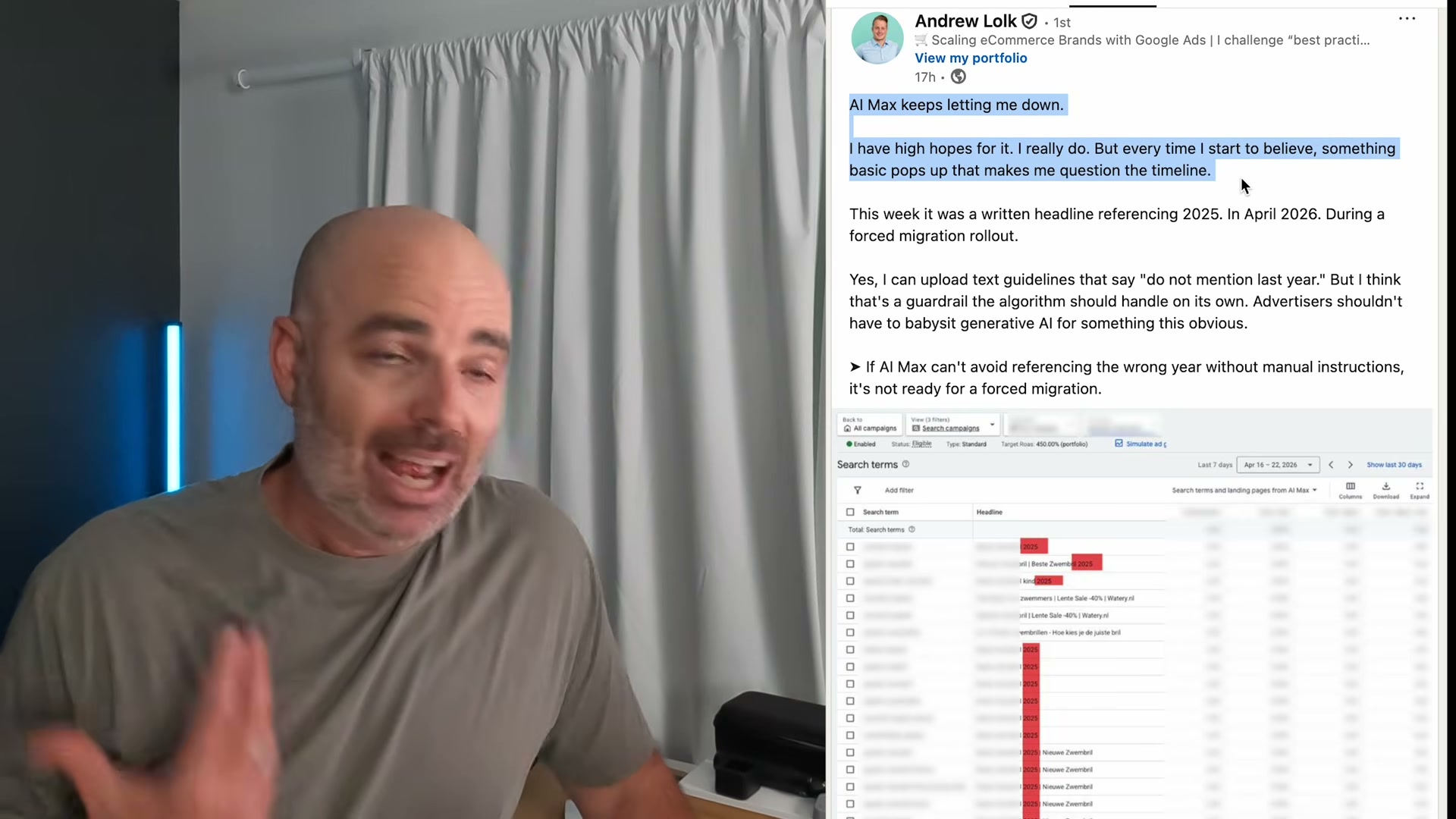
Adding a guideline like “don’t mention last year” is technically possible, but a guardrail at that level of specificity shouldn’t require manual intervention for a baseline quality issue. Until AI Max handles temporal accuracy without explicit instruction, copy output needs human review before any campaign goes live.
- Evaluate whether Google has published minimum threshold data for AI Max comparable to what exists for Performance Max. For PMax, practitioners have worked from two concrete benchmarks: 30 conversions in 30 days to launch, and 50 conversions in 30 days before adding a target CPA or target ROAS. No equivalent published minimums exist for AI Max’s stated 7% conversion lift claim. That figure comes from Google’s internal data, not independently reproducible benchmarks — which makes it difficult to know at what account scale or conversion volume the promise becomes reliable.
How does this compare to the official docs?
The practitioner case rests on live account data and reasoned analogy to Performance Max’s adoption curve, but Google’s official AI Max documentation tells a different story about what controls exist and what the published guidance actually says — which is where Act 2 begins.
Here’s What the Official Docs Show
The practitioner reasoning in Act 1 holds up well in its structural logic — the official documentation adds important mechanistic detail that strengthens the case for two of the four steps. Where the docs go quiet, those steps are flagged clearly so you can weigh the video’s account-level evidence on its own terms.
Step 1 — Pulling AI Max search term overlap data
No official documentation was found for this step —
proceed using the video’s approach and verify independently.
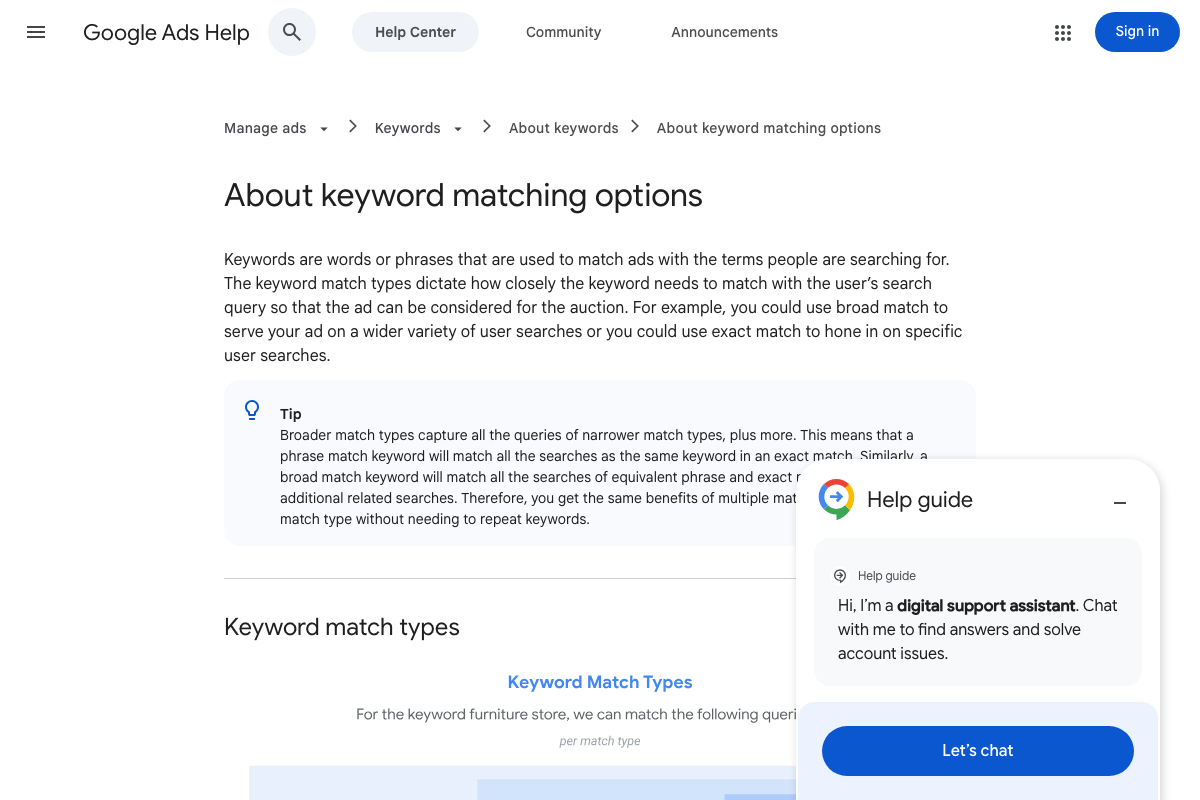
What the docs do confirm is the mechanism behind why overlap is structurally expected. Google’s keyword matching documentation states explicitly: “Broader match types capture all the queries of narrower match types, plus more.” If a campaign already runs broad match alongside exact match keywords, it is already competing for the full query range those match types cover — before AI Max enters the picture.
The 83% / 92% / 100% overlap figures come from one client account and cannot be confirmed or denied by any official source captured here. The keyword structure logic is sound; the specific numbers are the creator’s own data.
Step 2 — Check impression share, then sequence: budget → broad match → smart bidding → PMax → AI Max
The video’s approach here matches the current docs exactly.
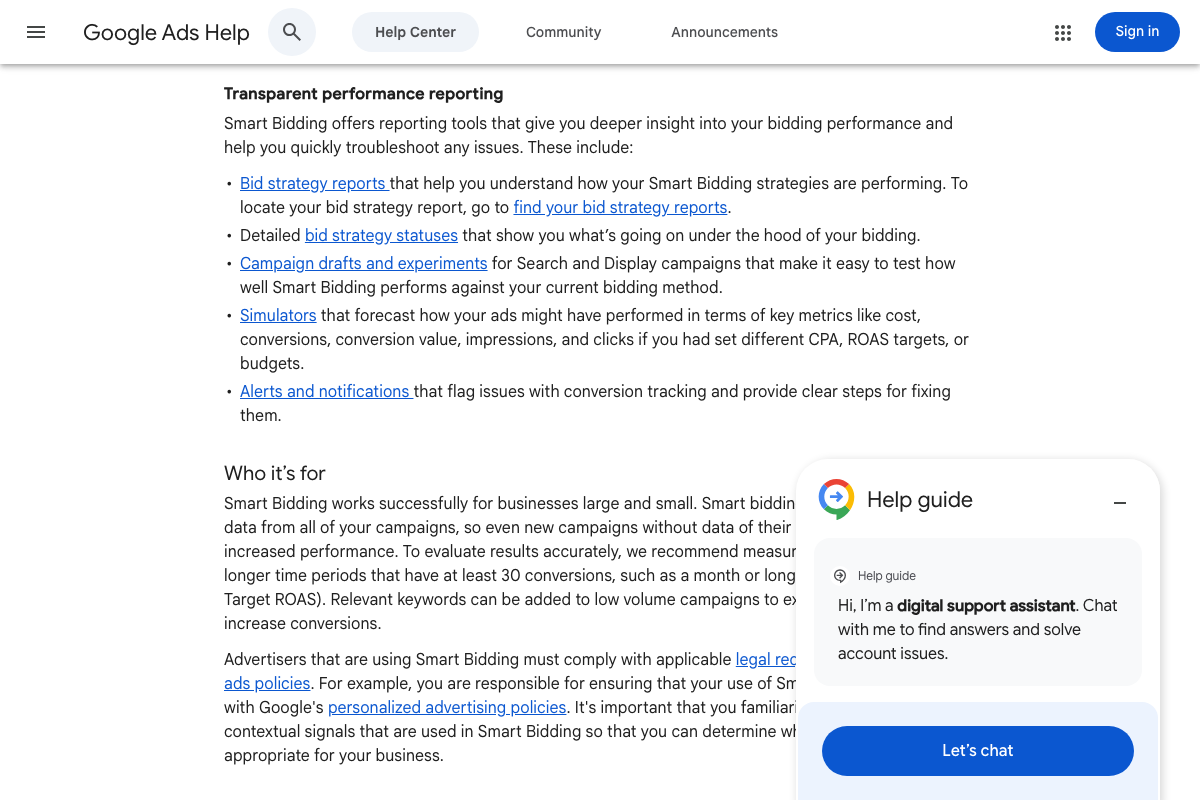
One clarification worth noting: the 60% search impression share threshold used in the video as a readiness gate for AI Max consideration does not appear in any official Google documentation captured here. That figure is the creator’s own benchmark, not a published Google standard. The underlying sequencing logic — earn your impression share before layering on new AI features — is consistent with how Google frames Smart Bidding adoption, but the 60% figure should be treated as practitioner guidance, not a Google-published threshold.
Step 3 — Test AI Max ad copy output before going live
No official documentation was found for this step —
proceed using the video’s approach and verify independently.
The specific LinkedIn post cited — showing AI Max generating headlines referencing “2025” during an April 2026 migration — was not accessible from the screenshots captured. LinkedIn requires authentication to view individual posts, so the stale copy example cannot be confirmed or denied here. The recommendation to audit copy output before a campaign goes live is sound practice regardless of whether this specific instance is verified.
Step 4 — Verify whether Google has published AI Max readiness thresholds
No official documentation was found for this step —
proceed using the video’s approach and verify independently.
The Google Ads marketing homepage (ads.google.com) does not contain an AI Max product documentation page, feature description, or the 7% conversion lift figure cited in the video. As of May 13, 2026, no AI Max help article was captured at any official Google URL in this analysis.
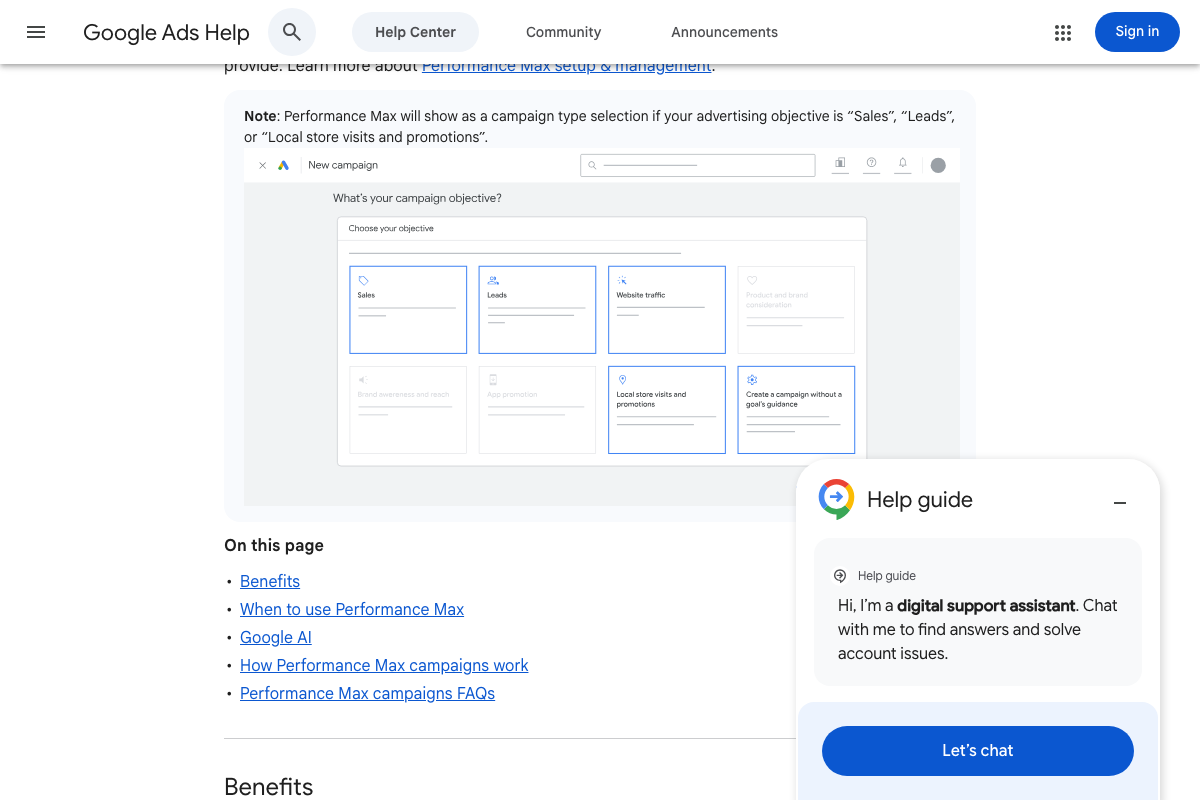
The Smart Bidding documentation does reference 30 conversions over a month as an evaluation accuracy benchmark. That figure contextually supports the video’s threshold-based reasoning but does not directly confirm the same numbers apply to PMax launch requirements or AI Max. The PMax-specific conversion thresholds (30 to launch; 50 to add tCPA or tROAS) were not visible in the three PMax screenshots captured and would require verification against the “When to use Performance Max” section of the official help article.
Useful Links
- About keyword matching options — Google Ads Help — Official documentation covering broad match, exact match, and phrase match behavior, including the auction prioritization rules that explain why existing keyword coverage suppresses incremental AI Max lift.
- About Smart Bidding — Google Ads Help — Defines Smart Bidding strategies, documents the explicit recommendation to pair Smart Bidding with broad match, and establishes the 30-conversion evaluation benchmark.
- About Performance Max campaigns — Google Ads Help — Official PMax product documentation including the “When to use Performance Max” readiness section — the closest published analogue to the AI Max threshold guidance the video argues is missing.
- Google Ads — Get Customers and Sell More with Online Advertising — The Google Ads public marketing homepage; as of May 2026, no AI Max product documentation, feature description, or benchmark data was found at this URL.
- LinkedIn: Log In or Sign Up — The platform where the AI Max stale-headline post cited in the video was published; individual post content requires authentication and was not verifiable from these captures.
- Learn Google Ads with Aaron Young — Define Digital Academy — The video creator’s practitioner education site; source of program context and account management background, not an official Google documentation source.


0 Comments