

Stop Grinding Through SEO Work — Use Pomodoro Instead
Unstructured deep work kills SEO output quality in ways most practitioners never trace back to the real cause. After completing this tutorial, you’ll understand how to apply the Pomodoro Technique to conversion-focused SEO landing page creation, eliminate the rabbit holes that waste hours of research time, and use structured breaks to surface the insights that actually move the needle.

- Recognize the hidden cost of working without breaks. Without structured breaks, SEO work degrades in two compounding ways: you waste hours chasing research rabbit holes that won’t affect rankings or conversions, and cognitive fatigue causes you to omit the page sections that would most convince a searcher. The result shows up as increased pogo-sticking and landing pages that fail to close.

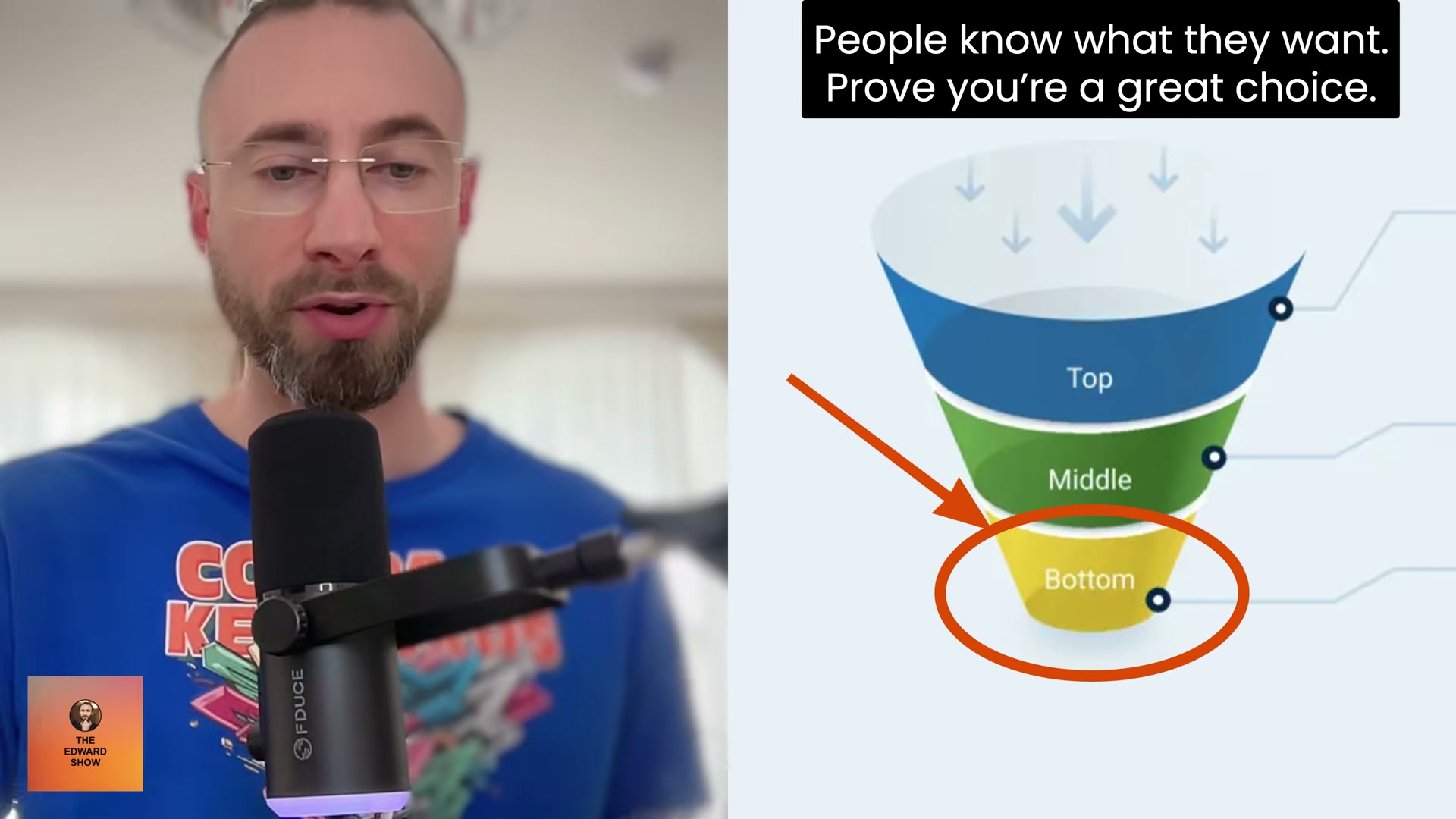
- Understand what these pages need to accomplish. Conversion-based SEO landing pages target bottom-of-funnel searchers — people who already know what they want. The page’s only job is to prove you’re the right choice. That requires precision, not volume. Fatigue-driven writing produces noise instead.
- Adopt the Pomodoro Technique and structure work into two-hour sessions. Each two-hour session contains four 25-minute focused work blocks. Between each block, take a 3–5 minute break — away from your screen and away from your desk entirely. Sitting somewhere else in the room counts; staying at your computer does not.
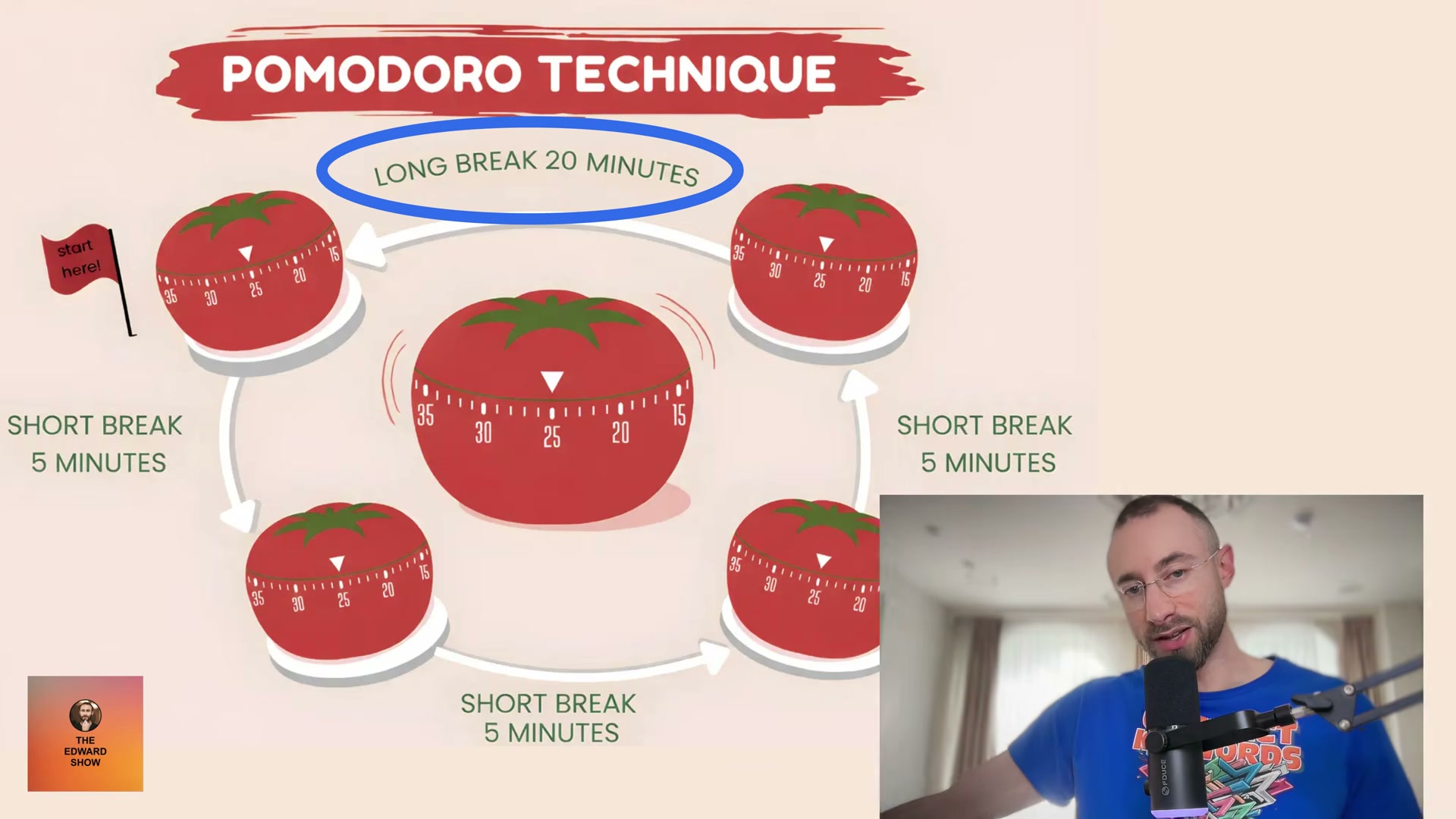
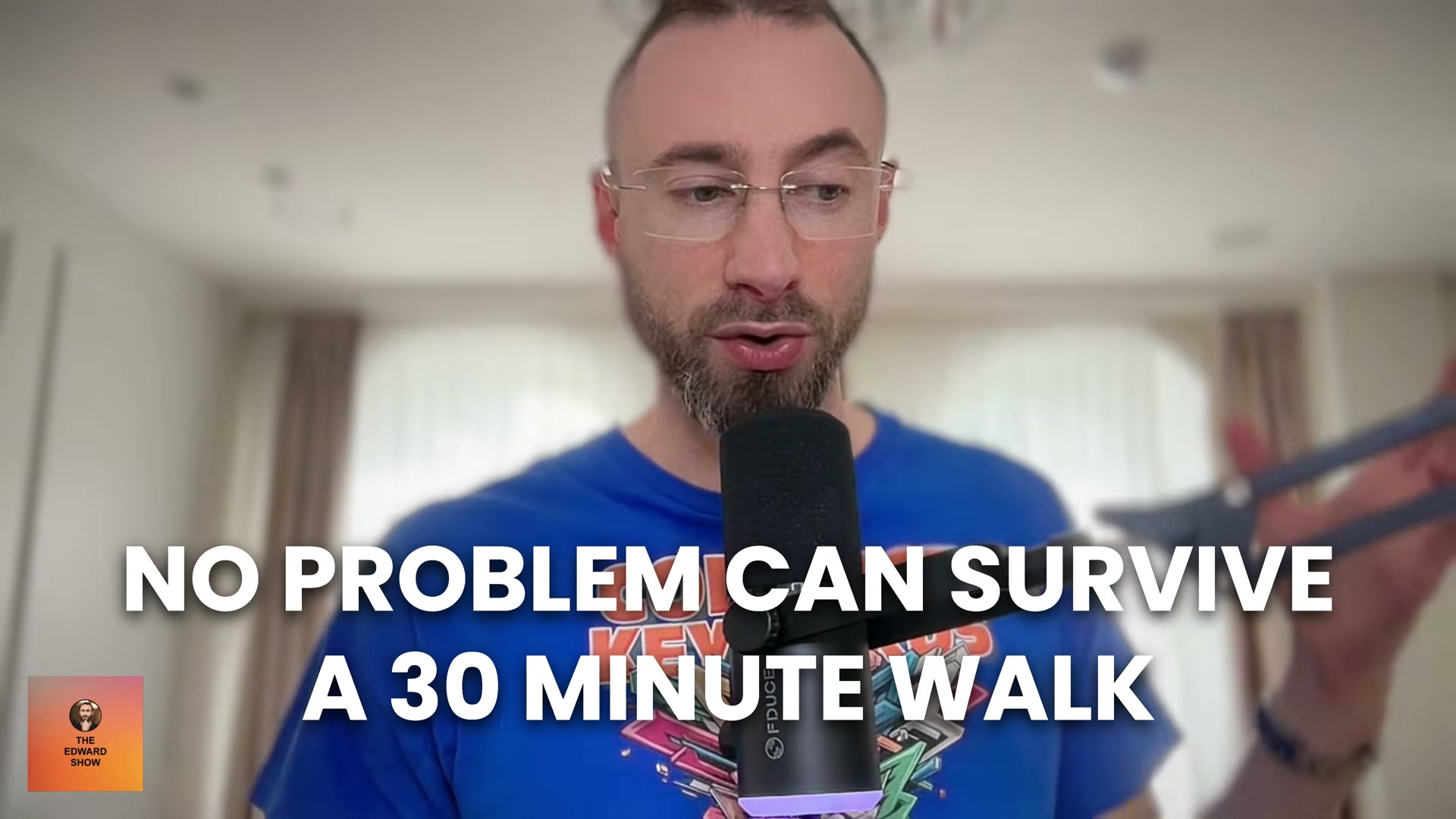
- Take a minimum 20-minute break after completing a full two-hour session. This break also cannot happen at your desk or in front of a screen. Walking around the block is the preferred option. The underlying principle: “No problem can survive a 30-minute walk.” Physical separation from the screen lets the subconscious process what the focused session couldn’t resolve.
-
Let the breaks do real work. The 3–5 minute micro-breaks are where insights surface — missing page sections, hero image concepts, and the connection between a topic and its target keyword. These are not passive recovery periods. They are when the brain makes the associative leaps that focused work blocks off.
-
Apply this structure to the full landing page workflow. The sequence Edward Sturm uses for conversion-based SEO landing pages maps cleanly onto Pomodoro sessions: keyword research → outline → fill the outline → publish with images. Each phase gets its own focused block, with breaks enforcing the transition between modes of thinking.
-
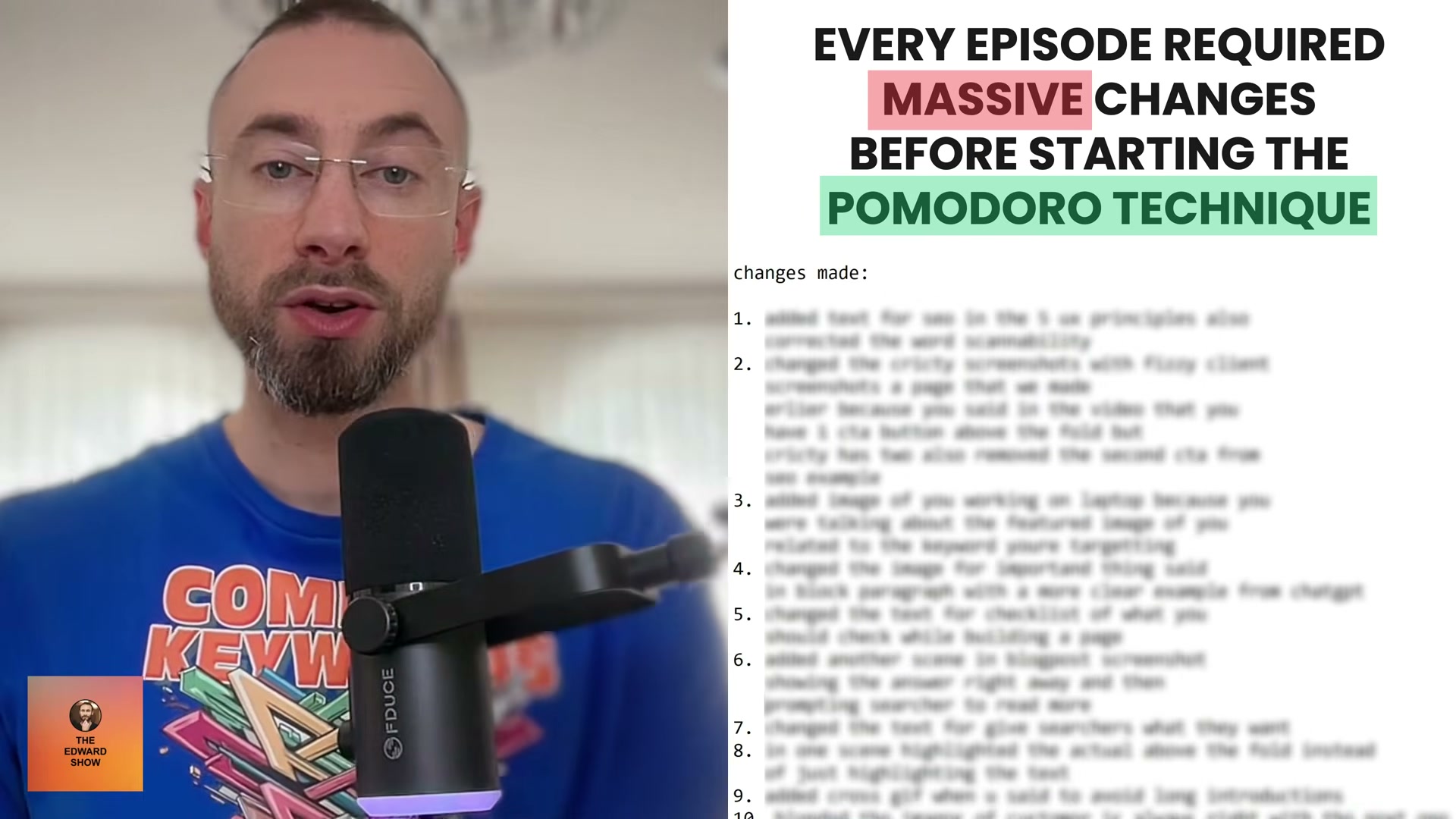
Extend the technique to any knowledge worker role. After applying Pomodoro to his video editor’s workflow, review times that previously ran three hours dropped by half — sometimes the edit passed on the first review with no changes required. The same pattern applies anywhere sustained cognitive output degrades under fatigue.

How does this compare to the official docs?
The Pomodoro Technique has a well-documented canonical specification — and the version Sturm describes diverges from it in at least one measurable way, which is worth examining before you build a workflow around it.
Here’s What the Official Docs Show
The video’s walkthrough of Pomodoro-disciplined SEO work is a practical, honest account of a real workflow — Act 2 builds on that foundation by anchoring the technique’s core mechanics to Francesco Cirillo’s published specification, so you know exactly which parameters are standardized and which are Sturm’s own adaptations. Note that because the documentation screenshot capture process failed entirely during production, all steps below carry an unverified flag — links to primary sources are listed at the end so you can confirm directly.
1. Recognize the hidden cost of working without breaks.
The cognitive fatigue argument Sturm makes is well-supported in the reasoning behind the Pomodoro Technique’s original design. Cirillo developed the method specifically to combat the anxiety and time-loss that come from open-ended, unstructured work sessions.
No official documentation was found for this step — proceed using the video’s approach and verify independently.
2. Understand what these pages need to accomplish.
The application of Pomodoro to conversion-focused SEO landing pages is Sturm’s own framing — the canonical Pomodoro documentation covers knowledge work broadly rather than any content-specific workflow.
No official documentation was found for this step — proceed using the video’s approach and verify independently.
3. Adopt the Pomodoro Technique and structure work into two-hour sessions.
The canonical specification sets each focused work interval at exactly 25 minutes — Sturm’s approach matches this. Where it diverges: the official technique does not use “two-hour session” as a named unit. Instead, it counts individual pomodoros sequentially across the day. Framing four pomodoros as a discrete “session” is Sturm’s practical adaptation, not a spec-defined structure — a useful mental model, but not the canonical framing.
No official documentation was found for this step — proceed using the video’s approach and verify independently.
4. Take a minimum 20-minute break after completing a full two-hour session.
The official specification sets the long break at 15–30 minutes after every four pomodoros. Sturm’s “minimum 20 minutes” sits inside that range but floors it higher than the official lower bound. As of April 2026, the canonical rule remains 15–30 minutes — Sturm’s version reflects a personal calibration, not a departure from intent.
No official documentation was found for this step — proceed using the video’s approach and verify independently.
5. Let the breaks do real work.
The official technique describes short breaks as exactly 5 minutes — Sturm says 3–5 minutes. The canonical spec is more specific than the video implies. As of April 2026, the correct parameter per Cirillo’s specification is 5 minutes for the short break — the video’s “3–5” range reflects a looser interpretation that may work in practice but isn’t the documented standard.
No official documentation was found for this step — proceed using the video’s approach and verify independently.
6. Apply this structure to the full landing page workflow.
The four-phase SEO sequence Sturm maps onto pomodoros — keyword research → outline → fill outline → publish — is his own workflow design. The official technique describes how to break any complex task into timed intervals; it does not prescribe content workflows.
No official documentation was found for this step — proceed using the video’s approach and verify independently.
7. Extend the technique to any knowledge worker role.
Cirillo’s original work was explicitly cross-disciplinary — the technique was designed for students and knowledge workers broadly, which supports Sturm’s claim that it applies beyond SEO to video editing, podcast review, and similar sustained cognitive tasks.
No official documentation was found for this step — proceed using the video’s approach and verify independently.
Useful Links
- The Pomodoro Technique — Official Site — Francesco Cirillo’s canonical overview of the technique’s rules, history, and intended application.
- The Pomodoro Technique Book by Francesco Cirillo — The primary source document defining all interval lengths, break rules, and tracking methodology.
- Do More and Have Fun with Time Management — Original Cirillo Paper — Cirillo’s original published essay, freely archived, containing the full specification including the 5-minute and 15–30 minute break parameters.


0 Comments