

A Five-Step Marketing Budget Allocation Framework for Maximum ROI
Most marketing budgets don’t fail from lack of funding — they fail from scattered allocation. After working through this framework, you’ll know how to audit your channels on the metrics that actually signal quality, concentrate 80% of your budget on the two to four channels earning their place in your mix, and reserve a protected 20% slice for experimentation in emerging channels like AI search and agentic AI. The framework draws on Exposure Ninja’s 12 years working with clients ranging from early-stage startups to multi-billion-dollar global brands.

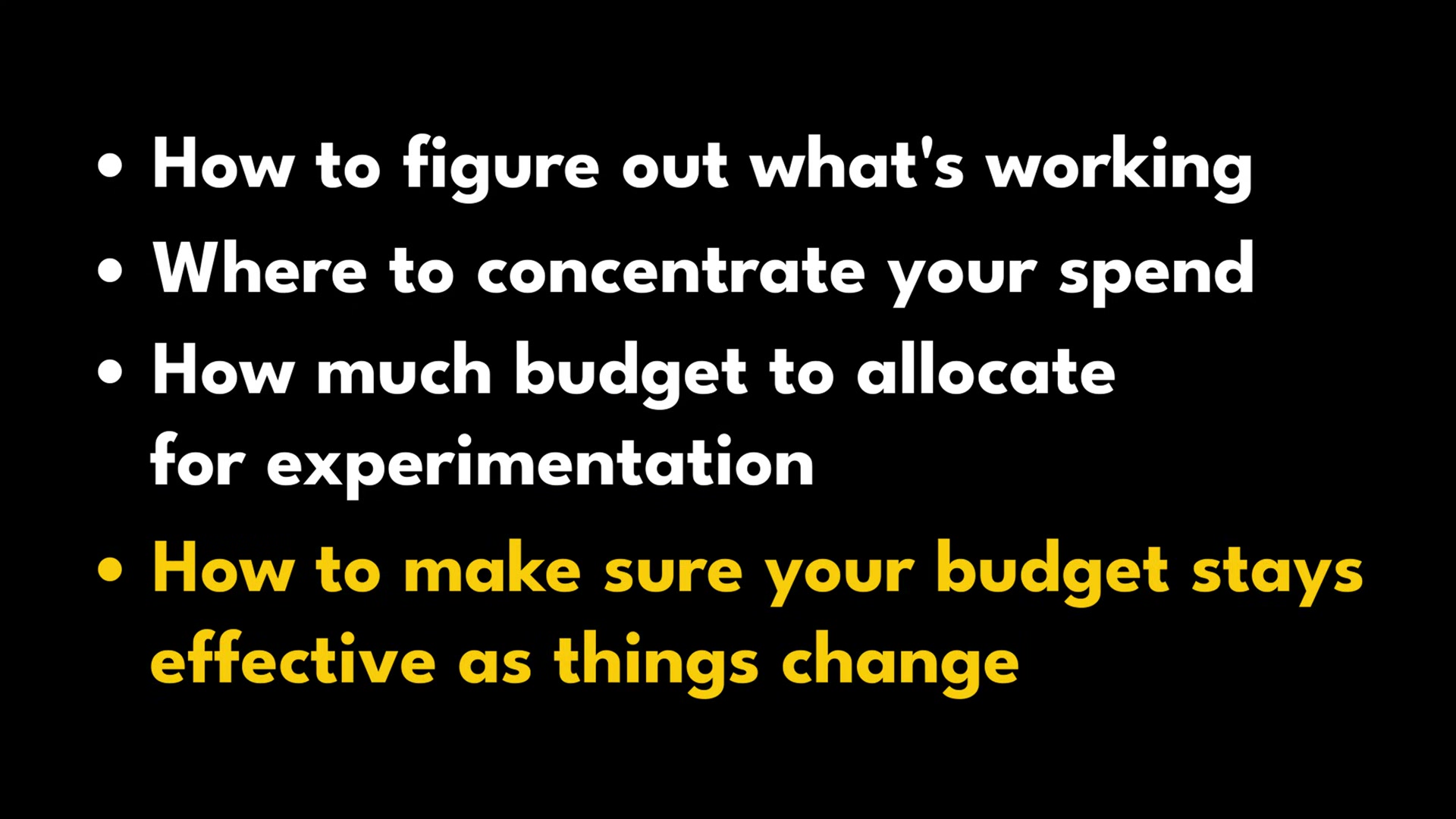
The standard benchmark for total marketing spend sits at 7.5–8% of revenue — a figure that drifted slightly lower in recent years before stabilizing around 7.7%. That number shifts based on whether you’re B2B or B2C, your industry’s competitive density, and whether you sell products or services. But the allocation of that budget, not its size, is what separates brands that compound their returns from those that scatter spend across a dozen underperforming channels.

- Set your goals. Define one primary revenue or outcome goal — something concrete and business-outcome-tied, like a 25% increase in monthly revenue. Then set two to three supporting goals that collectively make the primary goal achievable. Supporting goals might include conversion volume, organic search traffic, or AI referral traffic. A finance client cited in the video targeted just 150 AI-referred visits per month — modest in isolation, but a strategic priority because the conversion rate of that traffic was exceptionally high. Without this goal structure, you have no evidence base from which to judge whether your budget allocation is working or not.

-
Audit what’s working. Pull the last 6–12 months of channel data and evaluate each channel on four metrics: customer acquisition cost (CAC), lifetime value (LTV), lead-to-sale conversion rate, and lead or sales volume. Top-line revenue by channel will mislead you — a high-volume channel with weak LTV and poor conversion will overshadow a smaller channel that, at scale, could be transformational. The example from the transcript illustrates the point precisely: a client generating $66,000 in revenue from AI search across a tiny visitor count. Volume-only analysis would have buried that signal entirely.
-
Allocate 80% of your budget to two to four priority channels. Based on the audit, select the channels the data confirms are performing best and concentrate 80% of spend there. Split that 80% proportionally across the chosen channels according to their relative performance — not because a channel is fashionable or feels safe, but because the numbers justify the weight. One client example from the video: a $100,000/month budget distributed across SEO at $15,000 and Google Ads at $25,000–$35,000, with the remaining core channels taking the balance.

-
Reserve 20% of your budget for experimentation. Use this slice to test emerging channels — AI search optimization and agentic AI are the two explicitly named — to reduce future risk from channel disruption. This keeps the budget adaptive as the landscape shifts rather than locking all spend into channels that may not hold their performance over time. (Note: the transcript is cut off before this step is completed in full.)
-
Monitor, iterate, and reallocate. This step is implied by the framework structure but not reached in the transcript. The goal-tracking infrastructure built in Step 1 is what makes this possible: only by continuously measuring performance against both supporting and primary goals can you justify moving budget from one channel to another with confidence rather than instinct.

How does this compare to the official docs?
The 80/20 concentration rule and the four-metric audit are practitioner frameworks built from campaign data — and how they map to the formal guidance from platforms like Google, Meta, and HubSpot reveals some meaningful differences worth knowing before you rebuild your budget.
Here’s What the Official Docs Show
The tutorial’s five-step framework is a coherent practitioner methodology — and the documentation screenshots add useful platform-level context that sharpens a few of the steps considerably. Where gaps exist, they’re worth knowing before you open your budget spreadsheet.
Step 1: Set Your Goals
No official documentation was found for this step — proceed using the video’s approach and verify independently.
That said, the Exposure Ninja homepage does confirm the agency’s positioning of AI search and organic traffic as co-equal performance disciplines — consistent with the tutorial’s logic of including AI referral traffic as a supporting goal alongside primary revenue outcomes.
One important framing note: the 5-step framework, including the specific goal-structure guidance in this step, is Exposure Ninja’s proprietary methodology — not an industry-standard published by any platform or trade body. The case studies visible on the agency site support the premise that goal-aligned, data-led allocation drives strong returns, but no published standard corroborates the specific framework structure.
Step 2: Audit What’s Working
No official documentation was found for this step — proceed using the video’s approach and verify independently.
One dependency the tutorial does not state explicitly: you cannot audit AI referral traffic inside ChatGPT. The platform has no native analytics or referral reporting interface. As of March 30, 2026, auditing AI search as a traffic source requires an external tool — Google Analytics 4, a UTM-tagged link report, or equivalent. If your Step 2 audit includes AI referral volume as a metric, build that tracking infrastructure first.
Additionally, if Google Ads is one of the channels in your audit, note that the platform’s current architecture consolidates Search, Display, YouTube, Shopping, and App under Performance Max as a single campaign type. Per-channel CAC and LTV comparisons may aggregate across multiple placement types in ways the tutorial’s four-metric audit does not account for.
Step 3: Allocate 80% to Two to Four Priority Channels
The video’s approach here matches the current docs on the Google Ads side exactly — Google Ads is confirmed as an active, live paid channel with goal-based campaign structure, directly consistent with the tutorial’s treatment of it as a potential concentration channel.
A useful addition for practitioners: Google Ads currently offers up to $1,500 in ad credit for new accounts, a promotional detail not mentioned in the tutorial. If you’re evaluating Google Ads as a priority channel for the first time, that credit offsets early testing costs.
Meta Ads is a gap in this verification. The URL used for Meta Ads documentation — meta.com/business/ads — returned an error page at time of capture. All three Meta screenshots are error pages with no recoverable content. Meta Ads as a priority channel cannot be confirmed or contradicted from this screenshot set. For current Meta Ads documentation, use facebook.com/business/help or business.facebook.com directly.
Step 4: Reserve 20% for Experimentation
The video’s approach here matches the current docs exactly — ChatGPT is confirmed as a live, publicly accessible platform with expanded capabilities that reinforce the tutorial’s urgency around AI search experimentation.
One useful extension: the Deep Research feature visible in ChatGPT’s sidebar confirms the platform has evolved well beyond conversational chat into structured, source-cited research — meaning “AI search traffic” from ChatGPT may now arrive from a meaningfully different user intent than when this tutorial was likely recorded. That reinforces the experimentation budget rationale, not undermines it.
The tutorial’s reference to Agentic AI as an emerging channel is not corroborated by any screenshot in this set. No agentic AI platform documentation was captured. Treat that reference as directionally credible but unverified — it warrants independent research before budget allocation.
Step 5: Monitor, Iterate, and Reallocate
No official documentation was found for this step — proceed using the video’s approach and verify independently.
This step was not reached in the transcript and is unverified by any screenshot. The goal-tracking infrastructure established in Step 1 is the prerequisite — without defined supporting and primary goals, there is no objective basis for reallocation decisions.
Useful Links
- Award-Winning Digital Marketing Agency | Exposure Ninja — Agency homepage and source of the proprietary 5-step budget allocation framework presented in the tutorial
- Google Ads — Get Customers and Sell More with Online Advertising — Google Ads platform homepage, confirming goal-based campaign structure and Performance Max as the current primary campaign architecture
- ChatGPT — ChatGPT platform homepage, confirming live public access and expanded Deep Research capabilities relevant to Step 4 experimentation guidance


0 Comments