

How to Make Time for Everything Using Dan Martell’s Buyback System
Most productivity advice treats time like a fixed resource you manage better. Dan Martell argues it’s a market — one where you can buy back the hours that drain you and reinvest them in the work only you can do. After completing this tutorial, you’ll have a buyback rate, a two-week audit framework, and a preloaded calendar structure that puts your priorities first before anyone else’s requests arrive.

- Reframe your relationship with time. Drop the concept of work-life balance. Balance implies that work and life compete for the same finite space — that gaining one means losing the other. Work-life integration treats health, relationships, hobbies, and professional output as mutually reinforcing. A recovered, energized version of you does better work. A creatively stimulated version of you shows up more present at home. The goal is not to separate the two; it’s to design a life where neither cannibalizes the other.

- Calculate your buyback rate. Take your annual pay and divide it by 2,000 — the approximate working hours in a year after weekends and holidays. That gives you your effective hourly rate. Divide that number by four. The result is your buyback rate: the maximum hourly cost you should pay to hand a task off to someone else while still capturing a 4× return on that time investment. At $100,000 per year, your buyback rate is $12.50/hour. Anything you can delegate at or below that figure is a straightforward trade.

- Run a two-week time and energy audit. For 14 days, log every task you perform in 15-minute increments. Once you have the raw log, go back through it and highlight in green the tasks that energize you and in red the ones that deplete you. Then assign each task a value rating: one dollar sign ($) for low-value work that costs less than your buyback rate to outsource, four dollar signs ($$$$) for work at or above your effective hourly rate. The resulting color-coded table makes your delegation targets impossible to ignore.

- Delegate the red, low-dollar tasks first. Once the audit is complete, identify the tasks that are both energy-draining and low in dollar value. Start there. These are the easiest handoffs because you have no emotional attachment to keeping them and the cost of outsourcing them is low. Whether the recipient is a virtual assistant, a family member, or an intern is secondary — the priority is freeing those hours before they compound into another depleted quarter.

- Build your preloaded year. Before you schedule a single meeting, open a blank 12-month calendar and add the non-negotiables first: family birthdays, anniversaries, trips, quarterly getaways, and the three to five business events that actually drive revenue. Next, batch recurring commitments — client check-ins, team reviews, strategic thinking blocks. Finally, add maintenance and recovery time: the workouts, rest days, and recharge rituals that prevent the crashes most people treat as inevitable. The principle is identical to the classic jar-and-rocks model — big rocks go in before the sand.

-
Design your perfect week. With the year preloaded, compress the logic down to a weekly template. Place your highest-value, high-focus work blocks — the “big rocks” of each week — before reactive commitments like meetings and email have a chance to colonize your calendar. Proactive time should appear before the requests arrive, not after.
-
Get the companion workbook. Martell offers pre-built templates for the audit and calendar frameworks. Send the phrase YouTube workbook as a direct message to his Instagram account to receive the download link.
How does this compare to the official docs?
Martell’s system is drawn from his own book and coaching methodology rather than a third-party platform, which raises a practical question: how do the core calculations and calendar-design principles hold up when measured against established productivity research and tools?
Here’s What the Official Docs Show
The video gives you a clear mental model for how Martell’s system works — Act 2 adds the layer the docs reveal: what’s officially published, what the companion materials actually include, and where one step’s instructions diverge from the documented path. Nothing here overturns the framework; a few things sharpen it.
Step 1: Reframe your relationship with time.
The official site backs the core premise. The book’s subtitle — “Get Unstuck, Reclaim Your Freedom, and Build Your Empire” — and a Lewis Howes endorsement (“a no-nonsense playbook for how to build a thriving business empire all while living your best life”) both support the integration-over-balance argument. One small clarification: the phrase “work-life integration” doesn’t appear verbatim in the site’s copy. The documented framing is building a business while living your best life — same concept, different words.

Step 2: Calculate your buyback rate.
No official documentation was found for this step — proceed using the video’s approach and verify independently.
Step 3: Run a two-week time and energy audit.
No official documentation was found for this step — proceed using the video’s approach and verify independently.
Step 4: Delegate the red, low-dollar tasks first.
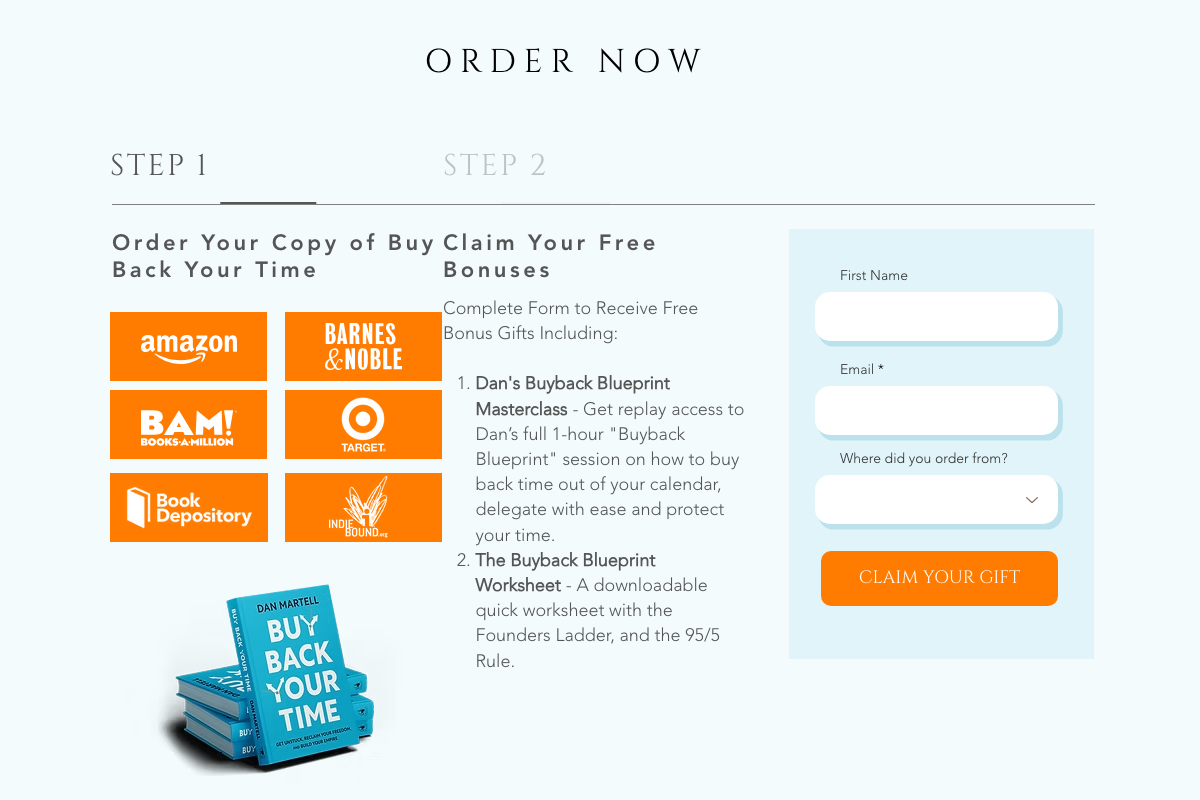
The official bonus materials confirm this step’s logic. The Buyback Blueprint Masterclass — offered free with book purchase — is described on the site as covering “how to buy back time out of your calendar, delegate with ease and protect your time.” That’s a direct match to the delegation priority the video teaches. Worth noting: the companion Buyback Blueprint Worksheet goes further than the tutorial covers, including two frameworks not mentioned in the video — the Founders Ladder and the 95/5 Rule. Both are part of the documented system.
Step 5: Build your preloaded year.
No official documentation was found for this step — proceed using the video’s approach and verify independently.
Step 6: Design your perfect week.
No official documentation was found for this step — proceed using the video’s approach and verify independently.
Step 7: Get the companion workbook.
As of April 20, 2026, the documented path to the companion worksheet is a book-purchase bonus — the video shows an Instagram DM keyword path. On buybackyourtime.com, the Buyback Blueprint Worksheet is listed as a free bonus gift requiring purchase verification and form submission after buying through a major retailer (Amazon, Barnes & Noble, Target, and others). The Instagram DM workflow described in the video — sending YouTube workbook to Martell’s account — does not appear in the official documentation, and three attempts to capture the relevant Instagram page returned only the public login wall, so the workflow cannot be confirmed or denied from official sources.


Useful Links
- Dan Martell | Buy Back Your Time — Official book site with purchase options, access instructions for the Buyback Blueprint Worksheet (which includes the Founders Ladder and 95/5 Rule), and the companion Masterclass offer.
- Instagram — Platform where the video’s DM keyword workflow is described; a logged-in session is required to access any profile or DM functionality, and the workflow itself is not corroborated by official documentation.


0 Comments