

(Free Planner File at Bottom)
Introduction: Why “Planning” Looks Nothing Like It Did 18 Months Ago
If you ran a social media plan in mid-2024 and dusted it off today, you would barely recognize the playing field. The fundamentals — know your audience, post consistently, measure what matters — have not changed. Almost everything else has.
Three structural shifts collided in 2025 to produce the operating environment marketers face in 2026:
- Agentic AI replaced generative AI as the default workflow. The work of planning, drafting, scheduling, and even responding has moved from “Claude or ChatGPT helps me write a caption” to “an autonomous agent monitors trends, drafts on-brand content, schedules across channels, and reports outcomes.”
- Social became the search and the storefront. The funnel collapsed. Social platforms now host discovery, validation, and checkout in the same scroll session.
- Public feeds emptied out as conversation moved into private spaces. Broadcast channels, Substacks, Discords, and group chats — collectively “dark social” — now carry the majority of brand-relevant sharing.
This article is a comprehensive field guide to planning social media in this environment. It covers the size and shape of the market, the leading platforms and how they differ, the planning frameworks that hold up under AI-era pressure, the tool stack actually being used by competent teams, the metrics that matter (and the ones to retire), and a set of use cases that show what good looks like in practice.
Sources are cited inline so you can verify any data point and dig deeper.
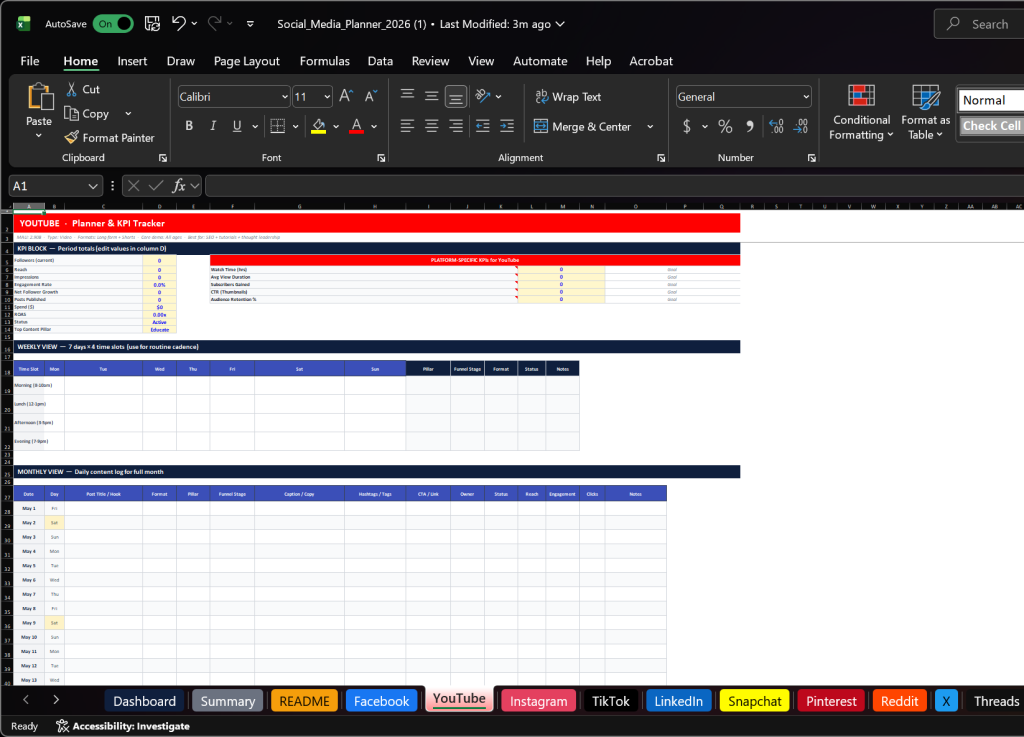
(Image above from the free planner you can download below.)
Part 1: The 2026 Landscape by the Numbers
Audience scale and behavior
The total addressable audience for social media planning in 2026 is roughly the entire connected adult population of Earth.
- There are approximately 5.66 billion active social media users worldwide in 2026, with the typical user moving between roughly 6.75 different networks per month and spending around 2 hours and 40 minutes per day in social apps. Globally, users spend around 2 hours and 40 minutes daily on social media apps.
- Social media users now make up a “supermajority” online, with 5.66 billion users worldwide — outnumbering those without social media nearly two to one.
- Spending on social ads is enormous. Global ad spend on social media is projected to hit 219 billion dollars in 2026, accounting for nearly one-third of total digital ad spend.
- Performance benchmarks are still healthy: Advertisers report an average return of 5.2 dollars for every 1 dollar spent on social media advertising, and video ads on social media deliver 48% higher engagement rates compared to static image ads.
Platform monthly active users (early 2026)
The hierarchy of platforms by monthly active users gives a clear picture of where attention sits — though attention is not the same as commercial value.
| Platform | Monthly Active Users (2026) | Notable Trend |
|---|---|---|
| ~3.07–3.1 billion | Still the largest; #1 platform marketers use (83% adoption) | |
| YouTube | ~2.5–2.9 billion | Long-form video stronghold; Shorts gaining |
| ~2.8–3.0 billion | Dominant private/business messaging | |
| ~2.3–3.0 billion (range across sources) | Reels-led growth; primary creator commerce hub | |
| TikTok | ~1.6–2.04 billion | Fastest commerce growth; engagement leader |
| ~1.3 billion | China’s super-app | |
| Messenger | ~1.2 billion | Slowing; consolidating with WhatsApp |
| ~1+ billion | Professional + B2B influencer growth | |
| Telegram | ~950 million | Privacy/community-focused |
| X (formerly Twitter) | ~450–660 million | Real-time news and sports niche |
| ~500 million | Community + AI training data goldmine | |
| Discord | ~400 million | Beyond gaming into communities & education |
Sources: Facebook is followed by Instagram and WhatsApp (tied at 3 billion users), and YouTube (2.5 billion users); TikTok surpassed 1.6 billion monthly active users; LinkedIn crossed 1 billion members, with nearly 200 million in India alone; X (formerly Twitter) records 660 million monthly active users in 2026; Discord reached 400 million monthly active users.
What the numbers really mean for planning
Three planning takeaways live inside this data:
First, you cannot meaningfully be on every platform. The average user moves across nearly seven platforms a month, but the average brand cannot generate quality content for nearly seven platforms a month. “You feel this overwhelming sense of FOMO… fear of missing out,” he said. “What happens is you end up spreading yourself too thin… and you’re not taking into account the nuance of each channel”. Picking 2–3 platforms and executing well outperforms a thin 7-platform sprawl.
Second, “where the eyeballs are” and “where conversion happens” are increasingly different questions. Facebook still leads on raw users, but TikTok now leads on commerce velocity, LinkedIn leads on B2B influence, and YouTube leads on long-form trust building. Plans should select platforms by funnel role, not just audience size.
Third, the cost of buying attention is rising while organic reach is shrinking. The average cost per thousand impressions (CPM) across social platforms in 2026 is 9.18 dollars. That makes earned distribution — community, creators, and dark-social sharing — disproportionately valuable.
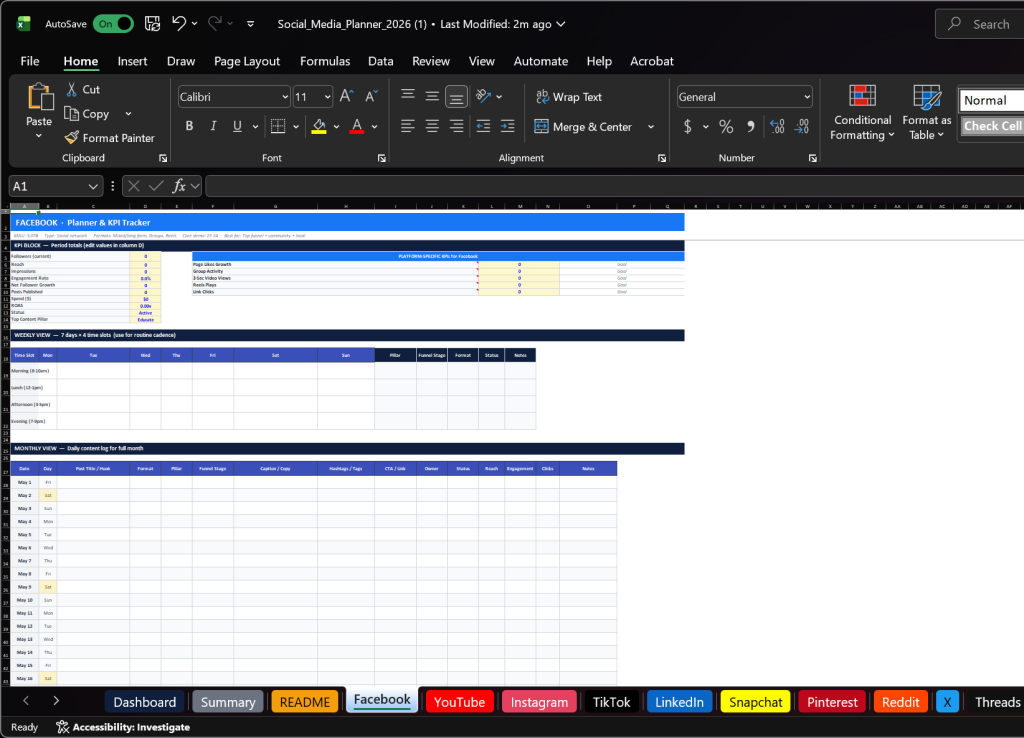
(Image above from the free planner you can download below.)
Part 2: The Eight Macro Trends Driving 2026 Planning
These eight shifts are the strategic context every plan needs to account for.
1. Agentic AI replaces generative AI as the operational layer
The shift is from “AI helps me write a caption” to “an AI agent runs the workflow.” In 2026, the shift from traditional automation to autonomous AI agents has revolutionized social media management. The best AI agent for social media today is one that does not just assist with tasks but independently executes entire marketing strategies. 78% of marketers expected to automate over 25% of their tasks with AI by 2026.
What an agent actually does in 2026 differs from a 2024 “AI tool”:
- A tool produces a caption when prompted.
- An agent monitors trending topics, identifies a relevant moment, drafts on-brand copy, generates a visual, schedules the post, monitors performance, and adjusts strategy — all within guardrails you set.
The implication for planning: stop building plans that require a human at every step. Build plans that specify what an agent should do autonomously, what should be human-reviewed, and what should be escalated.
2. Social became search
Nearly 60% of consumers rely on Instagram and 54.5% turn to TikTok when researching products—signaling a major shift away from traditional search engines. “Social networks are now the main media channel for audiences aged 16 to 34 when it comes to online brand research – a social scroll is outpacing traditional text-based search as the go-to discovery engine for young adults”.
This changes everything about caption writing, hashtags, and on-screen text. This new social SEO prioritizes naturally fitting keywords into hooks, post captions, and on-screen text in Instagram, YouTube, or TikTok videos. Plans should now include keyword research as part of social content briefs, not just as an SEO afterthought.
3. Social commerce hits the $100B inflection point
US social commerce sales will amount to $87.02 billion in 2025, up 21.5% year over year. In 2026, social commerce sales will grow another 18.0%, surpassing $100 billion for the first time. TikTok Shop alone is projected to hit $23.41 billion in US ecommerce sales in 2026, a 48% increase year-over-year, per EMARKETER. That would give TikTok Shop a larger US ecommerce business than Target, Costco, Best Buy, or Kroger.
The structural reason TikTok Shop converts so much better than its predecessors: TikTok Shop doesn’t feel like shopping—it feels like discovery. When users encounter products through TikTok Shop, they’re not in “shopping mode.” They’re in entertainment mode, which paradoxically makes them more receptive to purchases.
Planning implication: if you sell physical or digital products, social commerce is no longer a “test channel.” It is a primary revenue line that deserves dedicated content and creator strategy.
4. The creator and influencer economy matures into infrastructure
The influencer marketing industry reaches $32.6 billion in 2026: From a $1.7 billion market in 2016 to $32.6 billion today, influencer marketing has grown 19x in a decade. The U.S. creator economy ad spend specifically is set to reach $37.1 billion. But it also forecasts that next year, that figure is set to increase to $43.9 billion.
Three structural shifts inside the creator economy matter for planners:
- Micro and nano dominate the budget. Micro- and nano-influencers will claim 45.5% of influencer marketing spending in 2026. Micro-influencers (10K-100K followers) generate an average engagement rate of 3.86% compared to 1.21% for mega-influencers (1M+). Combined with per-post costs that are 60% lower, micro-influencer campaigns consistently deliver the highest ROI in the category.
- B2B influencer marketing is now the fastest-growing segment. B2B brands allocated $4.1 billion to influencer programs in 2026, a 47% increase from the prior year. LinkedIn-first influencer campaigns generate 3.2x more qualified leads than paid social for B2B companies.
- Creators are becoming co-strategists, not endorsers. Brands that involve creators at the planning stage produce more credible work than brands that hand creators a brief.
5. Public feeds empty out; “dark social” carries the conversation
This is arguably the single most under-discussed shift in the industry.
An estimated 69% of all content shares globally happen via dark social (private links, DMs, emails). Burn pointed to the rise of “micro networks” across DMs, Substack, Reddit, and Discord, alongside closed broadcast channels that allow creators and brands to bypass algorithms.
35% of creators are now engaging fans via exclusive access to content or private communities, with audiences actively seeking deeper connections and more security in gated spaces. The destinations: Instagram Broadcast Channels, private Facebook Groups, Substack communities, and niche Discord servers are all growing as users seek smaller, more intentional spaces away from noisy public feeds.
For B2B specifically, the most influential B2B conversations in 2026 will continue to happen out of sight. Planning needs to design content that travels well into private channels — content people forward to a colleague, a group chat, or a Slack room.
6. AI content fatigue and the authenticity premium
Our recent 2026 Social Media Content Strategy Report found that AI-generated content was one of the top things marketers planned to experiment with this year. But consumers are wanting more human-created content. 56% of respondents reported seeing AI slop on social media often or very often, with 83% seeing it at least sometimes.
There is a clear consumer preference signal: 52% of social users are concerned about brands posting AI-generated social content without disclosing it. 46% of social media users are not comfortable with brands using AI influencers.
But the same consumers are fine with AI in service: 65% of respondents in Sprout’s Q4 2025 Pulse Survey said they would be comfortable with companies using AI to deliver faster customer service on social.
The planning lesson is sharp: use AI heavily for invisible operational work (research, scheduling, response routing, analytics). Use it cautiously and with disclosure for visible creative output.
7. Community management gets its budget back
“Community management is finally getting its moment again,” says Kendall Dickieson, Freelance Social Media Consultant and writer of No Filter. The driver is consumer demand: two of the top traits that make brands stand out on social are how they engage with their followers and how quickly they respond to customers. Responding quickly is a must; roughly three-quarters of social users agree a brand should reply on social within 24 hours. Most users said if a brand doesn’t respond at all, they’ll buy from a competitor.
8. Long-form returns alongside short-form
Short-form video remains dominant, but it is no longer the only game. Brands that built whole strategies on 9-second hooks are now adding longer formats: Hootsuite’s 2026 research points to what they’re calling the “micro-drama trend,” a term for social-first episodic content that builds narrative over time. “Long-form in 2026 won’t just mean longer videos on TikTok or Instagram,” Maharaj said. “It will live on platforms like Substack or Reddit, where creators and brands can unpack ideas in depth and build trust without fighting the algorithm”.
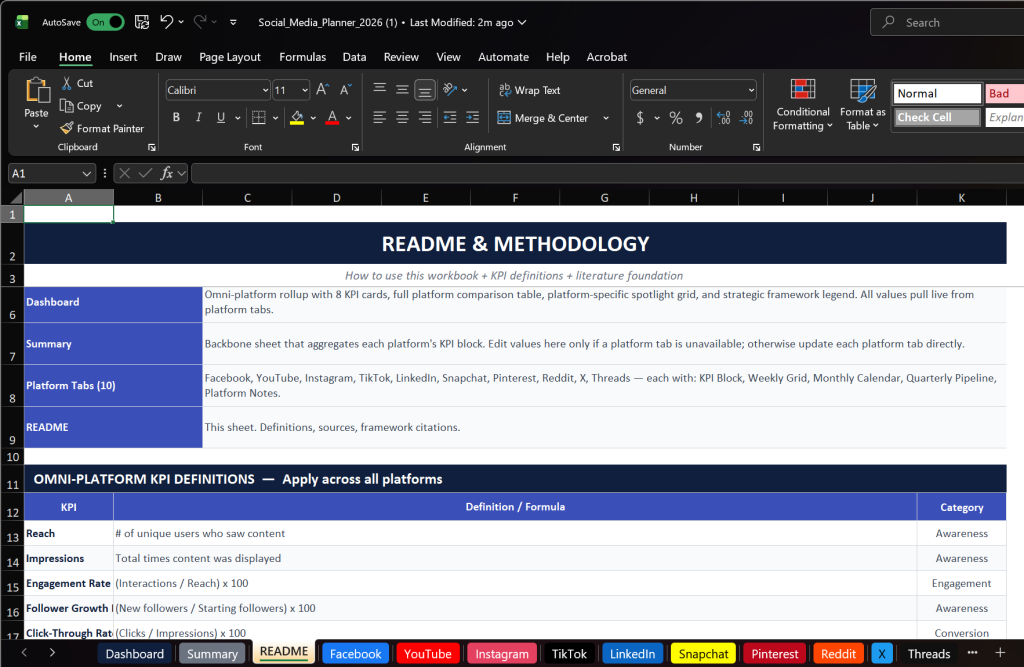
(Image above from the free planner you can download below.)
Part 3: A Modern Planning Framework
The framework below replaces the older “post 3x a week, mix promo and education” calendar approach. It treats social planning as a system with five layers that you build top-down.
Layer 1: Strategic intent (the why)
Every social plan needs to answer three questions before any content gets made:
- What business outcome does social produce for us this quarter? (Pipeline? Direct revenue? Brand consideration? Recruiting?)
- Which audiences are we trying to reach, and where do they actually spend time?
- What is the smallest set of platforms that lets us serve those audiences without spreading thin?
Layer 2: Content pillars (the what)
Pillars are 3–5 recurring topics your brand consistently covers. Good pillars are narrow enough to develop authority and broad enough to sustain content for months. A B2B SaaS company might use: customer wins, product education, founder POV, industry data, behind-the-scenes culture.
Layer 3: Format and platform mapping (the how)
This is where the modern plan diverges most from older templates. Instead of a single calendar, build a matrix that shows how each pillar gets expressed in each format on each platform.
| Pillar | Short-form video | Long-form video | Image / Carousel | Long-form text | Private channel |
|---|---|---|---|---|---|
| Customer wins | TikTok / Reels / Shorts (15s testimonial) | YouTube case study (5–10 min) | LinkedIn carousel of metrics | Substack deep dive | Broadcast channel teaser |
| Product education | TikTok / Reels (use-case demo) | YouTube tutorial | Instagram carousel “5 ways to…” | LinkedIn newsletter | Discord office hours |
| Founder POV | Reels (hot take) | YouTube long interview | LinkedIn quote graphic | Substack essay | LinkedIn DM follow-up |
Layer 4: Workflow (the who and when)
Workflow is where AI agents now do most of the heavy lifting. A 2026-native workflow looks roughly like this:
- Trend ingestion: Agent (e.g. Talkwalker, Brandwatch, or a custom Gumloop pipeline) monitors trending topics in your industry and competitor activity.
- Brief generation: Agent surfaces a daily shortlist of post opportunities tied to your pillars.
- Drafting: Agent or human drafts copy and visuals using brand voice docs.
- Approval: Human reviews. Time investment: minutes per post, not hours.
- Scheduling and publishing: Tool handles distribution at audience-specific peak times.
- Engagement: Community manager (human) handles top-of-funnel responses; agent handles routing and FAQs.
- Reporting: Agent assembles weekly performance summary against KPIs.
Layer 5: Measurement (the so what)
Modern measurement looks past vanity metrics. In 2026, vanity metrics like follower count are secondary to retention rates, share ratios, and save rates. For video content, tracking the average percentage viewed (APV) is critical; if your APV drops below 40% in the first 3 seconds, your hook needs adjustment.
The metrics that matter most in 2026:
- Save rate and share rate (signals content worth keeping or forwarding).
- Average percentage viewed for video.
- Comment quality (substance, not just count).
- Direct traffic and branded search as proxies for dark-social influence.
- Pipeline or revenue attribution where the funnel allows it.
- Community growth in gated spaces (newsletter subscribers, broadcast channel members, Discord MAU).
A simple monthly planning rhythm
| Week of month | Activity |
|---|---|
| Week 1 | Pull last month’s performance. Identify top 3 post types, topics, and hooks. Brief next month’s pillar mix. |
| Week 2 | Batch-create assets. Write captions, generate visuals, record video. Use AI for first drafts; human for voice and edits. |
| Week 3 | Schedule into management tool. Review approval queue. Check grid/feed visual coherence. Confirm key dates from your calendar. |
| Week 4 | Reserve budget for real-time/reactive content (~20–30% of slots). Run quick experiments. Set up next month’s brief. |
A deeper look at the modern KPI hierarchy
Most plans still report the wrong numbers. A 2026-grade measurement stack moves through four tiers, each answering a different question.
Tier 1: Distribution metrics (did anyone see it?)
Reach, impressions, and follower growth are the baseline. They are not the goal. Treat them as inputs to other metrics — high reach with low downstream signal usually means the content was clickbait, not value.
Tier 2: Quality engagement metrics (did the right people care?)
This is where most teams need to reset. The metrics worth obsessing over:
- Save rate: the strongest proxy for “this is worth keeping.” On Instagram and TikTok, a high save rate predicts longer-tail distribution.
- Share rate (and especially DM share rate): the strongest proxy for content traveling through dark social.
- Comment quality: length, sentiment, and whether comments include questions or tags. A post with 5 substantive comments outperforms one with 50 emoji reactions.
- Average percentage viewed (APV): the single most important video metric. Anything below 40% in the first three seconds is a hook problem.
- Profile visits and follows from a post: a strong signal that content earned attention beyond the algorithm push.
Tier 3: Audience and community metrics (are we building durable assets?)
These metrics reflect the resilience of your audience — the part that survives algorithm changes.
- Newsletter subscribers and broadcast channel members: owned audiences you can reach without paying.
- Returning viewers / repeat engagement rate: percentage of your engagement coming from people who have engaged before.
- Inbound DMs and qualified inquiries: signals of intent.
- Branded search lift: when social activity drives more people to search your brand directly.
Tier 4: Business outcome metrics (did it produce value?)
This is what gets reported to the executive team. The connection back to dollars:
- Pipeline influenced (B2B): accounts engaged with social content that subsequently entered the pipeline.
- Direct attributed revenue (DTC, social commerce): GMV traced to TikTok Shop, Instagram Shop, or affiliate links.
- Customer acquisition cost via social vs. other channels.
- Customer retention lift for community members vs. non-members.
- Recruiting funnel impact (employer brand): qualified applicants citing social as a discovery channel.
A useful exercise: list every metric your team currently reports. For each, ask “if this number doubled tomorrow, would it change a business decision?” If the answer is no, demote or drop it. The metrics that survive that question are the ones that belong on a dashboard.
Part 4: Platform-by-Platform Strategic Snapshot
Each platform serves a distinct planning purpose. Here is what they look like in 2026 and what each is genuinely good for.
TikTok
Position: The discovery and commerce engine.
Why it matters: At 3.70% average engagement, TikTok delivers 7-8x more interaction per impression than Instagram and over 20x more than Facebook. Users who discover products through TikTok content are 1.7 times more likely to complete a purchase compared to other social platforms.
Best uses:
- Product discovery (especially beauty, fashion, home, food)
- Short-form education (under 60s)
- Creator partnerships, especially nano/micro
- Live shopping events
- Trend participation (with brand voice intact)
What’s changed: One of the most significant recent developments is TikTok’s Smart Promotion program, which officially replaced Co-funded Promotion on March 3, 2026. The platform’s algorithm now optimizes paid distribution on the seller’s behalf in exchange for a flat fee on GMV.
Position: The visual storefront and influencer hub.
Why it matters: Instagram remains the default for product-based businesses and the dominant influencer platform. 57% of brands prefer Instagram as their primary influencer platform.
Best uses:
- Reels for reach (similar mechanics to TikTok)
- Carousels for educational content (high save rate)
- Broadcast channels for direct, intimate audience access
- Stories for community pulse and polls
- Shop tab for product discovery
YouTube
Position: The trust and authority layer.
Why it matters: YouTube reaches ~2.9 billion users and is #2 globally. It is also the long-tail engine: a YouTube video keeps generating views years after publication. YouTube influencers achieve the longest-lasting impact: 62% of viewers recall brand mentions after 30 days.
Best uses:
- Tutorials, deep dives, case studies
- Shorts for cross-posting short-form content
- Creator partnerships for authority topics
- Connected TV ad placement
Position: B2B’s primary channel for influence and pipeline.
Why it matters: LinkedIn-first B2B influencer campaigns now generate 3.2x more qualified leads than paid social. The platform has matured beyond “humble brag posts” into a genuine media platform with video, newsletters, and live events.
Best uses:
- Executive thought leadership
- B2B influencer / subject-matter expert partnerships
- LinkedIn newsletters (long-form content with native distribution)
- Document carousels for high engagement
Position: The reach and commerce backbone, especially for older demographics.
Why it matters: Facebook is the most-used platform by marketers worldwide (83%). Facebook is the #1 platform for product discovery and social customer service, which is a key pillar of broader 2026 social media ecommerce trends. Thirty-nine percent (39%) of consumers using it to find new products and 45% seeking support there.
Best uses:
- Reels (now the primary engagement surface)
- Marketplace and Shops
- Customer service and support
- Groups for community building
X (formerly Twitter)
Position: Real-time news and culture niche.
Why it matters: Smaller than its peak, but still where breaking news, sports culture, and certain professional communities (tech, finance, journalism) live.
Best uses:
- Reactive, timely brand voice
- Customer service for tech-forward audiences
- Live event coverage
- Distribution for thought leadership
Threads
Position: Real-time text platform with rapid growth.
Why it matters: Threads is going to overtake X in 2026, with 400 million monthly active users gained in two years, versus X’s reported 600 million that it’s gathered in its entire Twitter/X existence. Threads has built itself into a viable and valuable platform for many users, and it’s now cementing its role as a key real-time information platform, particularly around sports.
Best uses:
- Conversational brand voice
- Cross-posting from Instagram strategy
- Sports, culture, real-time community
Substack
Position: The long-form, owned-distribution play.
Why it matters: Substack is no longer just a platform for newsletters – it’s a true social media platform complete with a social feed, inbox, and profiles. It bypasses the algorithm and goes directly to subscribers.
Best uses:
- Founder/expert long-form essays
- Industry analysis and data
- Building owned audience for resilience against algorithm shifts
Position: The community and trust validation layer.
Why it matters: Reddit communities still drive real influence, especially for B2B, software, and considered purchases. They also feed AI training data — meaning Reddit mentions influence what AI assistants recommend.
Best uses:
- Authentic community participation (not promotional posting)
- AMAs from credible practitioners
- Customer research
Discord
Position: The fandom and gated community engine.
Why it matters: For brands with engaged customers, Discord servers create durable community spaces invisible to algorithms.
Best uses:
- Beta tester / power-user communities
- Creator fan communities
- Real-time customer support
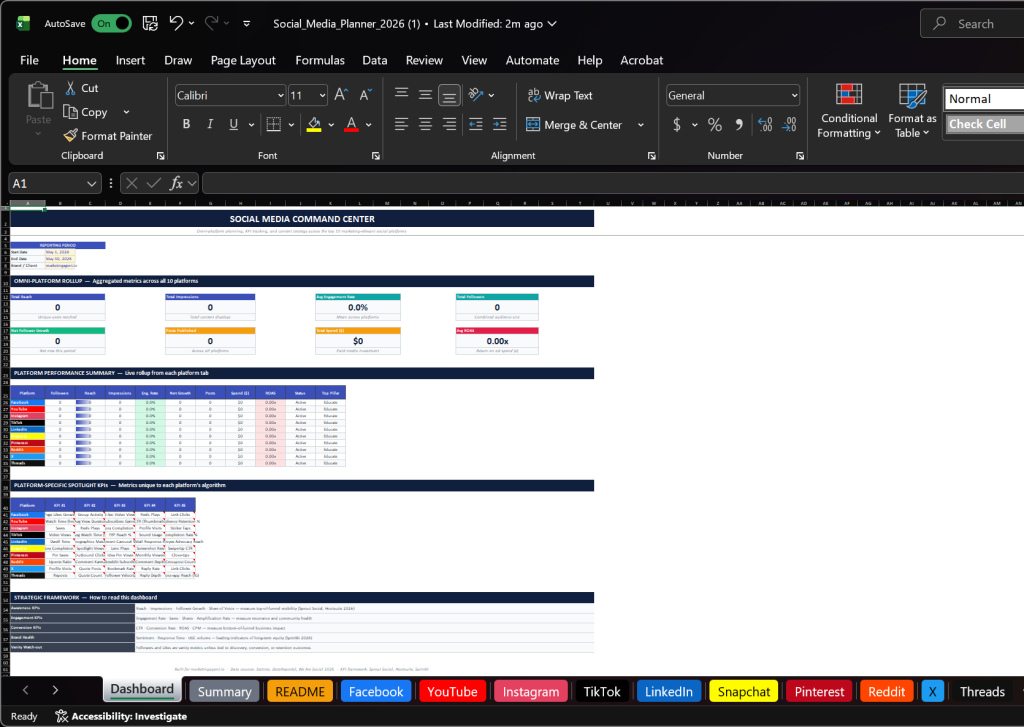
(Image above from the free planner you can download below.)
Part 5: The 2026 Tool Stack
The tools below are organized by job-to-be-done, not by vendor flash. The right stack combines a primary scheduler, a creative production tool, an AI agent or workflow layer, a listening/intelligence tool, and analytics.
Schedulers and management suites
| Tool | Best for | Notes |
|---|---|---|
| Hootsuite | Enterprise multi-platform management | Hootsuite Social Media Trends 2026 gives leaders a clear view of what’s shifting. AI-powered Talkwalker integration gives this suite a strong listening layer. |
| Sprout Social | Mid-market to enterprise; deepest sentiment analysis | Sprout Social’s AI Assist provides real-time sentiment analysis across mentions and messages, automated response suggestions for customer service teams, and reporting automation. |
| Buffer | Creators, SMBs, lean teams | Free plan available for up to 3 channels, 10 posts per channel, and 100 ideas. Essentials plan starts at $5/month/channel (billed annually), offering unlimited posts, storage, and ideas. Unlimited AI use in all plans. |
| Later | Visual-first brands, especially Instagram and Pinterest | Strong grid planning and Linkin.bio. |
| SocialPilot | Budget-conscious agencies | Generous channel limits at low per-channel cost. |
| Publer | Small business power users | Publer inverts the trend, offering a solid AI feature set on top of equally reliable social media management tools, at an accessible price point. |
| Metricool | Free-tier-friendly with surprisingly good analytics | Strong multilingual support. |
| SocialBee | Evergreen content recycling | Category-based content organization is unique and powerful. |
AI agents and autonomous workflow tools
| Tool | Best for | Notes |
|---|---|---|
| Lately.ai | Repurposing long-form into many social posts | Lately’s AI analyzes your long-form content, identifies the highest-performing phrases and hooks, and generates dozens of social posts. |
| FeedHive | Conditional auto-engagement, performance prediction | Conditional posting (e.g., add lead magnet if engagement is high) is its signature feature. |
| Gumloop | Custom no-code agent pipelines | Gumloop is an AI workflow automation platform that lets marketers build custom social media automation pipelines without code. |
| Lindy.ai / Relevance AI | Custom multi-step agent workflows | Built for marketers comfortable specifying logic. |
| MindStudio | AI agent platform without per-user lock-in | For teams that want AI-powered social media management without vendor lock-in or monthly per-user fees, MindStudio offers a flexible alternative to all-in-one platforms. |
| Beam AI | Enterprise governance, agents that connect to CRM and BI | Heavier setup but enterprise-grade controls. |
Creative production
| Tool | Best for |
|---|---|
| Canva Magic Studio | All-in-one design with AI assistance, brand kits, scheduling |
| Adobe Firefly | Commercially safe AI image generation (licensed training data) |
| Midjourney | Highest aesthetic quality for hero visuals |
| Capcut | TikTok-native short-form video editing |
| Runway / Sora | Generative video |
| Predis.ai | AI visual generation tied to social workflow |
| HeyGen | Avatar / UGC-style video at scale |
Listening and trend intelligence
| Tool | Best for |
|---|---|
| Talkwalker | Enterprise listening, audience analysis (now part of Hootsuite) |
| Brandwatch | Cross-source intelligence (social, news, forums) |
| Sprout Listening | Tightly integrated with Sprout’s publishing suite |
| Meltwater | PR and media monitoring blended with social |
| Exploding Topics | Lightweight trend discovery for SMBs |
Influencer marketing platforms
| Tool | Best for |
|---|---|
| CreatorIQ | Enterprise creator program management |
| Aspire | Mid-market influencer + UGC programs |
| Grin | E-commerce influencer ROI tracking |
| Upfluence | Creator discovery and outreach |
| Linqia | Managed influencer programs |
Analytics and attribution
| Tool | Best for |
|---|---|
| Native platform analytics | Required baseline (Meta Business Suite, LinkedIn Analytics, TikTok Analytics) |
| Google Analytics 4 | Cross-channel attribution including dark social estimation |
| Sprout / Hootsuite analytics | Cross-platform reporting |
| Funnel.io / Supermetrics | Pulling data into BI |
Part 6: Best Posting Times — and Why They Matter Less Than You Think
Posting time still matters because most platforms still give an initial distribution boost based on early engagement velocity. A post that gets strong engagement in the first 30-60 minutes of publication signals quality to the algorithm and is distributed more widely.
But consistency beats perfect timing. The accounts that grow are the ones that show up on a reliable schedule, not the ones that post at the perfect minute.
Cross-platform broad benchmarks
Overall best times to post on social media: Midday to late afternoon, between 11a.m. and 6 p.m. Best days to post on social media: Tuesdays and Wednesdays consistently show the highest peak engagement across almost all platforms. Worst days to post on social media: Sunday is the worst day to post, yielding the lowest engagement across the board.
Platform-specific guidance
| Platform | Best days | Best times | Notes |
|---|---|---|---|
| Tue, Wed, Thu | 6–9 AM, 11 AM–1 PM, 7–9 PM | Reels do best in evening leisure windows | |
| TikTok | Tue–Fri (and weekends OK) | Midday to evening; late-night also strong | TikTok is the notable exception — its algorithm is so sophisticated that content from months ago can resurface and go viral |
| Tue, Wed, Thu | 7–9 AM, 12–1 PM, 5–6 PM | Hard drop on weekends | |
| Mon–Thu | Mid-morning to early afternoon | Older audience peaks during workday breaks | |
| X / Threads | Mon–Fri | Early morning, lunch, after-work | Real-time relevance trumps scheduling |
| YouTube | Thu–Sat | 2–4 PM (let it index for prime evening watching) | Evening prime-time consumption |
| Sat–Sun | 8 PM, 4 PM, 9 PM | Weekend behavior is strong |
Compiled from Sprout Social, Buffer, SocialPilot, Heropost, and Eclincher 2026 datasets.
How to find your own best times
Even good benchmarks are starting points. The actual workflow:
- Check native analytics (Instagram Insights, LinkedIn Analytics, etc.) for when your followers are online.
- Audit your top 20 posts by engagement; look for time-of-day and day-of-week patterns.
- Run a 4-week experiment posting at two different windows. Compare.
- Re-check quarterly — algorithms and audiences shift.
Part 7: Use Cases — What Good Looks Like in Practice
Theory is one thing. Here are seven concrete planning use cases that show the 2026 framework in action.
Use case 1: Solo founder building B2B authority on LinkedIn
Goal: Generate inbound demand from senior buyers in a niche industry.
Plan:
- 3 LinkedIn posts/week (Tue, Wed, Thu, 7–8 AM local time).
- Pillars: industry data, customer wins, product POV, behind-the-scenes.
- Tooling: Supergrow or Taplio for drafting in voice; Buffer or Hootsuite for scheduling.
- Workflow: AI agent surfaces 2–3 daily prompts based on trending industry topics; founder voices each post (5–10 min effort); posts go through scheduler.
- Distribution: every post repurposed into a Substack issue weekly; key insights threaded into broadcast channel for inner-circle subscribers.
- Measurement: connection requests from ICP, demo bookings attributed to “saw a post on LinkedIn” in form question, pipeline.
Why it works: This pattern matches the data — LinkedIn-first influencer campaigns generate 3.2x more qualified leads than paid social for B2B companies — and the format requires no production team.
Use case 2: DTC beauty brand scaling on TikTok Shop
Goal: Drive direct revenue from social commerce.
Plan:
- 2–3 organic TikToks/day posted by founder + UGC creators.
- 1 weekly TikTok Live shopping event.
- Roster of 30–50 nano/micro creators on commission via TikTok Shop affiliate.
- Tooling: TikTok Creator Marketplace + an influencer platform (Aspire, Grin); native TikTok Shop analytics; Sprout for cross-channel reporting.
- Workflow: AI agent monitors top-converting creator content and surfaces patterns weekly; brand brief is updated to reinforce winning formats.
- Content style: founder-led, iPhone-shot, unscripted. “People will come to TikTok for unfiltered stories and BTS moments, with the most resonant brands showing real process and people over curated perfection”.
Why it works: TikTok Shop’s live shopping conversion rate of 7.4% and its discovery-mode psychology favor brands willing to be raw. Heavy creator volume, not polish, drives GMV.
Use case 3: B2B SaaS launching to enterprise buyers
Goal: Influence the long, multi-stakeholder buying committee.
Plan:
- LinkedIn as primary public channel (founder + 3 executive thought leaders post 2–3x/week).
- Quarterly research report (proprietary data) distributed via LinkedIn, Substack, and the website.
- Partner with 5–10 industry analysts and SMEs (B2B influencers) for co-created content.
- Private community: invite-only Slack for customers and prospects with monthly off-the-record sessions.
- Tooling: CreatorIQ or Aspire for influencer programs; Brandwatch for listening; HubSpot or Salesforce for attribution.
- Measurement: engaged accounts in CRM (not just MQLs), pipeline influenced, share of voice in industry conversation.
Why it works: Before a vendor is contacted, multiple conversations already take place internally. The plan optimizes for being the brand that gets shared internally, not just the brand with the most posts.
Use case 4: Local service business (e.g., a roofing company)
Goal: Generate qualified leads for a defined geographic market.
Plan:
- Facebook + Instagram + Google Business Profile as core trio.
- Weekly Facebook posts featuring completed jobs, before/after, customer reviews.
- Monthly Reels showing the work process (storm damage assessments, repairs).
- Active community management — respond to every comment and message within 24 hours.
- Run consistent geofenced ads with retargeting on Meta.
- Tooling: Buffer or Publer for scheduling; native Meta Ads Manager; Eclincher’s unified inbox for messages.
Why it works: Local services don’t need 7 platforms. They need consistency on the platforms older homeowners actually use, plus fast response times.
Use case 5: Personal brand creator monetizing on multiple channels
Goal: Build durable income across creator economy revenue streams.
Plan:
- TikTok and Instagram Reels for top-of-funnel discovery (daily).
- YouTube for long-form content that generates ad revenue and authority (weekly).
- Substack newsletter for owned audience and paid subscriptions (weekly).
- Discord or broadcast channel for super-fans and product launches.
- Brand partnerships with aligned companies (gifted + paid mix).
- Tooling: Capcut for editing; Buffer for scheduling; Beehiiv or Substack for newsletter; Stan or Gumroad for digital products.
- Workflow: One long-form YouTube video per week is the parent asset. From it: 5–10 short-form clips, 1 newsletter issue, 5–10 social posts. Lately’s AI analyzes your long-form content, identifies the highest-performing phrases and hooks, and generates dozens of social versions.
Why it works: Creators who depend on a single platform are one algorithm change away from disaster. Diversification across discovery, monetization, and owned audience is the modern resilience strategy.
Use case 6: Higher education program recruiting students
Goal: Drive applications to a specific degree program.
Plan:
- Instagram and TikTok for prospective students (day-in-the-life, student takeovers, professor highlights).
- LinkedIn for prospective parents and adult learners.
- YouTube for long-form student stories and program deep dives.
- Faculty thought leadership on Substack and LinkedIn.
- Community: private Discord or Instagram broadcast channel for admitted students.
- Tooling: Sprout Social for multi-account management; native analytics; CRM integration for application tracking.
Why it works: Students research universities the way they research products — via TikTok and Instagram first, then validate with longer YouTube content. Parents want LinkedIn-style proof of outcomes.
Use case 7: Internal communications for a global enterprise
Goal: Drive employee engagement and consistent brand storytelling.
Plan:
- LinkedIn corporate page for external brand stories.
- Employee advocacy program with pre-approved, on-brand content. Don’t miss out on your greatest untapped growth lever — employee advocacy. Hootsuite Amplify provides your team with pre-approved, on-brand content for your employees to share across their social networks in seconds.
- Internal Slack or Workplace channels for behind-the-scenes news.
- Quarterly town hall recordings posted to YouTube (gated for employees).
- Tooling: Hootsuite Amplify, Sociabble, or Bambu for advocacy; native LinkedIn Pages analytics.
Why it works: Employees collectively have 5–10x the network reach of a corporate page. Activated employees turn corporate content into trusted, peer-to-peer signal.
Use case 8: Nonprofit driving donations and volunteer signups
Goal: Convert awareness into both monthly recurring donors and event attendees.
Plan:
- Instagram + Facebook as the dual core (Facebook for older donors, Instagram for volunteer-age audiences).
- Story-led content: beneficiary spotlights, volunteer voices, behind-the-scenes program work.
- TikTok for younger volunteer recruitment with raw, mission-led content.
- LinkedIn for corporate giving and partnership outreach.
- Quarterly livestream events (giving Tuesday, year-end appeals) with donation links pinned in comments.
- Tooling: Buffer (low cost) or Sprout (with grant-funded discount); Canva for design at scale; Givebutter or Donorbox for embedded fundraising.
- Workflow: AI agent surfaces beneficiary stories from program staff in private channels and drafts social-ready versions for review.
Why it works: Nonprofits sit on a trove of authentic stories that already meet the 2026 authenticity premium. The bottleneck is operational, not creative — agents that compress story-to-post time unlock latent supply.
Use case 9: Restaurant or local hospitality brand
Goal: Drive foot traffic and reservations within a tight geographic catchment.
Plan:
- Instagram + TikTok for visual food content (Reels/TikTok of dish prep, daily specials).
- Google Business Profile for discovery and reviews (still the highest-converting local surface).
- Active community management on tagged photos and reviews.
- Partner with local micro-creators for tasting nights in exchange for content.
- Reserve key dates (Valentine’s, Mother’s Day, local festivals) months in advance in the calendar.
- Tooling: Later for visual planning; OpenTable / Resy for reservation linking; Canva for menu graphics.
Why it works: Local discovery is increasingly visual and increasingly social-first. Beauty and personal care, food and drink, and visually demonstrable products consistently outperform on TikTok and Reels — and a restaurant’s daily output is precisely that kind of content.
Use case 10: AI-native startup launching to developers
Goal: Drive sign-ups and product-led growth among technical buyers.
Plan:
- X (Twitter) and LinkedIn as primary channels — developers still gather on X for tech discourse.
- GitHub-tied content marketing (release notes, changelogs, technical deep dives).
- Discord community for users; Reddit (r/programming, r/MachineLearning) participation that is genuinely additive.
- Substack or company blog for long-form technical writing.
- Co-author posts with respected developer-influencers.
- Tooling: Typefully for thread drafting; Buffer for cross-posting; native GitHub analytics.
Why it works: Technical audiences are skeptical of marketing and rewarded by depth. Plans that prioritize technical credibility over reach win this audience — and Reddit and Discord remain the validation layer where AI assistants source their recommendations, making participation here a form of dark SEO investment.
Part 8: Risks, Pitfalls, and What to Avoid
A few patterns that consistently lead to wasted budget in 2026:
Over-automating creative
AI hallucinations remain a concern, with error rates ranging from 15-27% depending on the model and use case. Implement human review for customer-facing content and important communications. Brands that fully automate caption-and-publish cycles end up with off-brand or factually wrong posts. Keep a human in the loop on anything customer-facing.
Posting just to post
What’s much more important—especially entering 2026—is focusing on creating fewer quality posts. This means no more holiday posts (they don’t do you any good anyway—pure engagement grabs). This means no more post quotas (thank goodness). Quality and consistency beat volume.
Spreading thin across platforms
The data on burnout supports this. Pick fewer platforms and execute well.
Ignoring dark social attribution
If your analytics shows “direct traffic” growing while paid is flat, the cause is almost always dark social. Don’t dismiss it — track it as a positive signal.
Treating creators as ad placements
In 2026, leading creators are evolving beyond content execution into strategic partners. Briefing creators like a media buy produces forgettable content. Co-create.
Chasing trends without character
“The brands getting genuine engagement aren’t the ones with the fastest turnaround on trending audio,” explains Haberman. “They’re the ones building recognizable characters, lore, and brand worlds that feel distinctly theirs. Trends can be a tool, but they can’t be your entire strategy”.
Pretending AI content is human
Negative effects from AI content creation can be mitigated in two ways. Keep a human involved at every step of content production, and label AI content, as it’s unlabeled AI content that people object to most.
Underinvesting in brand voice documentation
Every agentic workflow is only as good as the brand voice doc it’s grounded in. The single highest-leverage hour you can spend in 2026 is writing a thorough voice document — tone, point of view, things you would never say, examples of “good” past content with annotations on why they worked. This becomes the system prompt for every AI agent you deploy, and the difference between agents that produce on-brand work and agents that embarrass you.
Part 8.5: Human-in-the-Loop Frameworks for AI Orchestration
The agentic shift creates a new design question: which decisions does the agent get to make, and which require human approval? Three operating models have emerged, each suited to different risk profiles.
HITL — Human-in-the-Loop
The agent drafts; a human reviews and approves before anything ships. This is the right default for most brands, especially in the first 90 days of any new agent deployment, and for any customer-facing communication where a wrong answer creates real risk. Time savings are real but modest — perhaps 40–60% reduction in production time vs. fully manual.
HOTL — Human-on-the-Loop
The agent acts autonomously within defined guardrails; a human monitors output and intervenes when something looks off. Appropriate for low-risk, high-volume work like response routing, FAQ replies, and trend monitoring summaries. Time savings: 70–85%.
HOVL — Human-out-of-the-Loop (rare and risky)
The agent operates with no human checkpoints. The agent runs your entire social presence with minimal human oversight. It identifies trends, creates and publishes content in response, adjusts strategy based on performance data, and even engages with your audience in comments and DMs. This level is technically possible but not recommended for most brands today. The risk of off-brand content or tone-deaf responses is still too high without human checkpoints. Time saved: 85–95% in theory, but with significantly higher brand risk.
The pragmatic 2026 deployment pattern: start every workflow as HITL. Move workflows to HOTL only after you have at least 4 weeks of data showing the agent consistently produces on-brand output. Never move customer-facing brand-voice work to HOVL. Reserve HOVL for purely operational tasks (scheduling, reporting, routing) where there is no judgement call to get wrong.
A practical decision matrix:
| Workflow | Recommended model | Why |
|---|---|---|
| Trend monitoring & summaries | HOVL | Pure information work; no brand voice risk |
| Post scheduling at optimal times | HOVL | Mechanical; consistency matters more than nuance |
| First-draft caption generation | HITL | High brand voice risk; needs human polish |
| Response to customer service inquiries | HOTL with escalation rules | Volume requires automation; complex cases need humans |
| Crisis response or sensitive topics | HITL with senior review | Stakes too high to delegate |
| Performance reporting | HOVL | Data is data; let the agent assemble it |
| Strategic recommendations from data | HITL | Agents surface options; humans choose direction |
Part 9: A Quarterly Operating Cadence for 2026
Tying it all together, here is an operating cadence that high-performing teams use to keep social planning aligned with strategy.
Monthly
- Performance review: top 3 posts, bottom 3 posts, why.
- Update brand voice doc with anything that worked or flopped.
- Plan next month’s content brief by pillar and platform.
- Audit at least one competitor for moves worth borrowing.
Quarterly
- Refresh content pillars based on business priorities.
- Review platform mix — is each one still earning its slot?
- Re-check posting time data; algorithms drift.
- Run a creator audit: are partnerships paying off in revenue, not just impressions?
- Update measurement framework against business outcomes.
Annually
- Full strategic reset against the macro trends shifting underneath you.
- Tooling audit — the tool stack changes fast; consolidate where possible.
- Budget reallocation across organic, paid, creator, and community.
- Skills audit — is the team capable of operating the agentic workflows your plan requires?
Conclusion: The Three Sentences That Sum Up 2026 Social Planning
One: Social media planning in 2026 is no longer a calendar of posts; it is a system of agents, creators, communities, and measurement that produces business outcomes.
Two: The brands winning are not the loudest or most automated; they are the ones that pair AI’s operational leverage with unmistakably human voice and genuine community.
Three: Plans built for 2024 — daily posts, follower-count metrics, single-platform focus — now actively underperform plans built for the present, which optimize for share-worthiness, dark-social travel, social commerce velocity, and creator-led trust.
The good news: the technology to execute at this level is more accessible than ever. The constraint is no longer tools or budget. It is strategic clarity, a willingness to specialize, and the discipline to put a human in the loop where it actually matters.
That’s where the work is in 2026. And that’s where the opportunity is, too.
Sources and Further Reading
- Hootsuite, Social Media Trends 2026 — hootsuite.com/research/social-trends
- Sprout Social, 7 Social Media Trends to Know in 2026 and State of Social Media in 2026 — sproutsocial.com/insights
- National University, Social Media Trends in 2026: What’s Next — nu.edu/blog/social-media-trends
- Sprout Social, 120+ Social Media Marketing Statistics for 2026 — sproutsocial.com/insights/social-media-statistics
- Power Digital Marketing, 2026 State of Social Media Trends Report — powerdigitalmarketing.com
- Emplifi, State of Social Media Marketing 2026 Report — emplifi.io/resources
- Social Media Today, 7 Digital Marketing Trends to Watch for in 2026 — socialmediatoday.com
- NEWMEDIA.COM, 200+ Social Media Marketing Statistics 2026 — newmedia.com/blog/social-media-marketing-statistics
- EMARKETER, TikTok Shop and Social Commerce Forecasts 2026 — emarketer.com
- Retail Dive, TikTok Shop Driving Social Commerce Growth — retaildive.com
- ALM Corp, TikTok Ads in 2026: The $37B Creator Economy Opportunity — almcorp.com
- Influencer Marketing Hub, Influencer Marketing Benchmark Report 2026 — influencermarketinghub.com
- Linqia, 2026 State of Influencer Marketing Report
- Aspire, 2026 State of Influencer Marketing
- Net Influencer, U.S. Creator Marketing Spending To Surpass $21B — netinfluencer.com
- Digiday, In Graphic Detail: The 2026 Creator Economy — digiday.com
- Buffer, Best Time to Post on Social Media in 2026 and 180+ Social Media Calendar — buffer.com/resources
- Sprout Social, Best Times to Post on Social Media 2026 — sproutsocial.com/insights/best-times-to-post-on-social-media
- SocialPilot, Best Times to Post on Social Media 2026 — socialpilot.co
- Heropost, Best Times to Post on Social Media 2026 — heropost.io
- Eclincher, 10 Best Social Media Automation Tools for 2026 and Best Time to Post Guide — eclincher.com
- Zapier, 9 Best AI Tools for Social Media Management in 2026 — zapier.com/blog
- DigitalApplied, AI Social Media Management Tools 2026 and Influencer Marketing Statistics 2026 — digitalapplied.com
- Enrich Labs, Best AI Social Media Automation Tools in 2026 — enrichlabs.ai
- MindStudio, 15 Ways to Use AI Agents for Social Media Management — mindstudio.ai
- Mediaweek (AiMCO), 10 Trends Influencing the Creator Economy in 2026 — mediaweek.com.au
- Bottle Digital PR, Influencer Marketing Trends 2026 — wearebottle.com/blog
- Internet Ghosts, Social Shifts: What To Expect In 2026 — internetghosts.substack.com
- Ticket Fairy, Mastering Dark Social in 2026 — ticketfairy.com/blog
- B2B Academy, Dark Social and Private Channels for B2B Marketing in 2026 — b2b-academy.com
- ALM Corp, How to Build a Social Media Calendar That Drives 47% Higher Engagement: 2026 Guide — almcorp.com
- ad.white, 2026 Social Media Trends — blog.adwhite.com
- Marketing Advice, First, Dark Social. Now, Dark SEO. — marketingadvice.substack.com
Article current as of April 2026. Social media is a fast-moving domain — verify any tool pricing or platform feature directly with the vendor before making purchasing or planning decisions.
Download Zipped File Below – Freebie File


0 Comments