• Docs
  • Free Website
Marketing Agent Blog Marketing Agent Blog

Marketing Agent Blog Marketing Agent Blog

  • Tutorial: Google Ads Strategy for E-Commerce

    by marketingagent.io
  • Article backdrop: Most consumers use AI, but few fully trust it

    AI Trust Gap: 60% of Consumers Use AI, Only 13%...

    by marketingagent.io

How to Avoid Destroying Your AI Agent: 6 Critical Deployment...

Post Pagination

  • Next PostNext
  • Agency Home
  • Hot
  • Trending
  • Popular
  • Docs
  1. Home
  2. AI Marketing
  3. How to Avoid Destroying Your AI Agent: 6 Critical Deployment Pitfalls
4 months ago 4 months ago

AI Marketing

How to Avoid Destroying Your AI Agent: 6 Critical Deployment Pitfalls

Building an AI agent takes a weekend. Destroying it in production takes about five minutes. The gap between a working demo and a reliable, secure, production-grade deployment is where most enterprise AI initiatives fail—and based on current research, the failure modes are shockingly consistent and p


marketingagent.io
by marketingagent.io 4 months ago4 months ago
37views
0

Building an AI agent takes a weekend. Destroying it in production takes about five minutes. The gap between a working demo and a reliable, secure, production-grade deployment is where most enterprise AI initiatives fail—and based on current research, the failure modes are shockingly consistent and predictable.

This tutorial walks you through the six most common ways teams ruin perfectly good AI agents, with a practical hardening checklist you can run against any agent before it touches real users or real data.


What This Is

An “agentic AI” system is fundamentally different from a chat interface. Where a traditional LLM answers a question and stops, an agent reasons through a task, invokes tools—file systems, APIs, databases, shell commands—and takes autonomous action. That autonomy is the product. It’s also the attack surface.

According to the NotebookLM research report on agentic enterprise security, this transition from conversational AI to agentic systems “represents a fundamental shift in enterprise technology” that introduces risks “that differ significantly from traditional software or standalone LLMs.” The report identifies this as an integration gap: probabilistic AI reasoning operating inside deterministic system constraints.

Salesforce’s analysis of AI implementation pitfalls frames it this way: an agentic enterprise “means more than just deploying agents—it’s a complete system. It starts with trusted governance as a foundational layer, not an afterthought.” That framing is exactly right, and it’s the framing most teams ignore when they’re shipping demos.

The agent skills ecosystem compounds the problem. Unlike traditional package managers—npm, PyPI—where packages run in sandboxed environments with declared permissions, agent skills inherit the full permission set of the agent that executes them. That means a single poorly-vetted skills package can do anything your agent can do: read files, call APIs, execute shell commands.

Snyk’s ToxicSkills research quantifies the scope: 36.82% of identified agent skills possess at least one security flaw, and 13.4% contain critical-level issues including embedded malware and prompt injection payloads, according to the NotebookLM research report. These aren’t hypothetical risks. They’re the current state of the ecosystem right now, in March 2026.

Understanding these six failure modes—privilege escalation, supply chain contamination, architectural fragility, performance collapse, data mismanagement, and governance neglect—is the prerequisite for shipping agents that work in production for more than a week.


Why It Matters

This isn’t a theoretical exercise. Enterprises are deploying AI agents against customer data, financial systems, HR records, and operational infrastructure. When an agent fails, the consequences scale with its permissions.

The research identifies who gets hurt by each failure mode:

Developers and platform engineers bear the cost of architectural failures. When dependency updates cascade into system-wide breakdowns—a pattern the research attributes to tight coupling between agent logic and volatile external components—it’s the engineering team running incident response at 2am.

Security and compliance teams own the fallout from privilege misconfigurations and supply chain contamination. An over-privileged agent that processes a malicious prompt injection doesn’t just return a bad answer; it executes commands with whatever permissions its service account holds.

Operators and product managers feel the impact of performance degradation. Context window overflow, inference cost escalation, and orchestration overhead all manifest as user-facing latency and runaway cloud bills.

Executives and data governance leads are responsible for the launch-and-leave failure mode—the assumption that deploying an agent is a one-time event rather than an ongoing operational discipline. Salesforce is explicit: agents require “trusted governance as a foundational layer.”

What makes this different from prior software risk categories is the hybrid failure profile. As the academic report “Characterizing Faults in Agentic AI” notes—cited in the NotebookLM research report—”failures in agentic AI systems are structured rather than ad hoc,” exhibiting “a distinctive hybrid failure profile” that combines probabilistic LLM errors with deterministic software faults. You can’t debug these failures with traditional logging alone.


The Data: Agentic Failure Taxonomy and Performance Bottlenecks

The research identifies five primary architectural dimensions where agentic faults occur, and four performance bottlenecks that degrade at scale. Both tables are drawn directly from the NotebookLM research report.

Agentic Fault Taxonomy

Fault Dimension What Breaks Example Failure Mode
Cognitive Control LLM misconfiguration, token-handling errors Agent loops indefinitely because stop tokens are misconfigured
Agency & Actuation Execution loop failures Infinite reasoning cycles; agent never reaches a termination state
Perception & Memory State inconsistencies, type-handling errors LLM output violates downstream program logic, causing runtime exceptions
Runtime & Grounding Dependency conflicts, platform incompatibilities Utility library update cascades into system-wide failure
Reliability & Observability Suppressed exceptions, silent errors Agent appears to complete tasks but is silently failing with no logged trace

Performance Bottlenecks at Scale

Bottleneck Primary Cause Strategic Solution
High Latency Memory-bound GPU operations during decode phase Implement quantization and Key-Value (KV) caching
Context Window Limits Exponential KV cache growth with long sequences Use semantic chunking and intelligent context pruning
Inference Costs Using flagship models for simple tasks Intelligent model routing (simple tasks → smaller models)
Orchestration Overhead Sequential tool execution, agent-to-tool gaps Adopt async-first architecture for parallel tool calling

The performance data point that should stop every team in their tracks: the research indicates that intelligent model routing—reserving flagship models for complex reasoning and routing classification or summarization tasks to smaller alternatives—can reduce inference spend by up to 90%, per the NotebookLM research report.


Step-by-Step Tutorial: Auditing and Hardening an AI Agent Deployment

This tutorial assumes you have an agent either in late-stage development or already in production. The goal is to run a systematic audit against the six failure modes, then implement targeted fixes. You don’t need to rebuild your agent—you need to harden it.

Prerequisites

  • Access to your agent’s configuration files and deployment environment
  • Service account credentials used by the agent
  • A list of all skills/plugins/tools your agent has enabled
  • Your current observability setup (logs, traces, dashboards)
  • A staging environment that mirrors production

Phase 1: Audit Permissions (The Privilege Problem)

The single most exploitable configuration in agentic deployments is an over-privileged service account. Most teams clone an admin profile when setting up agent credentials because it’s fast and it works. That convenience creates a “keyless” security risk—as Ruh AI’s security analysis puts it: “The difference between your ChatGPT session and these autonomous agents isn’t just power—it’s fundamental design choices that prioritize convenience over safety.”

Step 1.1: Start from zero, not from a clone.

Create a brand-new user or service account for your agent. Do not copy permissions from an existing admin or power user. Open a new account with zero permissions and add only the specific Object and Field-Level Security (FLS) required for the tasks this specific agent performs.

# Example: Creating a scoped service account in a cloud environment
# Instead of copying admin role:
gcloud iam service-accounts create agent-production \
  --description="Scoped service account for sales-summary agent" \
  --display-name="Agent Production"

# Grant only the specific roles this agent needs:
gcloud projects add-iam-policy-binding YOUR_PROJECT \
  --member="serviceAccount:agent-production@YOUR_PROJECT.iam.gserviceaccount.com" \
  --role="roles/bigquery.dataViewer"  # Read-only, specific dataset

Step 1.2: Implement an immutable safety core.

Separate your agent’s “personality” configuration (system prompts, tone, persona) from its safety constraints (never delete files, never send bulk communications without approval). The safety layer must be in a file or configuration block that the LLM cannot modify through prompt injection.

# agent_config.yaml — separating personality from safety
personality:
  tone: "professional"
  name: "Aria"
  instructions: "outputs/persona.txt"  # User-editable

safety_core:
  immutable: true
  rules:
    - "Never delete files without explicit human confirmation"
    - "Never initiate financial transactions > $500 without re-authentication"
    - "Never send communications to more than 5 recipients without approval"
  source: "system_controlled"  # Never loaded from LLM-accessible path

Step 1.3: Require session-based re-authentication for high-risk operations.

For any operation classified as high-risk—financial transactions, mass communications, file deletions, external API calls with write access—require the agent to re-verify user identity mid-task, not just at session start.


Phase 2: Audit Your Skills Inventory (The ToxicSkills Problem)

The research from Snyk’s ToxicSkills study, as reported in the NotebookLM report, documents three specific attack vectors currently deployed in the wild against agent skills ecosystems:

  • Prompt injection (91% of confirmed malicious skills): Deceptive instructions embedded in skill metadata that override safety guidelines
  • Data exfiltration: Obfuscated commands using base64 encoding to steal credentials and sensitive files
  • Malware distribution: Skills that instruct agents to download and install password-protected archives to evade scanners

Step 2.1: Inventory every installed skill.

Generate a complete list of every skill, plugin, tool, or capability package your agent can invoke. This includes first-party skills, community skills, and any skill imported as a dependency of another skill.

# Pseudocode: auditing your skills registry
import json

with open("agent_skills_manifest.json") as f:
    manifest = json.load(f)

for skill in manifest["skills"]:
    print(f"Skill: {skill['name']}")
    print(f"  Source: {skill['source']}")
    print(f"  Permissions requested: {skill['permissions']}")
    print(f"  Last verified: {skill['verified_at']}")
    print(f"  Hash: {skill['integrity_hash']}")
    print()

Step 2.2: Apply the least-privilege principle to skills.
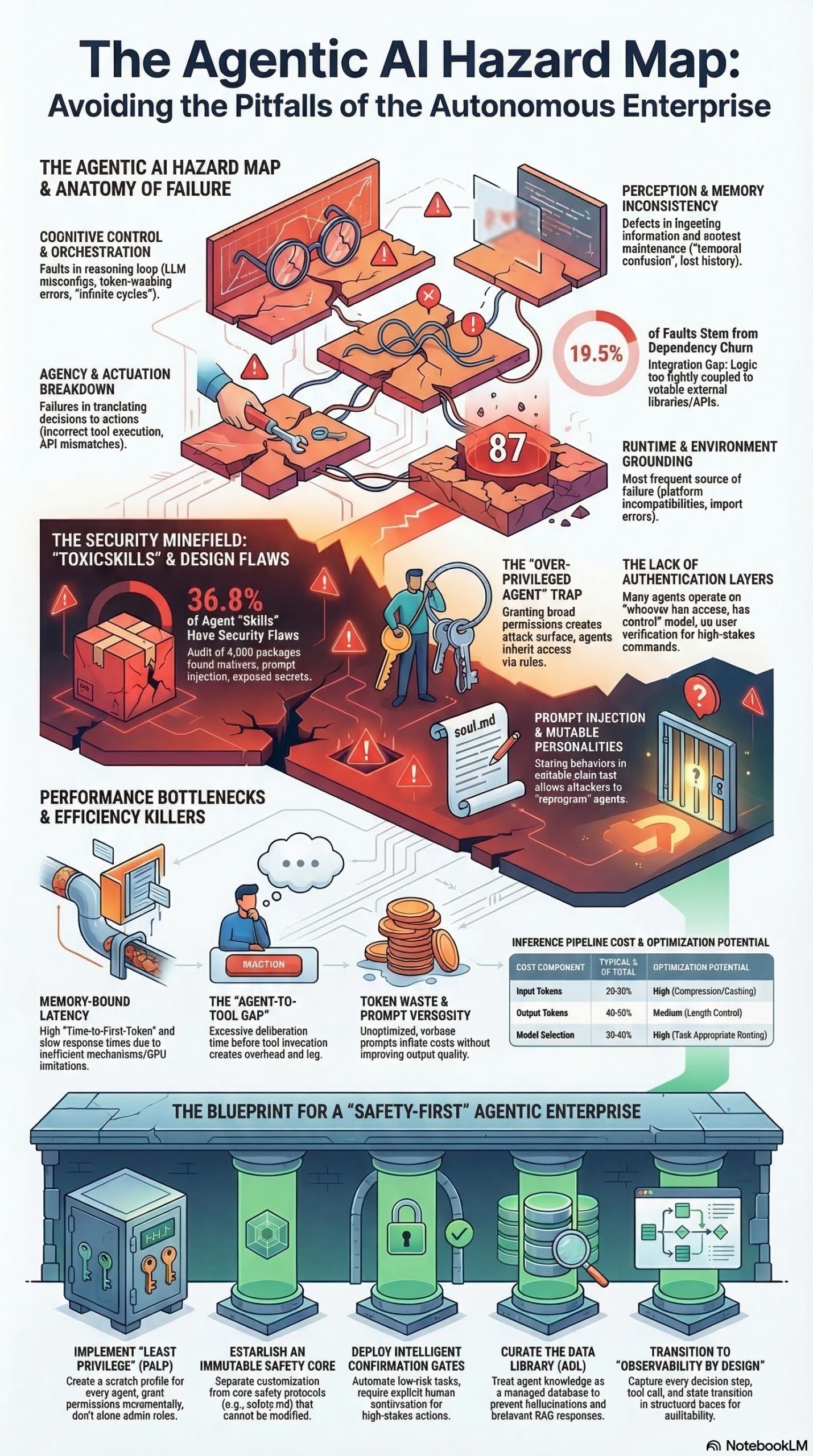
Infographic: How to Avoid Destroying Your AI Agent: 6 Critical Deployment Pitfalls

A skill that only needs to read from a CRM should not have access to your file system. Audit each skill’s declared permissions against what it actually needs, and strip anything that isn’t required.

Step 2.3: Scan skill system prompts for injection patterns.

Load each skill’s configuration file and scan for adversarial patterns: base64-encoded strings, instructions to “ignore previous instructions,” redirects to external URLs in system prompts, and commands referencing credential files.

# Basic scan for suspicious patterns in skill configs
grep -r "ignore previous" ./skills/ --include="*.json" --include="*.yaml"
grep -r "base64" ./skills/ --include="*.json" --include="*.yaml"
grep -r "download" ./skills/ --include="*.json" --include="*.yaml"
grep -r "\.env\|credentials\|secret\|token" ./skills/ --include="*.json"

Phase 3: Test Architectural Fault Points (The Integration Gap)

Per the NotebookLM research report, dependency and integration changes account for nearly 20% of all agentic system breakdowns. The integration gap—tight coupling between agent logic and volatile external dependencies—is the most common source of production outages.

Step 3.1: Pin your dependencies.

Never let your agent runtime use latest for any package. Pin every dependency to an exact version and use a lock file.

# Python: pin and lock dependencies
pip freeze > requirements.txt

# Node: use exact versions
npm install --save-exact some-agent-framework@2.4.1

Step 3.2: Build a fault injection test suite.

Before deploying, simulate each of the five fault dimensions from the taxonomy table: inject type mismatches into LLM output, force infinite reasoning loops with malformed stop conditions, simulate dependency failures, and suppress exception handlers to test your observability layer.

Step 3.3: Enable enriched event logs.

The research explicitly recommends enabling “enrich event logs with conversation data” to support root-cause analysis. Standard request/response logs are insufficient—you need the full reasoning chain, tool invocations, outputs, and any error states captured in a single trace.


Phase 4: Optimize for Performance (The Cost and Latency Problem)

Step 4.1: Implement intelligent model routing.

Map your agent’s task types to a three-tier model hierarchy: complex reasoning to your flagship model, summarization and classification to a mid-tier model, and simple lookup and formatting tasks to your smallest available model.

def route_to_model(task_type: str, complexity_score: float) -> str:
    if complexity_score > 0.8 or task_type in ["multi_step_reasoning", "code_generation"]:
        return "gpt-4"
    elif complexity_score > 0.4 or task_type in ["summarization", "sentiment_analysis"]:
        return "gpt-4o-mini"
    else:
        return "gpt-3.5-turbo"  # Or equivalent small model

Step 4.2: Implement multi-tier caching.

Use three cache levels as recommended in the NotebookLM research report: an exact-match cache for identical queries, a semantic cache for related queries using embeddings, and a prompt cache to store repeated system instructions and reduce token costs on every call.

Step 4.3: Move to async-first orchestration.

Any agent making more than one tool call in sequence should be audited for parallelization opportunities. If a task requires fetching from a CRM and querying a database independently, those calls should run in parallel.


Phase 5: Curate Your Data Library (The RAG Problem)

Step 5.1: Treat your data library as a database, not a firehose.

The research warns against the “firehose” approach to Retrieval-Augmented Generation (RAG)—dumping every available document into the index and hoping the retriever finds what it needs. Use “identifying fields” to help the retrieval system and “content fields” for the LLM response generation.

Step 5.2: Validate ingestion before going live.

After loading data into your search index or vector table, confirm the index status is “Ready” before enabling agent access. Agents querying empty or partially-built indices will hallucinate with false confidence.

Step 5.3: Run utterance analysis monthly.

Use your agent’s conversation logs to identify where it is failing to produce accurate answers. The research calls this “utterance analysis”—systematically reviewing real user queries that resulted in low-confidence or incorrect responses to identify knowledge gaps in your data library.


Phase 6: Establish a Governance Layer (The Launch-and-Leave Problem)

Step 6.1: Define Jobs to be Done before configuration.

Run a discovery workshop before touching configuration. Define the agent’s specific jobs to be done (JTBD) and establish baseline success metrics—concrete numbers like “reduce average handle time by 90 seconds” or “resolve 40% of tier-1 tickets without human escalation.”

Step 6.2: Implement a rollback window.

Give users and operators a configurable undo window for agent actions. A well-designed rollback window lets humans catch and reverse overzealous file deletions, incorrect API calls, or erroneous data updates within a defined time window—before they become irreversible incidents.

Step 6.3: Schedule quarterly permission reviews.

Agent permissions accumulate over time. New integrations get added; old constraints get loosened. Build a quarterly review cadence into your operations calendar to audit permissions, skills, and safety core configurations against the current threat landscape.


Expected Outcomes

After completing this six-phase audit, you should have:
– A zero-permission-baseline service account with scoped, documented permissions
– A vetted skills inventory with no unreviewed community packages
– Pinned dependencies with a fault injection test suite in CI
– An intelligent routing layer reducing inference costs
– A structured data library with validated indices
– Documented JTBD metrics and a governance review schedule


Real-World Use Cases

Use Case 1: Enterprise Sales Agent with CRM Access

Scenario: A B2B sales team deploys an agent that reads Salesforce records, drafts follow-up emails, and schedules meetings autonomously.

Implementation: Apply Phase 1 (privilege audit) by creating a scoped service account with read access to opportunity records and write access only to activity logs. Apply Phase 2 (skills audit) by reviewing the email drafting skill for prompt injection patterns. Apply Phase 6 (governance) by defining the JTBD as “draft three follow-up email options per open opportunity, per week” with a baseline metric of reducing SDR email-drafting time by 45 minutes daily.

Expected Outcome: The agent operates reliably within its permission boundary. Sales reps review and approve email drafts before send. No unauthorized data access. Performance measured against the 45-minute baseline.

Use Case 2: Customer Support Agent with Knowledge Base RAG

Scenario: A SaaS company deploys a support agent that answers tier-1 tickets by querying a product knowledge base using RAG.

Implementation: Apply Phase 5 (data management) with identifying fields for product version and topic classification and content fields for actual documentation text. Validate index readiness before launch. Set up monthly utterance analysis to identify knowledge gaps as the product evolves.

Expected Outcome: Accurate tier-1 resolution rate improves over time as knowledge gaps are identified and addressed. Hallucination rates decline because the RAG architecture is curated, not firehosed.

Use Case 3: DevOps Agent with Shell and API Access

Scenario: A platform team deploys an agent that monitors infrastructure, opens tickets for anomalies, and executes remediation scripts.

Implementation: This is the highest-risk deployment type. Apply all six phases, with extra attention to Phase 1 (immutable safety core explicitly blocking production deployments and database schema changes without human approval) and Phase 3 (fault injection testing for infinite reasoning loops). Require session-based re-authentication for any remediation action.

Expected Outcome: The agent operates as a force multiplier for the platform team—identifying and triaging anomalies at machine speed—while human engineers retain control over any action with irreversible consequences.

Use Case 4: Marketing Content Agent with Multi-Model Routing

Scenario: A marketing team deploys an agent that generates ad copy variants, classifies campaign performance, and summarizes analytics reports.

Implementation: Apply Phase 4 (model routing) by routing ad copy generation to the flagship model, campaign classification to a mid-tier model, and report summarization to the smallest capable model. Implement semantic caching for frequently-requested campaign summaries.

Expected Outcome: Inference costs drop significantly as simple classification and summarization tasks stop hitting the flagship model. Content quality remains high for creative generation tasks where the flagship model is used.

Use Case 5: Legal Research Agent with Document Access

Scenario: A law firm deploys an agent to search case law databases, summarize precedents, and draft motion outlines.

Implementation: Apply Phase 1 (least privilege scoped to read-only access to specific case law databases, no write access to client files without explicit approval) and Phase 2 (zero community skills—all capabilities are first-party or vetted internally). Apply Phase 6 governance with documented JTBD metrics and weekly log reviews given the sensitivity of the domain.

Expected Outcome: Attorneys get research acceleration without the liability exposure of an over-privileged agent that could write to client files or exfiltrate sensitive documents.


Common Pitfalls

Pitfall 1: Cloning admin credentials for the agent service account.
Most teams do this because it’s fast and eliminates permission errors during development. The problem is it never gets cleaned up before production. An agent running with admin credentials that receives a successful prompt injection attack now has admin access to everything. Fix: always create agent accounts from zero permissions, following the Principle of Least Privilege (PoLP) as recommended by the NotebookLM research report.

Pitfall 2: Installing community agent skills without review.
The ToxicSkills research shows that 36.82% of agent skills have security flaws. Installing a community skill because it looks useful and has good reviews is the agent ecosystem’s equivalent of curl https://example.com | bash. Always audit skills before installation. If you can’t audit the source code, don’t install it.

Pitfall 3: Using “latest” for all dependencies.
Dependency and integration changes account for nearly 20% of agentic system failures per the research. A utility library update that changes a function signature can silently break an entire reasoning pipeline. Pin versions, use lock files, and test dependency updates in staging before production.

Pitfall 4: Building RAG without curation.
Dumping 50,000 documents into a vector index and calling it a knowledge base produces an agent that confidently hallucinates. The retriever has no signal about which documents are authoritative, current, or relevant to specific query types. Curate the library, use structured fields, and validate index readiness before enabling agent access.

Pitfall 5: Treating agent deployment as a one-time event.
Governance rot is real. Agents deployed six months ago may be running with permission sets that have expanded, skills that haven’t been reviewed against new threat intelligence, and success metrics that were never checked after launch. Build quarterly review cycles into your operations calendar from day one.


Expert Tips

Tip 1: Build your rollback window before you need it.
Implement a configurable undo window for destructive agent actions before launch, not after the first incident. The rollback window is your safety net for overzealous file deletions, incorrect API calls, and erroneous mass communications. It is significantly easier to build this into your architecture from the start than to retrofit it after a production failure.

Tip 2: Run your safety core from a separate, agent-inaccessible config path.
If your agent’s safety constraints live in the same configuration file that the LLM can read and reference, a sophisticated prompt injection attack can instruct the agent to “update” those constraints. Keep your immutable safety core in a file path that is outside the agent’s read scope entirely.

Tip 3: Use utterance analysis as your product roadmap for the knowledge base.
Monthly utterance analysis—reviewing the queries where your agent performed poorly—is the most valuable input you have for improving RAG accuracy. Each cluster of failed queries maps directly to a knowledge gap that can be addressed by adding or restructuring documents. This is a continuous improvement loop, not a one-time setup task.

Tip 4: Profile your actual query distribution before building your routing logic.
Don’t guess which tasks need flagship models. Run a two-week logging period in production with your current model, classify every query by type and complexity, and then build your routing rules from the actual distribution. Most teams discover that 60-80% of their queries are classification or summarization tasks that a smaller model handles equally well.

Tip 5: Treat your agent’s permission audit as a threat model, not a checklist.
Walk through every permission your agent holds and ask: if an attacker could inject a single malicious instruction that made the agent use this permission, what’s the worst-case outcome? If the answer is “exfiltrate the entire customer database” or “send a mass email to all contacts,” the permission scope is too broad. Reduce it until the worst-case outcome of a successful injection is tolerable.


FAQ

Q: How do I know if my agent has been compromised by a ToxicSkill?
A: Look for behavioral anomalies in your enriched event logs: unexpected outbound network calls, base64-encoded strings appearing in tool parameters, unusual file system access patterns, or any tool invocations that weren’t triggered by user intent. The research documents exfiltration attempts using obfuscated commands—standard request/response logging won’t catch these. You need full trace logging of every tool invocation with its parameters, as recommended in the NotebookLM research report.

Q: What’s the minimum viable governance setup for a small team?
A: Three non-negotiables: a scoped service account built from zero permissions, an immutable safety core with documented constraints, and a quarterly review calendar entry. Beyond that, the governance layer scales with risk. A low-risk internal productivity agent needs less governance than a customer-facing agent with write access to a CRM. Start with the minimum and add governance where the risk profile demands it.

Q: How much can intelligent model routing actually reduce costs?
A: The NotebookLM research report documents potential inference cost reductions of up to 90% through intelligent routing—reserving flagship models for complex reasoning and routing classification and summarization tasks to smaller, cost-effective models. The actual reduction depends on your query distribution. A content agent with a high proportion of summarization tasks will see larger savings than a code generation agent where most queries need complex reasoning.

Q: Can I safely use community agent skills at all?
A: Yes, with a rigorous review process. The Snyk ToxicSkills research shows the ecosystem has serious supply chain problems, but not every community skill is malicious. The critical discipline is reviewing every skill’s source code (or a trusted audit of it) before installation, checking permissions against the principle of least privilege, and scanning configuration files for known injection patterns. If a skill is closed-source or unaudited, the risk is too high for production agents with sensitive permissions.

Q: How do I set meaningful baseline metrics before deploying an agent?
A: The research recommends conducting discovery workshops that define the agent’s Jobs to be Done (JTBD) and tie them to measurable outcomes. Concrete examples: “reduce average handle time by 90 seconds,” “resolve 40% of tier-1 support tickets without escalation,” “generate three qualified outreach email variants per open opportunity per week.” Abstract goals like “improve productivity” cannot be measured and cannot tell you whether the agent is working. Specific, baseline-anchored metrics can.


Bottom Line

The six failure modes documented here—over-privileged service accounts, ToxicSkills supply chain contamination, architectural fragility from tight coupling, performance collapse at scale, firehose RAG data mismanagement, and governance neglect—are not edge cases. They are the current, documented failure patterns of production agentic deployments, backed by empirical research across security, reliability, and performance dimensions. Salesforce’s implementation analysis puts it plainly: an agentic enterprise requires governance as a foundational layer, not an afterthought. The agents that survive in production are the ones built with scoped permissions, audited skills, pinned dependencies, structured data, and an operational review cadence—not the ones that were deployed fastest. Run the six-phase audit in this tutorial against every agent you have in production today. The findings will not be comfortable, but they will be actionable.

Post Pagination

  • Previous PostPrevious
  • Next PostNext

agentic AI fault taxonomy explained, agentic AI security best practices 2026, agentic enterprise governance framework, AgenticAI, AI agent dependency management best practices, AI agent integration gap failure modes, AI agent Jobs to be Done JTBD framework, AI agent knowledge base management tutorial, AI agent performance optimization techniques, AI agent production deployment checklist, AI agent quarterly governance review process, AI agent security vulnerabilities and fixes, AI agent session-based authentication setup, AI agent skills ecosystem security risks, AIAgents, AIDeployment, AISecurity, common AI agent deployment mistakes to avoid, enterprise AI agent observability and logging, EnterpriseAI, fixing AI agent infinite reasoning loops, how to audit agent skills for malware, how to audit AI agent permissions enterprise, how to deploy AI agents in production safely, how to harden AI agents against attacks, how to implement AI agent rollback window, how to prevent AI agent prompt injection, how to reduce AI agent latency with caching, how to set AI agent baseline success metrics, intelligent model routing reduce inference costs, multi-tier caching for AI agent cost reduction, over-privileged AI agent service account, principle of least privilege AI agents, RAG data curation for AI agents, ToxicSkills AI agent supply chain attack

Like it? Share with your friends!

0

What's Your Reaction?

hate hate
0
hate
confused confused
0
confused
fail fail
0
fail
fun fun
0
fun
geeky geeky
0
geeky
love love
0
love
lol lol
0
lol
omg omg
0
omg
win win
0
win
marketingagent.io

Posted by marketingagent.io

0 Comments

Cancel reply

Your email address will not be published. Required fields are marked *

  • Previous Post
    Tutorial: Google Ads Strategy for E-Commerce
    by marketingagent.io
  • Next Post
    Article backdrop: Most consumers use AI, but few fully trust it
    AI Trust Gap: 60% of Consumers Use AI, Only 13%...
    by marketingagent.io

You may also like

  • 150
    Article backdrop: Your Next AI Visitor Will Know Who Sent It via @sejournal, @
    AI MarketingAI agent SEO structured data best practices 2026, AI agent traffic attribution in Google Analytics, AI search agent referral tracking analytics setup, AIAgents, AIMarketing, blended retrieval content strategy for marketers, BlendedRetrieval, content marketing strategy for blended retrieval AI, e-commerce product schema for AI agent discovery, Gemini Deep Research Max SEO implications 2026, how AI agents use private context for search, how to optimize for AI agent blended retrieval, how to rank in AI agent synthesized recommendations, Model Context Protocol marketing strategy 2026, optimizing product pages for AI agent crawlers, protecting content strategy from AI blended retrieval, schema markup for AI-powered search results, SEOStrategy, structured data for AI agent search optimization, StructuredData

    AI Visitors Now Carry Private Context: What Marketers Must Know

    marketingagent.io
    by marketingagent.io
  • 210
    Article backdrop: Microsoft AI chief says company was “set free” from OpenAI t
    AI MarketingAIMarketing, Azure Foundry model routing strategy enterprise marketing teams, best Microsoft Copilot AI workflows for enterprise marketing 2026, CopilotMarketing, EnterpriseAI, Frontier Tuning first-party data marketing model customization Azure, how to use Microsoft Copilot MAI models for content marketing, MAI-Thinking-1 model performance enterprise marketing use cases, MAI-Transcribe multilingual marketing content localization AI tool, MarketingAutomation, Microsoft AI independence from OpenAI enterprise marketing implications, Microsoft AI Superintelligence Team impact on marketing technology, Microsoft Build 2026 AI announcements marketing teams guide, Microsoft Frontier Tuning brand voice model customization enterprise, Microsoft IQ Work IQ enterprise marketing intelligence automation, Microsoft MAI models vs OpenAI GPT enterprise marketing comparison, Microsoft OpenAI partnership restructure impact on marketing stack, Microsoft Scout agent marketing operations time savings ROI, MicrosoftAI, Mustafa Suleyman superintelligence strategy Microsoft AI 2026

    Microsoft Set Free: How the OpenAI Split Reshapes Enterprise Marketing

    marketingagent.io
    by marketingagent.io
  • 330
    Article backdrop: Microsoft and OpenAI broke up — now they’re ready to fight
    AI MarketingAIAgents, AIMarketing, best AI models for multilingual marketing content 2026, enterprise AI marketing compliance Agent Control Specification, EnterpriseAI, how to deploy AI agents in regulated marketing environments, how to use MAI Transcribe for multilingual campaign localization, how to use Microsoft Work IQ for marketing automation, MAI Thinking-1 256K context window long-form marketing research, MAI Thinking-1 model for content research and copywriting, MarketingAutomation, Microsoft Build 2026 AI agent governance MDASH ASSERT, Microsoft Build 2026 AI marketing tools for enterprise teams, Microsoft Foundry AI agents marketing workflow deployment, Microsoft Foundry IQ versus OpenAI enterprise marketing stack, Microsoft Frontier Tuning brand voice AI training 2026, Microsoft Scout AI agent enterprise marketing use cases, Microsoft versus OpenAI enterprise marketing platform comparison, MicrosoftBuild2026, Work IQ APIs Microsoft 365 marketing context grounding

    Microsoft Build 2026: AI Agents and In-House Models Reshape Enterprise Marketing

    marketingagent.io
    by marketingagent.io
  • 210
    Article backdrop: Why ‘it’s just SEO’ could cost the industry billions
    AI MarketingAI agent observability and governance for marketing teams, AI marketing personalization vs consumer privacy 2026, AI personalization creepy line for marketers 2026, AIAgents, AIMarketing, AIPersonalization, ambient AI marketing personalization consent framework, ambient AI personalization trust cost for brands, CMA publisher opt-out AI search implications for marketers, consent-first AI personalization strategy for brands, enterprise AI agent monitoring for marketing compliance, GeminiSpark, Google Gemini Spark AI personalization privacy concerns, Google Gemini Spark vs traditional marketing automation, how AI agents infer personal data without permission, how to audit AI personalization for consumer trust, how to build first-party data strategy for AI personalization, how to protect brand trust in AI personalization campaigns, MarketingAutomation, WhatsApp Business AI agent marketing use cases

    Google Gemini Spark Exposes AI Personalization’s Empty Promise

    marketingagent.io
    by marketingagent.io
  • 160
    Article backdrop: Salesforce pushes agentic marketing from planning to pipelin
    AI Marketingagentic AI marketing campaign management enterprise use cases, agentic marketing automation for B2B demand generation teams, agentic marketing workflow governance and performance review process, AgenticAI, AIMarketing, best AI marketing agents for inbound lead qualification 2026, DemandGeneration, how Salesforce Agentforce Content Agent generates multi-channel campaigns, how to configure Salesforce agentic marketing guardrails for campaigns, how to deploy Salesforce Agentforce marketing agents for B2B pipeline, how to prepare CRM data for AI marketing agent deployment, Hunter outbound prospecting agent Salesforce ABM program setup, MarketingAutomation, Piper AI SDR agent vs human SDR qualification accuracy, real-time offer personalization with Salesforce agentic AI platform, Salesforce Agentforce Marketing Expert Agent pilot access 2026, Salesforce Agentforce vs HubSpot Breeze marketing automation comparison, Salesforce Connections 2026 marketing agent announcements summary, Salesforce Marketing Cloud autonomous campaign optimization agent, SalesforceAgentforce

    How Salesforce Agentforce Is Moving Marketing from Plan to Pipeline

    marketingagent.io
    by marketingagent.io
  • 282
    Article backdrop: Gemini Spark is the most impressive and terrifying AI experi
    AI Marketing24/7 AI agent for campaign performance report drafting, agentic AI tools for small business marketing automation, AI agent competitive intelligence newsletter synthesis, AI agent email triage for marketing agencies 2026, AIAgents, AIMarketing, autonomous AI agent for content calendar gap analysis, best 24/7 AI agent for Google Workspace marketing teams, Gemini Spark MCP integrations for marketing teams, Gemini Spark vs ChatGPT agent for marketing workflows, GeminiSpark, Google AI Ultra subscription marketing use cases, Google Gemini Spark AI agent review for marketers, Google Gemini Spark privacy concerns for marketing agencies, GoogleWorkspace, how Gemini Spark integrates with Google Workspace for marketers, how to deploy AI agents in Google Workspace without data risks, how to set up Gemini Spark for inbox monitoring, how to use Google Gemini Spark for marketing automation, MarketingAutomation

    Google Gemini Spark: The 24/7 AI Agent Rewriting Marketing Workflows

    marketingagent.io
    by marketingagent.io

More From: AI Marketing

  • 38-1
    Article backdrop: Why 62% of AI citations don’t lead to brand mentions [Study]
    AI MarketingAI citations vs brand mentions difference marketers, AI overview brand mention rate by country, AI search brand visibility measurement framework, AIMarketing, AISearch, best content types for brand mentions in AI search, BrandVisibility, ChatGPT vs Gemini brand mention rate comparison, comparative content strategy for AI brand mentions, ContentMarketing, generative engine optimization brand mention strategy 2026, GEO strategy for increasing brand name in AI responses, ghost citation problem SEO generative engine optimization, ghost citations AI search brand visibility study, how to convert AI citations into brand mentions, how to improve brand mentions in ChatGPT responses, how to track brand mentions in AI search results, Semrush ghost citations study AI brand awareness, why AI cites your content but not your brand name

    62% of AI Citations Don’t Mention Your Brand: The Ghost Citation Problem

    marketingagent.io
    by marketingagent.io
  • 310
    Article backdrop: Researchers trained an open source AI search agent, Harness-
    AI MarketingABM prospect research automation open source AI agent 2026, AIMarketing, AISearch, best open source search agent for marketing research 2026, Chroma vector database marketing intelligence pipeline setup, content gap analysis AI retrieval agent B2B marketing, curated recall benchmark open source retrieval agent marketing, Harness-1 reinforcement learning search agent use cases marketing, Harness-1 state externalizing architecture marketing intelligence, Harness-1 vs GPT-5.4 information recall benchmark comparison, how to build AI-powered competitive monitoring with Harness-1, how to deploy open source retrieval agent for marketing research, how to replace frontier AI API with open source search agent, MarketingAutomation, MarketingIntelligence, open source AI competitive intelligence automation marketing teams, open source AI marketing research tool data privacy local inference, open source AI search agent better than GPT-5.4 recall, open source AI search agent local deployment cost savings, OpenSourceAI

    Harness-1: The Open Source AI Search Agent That Beats GPT-5.4

    marketingagent.io
    by marketingagent.io
  • 160
    Article backdrop: AI Visibility Used To Mean Citation. Late June 2026, It Star
    AI Marketingagentic web SEO technical audit checklist, AgenticWeb, AI agent transaction failures analytics blind spots, AI visibility citation vs transaction era marketers, AI visibility tracker ouroboros effect inflated metrics, AIMarketing, Gemini Intelligence Android agentic web marketing strategy, Google AppFunctions API marketing use cases 2026, Google Chrome auto-browse impact on e-commerce conversion, Google Universal Commerce Protocol UCP how to apply, GoogleGemini, headless browser audit for Gemini agent readiness, how failed AI agent bookings destroy revenue silently, how to make your website agent-friendly for Google Gemini 2026, how to remove CAPTCHA for AI agent compatibility, how to separate AI agent traffic from human traffic analytics, MarketingAutomation, Universal Commerce Protocol vs Shopify Etsy integration Gemini, WCAG accessibility agent-friendly website connection 2026

    AI Visibility Is No Longer About Citations — It’s About Transactions

    marketingagent.io
    by marketingagent.io
  • 150
    Article backdrop: Your Next AI Visitor Will Know Who Sent It via @sejournal, @
    AI MarketingAI agent SEO structured data best practices 2026, AI agent traffic attribution in Google Analytics, AI search agent referral tracking analytics setup, AIAgents, AIMarketing, blended retrieval content strategy for marketers, BlendedRetrieval, content marketing strategy for blended retrieval AI, e-commerce product schema for AI agent discovery, Gemini Deep Research Max SEO implications 2026, how AI agents use private context for search, how to optimize for AI agent blended retrieval, how to rank in AI agent synthesized recommendations, Model Context Protocol marketing strategy 2026, optimizing product pages for AI agent crawlers, protecting content strategy from AI blended retrieval, schema markup for AI-powered search results, SEOStrategy, structured data for AI agent search optimization, StructuredData

    AI Visitors Now Carry Private Context: What Marketers Must Know

    marketingagent.io
    by marketingagent.io
  • 160
    Article backdrop: Google Gives Sites AI Search Opt-Out, But Not The Data To Us
    AI MarketingAI Overviews SEO strategy for content marketers 2026, AISearch, CMA Google AI search publisher requirements UK 2026, ContentMarketing, Google AI Mode impact on publisher website traffic, Google AI Overviews click data missing publishers, Google AI Overviews traffic reduction 34 percent publishers, Google AI search exclusion domain level vs page level, Google AI search opt-out Search Console toggle, Google AI search opt-out SEO ranking penalty risk, Google Search Console AI impressions report no click data, GoogleAIOverviews, how AI Overviews affect organic click-through rates, how to measure Google AI Overview impact on organic traffic, how to opt out of Google AI Overviews 2026, how to protect organic traffic from Google AI answers, publisher content licensing Google AI search strategy, SearchMarketing, SEOStrategy, should I opt out of Google AI Overviews my website

    Google’s AI Search Opt-Out: Why Missing Click Data Changes Everything

    marketingagent.io
    by marketingagent.io
  • 140
    Article backdrop: Google’s New Guidance Claims Authority Over SEO, Tools, And
    AI MarketingAEO, AEO optimization strategy using Google official documentation, AIMarketing, answer engine optimization Google official guidance, generative engine optimization best practices Google, GEO vs SEO differences Google 2026 marketers guide, Google AEO GEO guidance official documentation 2026, Google authority over SEO advice third-party tools 2026, Google generative AI search optimization official guidance, Google new SEO guidance AEO GEO authority claims, Google Search Console vs third-party SEO tools comparison, how Google views third-party SEO tool data accuracy, how to build SEO reporting stack using Google Search Console, how to evaluate SEO vendor claims against Google documentation, how to optimize content for Google AI Overviews 2026, SearchMarketing, third-party SEO tool data accuracy limitations, why Google says third-party SEO tools don't guarantee rankings

    Google Claims Authority Over SEO, AEO/GEO Tools and Third-Party Data

    marketingagent.io
    by marketingagent.io

DON'T MISS

  • 38-1
    Article backdrop: Why 62% of AI citations don’t lead to brand mentions [Study]
    AI MarketingAI citations vs brand mentions difference marketers, AI overview brand mention rate by country, AI search brand visibility measurement framework, AIMarketing, AISearch, best content types for brand mentions in AI search, BrandVisibility, ChatGPT vs Gemini brand mention rate comparison, comparative content strategy for AI brand mentions, ContentMarketing, generative engine optimization brand mention strategy 2026, GEO strategy for increasing brand name in AI responses, ghost citation problem SEO generative engine optimization, ghost citations AI search brand visibility study, how to convert AI citations into brand mentions, how to improve brand mentions in ChatGPT responses, how to track brand mentions in AI search results, Semrush ghost citations study AI brand awareness, why AI cites your content but not your brand name

    62% of AI Citations Don’t Mention Your Brand: The Ghost Citation Problem

    marketingagent.io
    by marketingagent.io
  • 1050
    Daily Marketing Roundup: Google adds new Performance Max asset testing tools
    Digital Marketingagentic ai workflow governance marketing teams, ai email marketing tools comparison 2026, ai ethics brand positioning consumer trust 2026, ai search impressions no click data attribution, AIMarketing, AINews, answer engine optimization brand visibility tactics, apple private cloud compute marketer implications, cmo cio friction ai agent governance strategy, crm email marketing ai personalization integration, DigitalMarketing, fix kpi blind spots ai search performance, generative engine optimization zero click measurement, google aeo geo guidance official 2026, google ai search opt out site owners guide, google hyphenated domain names seo penalty myth, how to build topical authority ai search era, how to detect ai content creators influencers, hybrid human ai enterprise leadership skills, MarketingAutomation, open source ai search agent vs gpt 2026, openai super app agentic marketing workflows, seo tactician to search visibility leader career, which ai search prompts to track scoring framework

    Top 20 AI Marketing Stories: Jun 06 – Jun 09, 2026

    marketingagent.io
    by marketingagent.io
  • 630
    Daily Marketing Roundup: Google adds new Performance Max asset testing tools
    Digital MarketingAdweek Agency of the Year 2026 submissions, Adweek Commerce All-Stars 2026 retail media, AI adoption challenges for marketing agencies 2026, AI automation programmatic upfront marketplace 2026, AI share of voice measurement problems 2026, Best Buy Meta Lab shop-in-shop retail experience, ChatGPT ads competitive intelligence Adthena analysis, ContentMarketing, daily marketing news roundup June 2026, DigitalMarketing, employee advocacy B2B growth marketing strategy, experiential marketing best practices 2026, eye tracking international digital marketing strategy, Facebook Shops social commerce strategy 2026, Forrester Total Experience Score brand growth 2026, Google AI Brief vs keyword strategy SEO, Google Local Services Ads policy update July 2026, Google Performance Max asset testing tools 2026, how to build growth marketing team startup budget, how to stop siloing PPC budget across channels, how to unify search and video marketing teams, hyphenated domain names SEO Google guidance, Instagram Reels post view ads all advertisers, Knix CMO hire Cyntia Leo ex-Nike marketer, LinkedIn marketing reach analytics metric 2026, marketing industry news today June 2026, MarketingNews, MarketingToday, OpenAI ChatGPT ads UK market expansion 2026, OpenAI Codex business automation setup guide, Priyanka Chopra Jonas luxury brand advertising partnerships, top daily marketing stories June 9 2026, Tropicana CMO brand creative strategy refresh, what makes an enduring brand marketing discipline

    Top Daily Marketing Stories Today — June 9, 2026

    marketingagent.io
    by marketingagent.io
  • 210
    Viral 50: Influencer marketing platformRun your own campaigns
    ViralApple Intelligence Siri delays leadership shakeup June 2026, BuzzFeed first person essay viral intimacy content engagement, Cannes Lions 2026 creator economy celebrity community scale, daily viral marketing roundup June 8 2026 trending stories, employee advocacy organic social reach amplification tools 2026, EU open source strategy European tech sovereignty 2026, Exploding Topics trending products ecommerce early signal data, Google Gemma 4 12B Apache license any-to-any model, Have I Been Pwned data breach notification disclosure delay, how is Linear app so fast technical breakdown, Later Cannes Lions 2026 creator marketing La Croisette, Linear local-first architecture IndexedDB performance explained, NVIDIA Nemotron 3 Ultra benchmark open weights review, open weight AI models launched June 2026 roundup, OpenAI Codex 100-day developer usage limits program, self-serve influencer marketing platform brands without agency, Sprout Social premium analytics social ROI custom reporting, Teenage Engineering APC-2 professional vinyl record cutter, TikTok early trend detection tools for content marketers, Tim Cook Apple AI strategy WWDC 2026 Siri, tokenmaxxing AI multi-agent writing workflow productivity 2026, Troy Hunt data breach disclosure lag worse 2026, unified audio AI model streaming offline tasks GitHub, viral video expectation subversion short-form marketing strategy, YouTube AI generated content automatic labels detection policy

    Today’s 47 Biggest Stories Going Viral Right Now — Tuesday, June 9, 2026

    marketingagent.io
    by marketingagent.io
  • 310
    Article backdrop: Researchers trained an open source AI search agent, Harness-
    AI MarketingABM prospect research automation open source AI agent 2026, AIMarketing, AISearch, best open source search agent for marketing research 2026, Chroma vector database marketing intelligence pipeline setup, content gap analysis AI retrieval agent B2B marketing, curated recall benchmark open source retrieval agent marketing, Harness-1 reinforcement learning search agent use cases marketing, Harness-1 state externalizing architecture marketing intelligence, Harness-1 vs GPT-5.4 information recall benchmark comparison, how to build AI-powered competitive monitoring with Harness-1, how to deploy open source retrieval agent for marketing research, how to replace frontier AI API with open source search agent, MarketingAutomation, MarketingIntelligence, open source AI competitive intelligence automation marketing teams, open source AI marketing research tool data privacy local inference, open source AI search agent better than GPT-5.4 recall, open source AI search agent local deployment cost savings, OpenSourceAI

    Harness-1: The Open Source AI Search Agent That Beats GPT-5.4

    marketingagent.io
    by marketingagent.io
  • 160
    Article backdrop: AI Visibility Used To Mean Citation. Late June 2026, It Star
    AI Marketingagentic web SEO technical audit checklist, AgenticWeb, AI agent transaction failures analytics blind spots, AI visibility citation vs transaction era marketers, AI visibility tracker ouroboros effect inflated metrics, AIMarketing, Gemini Intelligence Android agentic web marketing strategy, Google AppFunctions API marketing use cases 2026, Google Chrome auto-browse impact on e-commerce conversion, Google Universal Commerce Protocol UCP how to apply, GoogleGemini, headless browser audit for Gemini agent readiness, how failed AI agent bookings destroy revenue silently, how to make your website agent-friendly for Google Gemini 2026, how to remove CAPTCHA for AI agent compatibility, how to separate AI agent traffic from human traffic analytics, MarketingAutomation, Universal Commerce Protocol vs Shopify Etsy integration Gemini, WCAG accessibility agent-friendly website connection 2026

    AI Visibility Is No Longer About Citations — It’s About Transactions

    marketingagent.io
    by marketingagent.io

Find Us On

Recent

  • Article backdrop: Why 62% of AI citations don’t lead to brand mentions [Study]

    62% of AI Citations Don’t Mention Your Brand: The Ghost Citation Problem

  • Daily Marketing Roundup: Google adds new Performance Max asset testing tools

    Top 20 AI Marketing Stories: Jun 06 – Jun 09, 2026

  • Daily Marketing Roundup: Google adds new Performance Max asset testing tools

    Top Daily Marketing Stories Today — June 9, 2026

  • Viral 50: Influencer marketing platformRun your own campaigns

    Today’s 47 Biggest Stories Going Viral Right Now — Tuesday, June 9, 2026

  • Article backdrop: Researchers trained an open source AI search agent, Harness-

    Harness-1: The Open Source AI Search Agent That Beats GPT-5.4

  • Article backdrop: AI Visibility Used To Mean Citation. Late June 2026, It Star

    AI Visibility Is No Longer About Citations — It’s About Transactions

  • Daily Marketing Roundup: Edits adds new audio and font features

    Top Daily Marketing Stories Today — June 8, 2026

  • Viral 50: The EU Open Source Strategy

    Today’s 46 Biggest Stories Going Viral Right Now — Monday, June 8, 2026

  • Article backdrop: Your Next AI Visitor Will Know Who Sent It via @sejournal, @

    AI Visitors Now Carry Private Context: What Marketers Must Know

  • Article backdrop: Google Gives Sites AI Search Opt-Out, But Not The Data To Us

    Google’s AI Search Opt-Out: Why Missing Click Data Changes Everything

  • Article backdrop: Google’s New Guidance Claims Authority Over SEO, Tools, And

    Google Claims Authority Over SEO, AEO/GEO Tools and Third-Party Data

  • Daily Marketing Roundup: Microsoft expands Audience Ads eligibility for cryptocurrenc

    Top Daily Marketing Stories Today — June 7, 2026

  • Viral 50: Clive Chan, the second hardware hire for OpenAI's custom chi

    Today’s 47 Biggest Stories Going Viral Right Now — Sunday, June 7, 2026

  • Article backdrop: Google Tests AI Search Data, UK Requires Opt Out – SEO Pulse

    Google’s AI Search Data Gap: What the New GSC Reports Mean for Marketers

  • Article backdrop: Google’s Updated Guidance Urges FTC Complaints Against Shady

    Google Tells Businesses to File FTC Complaints Against Shady SEOs

  • Daily Marketing Roundup: Google Analytics Is Adding Google Business Profile Data via

    Top 20 AI Marketing Stories: Jun 03 – Jun 06, 2026

  • Daily Marketing Roundup: Google Analytics Is Adding Google Business Profile Data via

    Top Daily Marketing Stories Today — June 6, 2026

  • Viral 50: Sakana AI launches its Recursive Self-Improvement Lab to bui

    Today’s 47 Biggest Stories Going Viral Right Now — Saturday, June 6, 2026

  • Article backdrop: Microsoft AI chief says company was “set free” from OpenAI t

    Microsoft Set Free: How the OpenAI Split Reshapes Enterprise Marketing

  • Article backdrop: The Download: AI hacking beyond Mythos, and chatbots’ impact

    AI Agent Security for Marketers: What the Meta Hack Reveals

  • Daily Marketing Roundup: Your #1 competitive advantage in Google Ads: Customer Match

    Top Daily Marketing Stories Today — June 5, 2026

  • Article backdrop: Microsoft and OpenAI broke up — now they’re ready to fight

    Microsoft Build 2026: AI Agents and In-House Models Reshape Enterprise Marketing

  • Viral 50: Social listeningTrack mentions, sentiment, + trends

    Today’s 50 Biggest Stories Going Viral Right Now — Friday, June 5, 2026

  • Article backdrop: AI agents can’t help if they can’t see your marketing data b

    AI Marketing Agents Need Live Data Access: The MCP Solution

  • Article backdrop: Why ‘it’s just SEO’ could cost the industry billions

    Google Gemini Spark Exposes AI Personalization’s Empty Promise

  • Daily Marketing Roundup: Uber Advertising, the NFL, WPP Media and Mazda are among the

    Top Daily Marketing Stories Today — June 4, 2026

  • Viral 50: Ashok Elluswamy, Tesla's VP of AI Software, announces the la

    Today’s 44 Biggest Stories Going Viral Right Now — Thursday, June 4, 2026

  • Article backdrop: Why ‘it’s just SEO’ could cost the industry billions

    GEO vs. SEO: Why “It’s Just SEO” Could Cost the Industry Billions

  • Article backdrop: Salesforce pushes agentic marketing from planning to pipelin

    How Salesforce Agentforce Is Moving Marketing from Plan to Pipeline

  • Daily Marketing Roundup: Uber Advertising, the NFL, WPP Media and Mazda are among the

    Top 20 AI Marketing Stories: May 31 – Jun 03, 2026

Trending

  • 1

    Guide to Inbound Marketing: Frameworks, Strategies, and Case Studies

  • 2

    Guide to Engagement Rate: Metrics, Benchmarks, and Case Studies

  • 3

    Are Psychographics Dead in the AI Age? The Surprising Truth About Marketing’s Most Powerful Tool

  • 4

    Marketing Agent Alert 2025: 10 Must-Know Agentive Marketing Stories From Last Week — Last Week’s Agentive Marketing News

  • 5

    Meta’s roadmap toward fully automated advertising by 2026 (and beyond): What it means for Digital Marketers

  • 6

    Chapter Four: Social Media Marketing

  • 7

    LinkedIn Accelerate – AI-Powered Ads Campaigns: Deep Dive, Use Cases & Best Practices

  • 8

    Best AI Tools for Social Media Content Generation (2026)

  • 9

    The Complete Roadmap to Using Meta Advantage+ in 2026

  • 10

    How to Balance YouTube Shorts and Long-Form Content for Maximum ROI in 2026 — Optimizing Both Formats

  • 11

    Tutorial: Connect Obsidian to Claude Cowork

  • 12

    Tutorial: Scroll-Animated Sites with Claude Cowork

  • 13

    The Complete Twitch Marketing Strategy for 2026: From Gaming Platform to Creator Economy Powerhouse

  • 14

    Tutorial: Obsidian Knowledge Base with Claude Code

  • 15

    The Complete Guide to Using Notebook LM for Marketing in 2026

  • 16

    The Complete Telegram Marketing Strategy for 2026: Direct, Encrypted, and Highly Profitable

  • 17

    Building a Search-First YouTube Content Strategy: SEO Tips for 2026

  • 18

    The Complete Threads Marketing Strategy for 2026: From X Alternative to Meta’s Conversational Powerhouse

  • 19

    Tutorial: Build an Agentic OS with Claude Code Skills

  • 20

    TikTok Marketing Strategy for 2026: The Complete Guide to Dominating the World’s Fastest-Growing Platform

© 2026 Marketing Agent All Rights Reserved

log in

Captcha!
Forgot password?

forgot password

Back to
log in