

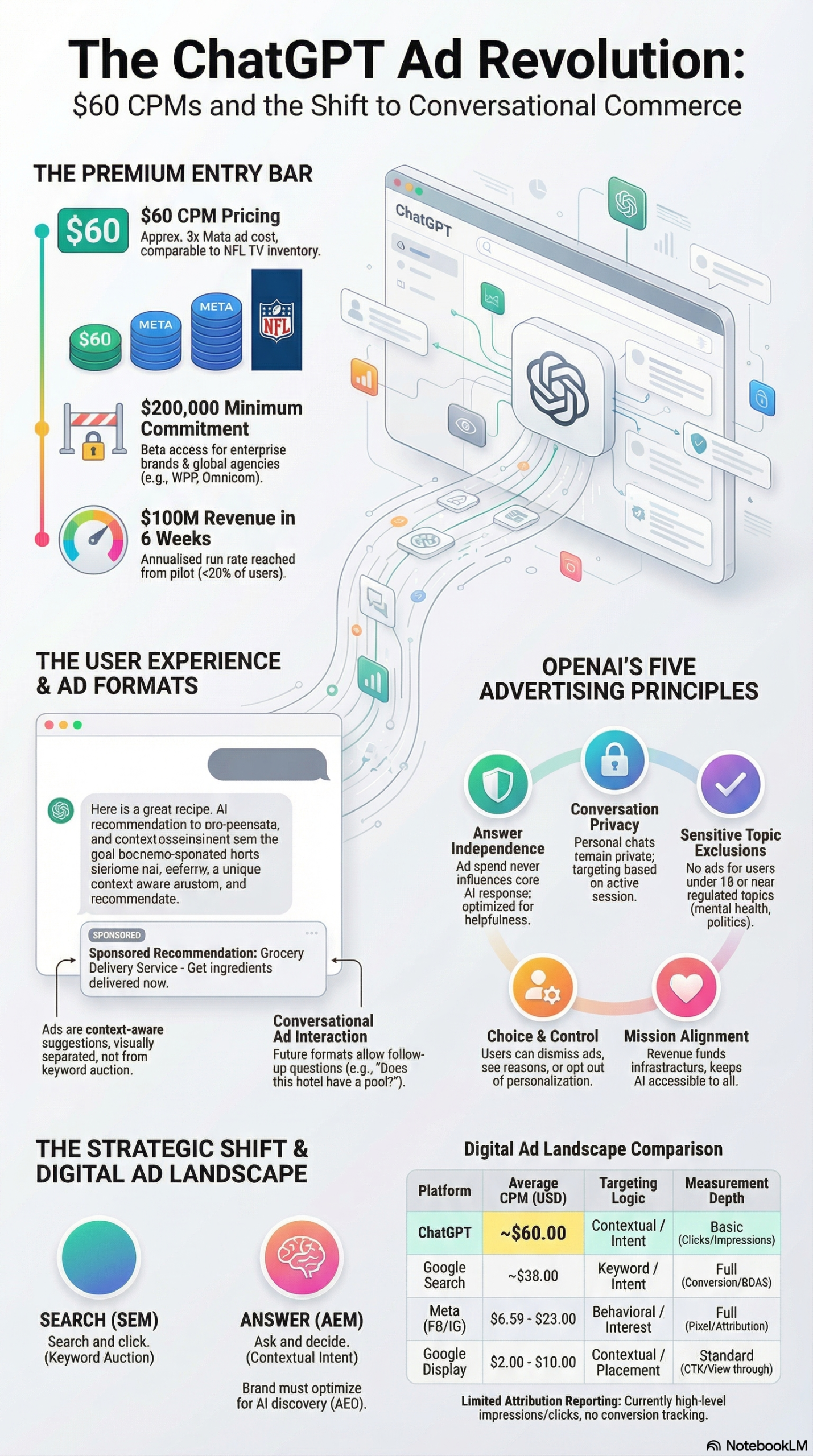
OpenAI officially entered the advertising market in February 2026, launching “Sponsored Recommendations” inside ChatGPT and reaching $100 million in annualized revenue within just six weeks. With self-serve access rolling out in April 2026, PPC managers and growth marketers now face a genuine decision: is this a legitimate new acquisition channel, or an expensive brand awareness play dressed up as performance media? This guide breaks down the full picture — pricing, placement logic, attribution strategy, and a step-by-step tutorial for evaluating and launching your first ChatGPT Ads campaign.
What This Is: OpenAI’s Sponsored Recommendations Explained
ChatGPT Ads are not banner ads, not pre-roll video, and not keyword-triggered text links. They are contextually matched sponsored recommendations that appear at the bottom of AI-generated responses — after the answer, clearly labeled “Sponsored,” and designed to integrate with the conversational flow rather than interrupt it.
According to the ChatGPT Advertising Strategy research report, OpenAI officially transitioned from a purely subscription-based model to an ad-supported ecosystem in January 2026. The catalyst is financial: the company faces projected losses of $14 billion in 2026 and estimated infrastructure costs of $1.4 trillion over the next decade. Advertising is the revenue bridge that keeps the free tier sustainable while the company scales toward profitability.
The initial product is called “Sponsored Recommendations.” Here’s how it works mechanically:
- Placement: Ads appear exclusively at the bottom of a ChatGPT response, below the AI-generated content. They are never woven into the answer itself.
- Labeling: Every ad unit carries an explicit “Sponsored” label — no native disguise.
- Targeting signal: Ads are matched based on the current conversation topic, previous chat history (if the user has history enabled), and past interactions with ads.
- Format: Currently text-heavy and conversational, consistent with the chat environment. Future formats include “conversational ads” where users can ask follow-up questions about the advertised product directly in the interface.
- Commerce integration: OpenAI is developing “Instant Checkout” functionality for merchants using its commerce APIs, enabling purchases without leaving the chat window.
The ad inventory is deliberately tiered. Per the research report, ads only appear on the ChatGPT Free and ChatGPT Go ($8/month) tiers. The Plus ($20/month), Pro ($200/month), Business, Enterprise, and Education tiers remain completely ad-free. Roughly 85% of Free and Go users are technically eligible to see ads, though OpenAI currently limits exposure to fewer than 20% of eligible users on any given day to protect the user experience during the rollout phase.
OpenAI has published five governing principles for its ad business: Mission Alignment (ad revenue supports free AI access for everyone), Answer Independence (ads never influence the content of AI responses), Conversation Privacy (user dialogues are never sold to advertisers), Choice and Control (users can opt out of personalization or clear ad data), and Long-Term Value (trust over impression volume). The Answer Independence principle is the load-bearing pillar — without it, the entire ad model collapses into a pay-to-rank scheme that would destroy user trust and, ironically, the very inventory advertisers are paying for.
David Dugan, a former Meta ads executive, was hired to lead OpenAI’s global advertising solutions team — a signal that the company is serious about building a real ad business, not just experimenting at the margins.
Why It Matters: The Shift from Search to Conversational Commerce
If you manage paid media budgets, this development changes your competitive landscape in ways that aren’t fully visible yet.
The framing that matters for practitioners is the shift from Search Engine Marketing (SEM) to Answer Engine Marketing (AEM). In traditional search, a user types a query, sees a list of ads and organic results, and clicks. In conversational AI, a user asks a question, receives a synthesized answer, and the ad appears as an extension of that answer — aligned to the specific decision or problem the user was trying to solve.
The intent quality difference is significant. Per the research report, while Google Search maintains a CTR advantage of approximately 29% for search ads, ChatGPT’s CTR runs at 0.91% (per Search Engine Journal). That sounds like a massive disadvantage — until you factor in conversion quality. Analysis suggests that conversion rates for referrals originating inside an AI conversation can be up to 23 times higher than traditional search referrals, because users are typically in a late-stage research and comparison mode when they receive a sponsored recommendation.
There is also a Dark SEO Funnel problem that standard analytics cannot capture. According to analysis cited in the research report, Radyant estimates that standard analytics tools understate AI search’s contribution to pipeline by 15 to 30 times, because users frequently discover a brand inside ChatGPT, then convert later via a direct URL, a Google search, or a branded query. Attribution models that can’t see the AI touchpoint will misallocate budget away from what is actually driving pipeline.
For agencies, the competitive dynamic is equally important. Search Engine Journal notes that nearly 80% of small and medium businesses have signaled interest in ChatGPT Ads. That’s a surge of demand that will hit as self-serve unlocks in April 2026. Agencies that have already built their attribution infrastructure, tested creative approaches, and developed an evaluation framework will be positioned to capture that client demand — agencies that haven’t will be playing catch-up.
The competitive reaction from the broader market is telling. Anthropic has explicitly positioned Claude as the “ad-free” alternative, running a Super Bowl-level campaign targeting users wary of OpenAI’s commercial pivot. Microsoft benefits as OpenAI’s primary backer and cloud infrastructure provider. Google faces its most credible threat to search advertising since search advertising was invented.
The Data: ChatGPT Ads vs. Existing Paid Channels
Before committing budget, every performance marketer needs a direct comparison. Here’s how ChatGPT Ads stack up against the channels already in your mix, based on data from the research report and Search Engine Journal.
| Metric | ChatGPT Ads | Google Search Ads | Meta Ads |
|---|---|---|---|
| CPM | ~$60 | ~$38 | ~$6.59–$23 |
| Buying Model | CPM (initial) | CPC-dominant | CPM / CPC |
| Minimum Spend | $200,000–$250,000 (beta); self-serve TBD | No minimum | No minimum |
| CTR | ~0.91% | ~6.4% (search benchmark) | Variable (1–3% typical) |
| Estimated Conversion Rate Lift | Up to 23x vs. standard search | Baseline | Below search intent |
| Targeting Signal | Conversation context + history | Keywords + audience | Demographic + behavioral |
| Ad Format | Text-based sponsored recommendation | Text / responsive search | Image / video / carousel |
| User Intent Stage | High-consideration research phase | Mixed (top-of-funnel to transactional) | Interruption-based (discovery) |
| Ad Transparency | Explicit “Sponsored” label | “Sponsored” label | “Sponsored” label |
| Audience Size (Platform) | 800M weekly active users | ~8.5B daily searches | ~3.2B daily active users |
| Self-Serve Access | April 2026 | Available now | Available now |
| Current Active Advertisers | 600+ | Millions | Millions |
The $60 CPM is the number that stops most budget conversations cold. It is roughly 3x Meta’s average and higher than Google Search at ~$38. But CPM is the wrong comparison metric for high-intent inventory. If the conversion rate multiplier is real — even if it’s only 5x, not 23x — the effective cost-per-acquisition can compress significantly. The honest answer at this stage is that the data is too thin to know, which is exactly why self-serve access matters: it creates the sample sizes needed to generate real CPA benchmarks.
Step-by-Step Tutorial: How to Evaluate, Prepare, and Launch ChatGPT Ads
This tutorial is designed for performance marketers who need to make a real budget decision, not a theoretical one. It covers the full workflow: from pre-launch readiness through first-campaign launch and measurement setup.
Prerequisites
Before you touch the ChatGPT Ads interface, you need three things in place:
1. GA4 or equivalent with referral source tracking active — you need to be able to see chat.openai.com as a referral source in your analytics right now, before you spend a dollar.
2. A “How did you hear about us?” field in your lead forms or post-purchase flow — this is non-negotiable for the attribution model described below.
3. Budget authority for $50,000 or more — self-serve minimums are not yet published, but early signals from Search Engine Journal suggest initial commitments of $50,000–$100,000. You need budget approval before you can act on self-serve access.
Phase 1: Evaluate Whether ChatGPT Ads Fit Your Brand
Not every brand belongs on this platform at launch. The research report is explicit about the categories where conversational ads perform best: B2B software, education, travel, and high-ticket e-commerce where buyers need confidence before converting.
Run this four-question fit assessment before proceeding:
1. Is your product a high-consideration purchase?
If a typical buyer needs to research, compare, or build confidence before converting, ChatGPT Ads is a natural fit. If your product is an impulse buy or a commodity, the intent environment is mismatched.
2. Are ChatGPT users already discovering your brand organically?
Log into GA4. Filter your referral traffic for chat.openai.com. If you’re already seeing organic referral traffic from ChatGPT — even a small amount — that’s strong signal that paid placements will yield high-intent visitors. If you see zero ChatGPT referrals, your brand may not yet be present enough in ChatGPT’s knowledge base to benefit from contextual ad placement.
3. Can you write an ad that answers a real user question?
ChatGPT ads are text-heavy and conversational. They need to feel like a natural extension of an answer, not a shout-out. Draft a test ad unit right now: “Looking for [your product category]? [Brand] helps [target buyer] [solve specific problem].” If it reads naturally in a chat context, you have a viable creative angle. If it sounds like a display banner, you’re not ready.
4. Can you tolerate 90-day measurement uncertainty?
ChatGPT’s attribution model is immature. You will not get clean CPA data for at least one full funnel cycle. If your organization cannot tolerate “we’re learning” as a Q2 answer for this budget, this is not the right channel yet.
Phase 2: Build Your Attribution Infrastructure
This step is the most important thing you can do, and most teams skip it. Because standard analytics are blind to AI referrals, you need a 3-Layer Attribution Model before your first ChatGPT ad impression is served. The research report documents this approach directly.
Layer 1: Click-Based Data (CRM / GA4)
Set up a UTM parameter structure for all ChatGPT ad traffic. Suggested structure:
– utm_source=chatgpt
– utm_medium=cpc (or sponsored_recommendation)
– utm_campaign=[campaign_name]
– utm_content=[ad_variant]
This captures users who click directly from the sponsored recommendation to your site. It will undercount real impact by 15–30x per Radyant’s analysis, but it’s your baseline.
Layer 2: Self-Reported Attribution
Add a mandatory free-text field to your lead form, demo request, or checkout flow: “How did you first hear about us?” Make it free-text, not a dropdown. Dropdowns bury the “AI chatbot” answer. Free-text responses will surface “ChatGPT,” “AI search,” or “an AI assistant” responses that no analytics tool will ever capture automatically. Review these responses weekly.
Layer 3: Verbal Attribution from Sales
Train your sales or onboarding team to ask “What made you reach out today?” or “Had you researched us before this call?” in the first two minutes of every discovery call. Log these answers in your CRM with a custom field. This third layer captures the late-converting, high-value buyers who discovered you in ChatGPT but didn’t click the ad — they navigated directly later.
Phase 3: Register for Self-Serve Access
OpenAI is launching self-serve tools in April 2026. As of this writing, the platform is transitioning from invite-only beta to open self-serve. Here’s how to get in early:
Step 1: Navigate to ads.openai.com (the self-serve portal launching in April 2026). If not yet live, sign up via the waitlist on the OpenAI for Business page.
Step 2: Create or connect your OpenAI business account. This is separate from your ChatGPT Plus or API account.
Step 3: Complete the advertiser onboarding, which will include brand safety review and category approval. Confirm your vertical is eligible — recall that ads are prohibited from conversations about health, mental health, and politics per the research report.
Step 4: Set your audience parameters. Current targeting options are: conversation topic context, previous chat history (for users who have history enabled), and prior ad interaction history. You cannot target by age, precise location, or individual user demographics — OpenAI provides only aggregated, anonymized performance data back to advertisers.
Phase 4: Develop Context-Native Creative
This is where most teams will struggle. ChatGPT ad creative must be built from scratch — your existing display, search, or social creative will not translate.
The Core Principle: Your ad should read like the next helpful sentence after the AI’s response. If ChatGPT just answered “What’s the best CRM for a 20-person sales team?”, your sponsored recommendation should not say “Try Acme CRM — #1 in the market!” It should say something like “Acme CRM was built specifically for SMB sales teams — free 14-day trial, no credit card required.” It answers the implicit next question: “Okay, where do I go?”
Creative framework for ChatGPT Ads:
1. Context line: Reference what the user was just researching (not the AI’s answer — the user’s intent).
2. Value statement: One specific, concrete benefit. Not a tagline.
3. CTA: Friction-free. Trial, demo, free tool, comparison guide — not “Buy Now.”
4. Trust signal: One proof point — customer count, awards, or recognizable client logo.
Write 3–5 variants per campaign. Test a “solution” framing (we solve X) against a “social proof” framing (X customers chose us for Y) to identify which performs better in the conversational context.
Phase 5: Launch, Monitor, and Optimize
First 30 days — measure, don’t optimize:
Let your first campaigns run for a full 30 days without changing creative or targeting. You need clean baseline data before you start making decisions. The platform is new enough that algorithmic optimization signals are thin — premature changes will give you noisy results.
KPIs to track during the learning phase:
– Impressions and CTR from the OpenAI ads dashboard
– ChatGPT-sourced sessions in GA4 (Layer 1)
– Self-reported “ChatGPT” responses in your lead forms (Layer 2)
– Sales team verbal attribution mentions (Layer 3)
– Assisted conversions: look for users who have both a ChatGPT referral session AND a later direct or branded-search conversion
After 60 days — make your first optimization decisions:
Compare your ChatGPT-attributed pipeline against your CPM spend. Calculate an estimated CPA using all three attribution layers. Compare this to your Google Search and Meta CPAs. If your all-in CPA is within 2x of your best-performing channel, continue scaling. If it’s 5x or higher, pause and reassess your creative approach before spending further.
Expected Outcome: At the end of a 90-day pilot, you should have enough data to make a Q3 budget recommendation with real numbers behind it — not speculation.
Real-World Use Cases
Use Case 1: B2B SaaS — Enterprise Demo Generation
Scenario: A project management software company ($50M ARR, 200-person sales team) wants to capture high-intent enterprise buyers who are actively researching tools.
Implementation: They deploy a ChatGPT sponsored recommendation targeting conversation contexts around “project management for enterprise,” “replacing Asana at scale,” and “cross-team collaboration software.” Creative leads with a free enterprise trial and a reference to their 500+ enterprise customer base. All three attribution layers are active.
Expected Outcome: Per the research report, B2B software is one of the top-performing categories for conversational ads. Buyers researching enterprise software in ChatGPT are in active evaluation mode — mid-to-late funnel. Even at $60 CPM, a single enterprise deal worth $50,000+ ARR justifies the spend if the attribution model confirms the channel’s contribution.
Use Case 2: Travel Brand — High-Consideration Trip Planning
Scenario: A luxury travel agency wants to reach users planning complex multi-destination trips where advice is sought before booking.
Implementation: They target conversation contexts around “itinerary planning for Southeast Asia,” “best time to visit Japan,” and “how to plan a safari.” The sponsored recommendation offers a free custom itinerary consultation — no booking commitment required. Instant Checkout integration (once available) could allow direct deposit bookings from within ChatGPT.
Expected Outcome: Travel is explicitly cited as a high-performing category in the research report. The consultation-first CTA reduces friction and matches the research-mode intent of the user. The gap between “ChatGPT session” and “booking confirmation” will likely span days or weeks — the 3-layer attribution model is essential to capture this delayed conversion path.
Use Case 3: Online Education Platform — Course Enrollment
Scenario: An online learning platform offering professional certification courses wants to reach users actively researching career transitions.
Implementation: They target conversational contexts around career change topics, skills development, and industry entry questions. The sponsored recommendation links directly to a free skills assessment or a “which course is right for me?” quiz — a low-commitment entry point that matches the exploratory intent of the conversation.
Expected Outcome: Education is one of the categories explicitly recommended for ChatGPT Ads in the research report. Users asking “how do I break into UX design?” are pre-qualified at a level most top-of-funnel display or social ads never reach.
Use Case 4: Retail / E-Commerce — Considered Purchase Categories
Scenario: A consumer electronics retailer (one of the 600+ active advertisers reportedly includes Best Buy) wants to capture users comparing specific product categories.
Implementation: Target conversation contexts around specific product comparisons — “best noise-canceling headphones under $300,” “OLED vs. QLED TV for a bright room” — with a sponsored recommendation linking to a relevant comparison landing page rather than a generic product listing page.
Expected Outcome: Product comparison contexts inside ChatGPT represent high-intent users who have moved past general awareness. The “Instant Checkout” feature currently in development would make this use case dramatically more efficient — but for now, driving to a comparison landing page that mirrors the structure of the AI’s answer is the best approach.
Use Case 5: Agency Client — Brand Safety and Managed Entry
Scenario: A digital marketing agency wants to add ChatGPT Ads to its service offering for mid-market clients but needs a low-risk entry point before recommending large commitments.
Implementation: Wait for self-serve access, run a 60-day pilot with a single client in the B2B or education vertical (highest fit categories), deploy all three attribution layers, and document the methodology. Use the pilot results — positive or negative — as a case study to inform recommendations for the broader client base.
Expected Outcome: Search Engine Journal’s Brooke Osmundson, Director of Growth Marketing at Smith Micro Software, advises that “most mid-market advertisers do not need to rush into ChatGPT Ads” and recommends prioritizing proven channels first. A single well-instrumented pilot gives the agency real data to make that recommendation responsibly, rather than speculating.
Common Pitfalls
1. Running without attribution infrastructure and calling it a “brand awareness play”
This is the most expensive mistake you can make. If you commit $50,000+ to ChatGPT Ads without the 3-layer attribution model in place, you will have zero ability to evaluate the channel’s performance and will likely either kill it prematurely (missing real pipeline) or continue it indefinitely (wasting budget). Set up attribution before you launch, not after.
2. Repurposing existing ad creative
Display banners, social video assets, and even Google responsive search ad copy do not translate to the conversational context. ChatGPT users will mentally dismiss an ad that feels tonally out of place with the AI response they just received. Build context-native creative from scratch — it requires a different brief and a different copywriter skill set.
3. Expecting immediate, clean CPA data
The research report documents that standard analytics understate AI search contribution by 15–30x. If you evaluate ChatGPT Ads using only GA4 last-click data after 30 days, you will almost certainly see a terrible CPA and pull the budget. Build in the full 3-layer attribution model and a 90-day evaluation window before making a go/no-go call.
4. Advertising in excluded categories
Per the research report, ads are prohibited from conversations about health, mental health, and politics. Brands in adjacent categories — wellness, supplements, financial planning — should expect that some conversation contexts will suppress their ads. Plan for this in your reach and frequency projections.
5. Treating ChatGPT Ads as a replacement for Google Search
It is not — at least not yet. ChatGPT’s CTR of 0.91% versus Google Search’s ~6.4% benchmark means volume is fundamentally different. Use ChatGPT Ads as a complement to search — capturing the research-and-consideration layer while your search campaigns capture the transactional layer.
Expert Tips
1. Monitor your organic ChatGPT referral traffic first.
Before spending a dollar, watch GA4 for chat.openai.com referrals for 30 days. If you’re already getting organic AI referrals, your brand is present in ChatGPT’s responses. That’s the highest-confidence signal that paid placement in the same environment will produce quality traffic. If you’re not showing up organically, invest in Answer Engine Optimization (AEO) — structured Q&A content, comparison articles, and product-specific landing pages — before paying for ads.
2. Align your landing page structure with conversational intent.
A user clicking a ChatGPT sponsored recommendation just finished reading a synthesized answer. They are further into the decision process than a typical search ad click. Your landing page should skip the awareness-level content and lead with the specific value, comparison data, or proof point that aligns with the conversation context that triggered the ad. Deep links to product comparison pages outperform generic homepages in this environment.
3. Build a “conversation context” map before you write creative.
List the 10–20 specific questions in ChatGPT that would make your product a natural recommendation. These are your targeting contexts and your creative briefs in one document. For each context, write one ad unit that feels like the natural next sentence. This mapping exercise will reveal which of your products have genuine conversational fit — and which don’t.
4. Keep your premium subscriber base fully ad-free.
OpenAI’s decision to restrict ads to Free and Go tiers is a structural feature, not a bug. Your highest-LTV customers are on ad-free tiers — make sure your existing subscribers know this. If you’re running ChatGPT Ads, your Plus-tier users will never see them, which protects the relationship with your best customers while you test the channel with new acquisition audiences.
5. Document the “Dark Funnel” contribution separately.
Build a dedicated pipeline report that isolates all three attribution layers for your ChatGPT Ads investment. Present this to budget holders as its own data story — not embedded in your overall paid media report. The channel’s contribution will be invisible in standard reports, and if it isn’t surfaced explicitly, it will be cut in the next budget cycle regardless of actual performance.
FAQ
Q: How much does it actually cost to get started with ChatGPT Ads?
The beta required minimum commitments of $200,000–$250,000, with some early participants reportedly committing up to $1,000,000 per the research report. The Search Engine Journal article reports advertiser commitments of $50,000–$100,000 for the broader pilot. Self-serve minimums have not been officially announced as of April 2026, but are expected to be significantly lower than the beta minimum, following the pattern of Google and Meta’s self-serve launches.
Q: Will ChatGPT ads ever influence the AI’s organic responses?
Per OpenAI’s published Answer Independence principle, documented in the research report: “Ads are always separate and clearly labeled. Answers are optimized based on what’s most helpful to you.” The entire business model depends on maintaining this separation — if paid placement began influencing organic responses, user trust would collapse and the inventory would lose its value. Whether this principle holds under growth pressure is a legitimate long-term concern, but it is OpenAI’s stated and operationally enforced commitment as of launch.
Q: Can advertisers target users based on their chat history?
Targeting signals include the current conversation topic, previous chat history (if the user has history enabled), and past ad interactions. However, advertisers receive only aggregated, anonymized performance data — impressions and clicks. They do not receive chat transcripts, user names, emails, or precise location data, per the research report. The targeting is managed entirely by OpenAI’s ad server, not exposed to advertisers.
Q: Is ChatGPT Ads right for direct response campaigns with CPA targets?
Not yet, and this is the honest answer. The platform launched on a CPM model rather than CPC or CPA, measurement tools are immature, and the 90-day attribution window needed to capture delayed conversions makes short-cycle CPA reporting impossible. Budget this as an innovation or upper-funnel channel for now. As self-serve measurement tools mature and CPA benchmarks accumulate across the advertiser base, expect the channel to move toward performance buying models — likely within 12–18 months.
Q: How should I handle client questions about ChatGPT Ads right now?
Following Brooke Osmundson’s guidance in Search Engine Journal: most mid-market advertisers do not need to rush. Recommend that clients in B2B software, education, and travel verticals register for self-serve access and run a structured 60-day pilot with full attribution instrumentation. For clients outside these categories, or with tight CPA targets, hold until the industry builds 6–12 months of CPA benchmark data.
Bottom Line
ChatGPT Ads represent a structurally new advertising surface — one built on conversational intent rather than keyword triggers, delivering sponsored recommendations inside the most high-attention AI environment available. The numbers are real: $100 million in annualized revenue in six weeks, 600+ active advertisers, and a conversion rate advantage that could justify the $60 CPM if the attribution infrastructure is built correctly. The platform is not ready for direct response budgets — yet — but it is ready for a carefully instrumented pilot, particularly for B2B software, education, and travel brands whose buyers seek confidence before converting. The single most important thing you can do right now, regardless of whether you plan to advertise, is to activate your ChatGPT referral tracking in GA4 and deploy a self-reported attribution field in your conversion forms. When self-serve access opens, you’ll have the baseline data to make a real decision instead of a speculative one. The shift from search to answer engines is not coming — it arrived in February 2026.


0 Comments