

Social media optimization (SMO) is no longer a set-it-and-forget-it checklist — it is a continuous, data-driven discipline that determines whether your content gets seen by millions or buried in algorithmic obscurity. With 5.6 billion people spending roughly 15 billion hours daily on social media, the gap between brands that optimize and those that don’t has never been wider. This tutorial walks you through all 13 optimization levers, backed by 2026 benchmark data, so you can implement each one this week.
What Social Media Optimization Actually Is
Social media optimization is the practice of systematically improving every element of your social presence — profiles, content formats, posting cadence, discoverability signals, and analytics feedback loops — to maximize reach, engagement, and conversions. The term has been around since the early days of Facebook Pages, but its meaning in 2026 is almost unrecognizable compared to what it meant in 2018.
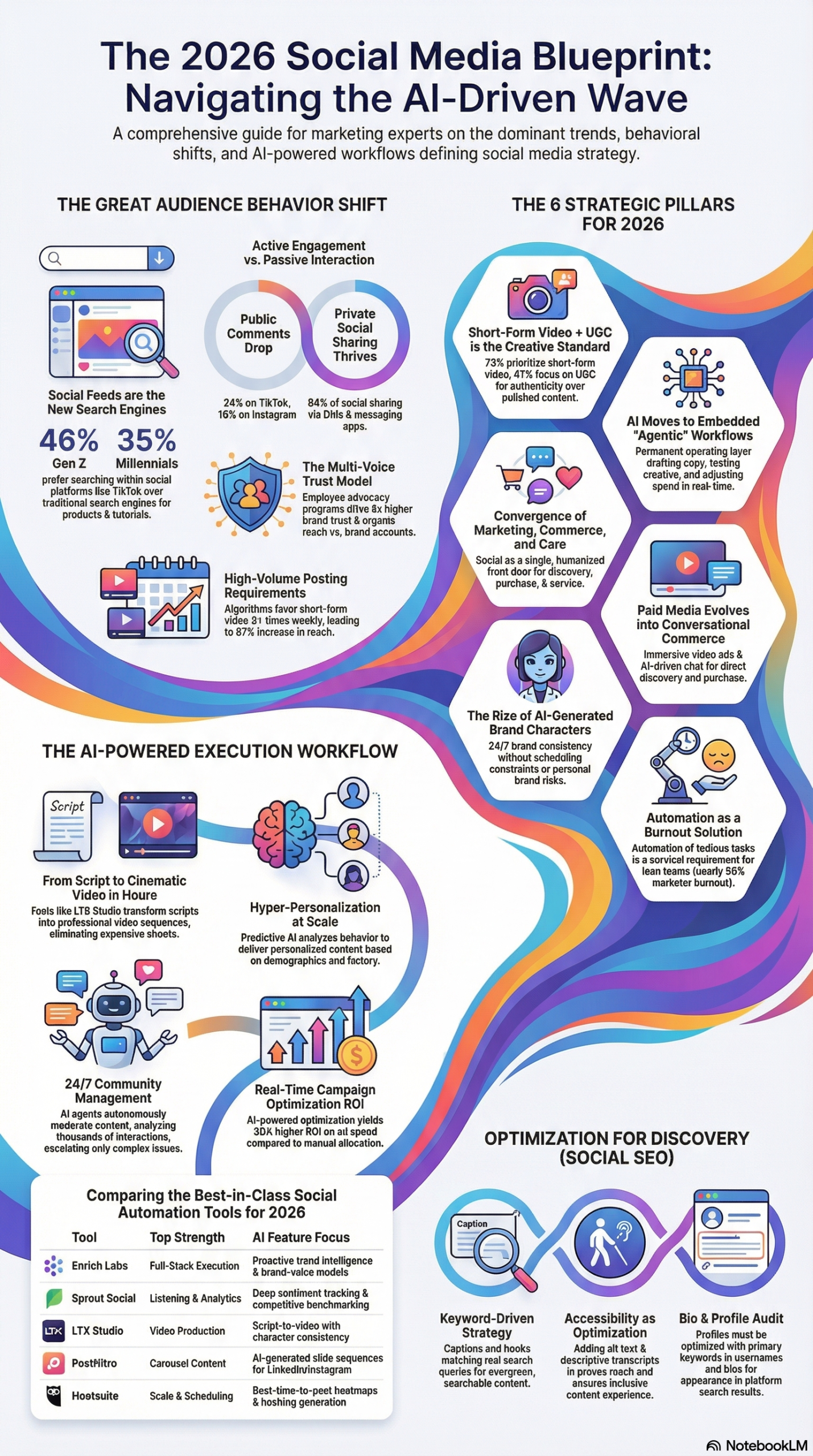
The shift is structural. Platforms have evolved from social networks into full-stack search engines, storefronts, and customer service channels. According to the 2026 Social Media Strategy research compiled via NotebookLM, social media is now the “front door” to the entire customer experience. A TikTok ad can route directly to a shopping cart. A customer DM can become an upsell opportunity. That convergence means SMO now touches marketing, commerce, and customer care simultaneously.
The Hootsuite social media optimization guide defines SMO through 13 concrete, executable steps — and that framework is the spine of this tutorial. But we’re going beyond the list. We’re layering each step with the behavioral data and AI infrastructure context that makes the difference between marginal improvement and compounding growth.
What SMO covers in 2026:
- Profile architecture: Username and bio keyword density, link placement, visual identity consistency
- Content strategy: Format selection, frequency, hook engineering, accessibility markup
- Discovery optimization: Hashtag discipline, social SEO, caption keyword strategy
- Analytics infrastructure: UTM tracking, cross-platform dashboards, automated reporting
Each of these layers feeds the others. A perfectly optimized bio loses impact if your content cadence is wrong. Great video content underperforms if you’re ignoring social search signals. This guide treats SMO as an interconnected system, not a checklist.
Why It Matters: The 2026 Stakes
The practitioner case for rigorous SMO has never been cleaner. Here’s what the data says happens when you do it right — and what happens when you don’t.
The search behavior shift is the biggest forcing function. Socialinsider’s 2026 benchmarks document that 46% of Gen Z and 35% of Millennials now prefer social media over Google when researching products. Specifically, 64% of Gen Z use TikTok to compare products and prices. If your TikTok profile has no keywords in the bio, no keyword-driven captions, and no structured titles, you are functionally invisible to the fastest-growing purchasing demographic.
Engagement patterns have fundamentally changed. The research report documents that 84% of social sharing now happens through private channels — direct messages and messaging apps — not public likes, comments, or reshares. This means your engagement metrics on most dashboards undercount actual content reach by a significant margin. The implication for SMO: optimize for saves and shares, not just likes.
Video frequency is now a reach lever, not just a content choice. Brands publishing short-form video at least three times weekly see 67% more reach than those posting less frequently, per 2026 benchmark data. This isn’t about quality over quantity — it’s both. The algorithm rewards consistency in format and cadence.
The AI efficiency gap is widening. Salesforce’s social team reported saving over 12,000 hours annually through automated social media processes, according to PostNitro analysis. For smaller teams, that efficiency gap is existential. Direct-to-consumer brands post six times more content than traditional retailers — a volume impossible without AI-assisted workflows. SMO in 2026 includes optimizing your AI toolstack, not just your content.
Personalization drives revenue, not just engagement. Companies that excel at personalization — the kind enabled by predictive AI analyzing behavioral signals — generate 40% more revenue than average performers. That number reframes SMO from a brand-awareness exercise into a direct revenue driver.
The Data: 2026 SMO Benchmarks at a Glance
| Metric | Benchmark | Source |
|---|---|---|
| Daily hours spent on social media globally | 15 billion hours | NotebookLM Research Report |
| Engagement lift from short-form video vs. other formats | 2.5x higher | NotebookLM Research Report |
| Reach increase: posting short-form video 3x+/week | +67% | NotebookLM Research Report |
| Gen Z using social media over Google for search | 46% | Socialinsider 2026 Benchmarks |
| Gen Z using TikTok to research/compare products | 64% | Socialinsider 2026 Benchmarks |
| Social sharing via private DMs vs. public channels | 84% | NotebookLM Research Report |
| Consumers who trust influencer recommendations over brands | 69% | Slate Strategy Guide |
| Revenue advantage for personalization leaders | +40% | NotebookLM Research Report |
| AI chatbot improvement in response times | Up to 50% | NotebookLM Research Report |
| Employee-led content vs. branded content brand trust | 2x higher | NotebookLM Research Report |
| Carousel post engagement rate on Instagram | ~4.2% | Hootsuite SMO Guide |
| Marketers prioritizing short-form video in 2026 | 73% | NotebookLM Research Report |
Step-by-Step Tutorial: Implementing All 13 SMO Levers
This is the operational walkthrough. Work through these in order the first time — each step builds context for the next. After initial setup, you’ll return to individual steps as you iterate.
Phase 1: Profile Architecture (Steps 1–3)
Step 1: Optimize Your Bio for Social SEO
Your bio is your social media homepage, and it needs to function like a landing page title tag. Start by identifying your primary keyword — the phrase your target audience types when searching for what you do. If you run a B2B SaaS company for e-commerce logistics, that phrase might be “e-commerce fulfillment software” or “shipping automation for Shopify.”
Embed that keyword in three places: your display name (where the platform allows it), your username or handle (use underscores or periods to separate words), and the first sentence of your bio. The Hootsuite SMO framework explicitly recommends including your location in bio fields as well — this is especially valuable for local businesses and for platforms like TikTok where local search is a growing discovery vector.
Include a clear CTA at the end of your bio. “Get the free guide →” or “Book a demo” with a link performs better than passive descriptions. On platforms that allow only one bio link, use a link tree tool to feature multiple destinations (your homepage, latest campaign, newsletter signup). Audit this quarterly — your bio’s primary CTA should match your current business priority.
Step 2: Standardize Visual Identity and Image Dimensions
Every platform has different image dimension requirements, and using the wrong spec makes your profile look amateur at scale. Here’s the 2026 baseline: profile photos at 400x400px (minimum), cover images at 1500x500px for X and 820x312px for Facebook. For content, Reels and TikTok require 1080x1920px (9:16). Feed posts on Instagram perform best at 1080x1080px (square) or 1080x1350px (portrait).
This matters algorithmically, not just aesthetically. Blurry or cropped images signal low production quality to platform AI, which factors into distribution decisions. Use a tool like Canva or Figma with saved templates for each platform so resizing is a one-click operation, not a manual task.
Step 3: Add Alt Text to Every Image and Subtitles to Every Video
This is both an accessibility requirement and an SEO lever. Platform algorithms on Instagram and LinkedIn read alt text as indexable content. A photo captioned “our team at the conference” with alt text “B2B SaaS founders networking at SaaStr Annual 2026 in San Francisco” ranks significantly better in social search for those keywords.
For video, auto-generated subtitles on TikTok and Instagram Reels are often inaccurate — 15-20% error rates on product names and industry terms are common. Always review and correct auto-subtitles, then export as SRT files for cross-platform reuse. As documented in the 2026 research report, social sharing increasingly happens in messaging apps where video is viewed without sound. Accurate subtitles are no longer optional.
Phase 2: Content Strategy (Steps 4–7)
Step 4: Match Content Format to Platform Algorithm Behavior
Each platform has a dominant format it rewards with organic reach. In 2026, the hierarchy is clear: short-form video generates 2.5x more engagement than other content types across platforms. But format alone isn’t enough — you need to match format to platform.
- TikTok and Instagram Reels: 15–60 second videos in 9:16 format. Hook in the first 3 seconds is the most important variable.
- Instagram Feed: Carousel posts average 4.2% engagement per Hootsuite’s benchmarks — significantly higher than single images. Use carousels for tutorials, listicles, and before/after comparisons.
- LinkedIn: Text-first posts with a document attachment (PDF carousel) reach decision-makers more effectively than video on this platform.
- Facebook: Video still outperforms static images, but Facebook’s algorithm particularly rewards content that generates comments, not just views.
Build a format matrix for your brand: which 2-3 formats will you commit to across which platforms? Consistency in format signals reliability to the algorithm.
Step 5: Post at Optimal Frequency and Timing
Platform-specific posting frequency recommendations based on Hootsuite’s 2026 data:
| Platform | Recommended Frequency | Best Posting Windows |
|---|---|---|
| 3–5x per week | Monday 3PM–9PM | |
| TikTok | 3–5x per week | Thursday 7AM–11AM |
| 1–2x per day | Tuesday 9AM | |
| 1–2x per day | Tuesday–Wednesday 4AM–6AM | |
| X (Twitter) | 2–3x per day | Wednesday–Friday 9AM–11AM |
Treat these as your starting hypothesis, not gospel. After 30 days, pull your analytics and find the 3 posts per platform with the highest reach — note the publish time and day. Your actual audience’s behavior will diverge from global benchmarks because your followers have distinct demographics and time zones. The global benchmarks get you into the right neighborhood; your own data tells you the exact address.
Use a scheduling tool (Hootsuite, Buffer, or Sprout Social) to pre-schedule content during these windows. Never rely on manual posting at optimal times — you’ll miss them.
Step 6: Include Keywords Naturally in Captions
Captions are now indexed content. TikTok’s search function, Instagram’s Explore algorithm, and LinkedIn’s content discovery all read caption text for relevance signals. Write your captions as you would a short blog excerpt: natural language, keyword-rich, structured.
The practical approach: identify 3-5 keyword phrases for your content category (e.g., “email marketing tips,” “cold outreach strategy,” “B2B lead generation”). Rotate these through your captions, keeping them contextually natural. Keyword-stuffed captions (“best email marketing tips email marketing strategy email tips 2026”) are penalized by platform spam filters.
For TikTok specifically, include your primary keyword in the first sentence of the caption. This mirrors on-page SEO best practices — the algorithm weights early-appearing keywords more heavily.
Step 7: Use Strategic Hashtags — Not Volume
The hashtag best practice has solidified in 2026: use 3–5 targeted hashtags placed directly in your caption, not in the comments, and not in a block of 30. Platform data across TikTok, Instagram, and LinkedIn consistently shows that hashtag volume above 5-7 does not increase reach and sometimes signals spam behavior.
Mix your hashtag strategy across three tiers: one broad category hashtag (e.g., #DigitalMarketing — millions of posts), one niche hashtag (e.g., #B2BSocialMedia — tens of thousands of posts), and one branded hashtag (e.g., #YourBrand). This tiered approach maximizes discoverability across different search intents.
Phase 3: Engagement and Discovery (Steps 8–10)
Step 8: Ask Questions to Drive Engagement
The single highest-ROI tactic for organic reach on most platforms is generating comments, because comments signal to algorithms that your content created conversation. The most reliable way to get comments: ask a direct, easy-to-answer question in your caption.
Bad: “What do you think of our new product?”
Better: “We just cut our CAC by 34% using this workflow. What’s the biggest challenge you’re facing with customer acquisition right now?”
The second version is specific, signals credibility, and invites a specific type of response. On Instagram Stories, use the question sticker to collect responses — these directly feed into your content calendar because you now have documented audience pain points.
Step 9: Tag Relevant Accounts Strategically
Tagging other accounts in your posts expands distribution potential — the tagged account’s followers see your content in their notifications. The key word is “strategically.” Tagging your partners, featured customers, or collaborating creators is high-value. Tagging large accounts with no relationship is noise and rarely converts to reach.
The highest-value tagging play in 2026: feature a customer success story or UGC content and tag the customer. According to the research report, 69% of consumers trust influencer and customer recommendations more than brand-originated content. User-generated content tagging creates a feedback loop — customers see their content featured, reshare it to their audience, and trust signals compound.
Step 10: Build a CTA Ecosystem for Your Bio Link
Your bio link should change with your business priorities, but your bio CTA architecture should stay consistent. Here’s a framework that works: use a single primary link that routes to a landing page with 2-3 secondary CTAs (your latest content, your core product, your email signup). Use UTM parameters on every single link.
UTM parameters are the SMO tactic most teams skip, and it’s a critical mistake. Without UTMs, your analytics platform cannot differentiate between traffic from your Instagram bio and your LinkedIn bio. You’re flying blind on which platform is actually driving business results. Build a UTM naming convention and make it mandatory: utm_source=instagram&utm_medium=bio&utm_campaign=q1-2026.
Phase 4: Analytics and Continuous Optimization (Steps 11–13)
Step 11: Implement a Cross-Platform Analytics Dashboard
Manual spreadsheet reporting is not SMO — it’s administrative overhead. The 2026 research infrastructure documents the shift toward platforms like Hootsuite, Socialinsider, and Sprout Social that compile cross-platform data into natural-language insights. The requirement in 2026: your analytics tool must pull data from every active platform into a single view and generate recommendations automatically.
What to track per platform, minimum: reach per post, engagement rate (engagement ÷ reach, not engagement ÷ followers), click-through rate on bio links, follower growth rate. What to track across platforms: which platform drives the most website traffic (from UTM data), which platform generates the highest quality leads, which content format produces the longest-lasting performance curve.
Step 12: Implement Social Listening for Trend Intelligence
Social listening is the difference between reactive posting and proactive trend capture. The research report documents how AI-powered listening tools identify emerging microtrends hours before they peak — giving brands a first-mover advantage on trending audio, hashtags, and conversation formats.
Set up listening for: your brand name (and common misspellings), your competitors’ brand names, your 3-5 primary category keywords, and your industry’s top 5 product terms. Review listening alerts daily during campaign periods, weekly during baseline operations. When you catch a trend early, you have 24-48 hours to publish a relevant post before the algorithm saturates the topic.
Step 13: Integrate AI into Your Content Production Workflow
As documented in the research report, “Soon, teams won’t talk about using AI, they’ll simply run on it” — Susan Ganeshan, CMO at Emplifi. That transition is happening now. The practical SMO implementation:
- Brand voice training: Feed your best-performing captions and your tone-of-voice document into your AI writing tool. This ensures AI-generated captions sound like you, not like generic marketing copy.
- Variation testing: Generate 5-10 caption variants for each post, test 2-3, let the winning variant’s pattern inform the next batch.
- Automated reporting: Replace your manual weekly report with a dashboard-generated summary. Tools like Hootsuite and Sprout Social now produce AI-written performance summaries.
- Content repurposing pipeline: Take every long-form piece (podcast, webinar, case study) and systematically break it into short-form clips, carousel posts, and caption-only posts. DTC brands post 6x more than traditional retailers because they’ve built this pipeline.
Expected Outcome After Full Implementation:
Teams that implement all 13 steps consistently over 90 days typically see: measurable follower growth (benchmarked against your starting baseline), engagement rate improvement of 20-40% (driven by timing optimization and format matching), and clearer attribution data showing which platform actually drives revenue (from UTM tracking).
Real-World Use Cases
Use Case 1: B2B SaaS Brand Building Social Search Presence
Scenario: A B2B SaaS company with a 3-person marketing team is invisible on TikTok and Instagram Search, where their target users (operations managers ages 25-35) are increasingly doing product research.
Implementation: Audit the bio across all platforms for keyword density. Add “operations automation software” to the LinkedIn bio and username display name. Build a TikTok content series called “Ops Hack of the Week” — 30-second videos demonstrating a workflow improvement, each caption opening with the phrase “operations automation tip.” Post 3x per week. Tag featured customers in case study posts.
Expected Outcome: Within 60 days, organic search impressions on TikTok and Instagram increase. 64% of Gen Z use TikTok to research products — if operations managers in this demographic search “operations automation,” keyword-optimized content surfaces. Monthly organic sign-ups from social increase.
Use Case 2: E-Commerce Brand Maximizing Short-Form Video
Scenario: A direct-to-consumer skincare brand is posting 3-4 times per week but seeing flat engagement. They’re using polished studio photography and professionally produced videos.
Implementation: Shift 50% of content to UGC-style video. Film unboxing-style product reveals on a phone camera, behind-the-scenes formulation content, and customer testimonial clips. Post at 3x the current cadence (enabled by lower production overhead). Use the carousel format for “before/after” comparison posts, which average 4.2% engagement on Instagram. Add 5 hashtag mix: one broad (#Skincare), one niche (#NaturalSkincareRoutine), one branded (#YourBrandSkin).
Expected Outcome: Short-form video at 3x weekly frequency should produce 67% more reach than their current cadence. The authentic UGC aesthetic leverages the documented consumer preference for relatable content over polished corporate production.
Use Case 3: Agency Managing 12+ Client Accounts
Scenario: A digital marketing agency manages social media for 12 clients across different industries. Their team spends 60% of their time on reporting and manual post scheduling.
Implementation: Standardize on a cross-platform dashboard (Hootsuite or Sprout Social) that generates automated performance reports. Build UTM parameter naming conventions for all 12 clients (consistent enough to compare, specific enough to differentiate). Implement AI caption drafting with brand-voice templates per client. Salesforce saved 12,000 hours annually through automation — at the agency scale, even a 30% efficiency gain recaptures significant billable hours.
Expected Outcome: Reporting time drops from 60% of bandwidth to under 20%. The recaptured capacity goes into strategy, creative direction, and client service — the high-value activities that justify retainer fees.
Use Case 4: Local Service Business Driving Foot Traffic
Scenario: A local restaurant chain in a mid-size city has 5,000 Instagram followers but isn’t converting them to reservations.
Implementation: Optimize every bio with the city name + cuisine type keywords (“Italian restaurant downtown Austin”). Add Google Maps link to bio. Post during local peak discovery times: Friday and Saturday 10AM-12PM (when people are planning weekend dining). Use Instagram Stories question stickers (“What’s your go-to Friday night dinner?” → engage → stay top-of-mind). End every caption with a direct CTA: “Reserve your table this Friday — link in bio.”
Expected Outcome: Social becomes a measurable reservation driver. With UTM tracking on the bio link, the restaurant can track exactly how many OpenTable or Resy clicks came from Instagram, and calculate cost-per-reservation from organic social.
Common Pitfalls
1. Posting Frequency Without Consistency
Many brands post 10 times in one week, then go dark for two weeks. Platform algorithms interpret inconsistency as low-priority content and reduce distribution. The fix: post less per week if needed, but never break your cadence. A consistent 3x/week schedule outperforms an inconsistent 7x/week schedule every time.
2. Using Hashtags as an Afterthought
Stacking 20-30 hashtags in comments or at the bottom of captions is a 2018 strategy. Platform spam detection now penalizes this pattern. Use 3-5 hashtags, placed in the caption body where they fit contextually, as recommended by Hootsuite’s 2026 SMO guide.
3. Ignoring Social Search Optimization
Most SMO implementations focus entirely on content and posting times, while ignoring the keyword infrastructure that makes content findable. With 46% of Gen Z preferring social search over Google, a profile with no keyword strategy is leaving a major discovery channel completely untapped.
4. Tracking Vanity Metrics Instead of Business Metrics
Follower count is the most common vanity metric trap. A brand with 5,000 highly engaged followers who buy is worth more than 50,000 passive followers who don’t. Track engagement rate, click-through rate from bio links, and (with UTM parameters) actual revenue attribution by platform.
5. Skipping Accessibility Markup
Alt text and video subtitles are regularly deprioritized as “nice to have.” They’re not — they’re indexed content that improves discoverability, and they’re increasingly required for platform policy compliance on major platforms. Build them into your production workflow, not as an optional final step.
Expert Tips
1. Build a Social Search Keyword Set Separate from Your Google SEO Keywords
Social search intent differs from web search intent. TikTok users search “how to fix dry skin in winter,” not “best moisturizer for dry skin 2026.” Model your social keyword set on the conversational phrases your audience uses, not the commercial intent phrases that perform on Google.
2. Treat Saves as Your North Star Metric for Content Quality
Saves indicate that someone found your content valuable enough to return to. They’re a leading indicator of the “passive engagement” shift documented by the research report — 84% of sharing now happens privately. If your saves are increasing, your content strategy is working even if public engagement metrics look flat.
3. Build a 90-Day Content Experiment Calendar
Don’t test one variable at a time on an ad hoc basis. Plan a 90-day experiment schedule: Month 1 tests posting frequency, Month 2 tests caption style, Month 3 tests video hooks. This produces clean data and prevents you from confounding variables.
4. Use Employee Advocacy as an Organic Amplification Layer
Employee-led content generates 2x higher brand trust than brand-published content. Build an internal program where 5-10 team members or founders post behind-the-scenes content on their personal profiles and tag the brand. This extends reach without additional ad spend and leverages the authenticity premium that polished brand content can’t replicate.
5. Audit Your AI Tool Outputs for Brand Voice Weekly
AI-generated captions drift toward generic marketing language over time, especially if the tool is pulling from broad training data. Set a weekly 15-minute audit: read 5 recent AI-generated captions and flag any that don’t sound like your brand. Feed the corrections back into your brand voice template. As Emplifi’s CMO documented, the teams running on AI successfully are those that invested in the training infrastructure, not just the tool license.
FAQ
Q: How long does it take to see results from social media optimization?
Profile optimization (bio, keywords, visual dimensions) produces improvements within 2-4 weeks as the platform re-indexes your content. Content cadence improvements take 6-8 weeks to show statistically significant reach changes because most platforms average performance over a rolling window. Analytics and attribution improvements are immediate once UTM parameters are set up correctly — you’ll see clean data from day one.
Q: Does SMO work differently for small accounts vs. large accounts?
Yes, and the difference favors small accounts in some ways. Smaller accounts with high engagement rates (10%+ engagement ÷ reach) get disproportionate algorithmic distribution because the signal-to-noise ratio is strong. Focus on engagement rate, not absolute follower count. The Hootsuite SMO framework is explicitly designed to work at any account size — the fundamental levers are the same.
Q: Which platform should I prioritize if I can only optimize one right now?
Prioritize the platform where your target audience’s age demographic aligns most closely with the social search shift. If your audience skews 18-34, TikTok and Instagram are critical because 64% of Gen Z use TikTok for product research. If your audience is 35-55 B2B professionals, LinkedIn’s search optimization yields higher-quality leads per hour invested.
Q: How do I measure ROI from organic social media optimization?
UTM parameters are the minimum requirement. Tag every bio link, every story swipe-up link, and every trackable social link with UTM parameters (source, medium, campaign). Connect your analytics platform to your CRM to track the full funnel from social click to lead to closed revenue. Without this infrastructure, you’re measuring effort, not results.
Q: Is AI-generated content hurting organic reach?
Platform data is mixed on this. The documented issue isn’t AI-generated content per se — it’s generic, low-differentiation content, which AI produces when given weak prompts or no brand-voice training. The research report documents that brands succeeding with AI content are using it for drafting and variation testing, not as a fully autonomous publishing system. Human review and brand-voice refinement remain essential inputs.
Bottom Line
Social media optimization in 2026 is a 13-step system, not a list of tips — and the teams winning are those treating it as engineering, not art. The foundational moves (bio keyword optimization, content format matching, UTM tracking) take one week to implement and pay compounding returns for years. The advanced layers (social listening, AI workflow integration, employee advocacy programs) require 90 days of consistent execution to show measurable lift. The data is unambiguous: 5.6 billion people spending 15 billion hours daily on social media represent an enormous organic opportunity, but the window for cheap attention on these platforms is narrowing every quarter. Build the infrastructure now, measure everything, and iterate weekly — that’s the practitioner’s edge.


0 Comments