

Social media for business in 2026 operates on a fundamentally different model than even two years ago — AI has shifted from a scheduling assistant to the core “operating system” driving brand growth, handling research, content drafting, optimization, and analytics while humans focus on creative direction and strategic oversight. According to the NotebookLM research report on Social Media Strategy and AI Marketing in 2026, organizations adopting these machine-augmented systems are saving 15–20 hours per week on routine tasks while achieving significantly higher reach through multi-platform distribution and predictive analytics. This tutorial walks you through exactly how to build, deploy, and measure that system — from tool selection through attribution modeling.
What This Is: The Machine-Augmented Social Media Framework
The Hootsuite Social Media for Business Guide makes the case plainly: social media for business is no longer optional. But in 2026, the more precise statement is that doing it manually at scale is no longer viable.
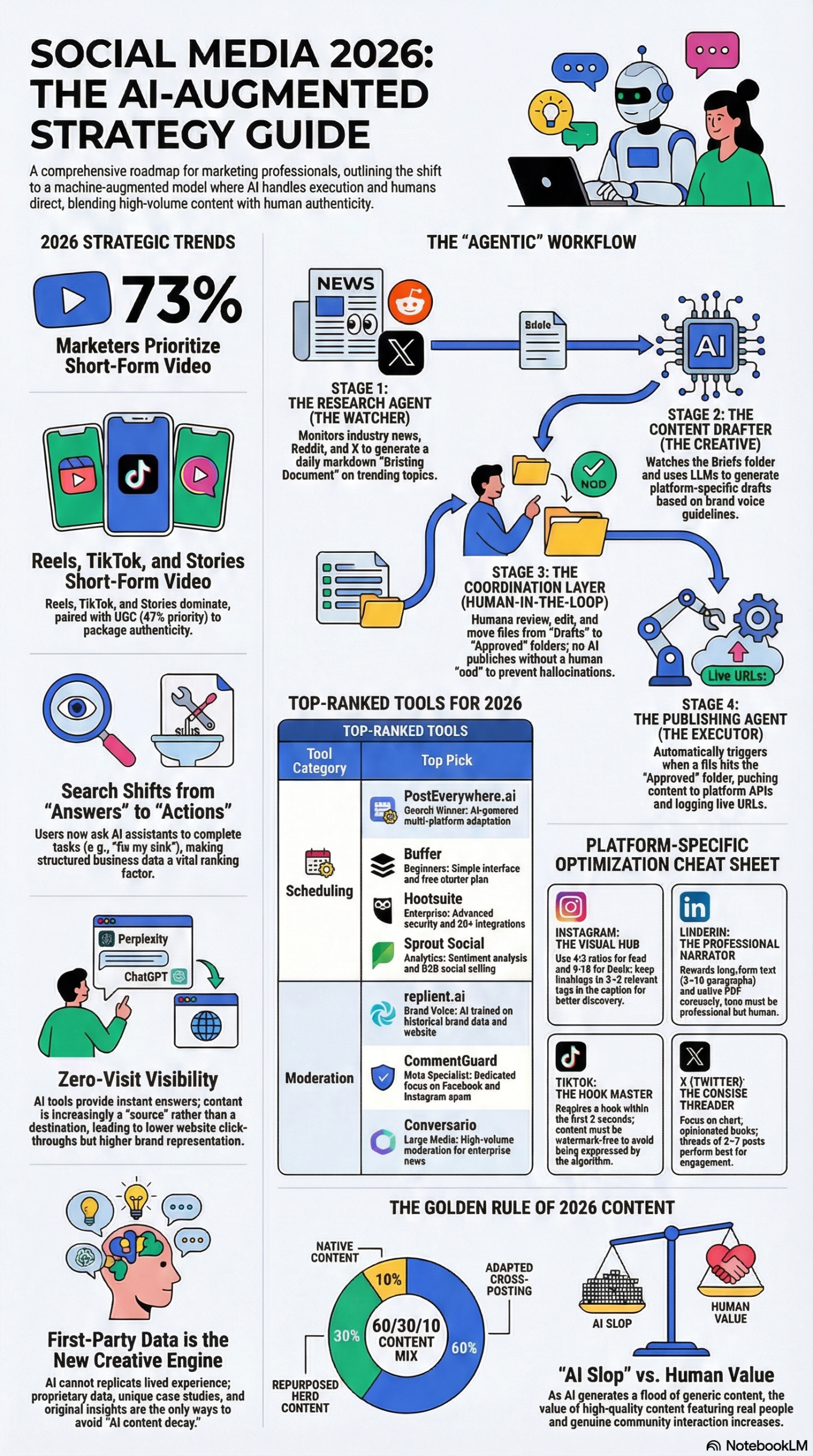
What we’re talking about is a machine-augmented strategic framework — a four-stage pipeline where AI agents handle perception (research and monitoring), reasoning (content drafting and adaptation), and action (scheduling and publishing), while human marketers own creative direction, ethical oversight, and final approval. This is not “set it and forget it” automation. It’s a structured collaboration between AI capabilities and human judgment.
The ecosystem has matured around this model. The top scheduling and management platforms of 2026 — tools like PostEverywhere.ai, Buffer, Hootsuite, Sprout Social, Later, SocialBee, and Sendible — have each evolved to serve specific roles in this pipeline. PostEverywhere.ai leads the rankings for AI content adaptation, supporting cross-platform distribution from LinkedIn to Reddit with intelligent reformatting built in. Buffer remains the go-to for beginners and small teams who need reliable scheduling without the learning curve. Hootsuite anchors enterprise deployments where social listening, CRM integrations, and team permissions matter most.
Alongside scheduling infrastructure, a new category of AI moderation tools has become essential. As AI-powered content pipelines scale post volume, comment management becomes a bottleneck — tools like replient.ai, NapoleonCat, CommentGuard, and Swat.io now handle spam filtering, sentiment detection, and AI-suggested brand-compliant replies at a level that wasn’t possible in 2024.
The critical challenge this framework addresses is what researchers are now calling “AI slop” — the flood of low-substance, generic AI-generated content that has degraded feed quality across every major platform. As Socialnomics observed: “AI isn’t replacing social media marketers — it’s replacing repetitive marketing.” The human role has shifted from execution to strategy, storytelling, and quality control. Organizations that treat AI as a replacement for human judgment — rather than a multiplier of it — are the ones producing the slop that audiences are tuning out.
Understanding this framework means understanding that the goal is not to automate everything. It’s to automate everything that doesn’t require human judgment, so the humans in the system can focus on the things that actually drive brand differentiation: authentic voice, original insight, and creative risk.
The same framework applies whether you’re a solo founder managing two platforms or an enterprise marketing team coordinating across twelve. The architecture scales; the principles don’t change.
Why It Matters: The Stakes for Practitioners and Marketers
The productivity case is straightforward: according to the 2026 research report, teams running the full four-stage AI agent workflow are saving 15–20 hours per week on routine tasks. At an average marketing salary, that’s a significant reallocation of labor toward strategy and creative work.
But the more important case is competitive. Three structural shifts make the AI-powered approach non-optional for any business serious about social media growth in 2026:
1. Zero Visit Visibility Has Replaced Zero-Click Search. Content is now frequently being consumed and cited by AI engines — ChatGPT, Perplexity, Gemini — without a user ever visiting your website. The research report identifies this as “zero visit visibility”: brands must now track citation rates and branded search lift across AI platforms, not just website traffic. Businesses with clear, structured content are being surfaced by AI assistants; businesses with keyword-stuffed, unstructured pages are being ignored.
2. Search Is Shifting from Answers to Actions. When a user asks an AI assistant to “fix my sink this afternoon,” the AI selects a provider — it doesn’t return a list of links. The research report calls this the move “from answers to actions.” Businesses must ensure their websites are “AI-ready” with structured data, clear service descriptions, and explicit pricing — not just for human readers but for AI extraction.
3. Attribution Is Breaking. Traditional last-click attribution is failing because of walled gardens, multi-device behavior, and “dark social” — the private DMs, screenshots, and word-of-mouth referrals that never show up in analytics. The research report is blunt about this: “Perfect attribution doesn’t exist — probabilistic accuracy does.” Teams still running last-click models are making budget decisions on fundamentally flawed data.
For agencies and enterprises specifically, the combination of AI content pipelines and AI moderation tools is reshaping headcount calculations. replient.ai is documented as saving approximately 0.5 FTE in comment management alone by automatically hiding spam, hate speech, and scams while suggesting brand-aligned replies.
The Data: Tool Comparison and Attribution Frameworks
2026 Social Media Management Tool Rankings
| Tool | Best For | Key AI Features | Starting Price |
|---|---|---|---|
| PostEverywhere.ai | Overall Best | AI content adaptation, lead tracking, all-platform support | $29/mo |
| Buffer | Beginners | Simple scheduling, free tier, basic analytics | Free / $6 per channel |
| Hootsuite | Enterprise | Social listening, CRM integrations, team permissions | $99/mo |
| Sprout Social | Analytics | Deep data insights, sentiment analysis, competitor tracking | $249/mo |
| Later | Visual Content | Visual calendar, Linkin.bio, Instagram/TikTok optimization | $18/mo |
| SocialBee | Content Recycling | Evergreen content categories, RSS + Canva integrations | $29/mo |
| Sendible | Agencies | White-label reporting, client dashboards, multi-client management | $29/mo |
Source: Social Media Strategy and AI Marketing in 2026 Research Report
Attribution Model Selection by Business Volume
| Attribution Model | Best For | How It Works |
|---|---|---|
| Position-Based (U-Shape) | <300 conversions/month | 40% first touch, 40% last touch, 20% middle |
| Time-Decay | 300–1,000 conversions/month | More credit to recent touchpoints; good for long sales cycles |
| Data-Driven (Algorithmic) | >1,000 conversions/month | Machine learning assigns credit based on actual conversion patterns |
Source: Social Media Strategy and AI Marketing in 2026 Research Report
Step-by-Step Tutorial: Building the Four-Stage AI Social Media Pipeline
This is the actual implementation guide. What follows is the workflow documented in the 2026 research report — a file-based, human-in-the-loop pipeline that uses shared folder coordination to prevent unreviewed AI content from going live.
Prerequisites
Before you start, you need:
– A shared drive (Google Drive, Dropbox, or Fast.io) configured with a folder structure for briefings, drafts, approved content, and published logs
– Access to at least one AI tool capable of web research and drafting (GPT-4o, Claude, Gemini)
– An account on your selected scheduling platform (PostEverywhere.ai for multi-platform, or Buffer/Hootsuite depending on your scale)
– Platform API access or a scheduling tool with API publishing built in
– A documented brand voice guide — at minimum 200 words describing your tone, banned phrases, and content pillars
Phase 1: Configure the Research Agent (“The Watcher”)
The Research Agent is the intake layer of your pipeline. Its job is to monitor the information streams relevant to your brand and produce a daily Briefing Document.
Step 1: Define your monitoring sources. For most businesses, this means:
– 3–5 industry news RSS feeds (your vertical’s top publications)
– Relevant subreddits and X/Twitter accounts for real-time sentiment
– 2–3 competitor brand accounts on each platform you’re active on
– Google Trends for your primary keyword clusters
Step 2: Set up your Research Agent prompt. This is the system instruction that tells your AI what to look for. A production-ready version looks like this:
You are a Research Agent for [Brand Name]. Each morning, review the following sources:
[list your RSS feeds and accounts]

Your output is a Briefing Document saved to /briefings/YYYY-MM-DD.md with:
- Top 3 industry stories with one-sentence summaries and source URLs
- 2 competitor moves worth noting (new content formats, campaigns, offers)
- 1 trending conversation in [industry] on X or Reddit
- 1 content angle recommendation based on the above

Do not editorialize. Report facts with links. Keep the entire briefing under 400 words.
Step 3: Save the output to your /briefings/ folder. If you’re using a tool with scheduling built in, configure it to run at 6:00 AM local time daily.
Phase 2: Set Up the Content Drafting Agent (“The Creative”)
The Content Drafter watches the /briefings/ folder and transforms the daily briefing into platform-specific content drafts.
Step 4: Write your Content Drafter prompt, incorporating your brand voice guide. The key requirement here is platform-specific output. The research report documents specific rules for each platform in 2026:
- LinkedIn: 3–10 paragraph captions, professional storytelling, data-driven frameworks, 3–5 hashtags. Native document posts (PDF carousels) receive preferential reach.
- TikTok: 9:16 vertical video required. Hook in the first 2 seconds. Remove any watermarks from Reels or other platforms — the algorithm penalizes cross-platform watermarks.
- Instagram: Visual-first. Reels, carousels, Stories dominate. 1–3 paragraph captions with 3–5 relevant hashtags.
- X (Twitter): Concise, opinionated “hot takes” and threads. 280-character limit for free users requires heavy condensation.
- Threads: Text-first, conversational. 500 characters max, one topic tag per post.
- Facebook: Community and link-sharing focused. Engagement in Facebook Groups often outperforms Page posts.
Step 5: Your Content Drafter prompt should output a draft for each platform as a separate file in /drafts/YYYY-MM-DD/:
Based on today's briefing at /briefings/[date].md, create the following drafts:

1. linkedin-post.md — Professional angle, 5 paragraphs, include data point from briefing, 4 hashtags
2. x-thread.md — Opinionated take, 5 tweets, each ≤280 characters, no hashtags except #1
3. instagram-caption.md — Hook-first, visual description at top for designer, 2 paragraphs + 5 hashtags
4. threads-post.md — Conversational version, max 480 characters, 1 topic tag

Brand voice: [paste your brand voice guide here]
Do not use filler phrases. Every sentence must be substantive.
Step 6: Set a file watcher or cron job to trigger the Content Drafter whenever a new file appears in /briefings/.
Phase 3: Implement the Human-in-the-Loop Review Layer
This is the most critical phase — and the one most teams skip, to their detriment. The research report explicitly recommends against connecting AI generators directly to social APIs. The review layer is what separates professional-grade content pipelines from spam factories.
Step 7: Assign a daily content reviewer. This person’s job takes 20–30 minutes per day. They:
– Open the /drafts/YYYY-MM-DD/ folder each morning
– Read each draft for brand voice accuracy, factual correctness, and tone
– Make edits directly in the draft files
– Move approved files to /approved/YYYY-MM-DD/
Step 8: Create a simple review checklist your reviewer runs through for each draft:
– [ ] Fact-checked against the briefing source
– [ ] No phrases on the banned list
– [ ] Appropriate for platform format and audience
– [ ] Hashtags are relevant and not overused
– [ ] No AI-sounding filler phrases (“delve into,” “in today’s fast-paced world,” etc.)
Step 9: For teams where the reviewer is unavailable, establish a “hold” rule: no file moves to /approved/ without a human sign-off. A draft sits in review until it’s cleared. Missing a day of posting is far less damaging than publishing off-brand or factually incorrect content.
Phase 4: Configure the Publishing Agent (“The Executor”)
The Publishing Agent watches /approved/ and handles the actual posting to each platform.
Step 10: Select your publishing infrastructure. For most teams, this means using the API capabilities of PostEverywhere.ai or Hootsuite, or a custom integration using each platform’s native API. Configure the agent to:
– Detect new files in /approved/YYYY-MM-DD/
– Parse the platform from the filename (e.g., linkedin-post.md → post to LinkedIn)
– Stagger posts by 30–60 minutes — the research report specifically notes that simultaneous posting to all platforms looks “bot-like” and can trigger algorithm suppression
– Log the live URL for each published post to /published/YYYY-MM-DD-log.md
Step 11: Configure platform-specific posting windows. Based on 2026 platform data:
– LinkedIn: 8–10 AM Tuesday–Thursday
– TikTok: 7–9 PM any day
– Instagram: 11 AM–1 PM or 7–9 PM
– X: 9–11 AM or during active news cycles
– Threads: Mirrors X timing; evening performs slightly better
Step 12: Set up your UTM taxonomy before going live. The research report recommends standardizing UTM parameters across all social links to maintain conversion attribution as cookie-based tracking erodes. A minimal UTM structure:
utm_source=[platform]&utm_medium=social&utm_campaign=[campaign-name]&utm_content=[post-type]
Phase 5: Set Up Attribution and ROI Measurement
Step 13: Select your attribution model based on your conversion volume (see table above). If you’re under 300 conversions per month, start with Position-Based (U-Shape) attribution — it’s the most forgiving for small datasets.
Step 14: Implement the Margin-Aware ROI formula documented in the research report:
ROI = (Revenue × Gross Margin) / Ad Spend
If your average customer buys three times, apply a Lifetime Value multiplier of 3 to determine the long-term channel value of each acquisition source. This prevents teams from cutting channels that look unprofitable on first-purchase revenue but generate high LTV customers.
Step 15: Add AI platform citation tracking. Monitor whether your brand is being cited in ChatGPT, Perplexity, and Gemini responses. Tools that support this include Semrush’s AI tracking features and BrightEdge’s Search Experience dashboards. This is your “zero visit visibility” metric.
Expected Outcomes
Teams running this full pipeline consistently report: 15–20 hours saved weekly on content production, a reduction in posting inconsistency (the #1 cause of follower attrition), and measurable improvement in content quality as the review layer filters out generic AI output before it ever goes public.
Real-World Use Cases
Use Case 1: SaaS Startup Building Thought Leadership on LinkedIn
Scenario: A 12-person B2B SaaS company wants to build founder authority on LinkedIn without hiring a dedicated content team.
Implementation: Configure the Research Agent to monitor their industry’s top five publications plus three competitor founders’ LinkedIn activity. The Content Drafter is set to produce one long-form LinkedIn post per day in the founder’s voice, using the daily briefing as a starting point. The founder reviews and edits each draft in 10 minutes over morning coffee, then moves it to /approved/. The Publishing Agent posts daily at 9 AM.
Expected Outcome: Consistent daily presence on LinkedIn without requiring the founder to write from scratch. Over 90 days, the pipeline produces approximately 90 posts — enough to build meaningful algorithmic momentum on the platform.
Use Case 2: E-Commerce Brand Scaling Cross-Platform Content
Scenario: A DTC fashion brand that has been Instagram-only wants to expand to TikTok, Threads, and Pinterest without hiring additional content creators.
Implementation: The Content Drafter is configured to take each Instagram Reel concept and produce platform-native adaptations — a TikTok script with a two-second hook, a Threads text post, and a Pinterest description optimized for search. The brand uses Later for its visual calendar and Linkin.bio integration, keeping Instagram as the primary visual hub while the pipeline handles text-adaptation for other platforms.
Expected Outcome: Quadrupled platform presence with the same content investment. PostEverywhere.ai’s cross-posting guide documents this approach as the professional standard: “True cross-posting isn’t copying and pasting the exact same text everywhere. It’s creating one core piece of content and adapting it to fit the format, tone, and audience expectations of each platform.”
Use Case 3: Agency Managing Multiple Client Accounts
Scenario: A digital marketing agency manages social media for 12 clients across different industries.
Implementation: The agency deploys a separate pipeline instance per client, each with its own brand voice guide and monitoring sources. Sendible’s white-label reporting and client dashboards handle the client-facing layer. The shared drive structure uses client folders as the top-level organization: /clients/[client-name]/briefings/, /clients/[client-name]/drafts/, etc. Each client has a designated 20-minute review window in the team’s morning workflow.
Expected Outcome: The agency can manage 12 client pipelines with a two-person content team — a headcount ratio that would have been impossible with manual content production. The research report supports this directly: AI handles the repeatable work, humans own the judgment layer.
Use Case 4: Local Business Optimizing for AI Search Visibility
Scenario: A local plumbing company wants to appear in AI assistant results when users ask for service recommendations in their area.
Implementation: Rather than focusing exclusively on keyword density, the business restructures its website with explicit, structured information: service area (cities and ZIP codes), specific services offered, pricing ranges, and availability. They publish weekly how-to content on Facebook and Nextdoor — platforms where local community engagement is high — using the pipeline to adapt each piece for each channel. They implement structured schema markup on all service pages.
Expected Outcome: As AI assistants move from returning links to completing tasks like booking service appointments, businesses with clear, structured, AI-readable content are surfaced first. The research report identifies this as the “actions” shift — AI selects providers it can justify based on structured data.
Use Case 5: Creator Tracking Brand Mention Lift Across AI Platforms
Scenario: A marketing consultant who regularly publishes original research wants to measure whether their content is being cited by AI assistants.
Implementation: The consultant sets up monthly queries in ChatGPT, Perplexity, and Gemini — asking questions that their published research answers directly. They track whether their name, their publication, or their specific frameworks are cited in the responses. This “zero visit visibility” tracking is documented in a simple spreadsheet and reviewed quarterly alongside website traffic.
Expected Outcome: An accurate picture of brand authority that doesn’t rely solely on Google Analytics. As the research report notes, content is increasingly being consumed by AI engines rather than human visitors — tracking that consumption requires a different measurement approach.
Common Pitfalls
Pitfall 1: Connecting AI Directly to Social APIs Without a Review Layer
This is the single most common mistake teams make when they first build a content pipeline. The appeal is obvious — full automation, no human bottleneck. The problem is that AI generators produce off-brand content, factual errors, and tone mismatches regularly enough that unreviewed output will eventually embarrass your brand publicly. The research report is explicit: do not connect AI generators directly to social APIs. The review layer is not optional.
Pitfall 2: Blind Copy-Pasting Across Platforms
PostEverywhere.ai’s cross-posting guide documents this as the primary cause of audience disengagement in cross-platform strategies. LinkedIn’s algorithm favors long-form storytelling; X requires brutal compression; TikTok punishes repurposed content with competitor watermarks. Posting identical text across platforms signals inauthenticity to both algorithms and audiences.
Pitfall 3: Ignoring “Dark Social” in Attribution
If your attribution model only tracks clicks from trackable links, you’re missing a large portion of actual referrals. Private DMs, screenshots shared in group chats, and word-of-mouth referrals don’t show up in standard analytics. The research report recommends probabilistic attribution models rather than expecting perfect data — and running periodic brand search lift surveys to capture the unmeasured influence.
Pitfall 4: Simultaneous Multi-Platform Posting
Posting to all seven platforms at exactly 9:00 AM every day creates a bot-like pattern that algorithms are designed to detect and suppress. The research report recommends staggering posts by 30–60 minutes and aligning each post with its platform’s specific peak activity window.
Pitfall 5: Producing “AI Slop”
Generic, filler-heavy AI content is now the dominant noise in most social feeds. Audiences have developed a fast pattern-recognition for it, and engagement rates on it are measurably lower. The solution is the review layer (see Pitfall 1) combined with a specific brand voice guide that your Content Drafter prompt enforces — not just tone descriptors (“professional, approachable”) but explicit banned phrases and required content standards.
Expert Tips
1. Prioritize First-Party Data Over General AI Knowledge. AI can synthesize virtually any general information. The content that stands out — and gets cited by AI assistants — is proprietary. Convert your CRM trends, customer behavior patterns, and original case studies into structured, publishable formats. The research report identifies this as the primary source of competitive differentiation in 2026.
2. Audit Your Website’s First 200 Words. AI assistants evaluate the clarity of your identity, services, and pricing from the top of the page. The research report recommends reviewing the first 200 words of every core web page to ensure your business is unambiguously identifiable by an AI extraction engine — not just readable by humans.
3. Implement Server-Side Tagging Now. As third-party cookies continue their deprecation, client-side tracking becomes increasingly unreliable. Server-side tagging preserves your conversion data through the signal loss. Combine this with a standardized UTM taxonomy across all social links, and your attribution models will have a viable data foundation even as browser-based tracking erodes.
4. Train Your AI on Rejection as Much as Approval. When your human reviewer edits or rejects a draft, log the specific reason in a running “feedback document.” Feed this document back into your Content Drafter prompt quarterly. The pipeline improves faster when the AI has explicit examples of what not to produce, not just a voice guide describing what to aim for.
5. Track Your AI Platform Citations Quarterly. Build a 15-minute quarterly ritual of querying ChatGPT, Perplexity, and Gemini with the questions your content answers. If your brand isn’t being cited, that’s a structured data problem — the research report documents that AI assistants favor businesses with clear, explicit, schema-marked content over those optimized purely for traditional keyword density.
FAQ
Q: What’s the actual difference between a scheduling tool and an AI agent workflow?
A scheduling tool executes pre-written content at pre-set times. An AI agent workflow generates content in response to real-world inputs (news, trends, competitor moves), adapts it for each platform, routes it through a human review layer, and publishes it with appropriate timing — then logs the results for the next cycle. The research report draws the distinction cleanly: traditional automation schedules; AI agent automation manages the entire content lifecycle.
Q: Which scheduling tool is the right starting point for a small business in 2026?
Buffer. It has a free tier, a clean interface that doesn’t require onboarding training, and reliable basic scheduling across the major platforms. The research report ranks it first for beginners specifically because the learning curve is minimal. Once you’re posting consistently and need AI content adaptation or deeper analytics, PostEverywhere.ai or Sprout Social are the logical upgrades.
Q: How do I measure social media ROI when attribution is unreliable?
Use the Margin-Aware ROI formula documented in the research report: ROI = (Revenue × Gross Margin) / Ad Spend. Apply an LTV multiplier if your customers make repeat purchases. Then layer in a Position-Based attribution model to distribute credit across touchpoints rather than collapsing everything onto the last click. Accept that probabilistic accuracy is the realistic goal — not perfect data.
Q: What is “AI slop” and how do I make sure I’m not producing it?
“AI slop” is low-substance, generic content that reads like a chatbot wrote it without any human editorial judgment — vague assertions, filler phrases, no original data, no specific voice. The research report identifies this as the central content quality challenge of 2026: as more businesses automate content production, the generic middle collapses in value. Avoiding it requires a strong brand voice guide, a human review layer, and a rule that every post must contain at least one specific, verifiable claim that a generic AI wouldn’t produce on its own.
Q: Should I use AI to auto-reply to comments?
Use AI to draft replies — not to auto-publish them. Tools like replient.ai suggest three brand-aligned reply options per comment, which a human then selects and posts. This saves the documented ~0.5 FTE in moderation time while keeping a human in the loop for anything that requires judgment. Auto-publishing AI replies without review is the comment moderation equivalent of connecting your content generator directly to the publishing API — the failure cases are public and damaging.
Bottom Line
The social media management landscape of 2026 has bifurcated cleanly into two camps: businesses running structured, AI-augmented pipelines with human oversight, and businesses producing generic content manually or with unreviewed AI. The research report documents the productivity gap — 15–20 hours per week — but the more important gap is in content quality and platform intelligence. Teams that implement the four-stage pipeline (Research Agent → Content Drafter → Human Review → Publishing Agent) aren’t just saving time; they’re producing more platform-appropriate, consistently on-brand content than manual workflows can sustain. Hootsuite’s foundational guide is right that social media for business is no longer optional — in 2026, neither is the AI infrastructure behind it. Build the pipeline, protect the human review layer, and measure the outcomes that actually matter.


0 Comments