

The global influencer marketing industry has crossed $34 billion and is showing no signs of slowing — but the campaigns that are actually driving revenue look nothing like what worked in 2022. According to the Influencer Marketing 2026 Strategic Briefing compiled from Sprout Social and cross-industry research, brands averaging $5.78 in return for every $1 spent are following a very specific playbook: nano and micro-creators over celebrities, performance-based contracts over flat fees, and AI-powered vetting over gut instinct. This guide breaks down exactly how those campaigns are built — step by step — and what the top-performing examples of 2026 have in common.
What This Is
Influencer marketing in 2026 is not the same discipline that existed five years ago. What began as a budget line for Instagram sponsorships has matured into a data-driven performance channel with its own attribution models, fraud detection systems, and creator-tier economics. Understanding the current state of the industry requires discarding a few outdated assumptions.
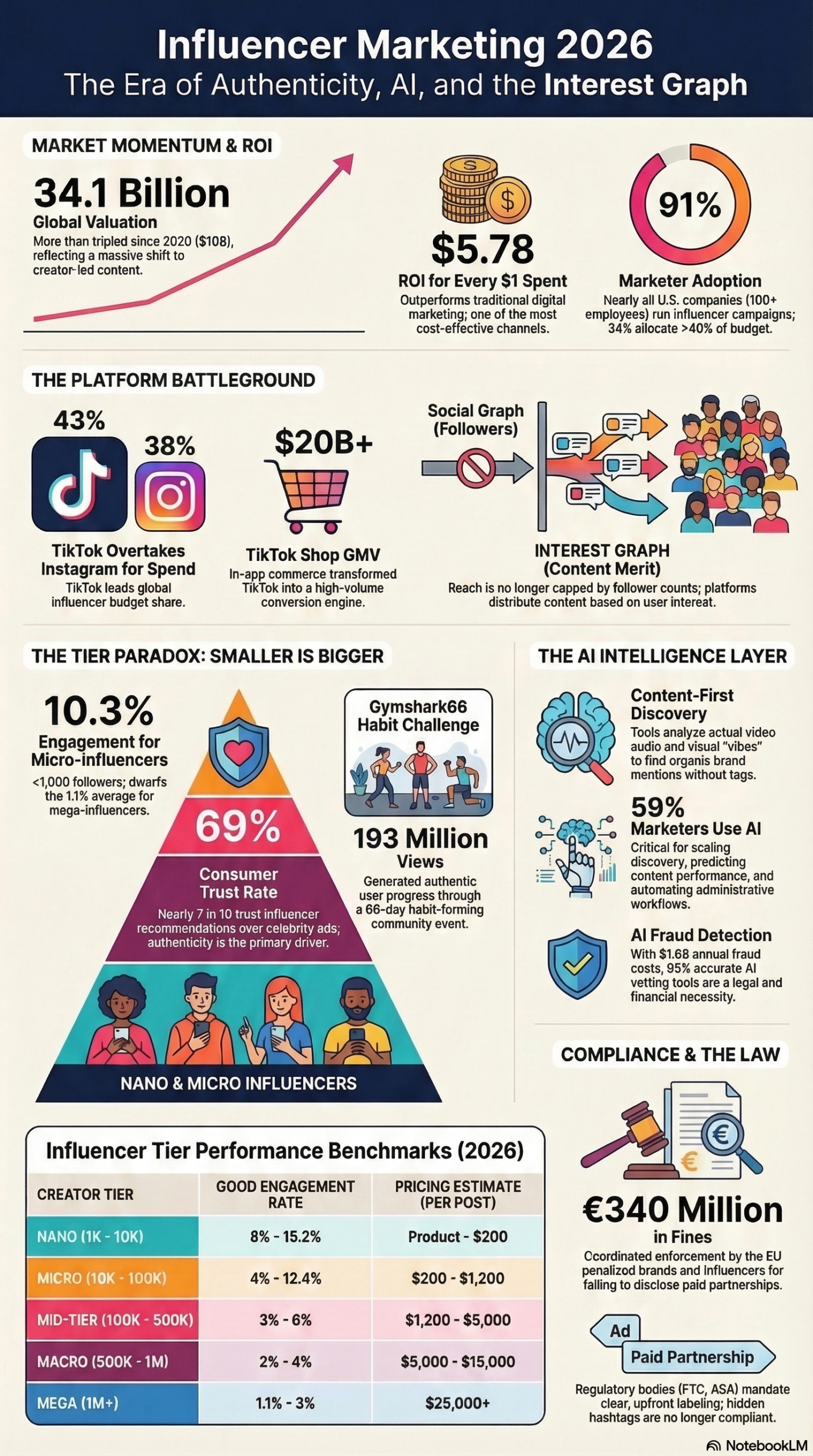
The market has tripled since 2020. The global influencer marketing platform market is projected to reach $34.1 billion in 2026, representing a compound annual growth rate of nearly 30% since 2020. This is no longer a niche digital tactic — 91% of U.S. marketers at companies with over 100 employees are running active influencer campaigns, according to research compiled in the 2026 Strategic Briefing.
The platform landscape has fundamentally shifted. TikTok has captured approximately 43% of global influencer budgets in 2026, edging out Instagram’s 38%, according to the research report. The reason is structural: Instagram operates on a social graph where reach is capped by follower count, while TikTok’s interest graph means a nano-influencer with 5,000 followers can achieve millions of views based purely on content quality. This is a critical operational distinction for campaign planners.
The creator tier hierarchy is well-established. Industry practice now segments creators into five tiers: nano (1K–10K), micro (10K–100K), mid-tier (100K–500K), macro (500K–1M), and mega (1M+). Counter to the celebrity logic that dominated early influencer marketing, the data shows engagement rates are highest at the nano level and decrease sharply as follower counts climb. On TikTok, nano-influencers achieve engagement rates as high as 15.2% while mega-influencers fall to roughly 1.1%, per the 2026 Briefing.
AI is now embedded in the workflow. Artificial intelligence is operating as both a discovery tool and a fraud-prevention layer. AI-powered natural language processing allows agencies to search for creators by the “vibes” and “spoken context” of their content — not just hashtags. AI vision and audio intelligence can identify untagged brand mentions within video content. AI fraud detection now identifies fake followers with 94–95% accuracy, a critical capability given that brands lose an estimated $1.8 billion annually to influencer fraud, with individual brands averaging $250,000 per year in wasted spend on inauthentic partnerships.
The management model has shifted in-house. 76.2% of influencer campaigns are now managed in-house, as brands seek direct ownership of creator relationships. Most of these in-house teams use third-party software for discovery, vetting, and analytics while managing the relationships directly.
The practical implication: if you are still running influencer campaigns the way you did in 2021 — finding macro-creators by follower count, negotiating flat fees for one-off posts, and tracking success by impressions alone — you are operating at a structural disadvantage against competitors who have rebuilt their approach around the 2026 playbook.
Why It Matters
The ROI case for influencer marketing is now better documented than almost any digital channel. eMarketer research cited in the 2026 Briefing found that influencer marketing generates 11x more ROI than traditional forms of digital advertising. The industry-wide average of $5.78 per dollar spent is an aggregate — the campaigns detailed below deliver multiples of that when executed correctly.
For brand marketers and CMOs, this matters because budget allocation is shifting. 34% of brands now allocate more than 40% of their total marketing budget to influencer partnerships. Brands that haven’t restructured their channel mix accordingly are likely underfunding their highest-performing acquisition channel.
For agencies, the shift creates a talent and tooling question. The move to in-house management means agencies that survive are those providing specialized AI-powered vetting, fraud detection, and creative optimization that in-house teams cannot replicate with general-purpose tools.
For e-commerce brands specifically, the creator economy is entering a phase of consolidation. The creator economy is projected to reach $480 billion by 2027, according to industry forecasts. Brands building long-term ambassador relationships now are locking in preferred rates — 71% of influencers offer lower rates for long-term partnerships versus one-off deals.
For healthcare and financial services marketers, the category expansion is significant. Adoption of influencer marketing in financial services has increased 31% and in healthcare 27%, as these traditionally conservative sectors recognize that authenticity-driven content outperforms polished institutional advertising in consumer trust metrics. 69% of consumers report they trust influencer recommendations when making purchase decisions.
What differentiates the 2026 playbook from previous approaches is the move away from transactional, one-post engagement metrics toward long-term, performance-based partnerships measured on actual business outcomes — sales, sign-ups, and customer acquisition cost.
The Data
The performance gap between creator tiers is the most operationally important data point in the 2026 influencer landscape. These benchmarks, drawn from the 2026 Influencer Marketing Strategic Briefing, should serve as the baseline for any campaign planning.
Influencer Tiers: Engagement Rate Benchmarks (2026)
| Creator Tier | Follower Range | Engagement Rate (TikTok) | Best Use Case | Cost Efficiency |
|---|---|---|---|---|
| Nano | 1K – 10K | 10% – 15.2% | High-intent conversions, niche trust | Highest |
| Micro | 10K – 100K | 4% – 8% | Authenticity, community building | High |
| Mid-Tier | 100K – 500K | 3% – 6% | Balanced reach and engagement | Moderate |
| Macro | 500K – 1M | 2% – 4% | Wide brand awareness | Low |
| Mega | 1M+ | 1.1% – 3% | Mass exposure, cultural ubiquity | Lowest |
Source: Influencer Marketing 2026 Strategic Briefing
Global Market at a Glance (2026)
| Metric | Value |
|---|---|
| Global Industry Valuation | $32.5B – $34.1B |
| Average ROI per $1 Spent | $5.78 |
| Annual Loss to Influencer Fraud | $1.8 Billion |
| % of Marketers Prioritizing Micro-Influencers | 61% |
| % of Campaigns Managed In-House | 76.2% |
| Consumer Purchase Trust Rate | 69% |
| Influencers Offering Discounts for Long-Term Deals | 71% |
| Campaigns Using Performance-Based Pricing | 25% |
Source: Influencer Marketing 2026 Strategic Briefing
Real Campaign Results (2026)
| Brand | Creator | Platform | Engagement Rate | Standout Result |
|---|---|---|---|---|
| Staples | @blivxx (Kaeden) | TikTok | 23.4% | 10M+ video views; store traffic increases |
| Midi Health | @JustBeingMelani | 3.2% (vs 2.1% avg) | $362K earned media value; 150K+ engagements | |
| DoorDash | Rob Rausch | TikTok/Instagram | 18% | 50x engagement lift vs. brand baseline |
| KFC | TurnUp Twins | TikTok/Instagram | 4% (vs 0.25% brand avg) | 15K+ engagements on Twister Wrap relaunch |
| Strava | Kudos Collective | IRL + Social | N/A (community) | Extended brand into physical community events |
Source: Sprout Social Post Performance Report 2026
Step-by-Step Tutorial: Building an Influencer Campaign That Converts
This is the operational framework. Whether you’re launching your first campaign or rebuilding a program that isn’t performing, these steps reflect how the top-performing campaigns of 2026 were constructed.
Phase 1: Define the Campaign Architecture Before Touching Creator Lists
The most common mistake brands make is starting with a creator roster and working backward to a brief. The 2026 playbook reverses this.
Step 1: Establish your primary business objective and one metric.
Before you open any discovery tool, answer this: are you optimizing for brand awareness, content production, direct sales, or community building? Each requires a different creator tier and compensation model. If you want direct sales, you need nano and micro-creators with trackable affiliate links or discount codes. If you want brand awareness at scale, mid-tier to macro creators with paid amplification behind top-performing posts. Choose one primary metric — engagement rate, attributed sales, cost per acquisition, or earned media value — before you brief a single creator.
Step 2: Determine your creator tier mix based on budget and objective.
As a rule of thumb derived from the 2026 Briefing: a $50,000 campaign generates better ROI spread across 20 micro-creators ($2,500 each) than concentrated on one macro-creator ($50,000 flat). That said, certain objectives — like a national product relaunch — may require macro reach combined with micro-creator social proof. Map your budget against the tier benchmarks in the table above.
Phase 2: AI-Powered Discovery and Vetting
Step 3: Use content-first discovery, not profile-first.
Stop using discovery tools to filter by follower count and niche category. Modern AI discovery platforms allow you to search by what creators are actually saying in their videos. This means you can find creators who have organically mentioned your product category without using any branded hashtag — these are your warmest prospects. The 2026 Strategic Briefing describes this as AI-powered Natural Language Processing that processes “spoken context” within video content to surface organic brand advocates.
Look for creators whose recent content (last 30 days) is outperforming their follower baseline. On TikTok specifically, a creator with 15,000 followers getting 300,000 views on a recent video is exhibiting “velocity” — the algorithm is amplifying their content, and your partnership can ride that momentum.
Step 4: Run mandatory fraud vetting before any outreach.
Before you contact any creator, run their profile through an AI fraud detection tool. The 2026 Briefing warns that individual brands lose an average of $250,000 per year to inauthentic partnerships, and that “one fraudulent creator recommendation can cost an agency the account.” Current AI tools identify fake followers with 94–95% accuracy by analyzing follower growth curves, engagement-to-follower ratios, comment quality, and audience demographic authenticity.
Key red flags to identify manually before the AI scan: sudden follower spikes, engagement rates that are unusually high on sponsored posts but low on organic posts (indicating engagement pod activity), and comments that are generic (“great post!”, “love this!”) rather than specific and conversational.
Step 5: Analyze audience alignment, not just creator fit.
A creator may be a perfect brand fit, but if 60% of their audience is in a different country than your distribution territory, the partnership won’t deliver business results. Require audience demographic data — age, location, gender split — as part of your vetting process. Most creator platforms make this available in their analytics dashboards.
Phase 3: Briefing and Creative Direction
Step 6: Write a brief that gives creative direction without a script.
This is the step where most brand teams overcorrect. The 2026 research is clear: 65% of influencers want to be involved in creative decisions early, not handed a script to read. Micromanagement kills the authenticity that makes the creator effective in the first place.
A strong brief includes:
– The one thing you want the audience to feel or do after watching (buy, click, remember the brand, visit a store)
– Non-negotiables: disclosure requirements, key product features to mention, any mandatory frames (brand logo visibility, product in frame)
– Open sandbox: everything not listed above is the creator’s creative domain
– Content format guidance: vertical video, 30–60 seconds, native-looking (no corporate voiceovers)
– Timeline: draft delivery date, revision rounds allowed (limit to 1), final publish date
The Staples × Kaeden (@blivxx) campaign, which generated 10M+ views and a 23.4% engagement rate, worked precisely because Kaeden — an actual Staples employee — was given the creative latitude to present custom product tutorials in his own voice, as if he was naturally sharing a work tip, not reading a brand script.
Step 7: Plan your content in modular segments.
Brief creators to shoot content in clear, separable segments: hook (0–3 seconds), product demonstration (3–20 seconds), call to action (final 5 seconds). This allows your team to repurpose one shoot into multiple platform-specific assets: a 15-second TikTok, a 30-second Instagram Reel, a 6-second ad unit. AI tools can then cut and reassemble these segments for A/B testing. This modular approach dramatically increases the ROI of each creator partnership without requiring additional shoots.
Phase 4: Launch, Amplification, and Optimization
Step 8: Amplify top performers with paid media immediately.
One of the highest-leverage moves in a 2026 campaign: when a creator’s organic post starts performing, put paid amplification behind it within 24–48 hours. This captures the content while the algorithm is already favoring it and extends reach beyond the creator’s native audience. DoorDash’s partnership with Rob Rausch used a non-linear approach of 6–7 ancillary content pieces per campaign, with paid support behind the top-performing organic posts — achieving an 18% TikTok engagement rate, a 50x lift over the brand’s baseline.
Step 9: Build in regulatory compliance at the content review stage.
The EU issued €340 million in fines in 2026 for non-compliant influencer disclosures, and the FTC continues enforcement in the U.S. This is not optional. Require creators to use platform-native disclosure labels (“Paid Partnership” on Instagram, “Branded Content” on TikTok) plus in-caption text (“Ad” or “#ad”). Do not accept ambiguous hashtags like #gifted or #collab — these do not meet disclosure standards in most jurisdictions. Build a compliance checklist into your content approval workflow and make it a condition of payment.
Step 10: Measure against business outcomes, not vanity metrics.
Set up attribution before the campaign launches. For direct sales: unique affiliate links or discount codes per creator, tracked in your e-commerce platform. For lead generation: UTM parameters on all links tracked in your CRM. For brand awareness: run a brand lift study using your paid social platform’s built-in tools for pre/post comparison. The benchmark to beat, according to the 2026 Briefing, is $5.78 ROI per dollar spent — if you’re hitting that with your current creator mix, start scaling; if you’re below it, the issue is almost always creator-audience misalignment or weak creative direction.
Expected Outcomes
A campaign built on this framework should deliver:
– Discovery: A vetted shortlist of 15–30 creators with verified authentic audiences aligned to your target demographic
– Content: 3–5 platform-native pieces per creator, structured for multi-platform repurposing
– Performance: Engagement rates at 2–5x your brand’s own social baseline (using creator tier benchmarks as your floor)
– Attribution: Clean sales or lead data attributable to each creator for ROI calculation
Real-World Use Cases
Use Case 1: Employee-as-Influencer for a Retail Brand
Scenario: A national retail chain wants to drive in-store traffic and increase sales of a specialty product category without the cost of macro-influencer deals.
Implementation: Identify existing employees who are already creating content on TikTok related to their job, products, or industry niche. Equip them with product samples, custom promotional assets (stamps, packaging, branded tools), and a brief that gives them full creative freedom. The Staples × Kaeden (@blivxx) “Staples Baddie” campaign is the 2026 blueprint: Kaeden, an actual Staples employee, posted TikTok tutorials using Staples custom products in his own voice.
Expected Outcome: Authentic content at near-zero talent cost, with the credibility advantage of a real employee perspective. The Staples campaign generated 10M+ views and a 23.4% engagement rate — 23% higher than comparable creators — with measurable lifts in both the custom mug and specialty print categories and quantifiable increases in store traffic.
Use Case 2: Niche-Credibility Partnership for a Health Brand
Scenario: A women’s health telehealth company needs to build trust with a specific demographic (perimenopausal women 40–55) on Instagram, where the audience skews older than TikTok.
Implementation: Find a creator who has built an existing community around the specific health topic — not just a wellness influencer, but someone whose personal narrative intersects with the condition. The Midi Health × @JustBeingMelani campaign followed this model exactly: Melani Sanders, author and founder of the “Do Not Care Club™,” posted a partnership piece in her standard content format about perimenopause, reaching her established, highly-relevant audience.
Expected Outcome: $362,000 in earned media value from a single partnership post, 150,000+ engagements, and a 3.2% engagement rate versus the 2.1% platform average. The niche-credibility factor — a creator whose entire identity aligns with the brand’s service — is what drives that 50%+ lift over baseline.
Use Case 3: Product Relaunch with Creator-Made Jingles
Scenario: A fast-food chain is relaunching a legacy menu item and wants to generate organic buzz on TikTok and Instagram without a traditional advertising campaign.
Implementation: Partner with creators who have a documented track record of creating viral audio content — not generic lifestyle influencers. The KFC × TurnUp Twins (@TurnUpTwinsTV) campaign for the Twister Wrap reintroduction paired the brand with jingle creators Minnie and Mattie, whose previous jingle for Crumbl Cookie had generated 80+ million views in 2024.
Expected Outcome: 15,000+ engagements with a 4% engagement rate — versus KFC’s own brand social average of 0.25%. Nostalgia plus creator-native audio format drives shareability that polished brand content cannot replicate organically.
Use Case 4: Community-First Fitness Brand Activation
Scenario: A fitness tracking app wants to build brand equity in a local market while extending influencer activation beyond digital content into a real-world brand experience.
Implementation: Recruit a small group of local creators who are community builders in the target niche, not just content publishers. Strava’s “Kudos Collective” campaign around the 2026 LA Marathon partnered with four local LA creators — including the founder of Big Girls Who Run, a Nike athlete, and the Good Vibes Track Club organizer — to host a combined panel and group run event that was also documented as content.
Expected Outcome: Community-level brand attachment that outlasts any individual post’s lifespan, measurable IRL event attendance, and multi-format content (video, photos, event recap) from a single activation. The brand-agnostic framing of the event increases creator and attendee trust compared to a purely commercial execution.
Use Case 5: Founder-Led Influence for DTC Brands
Scenario: A direct-to-consumer brand with a limited marketing budget wants to build a consistent influencer presence without paying external creator rates.
Implementation: Train the founder or a senior team member to create regular content in their own authentic voice on TikTok and Instagram. This “founder-led influence” model, documented in the 2026 Strategic Briefing, has been shown to reduce Customer Acquisition Costs (CAC) by 30% and significantly increase Return on Ad Spend (ROAS) versus paid advertising alone, based on brand case studies like ROWSE.
Expected Outcome: A compounding content asset that builds audience trust over time, generates platform-native organic reach, and can be amplified with paid media at a lower CPM than cold-audience ads, because the content carries the authenticity signals that algorithms reward.
Common Pitfalls
Pitfall 1: Choosing creators by follower count instead of content velocity.
The mistake: filtering creator discovery tools for macro or mega-influencers because the follower number looks impressive. The reality: on TikTok’s interest graph, a creator with 12,000 followers whose recent videos are averaging 500,000 views is algorithmically more valuable than a creator with 500,000 followers averaging 8,000 views. Always check recent performance against the follower baseline, not the static follower count.
Pitfall 2: Skipping fraud vetting to move faster.
Brands that bypass AI fraud detection to accelerate outreach are the brands losing the average $250,000 per year to inauthentic partnerships. Fraudulent creators deliver zero real ROI regardless of the engagement numbers reported, and discovering fraud post-campaign provides no recourse if contracts don’t include performance warranties.
Pitfall 3: Over-directing the creative brief.
Brands that provide full scripts, mandatory talking points, forced brand language, and zero creative latitude are destroying the core asset they are paying for: the creator’s authentic voice. 65% of influencers report that they want to be involved in creative decisions early. A creator reading a script has the same authenticity as a TV commercial — which is exactly what your audience is trying to skip.
Pitfall 4: Running one-off campaigns instead of building ambassador programs.
The biggest structural waste in influencer marketing is one-post campaigns. The relationship warmup, negotiation, and content review process costs nearly as much time whether you’re running one post or ten. 71% of influencers offer lower rates for long-term partnerships, and repeated exposure to a brand via the same trusted creator compounds conversion rates over time.
Pitfall 5: Ignoring disclosure compliance.
With EU regulators issuing €340 million in fines in 2026 and FTC enforcement ongoing, treating disclosure as optional is a material legal and reputational risk. The compliance rule is simple: every piece of sponsored content must be clearly labeled as such using platform-native tools, before the audience reads or watches any commercial content. “Gifted” hashtags and footnote disclosures do not satisfy current regulatory standards.
Expert Tips
Tip 1: Search for organic brand mentions before building your creator list.
Use AI-powered discovery platforms that process video audio and text to find creators who have mentioned your product or category organically — without being paid. These creators are pre-validated brand advocates with authentic opinions, and their partnership posts will outperform cold partnerships because their existing content has already established credibility on the topic.
Tip 2: Brief for modularity, not a single deliverable.
Every time you contract a creator, you should be getting more than one usable content asset. Brief for a “hero” piece plus 3–4 shorter cut-downs or related posts that can be deployed across platforms. AI content tools can then splice and reassemble these segments for A/B testing in paid amplification. One shoot should generate a TikTok, a Reel, a paid ad unit, and a Story — minimum.
Tip 3: Move 25% of your campaign budget to performance-based contracts.
25% of campaigns in 2026 already use pricing tied to specific outcomes — sales or sign-ups — rather than flat upfront fees. This structure aligns creator incentives with brand objectives and protects budget when content underperforms. Start with a base fee (to compensate the creator’s time) plus a performance bonus tied to tracked affiliate sales, which gives you both compliance and motivation.
Tip 4: Amplify within 24–48 hours of organic post publication.
The moment a creator’s post starts trending organically is your window to boost it with paid media. Platform algorithms interpret early organic engagement as a quality signal; paid amplification applied during that window rides the algorithmic momentum rather than fighting against it. Set a performance threshold trigger (e.g., if a post hits 2x the creator’s average engagement in 12 hours, immediately allocate $500–$2,000 in paid boost).
Tip 5: Use LinkedIn for B2B influencer campaigns — it’s still underpriced.
While TikTok and Instagram capture the most budget, LinkedIn is an emerging, undervalued channel for B2B influencer activation. Creators who consistently produce high-engagement LinkedIn content — particularly in financial services, SaaS, and professional development — are available at significantly lower rates than comparable Instagram or TikTok creators, with audiences that often have higher purchase authority for B2B products.
FAQ
Q: How much should I pay a micro-influencer in 2026?
Rates vary significantly by platform, niche, and engagement rate, but the general 2026 market range for a micro-influencer (10K–100K followers) is $200–$2,000 per post for a TikTok or Instagram Reel. Nano-influencers (1K–10K) often work for $50–$500 or product-plus-commission structures. The most critical factor is engagement rate, not follower count — a micro-creator with an 8% engagement rate commands and deserves more than one with a 2% rate. Always negotiate long-term rates: 71% of influencers reduce their fees for multi-post or ambassador arrangements.
Q: Is TikTok still worth investing in despite ongoing regulatory uncertainty?
Yes, based on current budget allocation data. TikTok captured approximately 43% of global influencer budgets in 2026, reflecting marketers’ continued commitment to the platform. Practically, you should run parallel content strategies on Instagram Reels and YouTube Shorts so that top-performing TikTok content can be redistributed quickly if the platform’s availability changes. Don’t put more than 60% of your creator content budget into a single platform.
Q: How do I measure influencer ROI without a direct e-commerce attribution model?
For brands that cannot deploy unique affiliate links or coupon codes (physical retail, services, brand awareness campaigns), the recommended approach is: (1) earned media value calculation, which assigns a dollar value to organic reach using comparable paid media CPMs; (2) brand lift studies run through your paid social platform to measure shifts in awareness, consideration, and purchase intent pre and post campaign; and (3) tracked UTM parameters on all website links. The Midi Health × @JustBeingMelani campaign generated $362,000 in earned media value as a measurable output from a single post.
Q: Should I work with virtual (AI-generated) influencers?
The data says no, at least in 2026. 89% of marketers report they will not work with virtual influencers, and consumer trust data supports that position — the primary driver of influencer purchase intent is human authenticity, which virtual creators cannot replicate. The brands currently experimenting with AI-generated creators are doing so for novelty content, not performance campaigns. Until consumer sentiment shifts meaningfully, human creators deliver measurably better results.
Q: How do I handle influencer fraud if I discover it post-campaign?
Prevention is the only reliable strategy. Post-discovery, your options are limited: you can withhold final payment if contracts include performance warranties tied to authentic engagement, and you can report the creator to the discovery platform for flagging. Going forward, build contracts that include clauses requiring creators to maintain audience authenticity, with audit rights using a named third-party tool, and payment milestones tied to verified performance checkpoints rather than content delivery alone.
Bottom Line
The 2026 influencer marketing playbook is not complicated, but it requires abandoning the assumptions that drove early-era campaigns. Nano and micro-creators outperform celebrities on engagement. AI vetting is non-negotiable with $1.8 billion in annual industry fraud. Long-term ambassador relationships consistently outperform one-off posts. And the best-performing campaigns — like Staples with a real employee-creator, or DoorDash with an unconventional reality TV personality — succeed because they treat the creator’s authentic voice as the product, not the distribution channel. Brands that commit to this framework, invest in proper attribution, and build the compliance infrastructure to operate at scale will find influencer marketing is their highest-ROI channel in 2026 and beyond.


0 Comments