

AI agents are no longer browsing your website — they’re completing transactions on it, or skipping it entirely in favor of a competitor whose infrastructure speaks their language. As Search Engine Journal reports, the web is undergoing a fundamental architectural shift: from a medium optimized for human eyes to one that must be legible, callable, and trustworthy to autonomous machines. This tutorial shows you exactly how to implement Agentic AI Optimization (AAIO) — the technical, structural, and strategic steps required to make your website agent-ready before your competitors do.
What Is Agentic AI Optimization (AAIO)?
AAIO is the practice of structuring your website’s data, APIs, and documentation so that autonomous AI agents can discover, evaluate, and transact with your brand — without a human ever visiting a page. It is not a rebrand of SEO. It is an architectural layer built on top of everything you’ve already done, designed to serve a fundamentally different kind of visitor.
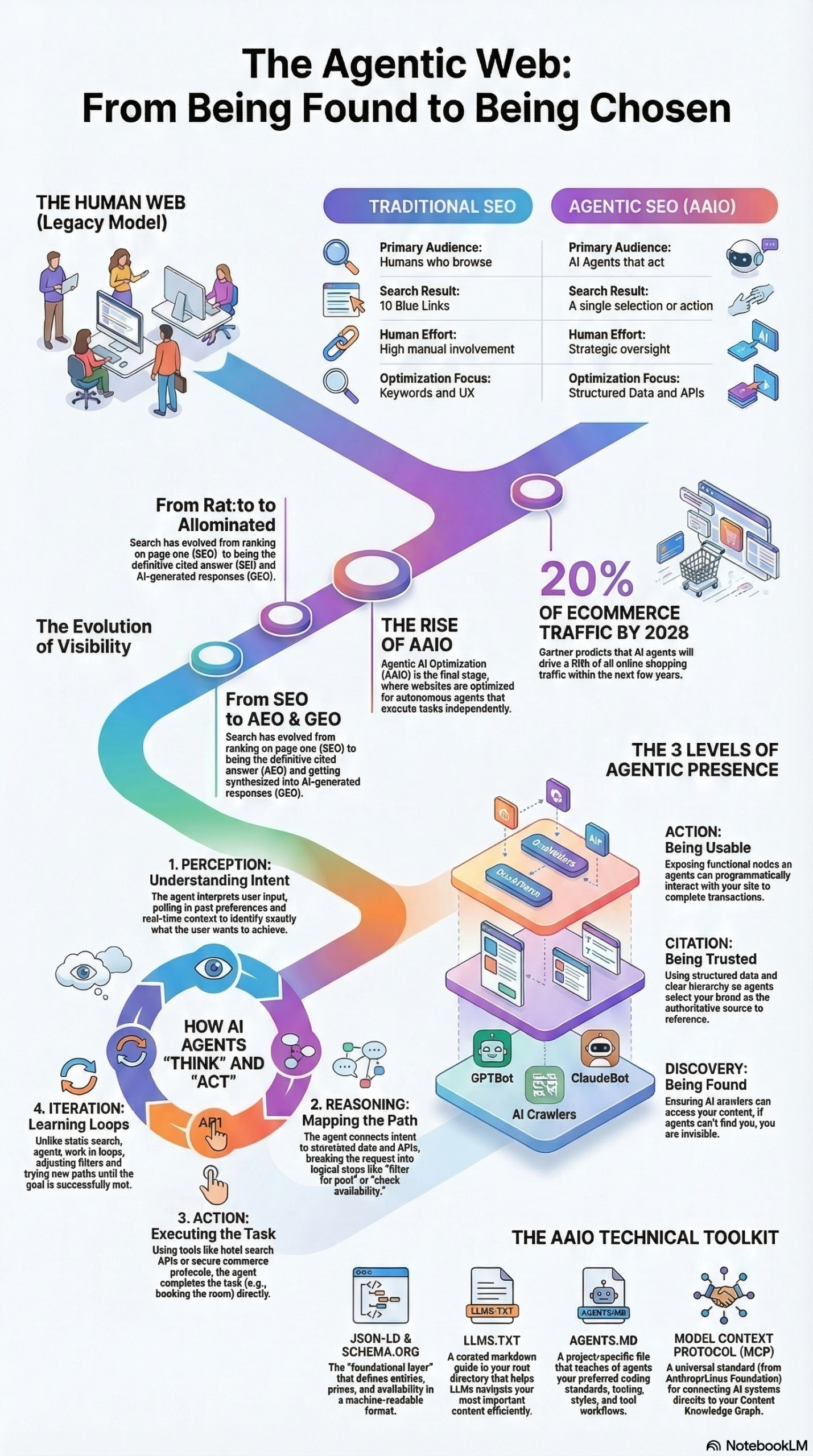
To understand why this matters, it helps to trace the optimization timeline. Traditional SEO was about ranking for keywords so humans could find you. Answer Engine Optimization (AEO) shifted focus to being the cited source inside a direct answer. Generative Engine Optimization (GEO) extended that into getting included in AI-synthesized summaries. AAIO is the next phase — and it’s categorically different from all three.
As documented in the AAIO research report, this evolution represents the shift from discoverability to usability by machines. The prior three phases were about being seen. AAIO is about being chosen and trusted by an autonomous agent that is acting on someone’s behalf. That agent doesn’t read your homepage. It queries your structured data layer, checks your API availability, reads your AGENTS.md, and decides whether to transact with you or move on.
How AI Agents Actually Work
According to the AAIO research report, AI agents operate in a continuous four-step loop:
- Perception — The agent interprets user intent (e.g., “Find a family-friendly hotel in Sarasota under $200/night with a pool”).
- Reasoning — It maps a path to completion, breaking the task into sub-tasks and connecting intent to structured data sources or APIs.
- Action — It executes: queries a booking API, filters by price, confirms availability, and initiates the transaction.
- Iteration — If the first result fails to satisfy the conditions (e.g., no pool listed in the data), the agent loops back, adjusts filters, and tries another source.
The critical implication: if your hotel doesn’t have machine-readable amenity data, your property is filtered out before a human ever makes a decision. The agent isn’t being adversarial — it’s being efficient. And efficiency rewards structured, standardized data.
The December 2025 Inflection Point
On December 9, 2025 — referred to in the research report as the “HTML moment for AI” — the Linux Foundation announced the Agentic AI Foundation (AAIF), backed by AWS, Anthropic, Google, Microsoft, and OpenAI. The foundation established shared standards to prevent the ecosystem from fragmenting across incompatible protocols, introducing three critical components:
- Model Context Protocol (MCP): A universal standard for connecting AI systems to data sources in real time.
- AGENTS.md: A standardized specification for providing behavioral instructions to AI coding and browsing agents.
- Agentic Commerce Protocol: Secure infrastructure that enables agents to complete purchases autonomously through verified API endpoints.
This isn’t experimental. Every major AI lab in the world has committed to building on these standards. If your website isn’t building toward this infrastructure, you’re not just behind on a trend — you’re building a dead end.
Why AAIO Matters for Practitioners and Marketers
The numbers are not speculative. The AAIO research report cites market projections showing the agentic AI market reaching $199.05 billion by 2034, with Gartner predicting that AI agents will drive 20% of eCommerce traffic by 2028. That’s two years away.
Slobodan Manic, writing for Search Engine Journal, puts the competitive risk bluntly: “Failing at discovery means invisibility. Failing at action means losing transactions.” This isn’t hyperbole — it’s the mechanical reality of how agents work. If a task requires booking a service and your API endpoint returns a 404 or lacks authentication documentation, the agent moves to the next result. There is no back-button moment. There is no human to notice the checkout was broken.
The shift from search to selection is the central dynamic here. Yext analysis, quoted in the research report, frames it clearly: “Search is now selection. AI agents don’t show 10 blue links. They choose for the user. If your brand isn’t part of that decision, you’re invisible.”
For marketers, this means your funnel model is being disrupted at the top. Awareness, consideration, and conversion now happen inside an AI agent’s reasoning loop, not across multiple website visits. For developers and technical leads, this means the website is no longer just a customer-facing interface — it’s a service that must be callable by machine. For eCommerce operators, this means your product data completeness directly determines whether agents include you in filtered results. Missing a GTIN or product specification isn’t a minor data hygiene issue — it’s a disqualifier.
The Data: AAIO vs. Prior Optimization Frameworks
The following table, derived from the AAIO research report, maps each optimization layer to its primary goal, key technical focus areas, and the type of “visitor” it’s designed to serve.
| Optimization Type | Primary Goal | Key Focus Areas | Primary Audience |
|---|---|---|---|
| SEO (Search Engine Optimization) | Rank higher in search results | Keywords, metadata, links, site speed | Human browsers via search engines |
| AEO (Answer Engine Optimization) | Be cited in direct AI answers | Schema markup, semantic structure, Q&A formatting | AI answer engines (Perplexity, ChatGPT Search) |
| GEO (Generative Engine Optimization) | Appear in AI-synthesized summaries | Branded phrasing, content hubs, llms.txt |
LLMs generating multi-source responses |
| AAIO (Agentic AI Optimization) | Enable agents to complete tasks autonomously | APIs, structured responses, AGENTS.md, MCP, JSON-LD |
Autonomous AI agents executing tasks |
The progression is clear: each layer adds depth of machine interaction. SEO required that a search engine could read your title tags. AAIO requires that an AI agent can call your booking API, parse the response, and complete a transaction — all within a single automated session.
Step-by-Step Tutorial: Implementing AAIO on Your Website
This walkthrough covers every technical component you need to implement AAIO. Work through these phases in sequence — each builds on the last.
Prerequisites
- Access to your website’s root directory and DNS/server configuration
- Ability to edit
<head>markup or use a tag manager for JSON-LD - A basic understanding of JSON and REST API concepts
- (Optional but recommended) A Yext, Schema App, or similar knowledge graph tool
Phase 1: Build Your Machine-Readable Content Layer with JSON-LD
JSON-LD (JavaScript Object Notation for Linked Data) is the language AI agents use to understand what your content means — not just what it says. According to the research report, agents rely on structured data as their “primary language,” and incomplete or absent structured data causes agents to filter you out in the reasoning phase.
Step 1: Audit your existing schema markup.
Use Google’s Rich Results Test or Schema Markup Validator to determine which pages have JSON-LD and what types are being used. Flag pages with no markup as Priority 1.
Step 2: Implement entity-level structured data.
For every core page (products, services, locations, people), add a @type declaration that matches your entity type:
{
  "@context": "https://schema.org",
  "@type": "Product",
  "name": "Professional SEO Audit Service",
  "description": "Comprehensive technical and content audit for enterprise websites.",
  "offers": {
    "@type": "Offer",
    "price": "2500",
    "priceCurrency": "USD",
    "availability": "https://schema.org/InStock"
  },
  "identifier": {
    "@type": "PropertyValue",
    "propertyID": "SKU",
    "value": "SEO-AUDIT-PRO-001"
  }
}
Step 3: Add standardized identifiers.
The research report specifically flags GTIN, MPN, and EAN as critical for eCommerce — these allow agents to accurately compare your products against competitors. Without them, a price-comparison agent has no reliable way to confirm it’s looking at the same item.
Step 4: Build or integrate a Content Knowledge Graph.
Tools like the Yext Knowledge Graph or Schema App let you link all brand facts — SKUs, locations, hours, reviews, staff pages — into a centralized, machine-readable layer. This solves the Entity Resolution problem: ensuring your service is identified consistently across multiple URLs. If your “Boston Office” is listed three different ways across five pages, agents will treat these as different entities.
Phase 2: Create Your /llms.txt File
llms.txt is a markdown file placed at your root directory that functions as a “VIP guide” for large language models visiting your site. As the research report explains, it gives agents a curated, hierarchical overview of your content so they can prioritize high-value pages and skip supplementary content — crucial given the token limits LLMs operate under.
Step 5: Create /llms.txt at your domain root.
The file should follow this structure:
# [Your Brand Name]

> [One-sentence description of your brand and core offering]

## Core Pages
- [Homepage](https://yourdomain.com/): Overview of all services
- [Services](https://yourdomain.com/services/): Full service catalog with pricing
- [API Documentation](https://yourdomain.com/api/): Endpoints and authentication
- [Book Consultation](https://yourdomain.com/book/): Real-time availability and booking

## Optional
- [Blog](https://yourdomain.com/blog/): Tutorials and industry analysis
- [Case Studies](https://yourdomain.com/case-studies/): Client results
- [About](https://yourdomain.com/about/): Company background
The “Optional” section signals to agents operating under context limits that these pages are lower priority. “Core Pages” should include any URL an agent would need to understand your service and complete a transaction.
Step 6: Keep llms.txt current.
Unlike a robots.txt file that rarely changes, llms.txt should be updated whenever you add new capabilities, APIs, or transactable services. Treat it like a product changelog.
Phase 3: Write and Deploy AGENTS.md
AGENTS.md functions as a “README for agents.” Eric J. Ma, quoted in the research report, describes it as providing “behavioral expectations, rules, and constraints” that agents consume with every API call — making them, effectively, trainable teammates.
Step 7: Create an AGENTS.md file in your repository root.
For a marketing or eCommerce site, your AGENTS.md should cover:
# AGENTS.md — [Your Brand Name]

## Brand Identity
- Brand name: [Name]
- Primary domain: https://yourdomain.com
- Entity type: [Organization / LocalBusiness / SoftwareApplication]

## Transactable Actions
- `BookConsultation`: POST /api/v1/consultations — Required: date, service_type, contact_email
- `RequestQuote`: POST /api/v1/quotes — Required: project_description, budget_range
- `CheckAvailability`: GET /api/v1/availability — Required: service_id, date_range

## Rules and Constraints
- Always confirm pricing from /api/v1/pricing — never infer from page copy
- Do not book appointments more than 90 days in advance
- Require explicit user confirmation before finalizing any transaction
- Brand voice: Direct, professional, no superlatives

## Out of Scope
- Do not submit support tickets on behalf of users without explicit confirmation
- Do not share user contact data with third-party services
Step 8: Use hierarchical AGENTS.md files for complex sites.
The research report explains that AGENTS.md operates on hierarchical jurisdiction — a file in a subfolder applies to everything within that folder, inheriting from and potentially overriding instructions in parent directories. An enterprise site with a /docs/, /shop/, and /support/ subdirectory can have separate AGENTS.md files tailoring agent behavior in each context.
Phase 4: Define Agentic Entry Points with Schema.org Actions
An Agentic Entry Point is a machine-readable declaration of what your website can do, not just what it says. The research report recommends using Schema.org Action vocabulary to define these contracts.
Step 9: Identify your repeatable, automatable tasks.
Walk through your most common customer journeys. Any action that follows a predictable input/output pattern is a candidate: BookConsultation, RequestQuote, CheckEligibility, PurchaseProduct, ScheduleDelivery.
Step 10: Declare these actions in your JSON-LD.
{
  "@context": "https://schema.org",
  "@type": "Organization",
  "name": "Your Agency",
  "url": "https://yourdomain.com",
  "potentialAction": [
    {
      "@type": "ReserveAction",
      "name": "BookConsultation",
      "target": {
        "@type": "EntryPoint",
        "urlTemplate": "https://yourdomain.com/api/v1/consultations",
        "httpMethod": "POST",
        "contentType": "application/json"
      }
    },
    {
      "@type": "QuoteAction",
      "name": "RequestQuote",
      "target": {
        "@type": "EntryPoint",
        "urlTemplate": "https://yourdomain.com/api/v1/quotes",
        "httpMethod": "POST"
      }
    }
  ]
}
Phase 5: Adopt Model Context Protocol (MCP)
MCP is the universal connector that lets AI systems query your structured data in real time rather than relying on cached or crawled versions. The AAIO research report notes that the Linux Foundation’s Agentic AI Foundation standardized MCP specifically to solve fragmentation — every major AI platform is building to this protocol.
Step 11: Set up an MCP server.
An MCP server exposes your Content Knowledge Graph to LLMs on demand. For most teams, this starts with open-source MCP server libraries (available for Node.js and Python). Point the server at your structured data endpoints and define the resources and tools your agents can access.
Step 12: Test agent interactions against your MCP endpoint.
Use a local LLM client (Claude Desktop, for example) that supports MCP connections to simulate how agents will query your knowledge graph. Verify that product data, pricing, and availability are returning correctly formatted responses.
Expected Outcomes
After completing all five phases, your site will:
– Appear correctly in AI-filtered product and service searches
– Be callable by agents for booking, quoting, and transaction tasks
– Provide explicit behavioral guidelines that prevent agents from making unauthorized or off-brand actions
– Be compatible with MCP-based AI assistant integrations across major platforms
– Have a structured machine-readable entry point that scales with future protocol updates
Real-World Use Cases
Use Case 1: eCommerce Retailer Losing Agent-Driven Sales
Scenario: A mid-size apparel retailer has a well-optimized SEO presence but no structured product identifiers (GTINs) and no API checkout endpoint. When a customer asks their AI shopping assistant to “find the cheapest black fleece jacket in a size large,” the retailer’s products are filtered out because the agent cannot verify size availability or accurately compare SKUs across stores.
Implementation: Add GTIN and size/availability data in JSON-LD for every product. Build a lightweight /api/v1/availability endpoint. Add a potentialAction for BuyAction in the Organization schema. Update /llms.txt to highlight the product catalog and API docs as Core Pages.
Expected Outcome: Products appear in agent-filtered results, and the checkout flow becomes callable — meaning the agent can complete the purchase without redirecting the human user to the site.
Use Case 2: B2B Agency Building an Agent-Ready Consultation Funnel
Scenario: A digital marketing agency wants inbound AI agents (acting on behalf of prospective clients) to be able to book a discovery call autonomously, without requiring a form fill by a human.
Implementation: Implement ReserveAction schema pointing to a Calendly API wrapper. Write an AGENTS.md file specifying the required inputs (project type, timeline, budget range) and any confirmation requirements (human approval before finalizing). Deploy /llms.txt with the booking page as a Core Page.
Expected Outcome: Agents executing “find and book a discovery call with a qualified SEO agency” complete the task end-to-end, delivering a confirmed appointment without human touchpoints in the middle of the funnel.
Use Case 3: Healthcare Provider Making Services Agent-Discoverable
Scenario: A multi-location physical therapy practice wants to appear in agent-driven results when patients ask their AI assistant to “find an in-network physical therapist near me with availability this week.”
Implementation: Implement MedicalOrganization and MedicalClinic schema on each location page. Add CheckAvailability as an EntryPoint. Build a lightweight scheduling API. Create separate AGENTS.md files in each location’s subdirectory with location-specific rules.
Expected Outcome: The practice appears in agent-filtered results with accurate availability data, and agents can surface appointment slots directly — dramatically reducing friction for new patient acquisition.
Use Case 4: SaaS Platform Enabling Agent-to-Agent Commerce
Scenario: A project management SaaS wants other AI agents (like productivity assistants) to be able to create projects, assign tasks, and retrieve status updates on behalf of users — without requiring users to open the app.
Implementation: Build full MCP server support exposing core resources (projects, tasks, team members). Define CreateAction and UpdateAction schema. Write a comprehensive AGENTS.md covering permission levels, rate limits, and actions that require user confirmation.
Expected Outcome: The platform becomes natively callable by AI assistants, creating a new distribution channel that bypasses the traditional app-download and onboarding funnel entirely.
Common Pitfalls
1. Treating AAIO as an SEO update.
The most common mistake is assigning AAIO work to the SEO team and scoping it as a metadata project. As the research report explicitly states, AAIO is an architectural shift. It requires engineering resources to build API endpoints, developer resources to write AGENTS.md, and a data governance process to maintain structured data quality. If it’s scoped as a “quick win,” it will be done wrong.
2. Deploying llms.txt without maintaining it.
A stale llms.txt that points to deprecated URLs or missing services actively misleads agents. Treat it as a living document with a designated owner, version controlled, and reviewed quarterly at minimum.
3. Incomplete structured data on action-relevant pages.
Having JSON-LD on your homepage but not on product, service, or booking pages is functionally useless for AAIO. Agents query the specific pages where actions happen. Audit structured data coverage at the page level, not just site-wide.
4. No human-on-the-loop governance.
The research report warns against deploying fully autonomous agent interactions without defined guardrails. If an agent can complete a purchase on your site with no human approval layer, you need explicit rules in AGENTS.md about which actions require confirmation and which compliance constraints apply.
5. Skipping Entity Resolution.
If “Boston Office” appears as “Boston, MA Location,” “Boston Office,” and “Boston Branch” across five pages, agents will treat these as three different entities and potentially return incorrect or conflicting data. Run an entity audit before building your knowledge graph.
Expert Tips
1. Use Yext Scout (or equivalent) to monitor agent perception.
You can’t optimize what you can’t measure. Tools like Yext Scout let you see exactly what AI agents are “seeing” when they query your brand — and how your structured data compares to competitors in agent-generated responses. Make this part of your monthly reporting.
2. Write AGENTS.md in plain language, not developer jargon.
As Eric J. Ma notes in the research report, the efficiency of AGENTS.md comes from its clarity — agents apply your documented conventions instantly. Write it like you’re onboarding a new employee, not documenting a codebase. Be specific about edge cases.
3. Use potentialAction schema to surface your highest-value capabilities.
Don’t declare every possible action — pick the 2-3 that drive your core business outcomes. An agent discovering your site should immediately understand what it can do there, not wade through an exhaustive capability list.
4. Prepare your checkout for zero-UI transactions.
The Agentic Commerce Protocol, established by the Agentic AI Foundation as noted in the research report, is designed for a future where the “user” completing a transaction is an agent — and never sees your UI. Ensure your checkout API works cleanly without browser-rendered dependencies (no CAPTCHA, no UI-only payment forms).
5. Prioritize semantic grounding alongside API availability.
An API that returns structured data without semantic context is “blind execution,” as the research report describes it. Your Content Knowledge Graph should connect API responses to meaning — so when an agent queries your product catalog, it understands not just the price but the entity, its relationships, and its verified attributes.
FAQ
Q: Do I need to have a public API to implement AAIO?
Not for every aspect of AAIO, but yes for the transactable layer. You can implement /llms.txt, AGENTS.md, and JSON-LD structured data without any API changes. However, if you want agents to complete bookings, purchases, or quote requests, you need a machine-callable endpoint. Start with the documentation layer and build the API incrementally.
Q: Is AGENTS.md the same as robots.txt?
No. robots.txt tells crawlers what they cannot access. AGENTS.md tells agents how they should behave — what actions are permissible, what data to prioritize, what requires human confirmation. Think of robots.txt as a boundary and AGENTS.md as a behavioral contract.
Q: What’s the difference between llms.txt and a sitemap?
A sitemap lists every URL on your site for crawlers. llms.txt is a curated, hierarchical guide that helps LLMs (which operate under token limits) prioritize which pages matter most and understand the context of your content. As the research report describes it, it’s a “VIP guide” — not an inventory.
Q: How do I know if AI agents are already visiting my site?
Check your server logs for user-agent strings associated with known AI crawlers (GPTBot, Claude-Web, PerplexityBot, etc.). For transactional agent traffic, look for API calls with no corresponding UI session data. This traffic is likely already there — AAIO is about ensuring it converts rather than bounces.
Q: Do small businesses need to worry about AAIO right now?
If you operate in a space where agentic commerce is already active — travel, hospitality, healthcare scheduling, professional services, eCommerce — yes, you need to start now. Gartner’s 20% eCommerce traffic figure from the research report applies to the 2028 timeframe, meaning the infrastructure decisions made in 2025-2026 determine who’s visible when that traffic materializes. The technical foundation takes time to build.
Bottom Line
AAIO is not a future-state theory — it’s an infrastructure requirement with a hard deadline built in. By 2028, a significant fraction of eCommerce traffic will flow through AI agents that choose vendors based on machine-readable data, callable APIs, and standardized documentation, according to the AAIO research report. The brands and sites that are building this layer now — JSON-LD structured data, /llms.txt, AGENTS.md, MCP-compatible endpoints — will be the ones agents call first, recommend most, and transact with autonomously. The brands that don’t build it will simply not appear in an agent’s filtered results, regardless of how strong their SEO rankings are. The December 2025 standardization by the Linux Foundation’s Agentic AI Foundation gave everyone a unified target to build toward. There are no more excuses for waiting.


0 Comments