

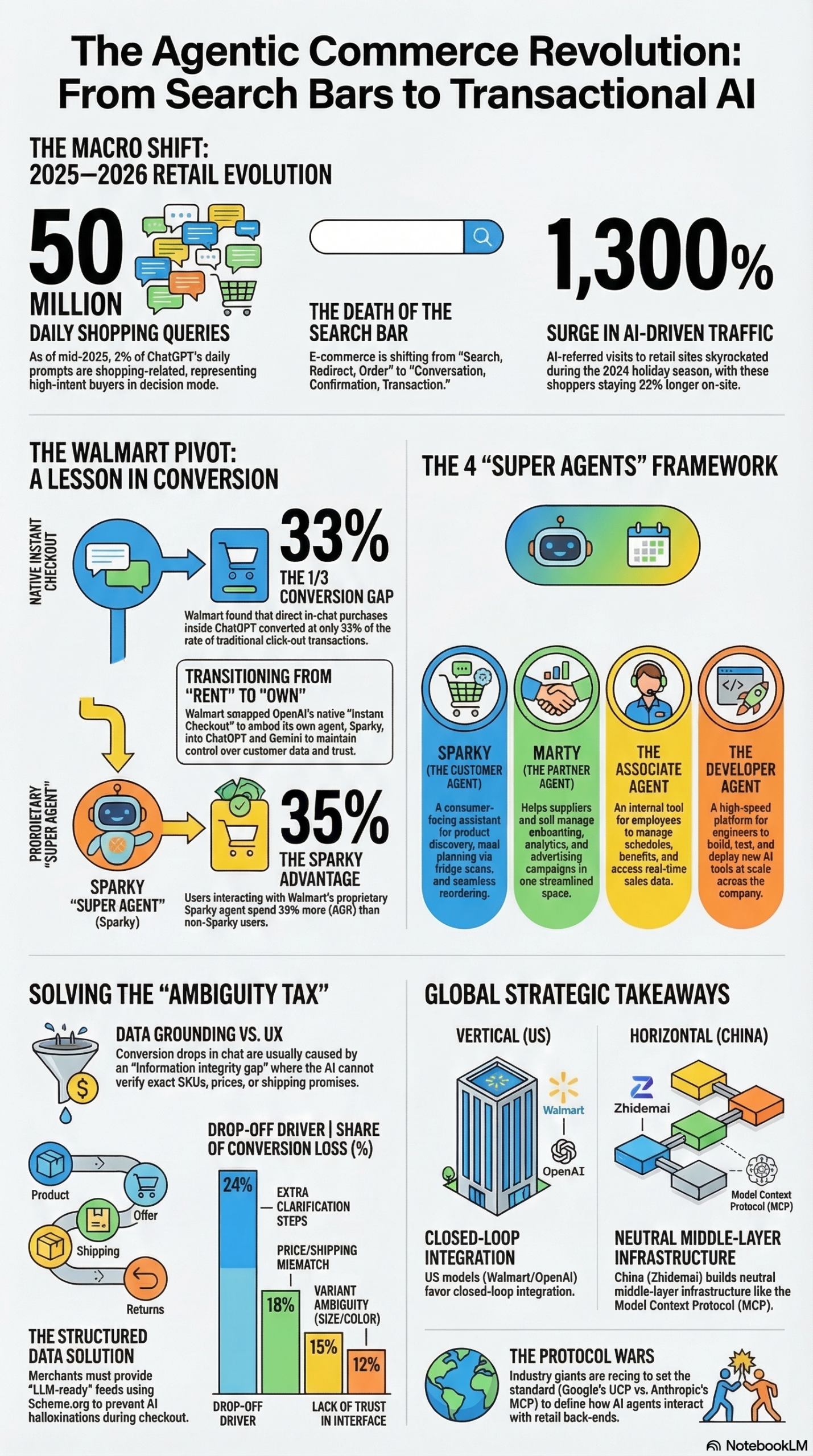
Walmart ran a direct test of ChatGPT’s “Instant Checkout” and found it converted at roughly one-third the rate of their own website — and the culprit wasn’t the AI interface, the user experience, or consumer resistance to buying through chat. It was a structured data problem. As Kevin Fincel, Founder of Geol.ai, put it plainly: “Walmart’s ChatGPT checkout converted 3x worse than its own website — a structured data problem, not a UX problem.” In this tutorial, you’ll learn exactly what caused that gap, how Walmart pivoted its strategy, and the precise steps ecommerce practitioners need to take right now to position their stores for AI-driven conversion in 2026 and beyond.
What This Is: Agentic Commerce and the AI Checkout Gap
Agentic commerce is the next structural shift in ecommerce — and it’s already underway. According to MarTech’s coverage of the Walmart-OpenAI experiment, the retail industry is moving from a model where humans search, click, and checkout, to one where AI agents do the searching, comparison, and purchasing on their behalf.
The model works like this: a consumer expresses a broad intent — “I need supplies for a weekend barbecue” — and instead of returning a list of links, an AI agent interprets the intent, selects products across multiple retailers, and executes the transaction. The human confirms or approves, but the discovery and decision layers are handled by the agent. According to the agentic commerce research report, this represents a systemic upgrade from passively responding to searches to proactively fulfilling user intent.
As Walmart CEO Doug McMillon framed it: “For many years now, eCommerce shopping experiences have consisted of a search bar and a long list of item responses. That is about to change.”
The experiment that broke this open was OpenAI’s Instant Checkout feature. OpenAI partnered with retailers — including Walmart — to enable users to complete purchases entirely within the ChatGPT interface. No click-out, no redirect to the retailer website. On paper, it was a frictionless dream. In practice, it exposed a fundamental problem: AI agents cannot complete transactions reliably when product data is ambiguous, incomplete, or unstructured.
The specific failure was what researchers and practitioners are now calling the “Product Truth Gap” — a term that describes the disconnect between how retailers store product information internally and how AI agents need to consume it to make confident purchase decisions. Large Language Models (LLMs) tasked with executing checkout couldn’t reliably infer:
- Specific variants: Which exact size, color, or model the consumer intended
- Real-time offers: Current price, sale conditions, and regional availability
- Fulfillment constraints: Accurate delivery windows, shipping zones, and return policy details
When an agent encounters ambiguity on any of these fronts, it has two options: ask a clarifying question (adding friction to the funnel) or make an assumption (risking a wrong order). Neither outcome supports conversion. The result was a checkout flow that converted at a fraction of the traditional click-out rate.
This failure is not a footnote — it’s the most important conversion lesson the ecommerce industry has received in years. Because the same agents that couldn’t complete checkout through Instant Checkout are now, according to the research report, driving 20% of Walmart’s referral traffic. ChatGPT is already one of Walmart’s top traffic sources. The agent-driven shopping era isn’t theoretical — it’s the current reality, and the gap between traffic and conversion is a structured data problem you can fix.
Why It Matters: The Practitioner Consequences of Agent-Driven Commerce
This shift hits differently depending on where you sit in the ecommerce stack, but no practitioner role is untouched.
For ecommerce managers and merchandisers, the immediate implication is that your product data quality directly determines your AI visibility and conversion rate. According to the agentic commerce research report, nearly 60% of Americans were using generative AI tools while shopping as of 2025. That percentage will only grow. If your product feeds have vague descriptions, missing variant identifiers, or stale pricing data, AI agents will route around you — or worse, attempt a transaction and fail.
For SEO and digital marketing practitioners, the discipline of Generative Engine Optimization (GEO) is now table stakes. Traditional SEO optimizes pages for human searchers navigating Google’s index. GEO optimizes product data for AI agents that query structured knowledge graphs, product APIs, and Schema.org markup. The research report is direct: brands must ensure their product data is “quotable” by AI. That means attribute-rich descriptions, not marketing copy.
For agencies working with retail clients, this creates a new service line. Auditing product feeds for AI-agent readiness, implementing structured data markup, and repositioning clients within emerging commerce protocols (MCP, UCP) are billable, high-value deliverables that most retail clients have not addressed.
For platform and technology teams, the protocol layer is where the infrastructure battle is being won and lost. The research report identifies three standards emerging as critical:
- Model Context Protocol (MCP): Anthropic’s open-source standard that enables AI agents to access data sources and tools across applications. Walmart already uses MCP internally to connect its “super agents” to real-time inventory and fulfillment data.
- Universal Commerce Protocol (UCP): Co-developed by Google, Shopify, Walmart, and Target, UCP enables agents to query real-time pricing, inventory, and checkout logic without the AI platform becoming an intermediary seller.
- Agent Payments Protocol (AP2): A Google-led initiative with Mastercard and PayPal to establish payment rails and digital permissions for agents to spend money safely.
The practitioners who understand and implement these protocols now will have a significant structural advantage as agentic commerce matures.
The Data: AI Commerce Metrics and Conversion Benchmarks
Understanding the scale of the opportunity — and the problem — requires looking at the numbers. Here’s a consolidated view of key metrics from the agentic commerce research report:
| Metric | Data Point | Source |
|---|---|---|
| Walmart in-chat checkout conversion rate | ~⅓ the rate of traditional click-out | MarTech / Research Report |
| ChatGPT share of Walmart’s referral traffic | 20% | Research Report |
| Americans using AI while shopping (2025) | ~60% | Research Report |
| AI-referred shopper session duration vs. traditional | +32% longer | Research Report |
| AI-referred bounce rate vs. traditional shoppers | 27% lower | Research Report |
| Sparky agent users’ Average Order Value vs. non-users | 35% higher | Research Report |
| Root cause of conversion failure | Structured data gaps (“Product Truth Gap”) | Geol.ai / Research Report |
The headline story is the conversion gap: 3x worse in-chat checkout vs. click-out. But the supporting metrics tell the flip side. AI-referred shoppers are higher quality — they stay longer, bounce less, and spend more. The traffic is valuable. The problem is that the checkout infrastructure to capture it hasn’t been built yet for most retailers.
Walmart’s Sparky agent driving 35% higher average order values is particularly instructive. That’s not the result of a chatbot upselling — it’s the result of an agent that has access to complete, structured, accurate product and fulfillment data, allowing it to fulfill complex, multi-item intent accurately. The data quality → agent confidence → conversion chain is real and measurable.
Step-by-Step Tutorial: Auditing and Fixing Your Product Data for AI Agent Conversion
This is the practical section. Follow these steps to audit your current product data situation, identify gaps, implement structured markup, and position your store for AI agent checkout.
Phase 1: Audit Your Current Product Data Quality
Before you can fix the Product Truth Gap, you need to measure it.
Step 1: Export your current product feed.
Pull your full product catalog from your ecommerce platform (Shopify, WooCommerce, Magento, BigCommerce, or your custom system) as a CSV or JSON export. You need every field: product name, description, SKU/GTIN, price, availability, variants, images, shipping details, and return policy.
Step 2: Score each field for AI-readiness.
Open your export and evaluate each column against this checklist:
- Product Name: Does it include category, key attributes, and brand? (“Nike Air Zoom Pegasus 41 Men’s Running Shoe” scores higher than “Running Shoe”)
- Description: Does it include specific, measurable attributes? Dimensions, materials, compatibility, certifications? Vague marketing language (“Great for all occasions”) fails AI agents.
- Variants: Do all size/color/model combinations have unique SKUs or GTINs? Agents need stable identifiers to reference specific variants without guessing.
- Price: Is your price field current and accurate? Does it reflect regional pricing where applicable?
- Availability: Is stock status real-time or batch-updated? Agents completing purchases need live inventory data.
- Shipping: Do you have machine-readable delivery windows by region? Flat “3-5 business days” is insufficient — agents need to evaluate against user-stated delivery requirements.
- Return Policy: Is your return policy structured and accessible, or buried in prose on a help page?
Step 3: Identify your “Product Truth Gap” score.
For each product, count how many of the seven fields above are fully populated and machine-readable. Products with fewer than 5/7 complete fields are high-risk for agent conversion failure. Products with 7/7 are agent-ready.
Flag your high-traffic, high-margin products first. Start the remediation there.
Phase 2: Implement Schema.org Structured Data Markup
Schema.org markup is the language AI agents use to read your product data without scraping HTML or making assumptions. If your ecommerce platform doesn’t already generate it automatically, you need to implement it manually.
Step 4: Implement the Product schema type.
At minimum, every product page should include the following Schema.org properties:
{
  "@context": "https://schema.org",
  "@type": "Product",
  "name": "Nike Air Zoom Pegasus 41 Men's Running Shoe — Size 10 Blue",
  "gtin14": "00012345678905",
  "sku": "NK-PEG41-M-10-BLU",
  "description": "Lightweight road running shoe with React foam midsole, mesh upper, and 10mm heel-to-toe drop. Weight: 9.9 oz. Best for: daily training runs up to 15 miles.",
  "brand": {
    "@type": "Brand",
    "name": "Nike"
  },
  "offers": {
    "@type": "Offer",
    "price": "130.00",
    "priceCurrency": "USD",
    "availability": "https://schema.org/InStock",
    "priceValidUntil": "2026-12-31",
    "shippingDetails": {
      "@type": "OfferShippingDetails",
      "deliveryTime": {
        "@type": "ShippingDeliveryTime",
        "handlingTime": {
          "@type": "QuantitativeValue",
          "minValue": 0,
          "maxValue": 1,
          "unitCode": "DAY"
        },
        "transitTime": {
          "@type": "QuantitativeValue",
          "minValue": 2,
          "maxValue": 4,
          "unitCode": "DAY"
        }
      }
    }
  },
  "aggregateRating": {
    "@type": "AggregateRating",
    "ratingValue": "4.6",
    "reviewCount": "1243"
  }
}
The fields that most retailers skip — and that kill agent conversion — are gtin14, shippingDetails with structured delivery time ranges, and priceValidUntil. Include all of them.
Step 5: Validate your markup.
Use Google’s Rich Results Test (search.google.com/test/rich-results) to validate your Schema.org implementation. Errors here translate directly to AI agents failing to parse your product data.
Step 6: Implement at the variant level, not just the parent product.
This is the most common mistake. Many platforms generate Schema.org markup for the parent product only. AI agents selecting a specific size or color need variant-level identifiers. Ensure each variant has its own GTIN/SKU and that your markup generates unique structured data for each selectable option.
Phase 3: Structure Your Product Feed for Agent APIs
Beyond on-page markup, you need a machine-readable product feed that AI agents and commerce protocols can query in real-time.
Step 7: Create or update your Google Merchant Center feed.
Google Merchant Center is one of the primary data sources AI agents query when evaluating products. Ensure your feed includes:
– id (unique per variant)
– title (attribute-rich, not just brand + product name)
– description (300+ characters, specific attributes)
– gtin (required for most categories)
– item_group_id (groups variants under a parent)
– shipping (all destination countries/regions with accurate windows)
– return_policy_label (mapped to a configured return policy)
Step 8: Expose a product availability API or webhook.
Retailers working with platforms like Shopify can expose real-time inventory data through the Storefront API. If you’re on a custom platform, build or expose an endpoint that returns current stock status, price, and available variants for any given product ID. This is what UCP-compatible agents will eventually call to confirm purchase eligibility before completing a checkout.
Step 9: Maintain canonical URLs and stable identifiers.
AI agents cache and reference product data. If your product URLs change (because you edited a slug or migrated platforms), agents may be pointing to stale or 404’d pages. Establish canonical URLs for every product and variant and maintain 301 redirects permanently when changes occur. Use GTINs as the stable identifier, not internal SKUs that may change.
Phase 4: Position for the Protocol Layer (MCP/UCP)
Step 10: Evaluate MCP integration for your platform.
The Model Context Protocol (MCP), developed by Anthropic and now open-source, is the emerging standard for how AI agents access real-time data from external systems. Walmart uses MCP internally to connect its Sparky agent to live inventory data — the same infrastructure that enables confident, accurate agent-driven checkout. If you’re on a platform that offers an MCP server (or if you have engineering resources), implementing an MCP endpoint for your product catalog puts you in the same discovery layer as major retailers.
Step 11: Monitor the Universal Commerce Protocol rollout.
The Universal Commerce Protocol (UCP), co-developed by Google, Shopify, Walmart, and Target, is designed to give AI agents direct access to real-time pricing, inventory, and checkout logic without requiring the AI platform to become an intermediary seller. If you’re on Shopify, watch for native UCP integration announcements — early adoption will give your products priority visibility in UCP-compatible agent flows.
Step 12: Optimize for reviews and social proof signals.
According to the research report, AI agents prioritize reviews and ratings over marketing copy when making product recommendations. They use social proof as a primary trust signal, not product descriptions. Ensure your Schema.org markup includes aggregateRating with current data, and implement a review collection process that generates consistent, recent review volume. An agent comparing two similar products will weight the one with 1,200 reviews at 4.6 stars over 50 reviews at 4.8 stars.
Expected Outcomes
A retailer who completes all 12 steps above should expect:
– Increased AI referral traffic as agents can parse and confidently recommend products
– Higher in-chat conversion rates as agents have the structured data to complete purchases without excessive clarification
– Better average order values consistent with the 35% AOV lift Walmart observed in Sparky-assisted orders
– Reduced agent abandonment at the checkout confirmation step due to accurate fulfillment data
Real-World Use Cases: Who Is Doing This and What Results Look Like
Use Case 1: National Apparel Retailer Fixes Variant Data Gaps
Scenario: A mid-size apparel retailer has 12,000 SKUs. Their Schema.org markup generates at the parent product level only, with no variant-level GTIN data. ChatGPT’s shopping integration attempts to recommend a specific size and color but can’t confirm availability for the variant — it asks the user to check the website. Conversion drops.
Implementation: The retailer’s technical team updates their Shopify theme to generate variant-level Schema.org markup using each variant’s barcode field as the GTIN. They also update their Google Merchant Center feed to include item_group_id grouping variants by parent, with individual id entries per variant. They set shipping at the variant level with accurate estimated delivery windows by region.
Expected Outcome: Agents can now confidently reference a specific variant by GTIN, confirm in-stock status via the Merchant Center feed, and complete a checkout referral or (as UCP matures) a direct agent checkout. The “check the website” fallback becomes unnecessary.
Use Case 2: Consumer Electronics Brand Adopts GEO Strategy
Scenario: A consumer electronics brand sells wireless headphones across Amazon, their own DTC site, and through retail partners. Their DTC product descriptions read as marketing copy: “Immersive sound experience. Premium build. Perfect for music lovers.” An AI agent asked to find “over-ear noise-canceling headphones under $200 with 30-hour battery and USB-C charging” cannot reliably match this product to the query.
Implementation: The brand rewrites all product descriptions using the attribute-first model from the research report: “Over-ear wireless headphones with active noise cancellation, 32-hour battery life, USB-C charging, 40mm drivers, and foldable design. Compatible with Bluetooth 5.3. Weight: 248g.” They update Schema.org markup to include structured technical specs using additionalProperty fields.
Expected Outcome: When agents query for headphones matching specific technical attributes, this product is now parseable and matchable. It enters the recommendation pool for agent-driven queries it was previously invisible to.
Use Case 3: Agency Builds AI-Readiness Audit Service
Scenario: A digital marketing agency working with 15 retail clients recognizes that none of them have addressed agentic commerce readiness. They build a structured data audit service as a new revenue line.
Implementation: The agency creates a standardized audit template using the 7-field scoring methodology above. They run audits across all clients, score each product catalog, and deliver a prioritized remediation roadmap. Implementation services include Schema.org updates, Merchant Center feed optimization, and GTIN data acquisition for products missing barcodes. They also offer ongoing monitoring using Google’s Rich Results Test and crawl-based structured data auditing tools.
Expected Outcome: Clients see measurable improvements in AI referral traffic within 60-90 days. The agency builds a defensible recurring revenue stream as agentic commerce optimization becomes a standard marketing function.
Use Case 4: Home Goods Retailer Implements MCP for Agent Access
Scenario: A home goods retailer with a robust engineering team wants to position their product catalog as a preferred data source for AI agents — not just optimizing for agent discovery but becoming an active participant in the agent infrastructure layer.
Implementation: Using Anthropic’s open-source Model Context Protocol (MCP), they build a custom MCP server that exposes their product catalog API, real-time inventory data, and delivery constraint logic. They register it with MCP-compatible agent platforms. When a user asks an MCP-connected AI agent to find a sectional sofa that fits in a 14×16 room and ships within 5 days, the agent can query the retailer’s MCP endpoint directly to confirm product dimensions, availability, and delivery timelines before making a recommendation.
Expected Outcome: The retailer’s products appear in AI recommendations for high-intent, high-specificity queries that traditional SEO would never capture. Agent conversion rates for MCP-sourced referrals are significantly higher because the agent has complete, real-time data before making the recommendation.
Use Case 5: Grocery Chain Monitors Fulfillment Data Accuracy
Scenario: A regional grocery chain partners with a food delivery AI agent platform. Orders placed through the agent frequently fail or require substitutions because the agent’s product availability data is batch-updated every 24 hours — not real-time.
Implementation: The chain builds a webhook-based inventory update system that pushes availability changes to the agent platform in near-real-time. They also implement structured delivery window data by zip code, allowing the agent to accurately communicate delivery timelines before completing orders. SKU-level GTIN data is cleaned and standardized to prevent variant confusion.
Expected Outcome: Substitution rates drop. Order completion rates rise. The agent can confidently communicate both availability and delivery timelines without asking clarifying questions, reducing funnel friction.
Common Pitfalls: What Goes Wrong and How to Avoid It
Pitfall 1: Generating Schema.org markup at the parent level only.
This is the single most common structured data mistake for product catalogs with variants. If your markup doesn’t specify which size, color, or model is in stock, agents can’t complete variant selection without human intervention. Fix: ensure your platform generates variant-level markup with unique GTINs per variant.
Pitfall 2: Using batch-updated inventory data.
If your product availability data is refreshed once per day, agents will recommend and attempt to purchase out-of-stock items. The resulting failed orders erode consumer trust in agent-driven shopping — and in your brand. Fix: implement real-time or near-real-time inventory feeds. Shopify’s Storefront API and most enterprise platforms offer webhook-based inventory updates.
Pitfall 3: Treating AI as a single channel.
According to the research report, the agentic commerce ecosystem is divided into “open” AI ecosystems (Walmart’s UCP participants, Google Shopping, Shopify) and “closed” walled gardens (Amazon’s internal tools). A strategy optimized only for one fails in the other. Fix: build separate data strategies for open vs. closed platforms. Don’t assume that a well-structured Google Merchant Center feed will automatically translate to visibility in Amazon’s agent tools.
Pitfall 4: Ignoring reviews as a structured data signal.
Practitioners focused on technical product data often miss the social proof layer. AI agents, per the research report, treat reviews and ratings as primary trust signals. A product with complete Schema.org markup but sparse reviews will still lose to a competitor with strong review volume. Fix: implement Schema.org aggregateRating markup and build systematic review collection processes.
Pitfall 5: Changing product URLs or SKUs without maintaining canonical references.
Agents cache product references. Breaking a URL or changing a SKU mid-cycle means the agent’s cached reference points to a dead page or a wrong product. Fix: establish canonical URLs as permanent infrastructure, maintain 301 redirects indefinitely, and use GTIN as your primary stable product identifier across all agent-facing data.
Expert Tips: Pro-Level Moves for Advanced Practitioners
Tip 1: Map your structured data to the “7-field Product Truth framework.”
Before implementation, build an internal rubric based on the seven fields that cause agent conversion failure: name, description, variant identifiers, price, availability, shipping, and return policy. Score every product before and after remediation. Use this score as a KPI in your product data governance process.
Tip 2: Monitor ChatGPT referral traffic as a leading indicator.
If ChatGPT is already driving 20% of Walmart’s referral traffic per the research report, it’s almost certainly driving measurable referral traffic to your store too — even if you haven’t noticed. Set up a UTM tracking parameter or referral source filter in your analytics to isolate AI-sourced sessions. This baseline tells you how much traffic you’re getting now before optimization and lets you measure lift post-implementation.
Tip 3: Adopt the “dual-stack” agent ecosystem strategy.
The research report recommends building separate strategies for open AI ecosystems and closed walled gardens. Practically, this means maintaining a UCP/MCP-optimized product feed for open ecosystems while separately managing Amazon Vendor Central or Seller Central feeds optimized for Amazon’s internal agent tools. Don’t assume cross-platform compatibility.
Tip 4: Front-load attribute-rich information in product titles and first sentence of descriptions.
AI agents often summarize or quote the first 150-200 characters of a product description when presenting it to a user. If that first sentence is “Our best-selling shoe for every occasion,” you’ve wasted your most visible real estate. The first sentence should read like a technical spec: category, key differentiator, primary attribute. Treat it like a structured data field, not marketing copy.
Tip 5: Build internal MCP infrastructure before you need it externally.
Walmart’s MCP implementation began as an internal tool to prevent “agent sprawl” — keeping its own Sparky, Marty, Associate, and Developer agents connected to shared context. Even if you’re not exposing an MCP server publicly today, implementing MCP internally to connect your AI tools to your product catalog and inventory systems gives you the architecture to scale externally when UCP and agent commerce protocols mature.
FAQ: Questions Practitioners Are Actually Asking
Q: Is the 3x conversion gap between AI checkout and traditional checkout still current, or has it improved?
The 3x gap figure comes from Walmart’s testing of OpenAI’s Instant Checkout in late 2025 and early 2026, as reported by MarTech and confirmed in the research report. Walmart has since pivoted away from in-chat checkout to an embedded Sparky model that maintains the checkout experience on Walmart’s own infrastructure. The gap for direct in-chat checkout (where the AI platform handles the transaction) is likely still significant for most retailers who haven’t implemented structured data grounding. The gap for click-out conversions from AI referrals is narrowing as agent traffic quality improves.
Q: Do I need to implement MCP to be competitive in agentic commerce, or is Schema.org markup sufficient?
For most retailers in 2026, Schema.org markup and a well-maintained Google Merchant Center feed are the highest-leverage starting points. MCP is more relevant for retailers with engineering resources and a desire to become infrastructure participants — not just product suppliers — in the agent ecosystem. The research report identifies three tiers: front-end agent gateways, back-end fulfillment providers, and infrastructure builders. Most retailers should focus on being excellent fulfillment providers (Schema.org + feeds) before considering infrastructure plays (MCP).
Q: How does the China model of agentic commerce differ from the US approach, and does it matter for US retailers?
The US model, represented by the Walmart-OpenAI partnership, is vertically integrated: a single retailer embeds its agent into a major AI platform and maintains control of the transaction. The China model, exemplified by Zhidemai’s Haina MCP Server, is horizontally open — a neutral middleware layer connecting multiple AI agents (Huawei’s Xiaoyi, Tencent’s Yuanbao) with multiple ecommerce platforms across fragmented ecosystems like WeChat, Douyin, and Taobao. For US retailers, the China model matters as a preview of what open, cross-platform commerce protocol infrastructure looks like at scale. UCP is essentially the US industry’s attempt to build the Haina equivalent.
Q: What’s the fastest win I can implement this week to improve AI agent visibility?
Validate your Schema.org structured data using Google’s Rich Results Test and fix any errors. Then check that your Google Merchant Center feed includes GTIN data for all products and that shippingDetails is populated with structured delivery time ranges. These two actions directly address the most common causes of agent conversion failure and can be completed without a full platform overhaul. Per the research report, agents that cannot infer fulfillment constraints fall back to clarification questions — eliminating that ambiguity is an immediate conversion win.
Q: How should I think about the Agent Payments Protocol (AP2) and when do I need to prepare for it?
AP2, the Google-led initiative with Mastercard and PayPal, is the payment rails layer for autonomous agent transactions — essentially, the infrastructure that allows an AI agent to complete a payment on a user’s behalf without human intervention at the checkout step. This is still emerging. For most retailers, the immediate preparation is ensuring your checkout flow is API-accessible (not dependent on JavaScript-rendered page interactions) and that your platform supports tokenized payments and digital wallets. Shopify’s native checkout and most headless commerce architectures are well-positioned. Custom legacy checkout flows built on form-submit patterns are the most at-risk.
Bottom Line
Walmart’s 3x conversion gap between ChatGPT in-chat checkout and traditional ecommerce isn’t a story about AI failing — it’s a story about data infrastructure failing to meet AI where it operates. The retailers who will win in agentic commerce are not necessarily the ones with the most sophisticated AI deployments; they’re the ones whose product data is complete, structured, real-time, and machine-readable at the variant level. The protocols establishing the shared language for agent-driven transactions (MCP, UCP, AP2) are being finalized now by Google, Shopify, Walmart, and Anthropic — early positioning in this stack translates directly to distribution advantage. Start with Schema.org, fix your variant data, monitor your AI referral traffic, and build toward the protocol layer. The agents are already sending traffic. The question is whether your data infrastructure can convert it.


0 Comments