

Build an AI-Managed Organization: Dan Martell’s Three-Level Framework
Most business owners using AI today are still operating as the worker — just a faster one. Dan Martell’s framework reframes that entirely, mapping a progression from AI-assisted tasks all the way to a self-managing organization of specialized agents. After working through this tutorial, you’ll understand where you sit on that progression, which tools move you to the next level, and how a real Level 3 multi-agent setup operates in practice.
-
Audit your current AI usage. If your workflow involves switching between Claude, ChatGPT, Gemini, and Perplexity depending on the task — writing, research, image creation, email — you’re operating at Level 1. These are AI assistants: smart, fast, and genuinely useful. The ceiling is that you remain the executor of every task.
-
Recognize the Level 1 constraint. Speed is real at Level 1, but the throughput is still bounded by your hours. Every output requires a human prompt, a human review, and a human next action. AI accelerates individual steps; it doesn’t close loops.
-
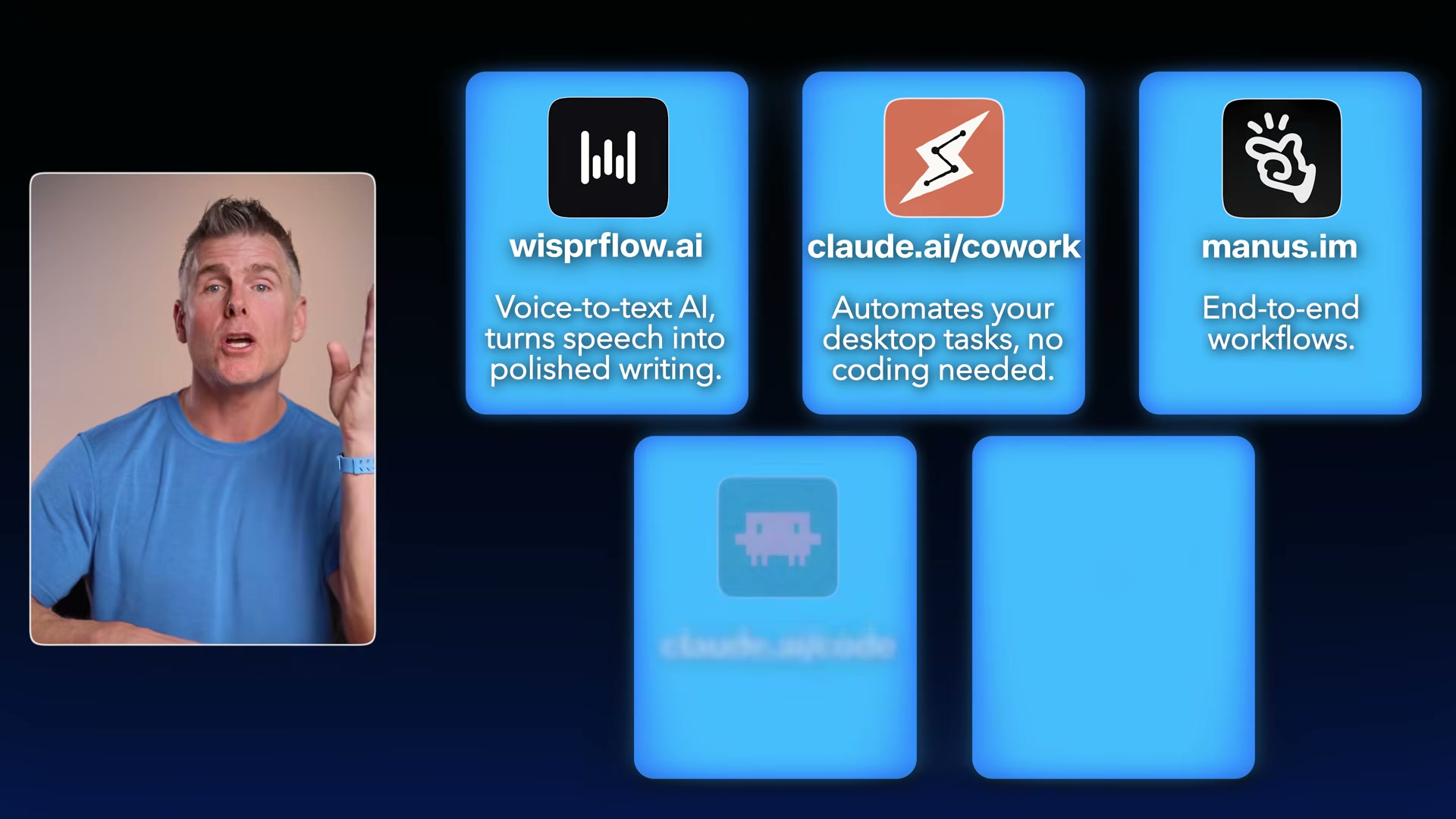
Move to Level 2 by adopting agentic tools. Tools like Manus, Claude Code, and Claude Cowork accept a goal and return a complete work product without hand-holding each intermediate step. You describe the outcome; the agent plans, executes, and delivers.
- Reassign your role from worker to agent operator. At Level 2 you configure the agent, assign the task, check the output, and iterate — you do not execute the work. Martell frames this as moving from doing to managing: you become the project manager of a set of AI workers.
- Conceptualize Level 3: a single orchestrator agent manages an entire hierarchy of specialized sub-agents across business and personal domains. Touch points collapse to one. Martell’s orchestrator is named Kai — a primary agent that spins up, delegates to, and coordinates every sub-agent beneath it.
-
Deploy a domain-specific sub-agent for real estate. Martell’s agent Reese runs continuously: scanning off-market deals, contacting brokers, and returning ranked bid recommendations with suggested offer prices. Human input is limited to a single approval decision.
-
Build a unified inbox sub-agent. All messaging platforms — email, WhatsApp, Slack, social — feed into one agent trained on your existing communication style per platform. The agent surfaces priority items, drafts context-aware replies, and handles routine responses without escalation.
-
Add a procurement sub-agent. Martell’s agent Procure handles end-to-end purchasing: product research, checkout, and shipping coordination using a monitored virtual credit card and a credential manager. The virtual card provides an audit trail and a hard limit on autonomous spend.
Warning: this step may differ from current official documentation — see the verified version below.
- Install a voice interface. The Speak agent gives the orchestrator a phone number, enabling real-time message triage and task delegation by voice call — useful when screen access isn’t available.
- Access Martell’s packaged implementation by joining the Apex waitlist. Apex (Agent Platform for Execution) is his internal build on top of OpenClaw, hardened for security and simplified for team deployment.
How does this compare to the official docs?
The framework Martell demonstrates maps loosely to concepts across several distinct platforms — Claude, Manus, and his proprietary Apex — so the next section grounds each capability in what the underlying tool vendors actually document and support.
Here’s What the Official Docs Show
Dan Martell’s three-level framework maps a real and useful progression, and Act 1 covers it faithfully from the video’s vantage point. This section adds the documentation layer — confirming what’s verifiable, surfacing one material status change before you act on it, and marking the sections where no public documentation currently exists.
Steps 1–2: Level 1 AI assistants and the throughput ceiling
The video’s framing of Level 1 — rotating between Claude, ChatGPT, Gemini, and Perplexity by task — is conceptual rather than product-specific, so there is no single vendor doc to anchor it.
No official documentation was found for these steps — proceed using the video’s approach and verify independently.
Step 3: Move to Level 2 with agentic tools (Manus, Claude Code)
Manus is a real, accessible product with exactly the goal-based input interface the video describes. The video’s approach here matches the current docs exactly.
One update you need before building a stack around it: as of April 16, 2026, a persistent site-wide banner at manus.im reads “Manus is now part of Meta — bringing AI to businesses worldwide.” The video presents Manus as an independent standalone tool with no mention of this acquisition. Roadmap, pricing, and enterprise access terms are now under Meta’s ownership — worth factoring into any procurement decision.
On Claude Code: the official Anthropic site confirms it as a real, actively maintained product consistent with the video’s framing. However, the documentation exposes two tiers the video doesn’t mention — Claude Code for Enterprise and Claude Code Security are listed as separate product entries alongside the standard Claude Code offering.

The current Anthropic flagship is Claude Opus 4.6, described on the Anthropic site as “the world’s most powerful model for coding, agents, and professional work.” The video does not specify which model version powers Claude Code, so no version mismatch can be confirmed — but Opus 4.6 is the correct reference point for any current deployment.
Step 4: Reassign your role from worker to agent operator
No official documentation was found for this step — proceed using the video’s approach and verify independently.
Steps 5–10: Kai (orchestrator), Reese, Procure, Speak, and Apex
No official documentation was found for these steps — proceed using the video’s approach and verify independently.
Martell’s proprietary agent stack — Kai, Reese, Procure, Speak, and the Apex platform — does not appear in any official third-party product documentation. These are custom implementations, not off-the-shelf tools, and their current availability, pricing, and technical architecture cannot be independently confirmed from public sources.
Useful Links
- Manus: Hands On AI — Official Manus product homepage, currently displaying a Meta acquisition announcement alongside its task-assignment interface.
- Home \ Anthropic — Anthropic corporate homepage listing Claude Code, Claude Code for Enterprise, Claude Code Security, and Claude Opus 4.6 as current products and model tiers.


0 Comments