

Quicken went from publishing one piece of content every four to five days to producing 100 pieces every few weeks — a roughly 250% year-over-year increase in output — by rebuilding their entire content operation around AI. According to Adweek, the financial software company didn’t just add AI tools on top of their existing workflow; they restructured their team, replaced junior copywriter positions with a single “editor in chief of AI” role, and rebuilt their distribution strategy around how large language models discover and cite content. This tutorial walks you through exactly how to replicate that system.
What This Is
Quicken’s AI content pipeline, as reported by Adweek in March 2026, is a real-world case study in what happens when a mid-sized brand commits fully to AI-augmented content production. The company now produces 100 pieces of content every three to four weeks across social media, editorial, and advertising channels — up from a pace of roughly one post every four to five days under their previous model.
This isn’t a marketing stunt. It’s a structural rebuild. Quicken’s CMO Euan Campbell described a fundamental change in how the company thinks about content: instead of producing fewer, higher-effort pieces, the team now treats AI as the production engine and humans as the editorial control layer. That distinction matters. Most brands are still thinking about AI as a writing assistant you use occasionally. Quicken has made it the factory floor.
The pipeline has three core components that work together:
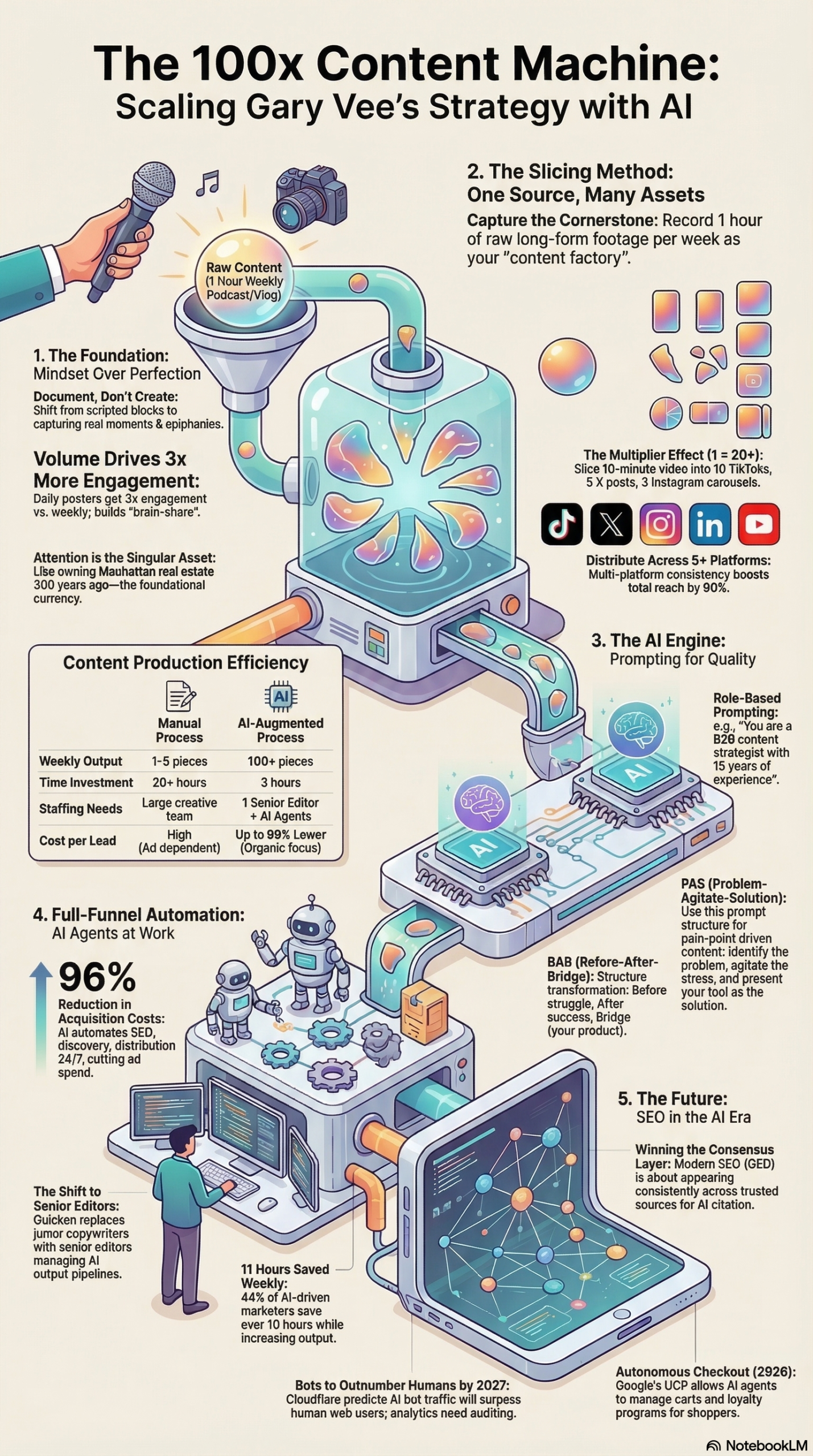
AI-generated drafts at scale. AI tools generate the raw content — social copy, ad creative, blog posts, educational articles — at a volume no human team could match. The MarketingAgent research briefing frames this within Gary Vaynerchuk’s “Document, Don’t Create” paradigm, which treats every business activity as raw material for a content factory. Vaynerchuk’s framework holds that posting 100+ pieces of content per week is the minimum threshold for “omnipresence” in an attention-saturated economy. Quicken has effectively productized this philosophy.
Senior human oversight. Rather than staffing a team of junior writers, Quicken created an “editor in chief of AI” role — a single senior editor responsible for compliance, legal vetting, and quality control across all AI-generated output. This consolidation of junior copywriter positions into one senior role is the defining workforce decision of the modern AI content era, and it’s a trend the research briefing confirms is spreading across marketing departments.
LLM-optimized distribution. Quicken discovered that users querying AI tools like ChatGPT use longer, more conversational prompts — “How do I manage my money better?” rather than “best budgeting app” — compared to traditional search queries. This insight drove them to expand distribution across Reddit and YouTube specifically to improve LLM crawlability, so their content gets cited when AI systems answer financial questions. This is not traditional SEO thinking. It’s a response to a fundamentally different discovery mechanism.
The technology stack itself isn’t proprietary. What makes Quicken’s approach replicable is the operational model: a defined role structure, a systematic editorial process, and a distribution strategy built for the AI search era rather than the Google keyword era.
One important nuance Quicken’s CMO flagged: human-created ad content still consistently outperforms AI-generated creative in terms of longevity. Per the Adweek report, AI-generated social creative lasts one to two weeks before performance drops off; human-made content averages 28 days. The pipeline isn’t about replacing humans — it’s about deploying them where they create the most leverage.
Why It Matters
The Quicken case study lands at exactly the moment the broader market hits an inflection point. According to the research briefing, 35% of enterprises have already integrated AI into their core operations, and AI agents are projected to handle up to 30% of marketing hours by 2030. The question for practitioners is no longer “should we use AI for content?” — it’s “how fast can we restructure around it before our competitors do?”
For practitioners, the Quicken model matters for three specific reasons:
It validates the ROI. The research report documents that marketing automation delivers $5.44 per dollar invested. A 250% increase in content output with a reduced headcount is a real-world proof point for that number. If your CFO is skeptical about AI content investment, Quicken is your case study. This isn’t a startup’s experimental budget — it’s a mature financial software company restructuring a proven content team around AI infrastructure.
It changes the hiring calculus. Most marketing departments are still structured around junior writers doing volume work and senior strategists doing oversight. Quicken has inverted this: AI does the volume work, and the senior role (editor in chief of AI) handles the judgment calls. This model is spreading. The research briefing cites Intuit CMO Thomas Ranese: “Execution is increasingly automated, so our teams’ value comes from what AI can’t do — deep customer insight, strategic judgment, and creative curiosity.” If you’re still hiring junior writers to produce first drafts, you’re paying human rates for work AI does in seconds.
It redefines content distribution. The insight about LLM query behavior — longer, more conversational searches — is significant for any brand that depends on content discovery. Brands that optimize only for Google’s traditional keyword model will increasingly miss the traffic coming from AI-mediated discovery. Nataly Kelly, CMO at Zappi, is quoted in the research briefing as saying: “Your AI brand presence is becoming just as important as your first-party one.” Quicken’s expansion to Reddit and YouTube for LLM crawlability is a direct, operational response to this shift — not a theoretical one.
For agencies and content teams, the bottom line is direct: you’re not evaluating whether to adopt AI content production anymore. You’re evaluating how fast to restructure around it.
The Data
The numbers behind Quicken’s transformation — and the broader market context — clarify why this structural shift is happening now and accelerating.
| Metric | Pre-AI Baseline | Post-AI Pipeline | Source |
|---|---|---|---|
| Content output pace | ~1 piece per 4–5 days | 100 pieces per 3–4 weeks | Adweek |
| Year-over-year output growth | — | ~250% increase | Adweek |
| AI creative shelf life (social) | — | 1–2 weeks avg | Adweek |
| Human creative shelf life (social) | — | 28 days avg | Adweek |
| Marketing automation ROI | — | $5.44 per $1 invested | Research Briefing |
| Weekly time savings (AI users) | — | 11 hours/week avg | Research Briefing |
| Enterprise AI adoption (core ops) | — | 35% already integrated | Research Briefing |
| AI agent share of marketing hours | — | 30% projected by 2030 | Research Briefing |
| Sales win rate lift (AI users) | — | 76% increase | Research Briefing |
| Global AI market 2025 → 2032 | $294B | $1.77T (CAGR 29.2%) | Research Briefing |
| AI bot vs. human web traffic | Human-dominant now | AI bots > humans by 2027 | Research Briefing |
The shelf life gap between AI and human content deserves extra attention. Quicken isn’t abandoning human-created content — they’re using AI to fill the volume requirement while humans produce the high-retention creative. That’s a deliberate hybrid model, not a wholesale replacement. Any pipeline you build should account for this performance difference and allocate human creative time to the formats where longevity matters most.
Step-by-Step Tutorial: Build Your AI Content Pipeline
This tutorial walks through building a Quicken-style content pipeline from scratch. I’ve structured it in four phases: infrastructure, workflow, brand voice, and distribution. Each phase builds on the last. This is the order that works — don’t skip to Phase 3 without completing Phases 1 and 2.
Prerequisites
Before starting, confirm you have:
– Access to at least one AI writing tool (Claude, ChatGPT, Gemini, or a specialized marketing AI platform)
– A content management system or editorial calendar that can handle increased volume
– At least one senior editor willing to take on the editor-in-chief-of-AI function
– A basic analytics stack with the ability to separate human traffic from bot and crawler traffic
– A documented list of your existing content formats and publication channels
If you’re missing the senior editor, stop here. The pipeline doesn’t work without editorial oversight. Scaling broken content faster just creates more problems.
Phase 1: Define Your Output Target and Role Structure
Before touching any AI tool, define what “100 pieces” means for your organization. Quicken produces 100 pieces every three to four weeks — roughly 25 to 33 pieces per week. For a smaller team starting out, target 20 to 30 pieces per week as your initial goal and scale from there.
Step 1: Map your content types and estimate production time.
List every format you publish: social posts by platform, blog articles, email newsletters, ad copy, product descriptions, FAQ content, video scripts. For each format, write down two numbers: current production time with humans only, and estimated production time with AI. The gap between those two numbers is your efficiency opportunity. Where the gap is largest, start your AI implementation first.
Step 2: Define the “editor in chief of AI” role explicitly.
This is the most important structural decision in the entire pipeline. Do not skip it or delegate it to a junior employee. The editor in chief of AI owns three distinct functions:
– Quality control: Reviewing AI drafts for factual accuracy, tone consistency, and brand alignment before publication
– Compliance: Catching legal and regulatory issues before they go live (Quicken operates in financial services — one compliance failure can cost more than a year of content production savings)
– Prompt library ownership: Maintaining and updating the prompts that generate content, retiring underperformers, and testing new approaches
This role should go to your most experienced editor or senior content strategist. The Adweek report on Quicken is explicit: senior writers are managing AI output pipelines rather than writing first drafts. That’s the operational model.
Step 3: Assign content categories to AI vs. human production.
Use this division as your starting framework, adjusting for your specific industry:
- AI-first: Social posts (all platforms), email subject lines, ad copy A/B variations, FAQ pages, product descriptions, repurposed content derived from existing long-form assets, newsletters, and metadata
- Human-first: Flagship editorial pieces, major campaign creative requiring original voice, any content requiring legal sign-off before generation, video scripts for high-production pieces, and thought leadership attributed to specific executives
This isn’t a permanent division — it should evolve as you learn which AI outputs consistently pass quality review and which don’t.
Phase 2: Build Your Prompt Library
The research briefing identifies prompt engineering as the primary competitive differentiator in 2026: “The competitive advantage lies not in having access to AI, but in the skill of directing it.” Your prompt library is the intellectual property of your content operation. Treat it that way.
Step 4: Build a brand voice snippet and make it non-negotiable.
Create a three-sentence description of your brand’s personality, tone, and prohibited language. This snippet gets prepended to every AI prompt in your library — no exceptions. Here’s an example structure for a financial services brand like Quicken:
Brand Voice Context: We are [Brand], a personal finance tool for households
managing monthly budgets. Our tone is clear, practical, and empathetic —
never condescending or alarmist. Avoid financial jargon, avoid superlatives,
and never make specific investment return promises.
According to the research briefing, including two to three sentences of brand-specific context in every prompt is the single most effective step for maintaining voice consistency across high-volume AI output. Without it, you get generic content that sounds like it came from a content farm — because it did.
Step 5: Build prompts using conversion frameworks.
The briefing documents three frameworks that consistently convert generic AI output into marketing-effective content. Match the framework to the content type:
- AIDA (Attention, Interest, Desire, Action): Use for ad copy, email sequences, and landing page copy where you need to move readers through a decision arc
- PAS (Problem, Agitate, Solution): Use for awareness content, landing pages, and any content where the reader has an identified pain point you can speak to
- BAB (Before-After-Bridge): Use for case studies, testimonial-style content, and product comparisons where transformation is the narrative
For each content type in your library, write a master prompt that includes: the brand voice snippet, the appropriate framework, the specific content format and target length, the target audience persona, and any required links, CTAs, or compliance language.
Step 6: Implement advanced prompting techniques for complex content.
For longer-form content or strategically important pieces, the research briefing recommends two advanced techniques that reduce revision cycles from five iterations down to one:
Role Stacking: Assign multiple expert perspectives within a single prompt to get output that balances competing priorities.
You are acting simultaneously as a seasoned personal finance writer with
15 years of experience AND a conversion rate optimization (CRO) specialist.
Write a 500-word blog introduction that educates the reader and drives
sign-ups for a free budgeting tool. Prioritize clarity over persuasion.
Chain-of-Thought Prompting: Ask the AI to reason through the problem explicitly before writing. This produces dramatically more coherent strategic content.
Before writing this email, think step-by-step: (1) What is the reader's
primary anxiety about budgeting this month? (2) What objection are they
most likely to raise to starting? (3) What single action do we want them
to take in the next 60 seconds? State your reasoning, then write the email.
Phase 3: Build the Editorial Workflow
Step 7: Set up your production cadence with a weekly rhythm.
For 100 pieces every three to four weeks, you need a repeatable daily structure. Here’s a sample weekly framework:
| Day | Primary Activity | Output Target |
|---|---|---|
| Monday | Generate all social posts for the week across platforms | 15–20 posts |
| Tuesday | Generate email copy, subject line variants, and ad copy | 8–12 pieces |
| Wednesday | Generate blog/editorial drafts and FAQ updates | 2–4 long-form |
| Thursday | Editor-in-chief review, compliance pass, revisions | Full week’s output |
| Friday | Schedule and publish; pull performance data from previous week | Pipeline closed |
Adjust the day-by-day allocation based on your specific mix. What matters is that generation and review are separated by at least 24 hours — reviewing content immediately after generating it reduces your ability to catch errors.
Step 8: Implement the five-step brand voice training loop.
The research briefing documents a five-step process that prevents the “bland output” failure mode that kills most AI content programs:
- Document: Create a matrix of voice attributes. Define where your brand sits on spectrums like formal↔casual, serious↔playful, authoritative↔approachable. Write these down explicitly — don’t assume everyone on the team has the same mental model.
- Collect: Curate 50 to 200 “gold standard” content samples — your historically best-performing pieces that represent ideal brand output. These become your style reference library.
- Implement: Use those samples directly in prompts: “Write this in the style and tone of the following examples: [paste 2–3 samples].” This is faster and more effective than trying to describe the style abstractly.
- Test: Run blind review panels quarterly — editors evaluate AI output against human benchmarks without knowing which is which. If reviewers can’t reliably distinguish them, your prompts are working.
- Retrain: Update your prompt library based on what passes and fails the blind review. Retire prompts that consistently underperform. Add new examples as your brand evolves.
Step 9: Establish your compliance checkpoint protocol.
Quicken’s editor in chief of AI isn’t just a quality reviewer — they’re a compliance checkpoint. Define a non-negotiable review checklist for every content category. At minimum, include:
– Does this claim require substantiation? Is the source current?
– Does this copy comply with platform advertising policies for the specific channel?
– Does this content contain outdated statistics, discontinued product features, or deprecated offers?
– Does this copy meet accessibility requirements (reading grade level, alt text if applicable)?
– Does this content make any regulatory claims that require legal review?
In financial services, healthcare, legal, or any regulated industry, skip this step at your own risk. Quicken’s creation of the editor-in-chief role was specifically designed to hold this compliance function at scale.
Phase 4: Optimize Distribution for LLM Discovery
This is where most brands haven’t moved yet — and where Quicken made a strategically significant decision.
Step 10: Audit your content footprint for LLM crawlability.
AI models cite content based on what they’ve indexed from trusted, high-volume sources: Reddit, YouTube, authoritative news and industry sites, and high-volume landing page domains. The research briefing documents that brands with 200+ indexed landing pages see significantly higher AI-driven referrals than those with minimal web presence. Run this audit against your current domain:
– How many indexed pages does your domain have? (Use Google Search Console or a crawler like Screaming Frog)
– Is your content present and active on Reddit? Quicken explicitly expanded here for LLM crawlability
– Do you have a YouTube presence with transcripts that search engines can index?
– Are your FAQ pages structured to match conversational query formats, not keyword fragments?
If you’re below 100 indexed pages, a content volume program built on the AI pipeline from Steps 1–9 will directly address this gap.
Step 11: Rewrite FAQ content for LLM query formats.
Quicken discovered that users ask AI tools “How do I manage my money better?” rather than “best budgeting app.” These are fundamentally different query structures, and they require different content structures to answer effectively. Rewrite your existing FAQ content using this format:
– Use a complete, conversational question as the heading (not a keyword fragment)
– Answer the question completely in the first sentence — don’t bury the answer
– Expand with context, examples, and supporting detail after the direct answer
– Include internal links to related content so AI crawlers can surface your broader authority
Step 12: Fix your analytics before you scale.
Quicken’s CMO discovered that analytics initially showed AI driving under 1% of traffic, while actual referral traffic was significantly higher — because users weren’t clicking trackable links from AI tool responses. The research briefing documents that AI bot traffic is expected to outnumber human web traffic by 2027. If you’re running standard last-click attribution, your AI-referral data is already inaccurate.
Configure your analytics platform to filter known AI crawler user agents into a separate segment. Set up a direct traffic analysis dashboard that accounts for AI-referred visits that arrive without UTM parameters. This gives you an accurate baseline before you start attributing results to the pipeline.
Expected Outcomes: After 90 days operating this pipeline, expect a 150–250% increase in content output volume, measurable reduction in cost-per-piece produced, and initial signals of improved LLM citation frequency if the crawlability audit is implemented.
Real-World Use Cases
Use Case 1: Financial Services Brand (The Quicken Blueprint)
Scenario: A personal finance app with a three-person content team wants to compete with the editorial volume of much larger operations without proportionally increasing headcount.
Implementation: The team designates their most senior writer as editor in chief of AI. AI generates 80% of social content and ad copy; human writers produce two to three flagship articles per month and all video scripts. The team builds a brand voice snippet emphasizing practical clarity and avoidance of financial alarmism, per their compliance requirements. FAQ content is rewritten in conversational query format and distributed across Reddit communities where their target audience already asks money questions.
Expected Outcome: 200%+ increase in content volume within 60 days, with compliance maintained through the editor-in-chief checkpoint. Expanded Reddit and YouTube presence begins improving LLM citation frequency for core financial queries within 90 to 120 days.
Use Case 2: E-Commerce Brand with Large Product Catalog
Scenario: An online retailer with 5,000+ SKUs needs product descriptions, email campaigns, and social content running simultaneously, but can’t staff enough writers to maintain all three at once.
Implementation: AI generates all product descriptions using a templated prompt that pulls in category, key features, and target customer persona. Social content is generated in weekly batches of 30 posts using platform-specific prompts. The team uses Chain-of-Thought prompting for email sequences addressing abandoned cart scenarios and re-engagement flows — the AI reasons through the customer’s drop-off psychology before writing.
Expected Outcome: Complete product description library built in days rather than months. Email open rates maintain parity with human-written campaigns because the brand voice snippet preserves tone. The team can now run promotions across all SKU categories simultaneously rather than focusing on their top sellers.
Use Case 3: Marketing Agency Managing Multiple Client Accounts
Scenario: A five-person agency managing 12 client accounts needs to produce consistent content for each client without adding writers. Their current model has senior strategists doing work that AI could handle.
Implementation: Each client gets a dedicated brand voice snippet and a separate prompt library stored in a shared document system. The agency builds a master editorial calendar template reused across all accounts and runs weekly batch generation sessions — roughly two hours of AI prompting produces the week’s content for all 12 clients. A senior strategist reviews output for each client using a tiered review system: full review for ad copy and landing pages, spot-check for social posts.
Expected Outcome: Agency absorbs three to five additional clients without additional headcount. The bottleneck shifts from content production to client strategy — which is where the senior talent should be spending time and billing hours.
Use Case 4: B2B SaaS Company Building AI Search Visibility
Scenario: A B2B SaaS company wants to improve their visibility when potential customers query AI tools for solutions in their product category. Their current SEO strategy is Google-focused and not designed for LLM citation.
Implementation: The content team audits their current indexed page count and finds 45 pages — well below the 200+ threshold documented in the research briefing. They build an AI-assisted content program producing 10 new landing pages and FAQ articles per week, all structured to answer conversational LLM-style queries relevant to their product category. Distribution expands to Reddit communities and LinkedIn groups where their target buyers ask questions. They begin tracking monthly ChatGPT and Perplexity citations for their key category queries.
Expected Outcome: Indexed page count reaches 200+ within five months. AI-generated referral traffic becomes measurable in their analytics. Brand citations begin appearing in AI tool responses for category-relevant queries within six to eight months.
Use Case 5: Independent Media Publisher Maintaining Publishing Frequency
Scenario: An independent media publisher has lost two staff writers and needs to maintain daily publishing frequency without the budget to replace both positions immediately.
Implementation: AI generates first drafts for news roundups, trend summaries, listicles, and how-to guides. Remaining senior editors handle original reporting, interviews, and opinion pieces exclusively — zero AI involvement in those formats. The publisher implements the repurposing engine: each long-form article gets processed through a repurposing prompt that produces five to eight social posts, an email newsletter excerpt, and a short video script.
Expected Outcome: Daily publishing frequency maintained with 40% of the previous headcount. Each human-produced piece generates six to eight additional content assets through AI repurposing, multiplying the value of every hour of original reporting.
Common Pitfalls
Pitfall 1: Scaling volume before the compliance checkpoint is in place.
The biggest operational risk in high-volume AI content is a compliance failure that gets published at scale. Quicken built the editor-in-chief role specifically to prevent this. If you automate publication without a human review step, one bad prompt can push legally problematic content across 100 pieces simultaneously. Build the review checkpoint into your workflow — and test it — before you increase volume. This is especially critical in regulated industries.
Pitfall 2: Measuring AI-driven traffic with unchanged analytics.
Quicken’s CMO found their analytics dramatically undercounted AI referral traffic because users weren’t clicking trackable links from AI tool responses. Standard last-click attribution doesn’t capture this behavior. If you launch an AI content pipeline and judge its performance using a broken measurement framework, you’ll make wrong decisions about what’s working. Fix your analytics before you scale.
Pitfall 3: Assigning AI oversight to the most junior team member.
The Adweek report is explicit: Quicken moved away from junior copywriters, not toward them. If you assign AI content review to your least experienced person to save cost, you’ll get the lowest-common-denominator output reviewed at the lowest standard. The editor-in-chief role requires editorial judgment, industry knowledge, and brand authority — not just proofreading.
Pitfall 4: Building a static prompt library.
A prompt that works today will drift as the AI model updates or your brand evolves. If you write your prompts once and treat them as permanent, output quality will gradually degrade without a clear cause. The research briefing recommends continuous feedback loops and quarterly prompt library reviews at minimum. Treat your prompts as a living system, not a finished product.
Pitfall 5: Ignoring the AI creative shelf life gap.
Per the Adweek report, AI-generated social creative lasts one to two weeks on average; human-made content lasts 28 days. If you replace all human creative with AI creative without tracking performance decay, you’ll run declining ads longer than you should and underinvest in the high-retention human pieces. Track creative shelf life by source type and adjust your production mix accordingly.
Expert Tips
Tip 1: Run a consensus layer audit before you scale production.
Before producing 100 pieces of content, audit where your brand is currently cited across the web. The research briefing explains that AI models cite brands based on frequency of appearance across authoritative third-party sources — what the briefing calls the “consensus layer.” If your brand has limited third-party citations today, content volume alone won’t significantly improve your AI search visibility. Invest in PR placements, content partnerships, and earned media simultaneously with your pipeline build.
Tip 2: Stack compliance roles into prompts for regulated industries.
If you operate in financial services, healthcare, insurance, or legal — like Quicken — add a compliance perspective directly into your prompt role stacking: “You are a senior copywriter and a financial compliance officer reviewing this output for regulatory issues before it goes live.” This doesn’t replace human compliance review, but it catches obvious issues before the editor-in-chief wastes time on them.
Tip 3: Create a tiered review system, not a uniform one.
Not all AI content carries equal risk. Tier 1 (high-stakes: paid ads, landing pages, flagship editorial) gets full human review before publication. Tier 2 (medium-stakes: social posts, email copy) gets spot-check review of 20% of output. Tier 3 (low-stakes: FAQ pages, product descriptions, metadata) gets automated quality checks only. This tiering system lets you scale volume without scaling review time linearly, which is the only way the economics work at 100 pieces per cycle.
Tip 4: Track LLM citations as a leading indicator.
Don’t wait for analytics to show AI referral traffic — actively query ChatGPT, Perplexity, Claude, and Gemini for your key category questions monthly and record whether your brand appears in the responses. This is your most direct signal of AI search visibility progress, more reliable than analytics data given the tracking gaps Quicken identified. Document the queries and responses in a simple spreadsheet so you can track changes month over month.
Tip 5: Repurpose before you create.
Before generating net-new content, audit your existing high-performing pieces. A 2,000-word blog post can generate 15 to 20 social posts, three email sequences, and five ad copy variations — all through AI repurposing prompts. The research briefing documents that a single long-form asset can produce 20 to 50 smaller assets. Most brands are leaving this leverage on the table while they pay to generate new content from scratch. Start with repurposing; move to net-new creation once you’ve exhausted your existing content inventory.
FAQ
Q: How long does it take to build an AI content pipeline from scratch?
Realistically, four to six weeks from decision to full production volume. Week one: role definition, brand voice documentation, and audit of existing content inventory. Week two: prompt library build for each content type. Week three: test run at 30–40% of target volume with full editorial review to catch prompt failures. Week four onward: scale to target volume with the tiered review system in place. The infrastructure is straightforward — the most common bottleneck is identifying the right person for the editor-in-chief function and getting them bought in on the workflow change.
Q: Does AI content actually perform as well as human-written content?
It depends on the format and the metric you’re measuring. Per the Adweek report on Quicken, human-created ads consistently outperform AI-generated versions in head-to-head tests, though the results vary weekly. AI content also has a demonstrably shorter shelf life on social media — one to two weeks versus 28 days for human creative. The practical answer is a deliberate hybrid: AI for volume and velocity, humans for high-retention flagship content. Don’t try to replace one with the other entirely.
Q: How do you prevent AI content from sounding generic?
Genericism is a prompt quality problem, not an AI capability problem. The three-step fix from the research briefing: first, build a brand voice snippet and prepend it to every single prompt without exception; second, use 50 to 200 gold-standard content samples as explicit style references in your prompts for complex content; third, run blind review panels quarterly where editors compare AI output to human benchmarks and flag anything that sounds off-brand. If your output sounds like it came from a generic content farm, your prompts are missing specificity.
Q: What’s the right ratio of AI to human content production?
Quicken’s operational model suggests roughly 80% AI-generated (social, email, ad copy, FAQ, repurposed content) and 20% human-led (flagship editorial, video creative, compliance-critical content). The research briefing frames this as AI handling “low-value, repetitive tasks” while humans own “deep customer insight, strategic judgment, and creative curiosity.” This ratio will shift as AI creative performance improves — but the shelf life data suggests human creative still earns its cost in high-stakes placements for now.
Q: How do you measure the ROI of an AI content pipeline?
Track five metrics on a monthly basis: (1) cost-per-piece-produced — divide total content budget by total pieces published; (2) total content volume — pieces per week or per month; (3) creative shelf life by source — AI-generated versus human-generated performance decay rate; (4) LLM citation frequency — track manually through monthly AI tool queries for your key category questions; (5) lead generation or conversion metrics by content type. The research briefing documents $5.44 return per dollar invested in marketing automation as the industry benchmark — use that as your target and measure your actual ROI against it each quarter.
Bottom Line
Quicken’s move to 100 pieces of content every few weeks isn’t an experiment — it’s a production reality backed by a 250% year-over-year increase in output and a deliberate restructuring of their content team. The model is replicable if you execute in the right order: define the editor-in-chief role before you scale volume, build your prompt library before you batch-generate content, and fix your analytics before you try to measure results. The brands that hesitate on restructuring their content teams will find themselves competing against organizations that have already operationalized this at scale with a smaller headcount. As Nataly Kelly, CMO at Zappi, puts it: your AI brand presence is becoming just as important as your first-party one — and building it starts with the pipeline infrastructure described here.


0 Comments