

Eighty-eight percent of companies are using AI in at least one function — but only 5% to 7% have successfully scaled those initiatives into production-grade deployments that deliver material business value, according to MarTech’s deep-dive on AI strategy and governance. The gap between running a demo and running a competitive operation isn’t a model problem; it’s a strategy and governance problem. This guide walks you through the exact framework — from AI Center of Excellence design to governance compliance — to move your organization from perpetual pilot to scaled AI advantage.
What This Is
The concept of building an AI competitive edge through strategy and governance addresses a structural crisis inside most enterprises: the ability to spin up AI prototypes has far outpaced the ability to turn those prototypes into reliable business assets. Researchers at Meta Intelligence describe this as “Pilot Purgatory” — a state where organizations run dozens of proof-of-concept projects simultaneously but never fundamentally change their value chain.
The math is stark. According to the NotebookLM research report on enterprise GenAI adoption, over 70% of enterprise Large Language Model (LLM) proof-of-concept projects fail to transition to production. The primary bottleneck is not the technology itself — it is organizational unreadiness: lack of a business value hypothesis, inadequate data governance, workflow designs that haven’t changed, and compliance frameworks bolted on as an afterthought.
What “building an AI competitive edge” actually means is creating a durable infrastructure that competitors cannot easily replicate. As Mike Ukstins, Director of Strategic Accounts at Cella by Randstad Digital, puts it: “The cost of average has dropped to zero. The only way to stand out is investing in things the machine can’t do.” Those things are proprietary data, human judgment at critical checkpoints, and governance frameworks that let teams move fast without losing brand integrity.
This framework involves three interlocking components:
- Organizational Infrastructure: An AI Center of Excellence (CoE) that acts as both a standards hub and a deployment coach across business units.
- Workflow Redesign: Not layering AI onto existing processes, but rethinking which tasks AI owns, which humans own, and how handoffs work.
- Governance and Compliance: Operationalizing risk management so that regulatory requirements (including the EU AI Act, enforceable by August 2026) are built into the pipeline, not added after the fact.
The strategic lens here is important. This is not about which LLM you use. GPT-4, Claude, Gemini — these are table stakes. The organizations pulling ahead are the ones who have built proprietary data moats, established clear operational protocols, and embedded AI into core business processes rather than keeping it in a skunkworks lab. As the research report notes, success is measured not by the “wow factor” of a prototype but by the ability to build an “AI factory” — a resilient, governed, scalable ecosystem integrated into the fabric of daily operations.
Why It Matters
For marketing practitioners, content teams, and enterprise leaders, this framework changes the competitive calculus entirely. The underlying problem is structural: Large Language Models now train on AI-generated content at scale, which means generic outputs are getting more generic, not less, as Ukstins notes. The companies that feed AI systems with their own performance data — winning subject lines, proprietary research, brand voice documentation — will produce outputs competitors cannot replicate with a public API key.
For marketing and content teams: The shift is from prompt engineering to strategic briefing. A prompt is a steering wheel, but it only works if the engine has proprietary fuel. Organizations that have built structured prompt libraries and connected their AI tools to internal knowledge bases via Retrieval-Augmented Generation (RAG) are producing content and analysis that reflects institutional knowledge — not just the averaged-out training data that everyone else is drawing from.
For enterprise leaders and CMOs: The governance angle is no longer optional. The EU AI Act becomes enforceable in August 2026, and organizations with high-risk AI applications that have not implemented documented risk taxonomies, audit trails, and human oversight checkpoints face regulatory exposure. The NIST AI Risk Management Framework offers a voluntary starting point, but the EU Act is binding — and compliance requires more than a policy document.
For developers and ML engineers: The gap between a Jupyter Notebook prototype and a production-grade API service is where most projects die. The engineering complexity of model serving, latency optimization, caching strategies, and error handling is routinely underestimated in early-stage pilots. Building this infrastructure correctly the first time — with MLOps pipelines and automated evaluation frameworks — is what separates the 5% that scale from the 70% that stall.
The ROI data supports urgency: according to the research report, organizations that follow a structured deployment methodology achieve a 2.4x higher success rate in scaling AI initiatives, and high performers are three times more likely to redesign workflows in depth rather than layering AI onto existing processes.
The Data: AI Governance Frameworks Compared
Before building your governance structure, you need to understand which frameworks apply to your organization and what each one requires. Here is a side-by-side comparison from the enterprise GenAI research report:
| Framework | Nature | Key Focus | Enforceability |
|---|---|---|---|
| EU AI Act | Binding Law | Risk-based taxonomy: Unacceptable, High, Limited, Minimal risk. | Enforceable Aug 2026 |
| NIST AI RMF | Voluntary Guidance | Four functions: Govern, Map, Measure, Manage. Sector-agnostic. | Voluntary |
| ISO/IEC 42001 | Certifiable Standard | Management system: leadership, data governance, continual improvement. | Certifiable |
AI Center of Excellence: The Four Pillars
The research report documents that successful enterprise AI programs are built around a CoE with four functional pillars:
| Pillar | Focus Areas |
|---|---|
| Strategy | Business alignment, ROI modeling, build-vs-buy decisions, roadmap development |
| People | Talent mix (Data Scientists, ML Engineers, Ethics Officers), org-wide upskilling |
| Processes | Rapid experimentation, standardized development, continuous improvement loops |
| Technology | Cloud + GPU infrastructure, MLOps/LLMOps pipelines, data management tools |
Phase-Based Deployment Timeline
| Phase | Timeframe | Primary Goal | Key Outputs |
|---|---|---|---|
| Exploration | Months 1–2 | Validate business value hypothesis | Pain point inventory, ROI estimates |
| Validation | Months 3–4 | Build production-grade POC | Evaluation framework, user test results |
| Scaling | Months 5–6 | Transform into a product | MLOps pipelines, training programs, feedback loops |
Step-by-Step Tutorial: Implementing the AI Strategy and Governance Framework
This is the operational guide for taking your organization from AI experimentation to scaled competitive advantage. I have structured this around the three-phase methodology documented in the enterprise GenAI research, which delivers a 2.4x higher success rate compared to ad-hoc approaches.
Prerequisites
Before you start, confirm you have the following in place:
- An executive sponsor with budget authority and P&L visibility — AI strategy without business ownership fails
- A designated cross-functional team that includes someone from IT/engineering, business operations, legal/compliance, and at least one domain expert from the target business unit
- Access to internal data assets — performance data, CRM records, brand documentation, historical campaign results
- A defined problem statement — not “we want to use AI” but “we spend 40 hours per week on X task and it has Y dollar impact if we reduce it by Z%”
Phase 1: Exploration — Validate Before You Build (Months 1–2)
The most common failure in enterprise AI is building before validating. As the research report documents, projects that originate from external stimuli (“our competitor just launched an AI chatbot”) rather than concrete business pain points consistently fail to produce ROI.
Step 1: Run a Pain Point Inventory
Map every high-friction, high-volume workflow in your target business unit. For each one, document: current time cost, error rate, cost of errors, and frequency. Rank by potential ROI impact, not by “how cool would AI be here.”
Step 2: Write a Business Value Hypothesis
For your top-ranked pain point, write a single-sentence hypothesis: “If we automate [specific task] using AI, we expect to reduce [cost/time/error rate] by [X%] within [timeframe], measured by [KPI].” This KPI must map to a line in the P&L — not to a model accuracy metric.
Step 3: Map Your Data Assets
Conduct a data inventory before writing a single line of code. Identify: what internal data exists that is relevant to this use case, its format and location, its quality and completeness, and any privacy or compliance classifications. This is the step that determines whether RAG is feasible and what your proprietary data moat looks like.
Step 4: Make the Build-vs-Buy Decision
Use the five-dimensional evaluation matrix from the research report to select your initial technology path:
- Performance Requirements — Does a closed-source API (GPT-4, Claude) meet the quality bar, or do you need a fine-tuned open-source model?
- Data Security — Can proprietary training data be sent to a third-party API, or must processing stay on-premise?
- Cost Structure — At what inference volume does a self-hosted model become cheaper than API pricing?
- Customization — Does the use case require fine-tuning, or will RAG + prompt engineering suffice?
- Operational Capability — Does your team have the capacity to operate and maintain a self-hosted model?
For most organizations, the correct answer at this phase is a dual-track strategy: use a commercial API for speed-to-market validation while simultaneously evaluating open-source alternatives (LLaMA, Mistral) for your production path.
Phase 2: Validation — Build the Right POC (Months 3–4)
This phase is where most organizations try to skip ahead to demos. Resist that impulse. The goal is a production-grade proof-of-concept, not a polished presentation.
Step 5: Implement a RAG Layer
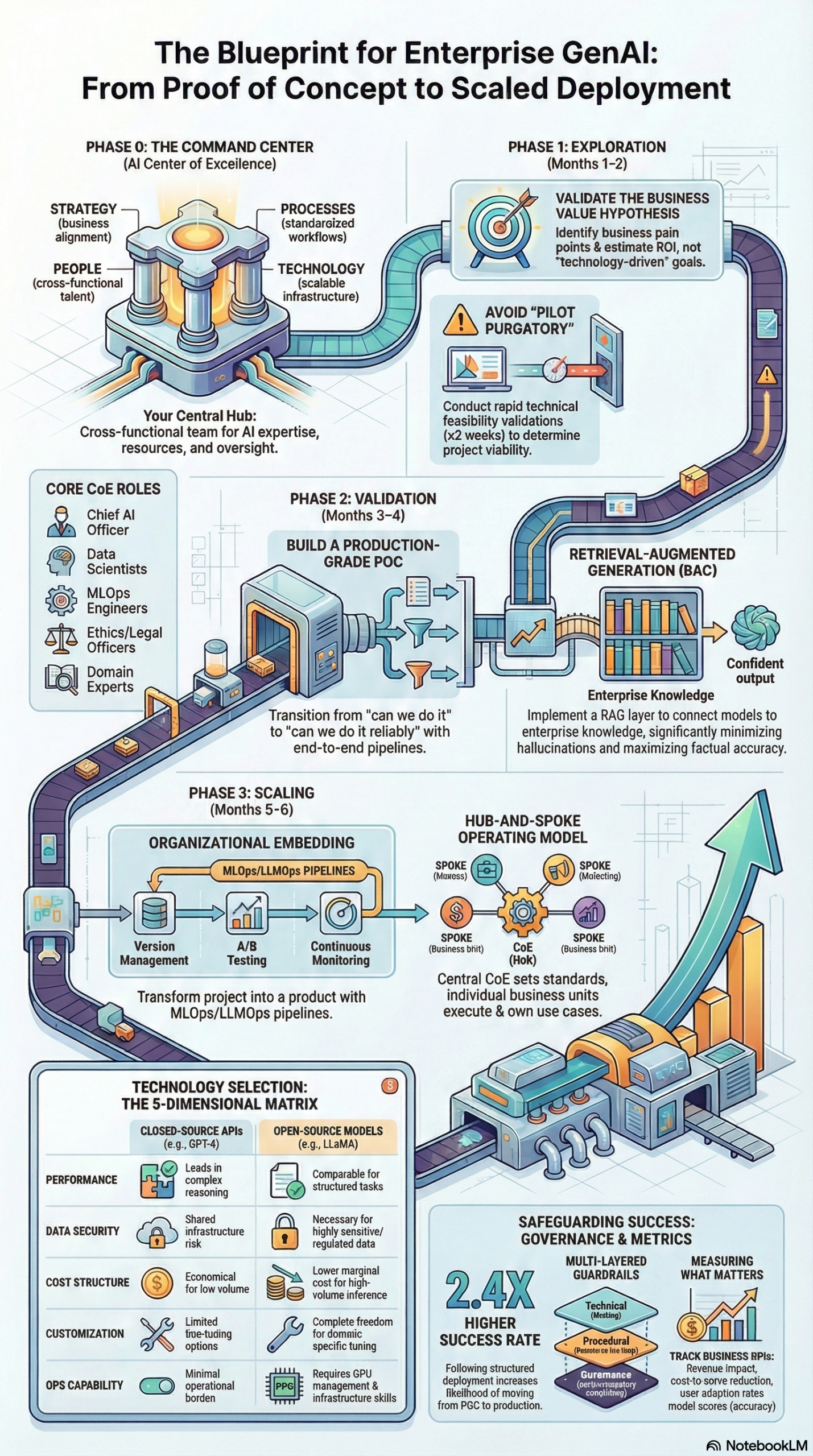
Retrieval-Augmented Generation is foundational to any enterprise AI deployment. Without it, your LLM produces generic outputs from its training data. With it, the model retrieves relevant context from your proprietary knowledge base before generating a response. Here is the minimum viable RAG architecture:
- Document ingestion pipeline: Process your internal documents (PDFs, Google Docs, CRM exports) into a vector database (Pinecone, Weaviate, pgvector)
- Embedding model: Convert text chunks into vector representations (OpenAI
text-embedding-3-smallor an open-source equivalent) - Retrieval mechanism: At inference time, embed the user query, retrieve the top-K relevant chunks from your vector store, and inject them into the LLM prompt as context
- LLM layer: Pass the enriched prompt to your chosen model with a system prompt that anchors the model to the retrieved context
This architecture means your AI is drawing on your winning subject lines, your brand voice guide, your past campaign data — not just the averaged-out internet.
Step 6: Build Your Evaluation Framework
Do not rely on subjective impressions to assess whether your POC is working. Establish a structured evaluation framework before user testing begins. Define metrics across three layers:
- Technical metrics: Retrieval precision, response latency, token cost per query
- Quality metrics: Factual accuracy rate, brand voice consistency score, hallucination rate (manual sample review)
- Business metrics: Time saved per task, error rate reduction, user adoption rate
Run at least four weeks of small-scale user testing with actual practitioners, not just the project team. Track every metric in a shared dashboard.
Step 7: Define Human-in-the-Loop Checkpoints
As Ukstins documents in the MarTech article, governance means establishing checkpoints where human judgment is required — not just hoping practitioners remember to review AI outputs. Define:
- Which decisions AI owns (first-draft generation, data summarization, research aggregation)
- Which decisions humans own (final editorial approval, strategic positioning, compliance review)
- Red line policies — 3 to 5 non-negotiable standards that AI outputs must never violate (factual accuracy, brand safety claims, regulatory language)
Document these policies. They become the foundation of your governance framework.
Step 8: Establish Governance Documentation
At this phase, before you scale, document:
- Model versioning protocol (which model version is in production and why)
- Automated usage logging (every AI query and output logged with timestamp, user, and context)
- Data classification for all training and retrieval sets
- Escalation path for human-in-the-loop intervention when outputs fall below quality thresholds
- Mapping of your use case to the EU AI Act risk taxonomy
Phase 3: Scaling — Build the AI Factory (Months 5–6)
If Phase 2 validated your hypothesis and your evaluation metrics are trending positive, you now need to productize. The research report is explicit: the goal is to transform the project into a product embedded in daily operations.
Step 9: Build MLOps Pipelines
Production AI is not a model — it is an automated system that includes:
- CI/CD pipelines for model updates and prompt version changes
- Monitoring dashboards for production quality metrics with alerting when metrics degrade
- A/B testing infrastructure for evaluating prompt variations, retrieval strategies, and model upgrades
- Rollback procedures that can revert to a previous model version within minutes
Step 10: Deploy the Hub-and-Spoke Operating Model
Scale through structure, not chaos. The research report recommends a hub-and-spoke model where the AI CoE (hub) maintains standards, governance, and shared infrastructure while individual business units (spokes) own execution of their specific use cases. This prevents both centralization bottlenecks and ungoverned fragmentation.
Step 11: Shift Your KPIs
Stop measuring model performance. Start measuring business outcomes. Replace perplexity scores and BLEU scores with:
- Customer Lifetime Value changes attributable to AI-assisted workflows
- Speed-to-market improvements (campaign cycle time, content production rate)
- Operational cost reduction (time saved × loaded labor rate)
- Error rate reduction in target workflows
Expected Outcomes: An organization that executes this three-phase methodology with fidelity should expect to achieve production-ready deployment within six months, with clear line-of-sight to P&L impact by month eight. The 2.4x success rate multiplier documented in the research report applies specifically to teams that follow structured methodology versus ad-hoc experimentation.
Real-World Use Cases
Use Case 1: Content Marketing Team Builds a Proprietary Data Moat
Scenario: A B2B SaaS content team is generating blog posts, email sequences, and social copy using commercial AI tools — but their content is indistinguishable from competitors who use the same tools.
Implementation: They implement a RAG system connected to five years of campaign performance data, their customer interview transcripts, and their top 50 performing pieces of content. Every AI generation request retrieves relevant context from this proprietary library before producing output. They also replace generic prompts with strategic briefs that include business objective, target audience psychographics, brand voice parameters, and performance benchmarks from past campaigns.
Expected Outcome: AI outputs that reflect actual customer language, proven messaging frameworks, and brand voice that cannot be replicated by a competitor with access to the same foundation model. Content production rate increases while editorial review time decreases because outputs require fewer revisions. As Ukstins notes, tools like Google’s NotebookLM can serve as the foundation for private, specialized engines that competitors cannot replicate.
Use Case 2: Enterprise Workflow Redesign for Customer Service Operations
Scenario: A financial services company has deployed an AI chatbot for customer service, but satisfaction scores have not improved because the AI was layered onto the existing broken process rather than redesigned around it.
Implementation: Following the workflow redesign principles documented in the research report, the team maps every step of the current customer service workflow, identifies the precise handoff points between AI and human agents, and redefines job descriptions accordingly. AI handles first-contact triage, information retrieval, and draft response generation. Human agents handle exception handling, emotional escalations, and final approval on any response involving regulatory language. Red line policies are defined: AI cannot make promises about refunds, regulatory timelines, or account modifications without human sign-off.
Expected Outcome: A workflow where AI reduces the cognitive load on human agents without removing human accountability on high-stakes decisions. Customer satisfaction improves because human agents are available for complex cases rather than bogged down in routine queries.
Use Case 3: Enterprise AI CoE Stands Up Governance Infrastructure Ahead of EU AI Act
Scenario: A European retailer with AI-powered pricing, product recommendation, and fraud detection systems needs to achieve EU AI Act compliance before the August 2026 enforcement deadline.
Implementation: They establish a formal AI Center of Excellence with a dedicated Ethics Officer and map each AI system to the EU AI Act’s risk taxonomy. Their fraud detection system is classified as High Risk, triggering requirements for human oversight, audit logging, and bias testing. They implement ISO/IEC 42001 as their certifiable management system, establishing documented data governance policies, model versioning controls, and a quarterly audit cycle. The CoE also publishes internal guidelines for each business unit on which AI applications require CoE review before deployment.
Expected Outcome: Full EU AI Act compliance before the enforcement deadline, plus a governance infrastructure that scales as new AI applications are added. The CoE also creates a competitive moat: enterprise customers in regulated industries gain confidence from auditable AI processes.
Use Case 4: Marketing Agency Implements Dual-Track Technology Strategy
Scenario: A mid-size digital marketing agency wants to reduce its dependency on expensive per-token API costs as AI becomes central to client deliverables.
Implementation: Following the dual-track strategy from the research report, the agency uses GPT-4 for client-facing, high-stakes applications (strategy documents, executive briefs, creative concepting) while deploying a self-hosted open-source model (LLaMA 3 on AWS) for high-volume, commodity tasks (meta description generation, image alt text, first-draft social copy). The build-vs-buy decision used all five evaluation dimensions: performance, data security, cost, customization, and operational capacity.
Expected Outcome: A 40–60% reduction in AI infrastructure costs on high-volume tasks while maintaining commercial model quality for strategic work. The agency’s own practitioners operate the open-source stack, building internal capability that reduces long-term vendor dependency.
Common Pitfalls
Pitfall 1: Starting with Technology Instead of a Business Problem
The most common failure pattern documented in the research report is initiating AI projects in response to competitive pressure or executive enthusiasm rather than a concrete business pain point. Without a business value hypothesis tied to a P&L metric, there is no objective way to evaluate whether the project is succeeding. Fix: write the value hypothesis before you evaluate any technology.
Pitfall 2: Treating Data Governance as an Afterthought
Teams frequently assume that LLMs require no data preparation — that you can point the model at unstructured internal documents and get reliable output. This is wrong. High-quality contextual data is required for effective few-shot learning and RAG retrieval. The research report documents data governance neglect as one of the six primary causes of POC failure. Fix: conduct a data inventory and classification exercise before any model integration begins.
Pitfall 3: Layering AI onto Broken Workflows
According to the research report, AI generates little value when superimposed on obsolete processes. A workflow that is slow and error-prone before AI is still slow and error-prone after — just with more automated steps producing more errors faster. Fix: map the target workflow end-to-end, identify the structural problems, redesign first, then determine where AI fits in the redesigned process.
Pitfall 4: Single-Vendor Lock-In
Tying your entire AI strategy to a single closed-source API exposes the organization to pricing changes, service disruptions, and capability limitations. As the research report documents, this is a standard failure mode. Fix: implement the dual-track strategy from day one — commercial API for speed-to-market, open-source infrastructure in parallel development.
Pitfall 5: Measuring the Wrong Things
Teams that measure model accuracy metrics (perplexity, BLEU score, human preference ratings) instead of business KPIs cannot make the case for continued investment when budgets tighten. Fix: from Phase 1, define KPIs that appear on the P&L. Every evaluation review should lead with business metrics, not model metrics.
Expert Tips
Tip 1: Build Your Prompt Library Before You Scale
One of the operational readiness checklist items from the research report is a standardized prompt library. Document every approved prompt template with its intended use case, tested parameters, and quality benchmark. Version-control it alongside your code. When a new practitioner joins, the prompt library is their onboarding document for AI-assisted work.
Tip 2: Use AI to Stress-Test Strategy, Not Just Produce Content
Ukstins recommends using AI as a thinking partner before execution, not just a production engine. Before finalizing a campaign strategy or market positioning, run it through your AI system with an adversarial prompt: “What are the three strongest objections to this strategy from a competitor’s perspective?” This surfaces blind spots before they become expensive mistakes.
Tip 3: Treat Workflow Redesign as a Political Project
The research report quotes Bertrand Duperrin: “A workflow is not just a diagram, it is also a political territory, with actors, rules, routines, and power relations.” Getting buy-in for AI-driven workflow redesign requires negotiating with the people whose authority is being reallocated. Involve department heads and process owners early. Frame changes around role enhancement, not replacement.
Tip 4: Implement Automated Quality Monitoring from Day One
Do not wait for a production quality incident to build monitoring. Establish automated checks on AI output quality from the first day of production deployment: hallucination detection sampling, brand voice consistency scoring, and factual accuracy spot-checks. Set alert thresholds that trigger human review before issues reach end users.
Tip 5: Map Every AI System to the EU AI Act Risk Taxonomy Now
Even if your organization operates primarily outside the EU, the August 2026 enforcement deadline affects any organization processing EU citizen data. The risk taxonomy classification (Unacceptable, High, Limited, Minimal) determines your compliance obligations. Running this classification exercise now — before enforcement begins — gives you 12 to 18 months to remediate high-risk systems. The research report frames AI-first governance as “built-in” rather than “bolted-on,” and the EU AI Act compliance timeline makes this urgency concrete.
FAQ
Q1: What is the difference between an AI Center of Excellence and just an AI team?
An AI team is typically a group of technical practitioners who build AI solutions. An AI CoE is an organizational structure that functions simultaneously as a standards body, a governance authority, and an internal consulting service. Per the research report, the CoE operates as both a hub (providing reference architectures, model catalogs, and governance standards) and a coach (guiding individual business units through pilots and scaling). The CoE owns cross-cutting concerns like compliance, vendor relationships, and MLOps infrastructure, while business unit teams own domain-specific execution.
Q2: How do I justify the cost of RAG infrastructure versus just using a standard LLM API?
The business case for RAG rests on two factors: output quality and proprietary differentiation. A standard LLM API produces outputs grounded in public training data — the same training data your competitors access. A RAG system connected to your proprietary performance data, customer insights, and brand documentation produces outputs that reflect your institutional knowledge. Quality improves (fewer hallucinations, more relevant responses), and the outputs become a competitive asset rather than a commodity. The research report identifies RAG as foundational to any enterprise deployment precisely because it addresses the hallucination problem that makes raw LLM outputs unreliable for business-critical applications.
Q3: How should we approach the EU AI Act if we are a US-based organization?
If your organization processes data from EU citizens — which covers most global enterprises — the EU AI Act applies to you regardless of where you are incorporated. The research report documents that the Act becomes enforceable in August 2026. Your first step is to map every AI system that touches EU citizen data to the Act’s risk taxonomy. High-risk applications (those affecting employment, credit, education, law enforcement, or critical infrastructure) require documented human oversight, audit logging, bias testing, and registration. Engaging EU legal counsel with AI Act expertise now — rather than in Q3 2026 — is the practical advice.
Q4: What does a “dual-track technology strategy” look like in practice?
A dual-track strategy means running two technology paths simultaneously rather than betting entirely on one approach. Track 1 uses a commercial closed-source API (GPT-4, Claude, Gemini) for speed-to-market — you get high-quality output quickly with minimal infrastructure overhead. Track 2 develops open-source model capability (LLaMA, Mistral, Falcon) on your own infrastructure for high-volume, sensitive, or cost-sensitive applications. The research report recommends this approach specifically to avoid the vendor lock-in risk that comes from building your entire AI strategy on a single provider’s API pricing and availability.
Q5: How long does it realistically take to move from pilot to production?
Based on the three-phase methodology documented in the research report, a well-structured deployment takes six months from exploration to scaled production for a single use case. Exploration (months 1–2) validates the business value hypothesis and maps data assets. Validation (months 3–4) builds a production-grade POC and runs four-plus weeks of structured user testing. Scaling (months 5–6) implements MLOps pipelines and embeds the AI capability into daily operations. Organizations that skip phases or run multiple pilots simultaneously without structured methodology see the 70% failure rate documented in the report. The 2.4x success rate advantage comes from following the methodology with fidelity, not speed.
Bottom Line
The organizations building sustainable AI competitive advantage are not the ones with the most sophisticated prompts or the largest model budgets — they are the ones that have built the infrastructure to absorb AI at scale. That means a governed, cross-functional AI Center of Excellence; workflows that have been genuinely redesigned rather than AI-patched; a proprietary data moat via RAG that competitors cannot replicate with a public API; and governance frameworks built into the pipeline rather than bolted on afterward. The 70% pilot failure rate documented in the enterprise GenAI research is not a technology problem — it is a strategy and structure problem, and it is entirely solvable. With EU AI Act enforcement arriving in August 2026, the organizations that treat governance as a competitive asset rather than a compliance burden will be the ones positioned to scale without interruption. Start with one use case, validate the business hypothesis, build the governance layer in parallel, and treat the six-month methodology as non-negotiable.


0 Comments