

Five Truths About Getting Rich With AI (And Why You’re Starting at Step Four)
The AI-to-riches pitch is everywhere — buy the tool, run the prompt, collect the money. Dan Martell, who has built and scaled AI companies through Martel Ventures, cuts through that noise with a five-part framework that reframes AI as leverage rather than a lottery ticket. Work through each truth and you’ll have a repeatable method for identifying real problems, validating demand before you write a single line of code, and deploying AI only where it actually earns its place.
-
AI is a tool — wealth comes from solving problems. Martell opens with the hammer analogy: without a nail, you’re just hitting the wall. AI has changed the speed at which you can reach financial outcomes, not the underlying mechanics. Focused operators with real skills become unstoppable with AI. Unfocused operators with no clear problem burn tokens and budget with nothing to show for it.
-
Start with the problem, not the technology — use the G.A.I.N. Matrix. Nobody wakes up wanting more AI; they wake up frustrated by an unsolved problem. Martell’s G.A.I.N. Matrix categorizes every task across two axes — easy vs. hard for humans, easy vs. hard for computers — producing four actionable quadrants:
-
Give (easy for both): Hand these off immediately. Data entry, simple calculations — no human should be touching these in an AI world.
- Accelerate (hard for humans, easy for computers): This is where leverage lives. Deep research, data analysis, pattern recognition across large document sets.
- Integrate (hard for both): Human-AI collaboration produces differentiated output here. Creative tasks, innovation, and strategy all require human taste to judge what the AI surfaces.
- No AI (easy for humans, hard for computers): Show up in person. EQ, leadership, conflict resolution, and inspiration are human territory — AI gives you more bandwidth for these, not a replacement.



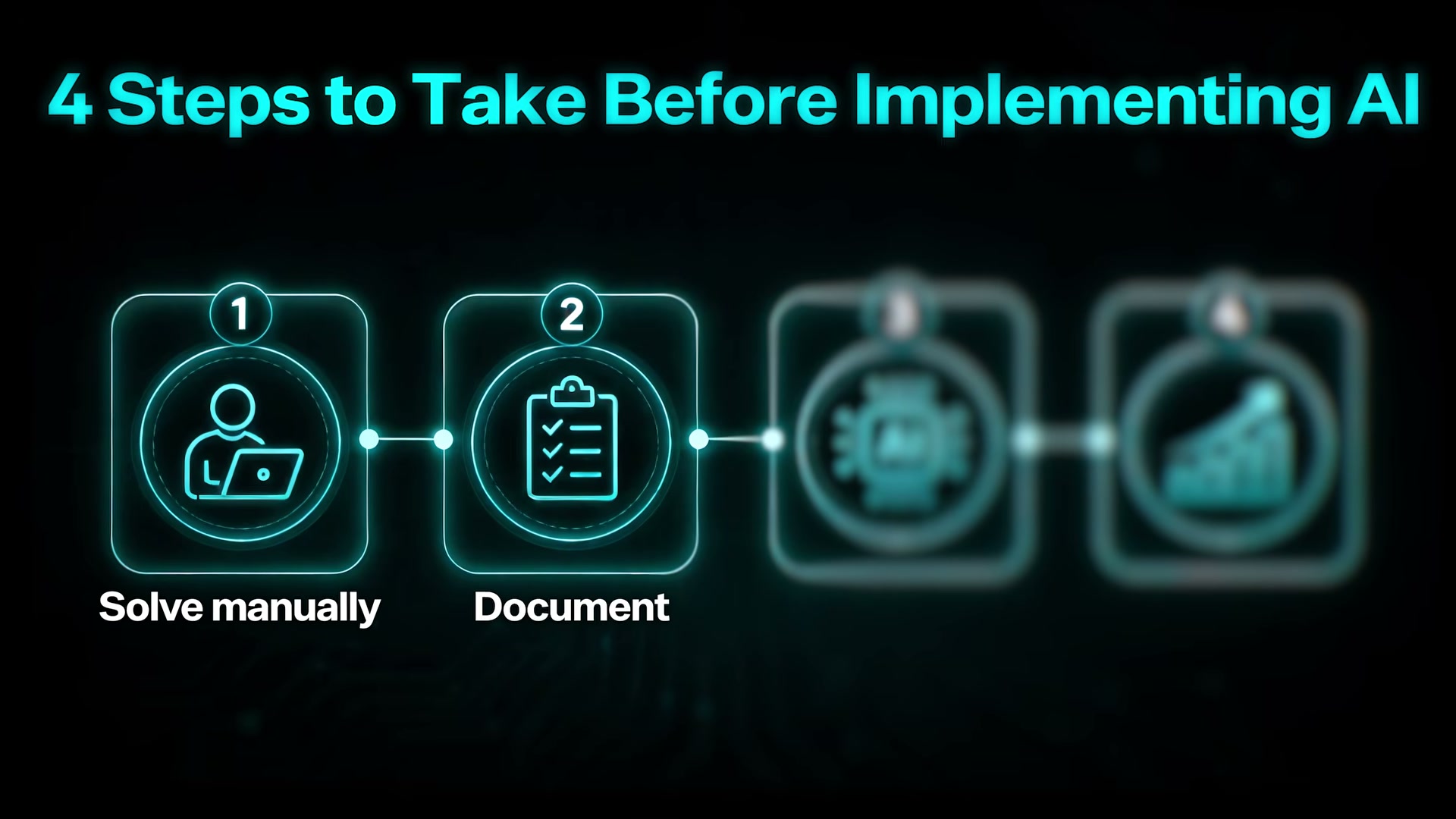
- Don’t use AI first — validate manually, then scale. Map the problem in the matrix, then resist the urge to build. Martell’s pre-AI sequence: launch a page, collect waitlist signups, confirm the problem exists in real conversations, then solve it manually for early customers. This is the Wizard of Oz method — the customer thinks it’s AI, you’re the person behind the curtain. You learn whether the problem is actually solved the way the customer wants it, without burning budget on a prototype nobody needs.


Once the manual process is proven, document every step in real time. That documentation becomes your spec sheet. Only after steps one and two do you build an MVP — the most basic AI-assisted version. Scale comes last, when you feed the documented playbooks into AI agents that can own execution.
-
AI does not replace people — it shifts them from roles to workflows. The org chart of the future is workflow-based, not role-based. Instead of five people each owning a discrete role in a YouTube production pipeline, one person owns the entire workflow while AI agents handle each individual role. Martell’s position: if you’re laying people off because of AI, that’s a leadership failure — you didn’t upskill your team before the shift arrived.
-
Hire agent operators, not task executors. The final truth surfaces partially in the transcript: the most valuable hire in an AI-native business is someone who can manage AI systems end-to-end, not someone who just executes individual tasks within them.
How does this compare to the official docs?
Martell’s G.A.I.N. Matrix and Wizard of Oz validation method are practitioner frameworks, not vendor documentation — which raises the question of how the underlying AI platforms themselves recommend you approach workflow design and deployment.
Here’s What the Official Docs Show
Act 1 laid out Dan Martell’s five-truth framework exactly as the video presents it — this section adds the platform-level context that official sources can provide, without revisiting what the video already covered well. Because the five truths are built on proprietary practitioner frameworks rather than platform documentation, the screenshot evidence is contextual rather than procedural — useful for corroboration, not line-by-line verification.
Truth 1 — AI is a tool; wealth comes from solving problems.
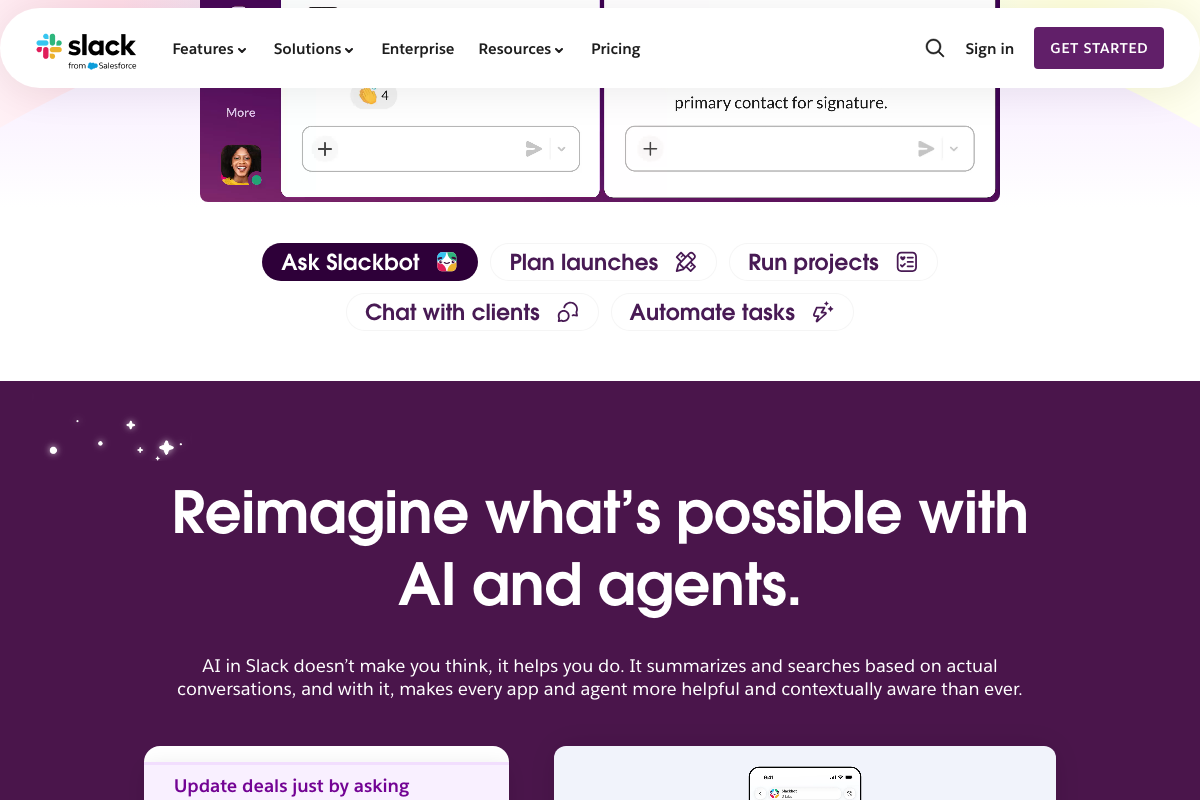
Slack’s own homepage copy — “AI in Slack doesn’t make you think, it helps you do” — frames AI as an execution accelerator, not a strategic decision-maker. That phrasing is directionally consistent with the hammer analogy: the tool amplifies the operator, it doesn’t replace the judgment call.
No official documentation was found for this step — proceed using the video’s approach and verify independently.
Truth 2 — Start with the problem; use the G.A.I.N. Matrix.
Slack’s listed AI use cases — Ask Slackbot, Plan launches, Run projects, Automate tasks — map loosely to task types the G.A.I.N. Matrix would categorize in the Accelerate and Give quadrants: structured, repeatable, low-ambiguity work that AI handles without human judgment.
No official documentation was found for this step — proceed using the video’s approach and verify independently.
Truth 3 — Validate manually before you build; use the Wizard of Oz method.
No official documentation was found for this step — proceed using the video’s approach and verify independently.

Truth 4 — AI shifts people from roles to workflows.
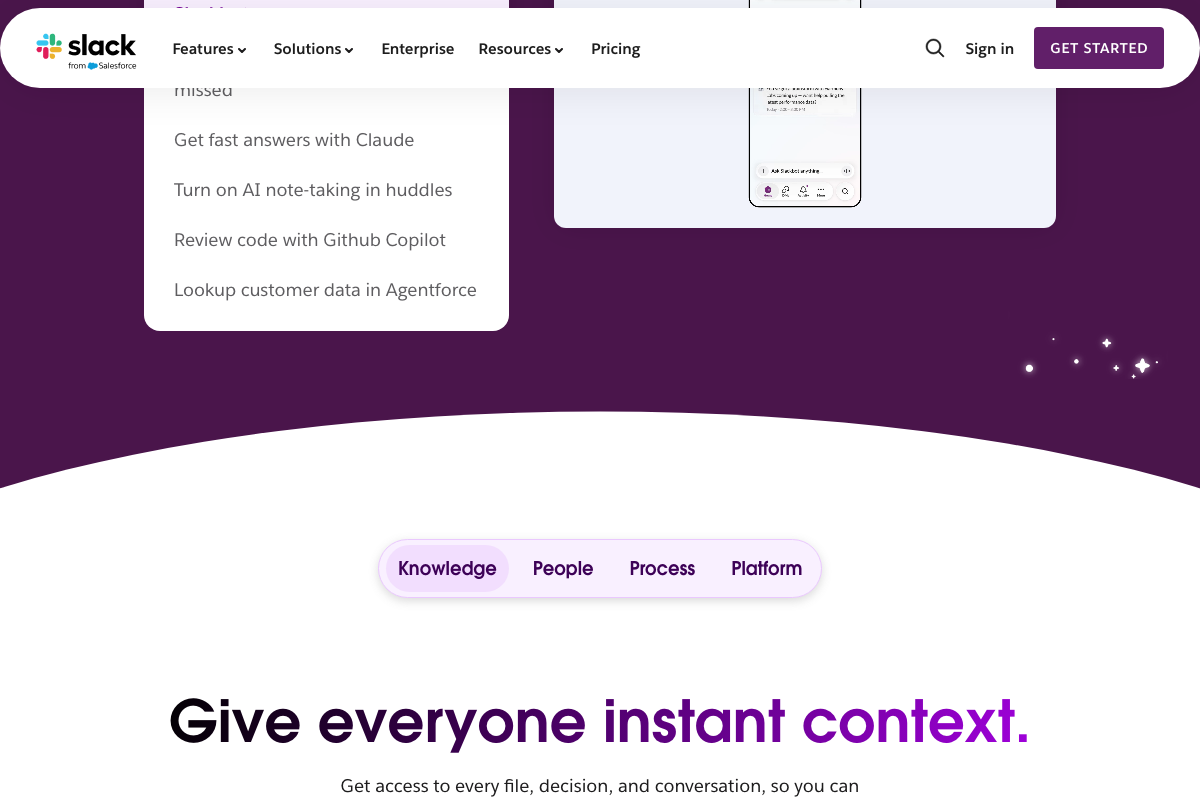
Slack positions its AI layer as “all your people and AI agents working together” — reinforcing the workflow-ownership model the video describes. The named integrations (Claude, GitHub Copilot, Agentforce) illustrate AI assigned to specific, bounded steps inside a larger human-managed process, not wholesale role replacement.
No official documentation was found for this step — proceed using the video’s approach and verify independently.
Truth 5 — Hire agent operators, not task executors.
No official documentation was found for this step — proceed using the video’s approach and verify independently.
Useful Links
- Slack | AI Work Platform & Productivity Tools — Slack’s public homepage, showing current AI feature positioning and integration partners as of May 2026.
- Instagram — Instagram login page; no platform documentation or feature content relevant to the tutorial’s framework was accessible from this URL.


0 Comments