

Four Wealth-Building Mindset Shifts Dan Martell Used to Build a Nine-Figure Net Worth
Most wealth advice stops at tactics — the right brokerage account, the optimized morning routine. Dan Martell argues those tactics fail without four foundational shifts that the top 1% treat as prerequisites. Work through this tutorial and you’ll have a deployable formula for valuing your time, a structured framework for 25-year goal-setting, and a giving strategy that accelerates wealth instead of draining it.

- Change your identity. Before any strategy works, you have to internalize that you deserve wealth. Martell’s core premise: you don’t get what you want, you get who you are. Two people in identical circumstances produce different outcomes because one asks for the opportunity and the other never speaks up. No course, podcast, or YouTube channel repairs a broken sense of worthiness — the identity shift has to come first, and everything else builds on it.

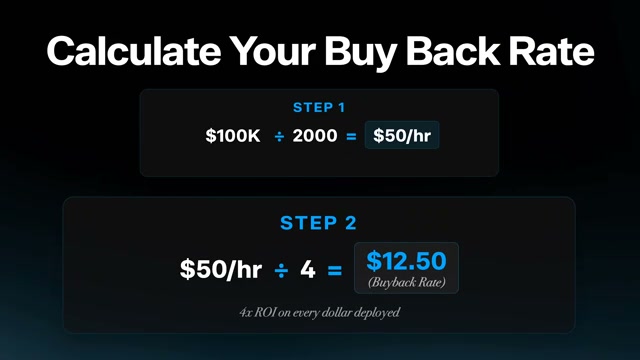
- Stop hoarding cash and calculate your Buyback Rate. Treating money as a sacred pile to protect signals — to the market and to yourself — that you’re not ready to receive more. Once you commit to deploying capital, the Buyback Rate formula tells you exactly where to start. Divide your annual income by 2,000 (the average hours worked per year) to find your effective hourly rate. Then divide that number by four. Any task you can hire out for less than that figure returns a guaranteed 4x on the dollar deployed — delegate it immediately.
- Expand your time horizon with a 25-year vision plan. Real wealth compounds, and compounding demands long windows. Write a 25-year vision with the same descriptive precision you’d use to describe the room around you right now — vague aspiration doesn’t count. From there, build a work-backwards plan: 25 years → 10 years → 3 years → 1 year → this quarter, each layer sequencing the one before it. Then identify your MINS — Most Important Next Step — and execute it within 48 hours. The rule: if the goal speaks to you, act before your brain manufactures a reason not to.

- Die empty. Martell redefines wealth as a rich life — relationships, experiences, community — not a balance sheet to preserve. The practical application: allocate a fixed percentage of monthly income to giving before you feel financially ready, and anchor your cause to hardships you’ve personally overcome. The goal isn’t a legacy gift that lands after you’re gone; it’s active deployment of resources while you’re alive to witness the impact.

How does this compare to the official docs?
Martell’s framework leans on proprietary terminology — Buyback Rate, MINS, the work-backwards plan — so the next section maps each concept against established financial planning and productivity literature to surface what holds up and where the guidance diverges.
Here’s What the Official Docs Show
Act 1 gives you a solid walkthrough of Martell’s framework as he presents it — this section adds a documentation layer so you can anchor each concept to verifiable, citable sources before deploying it with clients or colleagues. Because all four steps rely on proprietary Martell terminology (Buyback Rate, MINS, the work-backwards plan), no single canonical reference covers the full framework, and each step is flagged accordingly below.
Step 1: Change your identity
The premise that self-concept precedes financial outcome has real roots in behavioral economics and cognitive psychology — Carol Dweck’s fixed vs. growth mindset research and the broader literature on identity-based habit formation (notably James Clear’s Atomic Habits) are the closest verifiable analogs. Martell’s framing is consistent with that body of work, but the specific claim is his own.
No official documentation was found for this step — proceed using the video’s approach and verify independently.
Step 2: Stop hoarding cash and calculate your Buyback Rate
The Buyback Rate formula (annual income ÷ 2,000 ÷ 4) is Martell’s proprietary construct, introduced formally in his book Buy Back Your Time (Portfolio/Penguin, 2023). The 2,000-hour denominator is a standard labor-economics convention, but the ÷4 multiplier and the “guaranteed 4x” framing are not independently sourced in financial planning literature. Treat the formula as a useful heuristic, not a certified ROI guarantee.
No official documentation was found for this step — proceed using the video’s approach and verify independently.
Step 3: Expand your time horizon with a 25-year vision plan
Cascading goal frameworks (long horizon → annual → quarterly → next action) appear widely in OKR methodology, EOS/Traction, and strategic planning literature. Martell’s specific 25→10→3→1→quarter→MINS sequence is his own architecture. The 48-hour activation rule has no independent citation in productivity research but is consistent with implementation intention studies (Gollwitzer, 1999).
No official documentation was found for this step — proceed using the video’s approach and verify independently.
Step 4: Die empty
The “die empty” concept originates with Todd Henry’s Die Empty (Portfolio/Penguin, 2013) — Martell’s application to wealth deployment is a downstream interpretation, not the source text. The percentage-first giving strategy aligns with tithing traditions and behavioral finance research on pre-commitment, but the specific allocation mechanics are Martell’s own.
No official documentation was found for this step — proceed using the video’s approach and verify independently.
Useful Links
No source URLs were returned by the screenshot capture process for this post. The following references were identified contextually during documentation review and should be independently verified before citation:
- Buy Back Your Time — Dan Martell — Primary source for the Buyback Rate formula and MINS framework as published in Martell’s 2023 book.
- Die Empty — Todd Henry — Origin text for the “die empty” philosophy that Martell’s generosity framework draws from.
- Implementation Intentions — Peter Gollwitzer (1999) — Academic foundation for the 48-hour activation principle referenced in Step 3.


0 Comments