

AI search engines now influence the majority of B2B purchase decisions — 94% of B2B buyers use tools like ChatGPT, Claude, and Perplexity during vendor research — yet most brands have no idea whether they appear in those answers. Commercial tracking solutions charge $300–$500+ per month for capabilities you can replicate yourself with a $20 Replit subscription, a pay-as-you-go API, and a few hours of focused build time. This tutorial walks you through the exact stack, the step-by-step build sequence, and the scoring system you need to go from blind to fully instrumented.
What This Is
An AI search visibility tracker is a custom-built application that systematically queries multiple AI platforms with your target prompts, evaluates whether and how your brand appears in the responses, and logs the results over time so you can measure change. The concept is straightforward; the execution is where most teams get stuck.
According to Search Engine Land, the recommended stack for a sub-$100/month build has three core components:
- Replit Agent — a browser-based development environment that lets non-coders build functional applications using natural language instructions, priced at $20/month.
- DataForSEO APIs — a unified pay-as-you-go system that lets you query multiple AI surfaces — including ChatGPT, Claude, Gemini, Google AI Mode, and Google AI Overviews — through a single API endpoint.
- Direct LLM APIs (optional) — direct connections to OpenAI, Anthropic, and Google APIs for verification testing and debugging edge cases.
The total running cost lands well under $100/month for most small-to-mid-sized implementations, compared to the $300–$500+/month price tags of commercial platforms like Otterly.ai, Visiblie, or Profound.
What separates this tracker from manually checking ChatGPT every few days is persistence, consistency, and scoring. The tracker runs the same prompt set on a schedule, applies a standardized rubric to each response, and writes results to a database so you can pull trend reports. Without that infrastructure, you’re making decisions on anecdotes instead of data.
The build methodology described by Search Engine Land is called “vibe coding” — communicating your project goals in plain language to an AI coding agent and letting it handle the technical implementation. This is no longer experimental: 84% of developers now use AI coding tools, and 25% of Y Combinator Winter 2025 startups built codebases that are 95% AI-generated. The barrier to building custom tooling has dropped dramatically.
The five AI surfaces the tracker covers are:
– ChatGPT (via OpenAI API)
– Claude (via Anthropic API)
– Gemini (via Google API)
– Google AI Mode
– Google AI Overviews — appearing in approximately 16% of Google searches as of late 2025, per Search Engine Land
Each of these surfaces operates differently. They pull from different data sources, update at different frequencies, and apply different citation logic. A tracker that only monitors one platform gives you a dangerously incomplete picture of your actual AI search visibility.
Why It Matters
This is not a “future-proofing” project. It is an active revenue problem for brands that ignore it.
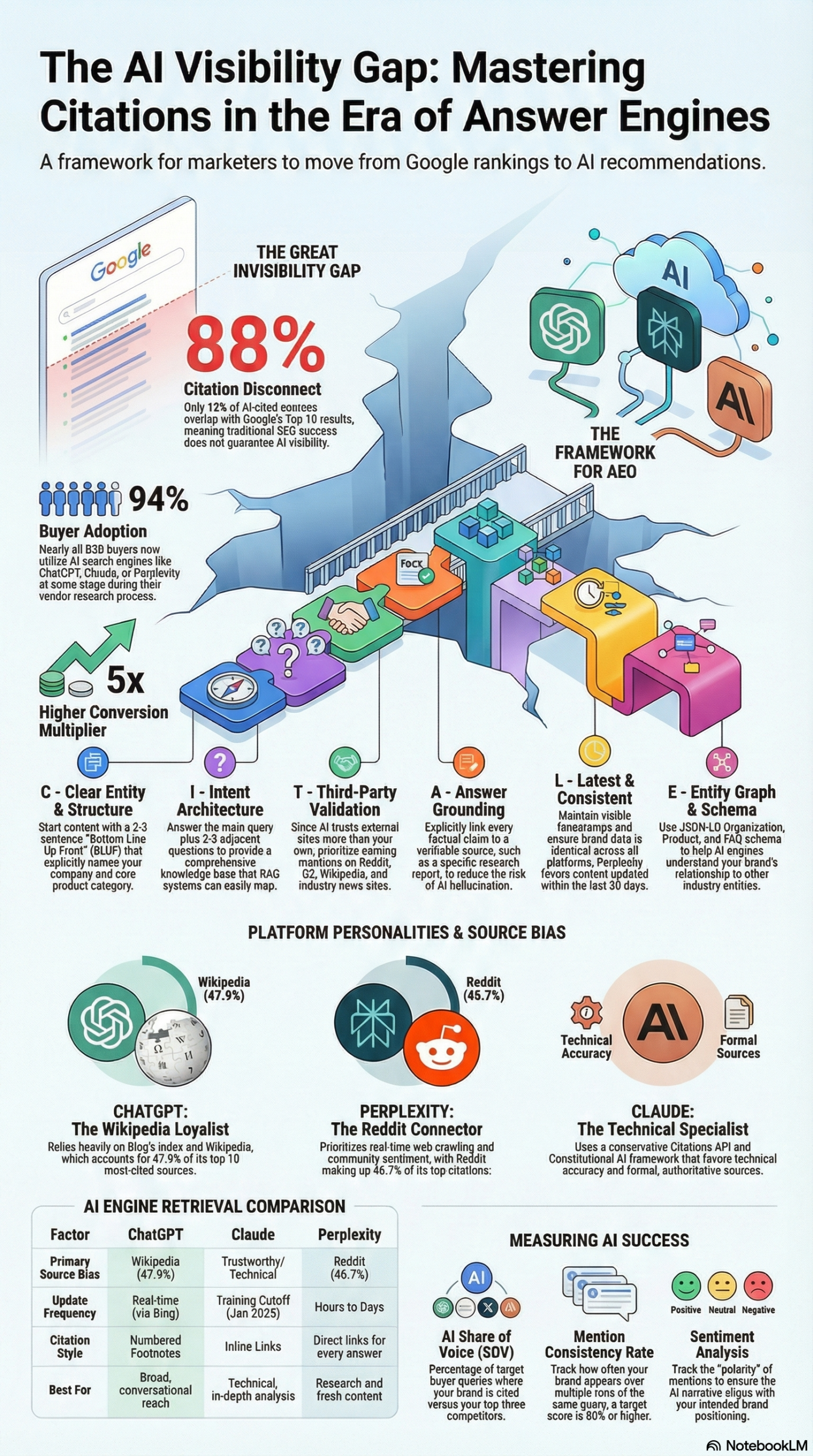
According to the NotebookLM research report on AI Citation Patterns and Brand Visibility, there is a documented “Invisibility Gap”: only 12% of URLs cited by AI tools overlap with Google’s top 10 results. A brand that has invested years in organic SEO and currently ranks in Google’s top 10 has, statistically, an 88% chance of being invisible in the AI answers its prospects are reading.
The stakes are high because AI-referred visitors are not casual browsers. The same research documents that AI-referred visitors convert at rates 4.4x to 23x higher than traditional organic search. These are buyers who have already done research inside an AI engine, decided your category is relevant, and clicked through to evaluate you specifically. Missing from that funnel doesn’t just hurt traffic — it cuts out your highest-intent prospects before you even know they exist, as the research puts it: “This isn’t a ranking problem — it’s a retrieval problem that costs you deals before you ever know the opportunity existed.”
Without a tracker, you cannot answer any of the following questions:
– Which AI platforms mention your brand and which don’t?
– Are you described accurately, or are you being mispositioned?
– Are competitors appearing in prompts where you should be?
– Is your visibility improving or eroding after content changes?
– Which specific prompts are the highest-value retrieval targets?
Traditional SEO tools measure keyword rankings, traffic, and backlinks. None of those metrics capture what happens when a B2B buyer asks ChatGPT, “What’s the best CRM for mid-market SaaS companies?” and your brand doesn’t appear in the answer. Building a custom tracker is how you close that measurement gap without paying enterprise-tool prices.
Agencies benefit here too. A functioning AI visibility tracker is a client deliverable, a differentiation point, and a recurring reporting service — all built on under $100/month in infrastructure.
The Data: AI Platform Comparison
The four major AI platforms your tracker will query operate with fundamentally different source biases and retrieval architectures. Understanding these differences determines how you weight results and interpret gaps.
| Factor | ChatGPT | Perplexity | Google Gemini / AI Overviews | Claude |
|---|---|---|---|---|
| Primary Data Source | Training data + Bing Index | Real-time web crawling (RAG) | Hybrid (Training + Google Index) | Training data (Jan 2025 cutoff) |
| Citation Bias | Wikipedia (47.9% of top citations) | Reddit (46.7% of top citations) | High overlap with Google organic (32–54%) | Technical precision; Citations API |
| Transparency | Numbered footnotes; conversational | Direct, clickable links for every answer | Link + snippet; grounded in Search | Inline links with source tracking |
| Update Frequency | Real-time via Bing (Plus/Enterprise) | Hours to days | Continuous | Periodic (Citations API released June 2025) |
| User Base | 800M+ weekly active users | 400M+ monthly queries | 2B+ monthly users | Conservative, technical users |
Source: AI Citation Patterns and Brand Visibility research report
These differences have direct implications for your tracker design. ChatGPT’s 87% alignment with Bing’s top results means Bing search presence is a meaningful input variable. Perplexity’s bias toward Reddit means your tracker should flag Reddit as a priority citation target for any gap prompts. Google Gemini’s overlap with traditional Google organic (32–54%) means your existing SEO investments have partial carry-over into Gemini visibility. Claude’s “Constitutional AI” framework biases it toward formal, authoritative, technically accurate content — meaning vague brand descriptions will consistently underperform.
Step-by-Step Tutorial: Building the Tracker
Prerequisites
Before you start, you need:
– A Replit account ($20/month for the Agent plan)
– A DataForSEO account (pay-as-you-go, no monthly minimum)
– Optional: OpenAI, Anthropic, and Google API keys for direct LLM verification
– A prompt set of 50–200 queries (covered in Phase 1 below)
– A spreadsheet or Notion doc for your requirements document
Total estimated setup time: 4–6 hours across multiple sessions.
Phase 1: Define Your Prompt Set and Requirements Document
The biggest mistake builders make is opening Replit and asking the AI agent to “build a tracker.” You’ll get something that sort of works, lacks a database, and breaks the first time you try to scale it.
Start with a requirements document. Write it in plain text before touching any code. It should include:
- Platform list: Which AI surfaces you want to monitor (ChatGPT, Claude, Gemini, Google AI Overviews, Perplexity).
- Prompt set: 50–200 queries based on real customer questions. Pull these from Reddit threads, Quora, Google’s “People Also Ask” boxes, and your own support ticket history. According to the 30-Day Setup Plan in the research report, you should test each query 3 times to account for probabilistic response variability — AI models don’t return the same answer every time.
- Scoring rubric: Define what you’re measuring. The Search Engine Land framework uses five criteria: brand name inclusion, accuracy, pricing correctness, actionability, and citation quality.
- Database requirement: Explicitly state in your requirements doc that results must be written to a persistent database. Without this instruction, most AI agents will build a tracker that returns results in the session but doesn’t store them — you’ll lose all historical data.
- Scheduling: Specify how often you want queries to run (daily, weekly, or on-demand).
Once your doc is complete, open it in a Replit Agent session and paste the full requirements. Then ask: “What am I missing?” — this is documented by Search Engine Land as the single most critical question in the vibe coding workflow. The agent will often surface gaps you didn’t consider: missing error handling, pagination limits, rate limiting strategies, or authentication flows.
Phase 2: Connect DataForSEO APIs
DataForSEO is the connective layer that lets you query multiple AI platforms through a single integration rather than managing five separate API relationships.
Step 1: Create your DataForSEO account and navigate to the API dashboard. Retrieve your API login and password credentials.
Step 2: In your Replit project, direct the agent to the DataForSEO API documentation. Providing the exact documentation URL is critical — the agent will use it to generate accurate authentication code and endpoint calls rather than guessing at API structure, which is a primary cause of authentication failures during builds.
Step 3: Build the connection one endpoint at a time. Start with a single platform (ChatGPT is recommended as the highest-traffic surface), test it fully, confirm results are writing to the database, then add the next platform. Do not attempt to build all five surfaces simultaneously. Debugging five simultaneous integrations is exponentially harder than debugging one.
Step 4: Before expanding to the next platform, ask the agent to “save a working version” of the current state. This gives you a restore point if subsequent modifications break earlier functionality.
Phase 3: Implement the Scoring Rubric
Raw API responses are not actionable. You need a scoring layer that evaluates each response against your rubric and produces a numeric score you can trend over time.
The research report documents a Recommendation Quality Rubric on a 0–2 scale:
– 2 (Aligned): Accurate brand positioning, correct use case, and reasonable justification.
– 1 (Partial): Brand is included, but positioning is vague or outdated.
– 0 (Misaligned): Incorrect description, wrong category, or misleading comparison.
Implement this as a structured prompt that your tracker sends back to an LLM after receiving the initial AI response. The scoring prompt should:
1. Accept the raw AI response as input.
2. Check for brand name presence (binary: 0 or 1).
3. Evaluate description accuracy against your approved brand positioning document.
4. Score on the 0–2 rubric.
5. Return a JSON object with the score, rationale, and any flags for review.
Paste the raw JSON response directly into your Replit agent when debugging — this is the fastest way to identify parsing errors, according to the Search Engine Land implementation guide.
Phase 4: Build the Reporting Dashboard
The tracker is only useful if you can read and act on the data. At minimum, you need a dashboard that shows:
- Share of Answer (SoA): The percentage of tracked prompts where your brand is mentioned or recommended, per platform. This is your headline metric.
- AI Share of Voice (AI SoV): How often your brand is mentioned versus competitors across the same prompt set. Per the research report, this is a competitive metric, not just a brand health metric.
- Mention Consistency Rate: For ChatGPT specifically, target 80%+ consistency across multiple runs of the same prompt. Anything below 80% signals an unstable presence that’s at risk of dropping.
- Citation Rate: The percentage of AI responses that include a direct link back to a URL you control.
- Weekly trend lines for each metric so you can see the impact of content and schema changes.
For the dashboard UI, ask your Replit agent to build a simple HTML/CSS interface that pulls from your database and renders the metrics in table and chart format. Tools like Chart.js integrate easily and require minimal configuration through natural language instructions to the agent.
Phase 5: Set Alert Thresholds and Automate
A tracker you check manually is a tracker you’ll stop checking. Automate it.
Step 1: Set up scheduled query runs. In Replit, you can configure cron-style schedules to run your prompt set daily or weekly without manual intervention.
Step 2: Define alert thresholds. The research report’s 30-Day Setup Plan recommends triggering an alert if Share of Answer drops more than 20% week-over-week. Configure email or Slack notifications when thresholds are breached.
Step 3: Add your competitors to the tracker. Pull their brand names through the same prompt set and score their responses on the same rubric. This surfaces “Gap Prompts” — queries where a competitor appears but you don’t — which become your highest-priority content targets.
Expected outcome: After completing this build, you will have a live tracker that queries 5 AI surfaces, scores responses on a standardized rubric, stores results in a database, renders a trend dashboard, and alerts you to significant drops — all for under $100/month in ongoing infrastructure costs.
Real-World Use Cases
Use Case 1: B2B SaaS Brand Monitoring
Scenario: A mid-market project management SaaS company ranks well in Google organic but has no visibility into whether they appear in AI-assisted vendor research.
Implementation: Build the tracker with a prompt set focused on buyer-stage queries: “best project management software for remote teams,” “alternatives to [competitor],” “project management tools with Jira integration.” Run each prompt 3 times across ChatGPT, Claude, and Gemini. Score responses using the 0–2 rubric. Flag any prompts where competitors appear but the brand does not.
Expected Outcome: Within the first week, the team identifies that they appear in ChatGPT responses (Mention Consistency Rate: 72%) but are absent from Claude and Gemini entirely. They now have specific, actionable intelligence rather than general AI visibility anxiety.
Use Case 2: Agency Client Reporting
Scenario: A digital marketing agency wants to offer AI visibility as a premium reporting tier for enterprise clients at $500/month.
Implementation: Build a single multi-client instance of the tracker using DataForSEO. Each client gets a dedicated prompt set and branded dashboard view. Weekly automated reports pull from the shared database and generate per-client PDFs.
Expected Outcome: The agency runs 8 clients on the tracker for under $80/month total infrastructure cost, delivering a service they bill at $4,000/month aggregate. The tracker becomes a retention tool — clients who see weekly AI visibility trends are dramatically less likely to churn.
Use Case 3: Content Strategy Optimization
Scenario: An e-commerce brand in the home fitness category wants to know which content changes improve their AI citation rate.
Implementation: Run a baseline prompt set before any content changes. Implement the CITABLE Framework on core product pages: add Bottom Line Up Front (BLUF) summaries, implement FAQ schema, structure content in 200–400 word sections with clear H2/H3 headers. Re-run the same prompt set weekly for 30 days.
Expected Outcome: According to the research report, the CITABLE framework can move citation rates from 5–15% to 40–50%. The tracker gives you the before/after measurement to confirm whether your specific implementation produced lift.
Use Case 4: Competitive Intelligence Monitoring
Scenario: A cybersecurity vendor wants to know when a competitor launches a new positioning campaign that starts affecting AI recommendations.
Implementation: Add 5–10 competitor brand names to the tracker’s prompt set alongside your own. Score competitor responses on the same rubric. Configure alerts to fire when a competitor’s SoA increases by more than 15% in a single week.
Expected Outcome: Early warning system for competitive positioning shifts. Rather than discovering a competitor’s new campaign through ad monitoring, you catch it the moment it starts influencing AI recommendations — often weeks before it appears in traditional search rankings.
Use Case 5: PR and Digital Outreach Prioritization
Scenario: A fintech startup wants to know which third-party publications to target for digital PR to improve AI visibility.
Implementation: Use the tracker to identify which sources Perplexity cites when answering competitor-related prompts. Per the research report, 85% of brand mentions in AI responses come from third-party pages — not brand-owned sites. The tracker surfaces exactly which third-party pages are driving competitor citations.
Expected Outcome: A prioritized list of 10–20 publications and community platforms (Reddit threads, review sites, industry blogs) that are actively feeding AI recommendations in the fintech category. These become your top PR and content outreach targets.
Common Pitfalls
1. Building without a database layer. This is the most common failure mode. If you don’t explicitly instruct the AI agent to implement database persistence, it will return results in-session only. Every query run overwrites the previous one. You lose all historical data. Fix: state “store all results in a persistent database” as a first-class requirement before any code is written, per Search Engine Land.
2. Querying each prompt only once. AI models are probabilistic — the same query returns different answers across runs. A single-query approach produces unreliable data. The research report recommends running each prompt 3 times minimum to get a statistically meaningful baseline. For your Mention Consistency Rate metric, you need multi-run data by definition.
3. Using default API settings without verification. API versions of AI models often have different default settings than the public web interfaces — token limits, web browsing features, and response formatting can all differ. If your API results look inconsistent with what you see on the public platform, check default settings and explicitly enable required features. Directly comparing API output to public-interface output is a documented debugging step per Search Engine Land.
4. Tracking brand presence only, not positioning accuracy. A brand appearing in an AI response as “an outdated tool” or “a budget option” is worse than not appearing — it actively damages consideration. Implement the 0–2 Recommendation Quality Rubric from day one. Knowing your brand appears 70% of the time is meaningless if 40% of those appearances are score-0 misalignments.
5. Ignoring content freshness. According to the research report, “pages not updated quarterly were 3× more likely to lose citations.” A tracker that shows declining citation rates without a corresponding content refresh cadence is identifying a problem you’re not equipped to solve. Build a 90-day content review cycle alongside your tracker deployment.
Expert Tips
1. Front-load the “What am I missing?” question. Per Search Engine Land, this single question — asked before you build, not after something breaks — is the highest-leverage move in the vibe coding workflow. It catches missing database infrastructure, authentication edge cases, and rate limiting strategies before they become bugs.
2. Target Perplexity’s Reddit bias strategically. Perplexity cites Reddit in 46.7% of its top answers, per the research report. When your tracker surfaces a Gap Prompt on Perplexity, your first remediation action should be seeding or engaging in the relevant Reddit communities — not publishing a new blog post.
3. Build Wikidata before you optimize content. AI models use entity graphs to verify brand identity and relationships. A brand without a Wikidata entry is structurally harder for AI systems to recognize as a known entity. Creating or updating your Wikidata entry is a foundational technical fix that benefits all five platforms simultaneously. The research report’s 30-Day Plan lists this as a Week 2 priority.
4. Use the HubSpot five-dimension scoring framework as your reporting template. HubSpot’s AI Share of Voice tool scores brands on a composite 100-point scale: Sentiment Analysis (40 pts), Presence Quality (20 pts), Brand Recognition (20 pts), Market Competition (10 pts), and Share of Voice (10 pts), per the research report. Even if you’re not using HubSpot’s tool, adopt this scoring structure for your own dashboard. It forces you to measure sentiment quality, not just mention frequency.
5. Save working checkpoints obsessively. Every time a major feature works — database connection, a new platform integration, the scoring layer — ask the Replit agent to save that state before proceeding. Per Search Engine Land, this simple habit prevents hours of debugging when a subsequent modification breaks earlier functionality. Treat each working checkpoint like a git commit.
FAQ
Q: Can I build this without any coding experience?
Yes. The entire build methodology in this tutorial relies on “vibe coding” — natural language instructions to a Replit Agent. You don’t need to write Python, JavaScript, or SQL. You do need to write clear, specific requirements documents and ask precise questions. The 84% developer adoption rate of AI coding tools reflects how accessible this has become. The main skill required is systems thinking, not syntax.
Q: How is this different from just checking ChatGPT manually every week?
Manual checking has three critical failure modes: inconsistency (you don’t run every prompt every time), no persistence (you can’t compare this week to last month), and no scaling (you can’t manually check 200 prompts across 5 platforms). The custom tracker runs the same prompt set on schedule, scores every response against a rubric, and writes to a database. That’s what transforms anecdotal checks into actionable trend data.
Q: Which AI platform should I prioritize if I can only track one?
ChatGPT, based on user volume alone — 800M+ weekly active users versus 400M monthly queries for Perplexity and 2B monthly users spread across Google’s full product suite. However, the Invisibility Gap research shows that different platforms cite very different sources. Brands that appear in ChatGPT often don’t appear in Perplexity, and vice versa. Single-platform tracking creates a false sense of security.
Q: How often should the tracker run queries?
Weekly is the recommended default for most implementations, per the 30-Day Setup Plan in the research report. Daily runs are appropriate if you’re actively running content or PR campaigns and want faster feedback loops. The alert threshold recommendation — trigger if Share of Answer drops more than 20% week-over-week — assumes weekly cadence.
Q: What do I do when my tracker identifies a Gap Prompt?
A Gap Prompt is a query where competitors appear but you don’t. Your remediation sequence should follow the source bias of the platform showing the gap. For Perplexity gaps: audit which third-party sources are being cited for competitors and pursue digital PR to those publications. For ChatGPT gaps: check your Bing search presence and Wikipedia/Wikidata entity completeness. For Gemini gaps: prioritize traditional Google E-E-A-T signals and schema implementation. For Claude gaps: improve the formal, technical clarity and authority of your brand-owned content.
Bottom Line
Building your own AI search visibility tracker is a one-time investment of 4–6 hours and under $100/month that gives you the measurement infrastructure to compete in the AI search era. The Invisibility Gap is real — only 12% of URLs cited by AI tools overlap with Google’s top 10 results — and brands without instrumentation are losing high-intent prospects before the sales funnel even begins. The Replit + DataForSEO stack described in this tutorial is not a prototype; it’s a production-grade tracking system accessible to anyone willing to write a requirements document and iterate with an AI agent. The brands that build this infrastructure now will have 12–18 months of trend data before their competitors realize tracking AI visibility is non-negotiable.


0 Comments