

90.3% of companies report using AI agents — but only 6.3% have actually integrated AI into their marketing stack. That gap is not a technology problem. It is an architecture problem, and this guide gives you the exact framework to close it.
According to Frans Riemersma writing for Martech.org, organizations winning with AI are not the ones running the most pilots. They are the ones who stopped bolting AI onto broken processes and started building what practitioners now call the agentic stack. This tutorial walks you through the diagnosis, the framework, and a step-by-step implementation plan that works whether you are a 10-person agency or a 10,000-person enterprise.
What This Is: The AI Integration Gap in Martech
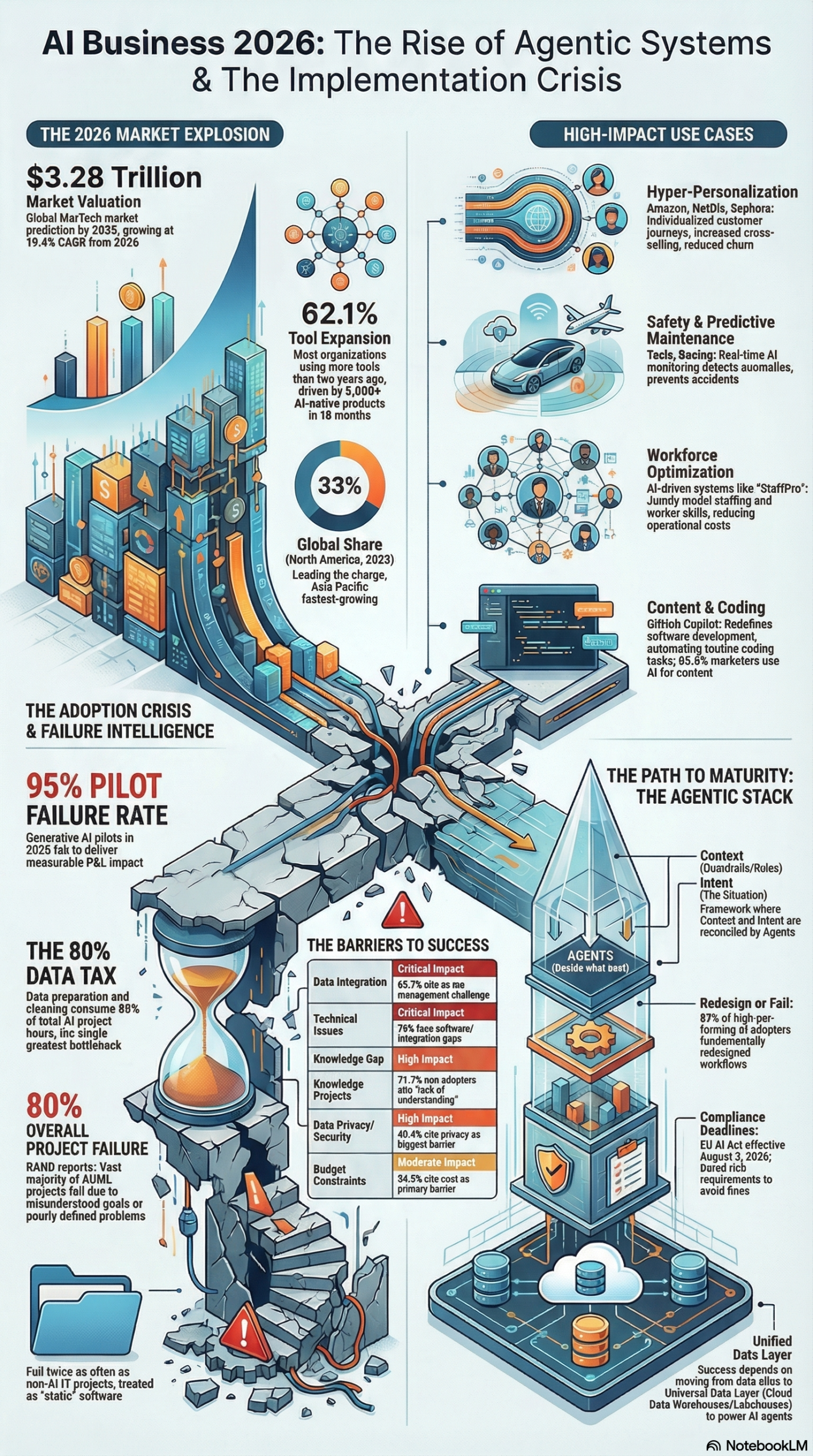
The martech industry is in the middle of a split-screen reality. On one screen: explosive adoption numbers, a market valued at USD 557.94 billion in 2025 projected to reach USD 3,286.94 billion by 2035 (CAGR of 19.40%), and 68.6% of organizations utilizing generative AI in some form. On the other screen: 95% of generative AI pilots failing to deliver measurable P&L impact, 42% of organizations scrapping at least one major AI initiative in the past 12 months, and the average sunk cost per failed pilot rising to $2.3 million in 2026, according to the AI Business Landscape 2025–2026 research report.
The core diagnosis from the research is what Frans Riemersma calls the Integration Fallacy: the mistake of treating AI as a software layer you deploy on top of your existing workflows rather than a new capability that requires your workflows to be fundamentally redesigned around it. This fallacy accounts for 63% of AI implementation failures in martech today.
Here is what the integration gap looks like in practice. A marketing team uses ChatGPT to draft email copy — that is AI adoption. A marketing team has their CRM automatically score leads via a probabilistic AI model, triggers a personalized multi-channel sequence, logs every touchpoint back into the system of record, and fires an alert when anomalous behavior is detected — that is AI integration. The first is a productivity tool. The second is an operational capability. Only 23.3% of companies have reached the production stage for AI agents, and a mere 6.3% have achieved full integration into their marketing stack, per Riemersma’s analysis.
The technology concept at the center of the integration conversation is the agentic stack — a layered architecture that reconciles two fundamentally different types of systems: deterministic SaaS (your systems of record: CRM, CMS, CDP, data warehouse) and probabilistic AI (agents that interpret situations and decide what happens next). These systems operate on different principles. Your CRM enforces rules. Your AI model interprets context. Connecting them without an architectural framework produces chaos — and that is precisely why 63% of integration attempts fail.
The agentic stack has three components, as described by Riemersma:
- Context (guardrails) — Pricing rules, product availability, legal constraints, brand guidelines. This is everything the agent must respect.
- Intent (situation) — What the customer wants, what the campaign objective is, what problem the agent is being asked to solve.
- Agents (decisioning) — The AI layer that reconciles context and intent to determine the next best action.
Understanding this three-layer model is the prerequisite for everything else in this guide.
Why It Matters: The Cost of Getting This Wrong
The failure to integrate AI into martech stacks is not an abstract strategic concern. It is a financial hemorrhage with a specific price tag, and it is hitting organizations of every size.
The research report puts the immediate cost in plain terms: the average failed AI pilot now costs $2.3 million in sunk costs. Only 1% of executives describe their generative AI rollouts as “mature.” Fewer than 50% of AI projects ever reach live production. These are not numbers from early-stage startups experimenting with AI for the first time — these are numbers from organizations that have already committed resources.
For practitioners, the “why it matters” breaks down into three specific pressure points:
Data readiness is the hidden blocker. The research report cites that 65.7% of martech professionals identify data integration as their single biggest management challenge. More damning: marketing AI projects spend an average of 84% of their time on data remediation before the AI can do anything useful. You are not failing at AI — you are failing at data infrastructure, and the AI just exposed the problem.
Change management is chronically underfunded. Organizations spending less than 15% of their total AI budget on change management and business alignment are 4.7 times more likely to experience pilot failure. The technology procurement portion of AI budgets is overweighted, and the workforce enablement portion is neglected. When the tool changes but the workflow does not, the tool gets abandoned.
Workflow redesign is the differentiator between high and low performers. McKinsey research cited in the report found that 89% of high-performing AI adopters redesigned core workflows around AI’s capabilities. Only 23% of low performers did the same. The difference in outcome is measurable: organizations that redesign workflows achieve up to 3.4 times higher revenue growth than those that simply layer AI onto existing processes.
This is why the martech industry is shifting from “no-code” toward what Scott Brinker, VP of Platform Ecosystem at HubSpot, calls “no-awareness-of-code” — where non-technical marketers generate and execute code via natural language prompts, without needing to understand that software is being written and executed on their behalf. The interface is changing, but only organizations that have the underlying integration architecture in place can actually use it.
The Data: AI Integration Reality Check
The following tables consolidate key data points from the AI Business Landscape 2025–2026 report and Riemersma’s martech integration analysis.
Table 1: The AI Implementation Failure Stack
| Failure Metric | Data Point | Source |
|---|---|---|
| Pilot failure rate (no P&L impact) | 95% | Report |
| Organizations that scrapped a major AI initiative (2025) | 42% | Report |
| Average sunk cost per failed pilot (2026) | $2.3 million | Report |
| Projects that reach live production | Fewer than 50% | Report |
| Executives rating their genAI rollout as “mature” | 1% | Report |
| Failures caused by the Integration Fallacy | 63% | Report |
| Treating AI like software produces failure at | 85% rate | Stanford HAI / CMU via Report |
Table 2: Integration Approach by Company Size
| Company Segment | Primary Integration Method | Key Challenge | Integration Friction Rate |
|---|---|---|---|
| SMB | iPaaS (Zapier, Make, n8n) — 53.6% | Business logic distributed across too many tools | Lower, but fragile |
| Mid-Market | Mix of iPaaS + custom | Scaling brittle automations | Moderate |
| Enterprise | Custom-built integrations — 72% | Governance constraints (48%), cost observability (44%) | 68% |
Table 3: AI Adoption Maturity Ladder
| Stage | Definition | % of Organizations |
|---|---|---|
| Adoption | Using AI tools in some capacity | ~90.3% |
| Production | AI agents in live production environments | 23.3% |
| Full Integration | AI embedded in governed, system-of-record workflows | 6.3% |
| Mature Rollout | Executive-rated mature, measurable P&L impact | ~1% |
Data sourced from Riemersma / Martech.org and AI Business Landscape Report.
Step-by-Step Tutorial: How to Build the Agentic Stack
This section gives you a concrete implementation path. It is structured in four phases: audit, architecture, connection, and governance. Work through these sequentially — skipping the audit phase is the single most common reason integration projects fail at phase three.
Phase 1: Audit Your Current Stack (Week 1–2)
Prerequisites:
– Access to all active martech platform accounts and admin panels
– An inventory of your data sources (even an informal one)
– One person with decision-making authority over the tech stack
– Budget visibility: what are you currently spending and on what?
Step 1: Map every tool in your current stack.
Start with a simple spreadsheet. Columns: Tool Name, Category (CRM/CMS/Email/Analytics/Ads/etc.), Data In (what data goes into it), Data Out (what data or actions come out of it), Current Integration Status (manual/API/iPaaS/native), and Owner. Do not skip any tool, including the ones “no one uses anymore.” According to the research report, 62.1% of marketers are using more tools than they were two years ago — tool sprawl is real and it directly causes integration failures.
Step 2: Identify your systems of record.
Your systems of record are your deterministic SaaS platforms — the tools that hold the authoritative version of your data. Typically: your CRM (customer data), your CMS (content data), your CDP or data warehouse (unified behavioral and transaction data), and your advertising platforms (campaign performance data). Circle these on your map. Everything else is either a system of intelligence (analytics, reporting) or a system of action (email delivery, ad serving, personalization engines). This distinction matters because your agentic layer will read from systems of record and write back to them.
Step 3: Document every data silo.
A data silo exists anywhere that information lives in one tool but cannot be accessed by another. For each silo, note: what data is trapped, what decisions that data should be informing but is not, and what connecting it would require (API availability, schema mapping, transformation logic). The research report is direct: data quality and readiness are the top obstacle for 43% of organizations. You cannot build a reliable agentic layer on top of unreliable data.
Step 4: Score your data quality for each system of record.
Rate each on three dimensions — completeness (what % of records have all required fields populated), freshness (how quickly does the data reflect real-world changes), and consistency (does the same customer appear with the same identifier across platforms). This scoring exercise will reveal where your 84% data remediation time will go before AI can operate reliably.
Phase 2: Define Your Agentic Architecture (Week 2–3)
Step 5: Choose one workflow to redesign first.
Do not attempt to integrate AI across your entire stack simultaneously. Choose one high-value, data-rich workflow. The research report recommends either content creation pipelines or lead scoring as strong first candidates — both have clear inputs and measurable outputs. Your choice should be the workflow where bad decisions currently cost you the most time or money.
Step 6: Map the agentic stack for your chosen workflow.
Using Riemersma’s three-component framework from Martech.org, define each layer for your specific use case:
- Context layer (guardrails): Write down every constraint the agent must respect. For a lead scoring agent: what is a disqualifying signal? What data privacy rules apply? What territories or segments are off-limits? What is the minimum data completeness threshold before a lead can be scored?
- Intent layer (situation): Define what the agent is reading to understand the current situation. What CRM fields? What behavioral signals from your CDP? What engagement signals from your email platform? Document the exact data sources and field names.
- Agent layer (decisioning): Define what the agent is authorized to decide and act on autonomously, what requires a human-in-the-loop approval step, and what it is never allowed to do. Be explicit. Vague agent permissions are how you end up with agents firing outreach sequences to the wrong segments.
Step 7: Choose your integration method based on your organization size.
Based on Riemersma’s analysis:
- SMB (under 200 employees): Start with an iPaaS platform (Zapier, Make, or n8n). Build your context layer as discrete workflow conditions. Connect your AI model via API within the automation. Write outputs back to your CRM via a final step. This approach is fast to deploy but requires discipline to avoid distributing critical business logic across dozens of small automations.
- Enterprise (200+ employees): Budget for custom-built integrations or a dedicated middleware layer. The 72% of enterprises using custom integrations do so because iPaaS platforms cannot handle the governance constraints (48%), cost observability requirements (44%), and audit trail demands of regulated or large-scale operations.
Phase 3: Connect and Deploy (Week 3–6)
Step 8: Implement a unified data layer first.
Before connecting any AI model, establish a single source of truth. This can be a Customer Data Platform (CDP) if you are mid-market, or a Cloud Data Warehouse (Snowflake, BigQuery, Databricks) if you are enterprise. Every system of record should write to this layer, and your AI agents should read from it. This solves the data silo problem at the architecture level rather than patching it one integration at a time.
Step 9: Build your context layer as code or configuration.
Your guardrails need to be machine-readable. Depending on your stack, this means:
– Business rules tables in your CRM (e.g., Salesforce custom objects with rule logic)
– Configuration files in your middleware or iPaaS platform
– System prompts in your AI model deployment if you are using an LLM-based agent
Document every rule in plain language first, then translate it into your target system’s syntax. This documentation step is not optional — it is the audit trail that lets you diagnose when the agent makes unexpected decisions.
Step 10: Deploy your AI agent with minimal permissions first.
Start with read-only mode. Let the agent observe, analyze, and surface recommendations without taking autonomous action. Run it in parallel with your existing process for two weeks. Compare the agent’s recommended actions to the actions your human team actually took. Measure the delta. This is your calibration baseline.
Step 11: Enable autonomous actions incrementally.
After calibration, enable the lowest-risk autonomous actions first. For a lead scoring agent, this might mean: auto-assign a lead tier (low/medium/high) in the CRM, but require human approval before any outreach sequence is triggered. After 30 days of clean performance, expand the permissions to include triggering low-touch nurture sequences automatically. Keep high-value outreach on human approval permanently until your confidence threshold warrants otherwise.
Phase 4: Governance and Monitoring (Ongoing)
Step 12: Implement drift detection.
Stanford HAI and Carnegie Mellon joint research cited in the report found that treating AI as a static software deployment — rather than a dynamic capability requiring continuous monitoring — produces an 85% failure rate. Your AI model’s behavior will drift over time as data distributions change. Set up monitoring dashboards that track: decision distribution (is the agent scoring leads differently than it did at baseline?), data quality metrics (is input data completeness deteriorating?), and outcome metrics (is the conversion rate of AI-scored leads holding steady?).
Step 13: Mandate human editorial oversight for all AI-generated content.
The research report cites a damning statistic: 50% of marketers have received incorrect information (hallucinations) from generative AI, yet only 27% of organizations review all AI-generated content before publishing. This is a brand risk that no integration project should expose you to. Build review checkpoints into your content workflows regardless of how confident your AI model appears.
Step 14: Align with compliance requirements.
The EU AI Act takes effect August 2, 2026, introducing tiered requirements based on risk classification. The NIST AI Risk Management Framework (four parts: Govern, Map, Measure, Manage) applies in regulated markets. Map your agentic workflows to these frameworks now — retrofitting compliance is far more expensive than building it in from the start.
Expected Outcomes After Full Implementation:
– Reduced data remediation time from the 84% baseline as your unified data layer matures
– AI agent decisions traceable back to documented context-layer rules
– Measurable P&L impact within 90 days of production deployment
– A replicable framework for expanding the agentic stack to additional workflows
Real-World Use Cases
Use Case 1: E-Commerce Personalization (Sephora / Amazon Pattern)
Scenario: A mid-market e-commerce retailer wants to replicate the recommendation engine results seen at scale by brands like Sephora (Virtual Artist) and Amazon (recommendation engines).
Implementation: The context layer contains product availability, margin thresholds, and category affinity rules. The intent layer reads browsing history, purchase history, and cart abandonment signals from the CDP. The agent layer runs a product recommendation model that generates a personalized product set for each visitor session. Outputs are written back to the CMS for storefront rendering and to the CRM for email personalization.
Expected Outcome: Measurable lift in average order value and email click-through rates. The key metric to track is recommendation acceptance rate — if it falls below your baseline click-through benchmark, the context layer rules may be overriding too aggressively and need to be loosened.
Use Case 2: Predictive Lead Scoring for B2B Marketing
Scenario: A SaaS company’s sales team is manually reviewing hundreds of inbound leads per week. Their CRM has a lead score field that no one trusts because it was built on static rules set three years ago.
Implementation: Audit the existing lead score field — document what signals it currently uses and what the historical correlation is between that score and closed-won deals. Build a new context layer that defines disqualifying signals (wrong company size, outside target territory, competitor domain). Connect the intent layer to pull in behavioral signals from your marketing automation platform: email engagement, webinar attendance, content downloads, product trial activity. Deploy an AI scoring model that writes a probabilistic score (0–100) plus a rationale field to the CRM. Start in read-only mode. After calibration, enable auto-routing of high-confidence leads to the senior sales queue.
Expected Outcome: Reduction in time spent on low-quality leads by the sales team. McKinsey data cited in the report shows that organizations redesigning core workflows around AI achieve up to 3.4x higher revenue growth.
Use Case 3: Automated Content Creation Pipeline (Washington Post Model)
Scenario: A media company or content-heavy brand wants to scale its content output using AI while maintaining editorial quality — similar to The Washington Post’s Heliograf system and the Associated Press’s automated earnings reports.
Implementation: Define your content types by risk level (low risk: data-driven roundups, performance summaries, product descriptions; high risk: opinion content, named individual stories, claims requiring legal review). Build the context layer around editorial guidelines, style rules, brand voice, and legal/compliance constraints. The intent layer reads current trending topics, scheduled content calendar, performance data from past content, and SEO keyword targets. The agent drafts content, attaches a confidence and risk score to each piece, and routes it to the appropriate editorial workflow — fully automated publishing for low-risk, human review for high-risk.
Expected Outcome: Significant increase in content volume output while human editorial capacity is redirected toward high-value, high-risk content. Critically: implement the 27% problem fix by ensuring 100% of AI-generated content gets at least a read-through before publishing, even for “low-risk” pieces.
Use Case 4: AI-Assisted Customer Service Routing
Scenario: A retail brand or hospitality company (similar to Hilton’s staff scheduling model) wants to use AI to route customer service inquiries intelligently and predict workload.
Implementation: The context layer contains service tier rules, escalation triggers (specific complaint keywords, account value thresholds, SLA commitments), and routing logic. The intent layer reads incoming ticket content, customer history from the CRM, and current queue depth. The agent classifies and routes tickets autonomously for standard inquiries and surfaces escalation recommendations for complex cases. All routing decisions are logged to the CRM for audit and future model training.
Expected Outcome: Reduced first-response time and improved routing accuracy. The agent learns from human overrides of its routing decisions — every time a human reroutes a ticket the agent assigned, that is a labeled training example.
Use Case 5: Enterprise Compliance and Governance Monitoring
Scenario: A large enterprise marketing team operating across multiple regions needs to ensure AI-generated content and campaign decisions comply with the EU AI Act (effective August 2, 2026) and internal brand governance policies.
Implementation: Build a compliance review agent as part of the content pipeline. Its context layer contains the risk classification criteria from the EU AI Act, internal brand guidelines, and regional legal requirements. The intent layer reads every piece of outgoing AI-generated content and every autonomous campaign decision. The agent flags items that exceed defined risk thresholds and generates an audit log that documents: what decision was made, what data informed it, what guardrails were in effect, and what human review (if any) was completed.
Expected Outcome: A defensible audit trail for every AI-assisted decision, drastically reducing compliance risk as new AI regulations come into effect. Organizations that build this in now will have a significant advantage over those retrofitting compliance in Q3 2026.
Common Pitfalls
Pitfall 1: Deploying AI Before Fixing Data Infrastructure
What goes wrong: The AI model produces inconsistent or obviously wrong outputs. The team loses trust in the tool and abandons it. The root cause is bad input data — incomplete records, duplicate entries, mismatched identifiers across platforms. Why it happens: Teams underestimate data remediation. The research report shows that marketing AI projects spend an average of 84% of their total project time on data remediation. How to avoid it: Run the data quality scoring exercise in Phase 1 (Step 4 above) before selecting or deploying any AI model. Fix the data layer first.
Pitfall 2: Confusing Adoption with Integration
What goes wrong: The team reports “we are using AI” while still doing entirely manual orchestration of outputs. No systems of record are updated automatically. No workflow has been redesigned. The AI is a productivity add-on, not an operational capability. Why it happens: Leadership wants to show AI progress without committing to the architectural work required for real integration. How to avoid it: Use the maturity ladder table above as your benchmark. Adoption is table stakes. Demand a measurable milestone — a specific workflow where AI is writing back to a system of record autonomously.
Pitfall 3: Skipping the Context Layer
What goes wrong: Agents make decisions that violate business rules — sending offers to customers in a market where the product is not available, scoring leads from competitor domains as high-priority, or generating content that violates legal guidelines. Why it happens: Teams focus on the AI decisioning layer and neglect the guardrails layer. Riemersma’s framework puts context first for exactly this reason. How to avoid it: Write your context layer documentation before selecting your AI model. The guardrails define the boundaries within which any AI model must operate.
Pitfall 4: Underinvesting in Change Management
What goes wrong: The technology is deployed but adoption by the team is low or hostile. People find workarounds. The AI tool sits unused. Why it happens: Budget allocation is heavily skewed toward technology procurement and training is treated as an afterthought. Organizations spending less than 15% of their AI budget on change management are 4.7 times more likely to fail. How to avoid it: Before any deployment, identify who in the organization will be most affected by the workflow change. Involve them in the architecture decisions. Budget explicitly for training, documentation, and a feedback channel.
Pitfall 5: No Drift Detection or Monitoring Plan
What goes wrong: The AI agent performs well at launch but degrades silently over time as data distributions shift or business rules change. Nobody notices until outcomes have already deteriorated significantly. Why it happens: Teams treat AI like a software release — ship it and move on. Stanford HAI and CMU research shows that this approach produces an 85% failure rate. How to avoid it: Define your monitoring metrics before launch (Step 12 above). Schedule a monthly review of agent decision distribution and outcome metrics. Treat model drift as a maintenance task, not an emergency.
Expert Tips
Tip 1: Build your context layer in plain language before you build it in code. Every guardrail rule should be expressible as a business statement a non-technical stakeholder can read, approve, and sign off on. This is your governance documentation. If you cannot explain a rule in plain language, the AI model will not be able to apply it reliably either.
Tip 2: Use SMB iPaaS tools (Zapier, Make, n8n) as a prototyping environment, not a production architecture. The research report specifically calls out that SMBs relying exclusively on iPaaS risk distributing business logic across too many tools — a fragility problem that becomes critical at scale. Build your first integration in iPaaS to validate the logic, then migrate critical workflows to more durable infrastructure.
Tip 3: Start measuring hallucination rates on your specific use case, not generic benchmarks. The report cites 50% of marketers encountering AI-generated incorrect information. But hallucination rates vary dramatically by task type — product description generation is fundamentally different from claim-based content. Measure your model’s accuracy rate for your specific task and set a minimum threshold below which content is automatically flagged for human review regardless of confidence scores.
Tip 4: Tag every AI-assisted decision in your CRM. Add a simple field that marks whether a lead score, content piece, campaign decision, or customer routing was AI-assisted. This lets you run comparative performance analysis between AI-assisted and human-only decisions — and it gives you the audit trail required by the EU AI Act when it takes effect August 2, 2026.
Tip 5: Redesign one workflow completely rather than partially automating ten. The McKinsey data is clear: 89% of high-performing AI adopters redesigned core workflows end-to-end. Partial automation leaves manual steps that create handoff errors and negates much of the efficiency gain. Pick one workflow, own it completely with the agentic stack architecture, prove the outcome, then replicate.
FAQ
Q1: Why are 95% of AI pilots failing to show measurable P&L impact?
The primary reason is the Integration Fallacy — organizations deploy AI on top of existing broken or inefficient workflows rather than redesigning those workflows around AI’s capabilities. A second major factor is underfunding change management: organizations spending less than 15% of their AI budget on workforce enablement and strategic alignment are 4.7 times more likely to experience pilot failure. The technology works. The organizational wrapper around it typically does not.
Q2: What is the difference between AI adoption and AI integration?
Adoption means your team uses AI tools — writing assistants, analytics dashboards, chatbots. Integration means AI is embedded in a governed workflow where it reads from systems of record, makes or supports decisions autonomously, and writes outputs back to those systems — all within a documented context layer of business rules and guardrails. According to Riemersma’s analysis, 90.3% of companies have adoption; only 6.3% have integration.
Q3: Should SMBs use iPaaS (Zapier/Make/n8n) or build custom integrations?
For most SMBs, start with iPaaS. Riemersma’s research shows 53.6% of SMBs already rely on these platforms for AI connections, and they enable rapid experimentation without engineering resources. The risk is distributing too much business logic across too many disconnected automations. As workflows mature, consolidate business logic into a dedicated configuration layer and use iPaaS for connectivity only — not as the logic engine.
Q4: How do I handle the EU AI Act requirements for my marketing AI systems?
The EU AI Act takes effect August 2, 2026. Start with a risk classification exercise — most marketing AI applications will fall into the limited or minimal risk categories, but personalization systems using biometric or sensitive data may have higher requirements. Implement the NIST AI Risk Management Framework’s four-part approach (Govern, Map, Measure, Manage) as your internal governance structure. The audit trail tagging in Expert Tip 4 above is a direct input to your compliance documentation.
Q5: How long does it take to see measurable ROI from a properly integrated AI workflow?
Based on the research, organizations that properly redesign workflows and solve the data quality problem first should see measurable P&L impact within 90 days of production deployment. The 95% failure rate applies to pilots that never reach real integration — projects that solve the data layer problem and deploy through the full agentic stack architecture are in a different performance class. The research report cites up to 3.4x higher revenue growth for organizations that redesign core workflows, though timelines depend heavily on workflow complexity and data readiness at the start.
Bottom Line
The gap between AI adoption (90.3%) and AI integration (6.3%) is the defining challenge in martech right now, and it is not a technology gap — it is an architecture gap. The Integration Fallacy, data silos, and underinvestment in change management account for the overwhelming majority of the $2.3 million average failed pilot. Organizations that close this gap do it by building the agentic stack deliberately: context layer first, systems of record connected to a unified data layer, AI agents deployed with minimal permissions and expanded incrementally, and governance baked in before the EU AI Act deadline. The practitioners winning in 2026 are not running more pilots — they are finishing the ones they started by treating AI as an operational capability, not a software deployment.


0 Comments