
Google’s AI Landing Page Patent: How to Protect Your Brand Pages
Google has been granted patent **US12536233B1** — a system that scores your landing pages against a threshold and, if they fall short, replaces them in search results with AI-generated alternatives built from your own brand data. This isn't a distant threat or a speculative roadmap item; it's a docu

Google has been granted patent US12536233B1 — a system that scores your landing pages against a threshold and, if they fall short, replaces them in search results with AI-generated alternatives built from your own brand data. This isn’t a distant threat or a speculative roadmap item; it’s a documented, patented capability paired with the Universal Commerce Protocol (UCP) that lets AI agents complete purchases without ever sending a user to your website. This tutorial walks you through exactly what the patent covers, how the scoring system works, and the concrete steps you need to take right now to keep Google from overwriting your brand presence.
What This Is: Google’s AI Landing Page Replacement System
According to Semrush’s analysis of the patent published March 26, 2026, Google has filed and been granted patent US12536233B1 — formally titled “Techniques for generating an artificial intelligence (AI)-generated page for a first organization.” The patent describes a machine-learned model that evaluates brand landing pages against a scoring threshold and generates updated search results pages containing links to AI-produced alternatives when a brand’s page scores too low.
Here’s how the system works at a technical level:
Step 1 — Page Scoring. Google’s system ingests signals from a brand’s existing landing pages. These signals include conversion rate, bounce rate, click-through rate, content quality, and page design. Each signal feeds a machine-learned model that produces an aggregate landing page score.
Step 2 — Threshold Comparison. The score is compared against a threshold value. If a brand’s page clears the threshold, nothing changes — your page appears in results as normal. If the page falls below the threshold, the system flags it as a candidate for AI replacement.
Step 3 — AI Page Generation. For flagged pages, the system generates an alternative page using the brand’s own data — product information, pricing, descriptions, and other structured content the brand has already supplied (think Google Merchant Center feeds, structured data markup). Critically, the patent notes that these AI-generated pages are personalized to individual users, not generic substitutes.
Step 4 — Search Result Swap. Instead of linking to the brand’s original landing page, the search result surfaces a link to the AI-generated version. The user still reaches a page “about” your brand — but Google controls that page’s content, layout, and optimization, not you.
The patent’s primary focus is commerce pages — product listings, category pages, and transactional landing pages. This aligns directly with Google’s broader move toward what the research report describes as agentic commerce via the Universal Commerce Protocol (UCP), a system that allows AI agents to make purchases directly within a conversational interface, bypassing the traditional website visit entirely.
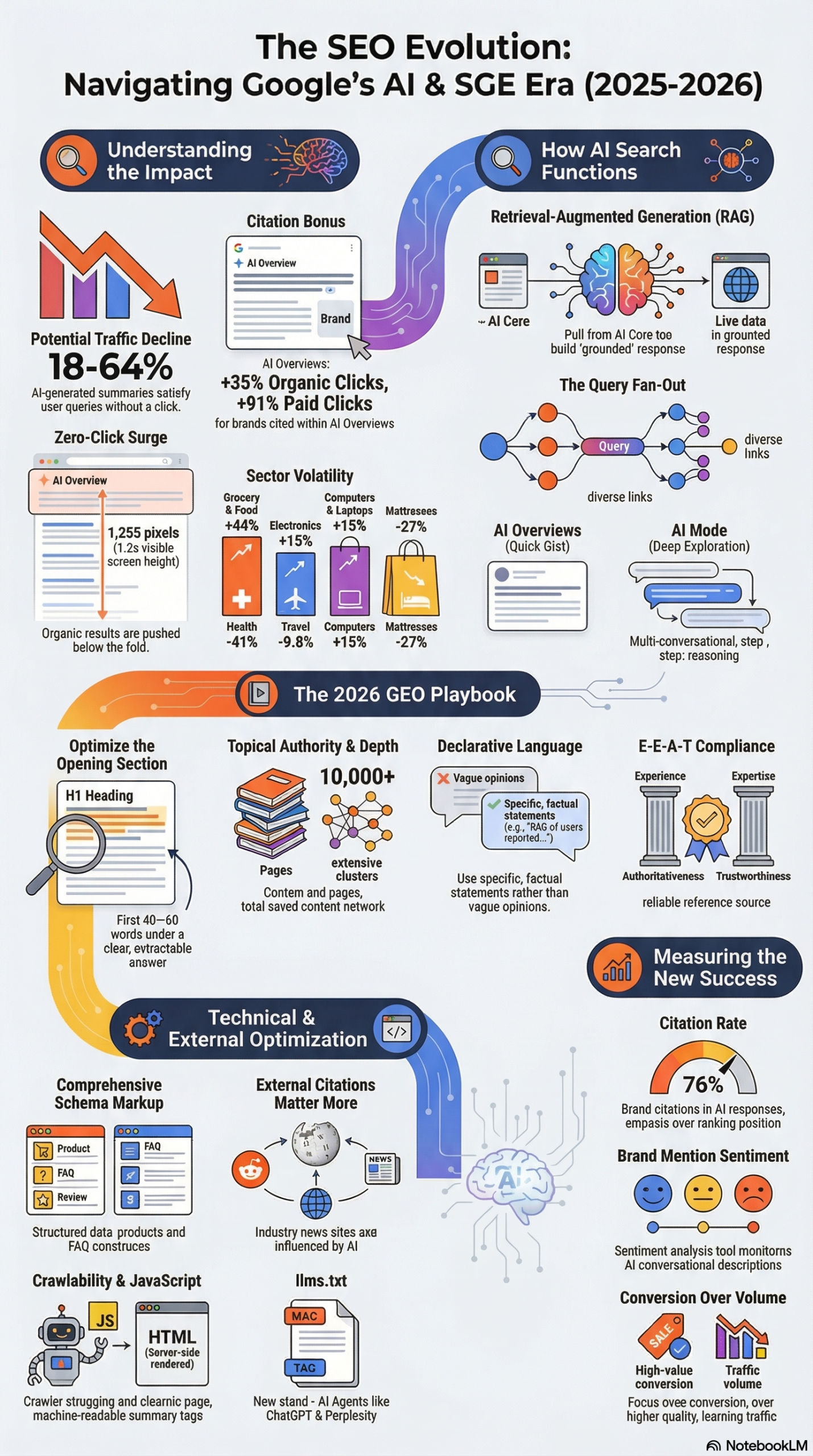
This isn’t the first signal of this direction. The research report documents that AI Overviews already appeared on 14% of all shopping queries by early 2026 — a 5.6x increase in just four months — with “best [product]” queries showing an 83% AI Overview presence. The AI landing page patent is the next logical step: when AI already answers the query, why send the user to a page that may underperform?
The practical implication is stark. Google has gone from indexing your pages, to summarizing them, to now potentially replacing them. Each step reduces your ability to control the user experience and conversion path for your own brand.
Why It Matters: The End of Passive Landing Page Strategy
For years, the implicit contract between brands and Google was simple: build a good page, rank it well, and Google sends you traffic. The AI landing page patent tears up that contract. Now, a page that ranks — but doesn’t convert, doesn’t reduce bounce, or doesn’t satisfy Google’s content quality signals — can be superseded in the SERP, even if it holds a strong organic position.
For eCommerce brands, the stakes are highest. The research report shows that categories requiring text-based comparison — electronics, appliances, software — face the highest AI disruption because AI Overviews can synthesize comparisons better than any single page. If your product pages are thin, lack structured data, or produce poor engagement signals, they are candidates for replacement under this patent’s framework.
For lead generation marketers, conversion rate is one of the explicit scoring signals. A landing page that gets traffic but fails to convert — due to a weak CTA, mismatched intent, or poor load speed — is now a liability not just for your business, but in terms of your standing with Google’s scoring model.
For agencies managing multi-brand portfolios, this creates a new audit category. Client pages now need to be evaluated not just against organic rankings and user experience standards, but against the specific signals Google’s scoring model uses: CTR, bounce rate, conversion rate, content quality, and page design.
For publishers and content marketers, this compounds an already severe traffic challenge. The research report documents that organic traffic declines range from 20% to 60% across industries, and that Google Search referrals to news sites fell 33% between 2024 and 2025. The AI landing page system means that even pages that survived zero-click erosion may now face direct substitution.
What makes this moment different from prior SERP changes is the degree of control transfer. Algorithm updates changed which pages ranked. Featured snippets borrowed content. AI Overviews synthesized answers. This patent allows Google to generate an entirely new page — using your brand’s assets — and serve it instead of yours.
The quote from the research report captures the underlying dynamic: “In the AI era… influence happens before traffic.” That was written about AI Overviews shaping purchase intent before a user ever clicks. The landing page patent takes it one step further: influence — and potentially conversion — can now happen on a page you didn’t build.
The Data: SERP Evolution and Scoring Signal Impact
The following table maps how Google’s SERP treatment of brand pages has shifted from 2023 through the patent’s current scope, with the scoring signals that now determine whether your page survives or gets replaced.
| Era | SERP Treatment | Brand Page Control | Key Signals |
|---|---|---|---|
| 2023 — Pre-SGE | Blue links, 10 organic results | Full — user clicks to your page | Ranking position, title tag, meta description |
| 2024 — AI Overviews Launch | AI summary above fold; organic results pushed down | Partial — cited pages get reduced CTR | Citation-worthiness, E-E-A-T, content structure |
| 2025 — SGE Expansion | AI Overviews on 14% of shopping queries; first organic result drops 1,255 pixels | Diminished — CTR drops from 1.76% to 0.61% when AIO present | Topical authority, structured data, entity coverage |
| 2026 — AI Landing Page Patent | Google may replace your page link with AI-generated alternative | Conditional — pages scoring below threshold are candidates for substitution | Conversion rate, bounce rate, CTR, content quality, page design |
Sources: Semrush patent analysis, NotebookLM research report
The data on sector-specific traffic impact provides critical context for which industries face the most acute exposure:
| Sector | Traffic Decline (2025-2026) | AI Overview Prevalence | Risk Level |
|---|---|---|---|
| Health | Up to 41% | High (complex queries) | Very High |
| Travel | 9.8% | Moderate | Medium |
| eCommerce (informational) | Significant | 83% on “best [product]” queries | Very High |
| eCommerce (transactional) | Lower | 13-14% on “buy [product]” | Medium |
| News / Publishing | 33% referral drop (2024-2025) | Growing | High |
Source: NotebookLM research report
Step-by-Step Tutorial: Audit and Fortify Your Landing Pages
This tutorial walks through the complete process of evaluating your landing pages against Google’s documented scoring signals and implementing fixes that make substitution far less likely. Treat this as a quarterly audit protocol, not a one-time fix.
Prerequisites
- Access to Google Search Console (free)
- Access to Google Analytics 4 or equivalent analytics platform
- Access to your CMS or development team for on-page changes
- Google Merchant Center access (for eCommerce pages)
- A structured data testing tool (Google’s Rich Results Test is free)
Phase 1 — Baseline Your Scoring Signals
Before optimizing anything, you need accurate baselines for the five signals Google’s patent explicitly identifies.
Conversion Rate: In GA4, create a segment for organic search traffic to each target landing page. Pull the conversion event completion rate for the last 90 days. Document this as your baseline.
Bounce Rate / Engagement Rate: In GA4, pull the Engagement Rate (the inverse of bounce rate in GA4’s model) for organic sessions on each page. A page with under 40% engagement rate on commercial queries is a candidate for immediate intervention.
Click-Through Rate: In Google Search Console, navigate to Performance > Search Results. Filter by page URL, then examine CTR for each target landing page across its primary query set. A CTR below 2% for commercial intent queries is a red flag.
Content Quality: This is the subjective signal, but you can proxy it with time-on-page (average engagement time in GA4), scroll depth if tracked, and a manual content audit against Google’s E-E-A-T guidelines.
Page Design: Use Core Web Vitals data from Search Console’s Page Experience report. LCP (Largest Contentful Paint), CLS (Cumulative Layout Shift), and INP (Interaction to Next Paint) scores directly reflect the design quality signals Google measures.
Phase 2 — Identify High-Risk Pages
Sort your pages by a composite risk score:
- Pull all pages with significant organic impressions in Search Console.
- Flag any page with: CTR < 2% AND Engagement Rate < 45% AND no conversion events in 90 days.
- Cross-reference with AI Overview prevalence: are the primary queries for this page the type that trigger AI Overviews? Use Search Console’s Search Appearance filter to see where AI Overviews are appearing on your queries.
- Prioritize pages where the query type matches “best [product]” or informational comparison patterns — the research report documents these have 83% AI Overview presence.
Phase 3 — Fix Conversion Rate and Bounce Rate
These are the two highest-weight signals based on the patent’s scoring description.
CTA Clarity: Every landing page should have a single primary CTA above the fold and a secondary CTA in the mid-page. Ambiguous CTAs (“Learn More” competing with “Get Started” competing with “Contact Us”) split conversion intent and suppress conversion rates. Pick one primary action per page.
Search Intent Match: The single most common cause of high bounce rates is a mismatch between what the user expected from the SERP listing and what the page delivers. Re-read your title tag, meta description, and H1 as a user who has never seen your brand. Does the page deliver exactly what those three elements promise? If not, the copy — not the design — is the problem.
Page Load Speed: A slow LCP (above 2.5 seconds) kills engagement before the user has a chance to convert. Use PageSpeed Insights (free) to identify render-blocking resources, unoptimized images, or server response time issues. Each 100ms improvement in LCP correlates with measurable engagement rate gains.
Social Proof Density: For commerce pages, add review counts, ratings, and trust signals in the first viewport. Users who see social proof immediately have lower bounce rates on transactional pages.
Phase 4 — Structure Content for Machine Readability
The research report documents that AI systems prioritize content structured into extractable “response units.” Applying this logic to your landing pages also protects them from replacement, because a page that AI can already parse cleanly is less likely to need a surrogate.
The First 40-60 Words Rule: Under every H1 or page headline, write 2-4 sentences that directly answer what the page is about. Make these sentences factual and declarative. Example: instead of “We’re a leading provider of enterprise software solutions,” write “This page covers [Product Name], a project management platform built for teams over 100 users. Pricing starts at $X/month. Integration with Slack, Jira, and Salesforce is included.”
FAQ Blocks: Add a structured FAQ section to every major landing page. Use FAQ schema markup so Google can extract individual questions and answers. Pages with visible, well-formatted FAQ blocks perform better as citation sources in AI Overviews — and a page that Google actively cites in its AI answers is a page it has less incentive to replace.
H2/H3 Hierarchy: Every major topic on the page should have its own header. This isn’t just for human readers — it’s how AI systems navigate and chunk a page. A page with a single H1 and walls of paragraph text is structurally opaque to machine extraction.
Phase 5 — Implement Comprehensive Structured Data
This is non-negotiable for commerce pages. The research report explicitly states that “maintaining comprehensive schema markup (price, availability, SKU, review count) in Google Merchant Center is essential for appearing in AI-driven shopping carousels.”
For product pages, implement:
{
  "@context": "https://schema.org/",
  "@type": "Product",
  "name": "[Product Name]",
  "description": "[Product Description]",
  "sku": "[SKU]",
  "offers": {
    "@type": "Offer",
    "price": "[Price]",
    "priceCurrency": "USD",
    "availability": "https://schema.org/InStock"
  },
  "aggregateRating": {
    "@type": "AggregateRating",
    "ratingValue": "[Rating]",
    "reviewCount": "[Count]"
  }
}
For lead generation pages, implement Organization and WebPage schema at minimum. For informational pages, use Article and FAQ schema.
After implementation, validate every schema block with Google’s Rich Results Test before pushing to production. Invalid schema provides no benefit and can create crawl errors.
Phase 6 — Sync Product Data with Google Merchant Center
For any eCommerce page, your Merchant Center feed must match your on-page data exactly. Discrepancies between Merchant Center attributes and page content are a content quality signal that feeds the patent’s scoring model.
Audit your feed for completeness against these attributes:
– Product title (specific, includes model number or key differentiator)
– Price (exact, updated in real time)
– Availability (accurate — “in stock” for out-of-stock products is a trust signal killer)
– Product description (800+ characters, includes specific attributes: dimensions, weight, compatibility, warranty)
– High-resolution product images (multiple angles)
– GTIN or MPN (required for most categories)
Phase 7 — Monitor and Iterate
Set up a monthly reporting cadence:
- Search Console: Pull CTR and impressions for all monitored landing pages. Flag any page with a CTR drop of more than 0.5 percentage points month-over-month.
- GA4: Pull engagement rate and conversion rate by landing page for organic traffic. Flag pages trending down.
- AI Visibility: Use an AI visibility monitoring tool to check whether your brand or products are being cited in AI Overviews and AI Mode responses. The research report recommends monitoring “Citation Rate” and “Brand Visibility” across ChatGPT, Perplexity, and Google AI Mode — not just traditional rank tracking.
Expected outcome after full audit cycle: Pages that clear the conversion rate, bounce rate, and content quality signals are, by the patent’s own logic, less likely to be flagged for replacement. You are not making your pages un-replaceable in a technical sense — Google holds that power — but you are ensuring your pages score above the threshold the system uses to trigger substitution.
Real-World Use Cases
Use Case 1: eCommerce Brand Defending Product Detail Pages
Scenario: A mid-size consumer electronics retailer has 500+ product detail pages. Several high-traffic pages show strong ranking positions but poor engagement rates (35%) and low CTR (1.4%) — below the risk thresholds identified in this audit.
Implementation: The team runs Phase 1-3 of the audit above, identifying 47 pages in the risk zone. They rewrite H1 tags to include specific product attributes (model number, key spec), add FAQ schema blocks answering the top questions from their internal site search data, and update Merchant Center feeds with missing attributes (battery life, warranty terms, weight). They also add review widgets above the fold on all flagged pages.
Expected Outcome: Engagement rates rise as page content now matches the search intent more precisely. CTR improves as richer, more specific title tags stand out in the SERP. Pages that previously scored below Google’s content quality threshold are now structured, data-rich, and engagement-positive — reducing substitution risk.
Use Case 2: SaaS Company Fortifying Lead Gen Landing Pages
Scenario: A B2B SaaS company runs 12 campaign landing pages for different use cases. Conversion rates average 1.8% — technically positive, but the pages have 68% bounce rates and thin content (fewer than 400 words per page).
Implementation: Following Phase 3-4 of the tutorial, the team adds a 200-word FAQ section to each page (with FAQ schema), rewrites the opening paragraphs to be declarative and specific (“This page explains how [Product] integrates with Salesforce in under 20 minutes”), and adds customer logos and a case study link above the fold. They implement Organization and WebPage schema sitewide.
Expected Outcome: Bounce rates drop as the page now delivers on its SERP promise immediately. Conversion rates improve from the stronger CTA hierarchy. The FAQ schema generates featured snippet appearances on long-tail queries, increasing both organic visibility and citation likelihood in AI Overviews.
Use Case 3: Healthcare Publisher Protecting Clinical Content Pages
Scenario: A health information publisher faces up to 41% traffic decline on condition-related pages due to AI Overview presence — the highest sector impact documented in the research report. Several condition overview pages are thin on structured content and lack author credentials.
Implementation: The team adds author bios with credentials (MD, RN, MPH) to all clinical pages, adds Article schema with author and dateModified properties, and restructures each page to include a “Quick Answer” box in the first 60 words. They also add FAQ schema for the top five questions their internal search shows users ask about each condition.
Expected Outcome: The E-E-A-T signals from credentialed authorship and structured data help the pages qualify as AI Overview citation sources. Instead of being bypassed, some pages are now cited within the AI Overview — a position that the research report shows reduces CTR loss compared to non-cited organic results.
Use Case 4: Digital Agency Implementing Portfolio-Wide Protection
Scenario: A digital marketing agency manages 30 client websites with a combined 2,000+ landing pages. They need a scalable audit process rather than a page-by-page manual review.
Implementation: The agency builds a scoring spreadsheet pulling data from the Search Console API and GA4 API, automating the composite risk scoring from Phase 2 of the tutorial. Pages scoring below threshold across CTR, engagement rate, and structured data completeness are automatically flagged for the next content sprint. The agency establishes a monthly review cadence and adds “AI substitution risk” as a KPI in all client reporting dashboards.
Expected Outcome: The agency can identify high-risk pages across the entire portfolio within hours rather than weeks, prioritize remediation, and demonstrate concrete value to clients through a metric — AI substitution risk score — that maps directly to a documented Google capability.
Common Pitfalls
Pitfall 1 — Treating This as a One-Time Fix. The patent describes a dynamic scoring system, not a one-time evaluation. Google re-crawls pages continuously. A page that scores well today can degrade if conversion rates drop (due to seasonality, product changes, or new competition) or if content goes stale. Build the audit into your quarterly SEO cycle, not a one-time project.
Pitfall 2 — Optimizing for Rankings Alone. Many teams will see this patent and default to “let’s rank higher.” Ranking position is not the signal the patent scores. A page in position 3 with a 0.8% CTR and a 72% bounce rate is more vulnerable than a page in position 7 with a 3.2% CTR and a 55% engagement rate. Shift your optimization target to the five documented scoring signals, not position.
Pitfall 3 — Ignoring Merchant Center Data Quality. For eCommerce teams, the path of least resistance is to fix on-page content and ignore the Merchant Center feed. This is a mistake. The AI-generated replacement pages in the patent are described as being “built from the brand’s own data” — meaning Google will pull from your Merchant Center feed to construct the alternative. If your feed has inaccurate pricing, missing attributes, or stale availability data, the AI-generated alternative may itself perform poorly — or worse, may contain inaccuracies that damage your brand.
Pitfall 4 — Adding Schema Without Validating. Implementing structured data that contains errors is worse than no structured data. Invalid schema can generate Search Console errors, and errored schema provides no scoring benefit. Always validate with Google’s Rich Results Test before deploying.
Pitfall 5 — Overlooking the UCP Threat in Isolation. The AI landing page patent does not exist in isolation. It pairs with Google’s Universal Commerce Protocol, which allows AI agents to complete purchases within a conversational interface — entirely bypassing your landing page. Even a page that scores above the replacement threshold can be circumvented by agentic commerce. The long-term response is not just page optimization but also ensuring your products are present and complete in every structured data feed Google uses to power these agentic experiences.
Expert Tips
Tip 1 — Use Internal Search Data as a FAQ Source. The best FAQ questions to add to your landing pages are the ones users are already asking on your site. Pull your site search query data from GA4 and map the top 10 questions per page category directly into FAQ schema blocks. This creates FAQ content that matches real user intent — exactly what AI systems extract for citation.
Tip 2 — Standardize Brand Descriptions Across All Platforms. The research report recommends standardizing brand descriptions across LinkedIn, Crunchbase, G2, and similar platforms as an entity optimization tactic. Google’s Knowledge Graph ingests these descriptions. A consistent brand entity profile strengthens E-E-A-T signals and makes your brand data — the same data the AI landing page system would use to build a replacement — more reliable and favorable.
Tip 3 — Monitor “Citation Rate,” Not Just Rank. Traditional rank tracking tells you where your page appears in position X. In 2026, the more important metric is whether your brand is cited in AI Overviews and AI Mode responses. Track citation rate per target query monthly. A page that is cited in an AI Overview is, by definition, one Google trusts — and one far less likely to be replaced.
Tip 4 — Build Topical Depth, Not Just Page Depth. A single long-form page on “best project management software” is less protected than a cluster of five pages covering the topic from different angles: “best for small teams,” “best for agencies,” “best for remote teams,” pricing comparison, and an integration guide. The research report documents that AI favors sources that “consistently cover a topic” — topical maps and content clusters establish this authority.
Tip 5 — Treat Conversion Rate Optimization as an SEO Strategy. CRO and SEO have historically been managed in separate workstreams. Under the AI landing page patent’s scoring model, conversion rate is an explicit SEO input. Bring CRO data — A/B test results, heatmaps, session recordings — into your SEO reviews. A page with a 4.5% conversion rate is not just a better business result; it is a structurally more protected page under Google’s own scoring framework.
FAQ
Q: Can Google legally replace my landing page with an AI-generated version?
The patent describes replacing the link in search results with a link to an AI-generated page — not replacing your actual website. Google controls what appears in its search results, including what URLs those results link to. Your website remains live; what changes is whether Google surfaces your URL or an AI-generated alternative URL in its SERP. This is legally consistent with Google’s control over its own index and results presentation.
Q: How will I know if my page has been replaced?
You will see it in Search Console data. If a page suddenly loses impressions and clicks for its primary queries — while the queries themselves maintain volume — that is the signal to investigate. Also check whether the search result for your branded queries now links to a Google-hosted page rather than your domain. AI visibility monitoring tools that track SERP features per query will make this detection faster.
Q: Does this apply to all landing pages or only eCommerce pages?
The patent’s primary focus is commerce pages — product listings and transactional pages. However, the patent language describes “pages for a first organization” broadly, and Google’s documented trajectory suggests expansion over time. Non-commerce pages are lower immediate risk but should still be optimized against the same five scoring signals.
Q: Will structured data alone protect my pages?
No. Structured data is one input into content quality scoring, but the patent explicitly scores conversion rate, bounce rate, and CTR as separate signals. A page with perfect schema markup but a 0.4% conversion rate and 80% bounce rate would still score poorly. The protection strategy requires improving all five signals simultaneously.
Q: How does this relate to GEO (Generative Engine Optimization)?
They are two sides of the same coin. GEO — structuring content for AI citation — addresses whether AI Overviews cite your page (reducing zero-click losses). The AI landing page audit addresses whether Google replaces your page entirely. The tactics overlap heavily: content structure, E-E-A-T signals, structured data, and engagement quality improvements benefit both strategies. Treating them as a unified discipline rather than separate workstreams is the most efficient approach.
Bottom Line
Google patent US12536233B1 is a concrete mechanism that transforms poor landing page performance from a business problem into an existential SEO risk. Semrush’s analysis makes clear the system is already built and patented — the only open question is deployment scale and timeline. The five scoring signals — conversion rate, bounce rate, CTR, content quality, and page design — are all measurable and improvable with the audit process laid out in this tutorial. Combine that with the Universal Commerce Protocol’s agentic commerce infrastructure documented in the research report, and the direction of travel is unambiguous: brands that do not actively maintain high-performing, machine-readable, data-rich landing pages will progressively cede control of their search presence to Google’s AI layer. The window to act is now, before this capability is deployed at scale.


0 Comments