

Six months ago, Frenos — a niche operational technology cybersecurity company — had near-zero search visibility. By January 2026, fractional CMO David Haas had grown that number to 18.32% using a methodology he calls “Foundation Up,” which layers traditional SEO with Answer Engine Optimization (AEO) into a single, unified growth strategy. This tutorial breaks down exactly how he did it — and how you can replicate it for your own brand or clients using Semrush One.
What This Is
The “Foundation Up” framework, documented in a Semrush case study published March 24, 2026, is a four-step methodology for building modern digital visibility in an era where search engines and AI answer engines operate in parallel — and where your buyers use both in the same research session.
David Haas is a fractional CMO with nearly 30 years of marketing experience. Frenos hired him to grow their online presence in the highly competitive OT cybersecurity market. The problem was typical for B2B companies in specialized technical verticals: they had genuine expertise but almost no discoverable presence — either in traditional search results or in AI-generated answers. Starting from essentially zero, he delivered measurable results within six months without a large in-house team or an unlimited content budget.
The framework Haas built answers a question every marketer is now wrestling with: when your buyers are using both Google and ChatGPT to research purchases, how do you show up in both places without running two disconnected content strategies?
The answer, as his work demonstrates, is that you don’t need to separate them. SEO and AEO are structurally compatible when you build them on a shared foundation of well-structured, authoritative content. Traditional SEO creates crawlable, organized pages that AI engines can retrieve. AEO research surfaces new keyword and topic opportunities that feed back into the SEO content plan. When executed together from the outset, each channel reinforces and amplifies the other.
The platform Haas used to execute this unified strategy is Semrush One, which combines traditional SEO tools — Keyword Magic Tool, Position Tracking, Site Audit — with newer AI visibility modules including the AI Visibility Toolkit, AI Search Optimizer, and Competitor Research for AI. This integration lets you measure, track, and optimize performance across both search and AI answer engines from a single dashboard, which is critical for resource-constrained teams that can’t afford to run parallel tooling stacks.
What makes the Frenos case study instructive beyond the headline result isn’t just the 18.32% visibility number — it’s the logical sequencing of the work: SEO first as the structural foundation, AEO second as the amplification layer. That sequencing is the insight most teams miss. Many conflate the two disciplines (treating AEO as a replacement for SEO), or they build them as entirely separate workstreams that never talk to each other. The Foundation Up methodology solves both problems: it uses SEO work to create the content infrastructure that AEO then leverages, and it uses AEO research to surface content opportunities that flow back into the SEO roadmap.
The framework is also designed for resource-constrained teams. Frenos is a small company. Haas operates as a fractional resource, not a full-time CMO. His system is built to maximize impact with limited bandwidth — which means the tooling, prioritization logic, and content architecture must all be efficient by design. That efficiency-under-constraint is exactly what makes it scalable to larger organizations and applicable to agency engagements across industries.
Why It Matters
Search behavior has fundamentally shifted. According to Semrush research, 33% of consumers now start their purchase research on a search engine and then switch to AI for summaries and comparisons. Another 26% reverse the pattern — beginning in AI and then validating with traditional search. Only 8% use a single channel exclusively. That means approximately 92% of buyers are moving across both discovery environments during a single research session.
The operational implication is clear: if your content isn’t structured for both environments, you’re invisible to most of your potential buyers at some critical point in their journey — regardless of how well you rank on Google.
For B2B companies in technical verticals, this dual-channel reality is especially consequential. Purchase cycles are long, buyers are sophisticated, and appearing in AI-generated answers carries tangible authority signals that competitors without AEO strategies can’t match. According to the Semrush case study, 50% of surveyed U.S. consumers have made purchases after using AI during their research phase. That’s not a marginal channel — it’s a primary conversion driver for half the market.
For agencies and fractional consultants, the Foundation Up approach also solves a client communication problem. It justifies a single, unified content investment rather than asking clients to budget separately for SEO and AEO as disconnected line items. Results come faster too: Haas reported that well-structured new content can appear in AI-generated answers within one to two weeks of publication — a fast win that builds client confidence while longer-horizon SEO rankings develop.
The broader industry trend confirms that this integration is where the market is heading. Andrew Warden, CMO at Semrush, has described the launch of ChatGPT as “the most disruptive event in the SEO industry since the creation of Google in 1998.” And Seth Besmertnik, CEO at Conductor, has framed the shift plainly: “AI hasn’t replaced search — it’s replaced your website as the first touchpoint. The brands showing up in AI answers today are shaping the new customer journey.”
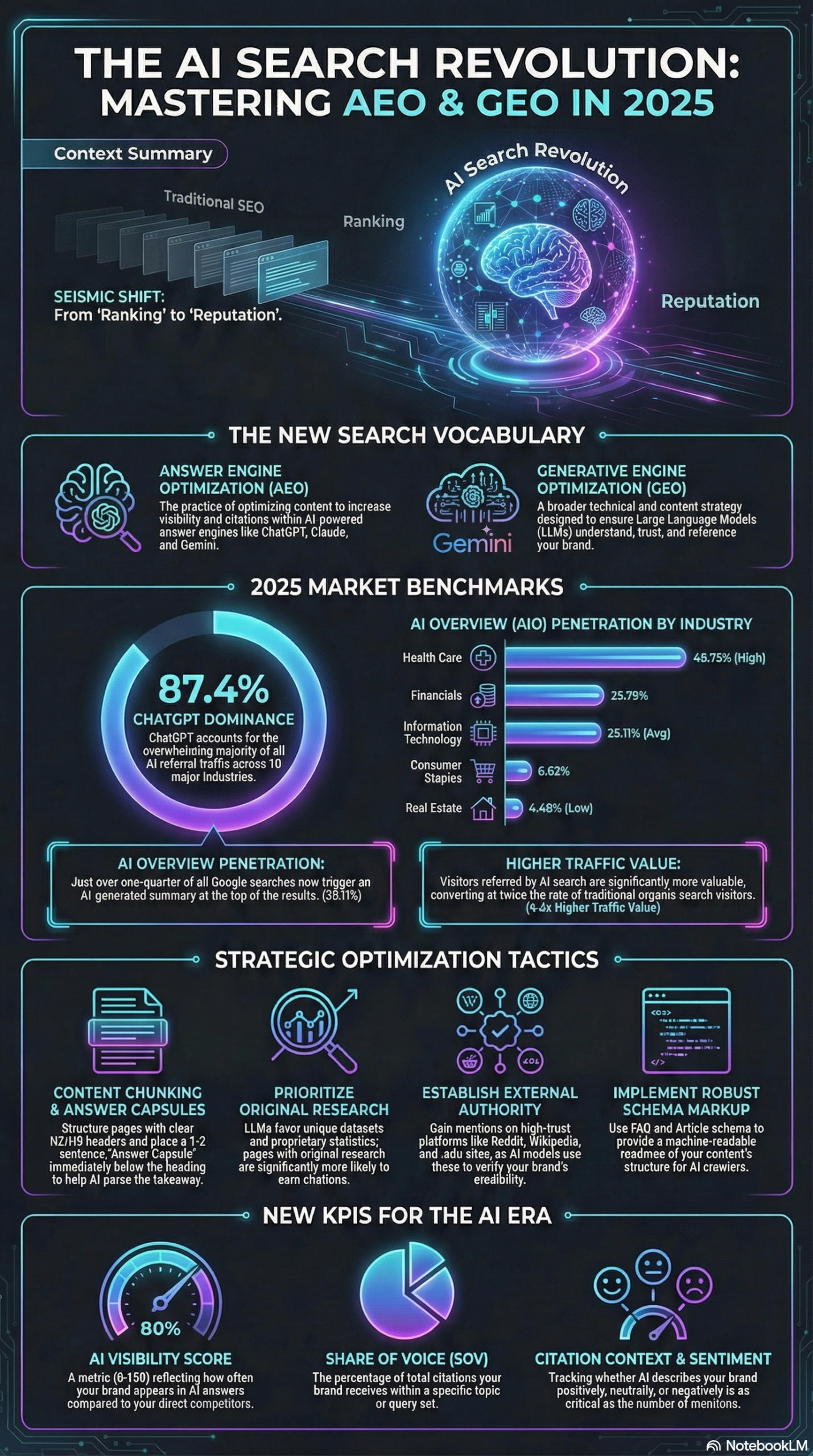
Research across 13,770 domains and 3.3 billion sessions, cited in industry benchmark analysis, shows AI referral traffic currently represents approximately 1.08% of total web visits — small in absolute terms, but growing at roughly 1% month-over-month. More significantly, AI-referred visitors are estimated to be 4.4x more valuable than traditional organic search visitors due to higher intent and conversion rates. The channel is small, growing fast, and disproportionately high-value. The question isn’t whether to invest in it — it’s how to sequence that investment alongside existing SEO work so neither channel is neglected.
The Data
Here is how the two discovery channels compare across key dimensions — and how the Foundation Up approach unifies them:
| Dimension | Traditional SEO | Answer Engine Optimization (AEO) | Foundation Up Approach |
|---|---|---|---|
| Primary Goal | Rank high in Google SERPs | Be cited in AI-generated answers | Build one content asset that serves both |
| Success Metric | Click-through rate, organic traffic | AI citations, brand mention frequency | Combined visibility score + traffic |
| Primary Platforms | Google, Bing | ChatGPT, Perplexity, Gemini, Copilot | All platforms via unified content structure |
| Content Format | Keywords + backlinks | Structured, direct, authoritative answers | Pillar + cluster with answer-ready formatting |
| Time to Results | Weeks to months | Days to weeks | Concurrent — SEO builds authority; AEO shows fast wins |
| Research Tool (Semrush) | Keyword Magic, Position Tracking | AI Visibility Toolkit, AI Search Optimizer | Both, managed from Semrush One |
Performance results from the Frenos case study as reported by Semrush:
| Metric | Starting Point (July 2025) | Result (January 2026) |
|---|---|---|
| Search Visibility | Near-zero | 18.32% |
| AI Visibility Score | ~14 | Improved (ongoing tracking) |
| Timeframe | — | 6 months |
| Consumers using AI in purchase research | — | 50% (U.S. survey) |
| Consumers: search first, then AI | — | 33% |
| Consumers: AI first, then search | — | 26% |
AI search platform market share context, from benchmark research across 13,770 domains:
| AI Platform | Market Share (2025) |
|---|---|
| ChatGPT | 87.4% |
| Microsoft Copilot | ~3.2%–8.05% |
| Perplexity | ~3.1%–8.2% |
| Google Gemini | 2.4% |
| Claude | 1.35% |
ChatGPT’s 87.4% share makes it the dominant target for AEO efforts — the platform Pat Reinhart, VP at Conductor, calls “the Google of AI search.” Optimize for ChatGPT first; improvements typically trickle down to other LLMs.
Step-by-Step Tutorial: Implementing the Foundation Up Framework
Here is how to replicate David Haas’s approach for your own brand, client, or agency practice. You will need access to Semrush One to follow along with the specific tooling, though the strategic logic applies regardless of platform.
Prerequisites:
– An active domain with at least some existing content
– Semrush One account (includes Keyword Magic Tool, Position Tracking, Site Audit, AI Visibility Toolkit, AI Search Optimizer, and Competitor Research)
– A defined list of 3–5 direct competitors
– A clear understanding of your buyer personas and the specific questions they ask during research
Phase 1: Establish Your SEO Baseline
Before touching a single piece of content, measure where you actually stand. Decisions made without this baseline are guesses.
Step 1: Map Your Core Topic Landscape in Keyword Magic Tool
Open Semrush’s Keyword Magic Tool and enter your primary category terms — the broad topics your brand competes in. You are not targeting these broad terms directly at this stage. You are using them to map the landscape and understand where competition is heaviest and where gaps exist. For Frenos, this meant terms like “OT cybersecurity” and “industrial security testing.”
Step 2: Filter for Buyer-Intent, Low-to-Moderate Difficulty Keywords
David’s approach is deliberately strategic here: he ignores high-volume terms dominated by entrenched competitors and identifies queries that signal purchase intent with manageable competition. In Keyword Magic Tool, apply filters for:
– Keyword difficulty scores appropriate to your domain authority (for small or new domains, typically under 40–50)
– Commercial or transactional intent markers
– Long-tail variants that reflect specific buyer decision criteria or comparison questions
Document your target keyword set in a working spreadsheet. You should have 20–40 primary targets per content pillar area before building anything.
Step 3: Configure Position Tracking Against Competitors
Set up a Position Tracking project in Semrush for your domain. Add your 3–5 direct competitors. Import your target keyword list from Step 2. This creates a live dashboard showing your ranking versus competitors on every target term — and it surfaces opportunities where a competitor ranks weakly for a term that matters to your buyers. These competitor weak spots become your highest-priority content targets.
Step 4: Run a Technical Site Audit With AI Readiness Checks
Run Site Audit in Semrush. Beyond standard technical SEO issues (broken links, crawl errors, page speed, duplicate content), specifically flag for the following AI-readiness signals:
– Missing Article and FAQ Schema markup — these help LLMs map questions to your answers
– Absence of an llms.txt file — this file helps AI models understand your site’s hierarchy and which content is authoritative
– Any robots.txt rules that block AI crawlers — these prevent AI systems from accessing your content entirely
– Pages missing “Last Updated” timestamps and dateModified structured data — AI systems, particularly ChatGPT, strongly favor recently updated content
According to research benchmarks, 95% of ChatGPT citations come from content published or updated within the last 10 months. If your content doesn’t signal recency through schema, even fresh content may be overlooked.
Phase 2: Measure Your AI Visibility Baseline
Run this phase in parallel with your SEO baseline work — don’t sequence them. You need both data points before you can prioritize intelligently.
Step 5: Pull Your AI Visibility Score
In Semrush’s AI Visibility Toolkit, retrieve your current AI Visibility Score. This 0–100 score measures how often your brand appears in AI-generated answers compared to competitors. For most small and mid-sized brands, scores near the baseline of Frenos (~14) are typical. This is not a failing mark — it is a starting line. The critical thing is documenting this number before any content changes so you have a clean before-and-after comparison.
Step 6: Review Your AI Narrative Drivers
The AI Visibility Toolkit also surfaces what Semrush calls “Narrative Drivers” — the specific language and framing that AI systems use when they mention your brand. Review these carefully:
– Is the AI describing your brand accurately and with the right value proposition?
– Are there factual inaccuracies or outdated product descriptions?
– What topics does the AI associate with your brand that you would rather not own?
Correct factual inaccuracies through schema markup updates, on-page clarifications, and updated structured data before building new content. You do not want to amplify a wrong story — you want to amplify an accurate one.
Step 7: Run Competitor AI Visibility Research
Use the Competitor Research tool in Semrush to identify which competitors are being cited in AI answers — and for which specific topics. This analysis reveals two types of strategic opportunity: topics where competitors have weak AI presence despite strong search rankings (where you can establish AI authority quickly), and topics where no one in the category has strong AI presence yet (where first-mover advantage is available at low competitive cost).
Step 8: Augment Semrush Data With Community Research
This is the step that separates Haas’s approach from pure tool-based research. He cross-references Semrush AI data with manual research in:
– Reddit threads relevant to your buyers’ industry and pain points
– Niche industry forums and Q&A communities
– LinkedIn discussions among target buyer personas
As Haas explained in the Semrush case study: “Semrush is giving you a very specific set of prompts, which are good, but community research is an augmentative way to look at a bigger picture and create content that is really going to resonate.”
This community layer surfaces the exact vocabulary and question patterns buyers use when articulating problems in natural language — which is precisely the language you need to match in both keyword-targeted SEO content and answer-ready AEO formatting.
Phase 3: Build Pillar and Cluster Content
With baselines established in both channels, you now have the intelligence to build efficiently and confidently.
Step 9: Define Your Content Pillars
Based on your combined keyword and AI research, identify 3–5 major topic areas where you will build authority. Each pillar should represent a problem category your ideal buyer researches before selecting a vendor. For Frenos, this included topics like OT penetration testing and industrial cybersecurity testing — buyer research topics, not product features.
Each pillar receives a comprehensive “pillar page” — a long-form, authoritative resource covering the topic broadly. These pages should:
– Open with a direct, one-sentence answer to the most common question about the topic (the “answer capsule”)
– Use descriptive H2 and H3 headings phrased as buyer questions (e.g., “What is OT penetration testing?” rather than “Overview”)
– Include self-contained paragraphs that AI engines can extract and cite independently without surrounding context
– Reference credible external sources — this signals authority to both search engines and LLMs
– Carry full Article Schema and FAQ Schema markup
Step 10: Build Cluster Content Around Each Pillar
For each pillar, produce 4–8 cluster pieces addressing specific sub-topics: use cases, technical FAQs, comparisons, implementation walkthroughs, and subject-matter deep dives. Each cluster piece should:
– Link back to its parent pillar page (this builds topical authority signals for both SEO and AI)
– Target a specific long-tail keyword identified in your Phase 1 research
– Cover exactly one topic in depth rather than attempting to cover multiple topics shallowly
– Open every major section with a direct answer capsule
– Include FAQ Schema on any section containing question-and-answer content
Step 11: Apply AI Readiness Formatting to Every Page
Every page you publish or significantly update should include:
– Article and FAQ Schema markup
– A “Last Updated” timestamp in the page header and dateModified in your schema
– An llms.txt file at your domain root (if not already deployed)
– Question-phrased H2/H3 headings throughout
– Self-contained paragraphs — write as if each paragraph might be extracted without surrounding context, because AI systems routinely do exactly that
Phase 4: Monitor, Iterate, and Expand
Step 12: Track Both SEO and AEO Progress Weekly
Review your Position Tracking dashboard and AI Visibility Toolkit on a weekly cadence. Look specifically for:
– Keywords climbing toward page one that deserve additional cluster content to accelerate momentum
– New AI citation opportunities competitors haven’t addressed
– Long-tail traction on recently published cluster pieces
– Competitor ranking vulnerabilities — keywords where they are slipping
Step 13: Treat Research as an Ongoing Loop, Not a Project
As Haas summarized: “SEO accelerates when data informs strategy — and strategy guides content.” Do not treat keyword or AI prompt research as a one-time activity. Run fresh research every quarter at minimum, or whenever you see a meaningful shift in either your search rankings or your AI Visibility Score. New buyer language emerges, competitors publish new content, and AI models evolve — your research loop must evolve with them.
Expected Outcomes by Timeline:
- Week 1–2 post-publish: Well-structured content begins appearing in AI-generated answers (as documented by Haas in the Semrush case study)
- Month 1–3: Long-tail cluster pieces gain search traction; AI Visibility Score begins climbing
- Month 3–6: Pillar pages drive significant organic traffic; topical authority signals accumulate
- Month 6+: Combined strategy replicates Frenos result — near-zero baseline to 18%+ visibility, with both channels contributing measurably
Real-World Use Cases
Use Case 1: B2B SaaS Company in a Competitive Technical Niche
Scenario: A cybersecurity SaaS company with strong product-market fit and a small marketing team. They have solid domain expertise documented in whitepapers and sales decks, but almost no organic presence. Better-known competitors dominate Google and are beginning to appear in ChatGPT answers when buyers ask evaluation questions.
Implementation: Execute Steps 1–4 to establish a keyword baseline, specifically targeting mid-funnel buyer queries around evaluation criteria (e.g., “how to evaluate endpoint detection platforms” rather than “endpoint detection software”). Run AI Visibility audit (Steps 5–7) to identify which competitors are being cited in AI answers and which topics have AI citation gaps. Build a pillar page around the buyer’s primary research question, plus 6 cluster pieces targeting specific decision criteria.
Expected Outcome: Within 90 days, cluster content begins ranking for long-tail queries with manageable competition. Within 6 months, pillar pages contribute material organic traffic. AI visibility score climbs as structured, schema-marked content gets retrieved by Perplexity and ChatGPT. Buyers begin arriving with specific questions already answered — a pattern that, anecdotally, shortens enterprise sales cycles because prospects have already resolved early-stage objections through AI research.
Use Case 2: Fractional CMO Onboarding a New Client
Scenario: A fractional CMO with 3–4 active clients takes on a new engagement — a mid-sized industrial equipment manufacturer with no existing SEO or content program and a modest monthly budget for content production.
Implementation: Use Semrush One’s combined toolkit to run both baselines in weeks 1–2 at near-zero additional cost. Prioritize 2 pillar topics based on AI gap analysis — topics where no competitor has established AI citation authority. Produce 2 pillar pages and 4 cluster pieces in the first 90 days. Track both Position Tracking and AI Visibility Score from day one so client reporting shows dual-channel ROI from the outset, not just months later.
Expected Outcome: Client sees measurable AI visibility improvement within weeks of first content publication — a fast win that builds confidence and justifies continued investment. Search rankings improve over months 3–6. Unified reporting in Semrush One makes the results visible, attributable, and easy to present. As Haas noted in the Semrush case study: “A solution like Semrush One is an incredible advantage for these companies — typically, they won’t have enough resources and expertise in-house.”
Use Case 3: In-House Marketing Team at a Healthcare Technology Company
Scenario: A healthcare technology company wants to appear in AI-generated answers when buyers research “patient engagement platforms.” Healthcare has one of the highest AI Overview penetration rates of any industry — 48.75% according to benchmark research across 13,770 domains — meaning AI visibility in this vertical is not a future consideration, it is a current competitive necessity.
Implementation: Start with a full AI Visibility audit (Steps 5–7) to identify current narrative drivers and competitor citation gaps. Audit the existing content library for AEO formatting gaps: missing FAQ schema, lack of question-based headings, no direct answer capsules at section tops. Update the top 10 existing pages with proper formatting as a quick-win first phase. Then produce 3 new cluster pieces targeting high-value AI prompt queries identified through Semrush AI Search Optimizer.
Expected Outcome: Existing high-authority pages begin generating AI citations within 2–4 weeks of formatting updates — no new content required for these early wins. New content fills topic gaps where competitors currently dominate AI answers. Combined result is broader AI presence with a modest production budget focused on strategic gaps rather than volume.
Use Case 4: Agency Building a Scalable SEO + AEO Service Offering
Scenario: A digital marketing agency wants to build a repeatable, documentable service offering that combines SEO and AEO under a single retainer. Most clients are currently buying SEO-only, and the agency wants to differentiate before competitors catch up.
Implementation: Standardize the Foundation Up framework as an agency methodology with defined phases and deliverables: dual baseline audit (weeks 1–2), content architecture design (weeks 3–4), pillar and cluster production (months 2–4), ongoing iteration and reporting (month 5+). Use Semrush One’s agency features to manage multiple client Position Tracking and AI Visibility dashboards from a single account. Package the AI Visibility Score as a featured KPI in all client reporting.
Expected Outcome: Differentiated, process-driven service offering in a market where most agencies still treat SEO and AEO as separate line items or ignore AEO entirely. The integrated methodology produces faster demonstrable results for clients (AI citations appearing in weeks vs. SEO rankings in months), which supports premium pricing and longer engagement retention.
Common Pitfalls
1. Targeting High-Volume Keywords Before Domain Authority Supports It
The instinct is to chase the largest terms in your category. Haas explicitly avoided this for Frenos — terms like “OT cybersecurity” were too competitive for the domain’s early-stage authority. Targeting keywords where you cannot realistically compete wastes content production resources and delivers demoralizing results. Start where you can win, build authority through early traction, then expand to broader terms as your domain strengthens. As documented in the Semrush case study, this discipline is central to why the approach worked.
2. Launching AEO Before the SEO Foundation Is Solid
Some teams, excited by AI visibility as a newer and shinier channel, start with AEO before building SEO fundamentals. This is the wrong sequence. AI engines retrieve structured, authoritative, well-linked content — which is the output of good SEO work. Publish poorly organized content with good answer formatting and you will see minimal AI citations, because the underlying content lacks the credibility signals LLMs use to select sources. SEO foundation first. AEO on top. Every time.
3. Ignoring Technical AI Readiness
Many teams focus on content strategy and ignore the technical signals that affect AI retrievability. Missing llms.txt files, robots.txt rules blocking AI crawlers, absent Article and FAQ schema, and missing dateModified structured data are all invisible to human readers but highly visible to AI crawlers. Per benchmark research, 95% of ChatGPT citations reference content published or updated within the last 10 months. Without proper freshness signals in your schema, even recently updated content may be treated as stale.
4. Treating AEO as a One-Time Audit Rather Than an Ongoing Loop
AI visibility is a continuous system, not a campaign. Buyer language evolves. Competitors publish new content. AI models update their training data and retrieval priorities. Haas’s framework explicitly treats keyword and prompt research as an ongoing loop — a quarterly commitment, not a one-time deliverable. Teams that run one AI audit and shelve the process will see their visibility erode as the landscape shifts around them.
5. Skipping Community Research in Favor of Tools Only
Relying solely on Semrush AI data misses the actual natural-language vocabulary buyers use in unstructured conversations. Reddit threads, industry forums, and LinkedIn discussions surface question patterns and problem framings that do not appear in formal keyword research. This qualitative layer makes content more resonant with real buyers and more likely to match the specific phrasing of AI prompts — because both buyers and AI systems tend to ask questions in natural, conversational language rather than formal search queries.
Expert Tips
1. Establish AI Visibility Score as a Client KPI on Day One
Do not wait until you have results to introduce AI Visibility Score as a metric. Set up measurement at kickoff — even when the score is near zero — so you have a documented baseline that makes later progress attributable and defensible. Clients who see the score climb from 14 to 40 in three months understand the value of what they are funding in a way that abstract “content strategy” language never communicates.
2. Retrofit Your Highest-Authority Existing Pages for AEO Before Creating New Content
Your highest-ROI early AEO investment is not new content — it is applying answer capsules, FAQ schema, and question-based headings to your top 10 existing pages. These pages already have domain authority and backlinks. Adding AEO formatting costs hours of work and can produce AI citation results within days. Build this retrofit phase into every new engagement as the first content deliverable.
3. Use AI Narrative Drivers as a Brand Messaging Audit Tool
The Narrative Drivers feature in Semrush’s AI Visibility Toolkit does more than catch inaccuracies. It tells you what buyers actually associate with your brand when they ask AI systems about it — which is a proxy for what the broader web says about you. If AI is describing you in terms you haven’t emphasized in your own marketing, that may signal what your buyers actually value. Use this as a feedback loop, not just a damage-control tool.
4. Prioritize Original Data and Expert Quotations in All Major Content Assets
According to research on AI visibility optimization, including statistics and expert quotations can boost source visibility by over 40%. Build proprietary data points — surveys, internal benchmarks, documented case study metrics — into every pillar page and major cluster piece. Original data that does not exist anywhere else on the web is consistently favored by LLMs as a citation source, because it provides unique informational value rather than restating what is already widely available.
5. Publish Across All Three Distribution Paths for Every Piece of Content
Every content asset should serve three channels simultaneously: traditional search (structured for crawlability and keyword relevance), AI answer engines (formatted with answer capsules and FAQ schema), and community channels where AI training data originates — specifically Reddit, LinkedIn, and niche industry forums. Seeding your content in credible community contexts builds the brand mention density that LLMs use to establish authority. This is what research on E-E-A-T signals describes as “brand seeding” — third-party mentions and citations that signal trustworthiness even when they do not include hyperlinks.
FAQ
Q: How long does it take to see results from AEO efforts?
Faster than most teams expect for AI visibility, slower for traditional search. According to David Haas’s work with Frenos, newly published content that is properly structured for AI retrievability can begin appearing in AI-generated answers within one to two weeks, as documented in the Semrush case study. Traditional SEO rankings develop over three to six months. This is precisely why the combined Foundation Up approach delivers better sustained results than either strategy alone — AEO provides fast wins while SEO builds durable long-term authority.
Q: Does this framework require Semrush One specifically?
The strategic logic — SEO baseline first, AI baseline second, pillar and cluster content, continuous iteration — does not depend on any specific tool. The principles apply regardless of platform. However, having SEO measurement and AI visibility measurement in a single integrated dashboard significantly reduces coordination overhead, especially for resource-constrained teams managing multiple clients or a small in-house team. Semrush One is the platform David Haas used and the one documented throughout the Frenos case study. Alternatives exist, but the integrated functionality is currently one of Semrush One’s clearest differentiators for practitioners running unified strategies.
Q: How do you measure AI visibility without a paid platform?
Manual testing in ChatGPT, Perplexity, and Google AI Overviews is free and surprisingly informative as a starting baseline. Open each platform and ask the questions your buyers would ask. Does your brand appear? In what context? Is the description accurate and current? Document the results in a simple spreadsheet with the date. This won’t produce a quantified score or competitive benchmarking, but it establishes a narrative baseline and surfaces obvious errors before you invest in content production. Scale to paid tooling once budget and process justify it.
Q: What is the difference between AEO and GEO, and which should I prioritize?
Answer Engine Optimization (AEO) focuses specifically on being cited in AI-generated answers — getting your content retrieved and attributed when users ask questions in tools like ChatGPT, Perplexity, or Google AI Overviews. Generative Engine Optimization (GEO) is a broader concept focused on building semantic relationships and brand mention density so that LLMs develop an organic association with your brand across their training data. Both are documented in research on digital visibility strategy. In practice, most practitioners prioritize AEO first because it is measurable, near-term, and directly tied to content actions you can take today. GEO tactics — broad brand seeding across authoritative sources like Reddit, Wikipedia, and industry publications — are layered in as a longer-term play once the AEO foundation is solid.
Q: Is AI search significant enough to justify dedicated investment right now?
Benchmark data across 13,770 domains and 3.3 billion sessions puts AI referral traffic at approximately 1.08% of total web visits — a small absolute share. But it is growing at roughly 1% month-over-month, and AI-referred visitors are estimated to be 4.4x more valuable than traditional organic search visitors due to higher intent and conversion rates. The Semrush research also documents that 50% of U.S. consumers have made purchases after using AI during research, and that 33% now blend search and AI in a single research session. The channel is real, it is growing at pace, and the practitioners who establish AI visibility now are building a compounding advantage over those who wait for the channel to hit some arbitrary size threshold before investing.
Bottom Line
The Foundation Up framework, documented through David Haas’s work with Frenos and reported in Semrush’s case study blog post, answers the most pressing structural question in B2B digital marketing right now: how do you build presence across both traditional search and AI answer engines without running two disconnected content strategies? The answer is that you build one shared content architecture — structured for SEO authority and formatted for AI retrievability — and you measure both channels in a single platform. Starting from near-zero, Frenos reached 18.32% visibility in six months with this approach. The methodology is repeatable, scalable from solo fractional CMOs to enterprise teams, and grounded in a sequencing logic — SEO foundation first, AEO amplification layer second, continuous research loop always — that makes both channels stronger rather than splitting your resources between them. Practitioners who master this sequencing now are building the compounding brand authority that will define AI-influenced discovery in 2026 and beyond.


0 Comments