

AI agents are no longer just productivity tools — they’re now the operational backbone of corporate sustainability programs at companies like Salesforce, where a 65% increase in customer sustainability inquiries between 2024 and 2025 was handled without scaling the headcount of the Impact team. This tutorial walks you through the architecture, implementation steps, and real-world playbook for deploying AI agents that reduce emissions, cut energy waste, and automate sustainability reporting at enterprise scale. By the end, you’ll know exactly how to configure, deploy, and measure AI-driven sustainability workflows in your own organization.
What This Is
AI agents for sustainability are purpose-built autonomous systems that monitor, analyze, and act on environmental data across an organization’s operations — from energy meters and supply chains to carbon accounting platforms and grant-management workflows. Unlike traditional business intelligence dashboards (which require a human to interpret and act), AI agents execute predefined or learned decision logic in real time, closing the loop between data and action.
The most concrete production example right now is Salesforce’s Agentforce platform, which the company deployed internally to handle sustainability operations at scale. Agentforce runs inside Slack and answers impact-related questions for Account Executives instantly — giving any sales rep access to the company’s sustainability policies and initiatives without routing the request to an already-stretched Impact team. The result: 50% faster response times on sustainability inquiries with zero additional headcount.
On the nonprofit and grantmaking side, Agentforce Nonprofit automates what used to be a three-step manual process: creating new grantee accounts, building prospect identification records, and generating grant application summaries. The time saving is measurable — 65% less time spent on record creation for grantmaking teams, which translates directly into more grants reviewed and more ecopreneurs funded.
Beyond Salesforce’s own stack, the broader landscape of AI agents for sustainability includes several categories of tools operating across the industrial stack:
-
Energy optimization agents: ML models that analyze historical and real-time consumption data from IoT sensors to predict demand, preempt equipment failures, and dynamically adjust heating, cooling, and lighting. In smart buildings, these agents learn occupancy patterns and reduce energy draw during low-utilization windows.
-
Supply chain transparency agents: Systems that trace supplier environmental footprints end-to-end, using predictive analytics to reduce overproduction and route optimization to cut fuel consumption and greenhouse gas (GHG) output.
-
GHG reporting agents: Autonomous agents that scan shipping documents and seaway bills, extract emissions data, and populate reporting templates with predefined formulas and validation rules — replacing a workflow that previously required significant manual labor. Given that manpower makes up 62% of total Accounts Payable costs, automating this extraction has compounding ROI.
-
Climate risk assessment agents: Models that analyze weather patterns, geographic risk data, and supply chain exposure to forecast disruptions from extreme weather, drought, or flooding — enabling proactive resilience planning.
-
Waste reduction agents: AI-powered robotics equipped with computer vision that categorize recyclable materials with higher accuracy than manual sorting, diverting materials from landfills and supporting circular economy operations.
What ties all of these together is a common architecture: IoT sensors or digital records feed real-time data into ML models, which run inference and either surface recommendations to human operators or trigger automated actions through workflow integrations (Slack, CRMs, ERP systems, etc.). The research report for this article — produced via NotebookLM — identifies Multi-Agent Systems (MAS) and Reinforcement Learning (RL) as the two most impactful underlying paradigms, since they allow distributed agents to coordinate on complex resource allocation without central bottlenecks.
Why It Matters
Sustainability reporting is no longer optional. With regulatory pressure mounting globally — from SEC climate disclosure rules to the EU’s Corporate Sustainability Reporting Directive — companies now face hard deadlines for tracking Scope 1, 2, and 3 emissions. The problem is that the data infrastructure to support that reporting is fragmented, labor-intensive, and expensive to maintain manually.
AI agents solve this in three ways that matter to practitioners:
1. They eliminate the human-in-the-loop bottleneck for routine data tasks. Salesforce’s Net Zero Cloud — originally built as an internal tool in 2019 — now delivers a 40% reduction in data collection time and 37% cost savings on consultant expenses for organizations managing carbon accounting. Those are real budget line items.
2. They enable 24/7 operation across time zones. Human sustainability teams can’t answer queries at 2am for a sales rep in Singapore who needs to respond to a client question about the company’s carbon offset program. An Agentforce agent in Slack can — and does. This isn’t a marginal improvement; it changes the operational model from a reactive support function to an always-available infrastructure layer.
3. They shift skilled teams from administrative work to strategic impact. Salesforce leadership has explicitly framed this as the core value proposition: “With a unified platform like Agentforce, we shift from managing data to driving meaningful action. By automating routine tasks, we free up our teams to focus on the creative, strategic work.” This is consistent with broader research showing that workers using generative AI save an average of 5.4% of their work hours, contributing to a 1.1% increase in aggregate productivity — a significant macro effect when applied across enterprise-scale teams.
For marketers and growth teams specifically, the angle is straightforward: sustainability claims backed by auditable, agent-generated data are far more defensible than manually assembled reports. Customers, investors, and regulators are all asking harder questions. Companies that can answer those questions with live data — not last quarter’s spreadsheet — hold a material competitive advantage.
The Data
The performance gains from AI-driven sustainability implementations are not theoretical. The following tables summarize both Salesforce’s internal metrics and a representative industrial case study from the NotebookLM research report for this post.
Salesforce Agentforce Sustainability Metrics
| Workflow | Tool | Measured Outcome |
|---|---|---|
| Sustainability Q&A for sales reps | Agentforce in Slack | 50% faster response time |
| Carbon data collection | Net Zero Cloud | 40% reduction in data collection time |
| Consultant cost reduction | Net Zero Cloud | 37% cost savings |
| Grantee record creation | Agentforce Nonprofit | 65% less time on record creation |
| Annual sustainability inquiries | Agentforce | Thousands handled without headcount increase |
| Year-over-year inquiry growth | Agentforce | 65% increase from 2024 to 2025 |
GreenTech Industries: ML Energy Optimization Results
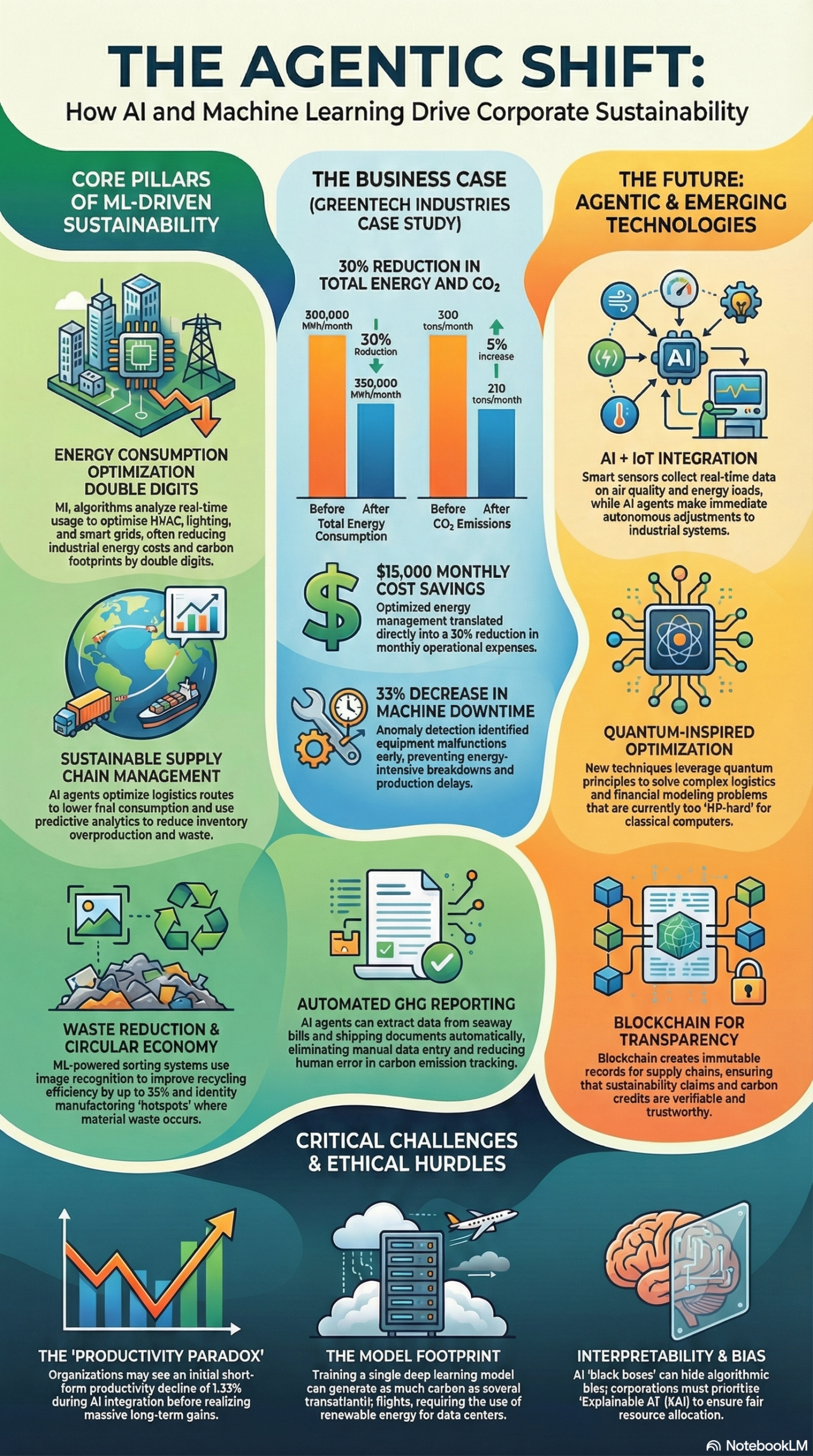
The following metrics come from a representative case study of an electronic component manufacturer that deployed ML-driven energy optimization across its production facilities, as documented in the NotebookLM research report:
| Metric | Before ML | After ML | Improvement |
|---|---|---|---|
| Total Energy Consumption | 500,000 kWh/month | 350,000 kWh/month | 30% reduction |
| Monthly Energy Cost | $50,000 | $35,000 | 30% reduction |
| CO2 Emissions | 300 tons/month | 210 tons/month | 30% reduction |
| Machine Downtime | 120 hrs/month | 80 hrs/month | 33% reduction |
| Production Output | 100,000 units/month | 105,000 units/month | 5% increase |
Broader Industry Benchmarks
| KPI | Reported Range | Source |
|---|---|---|
| ROI on AI implementations | 200–400% | NotebookLM Research Report |
| Energy consumption reduction | 18–30% | NotebookLM Research Report |
| Carbon emissions reduction | 20–30% | NotebookLM Research Report |
| Waste reduction | 22–25% | NotebookLM Research Report |
| Worker time saved via Gen AI | 5.4% of work hours | NotebookLM Research Report |
| Aggregate productivity gain | 1.1% | NotebookLM Research Report |
Step-by-Step Tutorial: Deploying AI Agents for Sustainability Operations
This walkthrough covers how to stand up a functional AI agent sustainability stack — from data readiness through live deployment. The architecture maps to what Salesforce has deployed internally, adapted for teams that don’t have a full-scale CRM platform already in place.
Prerequisites
- Access to your organization’s energy, emissions, or operational data (even CSV exports are sufficient to start)
- A CRM, ERP, or collaboration platform with API access (Salesforce, HubSpot, SAP, or similar)
- A basic understanding of webhook-based integrations
- At least one sustainability metric you need to report on (Scope 1, Scope 2, supply chain GHG, etc.)
- Stakeholder alignment: identify who will own the agent outputs (sustainability team, finance, ops)
Phase 1: Data Audit and Governance Setup
Before deploying any agent, you need clean, accessible data. This is not optional — the research is unambiguous: up to 80% of time in ML projects is dedicated to data preparation, and “the effectiveness of machine learning systems relies heavily on the quality and quantity of data… many organizations struggle with data silos, inconsistencies, and gaps.”
Step 1: Map your data sources.
List every system that holds sustainability-relevant data: utility bills, ERP inventory records, logistics platforms, supplier portals, IoT sensor outputs. For each source, document: format (CSV, API, PDF), update frequency (real-time, daily, monthly), owner, and current access method.
Step 2: Identify and break down silos.
Most organizations have sustainability data spread across finance (energy invoices), operations (equipment run logs), procurement (supplier contracts), and facilities (building management systems). You need a single data lake or federated query layer. Tools like Snowflake, Databricks, or even a well-structured Google BigQuery project work here. The goal is one place where all data is queryable without manual extraction.
Step 3: Establish a data governance policy.
Define: who can write to the data lake, what validation rules apply to incoming records (no negative energy consumption values, etc.), and how often models are retrained. Document this in a governance charter — you’ll need it for regulatory compliance and for explaining agent outputs to auditors.
Phase 2: Choose Your Agent Architecture
Step 4: Select your agent framework.
For teams already on Salesforce, Agentforce is the fastest path — it integrates directly with Net Zero Cloud for carbon accounting and Slack for distribution. For teams on other stacks, options include:
– Microsoft Copilot Studio (integrates with Azure ML and Power Platform)
– LangChain / LangGraph (open source, highly customizable for multi-agent pipelines)
– AutoGen (Microsoft Research’s multi-agent framework, strong for complex coordination tasks)
– Custom Python agents using OpenAI or Anthropic APIs with tool-calling enabled
For sustainability reporting specifically, a rule-based agent with structured output is more reliable than a pure LLM — you want deterministic extraction of GHG data from documents, not probabilistic summarization.
Step 5: Define agent tasks and boundaries.
Each agent should have exactly one primary function. Common task definitions for sustainability agents:
Agent: GHG_Extractor
Input: Shipping manifest PDF or seaway bill
Task: Extract net weight, transport mode, distance, and fuel type
Output: Structured JSON → {shipment_id, weight_kg, mode, distance_km, fuel_type, estimated_co2_kg}
Validation: Reject records missing weight or mode fields
Agent: EnergyOptimizer
Input: Real-time IoT data from building management system (BMS)
Task: Compare current consumption against occupancy schedule and weather forecast
Output: HVAC setpoint adjustment commands OR alert to facilities team
Trigger: Every 15 minutes OR when consumption deviates >10% from predicted baseline
Agent: SustainabilityQA
Input: Natural language question from sales rep via Slack
Task: Query internal knowledge base (sustainability policies, carbon offset programs, product certifications)
Output: Plain-language answer with source citation
Fallback: Escalate to Impact team if confidence score < 0.75
Step 6: Set escalation and fallback rules.
Every agent needs a defined path for edge cases. If an agent can’t extract required fields from a document, it should route to a human reviewer — not silently fail or hallucinate values. Build your fallback logic before you deploy.
Phase 3: Integration and Deployment
Step 7: Connect your data layer to the agent.
Using your chosen framework, create connectors to your data sources. For Salesforce, this is native via Net Zero Cloud’s data import tools. For custom agents, use:
# Example: pulling energy data via API for agent context
import requests

def get_energy_data(site_id: str, start_date: str, end_date: str) -> dict:
    response = requests.get(
        f"https://your-bms-api.com/sites/{site_id}/consumption",
        params={"start": start_date, "end": end_date},
        headers={"Authorization": f"Bearer {API_KEY}"}
    )
    response.raise_for_status()
    return response.json()  # Returns {timestamps: [], kwh_values: []}
Step 8: Build the reporting pipeline.
For GHG reporting agents, the pipeline is: document ingestion → field extraction → formula application → template population → validation → output.
# Simplified GHG calculation agent step
EMISSION_FACTORS = {
    "road_freight": 0.096,   # kg CO2e per tonne-km
    "sea_freight": 0.016,    # kg CO2e per tonne-km
    "air_freight": 0.602     # kg CO2e per tonne-km
}

def calculate_shipment_emissions(weight_kg: float, distance_km: float, mode: str) -> float:
    weight_tonnes = weight_kg / 1000
    factor = EMISSION_FACTORS.get(mode, 0)
    return round(weight_tonnes * distance_km * factor, 4)
Step 9: Deploy to your collaboration layer.
If you’re on Slack, Agentforce integrates natively. For other stacks, use Slack’s Bolt SDK or a webhook listener to pipe agent responses back to the appropriate channel:
# Slack webhook response for sustainability Q&A agent
from slack_bolt import App

app = App(token=SLACK_BOT_TOKEN)

@app.message("sustainability")
def handle_sustainability_query(message, say):
    question = message["text"]
    answer = sustainability_qa_agent.run(question)
    say(f"*Sustainability Answer:*\n{answer}\n\n_Source: Internal Impact Policy Database_")
Step 10: Run a pilot before full rollout.
Start with one use case (e.g., automated GHG extraction from shipping manifests) on a 30-day pilot. Measure: accuracy rate on extracted fields, time saved versus manual process, exception rate (documents that required human review), and user satisfaction from the team receiving outputs. Only expand to additional agents after the pilot validates the architecture.
Phase 4: Monitoring and Continuous Improvement
Step 11: Instrument your agents.
Log every agent decision — inputs, outputs, confidence scores, and exceptions. Without logging, you can’t audit, retrain, or explain agent behavior to regulators or stakeholders.
Step 12: Apply PDCA cycles.
The research recommends a Plan-Do-Check-Act framework for continuous improvement: set a baseline metric, deploy the agent, measure outcomes against the baseline at 30/60/90 days, and adjust either the agent logic or the data quality upstream based on findings.
Expected outcomes after a 90-day deployment:
– GHG reporting agents: 40–65% reduction in data collection time (consistent with Net Zero Cloud benchmarks)
– Energy optimization agents: 18–30% energy cost reduction (consistent with industry case studies)
– Sustainability Q&A agents: 50%+ reduction in time-to-answer for impact-related inquiries
Real-World Use Cases
Use Case 1: Enterprise Sales Teams Answering Sustainability RFPs
Scenario: A global manufacturing company’s sales team fields dozens of RFP questions per quarter asking about Scope 3 emissions, supplier audits, and product lifecycle data. The sustainability team can’t scale to answer every query in real time.
Implementation: Deploy a Slack-based Q&A agent (similar to Salesforce’s Agentforce implementation) trained on internal sustainability reports, CDP disclosures, supplier audit summaries, and product certifications. The agent handles Tier 1 questions (standard policy, existing certifications) autonomously and routes complex Tier 2 questions to the Impact team with a pre-populated research brief.
Expected Outcome: Based on Salesforce’s internal deployment, expect 50% faster response times and measurable reduction in Impact team ticket volume within the first 60 days.
Use Case 2: Automated Carbon Accounting for Multi-Site Operations
Scenario: A logistics company operates 40 distribution centers across 12 countries. Manual Scope 1 and Scope 2 reporting takes 3 weeks per quarter and relies on five different spreadsheet formats from facility managers.
Implementation: Deploy GHG extraction agents connected to utility bill ingestion (PDF parsing via document AI), an ERP integration for fleet fuel consumption, and Net Zero Cloud (or equivalent) as the reporting output layer. Agents normalize data across formats, apply IPCC emission factors, and populate the reporting template automatically.
Expected Outcome: Consistent with the 40% reduction in data collection time reported by Net Zero Cloud users, with the added benefit of quarterly close time dropping from weeks to days.
Use Case 3: Industrial Energy Optimization at a Manufacturing Facility
Scenario: A food processing plant runs 24/7 with variable production schedules. Energy is the second-largest operating cost, and the facilities team has no real-time visibility into which production lines are overconsumingbased on actual throughput.
Implementation: Install IoT current sensors on major equipment loads, feed data to an ML energy optimization agent, and set automated alerts plus SCADA integration for setpoint adjustments. The model is trained on 12 months of historical production and energy data before go-live.
Expected Outcome: Based on the GreenTech Industries case study from the NotebookLM research report, expect 30% energy cost reduction and 33% reduction in unplanned machine downtime within 6 months.
Use Case 4: Nonprofit Grantmaking at Scale
Scenario: A climate-focused foundation receives 800 grant applications per cycle and has a 5-person program team. Manual record creation and initial application screening consumes 60% of program officer time before any substantive review happens.
Implementation: Deploy Agentforce Nonprofit (or equivalent workflow automation) to handle new grantee account creation, prospect identification record generation, and initial application summary production. The agent flags applications meeting predefined criteria for priority human review.
Expected Outcome: Based on Salesforce’s internal grantmaking deployment, expect 65% less time on record creation, allowing program officers to review more applications and fund more projects per cycle.
Use Case 5: Supply Chain Scope 3 Emissions Tracking
Scenario: A consumer goods brand needs to report Scope 3 Category 1 (purchased goods and services) emissions and has 2,000+ active suppliers. Manual collection via annual surveys yields 30% response rates and inconsistent data quality.
Implementation: Deploy supplier portal agents that send automated data collection requests, validate submitted data against prior-year baselines and industry emission factors, and flag outliers for follow-up. Reinforcement Learning agents optimize the follow-up cadence to maximize response rates without overwhelming supplier relationships.
Expected Outcome: Significant improvement in Scope 3 data coverage and consistency, enabling compliant third-party disclosure with materially less manual effort.
Common Pitfalls
Pitfall 1: Skipping the Data Audit
The most common failure mode is deploying an agent against messy, siloed data. ML models trained on inconsistent inputs will produce inconsistent outputs — and in sustainability reporting, inconsistent outputs create regulatory and reputational risk. Fix: complete a full data inventory before writing a single line of agent code. The research is clear that up to 80% of ML project time should go to data preparation.
Pitfall 2: Building Agents That Are Too Broad
An agent assigned to “handle all sustainability questions” will fail at the edges. The agents that work in production have narrow, well-defined task boundaries with clear escalation paths. Broad scope leads to hallucination and low-confidence outputs that erode user trust quickly. Fix: define exactly one primary task per agent and build a routing layer on top if you need multi-domain coverage.
Pitfall 3: Ignoring the Carbon Cost of AI Itself
Training a single deep learning model can generate as much carbon as several transatlantic flights. If you’re deploying AI for sustainability and you’re running it on coal-powered compute, the math may not close. Fix: use pre-trained models where possible, run inference (not training) in production, and select cloud providers with verified renewable energy commitments. This is what the research calls “Green AI.”
Pitfall 4: Deploying Without Explainability
Stakeholders — including regulators, auditors, and senior leadership — will ask how the agent reached a specific emissions figure or recommendation. If you can’t explain it, you can’t defend it. The “black box” problem is real, and it creates both compliance risk and organizational resistance. Fix: prioritize Explainable AI (XAI) approaches from the start, and log every inference with full audit trails.
Pitfall 5: Scaling Before Validating
Agents that work on 100 records in a pilot often break on 100,000 records in production. Infrastructure, latency, exception handling, and edge cases all compound at scale. Fix: run a structured 30–90 day pilot, measure exception rates, and only scale after the architecture proves stable and accurate at the pilot volume.
Expert Tips
Tip 1: Start with a high-frequency, low-stakes workflow.
GHG data extraction from shipping documents is a perfect first agent deployment — high volume, rule-based, and the cost of an occasional error is reviewable before it hits a regulator. Avoid starting with automated decisions that directly affect capital allocation or public disclosures.
Tip 2: Use multi-agent coordination for complex resource allocation.
Multi-Agent Systems (MAS) let you decompose a complex optimization problem (e.g., minimize total fleet emissions while meeting all delivery SLAs) into parallel agents that each own one dimension. A coordinator agent then synthesizes their outputs. This is substantially more robust than a single monolithic model trying to optimize everything at once.
Tip 3: Build your fallback threshold before launch.
Decide in advance what confidence score triggers a human review. For regulatory reporting, a threshold of 0.90+ is reasonable — if the agent is less than 90% confident in an extracted value, it should flag it. Don’t wait until you have a production incident to define this.
Tip 4: Instrument for retraining signals, not just errors.
Errors tell you when an agent fails. Drift tells you when the world has changed and the agent’s training no longer reflects it. Track output distribution over time — if the range of extracted CO2 values starts shifting without a corresponding change in actual operations, your model may be drifting and needs retraining against fresh data.
Tip 5: Treat the sustainability agent as internal product.
The teams receiving agent outputs (Impact team, finance, ops) are your users. Conduct user interviews, collect feedback on output quality, and ship improvements on a sprint cadence. The agents that get adopted are the ones that feel like they were built for the people using them — not deployed at them.
FAQ
Q1: Do I need Salesforce to deploy AI agents for sustainability?
No. Salesforce’s Agentforce and Net Zero Cloud are one implementation path — a mature and well-documented one — but the underlying architecture is replicable with open-source tools (LangChain, AutoGen, Python) and any data infrastructure that supports API connectivity. The Salesforce stack is fastest if you’re already a Salesforce customer; otherwise, build on whatever platform your data already lives in.
Q2: How much data do I need to get started?
For GHG extraction agents, you need a representative sample of the documents you’re automating — 200–500 labeled shipping manifests is enough to fine-tune or prompt-engineer a reliable extractor. For energy optimization models, 12 months of historical consumption data at 15-minute intervals is the practical minimum for a meaningful baseline model.
Q3: How do I handle Scope 3 emissions data from suppliers who won’t share their data?
Use spend-based estimation as a fallback — industry-standard emission factors (from databases like EXIOBASE or the EPA’s supply chain emission factors) can produce defensible Scope 3 estimates when primary supplier data isn’t available. Agent workflows can automate this fallback logic: attempt primary data collection, fall back to spend-based if no response within a defined window.
Q4: What’s the regulatory risk of using AI-generated sustainability reports?
The risk is real but manageable. The key requirements are: auditability (can you show how each figure was derived?), accuracy (are figures within acceptable variance of manually verified samples?), and disclosure (are you transparent with auditors and regulators about the role of automation?). Explainable AI approaches and comprehensive logging address all three. Regulators generally accept automated data aggregation when it’s well-documented — they’re auditing the process as much as the numbers.
Q5: How long does a typical deployment take from start to first production output?
For a focused first agent (e.g., GHG extraction from shipping documents), a realistic timeline is: 2 weeks for data audit and governance setup, 2 weeks for agent development and testing, 4 weeks for pilot, 2 weeks for iteration and hardening = approximately 10 weeks from kickoff to validated production agent. Salesforce’s internal deployments are faster because Net Zero Cloud provides much of the infrastructure out of the box. Custom builds on open-source stacks take longer but are more flexible.
Bottom Line
AI agents for sustainability have moved past proof-of-concept into measurable production impact. Salesforce’s internal deployment of Agentforce delivers 50% faster sustainability response times, 40% reduction in data collection time via Net Zero Cloud, and 65% reduction in grantmaking record creation time — all without increasing headcount. The industrial case study data from the NotebookLM research report reinforces this: well-deployed ML energy optimization delivers 30% reductions in energy cost and emissions simultaneously, with reported ROI in the 200–400% range across enterprise implementations. The implementation path is well-defined — data governance first, narrow agent scope second, pilot before scaling — and the technology stack is accessible whether you’re on Salesforce or building from open-source components. Companies that deploy these agents now will have auditable, AI-generated sustainability data ready when regulators and customers come asking — and based on the 65% year-over-year growth in sustainability inquiries, they’re already asking.


0 Comments