

OpenAI officially shut down the Sora app and API on March 24, 2026 — ending a two-year experiment that once promised to redefine how video content is created. If you’re currently using Sora in a production workflow, the clock is ticking: data preservation windows are finite and alternatives need to be evaluated now. This post unpacks exactly what happened, why the world’s most-hyped AI video generator failed, and gives you a step-by-step playbook for migrating to a resilient, model-agnostic video pipeline that won’t leave you stranded the next time a lab pulls the plug.
What This Is
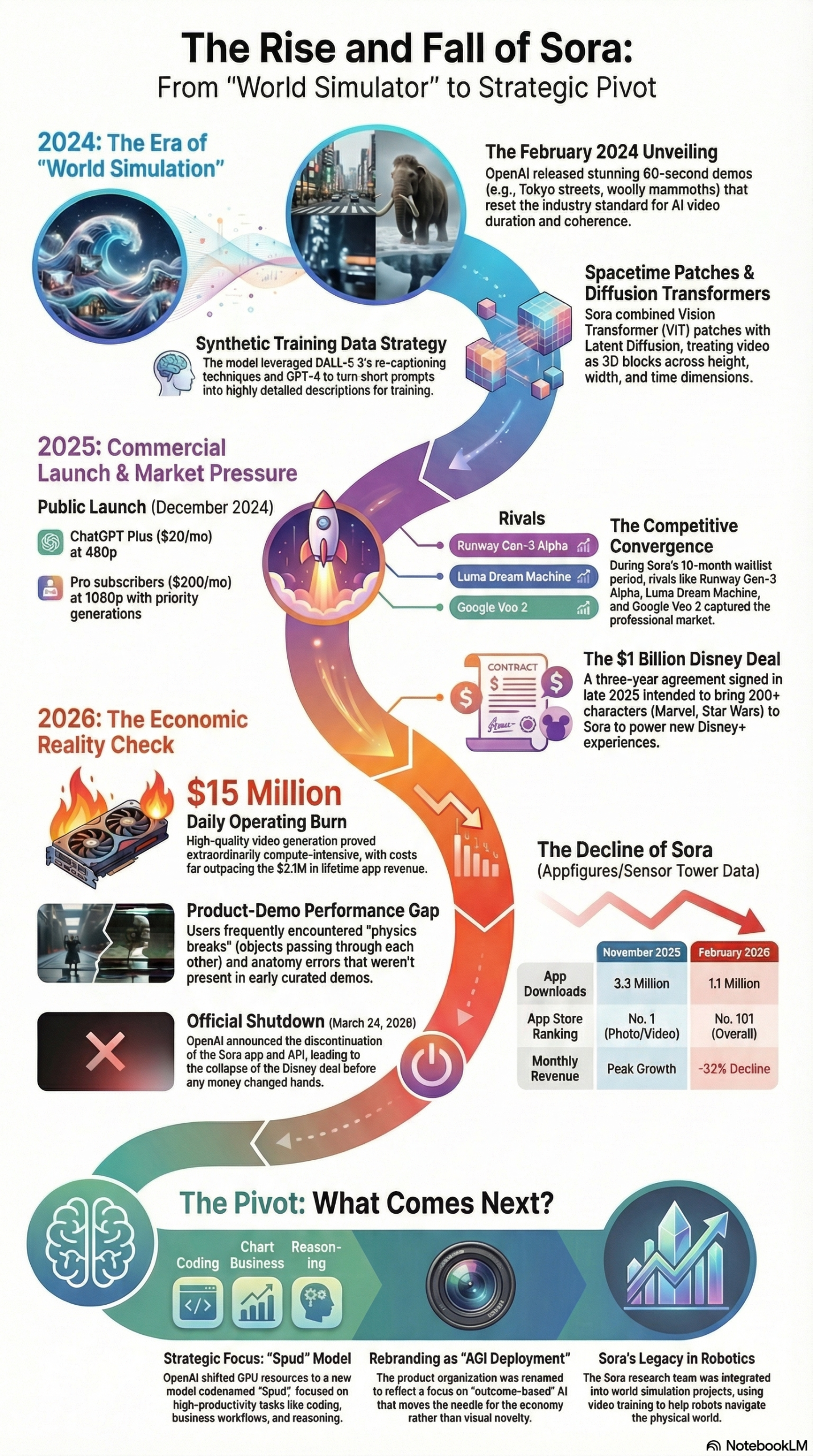
According to the NotebookLM research briefing on Sora’s lifecycle, Sora was unveiled in February 2024 as one of the most technically sophisticated generative video systems ever demonstrated publicly. It was not merely a “text-to-video” tool — OpenAI’s own technical documentation positioned it as a “world simulator” capable of internalizing physical logic and generating coherent environments.
The Architecture Behind the Hype
What made Sora architecturally distinct was its adoption of the Diffusion Transformer (DiT) backbone. Traditional video generation models used a U-Net architecture (as seen in Stable Diffusion), but Sora replaced that with a transformer-based pipeline. This allowed the model to operate on “latent patches” rather than pixel space, improving scalability dramatically.
The key innovation was Spacetime Patches: just as Large Language Models use text tokens, Sora treated video as sequences of patches that extended across width, height, and time simultaneously. This meant the model could handle variable durations, resolutions, and aspect ratios without needing separate fine-tuned models for each format — a genuine engineering breakthrough.
To handle the computational load of raw video data, Sora used a VQ-VAE (Vector Quantised Variational AutoEncoder) to compress video into a latent representation before feeding it to the transformer. This dimensionality reduction was critical to making the model tractable at all. For prompt alignment, OpenAI applied GPT-4-powered re-captioning techniques similar to those used in DALL·E 3 — ensuring that verbose or ambiguous prompts were faithfully translated into visual instructions.
The “world simulator” framing wasn’t just marketing. The research briefing notes that capabilities like object permanence and 3D scene consistency emerged as phenomena of model scaling rather than being explicitly programmed. This suggested that with enough compute, video generation models could eventually internalize genuinely useful physical reasoning.
From Research Preview to Sora 2
The original Sora launch in February 2024 was a limited research preview — no public API, no consumer app, just a demonstration that stunned the industry. It took until September 2025 for OpenAI to relaunch as Sora 2, repositioned as a social-centric creative app for consumers. The app debuted at the top of the iOS App Store charts, hitting 3.3 million downloads by November 2025. That milestone turned out to be the peak.
By March 2026, according to the Wall Street Journal investigation, downloads had plummeted from 3.3 million to 1.1 million — a 67% decline in three months. On March 24, 2026, OpenAI’s official X account posted a terse statement: “We’re saying goodbye to Sora.” The app and API were shut down simultaneously, and the former Sora team was redirected toward world-simulation research for robotics.
Why It Matters
The Sora shutdown is not just a product failure post-mortem — it’s a signal about where the entire AI tools market is heading, and practitioners who read it correctly will be positioned to make smarter tooling decisions going forward.
For Creators and Media Professionals
If you built production workflows around Sora — whether for social content, motion graphics, or concept visualization — you are now dealing with an abrupt pipeline break. The shutdown also collapsed a $1 billion licensing deal with The Walt Disney Company that would have given Sora users access to over 200 licensed characters from Marvel, Pixar, and Star Wars. Disney pulled its planned equity investment and publicly stated it would seek AI platforms that “respect intellectual property and creator rights.” The creative ecosystem that was forming around Sora dissolved overnight.
For Developers and AI Engineers
The shutdown exposes a critical architectural risk: single-model dependency. Many developers integrated Sora’s API directly into their production code without abstraction layers. Those integrations are now broken with zero path forward. The research briefing explicitly recommends building “generate video” nodes that can swap underlying models — using platforms like MindStudio or custom abstraction layers — to avoid rebuilding entire workflows when a model is deprecated.
For Strategists and Investors
Sora’s failure validates what Anthropic has been doing by design: avoiding video and image generation entirely and focusing on enterprise text and code. According to the research briefing, Anthropic has captured 73% of new enterprise spending in AI by executing a “focus over flash” strategy. OpenAI is now chasing that same approach with a new model codenamed “Spud,” designed for coding, reasoning, and business planning rather than novelty consumer clips. The era of compute-burning consumer AI experiments appears to be over — at least at OpenAI.
The Data
Sora Lifecycle Metrics
The following data points are sourced directly from the NotebookLM research briefing on Sora’s discontinuation and the Wall Street Journal report:
| Metric | Value |
|---|---|
| Initial Launch | February 2024 (research preview) |
| Sora 2 Launch | September 2025 (consumer app) |
| Peak Downloads | 3.3 million (November 2025) |
| Downloads at Shutdown | 1.1 million (March 2026) |
| Download Decline | −67% in three months |
| Lifetime Revenue | $2.1 million (as of March 2026) |
| Estimated Daily Operational Cost | $15 million/day |
| Estimated Annual Burn Rate | $5.4 billion |
| Cost Per 10-Second Video | ~$1.30 in compute |
| Disney Deal Size (Collapsed) | $1 billion equity investment |
| Shutdown Date | March 24, 2026 |
AI Video Tool Comparison (Post-Sora Landscape)
| Tool | Status | Best For | API Available | Approx. Cost |
|---|---|---|---|---|
| Google Veo 2/3 | Active | High-fidelity cinematic video | Yes (Vertex AI) | Per-second pricing |
| Runway Gen-3 Alpha | Active | Creative/editorial workflows | Yes | Credit-based |
| Kling | Active | Consumer + short-form video | Yes | Subscription + API |
| Stability AI (Stable Video) | Active | Open-source / self-hosted | Yes | Free (self-hosted) |
| Pika Labs | Active | Quick social content | Limited | Subscription |
| OpenAI “Spud” | Pre-training complete | Coding/reasoning/enterprise | TBD | TBD |
Source: NotebookLM research briefing; tool availability current as of March 2026.
Step-by-Step Tutorial: Migrating Your AI Video Workflow After Sora
This is the operational playbook. Whether you had a light integration or a deep production dependency on Sora, these steps will get you to a stable, model-agnostic video pipeline that won’t leave you exposed the next time a lab shuts down a model.
Prerequisites
- Access to your existing Sora project files, API keys, and generated content
- A list of workflows or applications that called Sora’s API or used the Sora UI
- Accounts (free tier is fine to start) on at least two alternative platforms: Runway, Google Veo 2 (via Google AI Studio or Vertex AI), and/or Kling
- If you run automated pipelines: a prompt-to-video abstraction layer (MindStudio, LangChain, or a custom API wrapper)
Phase 1: Archive Everything Immediately
Before anything else, download every piece of content you generated with Sora. OpenAI has indicated that transition windows for data preservation will be finite, and there is no guarantee that your generated videos will remain accessible past the initial shutdown window.
Step 1 — Inventory your Sora content. Log into the Sora app or your account dashboard. Export or download every video and project file. If you accessed Sora via the API, query your generation history endpoint and pull all output files to local storage or your cloud bucket (S3, GCS, etc.) now.
Step 2 — Document your prompt library. Export or manually copy every prompt you used successfully in Sora. These prompts are workflow assets — you’ll want to re-test them against alternative models to understand capability gaps. Organize them by use case: social content, explainer video, concept visualization, etc.
Step 3 — Map API call locations. If you built any code that called the Sora API, identify every location where those calls occur. Search your codebase for Sora API endpoint references. Flag these as migration targets for Phase 3.
Phase 2: Evaluate Your Replacement Tools
Not all Sora alternatives are equivalent. The right replacement depends on your specific use case, budget, and whether you need API access or a UI-driven workflow.
Step 4 — Test your top 5 prompts on each candidate tool. Take the five prompts that generated your best or most-used Sora outputs and run them through Google Veo 2, Runway Gen-3 Alpha, and Kling. Use the same prompt text — don’t adjust for the new tool yet. This gives you a baseline comparison of output quality differences.
Step 5 — Evaluate on four dimensions. Score each tool on: (a) visual quality — does it match or exceed your Sora baseline? (b) physics coherence — one of Sora’s known weaknesses was objects passing through each other and liquids behaving unnaturally; does the replacement do better? (c) temporal consistency — does the video hold together across frames without objects teleporting or scenes shifting without logic? (d) prompt adherence — does the output actually match what you asked for?
Step 6 — Factor in cost structure. Sora’s consumer pricing was effectively subsidized — the research briefing estimates real compute cost at approximately $1.30 per 10-second clip, which was not passed through to users at that rate. Replacement tools may have higher nominal costs that better reflect actual compute. Map your monthly video generation volume to each tool’s pricing model to find the most economical fit.
Step 7 — Check API maturity. If you need programmatic access, verify that each candidate tool’s API is production-stable: review rate limits, SLAs, error handling documentation, and whether the API has versioning that protects you from breaking changes. Runway and Google Veo 2 (via Vertex AI) currently offer the most mature API surfaces among the active alternatives, per the research briefing.
Phase 3: Build a Model-Agnostic Abstraction Layer
This is the step most teams skip — and it’s the reason the Sora shutdown hurt so many workflows. The fix is an abstraction layer: a single internal interface that your application calls, which then routes to whichever underlying video model you’ve configured. When the next model gets deprecated, you swap the backend, not your entire codebase.
Step 8 — Define a standard interface. Create a function or service with a consistent signature regardless of the underlying provider. A minimal interface looks like this:
def generate_video(
    prompt: str,
    duration_seconds: int = 10,
    aspect_ratio: str = "16:9",
    resolution: str = "1080p",
    provider: str = "runway"  # or "veo2", "kling", etc.
) -> VideoGenerationResult:
    """
    Model-agnostic video generation interface.
    Swap 'provider' to change the underlying model.
    """
    if provider == "runway":
        return _call_runway(prompt, duration_seconds, aspect_ratio, resolution)
    elif provider == "veo2":
        return _call_veo2(prompt, duration_seconds, aspect_ratio, resolution)
    elif provider == "kling":
        return _call_kling(prompt, duration_seconds, aspect_ratio, resolution)
    else:
        raise ValueError(f"Unknown provider: {provider}")
Step 9 — Implement provider adapters. Write one adapter function per provider. Each adapter handles the provider-specific API call, authentication, polling for completion (most video APIs are async), and result normalization into your standard VideoGenerationResult format (file URL, duration, resolution, metadata).
Step 10 — Externalize the provider config. Store the provider setting in an environment variable or config file — not hardcoded in your application logic. This way, switching from Runway to Veo 2 globally requires changing one config value, not a code deployment.
# .env or secrets manager
VIDEO_GENERATION_PROVIDER=runway
VIDEO_GENERATION_FALLBACK_PROVIDER=kling
Step 11 — Add a fallback mechanism. The Sora shutdown was announced with limited notice. Build your abstraction layer to support a fallback provider: if the primary provider returns an error or is unavailable, automatically retry with the fallback. Log the fallback event so you can track reliability trends.
Step 12 — Re-test your full workflow end-to-end. Run your complete content generation pipeline using the new abstraction layer against your primary replacement provider. Validate: (a) outputs match expected quality standards, (b) async completion polling works correctly, (c) error handling and fallback logic triggers as expected under simulated failure conditions, (d) costs per run match your projections from Phase 2.
Expected Outcomes
After completing this migration:
– All existing Sora-generated content is archived and preserved
– You have empirical quality benchmarks across two or more replacement tools
– Your video generation code is provider-agnostic and can swap backends in minutes
– Your cost model is realistic (no more subsidized pricing illusions)
– You are protected against the next model shutdown with a working fallback
Real-World Use Cases
Use Case 1: Social Media Agency Migrating Client Campaigns
Scenario: A digital agency was using Sora 2’s UI to generate short video clips for client social campaigns — primarily 15-second product teasers for Instagram Reels and TikTok. They had 12 active clients with monthly video deliverables.
Implementation: The agency immediately archived all existing client-approved Sora outputs. They ran a prompt audit, identifying the 20 most-used prompt templates, and benchmarked them against Runway Gen-3 Alpha and Kling. Kling performed better for short-form social content at lower cost. They rebuilt their internal Notion template for video briefs to include a “target tool” field, defaulting to Kling with Runway as fallback.
Expected Outcome: Minimal disruption to client deliverables, a 20-30% reduction in per-video cost compared to Sora’s consumer tier, and a vendor-agnostic workflow that can accommodate future model changes without client-facing impact.
Use Case 2: Developer Building an Automated Content Pipeline
Scenario: An independent developer built a SaaS tool that used the Sora API to auto-generate explainer video previews for product listings. The API shutdown broke the core feature for all paying customers.
Implementation: Following the abstraction-layer approach from the tutorial above, the developer replaced the direct Sora API call with a provider-agnostic wrapper. They integrated Runway Gen-3 Alpha as the primary provider via its REST API, with Google Veo 2 (via Vertex AI) as a fallback. The VIDEO_GENERATION_PROVIDER config variable allows them to switch providers globally in under a minute.
Expected Outcome: Service restored within 48 hours of Sora’s shutdown. Future-proofed against single-provider dependency. The abstraction layer also enabled A/B testing different providers against each other to optimize output quality over time.
Use Case 3: Enterprise Marketing Team Preserving Brand Assets
Scenario: A Fortune 500 marketing team had been generating concept visualization videos for internal presentations and campaign mockups using Sora. They had hundreds of approved outputs stored in Sora’s cloud.
Implementation: The team ran an emergency export of all Sora project files and outputs within the first 48 hours of the shutdown announcement. They documented all successful prompts in a shared Notion database tagged by campaign, use case, and quality tier. They then evaluated Google Veo 2 via Vertex AI for enterprise-grade API access with proper SLAs, data residency controls, and usage reporting.
Expected Outcome: All brand assets preserved. A vendor-assessed replacement deployed within two weeks. The prompt library, now properly documented, became a reusable creative asset rather than lost tribal knowledge locked inside a deprecated platform.
Use Case 4: Robotics Researcher Reframing the Loss as an Opportunity
Scenario: A robotics R&D team had been using Sora as a prototyping tool for visualizing robot behavior in simulated environments. According to the research briefing, OpenAI has redirected the former Sora team toward exactly this kind of world-simulation research — meaning the underlying technology isn’t gone, it’s being repositioned.
Implementation: The team pivoted to open-source alternatives (Stable Video Diffusion, self-hosted) for immediate needs, while tracking OpenAI’s robotics-focused research output for potential future access to the next-generation world-simulation models that the former Sora team is now developing.
Expected Outcome: No production dependency on a consumer app. The team is positioned to be early adopters of whatever world-simulation tooling OpenAI releases from the robotics research program — which will likely be more technically capable than the consumer Sora product ever was.
Common Pitfalls
Pitfall 1: Delaying the Archive Export
The most common mistake teams are making right now is assuming they have “plenty of time” to export Sora content. The research briefing is explicit: transition windows for data preservation will be finite. Once the window closes, generated videos and project files are gone permanently. Export everything before evaluating alternatives.
Pitfall 2: Picking One Replacement and Hard-Coding It
The entire lesson of the Sora shutdown is that single-model dependency is a business risk. Replacing Sora with Runway — and then hard-coding the Runway API call the same way Sora was hard-coded — just recreates the same vulnerability. Build the abstraction layer. It takes one to two days and saves weeks of emergency work the next time.
Pitfall 3: Assuming Comparable Output Quality Immediately
Sora’s outputs, despite their limitations, had a distinctive visual style that your stakeholders may have come to expect. Replacement tools will produce different aesthetics. Run your top prompts through alternatives before committing to one — and brief your clients or internal stakeholders that a calibration period is normal. The research briefing notes that Sora itself suffered from physics inconsistencies, anatomy errors, and temporal incoherence; your replacement may actually outperform it on technical accuracy even if the visual style feels different initially.
Pitfall 4: Ignoring the Real Cost Structure Going Forward
Sora’s consumer pricing was effectively subsidized. The research briefing estimates that OpenAI was burning approximately $15 million per day operating Sora — with only $2.1 million in lifetime revenue by the time of shutdown. That math is not sustainable, and it means no rational operator can price video generation at those rates long-term. Budget for realistic compute costs as you migrate. The days of near-free AI video generation were an anomaly, not a baseline.
Pitfall 5: Overlooking Content Moderation Differences
Sora’s moderation system was widely criticized for two opposite failure modes: blocking harmless creative prompts with heavy-handed filters, while deepfake detection firms like Reality Defender were reportedly able to bypass safeguards within 24 hours of launch. Different tools have different moderation profiles. Test your prompt library for false-positive blocks on your new platform before going live.
Expert Tips
Tip 1: Treat your prompt library as a first-class software asset. The prompts that consistently produce high-quality outputs are intellectual property. Version-control them in Git alongside your application code. Tag them by use case, quality tier, and which model they were optimized for. When you switch models, you’ll have a structured test suite ready.
Tip 2: Monitor model performance degradation, not just availability. Models don’t only fail by going offline — they also degrade when providers silently update them. Implement a weekly automated quality check: run three benchmark prompts through your production model and compare outputs against a reference baseline using a simple image similarity metric. Catch silent quality regressions before your clients do.
Tip 3: Use OpenAI’s strategic pivot as a roadmap, not just a cautionary tale. The research briefing confirms that OpenAI’s new “Spud” model is focused on coding, reasoning, and business planning. If you are building agentic AI workflows — systems that execute multi-step tasks, write code, or analyze data autonomously — you are aligned with where OpenAI is deploying compute. Invest in agentic capabilities now; that’s where the next wave of enterprise AI value is forming.
Tip 4: Negotiate SLAs with your video AI vendor. The Sora shutdown came with limited notice. When contracting with AI API providers, push for service continuity clauses that require a minimum deprecation notice period (90-180 days is reasonable). Runway, Google Vertex AI, and other enterprise-grade providers are more likely to negotiate this than consumer-focused tools.
Tip 5: Follow the compute trail. The research briefing notes that GPU scarcity — particularly NVIDIA H100 and Blackwell chips — was a deciding factor in OpenAI’s choice to shut down Sora and redirect compute to higher-priority workloads. AI labs make strategic decisions based on compute economics, and those decisions will continue to shape which products survive. Track where AI labs are concentrating compute investment; it predicts which product categories will receive sustained development.
FAQ
Q: How long do I have to download my Sora content before it’s gone?
OpenAI has not published a specific end date for data access following the March 24, 2026 shutdown. The research briefing states that “transition windows for data preservation will be finite.” The safest assumption is to export everything within the first week after shutdown. Do not wait for a specific deadline to be announced.
Q: Is there a direct technical replacement for Sora’s Diffusion Transformer architecture?
No single consumer or API product replicates Sora’s exact DiT + Spacetime Patches architecture. However, Google Veo 2 and Veo 3 (available via Vertex AI) are the closest in terms of output quality and duration support. For self-hosted options, the open-source Stable Video Diffusion lineage is the most technically accessible alternative, though it lacks Sora’s native resolution and duration range.
Q: Will OpenAI release any of Sora’s technology as open-source?
There is no indication in the research briefing or the Wall Street Journal report that OpenAI plans to open-source the Sora model weights. The former Sora team has been redirected to robotics world-simulation research under the “AGI Deployment” organizational structure, suggesting the technology will be repurposed internally rather than released publicly.
Q: What does the Sora shutdown tell us about which AI products are safe to depend on?
The research briefing offers a clear signal: Anthropic captured 73% of new enterprise spending by focusing exclusively on text and code — specifically avoiding video and image generation. The AI products that are safest to build on are those tied to high-margin enterprise use cases (coding assistance, reasoning, document analysis) rather than compute-intensive consumer novelties. Evaluate tools by whether their core business model is sustainable, not by launch hype.
Q: What is the “Spud” model and when will it be available?
“Spud” is a codename for a new OpenAI model that has completed pre-training as of the time of this report. Per the research briefing, it is designed for economic acceleration use cases: coding, reasoning, and business planning. It is intended to integrate into a “super app” combining chat, browsing, and coding. No public release date has been announced. OpenAI’s Q4 2026 IPO timeline suggests that Spud will be a central product in their go-to-market story for enterprise customers.
Bottom Line
Sora’s shutdown is the cleanest case study yet in what happens when an AI product’s compute economics are fundamentally broken: $5.4 billion in annualized operational costs against $2.1 million in total lifetime revenue is not a gap you close with product iteration. As Sora Technical Lead Bill Peebles stated in October 2025, “The economics are completely unsustainable right now.” For practitioners, the immediate action is to archive Sora content and rebuild video generation workflows with a model-agnostic abstraction layer. The broader lesson is to evaluate AI tool dependencies through the lens of compute sustainability — if a tool’s pricing model doesn’t cover its true infrastructure costs, it is not a stable foundation to build on. OpenAI’s pivot toward enterprise utility with the “Spud” model, and Anthropic’s success capturing enterprise spending with a “focus over flash” strategy, signals where durable AI value is accumulating: in agentic systems that code, reason, and execute tasks — not in subsidized consumer video generators.


0 Comments