

Salesforce Agentforce has crossed a threshold that most enterprise AI platforms only talk about: autonomous digital labor that actually resolves customer issues, closes sales tasks, and executes cross-functional workflows without a human in the loop. As of March 2026, Salesforce has secured more than 6,000 paid Agentforce deals since launch, and the platform just added Intent-Aware Search for Commerce — powered by a proprietary small language model (SLM) from Cimulate. This guide breaks down exactly what Agentforce is, how the Atlas Reasoning Engine works under the hood, and a step-by-step walkthrough to build and deploy your first agent.
What This Is
Agentforce is a platform layer within the Salesforce ecosystem featuring generative AI agents that take independent action rather than following prescribed response patterns. This is a meaningful architectural distinction. Traditional chatbots operate on decision trees and keyword matching. Agentforce agents draw on internal enterprise data, large language models (LLMs), and real-time reasoning loops to respond flexibly — and then actually do things rather than just surface information.
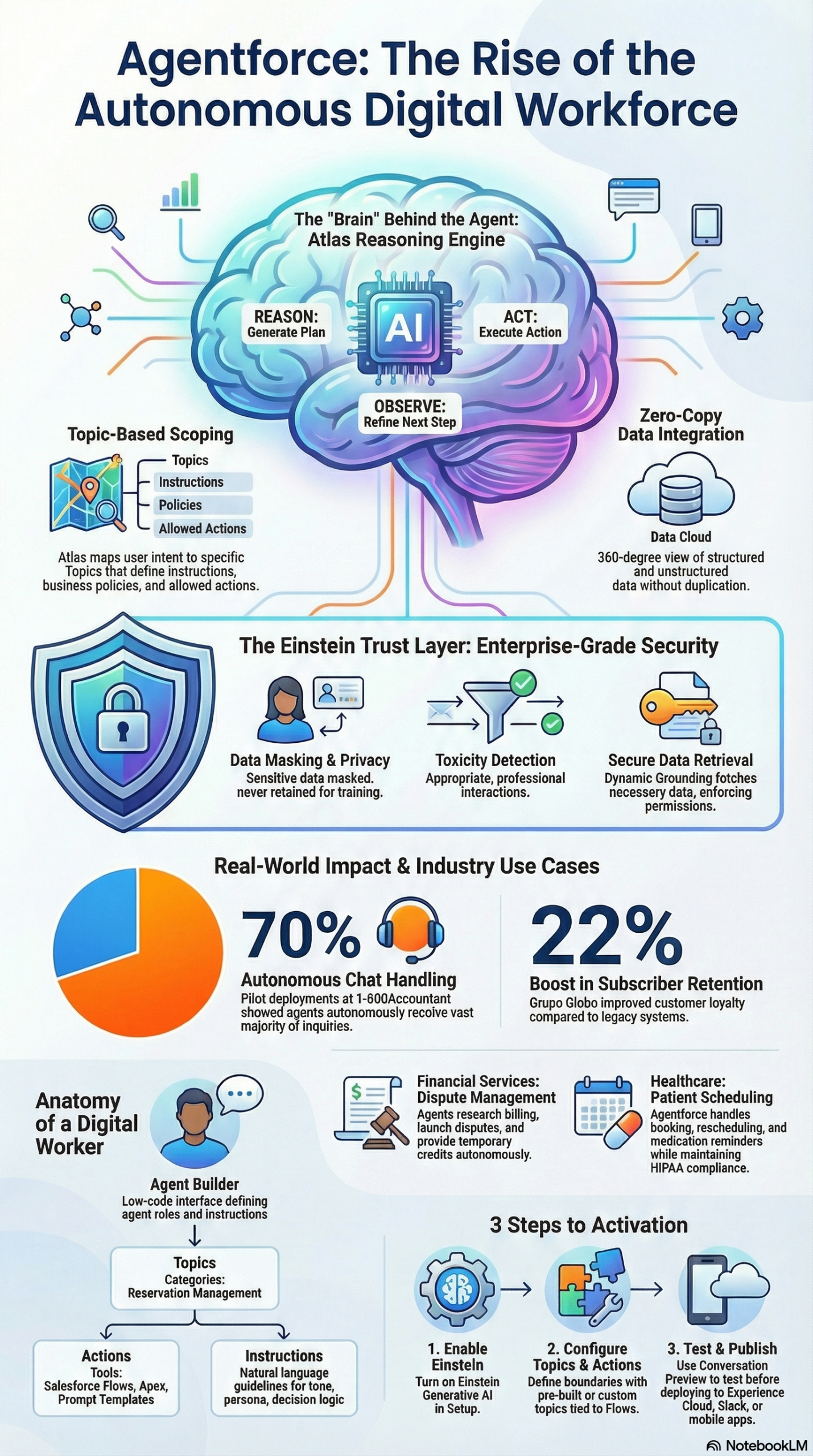
At its core, the platform is built around three builder tools: Agent Builder, Model Builder, and Prompt Builder. Agent Builder is the low-code configuration environment where administrators define agent roles, topics, and the actions they’re allowed to execute. Model Builder is where you connect and configure the underlying LLM. Prompt Builder handles the standardized text generation templates that keep agent communications consistent.
The engine driving all of this is Salesforce Atlas, the proprietary reasoning framework that serves as what Salesforce describes as the “brain” of Agentforce. Atlas doesn’t just pick a response from a menu — it uses ReAct (Reason + Act) prompting to iteratively plan, observe results, and refine its next action. This is the same class of approach used in advanced AI agent research: reason about the situation, select an action, observe the result, update the plan. The Atlas loop integrates directly with Data Cloud via a zero-copy architecture, meaning it can perform semantic vector searches against your enterprise’s structured and unstructured data (emails, transcripts, PDFs) in real time through retrieval-augmented generation (RAG).
Before any prompt leaves the Salesforce environment and touches an external LLM, it passes through the Einstein Trust Layer. This is a security and compliance pipeline that masks personally identifiable information with placeholder tokens, instructs the LLM to retain zero data after the response, and scans outputs for toxicity and policy violations before they reach the user. Every agent action and output is logged to an audit trail. For organizations operating under HIPAA, FedRAMP, or GDPR requirements, this architecture is the difference between a pilot project and a compliant production deployment.
Agentforce launched with seven pre-built agent types: Campaign Optimizer, Service Agent, Buyer, Personal Shopper, Merchant, Sales Development Representative, and Sales Coach. Since then, Salesforce has shipped vertical-specific packages for Retail (January 2025), Field Service (April 2025), HR Service (May 2025), Financial Services (May 2025), Revenue (July 2025), Public Sector (August 2025), Manufacturing (August 2025), IT Service (October 2025), and Commerce with Intent-Aware Search (March 2026). Each vertical package includes pre-built skills, topics, and action libraries tailored to that domain’s specific workflows and compliance requirements.
Agentforce 3, announced in June 2025, added native Model Context Protocol (MCP) client support — meaning agents can connect to any MCP-compliant server without custom code, across a partner ecosystem that already includes AWS, Box, Cisco, Google Cloud, IBM, Notion, PayPal, Stripe, Teradata, and WRITER. The accompanying Agentforce Command Center gives operations teams a single dashboard for monitoring agent health, performance, and optimization across all deployed agents.
Why It Matters
The shift from “AI assistant” to “AI that executes” is the inflection point practitioners need to understand. Copilots surface information and suggestions; agents close the loop. When Salesforce’s own help.salesforce.com deployed agents using this platform, they reported 83% of customer support queries resolved independently, with human escalations dropping 50% in the first two weeks. Research from the NotebookLM Agentforce briefing cites specific early deployments showing a 70% autonomous resolution rate for customer chats and a 22% increase in subscriber retention in pilot programs. These aren’t projections — they’re documented production results.
For marketers, the impact is direct. Agentforce agents handle lead qualification, hyper-personalized email campaign execution, abandoned cart recovery, and loyalty program management without human scheduling or sequencing. For sales teams, the SDR agent works 24/7 — no ramp time, no quota anxiety, no territory conflicts. For operations teams, IT ticket routing and IoT-triggered maintenance workflows run on the same reasoning stack as customer-facing agents.
The Commerce Intent-Aware Search update (March 2026) is particularly significant for e-commerce teams. Retailers have historically lost significant revenue to “no results” search failures — when a shopper searches for something in natural language and the product catalog’s keyword index returns nothing. The new feature, powered by Cimulate’s commerce-optimized SLM, understands shopper intent and maps natural-language queries to actual catalog items through real and simulated journey data. Merchandisers no longer need to manually maintain thousands of search rules.
Deloitte research cited in the Agentforce for Revenue release found that 71% of B2B executives struggle with manual, fragmented sales processes, and 13% of deals are lost due to disconnected tools. Agentforce’s Revenue Cloud integration — handling quote-to-cash processes including quoting, contracting, ordering, and invoicing — addresses this directly with a constraint-based logic engine that replaces rigid rule systems.
The Data
Agentforce vs. Salesforce Einstein AI: Core Distinction
| Feature | Salesforce Agentforce | Salesforce Einstein AI |
|---|---|---|
| Primary Purpose | Execution — autonomous digital workforce that performs tasks | Insight — predictive analytics and recommendations for human decision-making |
| Interaction Model | Operates autonomously across enterprise systems | Surfaces data-driven insights (lead scoring, trend forecasting) |
| Decision-Making | ReAct reasoning loops + programmed logic | Machine learning predictions and suggestions |
| Integration Scope | Enterprise-wide: IT, Finance, HR, Customer Service, Sales | Focused on Sales, Marketing, and Analytics |
| Human Role | Oversight and exception handling | Primary decision-maker using AI recommendations |
Source: Salesforce Agentforce Research Briefing
Agentforce Pricing Models (2025–2026)
| Model | Structure | Best For |
|---|---|---|
| Original | $2 per conversation | Simple, predictable use cases |
| Flex Credits | $0.10 per action (20 credits); 100K-credit packs at $500 | High-volume, variable workloads |
| Flex Agreement | Converts user licenses to Flex Credits and vice versa | Organizations shifting between human and digital labor investment |
| User License + Add-ons | Per-user per-month (PUPM) | Unlimited employee-facing agent usage |
| Pay-as-you-go | No upfront commitment | Pilots and unpredictable workloads |
| Pre-commit | Upfront commitment, favorable pricing | Established workloads with cost optimization goals |
| Pre-purchase | Full upfront payment | Consistent, predictable high-volume usage |
Source: Martech.org — Salesforce Agentforce: What you need to know
Agentforce Vertical Solutions Timeline
| Release Date | Product | Key Capability |
|---|---|---|
| Launch | Core Agentforce (7 agents) | Service, Sales, Commerce, Marketing |
| January 2025 | Agentforce for Retail | Order management, guided shopping, loyalty promotion |
| April 2025 | Agentforce for Field Service | Autonomous scheduling, voice commands, job summarization |
| May 2025 | Agentforce for HR Service | Time-off requests, expense submission, HR case management |
| May 2025 | Agentforce for Financial Services | Advisor meeting prep, loan officer guidance, compliance controls |
| June 2025 | Agentforce 3 | MCP support, Command Center, reduced latency |
| July 2025 | Agentforce for Revenue | Quote-to-cash automation, constraint-based logic engine |
| August 2025 | Agentforce for Public Sector | FedRAMP High, Protected-B, IRAP compliance; citizen services |
| August 2025 | Agentforce for Manufacturing | ERP integration, demand matching, IoT asset monitoring |
| October 2025 | Agentforce for IT Service | Cross-departmental auto-resolution, data silo elimination |
| March 2026 | Intent-Aware Search (Commerce) | SLM-powered natural language product discovery |
Source: Martech.org — Salesforce Agentforce: What you need to know
Step-by-Step Tutorial: Build and Deploy Your First Agentforce Agent
This walkthrough covers standing up a Service Agent — the most common starting point — from scratch to a live channel deployment. The same workflow applies to other agent types; what changes are the topics, actions, and data sources you configure.
Prerequisites
Before you start, confirm you have the following:
- Salesforce org with Einstein Generative AI enabled (available in Enterprise Edition and above)
- System Administrator profile or equivalent permissions to access Setup
- Data Cloud provisioned and connected to your org (required for RAG-based knowledge retrieval)
- At least one Knowledge Article or file library to ground agent responses
- A deployment channel configured: Experience Cloud site, Messaging (WhatsApp/SMS), or Salesforce Mobile App
If you’re piloting Agentforce without a full Data Cloud setup, you can still configure a basic agent using standard Knowledge Articles — but response accuracy will be lower because the agent won’t have access to the full vector search layer.
Phase 1: Enable Einstein Generative AI
Step 1: Navigate to Setup > Einstein Setup in your Salesforce org.
Step 2: Toggle Einstein Generative AI to ON. Salesforce will confirm your org’s data residency region — this matters for Data Cloud processing and compliance rules.
Step 3: Accept the Einstein Generative AI terms of service. Note: at this point, the Einstein Trust Layer is automatically active. All prompts sent to external LLMs will be masked and subject to zero-data retention by default.
Step 4: Under Einstein Setup, verify that Agentforce appears in your available products. If it doesn’t, check your org’s license assignments — Agentforce requires specific Agentforce user licenses, not just Einstein feature licenses.
Phase 2: Create the Agent in Agent Builder
Step 5: In Setup, search for Agentforce and open Agentforce Builder (previously called Agent Builder in earlier releases).
Step 6: Click New Agent and select Service Agent as the agent type.
Step 7: Write your agent’s role definition in the Agent Role field. Be specific and functional — this text directly grounds how Atlas classifies incoming requests. Example:
“A 24/7 customer service agent for Acme Corp. Your job is to resolve order status questions, process return requests, and escalate technical issues to human agents when required. You do not discuss pricing changes, legal matters, or product roadmap.”
The role definition is not just a label — Atlas uses it for topic classification and as a constraint on which actions the agent can consider. Vague role definitions lead to off-topic responses and higher escalation rates.
Step 8: Set the Agent Language and Time Zone appropriate to your primary user base.
Phase 3: Configure Topics and Actions
Step 9: Click New Topic to define the first task category. For a Service Agent, start with Order Management.
Step 10: In the Topic definition, fill in:
– Topic Name: Order Management
– Topic Description: Handles customer questions about order status, shipping updates, and delivery issues.
– Scope: The agent should look up order records in Salesforce and provide status updates. It should NOT modify or cancel orders without explicit customer confirmation.
The scope field is the key guardrail. Write it the way you’d write a policy document — with explicit DO and DO NOT statements.
Step 11: Assign Actions to the topic. Actions are the actual tools the agent can invoke. For Order Management, you’ll add:
– A Flow Action that queries the Order object and returns status fields
– A Prompt Template Action that formats the response in natural language
– An escalation Flow Action that creates a Case record and routes to a human queue
Step 12: Set the action as Public (no authentication required) for order status lookups, since this is read-only. If your flow modifies records — like updating a delivery address — mark it Private and configure two-factor authentication verification within the flow.
Step 13: Repeat the Topic + Action configuration for each task category your agent needs. Common starting set for a Service Agent:
– Order Management
– Returns and Refunds
– Technical Troubleshooting
– Account Information (Private — requires identity confirmation)
– Escalation to Human Agent
Phase 4: Connect Data Sources
Step 14: In Agent Builder, navigate to Data Library. Select the Knowledge Articles or file libraries this agent should draw on for RAG.
Step 15: If you have Data Cloud provisioned, connect your unified customer data profile. This allows the agent to personalize responses based on order history, tier status, and prior interactions — not just general knowledge.
Step 16: Enable Context Indexing for any unstructured content you want Atlas to search semantically. This is what allows the agent to answer questions phrased in natural language against documents that weren’t written as Q&A pairs.
Phase 5: Test Before Deployment
Step 17: Use the Testing Center (generally available since December 2024) to validate agent behavior before going live. The Testing Center allows you to:
– Submit test prompts and verify response accuracy
– Confirm the agent stays within its defined topic scope
– Audit the Atlas reasoning trace to see exactly how it classified the input, what data it retrieved, and which action it selected
– Test edge cases: off-topic queries, attempts to bypass guardrails, ambiguous inputs
Run at least 20-30 test scenarios covering your most common support queries plus intentional adversarial inputs. If the agent responds to queries outside its defined topics, tighten the scope constraints in your Topic definitions.
Step 18: Verify that the Einstein Trust Layer is correctly masking PII in the audit logs. In your test runs, include prompts that contain customer names, email addresses, and account numbers. Confirm these appear as masked placeholders in the reasoning trace — not raw data.
Phase 6: Deploy to a Channel
Step 19: Navigate to Channels in Agent Builder and select your deployment target. For a customer-facing Service Agent, Experience Cloud Messaging is the most common first channel.
Step 20: Configure Handoff Rules — the conditions under which the agent transfers to a human. Best practice is to define at least three escalation triggers:
– The customer explicitly requests a human
– The agent has attempted resolution twice without success
– The topic falls outside all configured action scopes
Step 21: Set the agent Live. Monitor initial traffic in the Agentforce Command Center (available in Agentforce 3+), which provides real-time dashboards for resolution rate, escalation rate, topic distribution, and average handling time.
Expected Outcomes: A well-configured Service Agent handling order management and returns for a mid-size e-commerce operation should achieve an autonomous resolution rate of 60–70% within the first month, based on documented production benchmarks from Salesforce’s own deployment. Resolution rates improve as you refine topic scope, expand your Knowledge library, and review reasoning traces to identify where the agent is failing.
Real-World Use Cases
1. E-Commerce: Abandoned Cart Recovery
Scenario: A direct-to-consumer retailer using Commerce Cloud is losing 35% of carts at checkout. Their email recovery sequence has a 12% open rate and 2% conversion. They want to try conversational recovery.
Implementation: Deploy the Personal Shopper agent with an Abandoned Cart topic. The action flow triggers when a cart has been inactive for 45 minutes and a customer session is active on a web channel. The agent initiates a conversation: surfaces the abandoned items, checks real-time inventory, offers to answer product questions, and — if configured — applies a one-time discount code via a Flow Action that reads from a Promotions object.
With the new Intent-Aware Search capability, the agent can also respond to product substitution questions in natural language: “Do you have something similar in a smaller size?” maps to catalog attributes without merchandising team involvement.
Expected Outcome: Conversational cart recovery consistently outperforms email in documented retail deployments. The 24/7 availability and immediate inventory confirmation remove the primary friction points that cause cart abandonment.
2. Financial Services: Advisor Meeting Prep
Scenario: A wealth management firm with 200 financial advisors spends an average of 45 minutes per advisor per client meeting on pre-meeting preparation: pulling account history, recent trades, outstanding service requests, and relevant market context.
Implementation: Using Agentforce for Financial Services, configure an Advisor Prep agent that runs automatically when a meeting is scheduled in Salesforce Calendar. The agent pulls the client’s account record, recent interaction history from Service Cloud, open financial planning tasks, and — through a MuleSoft integration — relevant portfolio performance data from the firm’s portfolio management system. It generates a structured briefing document using a Prompt Template Action and delivers it to the advisor via Slack 30 minutes before the meeting.
Expected Outcome: Reduction in advisor prep time, consistent briefing quality across all advisors, and a complete audit trail of what data was surfaced before each meeting — valuable for compliance documentation.
3. Manufacturing: Predictive Asset Maintenance
Scenario: An industrial equipment manufacturer has IoT sensors on equipment deployed at customer sites. Currently, maintenance is reactive — the customer calls when something fails. Downtime costs average $15,000 per incident.
Implementation: Using Agentforce for Manufacturing, configure an Asset Monitoring agent connected to IoT sensor data via a MuleSoft integration. The agent monitors temperature, vibration, and operational cycle data in real time. When readings cross defined threshold parameters, the agent triggers a proactive outreach: it creates a Field Service work order, contacts the customer via their preferred channel to schedule preventive maintenance, and pulls the relevant service documentation from the Knowledge library into the technician’s job brief.
Expected Outcome: Shift from reactive to predictive maintenance, reduction in emergency callout costs, and improved customer satisfaction scores — documented outcomes in Salesforce’s Manufacturing vertical case studies.
4. HR Operations: Employee Self-Service
Scenario: A 5,000-person enterprise HR team handles 800+ employee inquiries per month — vacation balances, expense policies, benefits enrollment windows, and onboarding documentation. Most of these are answerable from existing policy documents, but the volume overwhelms the HR service desk.
Implementation: Deploy Agentforce for HR Service embedded in Slack. Configure topics for: PTO balance inquiry (integrated with the HRIS), expense policy questions (grounded in policy documents via RAG), benefits enrollment (read-only information + handoff to enrollment system link), and onboarding task tracking. Employee identity is confirmed via Salesforce’s SSO integration, enabling Private Actions for queries that surface personal data.
Expected Outcome: Documented Salesforce HR implementations report significant reduction in routine HR ticket volume, faster resolution for common queries, and HR staff freed to handle complex cases requiring human judgment.
5. B2B Sales: SDR Agent for 24/7 Lead Engagement
Scenario: A SaaS company’s inbound lead response time averages 4.2 hours. Research consistently shows lead conversion rates drop sharply after the first 5 minutes. Their SDR team is US-based and offline during APAC business hours.
Implementation: Configure the Sales Development Representative agent with topics for initial inquiry response, qualification question sequences (mapped to ICP criteria), meeting scheduling (via Salesforce Calendar integration), and CRM record creation. The agent responds to web form submissions immediately, asks qualification questions conversationally, and — for qualified leads — books a meeting directly on a human AE’s calendar. For disqualified leads, it records the interaction and triggers a nurture sequence in Marketing Cloud.
Expected Outcome: The SDR agent documented a 70% autonomous resolution rate for customer interactions in early deployments, with human SDRs focusing exclusively on warm, qualified handoffs rather than cold initial qualification.
Common Pitfalls
1. Deploying Before Data Quality Is Addressed
The Atlas Reasoning Engine’s RAG layer is only as accurate as the data it searches. Organizations that deploy Agentforce against fragmented, duplicated, or outdated Knowledge Articles and CRM records see high hallucination rates, incorrect customer-facing responses, and rapid loss of user trust. The research briefing explicitly flags this: “Garbage in, garbage out applies heavily to autonomous reasoning.” Audit and standardize your Data Cloud data before configuring topics, not after.
2. Overly Broad Topic Scope Definitions
If your topic scope says “handle all customer service questions,” the agent will attempt to answer everything — including questions it has no action to resolve. This leads to confident-sounding but inaccurate responses. Write scope definitions with explicit exclusions. Narrow topics with clear actions consistently outperform broad topics with vague instructions.
3. Skipping the Testing Center
Many teams push straight from Agent Builder configuration to live deployment. The Testing Center exists specifically to catch reasoning failures, off-topic responses, and guardrail gaps before they reach real customers. Running 20–30 adversarial test cases — including inputs designed to extract information outside the agent’s scope — is not optional for production deployments.
4. Ignoring Token Cost Optimization
Agentforce’s Flex Credits model charges per action, and each Atlas reasoning cycle that calls an external LLM consumes credits. Long, unoptimized system prompts and prompt templates that include redundant context increase costs without improving accuracy. Review prompt template length, implement caching for high-frequency lookups, and monitor token usage per topic in the Command Center.
5. No Human-in-the-Loop for High-Stakes Actions
Configuring Private Actions for sensitive operations (high-value financial changes, legal document generation, healthcare scheduling) without a human review step is a governance risk. As the Agentforce research briefing recommends, configure high-risk actions to draft outputs for human approval rather than executing autonomously. Build the approval step into the Salesforce Flow, not as an afterthought.
Expert Tips
1. Use the Reasoning Trace for Continuous Improvement
The Atlas reasoning trace — accessible in the Testing Center and Command Center audit logs — shows exactly how the agent classified an input, which data it retrieved, and why it selected a particular action. Review failed or escalated interactions weekly. The trace tells you whether the failure was a data gap, a topic scope problem, or a prompt template issue.
2. Version Your Prompt Templates
Prompt templates in Prompt Builder should be version-controlled and reviewed the same way you’d review code changes. A single word change in a high-traffic template can shift response tone across thousands of interactions. Use Salesforce’s deployment tools to stage prompt changes in a sandbox before promoting to production.
3. Build MCP Integrations for External Data
Agentforce 3’s native MCP client support means you can connect agents to external data sources — Notion documentation, Stripe payment records, Google Cloud data — without writing custom Apex. If your enterprise data lives outside Salesforce, an MCP integration is faster and more maintainable than a custom API integration.
4. Leverage the Flex Agreement for Workforce Planning
The Flex Agreement pricing model lets you convert user licenses to Flex Credits and back. For seasonal businesses or teams with variable workloads, this means you can shift budget between human headcount and digital labor capacity as demand changes — a level of workforce flexibility that wasn’t possible in traditional software licensing.
5. Start With Internal Agents, Then Go Customer-Facing
Deploy your first agents on internal use cases — IT helpdesk, HR self-service, sales enablement — before customer-facing deployment. Internal users give faster, more honest feedback. The stakes for a misfired response to an employee are lower than to a customer. Use internal deployments to tune your Topics, Actions, and Prompt Templates, then promote the refined configuration to customer channels.
FAQ
Q: How does Agentforce differ from Salesforce’s previous Einstein Bots?
Einstein Bots used decision-tree logic and keyword matching — you had to define every conversation path explicitly. Agentforce agents use the Atlas Reasoning Engine’s ReAct loop to reason over context and select actions dynamically. You define topics, scope, and available actions; the agent figures out the path. This means Agentforce handles novel queries that would have fallen through in a bot, but it also means testing and scope definition are more important — the agent has more degrees of freedom. Source: Salesforce Agentforce Research Briefing
Q: What’s the Einstein Trust Layer, and does it slow down responses?
The Einstein Trust Layer is the security pipeline that masks PII before prompts reach external LLMs, enforces zero-data retention, and scans outputs for toxicity. The latency impact is minimal in Agentforce 3, which specifically shipped architecture improvements for reduced latency. For highly latency-sensitive applications, Salesforce’s MuleSoft integration layer allows you to cache common responses, reducing full reasoning cycles for repeat queries. Source: Martech.org
Q: Can Agentforce agents work across multiple Salesforce clouds simultaneously?
Yes. This is one of Agentforce’s design advantages over point solutions. A single agent can pull data from Sales Cloud, Service Cloud, and Commerce Cloud within the same conversation, execute a Flow that spans objects across clouds, and hand off to a human in a different cloud’s interface. The MuleSoft Agent Fabric feature in the Agentforce Trust and Governance release (October 2025) specifically addresses agent sprawl for organizations running multiple agents across clouds. Source: Martech.org
Q: What Salesforce editions and licenses are required?
Agentforce requires Enterprise Edition or above, with Einstein Generative AI enabled, and specific Agentforce user licenses. The Flex Credits model is available in 100,000-credit packs ($500). Data Cloud provisioning is strongly recommended for production deployments that require RAG-based knowledge retrieval. For the vertical-specific solutions (Financial Services, Healthcare, Manufacturing), additional industry-specific licenses may apply. Check your Salesforce AE for current license requirements, as these have been updated through multiple pricing revisions. Source: Martech.org
Q: How does the Intent-Aware Search for Commerce work in practice?
The March 2026 Intent-Aware Search update uses a commerce-optimized small language model (SLM) built on Cimulate’s platform that was trained on real and simulated shopper journey data. When a customer types “something waterproof for a camping trip under $100,” the SLM maps that natural language query to product attributes (waterproof rating, product category, price range) and returns relevant results — even if no product in the catalog is tagged with the word “camping.” Merchandisers configure it through the Commerce Cloud admin, and the model handles the intent-to-catalog mapping without manual rule creation. This solves the longstanding “no results” problem that causes shoppers to bounce.
Bottom Line
Salesforce Agentforce is a production-ready platform for autonomous enterprise AI, not a preview feature or a roadmap item. The combination of the Atlas Reasoning Engine, Einstein Trust Layer, and Data Cloud integration gives organizations a deployable foundation for AI agents that reason, act, and comply with enterprise security requirements simultaneously. With 6,000+ paid deals closed and a full vertical solutions library now spanning retail, financial services, manufacturing, HR, and public sector, the implementation patterns are documented and repeatable. The practitioners who start with internal agents, invest in data quality before deployment, and use the Testing Center rigorously will hit the 70%+ autonomous resolution rates the platform is capable of. Those who deploy broadly without proper topic scoping and data preparation will spend months cleaning up after it.


0 Comments