

How Iran’s Lego Propaganda Became a Content Marketing Masterclass
A group of anonymous Iranian students with AI tools produced Lego-style animated videos that outperformed Pentagon press communications in views and engagement. After completing this tutorial, you’ll be able to identify four content principles — drawn from a century-old persuasion playbook — that explain why entertaining content beats authoritative content every time. The framework comes from Russell Brunson’s deconstruction of a propaganda campaign that millions of Americans watched, laughed at, and shared without knowing what they were doing.
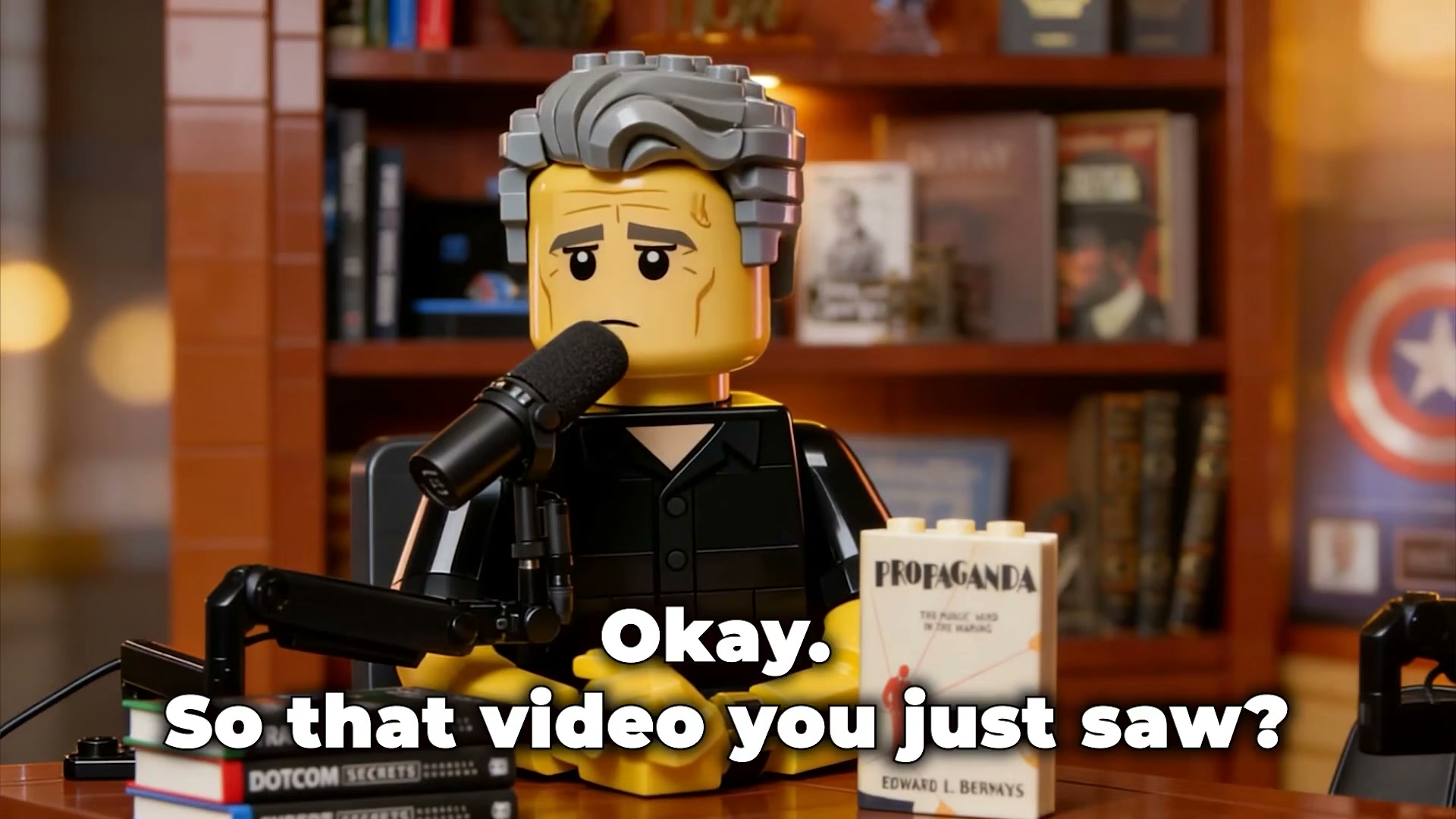
- A group calling itself Explosive Media, reportedly anonymous Iranian students, released AI-generated Lego-style animated videos at the start of major U.S. combat operations in Iran in early 2026. The videos rapped in English, mocked U.S. leadership, referenced the Epstein files, and exploited internal political fault lines in the American electorate. Within a month they had millions of views across every platform. The New Yorker called them “inescapable artifacts of the war.” The Wall Street Journal coined the term “Lego Ganda.”

- To decode the mechanism, Brunson turns to Edward Bernays — Sigmund Freud’s nephew and the inventor of public relations. In 1929, Bernays needed American women to smoke in public. Rather than run ads, he organized the Torches of Freedom campaign: women lit cigarettes at the Easter Parade and the press framed it as a feminist act. That’s cultural hijacking — embedding a message inside a movement that already carries emotional momentum. Iran applied the same technique a century later, embedding their anti-war narrative inside Legos, rap, and American meme culture without inventing any new cultural form.

- The second Bernays principle is third-party distribution. When Bernays wanted green to become fashionable — so Lucky Strike packaging would match women’s wardrobes — he didn’t advertise green. He got fashion designers, department stores, and society pages to promote it through channels that were unaware they were running a campaign. The Lego videos replicated this at internet scale: Iran didn’t need a media empire. Americans distributed the propaganda themselves because the content was entertaining enough to share. Every retweet was free distribution work performed voluntarily by the target audience.
- Neil Postman’s 1985 book Amusing Ourselves to Death explains why this works at scale. Postman argued that Huxley’s dystopia — not Orwell’s — was the correct one to fear: not a world where information is suppressed, but one where truth drowns in entertainment until nobody cares. Nobody watching a Lego video believes they’re watching news. The propaganda works not because anyone believed it, but because everyone enjoyed it. The message embeds during the act of being entertained.

- Researchers named this dynamic “slopaganda” — a portmanteau of slop (cheap, mass-produced AI content) and propaganda. It’s engineered for volume and shareability, not accuracy or production quality. It doesn’t need to be true. It needs to be fast, frequent, and entertaining enough that the audience becomes the distribution mechanism.

- Brunson distills the case study into four principles he calls the Lego Lesson: (1) use the audience’s culture, not yours; (2) entertain rather than convince; (3) ship fast and frequently rather than perfect and rarely; (4) engineer your audience to become your distribution channel. Each principle maps directly to a documented failure mode in the Pentagon’s response to the Explosive Media campaign.

- Brunson closes by prompting viewers to comment with the number — 1 through 4 — of the Lego Lesson principle they struggle with most. The move itself is a live demonstration of Principle 4: the audience generates algorithm-feeding engagement, becoming the distribution signal.
How does this compare to the official docs?
Bernays and Postman provide the historical scaffolding, but the applied content strategy layer Brunson constructs on top of them warrants a harder look at what modern persuasion research and platform-native distribution data actually support.
Here’s What the Official Docs Show
Act 1 gives you a well-constructed framework drawn from a genuinely striking case study — Act 2 follows the same sequence and surfaces the primary sources you would need to independently verify each claim before building strategy on top of it. Because documentation coverage here has real gaps, treat this section as a research checklist rather than a rubber stamp.
Step 1 — The Explosive Media Case Study
No official documentation was found for this step —
proceed using the video’s approach and verify independently.

Step 2 — Bernays and the Torches of Freedom Campaign (1929)
No official documentation was found for this step —
proceed using the video’s approach and verify independently.
The Bernays “Torches of Freedom” campaign is a well-documented historical event, but the screenshot set does not include a primary or academic source. Before citing this as a direct analog, cross-reference Larry Tye’s The Father of Spin (1998) or the primary press coverage archived in the Library of Congress.
Step 3 — Third-Party Distribution as Propaganda Amplification
No official documentation was found for this step —
proceed using the video’s approach and verify independently.
Step 4 — Neil Postman’s Amusing Ourselves to Death (1985)
No official documentation was found for this step —
proceed using the video’s approach and verify independently.
Postman’s thesis is accurately characterised in Act 1 — the book is a citable primary source and widely held in university libraries. Linking directly to a publisher or academic edition will strengthen any post that quotes it.
Step 5 — “Slopaganda” as a Named Phenomenon
No official documentation was found for this step —
proceed using the video’s approach and verify independently.
The portmanteau is recent enough that no single authoritative definitional source exists yet. Attribute it to named researchers or publications if you use it in client-facing work.
Step 6 — The Four-Principle Lego Lesson Framework
No official documentation was found for this step —
proceed using the video’s approach and verify independently.
This framework is original to Brunson’s analysis in this video. It is not drawn from a published methodology, so treat it as a practitioner synthesis rather than a citable framework.
Step 7 — The Comment-Prompt as Live Demonstration of Principle 4
No official documentation was found for this step —
proceed using the video’s approach and verify independently.
Useful Links
- YouTube — Platform homepage where the Explosive Media videos circulated; search directly for current availability of the source videos referenced in Act 1.


0 Comments