

Fanta and Xbox just executed the most technically integrated FMCG-gaming campaign in history — spanning 60+ global markets with QR-coded packaging, exclusive in-game rewards across five game franchises, limited-edition hardware, and physical immersive experiences. If you run brand partnerships, growth marketing, or campaign strategy, this post breaks down exactly how to replicate the playbook: from structuring the IP deal and building the reward mechanic to measuring cumulative attention and engineering organic amplification before spending a dollar on paid media.
What This Is
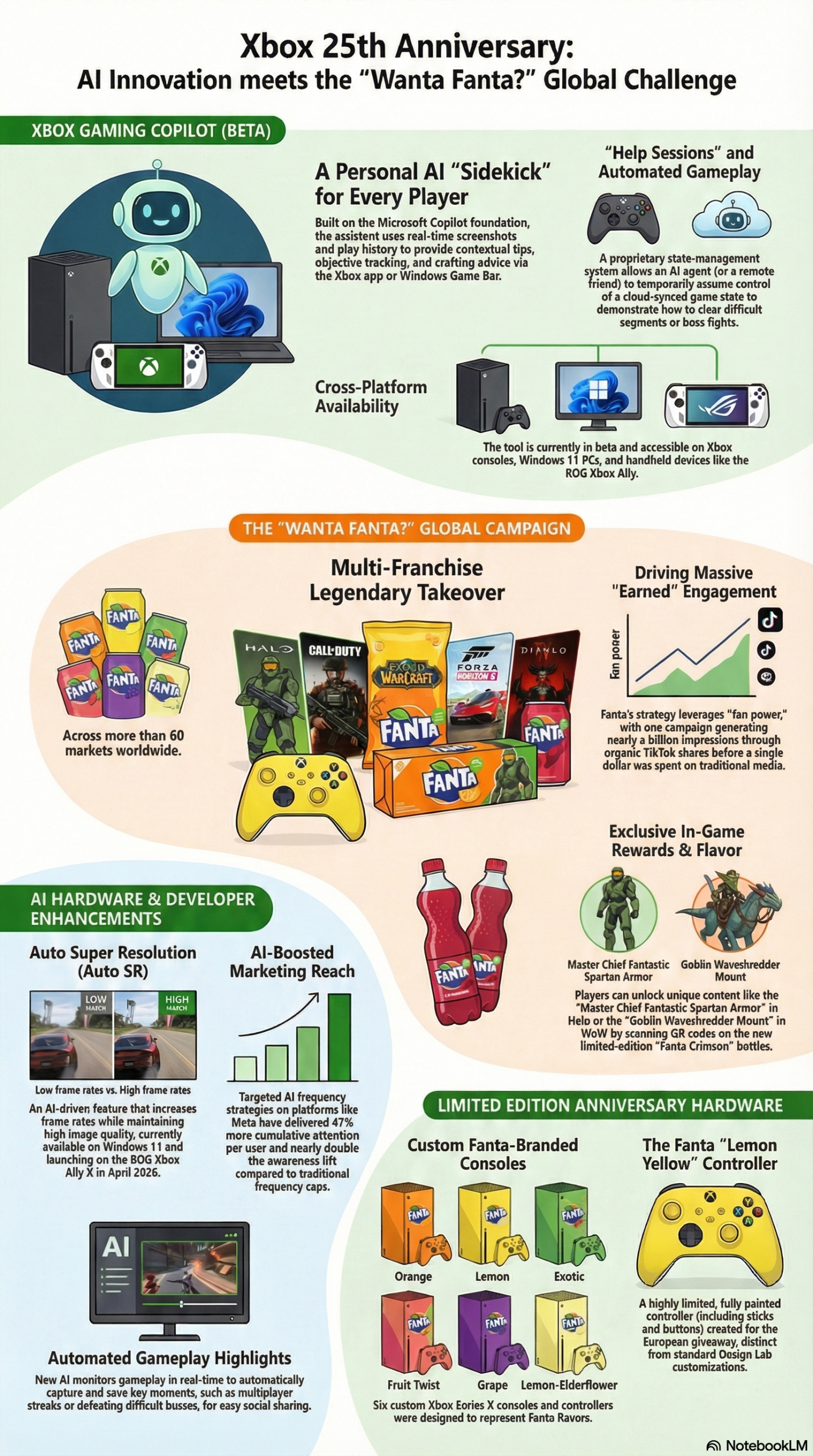
The Fanta x Xbox 25th Anniversary collaboration is Fanta’s first-ever global campaign focused entirely on gaming. Launched in conjunction with Xbox’s 25th anniversary, the campaign reaches consumers across more than 60 markets worldwide and introduces a new flavor — “Fanta Crimson” — alongside limited-edition packaging, custom hardware, and in-game rewards. According to the Fanta x Xbox Campaign Research Briefing (Marketing Dive, March 31, 2026), this is a “gamified” marketing effort that moves well beyond traditional co-branding by integrating physical product purchases with digital rewards and immersive real-world experiences.
The campaign is built around five major Xbox game franchises and their communities:
- Halo: Campaign Evolved — Master Chief’s “Fantastic Spartan Armor”
- World of Warcraft — “Fantastical Goblin Waveshredder Mount”
- Forza Horizon 6 — A limited 1966 Toyota Sports 800 Fanta Edition car
- Diablo IV — “Citron Whirl Town Portal” cosmetic
- Call of Duty: Warzone — Tactical Orange Calling Card and 2XP Tokens
These rewards are accessed through QR codes printed on special-edition Fanta cans and bottles. Scanning the code opens the “Fanta Rewards Chest” — an interactive challenge interface, not a passive code-entry form. The packaging transforms a grocery store purchase into a gaming access point. According to the NotebookLM Research Report on the Fanta x Xbox Campaign, the Rewards Chest mechanic is described specifically as an interactive challenge loop designed to keep consumers engaged in the digital ecosystem beyond the initial scan.
On the hardware side, custom-colored Xbox Series X consoles and controllers inspired by Fanta’s flavor palette — Lemon Yellow, Exotic Green, and Fanta Orange — are distributed through regional giveaways, primarily targeting European markets. Critically, these are not sold at retail. The scarcity is intentional: giveaway-only hardware generates the kind of earned media that paid advertising cannot replicate.
The physical experiential layer includes a “Haunted Fanta Factory” activation and a Diablo IV immersive fan experience scheduled for AMC at The Grove in Los Angeles in May 2026. These touchpoints bridge digital fandom with physical engagement, giving the campaign a 360-degree presence across retail, social, in-game, and live event channels.
Ibrahim Salim Khan, Global VP of Sparkling Flavors at Fanta, is the executive architect of this strategy. His framing — “The era of TV is gone – audiences hold the mic” — reflects a deliberate departure from broadcast-first marketing toward community-driven virality. As documented in the research briefing, the brand reached hundreds of millions of impressions before spending a single dollar on paid media, driven by teenagers sharing the new packaging organically on TikTok. That pre-paid organic surge is the north star of the entire campaign architecture.
Haiyan Zhang, Gaming AI General Manager at Xbox, reinforced the campaign’s philosophy from the technology side: “Creative control should always stay with the game creators and the development team.” This signals that authentic franchise integration — not logo placement — is the mechanism behind the campaign’s gaming community acceptance.
Why It Matters
This campaign operationalizes three marketing trends that have been discussed in theory for years but rarely executed at global scale simultaneously: physical-digital integration, community-led amplification, and franchise IP as experiential currency.
For brand marketers, the Fanta x Xbox model demonstrates that FMCG brands can penetrate gaming audiences without building games themselves. The key insight from the research briefing is that gaming audiences respond to authentic IP integration. When consumers feel like they’re getting something meaningful from a gaming perspective — a rare cosmetic, exclusive 2XP tokens, a franchise-native vehicle — the beverage brand earns credit for enhancing their gaming experience. That’s a fundamentally different value exchange than a display ad or a sponsored stream overlay.
For partnership and business development teams, this campaign illustrates the compound reach value of a multi-IP deal. Rather than partnering with a single game title, Fanta secured access to five distinct Xbox franchises simultaneously. Each franchise has its own fanbase, community forums, and content creator ecosystem. One campaign announcement generates five distinct waves of community discussion, five sets of UGC, and five different editorial coverage opportunities. The franchise diversification is what elevates this campaign from a single-channel activation to a sustained cultural presence.
For performance marketers, the data on Fanta’s cumulative attention strategy is the most directly actionable finding in this campaign. Working with Xpln.ai, Fanta tested ad frequency on Meta and discovered that a targeted frequency model — guaranteeing two exposures per user per week — generated 47% more cumulative attention and nearly double the awareness lift compared to traditional frequency caps. This result, cited in the research briefing via Dominic Di Talamo, UK MD at Xpln.ai, challenges the standard practice of maximizing unique reach. For any brand running awareness campaigns on Meta, this is a concrete benchmark to test against.
For creative and experiential teams, the campaign’s hybrid format — QR codes on packaging, digital reward chests, console giveaways, and physical activations in LA — represents the new definition of integrated marketing. Single-channel campaigns are structurally insufficient for audiences who live simultaneously across physical retail, social feeds, gaming sessions, and live events. The Fanta x Xbox architecture is designed for that fragmented attention reality, not against it.
The Data
Campaign Scope at a Glance
| Campaign Element | Detail | Geographic Scope |
|---|---|---|
| Global Markets | 60+ countries in rollout | Global |
| Franchises Featured | Halo, WoW, Forza Horizon 6, Diablo IV, CoD: Warzone | 5 titles |
| New Flavor | Fanta Crimson | Global launch |
| Reward Mechanic | QR code → “Fanta Rewards Chest” interactive challenges | All special-edition packaging |
| Limited-Edition Hardware | Custom Xbox Series X consoles + controllers (Lemon Yellow, Exotic Green, Fanta Orange) | European giveaways |
| Physical Activations | “Haunted Fanta Factory” + Diablo IV experience at AMC The Grove (May 2026) | LA + select markets |
| Organic Reach | Hundreds of millions of impressions before first paid dollar | TikTok-driven |
| Meta Frequency Result | Targeted 2x/week exposure = 47% more cumulative attention vs. standard caps | Meta platform (via Xpln.ai) |
| Awareness Lift | Nearly 2x vs. traditional frequency campaigns | Meta platform data |
In-Game Rewards Breakdown
| Game Title | Reward Item | Availability |
|---|---|---|
| Halo: Campaign Evolved | Master Chief’s “Fantastic Spartan Armor” | At Launch |
| World of Warcraft | Fantastical Goblin Waveshredder Mount | Ongoing |
| Forza Horizon 6 | 1966 Toyota Sports 800 Fanta Edition | At Launch |
| Diablo IV | Citron Whirl Town Portal | Ongoing |
| Call of Duty: Warzone | Tactical Orange Calling Card & 2XP Tokens | Ongoing |
Source: NotebookLM Research Report — Fanta x Xbox Campaign Briefing
Step-by-Step Tutorial: How to Build a Gamified Brand Collaboration Campaign
This tutorial walks you through the full strategic and operational process of building a campaign modeled on the Fanta x Xbox framework. It is written for brand marketers, partnership managers, and campaign strategists who need to move from concept to execution. Each phase maps to a real element of the Fanta x Xbox campaign structure documented in the research briefing.
Prerequisites
Before beginning, you need:
– Documented evidence of audience overlap between your brand and your target gaming platform
– A defined budget split across physical (packaging, hardware, events) and digital (rewards infrastructure, paid media)
– Legal and licensing counsel experienced in gaming IP agreements
– A technology partner capable of building and instrumenting the QR-to-reward chain
– An analytics stack that can measure attention (not just reach) on paid channels
Phase 1: Define and Prove Your Audience Overlap
Before you approach any gaming partner, you need documented evidence that your audience intersects with theirs. Gaming partnerships fail when brands assume overlap rather than prove it.
Step 1: Pull first-party audience data.
Use your CDP or CRM to identify behavioral and demographic segments. Look for high-index signals: What streaming platforms do your buyers subscribe to? What social platforms do they over-index on? Do existing customers self-identify as gamers in surveys or preference centers? Any signal that connects your buyer to gaming culture is useful input for your platform selection.
Step 2: Layer on third-party gaming audience data.
Cross-reference your segments against platform-level data. Xbox’s core audience skews 18-34, is predominantly (but not exclusively) male, and has a particularly strong presence in European markets — which is exactly why the Fanta x Xbox hardware giveaways were concentrated there. Your gaming partner selection should follow the same logic: find the platform and franchise where your audience’s behavioral signals overlap most strongly.
Step 3: Map the audience to specific franchises, not just the platform.
This step is what separates sophisticated gaming partnerships from generic “gaming deals.” Halo skews toward older, nostalgia-driven fans (25-35). Call of Duty skews competitive and younger (18-24). World of Warcraft retains a passionate long-form community that rewards deep lore integration. Forza Horizon has a built-in automotive culture that welcomes branded vehicles as a feature, not an intrusion — as evidenced by the 1966 Toyota Sports 800 Fanta Edition integration documented in the research briefing. Identify which franchise matches your brand’s tone and audience’s behavioral profile.
Phase 2: Structure the IP Deal and Reward Tiers
Step 4: Negotiate multi-IP access through the platform holder.
Single-title partnerships have a ceiling on organic reach. The Fanta deal — spanning five franchises across Xbox Game Studios and its publishing partners — multiplies the organic reach by the number of franchise communities it touches. Negotiate for access to multiple titles with clearly delineated, franchise-native reward types for each. A calling card works in CoD. A mount belongs in WoW. A vehicle livery fits Forza. Do not use the same generic cosmetic across every title — that signals to gaming communities that the partnership was a cut-and-paste job.
Step 5: Design tiered rewards by engagement depth.
A critical mistake in gaming partnerships is offering the highest-value reward for the lowest-effort action. Fanta’s “Fanta Rewards Chest” is described in the research briefing as an interactive challenge mechanism — not just a code-entry form. Structure your reward tiers to match investment to value:
- Tier 1 (entry-level): Scan QR code → standard cosmetic (calling card, emblem, consumable)
- Tier 2 (active engagement): Complete a challenge series → exclusive cosmetic (armor set, vehicle skin, mount)
- Tier 3 (loyalty/multi-purchase): Multiple purchase occasions or repeat challenge completions → hardware giveaway entry
This tiering sustains engagement across multiple purchase occasions rather than collapsing value into a single transaction.
Step 6: Establish scarcity mechanics for hardware distribution.
The custom Xbox Series X consoles in the Fanta campaign are not available for purchase — they exist exclusively as giveaway prizes distributed through regional sweepstakes. As the research briefing documents, this scarcity is by design: giveaway-only hardware creates earned media that no paid placement can replicate. Content creators cover it, gaming forums discuss it, and fans speculate about winning it. When structuring your hardware component, be aggressive about limiting quantities. The goal is not volume of distribution — it is volume of media coverage per unit distributed.
Phase 3: Build the Physical-Digital Bridge
Step 7: Design and test the QR code experience end-to-end.
The packaging QR code is the campaign’s primary call-to-action for consumers who encounter the product in-store. It must function reliably before anything else launches. Test at scale: at arm’s length and at distance, in store lighting conditions and in direct sunlight, across iOS and Android with multiple camera apps. The experience on the other side of the scan must load in under two seconds on a mid-range mobile connection — anything slower and you lose the conversion at the most important moment in the consumer journey.
Map the complete user journey and instrument every step:
- Consumer purchases Fanta special-edition can or bottle
- Consumer scans QR code with phone camera
- Landing page loads with “Fanta Rewards Chest” UI (< 2 seconds)
- Consumer engages with challenge or reward selection
- Reward code is delivered via email or directly pushed to linked gaming account
- Consumer activates reward in-game
- In-game confirmation triggers optional social sharing prompt
Scan-to-activation conversion rate is your primary success metric for the digital layer. Track drop-off at each step and optimize aggressively in the first two weeks of launch.
Step 8: Create physical activations engineered for content creation.
Physical experiences like the “Haunted Fanta Factory” and the Diablo IV immersive fan experience at AMC at The Grove in Los Angeles (scheduled for May 2026, per the research briefing) serve a specific strategic function: they generate the type of visual content that social platform algorithms reward. Design these activations around content creation, not just attendance figures.
Every design element in the physical space should answer one question: Does this create a memorable, shareable moment? Key criteria:
- Visually distinctive and immediately identifiable with the brand and franchise
- Access must be scarce (limited tickets, exclusive invite lists) to generate FOMO-driven amplification
- Attendees leave with an exclusive in-game reward or physical collectible that extends the digital tie-in
- Location in a high-density media market (LA, NYC, London) to maximize influencer density per event
Phase 4: Execute the Paid Media Strategy
Step 9: Deploy cumulative attention targeting on Meta.
Based on Fanta’s documented results via Xpln.ai, the optimal Meta paid strategy is a targeted frequency model: guarantee two exposures per unique user per week rather than maximizing unique reach. This approach generated 47% more cumulative attention and nearly double the awareness lift versus standard frequency capping, as cited in the research briefing by Dominic Di Talamo (UK MD at Xpln.ai): “Even when individual impressions generate short attention spans, repeated exposures can accumulate attention over time.”
To implement this on Meta:
- Set campaign objective to Reach (not conversions — this is an awareness build)
- Configure frequency caps at the weekly level (not daily), targeting exactly 2 exposures per user per week
- Run the campaign flight for 4-6 weeks to allow cumulative attention to compound
- Integrate an attention measurement layer — Xpln.ai or a comparable attention analytics vendor — alongside standard Meta reporting
- Measure cumulative attention (total seconds of engaged viewing across all exposures per user) as the primary KPI, not impressions or reach
The distinction between reach-optimized and attention-optimized targeting is the most technically important finding in this campaign. Without attention measurement infrastructure, you will optimize for the wrong signal and underperform against Fanta’s benchmarks.
Step 10: Engineer organic amplification before launch.
Fanta reached hundreds of millions of impressions before spending a dollar on paid media. That pre-launch surge, driven by teens sharing packaging on TikTok, is not accidental. It is the result of deliberate seeding and visual distinctiveness in the packaging design.
To replicate the organic pre-launch phase:
- Release packaging imagery and hardware previews to micro-creators (10K-200K followers) in your target demographic 2-3 weeks before official launch
- Brief creators on campaign details but do not script content — authenticity is the algorithmic mechanism
- Monitor early UGC daily and identify the highest-performing organic posts within the first 72 hours
- Amplify those specific posts through paid boosting (not new creative — the organic posts have already proven their resonance)
- Ensure the packaging visual is distinctive enough to be recognizable in a fast-scrolling feed without any accompanying text
Phase 5: Measure, Report, and Optimize
Step 11: Define your measurement framework before launch.
A gamified collaboration campaign spans physical retail, digital rewards, social media, and in-game activity. You need a pre-defined measurement framework that captures each layer:
| Layer | Primary Metric | Secondary Metric |
|---|---|---|
| Retail | QR code scan rate per SKU | Special-edition units sold |
| Digital Rewards | Scan-to-activation conversion rate | Reward chest challenge completion rate |
| Social (Organic) | Impressions generated pre-paid-spend | UGC volume and engagement rate |
| Paid Media | Cumulative attention (via Xpln.ai or equivalent) | Awareness lift (brand study) |
| In-Game | Reward activation rate | In-game engagement post-reward |
| Experiential | Social content generated per event | Attendance vs. media coverage ratio |
Step 12: Build regional feedback loops for ongoing optimization.
With 60+ markets in Fanta’s campaign, performance will vary significantly across geographies. Set up weekly reporting by market cluster (Western Europe, North America, LATAM, Southeast Asia) and be prepared to reallocate paid media budget toward over-performing regions mid-flight. Regional variation in QR scan rates often reveals consumer behavior differences worth feeding back into future packaging or reward design decisions.
Expected Outcomes
A campaign built on this framework, executed at even a regional scale, should deliver measurable QR scan-to-activation conversion benchmarks within the first two weeks; organic social amplification that precedes and supplements paid media spend; quantifiable awareness lift within the gaming demographic as measured through a pre/post brand study; and long-term brand affinity signals from consumers who activated in-game rewards — those consumers now associate your brand with a positive gaming memory, which is among the most durable brand impressions available to an FMCG marketer.
Real-World Use Cases
Use Case 1: Energy Drink Brand x Battle Royale Title
Scenario: A regional energy drink brand wants to break into the 18-24 gaming demographic and has secured a partnership with a mid-tier battle royale title with an engaged North American player base.
Implementation: Apply the Fanta x Xbox tier structure directly. Cans with QR codes unlock in-game consumables (health boosts, cosmetic sprays). A secondary tier unlocks an exclusive weapon skin for players who complete three distinct challenge objectives within the game. Hardware giveaways are branded gaming peripherals — headsets, controllers — rather than full consoles, which reduces budget while maintaining scarcity mechanics. Paid media runs on Meta with weekly frequency caps of 2x per user, measured through a cumulative attention vendor.
Expected Outcome: High scan rates among existing buyers who already identify as gamers. New user acquisition from the game’s community through in-game reward visibility — when other players see the weapon skin, they investigate the brand. Quantifiable awareness lift within 6 weeks. Secondary sell-through lift for special-edition SKUs in gaming-adjacent retail channels (convenience stores near university campuses and esports venues).
Use Case 2: Snack Brand x Mobile Gaming Platform in Southeast Asia
Scenario: A snack brand with strong convenience store distribution wants to reach the mobile gaming audience across Southeast Asian markets, where mobile gaming is mainstream across a 16-40 demographic — not a niche segment.
Implementation: Partner with a dominant mobile gaming platform or publisher — not individual titles — to unlock in-app currency or premium lives through QR scan. The scarcity mechanic shifts from hardware giveaways (less effective at scale in this context) to time-limited rewards: all unlocked items expire within 7 days of scan, driving repeat purchase behavior. Physical activations are replaced by in-game challenge events. The mobile platform’s own push notification channels amplify the campaign at zero additional media cost.
Expected Outcome: High-volume QR scan rates driven by the frequency of mobile gaming sessions (multiple sessions per day vs. once-weekly console play). Cross-promotional reach through the platform’s owned channels substantially reduces paid media dependency. Time-limited expiry windows drive repeat purchase cycles.
Use Case 3: Automotive Brand x Racing Simulation Franchise
Scenario: A mid-luxury automotive brand wants to introduce a new model to younger prospective buyers aged 25-35 and has identified Forza Horizon 6 as the correct franchise fit — the series already integrates real vehicle manufacturers natively, making branded vehicles a feature rather than an intrusion.
Implementation: Partner directly with Forza Horizon 6 for a vehicle integration — the new model appears in-game as a driveable asset. QR codes in dealerships, OOH placements, and partner retail locations unlock the in-game vehicle for free. Physical test drive events are themed around the in-game experience, with matching environments or driving challenges. This directly mirrors the 1966 Toyota Sports 800 Fanta Edition integration documented in the research briefing, proving that the franchise is already receptive to this format.
Expected Outcome: The in-game vehicle becomes a persistent 24/7 brand placement within one of the world’s most-played racing games. Test drive conversions tracked through QR-code attribution create a direct line from gaming engagement to dealership footfall — a rare attribution path for automotive upper-funnel marketing.
Use Case 4: Streaming Service x MMO Cross-Promotion
Scenario: A streaming platform is launching a new fantasy series and wants to build launch buzz within the RPG gaming community — the audience most primed to respond to high-production-value fantasy IP.
Implementation: Secure a content integration with World of Warcraft or a comparable MMO, creating limited in-game cosmetics — cloaks, mounts, companion pets — designed with the show’s visual language. Players who subscribe to or trial the streaming service receive the in-game items at no additional cost. This inverts the Fanta model: instead of the physical product unlocking a digital gaming reward, the digital subscription unlocks an in-game reward. The exchange mechanic is the same; the commercial objective is trial conversion rather than retail sell-through.
Expected Outcome: Trial subscription sign-ups from the highly engaged RPG gaming community. Long-term brand association between the fantasy series and the franchise’s aesthetic universe. Sustained organic content creation as players showcase items in-game through screenshots, clips, and streaming sessions — all of which carry the streaming platform’s visual identity passively.
Use Case 5: CPG Brand x Halloween Gaming Activation
Scenario: A confectionery brand wants to own Halloween within gaming culture — an opportunity the research briefing documents that Fanta itself has already demonstrated with its horror-adjacent campaigns, including the Universal/Blumhouse Chucky integration.
Implementation: Partner with a horror game title — Resident Evil, Dead by Daylight, or a comparable franchise — for a Halloween-specific 6-8 week activation. Limited-edition packaging uses franchise iconography. QR codes unlock exclusive Halloween cosmetics. Physical activations mirror Fanta’s “Haunted Fanta Factory” format: immersive, visually shareable, horror-authentic. The campaign slogan should be IP-native, as Fanta’s own Halloween campaign demonstrates — their line “Fanta is so delicious, even the dead crave it” works because it respects the horror genre rather than sanitizing it for brand safety.
Expected Outcome: Dominant share of voice in Halloween gaming culture for the duration of the activation window. High UGC volume from horror gaming communities, which are among the most active content-creating subcultures in gaming. Long-term brand association with gaming communities that take their seasonal identity seriously — associations that persist beyond the activation period.
Common Pitfalls
1. Treating the gaming IP as a logo, not an experience.
The most common mistake in gaming partnerships is using franchise characters as visual decoration on packaging without creating any actual gaming value. Players immediately recognize this as “slapping a logo on a box” and respond with skepticism or ridicule. Haiyan Zhang’s guidance — that creative control should stay with game creators and development teams — directly addresses this: authentic integration means the franchise community endorses the creative execution, not just the contract. Every in-game reward must feel like something that belongs in the game universe.
2. Building a passive redemption flow instead of an active challenge.
A QR code that redirects to a static page with a discount code is not gamification — it is a digital coupon with extra steps. Fanta’s QR codes unlock interactive challenge chests, as documented in the research briefing. The distinction matters: every step that requires active user participation increases investment in the outcome and deepens the brand association with effort and reward. Design the post-scan experience around decision-making or challenge completion, not passive code entry.
3. Underestimating the organic amplification window.
Brands that treat launch day as the start of amplification are leaving the most valuable earned media window unused. Fanta’s pre-paid organic reach — hundreds of millions of impressions — came from the visual distinctiveness of the packaging and deliberate early seeding with teen creators on TikTok, per the research briefing. If you don’t engineer the organic pre-launch phase, you are paying full media rates for reach you could have earned for the cost of sampling and creator seeding.
4. Ignoring cumulative attention in favor of raw reach metrics.
Standard Meta campaign optimization for reach maximizes unique users reached but does not account for how long or how attentively those users engaged with each impression. Fanta’s documented results via Xpln.ai show that cumulative attention — total seconds of genuinely engaged exposure across multiple impressions per user — is a far stronger predictor of awareness lift than reach alone. Running reach-optimized campaigns without attention measurement means optimizing for the wrong signal and systematically under-delivering on brand recall.
5. Neglecting the creator ecosystem that powers gaming culture.
The research briefing explicitly identifies a risk: as AI tools rely increasingly on creator-generated guides and community content, brands must establish clear, compensatory frameworks for the creators who amplify their campaigns. Extracting value from gaming communities — their audience, their content, their cultural credibility — without reciprocating through transparent partnerships, affiliate structures, or content licensing will damage brand reputation within communities that have long institutional memories and organized advocacy networks.
Expert Tips
Tip 1: Let franchise communities dictate reward type before your designers touch a brief.
Before finalizing any in-game reward, spend real time in the franchise’s community: subreddits, official forums, Discord servers, content creator comment sections. What cosmetics do players actually want? What’s been absent from the game for years? The Goblin Waveshredder Mount in WoW and the Fantastic Spartan Armor in Halo, as documented in the research briefing, both read as items the community would have requested organically — that’s not an accident, it’s the result of research-driven creative development. The best collaborations feel like the community got what it asked for.
Tip 2: Set scarcity targets for hardware before creative development begins.
Do not build a custom console design and then figure out how many to give away. Start with the question: how few items need to exist to generate the earned media coverage equivalent to a significant paid placement? For Fanta x Xbox, custom consoles distributed exclusively through European regional giveaways — never sold at retail — generated content creator coverage, social discussion, and fan speculation without any paid amplification. Make scarcity a strategic input, not an afterthought.
Tip 3: Add attention measurement infrastructure to your Meta stack before launch.
Standard Meta analytics measure reach, impressions, frequency, and click-through rate. None of these metrics capture how long your target audience actually engaged with each impression. Platforms like Xpln.ai measure genuine attention duration across exposures. Without this layer, you cannot replicate Fanta’s finding that targeted frequency at 2x weekly generates 47% more cumulative attention than standard caps — because you cannot see cumulative attention in Meta’s native reporting. Set up the measurement before the campaign runs, not after.
Tip 4: Design physical activations primarily for content output, not headcount.
The Diablo IV fan experience at AMC The Grove (May 2026) and the “Haunted Fanta Factory” documented in the research briefing are not designed to maximize attendance — they are designed to maximize the quality and volume of social content generated by attendees. Every physical activation should have a content production budget (lighting, backdrops, dedicated social capture stations) and a defined content output goal (e.g., X TikToks with combined Y reach from attendees within 48 hours of the event). Measure activation success by content output, not ticket sales.
Tip 5: Account for in-game cosmetic impressions in your post-campaign ROI model.
Every time a player equips Master Chief’s Fantastic Spartan Armor in a Halo session, drives the Fanta Edition Toyota in Forza, or activates the Citron Whirl Town Portal in Diablo IV, other players see it. In games with spectator modes, streaming integrations, and recorded gameplay clips, in-game cosmetics generate impressions that extend indefinitely beyond the initial reward activation. Calculate this downstream impression value — estimated from in-game active player counts, average session views, and streaming audience data — when building your internal ROI case. It is consistently the most undervalued line item in gaming partnership valuations.
FAQ
Q: How do you negotiate access to multiple franchises in a single deal?
The key is going through the platform holder rather than approaching individual studios. As the research briefing documents, Xbox controls access to its Game Studios titles (Halo, Forza) and has publishing relationships with Activision Blizzard titles (CoD, WoW, Diablo). A single deal with Xbox’s partnerships team can, in principle, span cross-studio franchises. Work with the platform’s centralized partnership function rather than cold-approaching studios directly, and ensure each franchise integration has a named product owner on the studio side with authority and creative investment in the execution quality.
Q: What is the minimum viable version of this campaign for a brand without global scale?
Start with one franchise, one reward tier, and one regional market. A regional snack brand can partner with a single game title to unlock one cosmetic through QR codes on special-edition packaging. The core mechanics — physical purchase → digital reward → in-game activation → optional social sharing — scale down entirely cleanly. Fanta’s 60-market scope is a function of Coca-Cola’s global distribution infrastructure, not a structural requirement for the model to work. The Rewards Chest mechanic, the scarcity-driven hardware giveaway, and the cumulative attention paid media strategy all operate at any budget scale.
Q: How do you measure ROI when in-game cosmetics don’t produce direct revenue?
Frame the ROI across four measurable signals: (1) Awareness lift within the gaming demographic, measured through pre/post brand study; (2) QR scan-to-activation conversion rate as a proxy for engaged purchase intent; (3) Organic impressions generated by player-created content featuring the cosmetic in-game; (4) Special-edition SKU sell-through data compared to standard packaging sell-through in the same period. Together, these four signals build a defensible ROI case that captures both brand and commercial value without requiring a direct revenue attribution line.
Q: What separates a QR code campaign that converts from one that doesn’t?
Three factors determine QR code success on product packaging. First, visual prominence: the code must be large enough to scan easily and positioned within a compelling design context — not in a corner competing with legal text. Second, reward clarity: the packaging must communicate exactly what the scan delivers (“Unlock your free in-game reward”) so the consumer has a concrete expectation before they point their phone. Third, load speed: the post-scan landing page must load in under two seconds on a mid-range mobile connection. A slow or confusing post-scan experience kills conversion regardless of packaging design quality.
Q: How do you avoid alienating a gaming community with a brand integration?
Ibrahim Salim Khan’s guidance, as quoted in the research briefing, is direct: treat the IP with “love and attention.” This means studying the franchise’s lore, visual language, and community values before any creative work begins. The Fantastic Spartan Armor looks like something that belongs in the Halo universe. A poorly designed cosmetic that ignores the game’s established aesthetic signals disrespect to the community. Brief creative teams with franchise-specific style guides, not just brand guidelines — and have the work reviewed by people with genuine genre knowledge before it reaches the IP owner for approval.
Bottom Line
The Fanta x Xbox 25th Anniversary collaboration is the most complete public playbook for how FMCG brands can enter the gaming space with measurable, multi-layered, and authentic campaigns. The model works because it converts physical product purchases into gaming access points through QR-coded rewards with genuine in-game value, engineers organic amplification through visually distinctive packaging and deliberate creator seeding, and deploys precision paid media targeting built around cumulative attention rather than raw reach. The 47% attention advantage from targeted frequency and the hundreds of millions of pre-paid organic impressions, both documented in the research briefing, are the concrete benchmarks to test against in your own campaigns. As Ibrahim Salim Khan of Fanta stated, the era of top-down broadcasting is over — the brands that build infrastructure for audiences to hold the mic are the ones that will own the next decade of gaming culture marketing.


0 Comments