

AI influencer discovery has crossed a threshold: agencies are no longer using AI to assist their casting process — they’re using it to run it. As of early 2026, tools powered by agentic AI can move from campaign brief to a qualified creator shortlist faster than a human team can book its first discovery call, and the results are backing that up. This tutorial walks you through exactly how these systems work, which platforms are leading the category, and how to build an AI-assisted influencer casting workflow your agency can deploy on the next campaign.
What This Is: The Shift from Database Filtering to Agentic Discovery
For the past decade, influencer discovery meant logging into a SaaS platform, filtering by follower count and category, eyeballing profiles, and manually building a shortlist. It was slow, inconsistent, and heavily dependent on whoever was doing the filtering that day. What’s changed in 2026 is the underlying architecture: AI agents don’t filter a database — they reason about a campaign brief and go find the right creators.
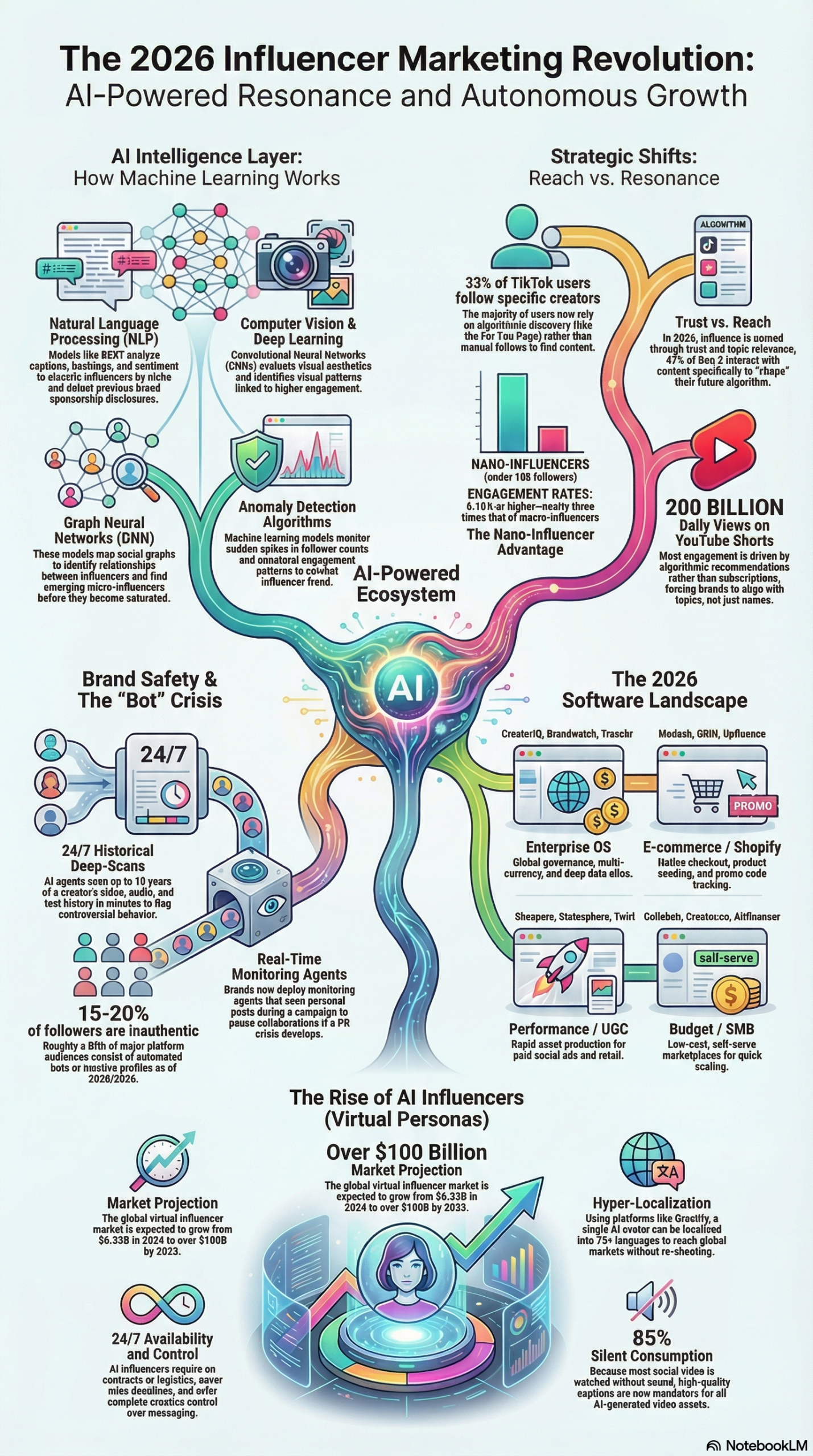
According to the 2026 Influencer Marketing Technology Briefing (our primary research source for this post), the industry has shifted from a “Human + SaaS” model to an autonomous agentic model. Three capabilities define this new generation of tools:
Persona-Based Discovery. Instead of searching hashtags or categories, you describe your Ideal Customer Persona (ICP) — demographics, psychographics, behavioral triggers — and the AI scans the creator ecosystem to find influencers whose actual audience matches that profile. The discovery starts with the audience, not the creator.
Visual and Tonal Analysis. Multi-modal AI can now perform what practitioners call “vibe checks” — analyzing a creator’s video lighting, editing rhythm, voice sentiment, and aesthetic consistency. A brand with a clean, minimalist visual identity can now automatically filter out creators whose content is loud, chaotic, or stylistically mismatched, without a human watching hours of video.
Predictive Performance Modeling. This is perhaps the most consequential shift. Platforms like Later now model potential content performance before a dollar is spent, using a creator’s historical engagement data to project impressions, clicks, and likely conversions. As Scott Sutton, CEO of Later, described it: “That’s a much richer picture that gives me confidence I’m going to get a high ROAS.”
One of the clearest enterprise examples is Dentsu X’s Creator & Trends Studio (CATS), launched in January 2026. Built on a Meta API partnership, CATS suggests creators based on subject matter, profile fit, and social trend participation — not just reach. For Elizabeth Arden, the system helped drive a 14.3% increase in unaided ad recall and a 41% rise in sales conversions. That’s not a marginal improvement — it represents a fundamentally different casting quality than manual shortlisting could produce.
The broader software landscape now spans five distinct categories: enterprise operating systems like CreatorIQ, Traackr, and Brandwatch for large-scale governance; eCommerce-focused tools like GRIN, Modash, and Upfluence for Shopify and Amazon attribution; UGC production platforms like Billo and Statusphere for high-volume creative asset generation; AI-native discovery tools like Stormy AI, Influencity, and InsightIQ for persona-based discovery; and SMB-focused marketplaces like Collabstr and Ainfluencer for lower-cost workflows. Understanding which layer you’re buying matters as much as which tool you’re choosing.
Why It Matters: Workflow Transformation for Agencies and Brands
The business case here isn’t abstract. The research briefing confirms influencer marketing now delivers an average ROI of $5.78 for every $1 spent, with top-performing campaigns reaching $18–$20 per dollar — that’s 11x higher than traditional digital advertising. With numbers like that, the inefficiency tax on manual discovery is getting harder to justify.
For agencies specifically, the impact is operational. Digiday reporting from March 2026 found that agencies are now working with 30–40% more influencers per campaign on average since adopting AI discovery tools — not because budgets increased, but because the time-per-creator in the vetting and selection phase dropped dramatically. Agencies like Goat, Obviously, Viral Nation, Influencer, and Creo are all named in that reporting as active adopters.
There’s also a strategic shift happening at the platform level that makes AI discovery not just useful, but necessary. Only 33% of TikTok users use the platform to follow specific creators; the majority rely on the For You Page for content discovery, according to the research briefing. This means follower count — the metric most manual discovery workflows optimize for — has become a poor proxy for actual reach or influence. The creators who matter are those who surface organically in a target audience’s algorithmic feed, which requires understanding topic alignment and content resonance, not just subscriber totals.
As Trevor Souki, Product Marketing Manager at Sprout Social, put it: “Influence no longer lives in the follower count. It lives in the relevance and resonance of a message.”
For brand safety teams, the stakes are equally high. The briefing estimates that 30% of global ad spend is currently wasted on non-human (bot) traffic — and enterprise AI tools now scan up to 15 years of a creator’s historical content for hate speech, misinformation, and controversial associations in under 48 hours. That kind of systematic vetting was previously impossible at scale.
75.6% of brands plan to dedicate specific budgets to influencer marketing in 2026, and 69% of consumers trust influencer recommendations over direct brand messaging. The agencies and brands that build systematic AI-assisted casting workflows now will outperform those still doing it manually — not because AI is a buzzword, but because the data velocity required to compete algorithmically has simply exceeded human throughput.
The Data: AI Influencer Tools and Performance Benchmarks
Influencer Marketing ROI Benchmarks (2026)
| Metric | Performance Data | Source |
|---|---|---|
| Average ROI | $5.78 per $1 spent | Research Briefing |
| Top-tier campaign ROI | $18–$20 per $1 spent | Research Briefing |
| ROI vs. traditional digital ads | 11x higher | Research Briefing |
| Marketers reporting improved outcomes with AI | 66.4% | Research Briefing |
| Consumers trusting influencer recs over brand ads | 69% | Research Briefing |
| Brands with dedicated influencer budgets in 2026 | 75.6% | Research Briefing |
| TikTok nano-influencer engagement rate | 10.3% | Research Briefing |
| Wasted ad spend from bot traffic | ~30% of global spend | Research Briefing |
| Increase in influencers per campaign (AI-assisted) | 30–40% more | Digiday |
AI Influencer Discovery Platform Comparison
| Platform | Category | Key AI Capability | Best For |
|---|---|---|---|
| Dentsu X CATS | Enterprise Agency Tool | Meta API + trend participation scoring | Agency-side casting for large brands |
| Later | Campaign Management | Historical engagement modeling + brief matching | Mid-market brands, performance forecasting |
| Stormy AI | AI Discovery & Vetting | ICP-based discovery + brand safety auditing | Persona-driven discovery workflows |
| Influencity | AI Discovery & Analytics | Audience demographic analysis | Data-first agencies |
| InsightIQ | AI Discovery & Vetting | Historical content auditing | Brand safety–focused programs |
| CreatorIQ | Enterprise OS | Multi-market governance and benchmarking | Large-scale enterprise programs |
| GRIN | eCommerce Attribution | Shopify/Amazon integration | DTC brands tracking creator-to-sale |
| Modash | eCommerce Discovery | Real-time audience demographic verification | Performance marketers |
| Collabstr | SMB Marketplace | Streamlined creator-brand matching | Small brands, lower-cost workflows |
Step-by-Step Tutorial: Building an AI-Assisted Creator Casting Workflow
This is the workflow I’d walk any agency or in-house marketing team through when setting up AI-assisted influencer casting from scratch. It handles brief translation, discovery, vetting, and shortlist construction — the four phases where AI creates the most leverage.
Phase 1: Prerequisites and Tool Selection
Before you open any platform, get clear on your stack requirements:
- Budget tier: Enterprise tools (CreatorIQ, Traackr) start at $15K–$50K/year. Mid-market tools (Later, Influencity, Modash) run $500–$2,000/month. SMB tools (Collabstr, Ainfluencer) offer free tiers or usage-based pricing.
- Primary objective: Is this a brand awareness play, an eCommerce attribution campaign, or a UGC content production program? The objective determines the platform category you need.
- Channel focus: TikTok, Instagram, YouTube, and LinkedIn each have different engagement dynamics and creator ecosystems. Confirm your tool covers your specific channels.
- Brand safety requirements: If you’re in a regulated industry (pharma, finance, alcohol, children’s products), confirm the platform includes historical content auditing — not just keyword filters.
If you’re starting from zero and want the most direct path to AI-powered discovery, Stormy AI and Influencity are both purpose-built for the persona-based approach. For eCommerce DTC brands, GRIN or Modash with their Shopify integration will give you faster sales attribution. For agency use at scale, CreatorIQ or Traackr provide the governance layer you’ll need for multi-client programs.
Phase 2: Translating the Campaign Brief into an AI-Readable ICP
This is where most teams lose time. The AI doesn’t care about your creative concept — it cares about your target audience. Before touching a discovery tool, translate your brief into three components:
1. Audience Profile (ICP)
Define the actual human you’re trying to reach:
– Age range, gender split, household income
– Geographic targets (country, region, or DMA)
– Psychographic interests (not categories — specifics like “sustainable fashion,” “home barista culture,” or “budget travel hacking”)
– Purchase behaviors and platform habits
2. Content Alignment Parameters
Describe the creator’s content, not just their niche:
– Visual style (clean/minimal, raw/authentic, high-production, lo-fi)
– Tonal register (educational, entertaining, aspirational, community-focused)
– Content formats they should specialize in (long-form tutorials, short-form reviews, behind-the-scenes, comedic skits)
– Topics they actively discuss vs. topics to avoid
3. Performance Thresholds
Set hard minimums before discovery begins:
– Minimum engagement rate by follower tier (nano: ≥5%, micro: ≥3%, macro: ≥1%)
– Minimum audience authenticity score (most platforms offer this — set a floor at 85%+)
– Geographic audience match: what % of a creator’s audience must be in your target market
With these three inputs documented, you have everything the AI needs to surface relevant candidates.
Phase 3: Running AI Discovery and Initial Scoring
Input your ICP into your chosen platform and run the initial discovery pass. Here’s how to interpret what comes back:
Step 1 — Run a broad discovery pass first. Set your demographic and interest parameters, but leave the follower count range wide initially. AI tools surface creators you wouldn’t find through keyword search, so resist the urge to narrow too early. Generate a list of 100–200 candidates.
Step 2 — Apply engagement and authenticity filters. Use the platform’s filters to cut the list to creators meeting your minimum engagement rate and audience authenticity thresholds. Most platforms calculate authenticity using follower growth curves, engagement pattern analysis, and comment quality scoring. Expect to cut 20–40% of the initial list here.
Step 3 — Review audience demographic overlap. For each remaining creator, pull the audience demographic breakdown. Confirm that ≥60% of their audience is in your target geography and that the age and interest profile aligns with your ICP. This is where persona-based discovery earns its keep — a creator with 50K followers whose audience is 78% your target demographic is worth far more than a creator with 500K followers at 12% overlap.
Step 4 — Run visual and tonal analysis. In tools that support multi-modal analysis (Stormy AI, CreatorIQ, Dentsu X CATS), trigger the aesthetic and tonal scoring. This evaluates video production style, editing cadence, voice sentiment, and visual consistency against parameters you set. Flag any creators with a tonal score below your threshold — even if their audience data looks perfect.
Step 5 — Pull predictive performance estimates. Platforms like Later model expected impressions, engagement, and click-through based on historical post performance for that creator. Use these estimates to rank your shortlist by projected ROAS, not follower count. A creator projecting $4.20 return per dollar beats a bigger name projecting $1.80 every time.
Phase 4: Brand Safety Auditing
Do not skip this step, and do not run it after you’ve already contacted the creator. Run it on every creator before outreach.
Historical Content Scan. Enterprise tools like InsightIQ and Stormy AI can now audit up to 15 years of a creator’s content history — video, audio, and text — for hate speech, misinformation, controversial brand associations, and political content within 48 hours, according to the research briefing. Feed in your brand’s specific suitability parameters, not just generic “safety” flags.
The Safety vs. Suitability Distinction. Brand safety avoids universally harmful content (hate speech, graphic violence). Brand suitability goes further: a children’s product brand should flag creators who make edgy adult humor even if it’s technically “safe.” Configure your suitability rules explicitly in the platform — don’t rely on defaults.
Real-Time Monitoring Setup. Beyond historical auditing, set up ongoing monitoring for creators you’ve contracted. The research briefing recommends deploying monitoring agents that scan a creator’s personal posts in real-time during a campaign to detect potential PR issues before they escalate. Most enterprise platforms include this as a campaign monitoring feature.
Phase 5: Shortlist Construction and Human Review
After your AI-assisted passes, you should have a shortlist of 15–25 creators ranked by projected performance and cleared for brand safety. Now human judgment re-enters the workflow.
Step 1 — Manual review of top 25. Have a strategist watch 5–10 minutes of recent content from each creator. AI scores tonal alignment well, but it can miss cultural nuance, emerging platform behavior, and the kind of sarcasm or irony that reads differently to a human. As the Stormy AI analysis in the research briefing notes: “AI can identify the ‘who’ and the ‘how,’ but human intuition must still validate the ‘why’ behind a partnership.”
Step 2 — Final shortlist of 8–12 creators. Present these to the client or campaign lead with full data packages: audience demographics, engagement benchmarks, predicted performance, safety audit status, and strategic rationale.
Step 3 — Outreach and negotiation. Most platforms now include CRM-like outreach tools. For nano and micro-influencers (under 50K followers), AI-generated outreach templates personalized to the creator’s content are increasingly standard. For mid-tier and macro talent, personalized human outreach still performs better.
Expected Outcome: A completed AI-assisted casting workflow from brief to finalized shortlist should take 2–4 days, compared to 2–3 weeks for a fully manual process. Digiday’s reporting confirms agencies are now managing 30–40% more influencers per campaign as a direct result of this time compression.
Real-World Use Cases
Use Case 1: Skincare Brand Launching a New Product Line
Scenario: A mid-size skincare brand is launching a new SPF line targeting Millennial women aged 28–38 in the US who are interested in “clean beauty” and “dermatologist-recommended” content. The brand has a $150K creator budget and needs content for both organic posts and Meta partnership ads.
Implementation: Using a platform like Influencity or CreatorIQ, the team builds an ICP around clean-beauty interest clusters, dermatology-adjacent content, and US-based audiences aged 28–38. They run discovery targeting micro-influencers (10K–100K followers) with ≥3% engagement rates, pull audience demographic overlays, then run historical safety audits on the top 50 candidates. Predictive modeling ranks the list by expected ROAS. The Dentsu X CATS approach for Elizabeth Arden — using subject matter and trend participation signals — is directly applicable here.
Expected Outcome: A shortlist of 12–15 qualified micro-influencers within 3 days. The brand partners with 8, using the content for both organic posts and Meta’s Partnership Ads feature (running paid ads from the creator’s handle). Outcome aligned with the Elizabeth Arden benchmark: measurable lifts in ad recall and sales conversions.
Use Case 2: DTC eCommerce Brand Scaling Creator Programs
Scenario: A Shopify-native apparel brand wants to work with 50+ nano-influencers simultaneously to drive product sales, tracking creator-to-purchase attribution directly.
Implementation: GRIN or Modash with Shopify integration is the correct stack here. The brand uses AI discovery to identify nano-influencers (1K–10K followers) with documented audiences matching their customer demographic. Product seeding is automated through the platform. Unique tracking links are auto-generated per creator. The research briefing highlights that nano-influencers achieve 10.3% engagement rates on TikTok — nearly 3x macro-influencers — making them ideal for word-of-mouth conversion at scale.
Expected Outcome: 50 nano-creator partnerships deployed simultaneously, each with individual sales attribution. Total workflow managed by one coordinator rather than a team, with the AI handling candidate sourcing, brief distribution, and link generation.
Use Case 3: Agency Managing Multi-Brand Creator Rosters
Scenario: A mid-size agency manages creator programs for 12 clients across CPG, fashion, and tech categories. Manual management is creating bottlenecks: different clients, different ICPs, different safety parameters.
Implementation: Enterprise platforms like CreatorIQ or Traackr provide the governance layer needed for multi-client programs. Each client profile has its own ICP, brand suitability rules, and performance benchmarks. The AI discovery engine runs concurrent searches across clients without cross-contamination. As Kevin Blazaitis of Creo noted: “I don’t view this as a replacement for humans. It’s giving them a better starting point.” The agency’s strategists focus on relationship management and strategic decisions while AI handles volume discovery and vetting.
Expected Outcome: The agency’s 30–40% increase in creators managed per campaign (per Digiday benchmarks) translates directly to competitive differentiation — same team size, more clients served, better creator quality.
Use Case 4: B2B Brand Discovering LinkedIn and YouTube Creators
Scenario: A SaaS company targeting mid-market operations managers wants to build an influencer program on LinkedIn and YouTube — platforms often overlooked in influencer tools.
Implementation: Platforms like Traackr and Influencity cover LinkedIn creator discovery. The ICP is built around job titles (operations manager, COO, supply chain director), company size, and software adoption signals. Content alignment parameters focus on educational, long-form explainer content rather than entertainment-first formats. Predictive modeling focuses on lead quality signals (comment depth, click-through on professional topics) rather than pure engagement volume.
Expected Outcome: A roster of 10–15 subject-matter expert creators whose audiences are actual B2B buyers. Partnerships structured around LinkedIn newsletters, YouTube tutorials, and co-produced webinar content — all discoverable through AI-assisted topic alignment rather than manual scrolling.
Use Case 5: Real-Time Brand Safety Response During an Active Campaign
Scenario: A brand is mid-campaign with 20 active creator partners when one creator makes a controversial public statement unrelated to the campaign.
Implementation: Using real-time monitoring tools within platforms like CreatorIQ or Stormy AI, the brand’s safety alert triggers within hours of the post going live — before media pickup. The brand’s automated protocol pauses that creator’s content amplification and notifies the campaign manager. The research briefing recommends deploying monitoring agents that scan creator personal posts in real-time during campaigns — this use case is exactly why.
Expected Outcome: Campaign paused for that single creator within hours, not days. The brand avoids association with a news cycle that runs for 72 hours afterward. Other 19 creator partnerships continue uninterrupted.
Common Pitfalls
1. Optimizing for AI Score Without Human Review
AI platforms produce aggregate scores that are powerful but incomplete. A creator might score perfectly on demographic overlap, engagement rate, and content alignment while still being a poor fit due to cultural nuance, emerging platform behavior, or audience-creator dynamics a model can’t fully capture. The Stormy AI analysis explicitly flags this: AI can identify the “who” and “how,” but not always the “why.” Always run human review on your final shortlist.
2. Treating Follower Count as a Proxy for Reach
This is the most persistent mistake in influencer marketing and the one AI tools were explicitly built to fix. With only 33% of TikTok users actively following specific creators (per the research briefing), follower count tells you almost nothing about actual content reach. Use audience demographic overlap, engagement rate, and predictive impression modeling instead.
3. Skipping Brand Suitability Configuration
Most teams configure brand safety defaults and forget to customize suitability parameters. A default “safe” filter might clear content that’s still wrong for your specific brand. A children’s brand, a financial services brand, and an alcohol brand all have different suitability thresholds that must be configured explicitly. Defaults will fail you.
4. Ignoring Bot Traffic Validation
30% of global ad spend is estimated to be wasted on non-human traffic, per the research briefing. Most platforms offer audience authenticity scoring — but teams frequently don’t set a hard minimum before discovery. Set an 85%+ authenticity threshold as a non-negotiable filter before any other ranking criteria is applied.
5. Using AI Only for Discovery and Not for Workflow Unification
The highest-performing brands aren’t just using AI to find creators — they’re running the entire workflow through a single unified system: discovery, outreach, content approval, payment, and performance reporting. The research briefing identifies this unification as a primary differentiator for top-growth brands. Fragmented spreadsheets + an AI discovery tool is still a fragmented workflow.
Expert Tips
1. Build your ICP before you open any platform. Every hour spent sharpening your Ideal Customer Persona before entering a discovery tool saves three hours of post-discovery filtering. The AI is only as good as the brief you give it. A vague ICP produces a vague shortlist.
2. Run separate discovery passes for nano, micro, and macro tiers. Each tier has different engagement dynamics, audience trust profiles, and content production capabilities. Mixing them in a single pass produces noise. Run three separate searches, evaluate each tier on its own merits, and assemble the final mix intentionally.
3. Integrate first-party CRM data for loyalty-based discovery. The research briefing recommends integrating CRM data with your influencer platform to identify existing customers who are also creators. These creator-customers carry implicit authenticity — they already use and believe in the product, which produces measurably different content than paid partnerships with strangers.
4. Use Partnership Ads (Meta) and Spark Ads (TikTok) to amplify top performers. Organic influencer content is only the starting point. Platforms like CreatorIQ and GRIN support direct integration with Meta’s Partnership Ads and TikTok’s Spark Ads formats, which run paid amplification from a creator’s own handle. This hybrid approach combines influencer authenticity with paid media targeting precision and consistently outperforms standard brand creative.
5. Set up predictive benchmarks before the campaign and measure against them after. AI platforms project impressions, clicks, and conversions pre-campaign. Capture those estimates formally before launch and compare actuals against them post-campaign. This creates a feedback loop that improves the model’s accuracy for your specific brand and audience over time — something that simply doesn’t happen when teams skip the documentation step.
FAQ
Q: Can AI influencer discovery tools replace human strategists?
Not for complex or high-stakes campaigns. The tools are excellent at volume discovery, demographic verification, engagement analysis, and brand safety auditing — tasks that are data-intensive and repetitive. Human judgment remains essential for evaluating cultural fit, relationship quality, and strategic alignment at the campaign level. Kevin Blazaitis of Creo frames it correctly: “I don’t view this as a replacement for humans. It’s giving them a better starting point.”
Q: What engagement rate should I use as a minimum threshold for nano-influencers?
Based on platform data cited in the research briefing, TikTok nano-influencers (1K–10K followers) achieve engagement rates of 10.3% on average. Set your minimum threshold at ≥5% for nano-tier creators and adjust by platform — Instagram nano-influencers typically run 3–6%. Any creator below 3% engagement regardless of follower count should require additional scrutiny before inclusion.
Q: How long does an AI-assisted casting workflow actually take?
From brief to finalized shortlist: 2–4 days for a well-configured workflow. Compare this to 2–3 weeks for a fully manual process. Digiday’s March 2026 reporting confirms that agencies actively using these tools are managing 30–40% more influencers per campaign without proportional headcount increases.
Q: Is it worth using AI tools for small campaigns with only 3–5 creators?
Yes, but the ROI math changes at that scale. For small campaigns, the brand safety auditing and audience authenticity scoring features are often worth the cost alone — even if the discovery phase is faster to do manually. Running a 15-year historical content audit on 5 creator candidates in 48 hours is not something a human can replicate, regardless of campaign size.
Q: How do I verify that a creator’s audience is real and not purchased?
Use the platform’s audience authenticity score, which analyzes follower growth curves, engagement pattern consistency, comment quality (genuine vs. bot-pattern text), and follower account profiles. Set a hard minimum of 85% authenticity before any other evaluation criteria. The research briefing estimates 30% of global ad spend is currently lost to non-human traffic — audience authenticity verification is not optional.
Bottom Line
AI influencer discovery has graduated from a nice-to-have feature into a core operational capability for any agency or brand running creator programs at scale. The combination of persona-based discovery, multi-modal content analysis, predictive performance modeling, and automated brand safety auditing doesn’t just speed up the casting process — it systematically improves the quality of creator matches in ways that manual methods can’t replicate. With $5.78 average ROI per dollar spent and documented performance uplifts like Dentsu X’s 41% conversion increase for Elizabeth Arden, the financial argument is no longer theoretical. The teams building systematic AI-assisted casting workflows now — learning the tools, calibrating the ICPs, building feedback loops — are creating a compounding operational advantage that will be very difficult to close in 18 months. Start with one campaign, one platform, and one well-defined ICP. The results will make the next build-out an easy conversation.


0 Comments