

AI agents are already making purchasing decisions, booking services, and filtering which brands get recommended to millions of users. According to Semrush’s 2026 breakdown of AI agents, these systems combine large language models with real-world tool access to research, evaluate, and act on behalf of users—without constant human input. This tutorial breaks down exactly how AI agents work at a technical level, why your brand’s machine-readability now determines its visibility in this new landscape, and the concrete steps you can take to ensure your brand gets surfaced, cited, and acted upon.
What Is an AI Agent?
An AI agent is a software system that reasons through tasks, uses tools, and takes action toward a goal without requiring step-by-step human instruction. It’s not a chatbot that waits for your next prompt—it’s a goal-oriented system that plans, executes, observes outcomes, and adapts.
According to Semrush, every AI agent is built on two core components:
- A large language model (LLM) — the reasoning engine that interprets the goal, decomposes it into steps, and evaluates outcomes.
- Software tools — web browsers, APIs, databases, code execution environments, and external services the agent can interact with to take real-world action.
The system that ties these together is what practitioners call the execution loop: receive goal → make plan → take action using tools → observe results → decide next steps. This loop repeats autonomously until the task is complete or a human checkpoint is triggered.
There’s also a memory layer. Unlike a single-turn chat session, AI agents can retain context across sessions—learning user preferences, past interactions, and accumulated task history to become more effective over time. This is what allows an agent to remember that you prefer morning flights, don’t want middle seats, and always book refundable rates when it’s booking travel on your behalf three weeks from now.
Semrush draws a clean distinction between two modes of AI behavior:
- Generative behavior: The model generates a response and waits for the next prompt. This is standard ChatGPT territory.
- Agentic behavior: The system takes a goal, determines its own steps, executes them using available tools, and iterates until the outcome is achieved.
The research layer of agentic AI uses what the AI Search Trends for 2026: Strategic Briefing describes as a six-stage RAG (Retrieval-Augmented Generation) pipeline. Using Perplexity AI as an exemplar, the pipeline works like this:
- Query Intent Parsing: The agent classifies the query type—factual, procedural, comparative—to determine how to retrieve information.
- Embedding-Based Indexing: Custom embedding models (like Perplexity’s
pplx-embed) convert queries and web pages into numerical vector representations. - Multi-Method Retrieval: Sources are pulled using both keyword-based (BM25) and semantic (dense vector) retrieval methods simultaneously.
- Multi-Layer ML Ranking: A quality threshold—typically around 0.7—filters results. Content that doesn’t meet this threshold is discarded entirely, not demoted.
- Structured Prompt Assembly: Citation markers and document excerpts are embedded into the prompt before the LLM generates any response.
- Constrained LLM Synthesis: The model generates an answer strictly bounded by the retrieved evidence—it cannot insert facts not present in the retrieved sources.
What this means practically: if your content isn’t in the retrieval pool at stage 3, you don’t exist in the answer. If your content clears retrieval but fails the quality threshold at stage 4, you’re still invisible. The final output isn’t a web search result—it’s a synthesized recommendation, often accompanied by action.
That action layer is where agentic AI diverges most sharply from traditional search. As the 2026 Strategic Briefing notes, we are moving toward a web where AI agents perform tasks—booking, purchasing, coordinating—rather than just retrieving information. Brands that expose machine-readable action endpoints will be invokable by AI. Brands that don’t will be invisible to it.
Why It Matters for Practitioners and Marketers
The shift from search to agents isn’t a future concern—it’s a current operational reality that’s already rewriting how brands acquire customers.
According to Semrush, agents evaluate brands through two distinct mechanisms:
- Legibility: Can machines extract your pricing, descriptions, policies, and capabilities from your digital presence in structured, machine-readable formats?
- Authority: Do citations, reviews, and consistent brand information across multiple platforms demonstrate that you’re a trustworthy recommendation?
Both of these are different from traditional SEO. Legibility is a technical problem. Authority is an entity-building problem. Neither is solved by simply ranking for keywords.
The 2026 Strategic Briefing highlights a counterintuitive finding from research by Evertune: “Traditional SEO strength shows inverse correlation with AI visibility. The top 10% of most cited pages have less traffic, rank for fewer keywords, and get fewer backlinks than the bottom 90% of cited pages.” AI models use different selection criteria than Google—meaning smaller, highly-structured expert sites can out-compete massive publishers in AI-generated responses.
For marketers, this changes three things immediately:
-
The visibility model is now binary. In traditional search, you might rank 15th—still visible, still driving some traffic. In AI search, as the Briefing documents, the model is “Cited or Invisible.” There’s no position 15 in an AI-synthesized answer.
-
Traffic quality has inverted. AI search referrals convert at 14.2% versus 2.8% for traditional organic search—but the volume is drastically lower, with AI engines driving 95–96% less referral traffic than Google. The visitors who do click through arrive pre-qualified by the AI’s research process.
-
The emergence of agentic commerce protocols means your brand must now be invokable, not just findable. Standards like the Model Context Protocol (MCP), Google’s Universal Commerce Protocol (UCP), and OpenAI’s Agentic Commerce Protocol (ACP)—all documented by Semrush—standardize how agents interact with businesses. Brands that implement these now have a structural first-mover advantage.
As Mahi Kothari of Quattr put it in the 2026 Briefing: “In a world where AI is increasingly writing the answers your customers read, being unmeasured is the same as being invisible.”
The Data: AI Search vs. Traditional Search Performance
The performance gap between traditional and AI-mediated search is stark. Here is the comparison documented in the AI Search Trends for 2026: Strategic Briefing:
| Metric | Traditional Search | AI Search (2026) |
|---|---|---|
| Average Click-Through Rate (CTR) | 3–10% (top positions) | < 1% |
| Referral Conversion Rate | 2.8% | 14.2% |
| Visitor Engagement | Baseline | 8% longer stays; 12% more page views |
| Visibility Model | Graduated (Position 1–100) | Binary (Cited or Invisible) |
| Content Freshness Window | Evergreen (months–years) | 70% of citations updated within 12–18 months |
| Schema Markup Advantage | Modest ranking boost | +19 percentage points in Top-3 citation rates |
| Cross-Platform Mentions Multiplier | Standard link equity | 2.8x citation probability with 4+ non-affiliated forums |
Additionally, the Briefing notes that approximately 90% of top AI citations follow the BLUF (Bottom Line Up Front) rule—meaning the direct answer to the query appears within the first 100 words of the page. This single structural pattern is the clearest predictor of AI citation success short of brand authority.
Step-by-Step Tutorial: Optimizing Your Brand for AI Agent Visibility
This is a practical implementation guide for making your brand legible, authoritative, and actionable to AI agents. Work through these phases in order.
Phase 1: Audit Your Current AI Visibility
Before you optimize, you need a baseline.
Step 1: Run a brand prompt audit. Open ChatGPT, Perplexity, and Gemini. Search for your brand name directly, then search for the top 5 problems your product solves. Document: Does your brand appear? In what context (cited as definitive source vs. passing mention)? What sentiment does the AI use to describe you?
Step 2: Check structured data implementation. Use Google’s Rich Results Test and Schema Markup Validator to assess your current schema coverage. Document which pages have no schema, which have basic schema, and which have full JSON-LD implementations.
Step 3: Map your entity footprint. Search for your brand on Reddit, Wikipedia, industry-specific forums, and third-party review platforms. According to the 2026 Briefing, brands mentioned positively across at least four non-affiliated platforms are 2.8x more likely to appear in ChatGPT responses. Count your current platform presence.
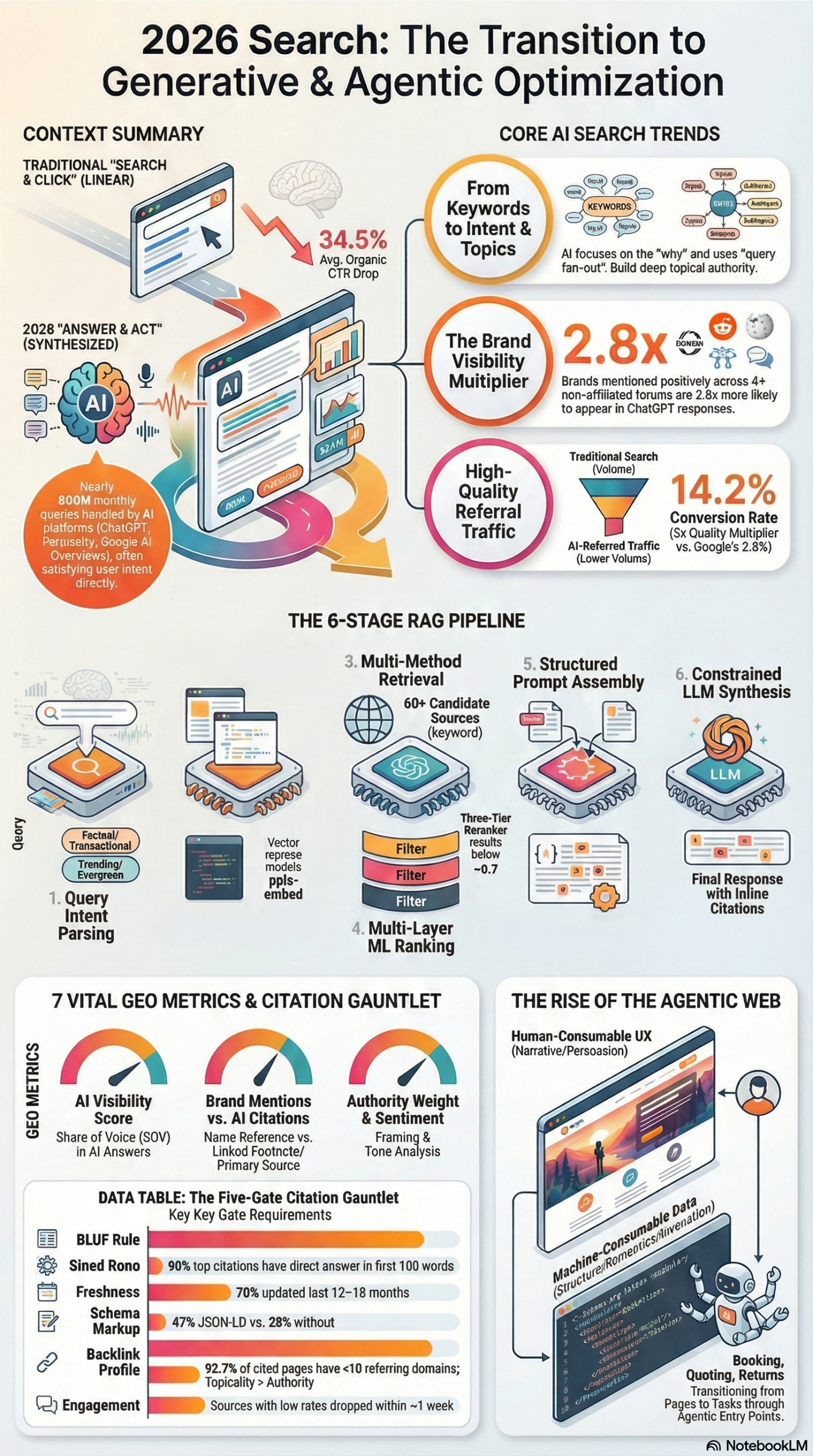
Step 4: Track your content freshness. Pull a list of your 20 most important pages and their last-modified dates. The Briefing documents that 70% of Perplexity’s top citations are updated within a 12–18 month window. Any page older than 18 months on a competitive topic is at risk of being filtered out of AI citation pools.
Phase 2: Implement BLUF Content Architecture
The most impactful structural change you can make is implementing the BLUF (Bottom Line Up Front) rule across all key pages.
Step 5: Rewrite your opening paragraphs. Every article, product page, and landing page should answer its primary question within the first 100 words. This is not a summary—it’s the complete, direct answer, with detail to follow. If your article title is “What Is [X]?”, the first paragraph must define [X] clearly and completely before elaborating.
Step 6: Add direct-answer summary boxes. At the top of long-form content, add a structured “Key Takeaway” or “Quick Answer” section. Format it as a brief bulleted list or single-paragraph answer. AI retrieval systems treat these as high-confidence extraction targets.
Step 7: Structure your content in hub-and-spoke clusters. The Briefing identifies hub-and-spoke content architecture as a key signal of topical authority to AI systems. For each major topic your brand covers:
– Create one comprehensive “pillar” page covering the topic end-to-end
– Create 5–10 “spoke” pages addressing specific subtopics in depth
– Link bidirectionally between pillar and all spokes
Topical authority—demonstrated through this architecture—now outweighs domain authority in AI citation selection, according to the 2026 Briefing.
Phase 3: Deploy Structured Data (JSON-LD Schema)
Structured data is the single highest-leverage technical implementation for AI visibility. Pages with Article, FAQ, or Person schema achieve a 19-percentage-point advantage in Top-3 AI citation rates, per the 2026 Briefing.
Step 8: Implement Article schema on all editorial content. Use JSON-LD format (Google’s preferred method) rather than Microdata. Every blog post and guide should include Article schema with headline, datePublished, dateModified, author, and publisher properties at minimum.
Example JSON-LD for an article:
{
  "@context": "https://schema.org",
  "@type": "Article",
  "headline": "How AI Agents Work—and How to Make Your Brand Visible to Them",
  "datePublished": "2026-03-30",
  "dateModified": "2026-03-30",
  "author": {
    "@type": "Organization",
    "name": "MarketingAgent"
  },
  "publisher": {
    "@type": "Organization",
    "name": "MarketingAgent",
    "url": "https://marketingagent.blog"
  }
}
Step 9: Add FAQ schema to all Q&A content. Any page that answers questions—and most pages should—benefits from FAQPage schema. This makes individual Q&A pairs directly extractable by AI retrieval systems.
Step 10: Implement Person and Organization schema for entity clarity. AI agents need to know who you are as an entity, not just what pages you publish. Implement Organization schema on your homepage and Person schema for any individual contributors. Include sameAs properties linking to your official social profiles, Wikipedia entry (if applicable), and Wikidata entry.
Phase 4: Build Agentic Entry Points
This is where most brands are completely unprepared. According to Semrush and the 2026 Briefing, the next phase of AI agent interaction is agentic commerce—agents completing transactions and tasks directly.
Step 11: Identify your 3–5 repeatable agentic tasks. What actions can an AI agent complete on a user’s behalf via your brand? Examples: BookConsultation, CheckEligibility, GetQuote, ScheduleDemo, CheckAvailability. These are the entry points you need to expose.
Step 12: Express actions using Schema.org Action vocabulary. Map each agentic task to the appropriate Schema.org Action type. For example:
{
  "@context": "https://schema.org",
  "@type": "ReserveAction",
  "name": "Book a Consultation",
  "target": {
    "@type": "EntryPoint",
    "urlTemplate": "https://yoursite.com/book?service={service_type}",
    "actionPlatform": ["https://schema.org/DesktopWebPlatform"]
  },
  "result": {
    "@type": "Reservation",
    "name": "Consultation Booking"
  }
}
Step 13: Monitor emerging agent protocols. As documented by Semrush, four major protocols are competing to standardize agent-business interaction: MCP (Model Context Protocol), WebMCP, Google’s Universal Commerce Protocol (UCP), and OpenAI’s Agentic Commerce Protocol (ACP). Subscribe to developer changelogs for each and implement API compatibility as these standards solidify.
Phase 5: Establish Your GEO Measurement Framework
Step 14: Define your GEO metrics baseline. According to the 2026 Briefing, the core metrics to track are:
– AI Visibility Score: How often your brand surfaces in AI responses for a defined set of prompts
– Share of Voice in AI Answers: Your citation rate vs. top 5 competitors
– Authority Weight: Are you cited as “According to [Brand]…” (definitive) or just mentioned in passing?
– Sentiment Score: Is the AI describing you positively, neutrally, or negatively?
Step 15: Set up your prompt monitoring system. Create a spreadsheet with 20–30 prompts your target customers would ask an AI agent. Run these weekly across ChatGPT, Perplexity, and Gemini. Log which prompts mention your brand, in what context, and with what sentiment. This manual process is imperfect but gives you a baseline immediately. Tools like Semrush’s AI Visibility Toolkit automate this at scale.
Expected outcomes after 90 days of implementing Phases 1–5: You should see measurable improvement in brand mentions across AI platforms, particularly on queries where you have genuine topical depth. Traffic volume from AI referrals may remain modest—but conversion rates from those visitors should significantly exceed your organic search baseline.
Real-World Use Cases
Use Case 1: B2B SaaS Qualifying Leads via AI Agents
Scenario: A project management software company wants to appear in AI-generated responses when enterprise buyers ask agents to “find project management tools that integrate with Salesforce and support 50+ users.”
Implementation: The company implements SoftwareApplication schema across all product pages with complete feature lists, integrations, and pricing tiers expressed in structured data. They publish a hub-and-spoke content cluster around “enterprise project management”—one comprehensive pillar page linked to 8 spoke pages on subtopics like “Salesforce integration setup,” “enterprise user management,” and “project management for remote teams.” They also earn brand mentions through guest contributions on enterprise software review sites and discussion threads on Reddit’s r/projectmanagement.
Expected Outcome: When an AI agent researches project management tools for an enterprise buyer, the structured feature data makes the brand directly extractable and comparable. The topical depth signals expertise. The cross-platform mentions satisfy the trust threshold. Citation probability increases significantly, and the leads who arrive already understand the product’s fit for their needs.
Use Case 2: Local Service Business Building Agentic Booking
Scenario: A dental practice wants to be bookable directly by AI agents when patients ask their AI assistant to “find a dentist near me who accepts [insurance] and has availability this week.”
Implementation: The practice implements Dentist and LocalBusiness schema with complete service offerings, accepted insurance plans, and geographic coverage. They expose a MakeAction endpoint via their booking system API and express it using ReserveAction schema. They ensure their Google Business Profile, Yelp, Healthgrades, and Zocdoc listings are complete, consistent, and regularly updated—establishing the cross-platform entity presence the 2026 Briefing identifies as critical.
Expected Outcome: As AI agents gain booking capabilities, the practice is technically equipped to receive direct reservations. In the interim, their structured data and cross-platform presence ensure they surface prominently in AI-generated local service recommendations.
Use Case 3: E-Commerce Brand Winning Agentic Product Research
Scenario: A running shoe brand wants to be recommended when someone asks an AI agent to “find the best trail running shoes for wide feet under $150.”
Implementation: The brand implements Product schema on every product page with complete size availability, width options, terrain suitability, and pricing. They publish detailed comparison guides following the BLUF rule—answering “what are the best trail running shoes for wide feet” in the first paragraph of their guide, with supporting detail to follow. They build topical authority around “trail running for wide feet” with a cluster of articles covering sock recommendations, insole options, fit guides, and terrain-specific advice.
Expected Outcome: When an AI agent evaluates running shoes for a user, the complete product schema makes the brand’s offerings directly comparable. The topical content cluster signals genuine expertise in the niche. The brand appears not just as a product option but as a trusted source on the broader topic.
Use Case 4: Content Publisher Becoming a Cited AI Source
Scenario: A marketing technology blog wants to be cited by AI systems when professionals ask questions like “what are the best AI tools for email marketing automation in 2026?”
Implementation: The publication audits its top 50 articles and rewrites opening paragraphs to follow the BLUF rule—direct answers in the first 100 words. They implement Article and FAQPage schema across all content. They establish a strict 12-month content refresh cycle, updating statistics, adding new tool comparisons, and revising recommendations annually. They also publish original research studies to generate brand mentions across other publications.
Expected Outcome: Per the 2026 Briefing, content updated within 12–18 months captures 70% of Perplexity’s top citations. The BLUF structure satisfies the pattern that drives 90% of top AI citations. The structured data makes individual answers extractable. The publication becomes a go-to cited source rather than just a search traffic destination.
Common Pitfalls
1. Treating AI optimization as a keyword exercise. Brands apply traditional keyword stuffing logic to AI visibility—cramming target phrases into meta descriptions and headings. AI retrieval systems evaluate semantic depth and structured data, not keyword density. The 2026 Briefing is explicit: topical authority now outweighs domain authority. Fix: Build content depth around genuine expertise, not keyword frequency.
2. Ignoring the freshness threshold. Teams publish strong content and leave it untouched for years. As the Briefing documents, 70% of Perplexity’s top citations are updated within 12–18 months, and content decay for time-sensitive queries can begin within 2–3 days. Fix: Implement a content audit calendar with 12-month mandatory refresh cycles on all high-priority pages.
3. Overlooking off-site entity signals. SEO teams focus exclusively on on-site optimization while neglecting cross-platform brand presence. The 2026 Briefing shows that brands mentioned positively across at least four non-affiliated forums are 2.8x more likely to appear in ChatGPT responses. Fix: Treat forum participation, community engagement, and third-party publication as a primary channel—not a nice-to-have.
4. Deploying schema incorrectly. Many brands implement schema in Microdata format, use incomplete properties, or fail to validate their markup. Broken schema provides no citation advantage. Fix: Use JSON-LD exclusively, validate with Schema Markup Validator before publishing, and audit schema quarterly.
5. Skipping measurement entirely. Most brands have no visibility into how AI agents describe them, whether they’re being cited, or what sentiment AI systems associate with their brand. As Mahi Kothari of Quattr stated in the 2026 Briefing: “Being unmeasured is the same as being invisible.” Fix: Implement a weekly prompt monitoring routine immediately—even manual tracking provides actionable insight.
Expert Tips
1. Target “why” and “how” queries over “best” lists. The 2026 Briefing specifically identifies long-tail intent queries—”why does [problem] happen” and “how do I [accomplish task]”—as the most aligned with natural language AI prompts. Queries like “best trail shoes” are more competitive and more likely to trigger a generic AI summary. “How to choose trail shoes for wide feet” is where niche expertise wins.
2. Track Authority Weight, not just mentions. Being cited as “According to [Brand], the leading authority on X…” carries ten times the influence of a passing mention. When monitoring AI responses, distinguish between definitive citations and supporting citations. Focus your content strategy on establishing definitive-source status in your specific niche rather than broad coverage.
3. Make your dateModified schema accurate and current. AI retrieval systems actively use dateModified signals to assess freshness. Many brands set this date once and never update it, or use the original publish date for revised content. Every time you meaningfully update a page, update the dateModified value in your Article schema. This single technical detail directly affects whether you clear the freshness filter.
4. Build your Wikidata entity before you need it. Wikidata entries are strong entity-recognition signals for LLMs. Brands with established Wikidata entries, linked to their official website, social profiles, and Wikipedia article, have a structural advantage in entity resolution. Create and maintain your Wikidata entry now—it compounds over time.
5. Separate your agentic entry points by task, not by page. When implementing Schema.org Action vocabulary, define one action per distinct task rather than creating a single generic “contact us” entry point. An AI agent looking to BookConsultation needs a precise, predictable endpoint. Generic contact forms are not actionable by current AI agent architectures.
FAQ
Q: How is an AI agent different from a chatbot?
A chatbot responds to prompts within a conversation window and relies on human guidance for each step. An AI agent receives a goal, decomposes it into a task plan, executes those tasks using real tools (APIs, web browsers, databases), observes outcomes, and adapts—all autonomously. The execution loop continues until the goal is achieved, not until the human’s next message. As Semrush explains, agents combine an LLM reasoning engine with software tools that enable real-world interaction.
Q: If AI search has less than 1% CTR, why optimize for it at all?
Because the traffic that does click through converts at 14.2%—compared to 2.8% for traditional organic search—and engages more deeply (8% longer sessions, 12% more page views), per the 2026 Briefing. The visitors are pre-qualified by the AI’s research process before they arrive. Additionally, brand mentions in AI responses build authority even when users don’t click—the AI is effectively endorsing your brand to high-intent users at scale.
Q: What’s the difference between GEO and traditional SEO?
Traditional SEO optimizes for Google’s ranking algorithm—focusing on backlinks, keyword density, and domain authority signals. Generative Engine Optimization (GEO) optimizes for how AI systems retrieve, rank, and synthesize your content into responses. The criteria differ significantly: the 2026 Briefing notes that traditional SEO strength actually shows an inverse correlation with AI visibility in some studies. GEO prioritizes structured data, semantic depth, topical authority, and cross-platform entity signals.
Q: Do I need to implement all four agent protocols (MCP, WebMCP, UCP, ACP)?
Not immediately. As Semrush documents, there is currently no single optimization standard. The protocols are still competing for adoption. The practical approach is to monitor each protocol’s developer documentation, identify which platforms your customers use most (ChatGPT users → ACP priority, Google users → UCP priority), and implement the most relevant one first. Build your internal agentic action architecture now using Schema.org vocabulary—which all four protocols reference—so you can layer on protocol-specific implementations as standards mature.
Q: How do I know if an AI agent is accurately representing my brand?
Run a regular prompt audit across ChatGPT, Perplexity, and Gemini using 20–30 queries relevant to your category. Document the brand mentions, their sentiment, and whether you’re cited as a definitive source or a supporting mention. Tools like Semrush’s AI Visibility Toolkit automate this tracking at scale. Per the 2026 Briefing, the four GEO metrics to track are: AI Visibility Score, Share of Voice in AI Answers, Authority Weight, and Sentiment Score. Without this measurement, you have no signal on whether your optimization efforts are working.
Bottom Line
AI agents have fundamentally changed what it means to be visible online. The binary nature of AI-citation visibility—cited or invisible—demands that brands shift from keyword ranking as a primary goal to becoming structured, machine-readable, cross-platform authoritative entities. The practical steps are clear: implement BLUF content architecture, deploy JSON-LD schema comprehensively, build topical depth through hub-and-spoke clusters, earn brand mentions across multiple non-affiliated platforms, and establish agentic entry points before the commerce protocols fully standardize. Brands that treat this as a future consideration will find themselves invisible to the AI systems actively making—or heavily influencing—their customers’ next decisions. The infrastructure you build now compounds directly into citation probability, conversion quality, and ultimately, agentic commerce eligibility.


0 Comments