

Glimpse just raised $35M in a Series A led by Andreessen Horowitz to automate financial deduction processes for 200+ consumer packaged goods (CPG) brands — bringing its total funding to $52M. If you work in CPG finance, trade promotion, or accounts receivable, this signals the end of the spreadsheet-and-email approach to deduction management. This tutorial walks you through how AI agent systems for deduction automation actually work, what the architecture looks like under the hood, and how your team can start deploying similar workflows today.
What This Is
Deductions are one of the most damaging, underestimated profitability leaks in the CPG industry. When a retailer like Walmart or Target ships a product and claims a shortage, a pricing discrepancy, or an unearned promotional allowance, they issue a deduction — a unilateral reduction of the invoice payment. For mid-to-large CPG manufacturers, unresolved deductions can represent millions of dollars annually in contested, often invalid, revenue reductions.
Traditionally, managing deductions meant assigning finance analysts to log into dozens of individual retailer portals, manually download Proof of Delivery (POD) and Bill of Lading (BOL) documents, cross-reference them against ERP data, write dispute letters, and track resolution status in Excel. This process is slow, error-prone, and doesn’t scale as a brand grows its retail footprint.
Glimpse, a Y Combinator alumni company now backed by a16z and 8VC, has built an AI agent platform that automates this entire workflow for CPG brands and retailers. Their system handles dispute tracking, evidence retrieval, reason code mapping, and resolution routing — replacing much of the manual analyst work with autonomous AI agents that operate around the clock.
At the technical level, Glimpse’s approach reflects broader architectural trends in agentic AI documented in the 2026 AI Agent Architecture Briefing: moving away from rigid RPA scripts toward adaptive, goal-driven agents that maintain context, retrieve evidence autonomously, and escalate to humans only when truly necessary.
Here is what makes this category technically distinct from legacy automation:
Legacy RPA vs. Agentic Deduction Management
Legacy Robotic Process Automation (RPA) tools execute fixed scripts. If a retailer portal changes its layout, the bot breaks. If an invoice has an unusual format, the rule fails silently. Agentic systems, by contrast, use reasoning engines — typically large language models paired with structured tool-use — to interpret novel inputs, adapt to interface changes, and make nuanced decisions like whether a shortage claim is valid based on carrier records.
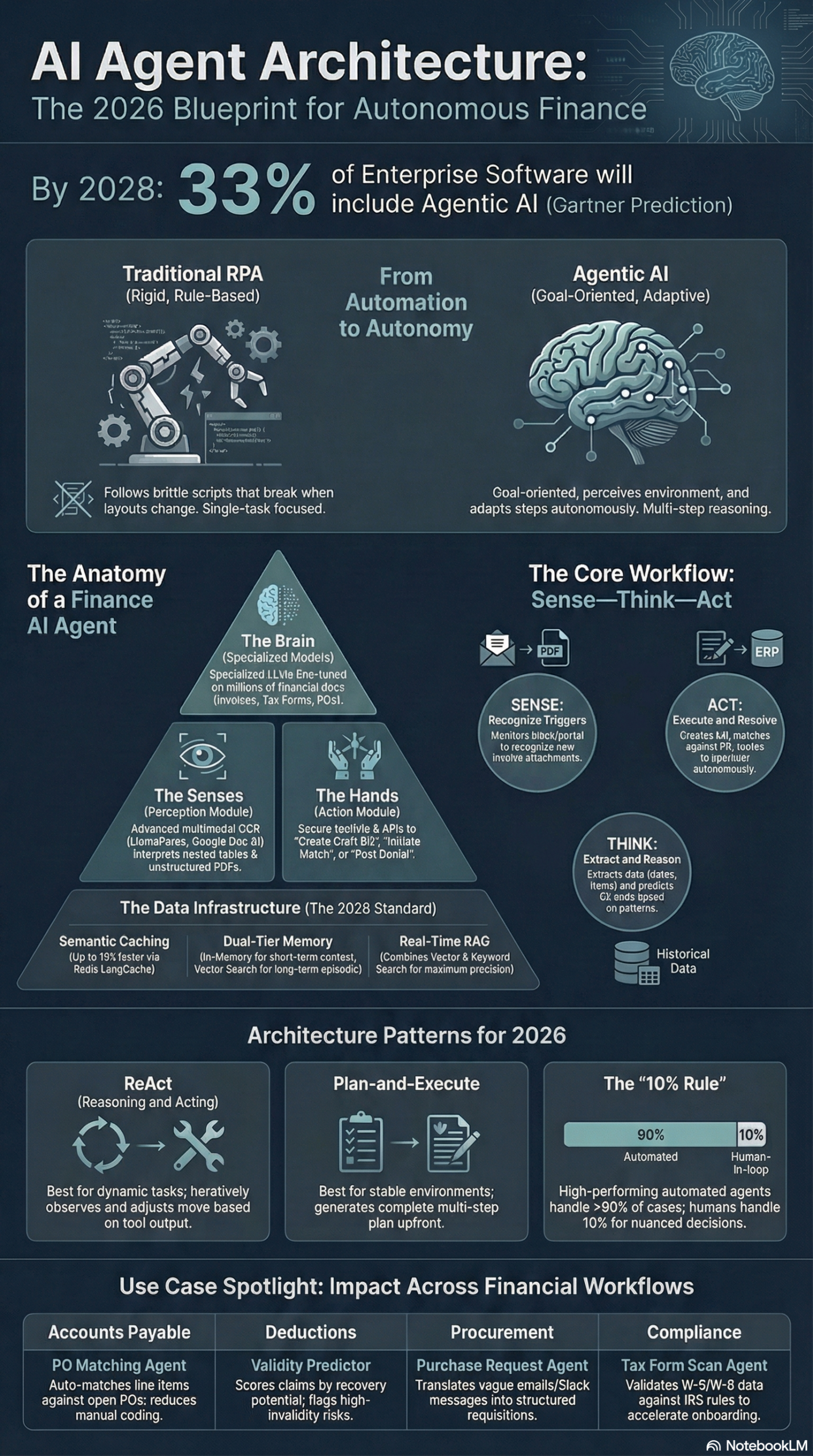
According to the AI Agent Architecture Briefing, modern agent systems are built on functional layers: Perception & Input (transforming raw documents into structured data), Reasoning Engines (deciding what action to take), Memory Systems (retaining context across sessions), Tool Execution (connecting to portals and ERP APIs), and Orchestration (managing the flow between all components). In deduction management, every one of these layers does real work.
The document processing layer alone is a major upgrade. Tools like LlamaParse use “semantic reconstruction” rather than raw OCR transcription — they understand the relationships within financial documents, including nested tables in retailer deduction notices and confidence-scored field extraction for auditability. This matters because deduction documents are notoriously inconsistent: different retailers use different formats, reason codes, and portals.
Why It Matters
The $35M raise led by a16z isn’t speculative. It reflects real demand from CPG finance teams that are drowning in deduction volume as retail channels multiply. The problem compounds as brands expand: more SKUs, more retailers, more portals, more deduction types. Human analysts don’t scale linearly with that growth — but AI agents do.
For practitioners, the shift from manual deduction management to agentic automation has three concrete impacts:
1. Recovery rate improvement. Invalid deductions that would previously age out and be written off — because an analyst didn’t have time to gather evidence before the dispute window closed — get handled automatically. The HighRadius research cited in the briefing frames this as the “10% Rule”: high-performing automated systems reach a state where ≤10% of cases require human intervention. The other 90% are fully resolved by agents.
2. Analyst role elevation. When agents handle routine evidence retrieval and dispute filing, human analysts shift to managing exceptions, building retailer relationships, and analyzing deduction trends to fix upstream process problems. This is the shift from “automation” (doing tasks faster) to “autonomy” (handling entire workflows intelligently), as framed in the Tipalti Finance AI Analysis.
3. Real-time cash flow visibility. Because agents process deductions continuously rather than in batch cycles, finance leadership gets live dashboards of disputed amounts, recovery rates, and aging — instead of waiting for weekly analyst reports.
What differentiates Glimpse and platforms like it from generic AI tools is domain specialization: pre-built integrations with major retailer portals (Walmart, Amazon, Target, Kroger), reason code libraries mapped to ERP-recognized codes, and workflows tuned to CPG-specific dispute types (promotional allowances, co-op advertising deductions, short-shipment claims). Building this from scratch with general-purpose LLMs is possible, but the integration work is the hard part.
The Data
The table below compares the key characteristics of manual deduction management, legacy RPA, and modern AI agent platforms, based on the 2026 AI Agent Architecture Briefing and publicly available data on the Glimpse platform from TechCrunch.
| Dimension | Manual (Analyst-Led) | Legacy RPA | AI Agent Platform (e.g., Glimpse) |
|---|---|---|---|
| Evidence retrieval | Manual portal login, download, email | Script-based bot (brittle) | Autonomous agent with adaptive navigation |
| Document processing | Human reads & interprets | Template-based OCR | Semantic reconstruction (LlamaParse-style) |
| Reason code mapping | Analyst knows codes by memory | Static lookup table | LLM interprets novel/custom retailer codes |
| Human intervention rate | ~100% | ~60-80% (bot breaks on edge cases) | ≤10% (automated agent target) |
| Dispute window adherence | Frequently missed | Improves but still rule-bound | Continuous processing, deadline-aware |
| ERP integration | Manual data entry | Scripted API calls | Structured tool-use with error handling |
| Scalability | Linear with headcount | Semi-linear | Elastic — agents parallelize across retailers |
| Cost trajectory | Grows with volume | Moderate reduction | Significant reduction via semantic caching (up to 70% per Redis LangCache data) |
| Auditability | Email trails, spreadsheets | Log files | Field-level confidence scores, citation trails |
Step-by-Step Tutorial: Implementing AI Agent Deduction Automation
This tutorial covers how to design and deploy an AI agent system for CPG deduction management — whether you’re evaluating a platform like Glimpse or building custom agents on top of LLM infrastructure. We’ll walk through architecture decisions, integration setup, agent configuration, and go-live validation.
Prerequisites
Before you start, you need the following in place:
- ERP access: API credentials or a middleware connector for your ERP (SAP, Oracle NetSuite, Microsoft Dynamics). Most agent platforms require read/write access to the Accounts Receivable module.
- Retailer portal credentials: Login credentials for each retailer portal you’re targeting (Walmart Retail Link, Amazon Vendor Central, Target Partners Online, etc.). These are stored securely in a credential vault — not hardcoded.
- Deduction data export: A historical export of at least 90 days of deduction data from your ERP, including invoice numbers, deduction amounts, retailer IDs, and reason codes. This seeds the agent’s initial training context.
- Dispute submission access: Confirm you have the ability to submit disputes programmatically (API) or via portal automation for each retailer. Some retailers require form submissions; others accept EDI.
Phase 1: Map Your Deduction Taxonomy
Before configuring any agents, document your deduction landscape. This is the step most teams skip — and it’s why pilots fail.
Step 1: Categorize your deduction types.
Pull your last 12 months of deductions from the ERP and group them into three buckets:
– Valid deductions: Correctly applied promotional allowances, co-op fees, freight deductions per contract. These should be auto-approved without dispute.
– Unauthorized deductions: Shortage claims, pricing discrepancies, unsupported deductions with no contract basis. These are dispute candidates.
– Gray-area deductions: Trade promotion claims where the promotional event happened but the deduction amount is miscalculated, or timing is off. These require human review.
Only unauthorized deductions should route to automated dispute agents. Trying to automate gray-area cases without human oversight is where agents cause problems. As the AI Agent Architecture Briefing notes, high-performing automated systems reserve ≤10% of cases for human touch — the key is designing your routing logic to correctly identify which 10%.
Step 2: Map retailer reason codes to your internal taxonomy.
Every retailer uses different deduction reason codes. Walmart’s “shortage” code is not the same format as Amazon’s. The HighRadius analysis in the briefing identifies reason code mapping as a critical agent function — the system must interpret retailer-specific codes and translate them to ERP-recognized categories.
Build a mapping table: Retailer → Retailer Code → Internal Code → Dispute Eligible (Y/N). Start with your top 5 retailers by deduction volume. This table becomes a reference tool for your reasoning agent.
Phase 2: Configure the Agent Architecture
Following the Sense-Think-Act framework used by finance AI teams:
Step 3: Set up the Sense layer (document ingestion).
Configure your agent to monitor the following input channels:
– Email inbox: A dedicated AP/AR email address where retailers send deduction notices. The agent monitors this inbox, detects PDF/EDI attachments, and classifies them as deduction documents.
– Portal polling: A scheduled task (every 4-6 hours) where agents log into each retailer portal, scan for new deduction postings, and download associated documents.
– ERP webhook: An event trigger from your ERP that fires whenever an open invoice ages past a configurable threshold (e.g., 30 days with a partial payment).
For document processing, use a layout-aware parsing tool that goes beyond raw OCR. The research report specifically highlights tools like LlamaParse for their ability to handle nested tables and financial charts while providing field-level confidence scores — critical when you’re building an audit trail for disputed amounts.
Step 4: Configure the Think layer (reasoning engine).
Your reasoning agent needs two inputs: the structured document data from Step 3, and context from your ERP (original invoice, PO, shipping records). The agent then:
- Identifies the deduction type and reason code
- Maps to your internal taxonomy (from the table built in Step 2)
- Determines dispute eligibility based on your routing rules
- Searches for available evidence (POD, BOL, carrier confirmation)
For the reasoning pattern, the Architecture Briefing recommends a ReAct (Reason + Act) pattern for deduction management rather than Plan-and-Execute, because the evidence available for a specific deduction is unknown until the agent checks. ReAct agents observe, reason, and act in loops — they’ll check a carrier portal, find no POD, then check an alternate source, then adjust their action. Plan-and-Execute agents would generate a fixed plan upfront that breaks when the expected document isn’t where it’s supposed to be.
Step 5: Configure the Act layer (dispute filing and ERP update).
When the reasoning agent determines a deduction is invalid and evidence is available, it hands off to action tools:
- Dispute submission tool: Submits the dispute via the retailer’s preferred channel (portal form, EDI 812, or email template). Each retailer requires a different format — pre-build these as structured tool configs.
- ERP update tool: Flags the invoice in your ERP as “disputed,” attaches the evidence documents, and updates the expected payment date.
- Notification tool: Sends a status update to the responsible AR analyst confirming the dispute was filed and the deadline.
For cases that fail the routing rules (gray-area, insufficient evidence, or over the dispute threshold), the agent escalates to a human via a task in your workflow system with all gathered context pre-populated.
Phase 3: Build the Memory and Data Infrastructure
Step 6: Set up semantic caching for portal interactions.
Agents that query retailer portals repeatedly for similar document types can use semantic caching to avoid redundant calls. Redis LangCache data cited in the briefing shows up to 70% cost reduction and 15x faster responses when semantic caching is deployed. Cache common portal responses at the session level and invalidate on a schedule tied to portal refresh rates.
Step 7: Configure episodic memory for dispute history.
The agent needs to remember prior interactions with each deduction case — what evidence was retrieved, what was submitted, what the retailer responded with, and whether the dispute was resolved or rejected. This is episodic memory: event-based records with temporal context. Store these in a vector database with timestamps so the agent can surface relevant history when a similar deduction appears from the same retailer.
This is also your audit trail. The briefing emphasizes that in high-stakes financial workflows, episodic memory must provide regulatory traceability — every agent decision must be recoverable and explainable.
Phase 4: Validate and Go Live
Step 8: Run a shadow mode pilot.
Before agents take live action, run them in shadow mode: agents process real deductions, generate recommendations, and log what they would do — but humans make the final calls. Compare agent decisions to human analyst decisions over a 30-day period. Track: accuracy of dispute eligibility classification, quality of evidence retrieval, and correctness of reason code mapping.
Target ≥95% agreement between agent and analyst on eligibility decisions before switching to live mode. If agreement is lower, review your routing rules and taxonomy mapping from Phase 1.
Step 9: Go live with the 10% rule as your target.
Launch with automated dispute filing for the clearest-cut unauthorized deductions first (e.g., shortage claims with available POD documentation that clearly contradicts the claim). Expand agent autonomy incrementally as you validate performance. The HighRadius benchmark sets the gold standard at ≤10% human touch rate — but most teams start at 40-50% automation and improve over 90 days.
Step 10: Monitor agent decisions, not just outcomes.
Production agents require observability of what they decided and why, not just downstream metrics like recovery rate. As the Architecture Briefing emphasizes: “Prioritize behavioral observability.” Build a dashboard that surfaces agent decision traces — the sequence of steps an agent took to reach a dispute recommendation — so analysts can spot systematic errors before they affect large deduction volumes.
Expected Outcome: After a full 90-day deployment, teams running mature AI agent deduction systems should see: deduction processing time reduced from days to hours, dispute submission rate increases (because agents catch deadlines humans miss), and a measurable improvement in recovery rate on invalid deductions.
Real-World Use Cases
Use Case 1: High-Volume Shortage Claim Resolution
Scenario: A mid-size CPG brand with $200M in annual revenue sells through 8 major grocery retailers. Shortage claims represent 40% of total deduction volume — retailers claiming they received fewer units than invoiced.
Implementation: Configure agents to monitor each retailer’s portal for shortage deductions daily. When a new shortage claim appears, the agent automatically retrieves the carrier-confirmed delivery records from the 3PL portal, extracts the delivered quantity, and compares against the claimed shortage. If the carrier record contradicts the shortage claim, the agent files a dispute with attached evidence, updates the ERP, and closes the loop.
Expected Outcome: Shortage disputes filed within 24 hours of posting (vs. 7-10 days manually), with complete evidence attached. Dispute window adherence improves to near-100% from the previous 60-70%.
Use Case 2: Trade Promotion Deduction Validation
Scenario: A beverage brand runs quarterly promotional events with major retailers. Post-event, retailers deduct promotional allowances from invoices — but the deduction amounts frequently exceed what was contractually agreed.
Implementation: The agent retrieves the promotional contract from the brand’s document management system, extracts the agreed allowance rates, and compares them against the retailer’s claimed deduction. For overages above a threshold (e.g., 5%), the agent flags for human review with the contract terms and deduction amount pre-populated in a dispute template.
Expected Outcome: Overpayment of promotional allowances reduced. Finance team identifies systemic promotional deduction inflation patterns that inform contract renegotiations.
Use Case 3: New Retailer Onboarding Acceleration
Scenario: A CPG brand is expanding to a new regional retailer with non-standard deduction processes and unfamiliar reason codes.
Implementation: The agent’s reason code mapping module is fed the new retailer’s deduction code documentation. Using the LLM-powered interpretation layer (based on the semantic reconstruction approach), the agent maps novel codes to internal ERP categories without requiring manual lookup table updates. The agent runs in assisted mode (human review for the first 60 days) while it builds episodic memory of this retailer’s deduction patterns.
Expected Outcome: New retailer onboarded to the deduction automation workflow in weeks rather than months. Analyst time spent on new-retailer deduction setup reduced by 70%.
Use Case 4: Fraud Detection on Unauthorized Rebates
Scenario: A manufacturer suspects a retailer is claiming deductions under obscure reason codes that don’t correspond to any contractual obligation — effectively taking unauthorized rebates.
Implementation: The agent’s reason code mapping layer flags any code that cannot be matched to a contract term or internal policy. These are routed to a fraud review queue with full documentation of the deduction amount, posting date, frequency, and historical pattern for that retailer.
Expected Outcome: Unauthorized rebate deductions identified and escalated to the legal/compliance team with a complete evidence package, enabling formal dispute escalation beyond standard AR channels.
Common Pitfalls
1. Automating before your taxonomy is clean.
If your reason code mapping is incomplete or your routing rules aren’t tested, agents will misclassify deductions — filing disputes on valid promotional deductions and letting unauthorized ones through. Spend Phase 1 doing the taxonomy work before touching the agent configuration. This is the most common reason AI deduction pilots fail.
2. Ignoring the “body layer” integration complexity.
The Architecture Briefing identifies the “body layer” — secure authentication with third-party portals, credential management, and well-formed API calls to legacy ERP systems — as “a common reason pilots stall before reaching production.” Retailer portal logins break when portals update their UIs. Credential rotation needs to be automated. Build these infrastructure concerns into your project plan from day one, not as afterthoughts.
3. Setting the automation threshold too aggressively.
Deploying agents with full autonomy across all deduction types immediately — without a shadow mode period — exposes you to agents filing incorrect disputes, damaging retailer relationships, or missing valid deductions. The 10% human touch rule is a mature system benchmark, not a starting point. Start at 50% automation and earn your way to full autonomy.
4. No observability on agent decisions.
Running agents without behavioral monitoring means you won’t know why recovery rates drop until it’s a significant problem. Monitor decision traces — the specific steps and reasoning an agent followed — not just aggregate outcomes like disputes filed or recovery rate.
5. Single-agent designs for multi-step workflows.
Do not attempt to have a single agent handle the entire deduction workflow from ingestion to dispute filing. As the Architecture Briefing recommends: “Decompose complex workflows.” Use an orchestration layer (like LangGraph) to separate document ingestion, reasoning, evidence retrieval, and dispute submission into discrete specialized agents. This makes debugging vastly easier and failure modes more contained.
Expert Tips
1. Use the ReAct pattern for evidence retrieval, Plan-and-Execute for dispute filing.
Treat these as separate agents with different architectures. Evidence retrieval is exploratory — use ReAct so the agent can adapt when an expected document isn’t found. Dispute filing is deterministic — use Plan-and-Execute once evidence is confirmed, so the submission process is fast and predictable. Mixing them in a single agent creates an unpredictable loop.
2. Build retailer-specific tool configs, not generic portal scrapers.
Generic web scrapers break constantly. Build structured tool configurations for each major retailer portal — define expected page structures, field mappings, and fallback paths. Treat these as maintained assets, not throwaway scripts.
3. Prioritize semantic caching on document retrieval.
If your agents retrieve BOL and POD documents from carrier portals multiple times for the same shipment (common in complex multi-leg deductions), semantic caching with a tool like Redis LangCache can cut retrieval costs dramatically. Cache at the document hash level and invalidate when the carrier record is updated.
4. Design your episodic memory schema for regulatory retrieval.
Store agent decision logs with: timestamp, agent ID, input document hash, reasoning steps, action taken, outcome, and analyst review status. This schema makes it straightforward to retrieve the full audit trail for any deduction — essential if you’re in a regulated industry or face litigation on a disputed amount.
5. Track dispute window deadlines as first-class data.
Every retailer has a different dispute window (30, 45, 60 days from deduction posting). Make deadline tracking a core field in your deduction data model, not a derived calculation. Build deadline-aware prioritization into your agent’s task queue so it always processes the most at-risk deductions first.
FAQ
Q1: How is Glimpse different from traditional AR automation tools like HighRadius or Esker?
Traditional AR automation tools apply rules-based logic to structured invoice data. They’re effective for straightforward payment matching but struggle with the unstructured, portal-specific, document-heavy nature of deduction disputes. Glimpse uses AI agents that interpret novel documents, adapt to portal changes, and reason about evidence quality — capabilities not available in rule-based systems. The TechCrunch reporting notes Glimpse specifically pivoted its model to focus on this dispute-tracking automation niche, rather than offering broad AR functionality.
Q2: What ERP systems does AI deduction automation typically integrate with?
The most common integrations are SAP S/4HANA, Oracle NetSuite, Microsoft Dynamics 365, and Infor CloudSuite. As the Architecture Briefing notes, ERP integration is part of the “body layer” — the most technically complex part of deployment. Most platforms offer pre-built connectors for the major ERPs, but custom fields and non-standard GL coding setups require additional configuration time.
Q3: Is it safe to give AI agents access to retailer portals?
Yes, with the right credential management architecture. Agents should access portals through a secrets vault (e.g., HashiCorp Vault or AWS Secrets Manager) that rotates credentials automatically and logs all access. Agents should never store credentials in memory or logs. The Architecture Briefing explicitly flags credential management as a core infrastructure requirement, not an optional security add-on.
Q4: How long does a typical implementation take before agents are processing live deductions?
Based on industry deployment patterns, expect 8-12 weeks from kickoff to live processing for a focused rollout covering 3-5 major retailers. The taxonomy mapping and shadow mode validation phases account for most of that time. Rushing these phases to accelerate go-live is the primary cause of first-month performance issues.
Q5: What’s the ROI model for AI deduction automation?
ROI comes from three sources: increased recovery rate on invalid deductions (direct revenue recovery), reduced analyst time on routine dispute tasks (labor efficiency), and improved cash flow timing from faster dispute resolution. For a brand processing $5M+ in annual deductions, even a 5-10% improvement in recovery rate — which is conservative for a well-implemented system targeting the ≤10% human touch benchmark — produces meaningful payback within the first year.
Bottom Line
Glimpse’s $35M Series A led by a16z is a clear signal that agentic AI in CPG finance has moved from experimental to proven — 200+ brands don’t deploy a platform that doesn’t deliver results. The architecture powering this category — ReAct reasoning engines, layout-aware document parsing, retailer portal tool integrations, and episodic memory for audit trails — is buildable today using available infrastructure, whether you’re evaluating a vendor or building custom agents. The key to a successful deployment is the unsexy work: cleaning your deduction taxonomy, mapping reason codes, and running shadow mode validation before agents take autonomous action. Teams that do this groundwork consistently reach the 10% human touch benchmark documented by HighRadius — meaning 90% of deductions are fully resolved without analyst involvement. As AI agent investment continues to accelerate across financial operations, deduction management is one of the clearest, most measurable starting points for CPG and manufacturing finance teams ready to move from automation to autonomy.


0 Comments