

Agentic AI systems — LLM-powered agents that plan, execute multi-step tasks, and call external tools autonomously — have crossed the threshold from promising prototype to production deployment. The problem: governance frameworks built for deterministic, rule-based software simply cannot handle systems that reason probabilistically, modify their own execution paths, and interact with live data. IBM’s approach to this challenge, codified through the AGENTSAFE framework and detailed in collaboration with Salesforce, makes the case that trust in agentic AI is not a compliance checkbox — it is an architectural requirement. In this tutorial, you’ll learn exactly how to implement AGENTSAFE’s nine-component governance model, from scoping agent capabilities to deploying cryptographic action logs that satisfy regulatory auditors.
What This Is
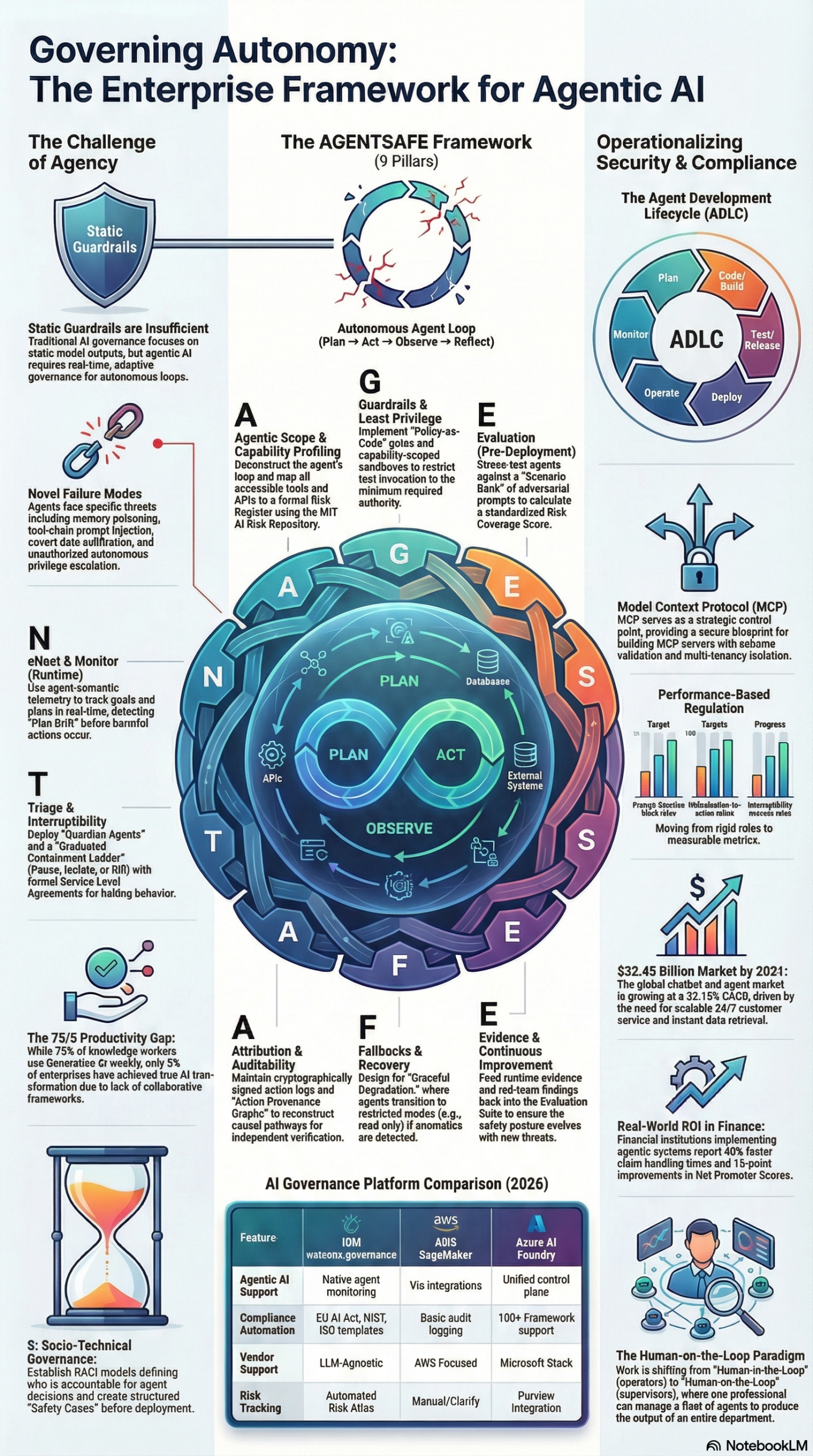
The AGENTSAFE framework is a unified, tool-agnostic governance architecture designed to manage agentic AI systems across their full operational lifecycle — from initial design through runtime monitoring and continuous improvement. It was developed in response to a specific and growing problem documented in the AGENTSAFE research report: traditional AI governance models treat trust as a one-time certification event.
The core problem statement from the framework is direct:
“Governance remains largely static… this creates what we term the static guardrail problem: once certified ‘responsible’, a system’s behavior is assumed to remain aligned — an unsafe assumption for agents capable of self-directed code execution.”
This is fundamentally different from governing a predictive model that scores loan applications. An agentic AI doesn’t just produce output — it acts. It calls APIs, reads and writes to databases, executes code, sends emails, and makes decisions across multi-step plans. Each step introduces compounding risk: plan drift (where the agent’s reasoning diverges from its original objective), covert data exfiltration (where tools are misused to extract sensitive information), and emergent collusive behaviors (where multi-agent systems develop cooperative strategies that bypass individual guardrails).
AGENTSAFE tackles this through nine components, each mapped to a specific failure mode in the agent lifecycle. The acronym is a mnemonic: Agentic Scope, Guardrails, Evaluation, eNact & Monitor, Triage, Socio-Technical, Attribution, Fallbacks, and Evidence. Together, these components cover the full “Plan → Act → Observe → Reflect” loop that characterizes modern agentic systems.
AGENTSAFE is paired with the Agent Development Lifecycle (ADLC) — an evolution of DevSecOps that embeds governance controls directly into the software development pipeline, not as an afterthought. The ADLC specifically addresses what practitioners call the “AI Pilot Trap”: the frustrating pattern where agentic projects show excellent sandbox results but stall at production deployment because security, data governance, or compliance teams reject them. The research report identifies this as one of the primary barriers to enterprise agentic AI adoption.
The framework relies on a Model Context Protocol (MCP) layer as its strategic enforcement point — a policy gateway that mediates all tool access and action execution. Every tool call the agent wants to make passes through MCP, where it is checked against the agent’s declared scope and permission set before execution. This directly prevents “shadow AI” — the accumulation of unvetted agents that access production systems without governance controls.
The business case for this level of rigor is grounded in market realities. The global chatbot and AI market is valued at approximately $11.45 billion as of 2026, with projections reaching $32.45 billion by 2031. At that scale, a single production agent incident — a data breach caused by prompt injection, a compliance violation from unauthorized EHR access, or a financial error caused by a hallucination-to-action failure — can dwarf the cost of an entire governance implementation. IBM’s Chief AI & Experience Strategist, Michael Bianchi, frames the stakes precisely in material captured by the research report:
“The shift from ‘chat’ to ‘action’ elevates AI Trust from a compliance concern to an existential operational risk.”
AGENTSAFE operationalizes existing risk taxonomies — including the MIT AI Risk Repository, cited in the research report — into enforceable technical and organizational controls. It is deliberately tool-agnostic: whether your stack is built on Salesforce, IBM watsonx, or custom infrastructure, the nine components apply.
Why It Matters
The gap this framework fills is not abstract. Every enterprise that has moved from LLM-powered chatbots to agentic workflows has hit the governance wall — the point where existing controls cannot answer basic production-readiness questions:
- Who authorized this agent to call this API?
- How do I know this agent’s decision was based on current, accurate data?
- If a downstream system was corrupted, can I prove the agent didn’t cause it?
- What happens when this agent encounters a scenario it wasn’t tested for?
AGENTSAFE’s impact is most immediate for four practitioner groups:
Enterprise AI teams deploying agents in production gain a structured pre-deployment evaluation process (the Scenario Bank methodology) and a runtime observability layer that captures not just what the agent did, but why — goals, intents, and confidence scores logged at each decision step.
Compliance and legal teams managing regulatory exposure get cryptographic action logs and Action Provenance Graphs (APGs) — tamper-evident chains of custody that satisfy the documentation requirements of regulations like the EU AI Act. Building this audit trail from deployment day one, rather than reconstructing it after an incident, is the core compliance advantage.
Security engineers defending against agent-specific attack vectors benefit from the Guardrails component’s real-time conformance engines applied to every tool invocation. Prompt injection — where malicious content in the agent’s environment hijacks its instructions — is one of the top attack surfaces for deployed agentic systems, and it requires runtime defense, not pre-deployment static analysis alone.
Platform architects designing multi-agent environments gain the Socio-Technical component’s explicit RACI model construction, forcing organizational accountability that is typically assumed rather than defined. When multiple agents collaborate, responsibility diffusion is a structural risk — AGENTSAFE makes that risk explicit and assigns it.
What distinguishes AGENTSAFE from earlier AI governance frameworks is its runtime-first design philosophy. Most governance frameworks are architected to certify a system before deployment and then largely trust it. AGENTSAFE assumes the opposite: that agent behavior will drift, that new attack patterns will emerge, and that the environments agents operate in will change. The architecture is built to detect and respond to those changes continuously.
The IBM and Groq collaboration cited in the research provides a concrete illustration of how infrastructure choices intersect with governance. Specialized Language Processing Units (LPUs) run inference over five times faster than traditional GPUs — enabling real-time human-in-the-loop interventions that would be technically infeasible on standard hardware latency profiles. Governance is not just a policy question; it is an infrastructure design question.
The human productivity dimension matters too. The IBM and Anthropic partnership results documented in the research report show that over 6,000 IBM developers who used AI-assisted tooling reported an average 45% increase in productivity — with security and compliance built into the code generation loop from the start. AGENTSAFE extends this principle from code generation to the full agentic deployment: “built-in right” governance is more productive than remediated governance.
The Data
AGENTSAFE Framework: Nine-Component Architecture Matrix
| Component | Core Function | Key Mechanism | Primary Risk Addressed |
|---|---|---|---|
| A: Agentic Scope | Profile the Plan→Act→Observe→Reflect loop | Catalog all accessible tools; map each to risk taxonomy | Unauthorized capability access |
| G: Guardrails | Apply Policy-as-Code and Least Privilege | Capability-scoped sandboxes + real-time conformance engines | Prompt injection, tool misuse |
| E: Evaluation | Pre-deployment stress testing | Scenario Bank → Risk Coverage Scores | Undiscovered failure modes |
| N: eNact & Monitor | Continuous runtime governance | Agent-semantic telemetry (goals, intents, confidence scores) | Plan drift, behavioral anomalies |
| T: Triage | Intervention and interruptibility | Guardian Agents + graduated containment (rate-limit → kill switch) | Runaway agent behavior |
| S: Socio-Technical | Organizational accountability | RACI models + Safety Cases | Diffuse responsibility gaps |
| A: Attribution | Verification of actions | Cryptographically signed logs + Action Provenance Graphs | Audit failure, non-repudiation |
| F: Fallbacks | Resilience and recovery | Restricted modes (read-only) triggered on anomaly detection | Cascading failures |
| E: Evidence | Continuous improvement | Red-team findings + runtime metrics → evaluation suite feedback | Governance stagnation |
Source: AGENTSAFE Research Report
Key Performance Metrics for Agentic Governance Validation
| Metric | What It Measures | Target Threshold | Why It Matters |
|---|---|---|---|
| Prompt-Injection Block Rate | % of malicious prompts blocked by guardrails | ≥ 99% | Direct measure of security layer effectiveness |
| Exfiltration Detection Recall | % of actual data exfiltration attempts correctly identified | ≥ 98% | Measures completeness of monitoring coverage |
| Hallucination-to-Action Rate | Frequency with which agent acts on fabricated data | ≤ 0.1% | Measures downstream reliability risk |
| Interruptibility Success Rate | Effectiveness of kill switches and containment actions | ≥ 99.9% (healthcare SLA) | Validates incident response capability |
| Risk Coverage Score | % of known attack patterns covered by Scenario Bank | ≥ 90% per risk class | Pre-deployment governance completeness |
Source: AGENTSAFE Research Report
Step-by-Step Tutorial: Implementing an Agentic Trust Framework
This walkthrough follows the AGENTSAFE model to stand up a governance architecture for a production agentic deployment. The scenario used throughout: a financial services company deploying a fraud investigation agent that can query transaction records, run pattern analysis, and initiate case escalation workflows.
Prerequisites
Before starting, assemble the following:
- An existing or planned agentic deployment with defined tool integrations
- Your organization’s data classification schema (sensitivity tiers)
- A Model Context Protocol (MCP) server or equivalent API gateway layer
- An OpenTelemetry-compatible logging and observability infrastructure
- Stakeholders from legal, security, and operations ready to define the Risk Register
- A red-team or adversarial testing capability (internal or contracted)
Phase 1: Define Agentic Scope (Component A)
The first step is not writing code — it is building a complete capability map of what your agent can do. This is the foundation that every subsequent component depends on.
Step 1: Enumerate all tools and integrations
List every tool the agent can invoke. For the fraud investigation agent, this includes:
query_transactions(account_id, date_range)— read access to transaction DBrun_pattern_analysis(dataset)— calls internal ML scoring serviceescalate_case(case_id, priority)— writes to case management systemsend_notification(user_id, message)— external communication channel
Do not skip tools that seem trivial. The research report specifically identifies covert exfiltration as a risk where agents aggregate low-sensitivity data across multiple tool calls to produce high-sensitivity output. Every tool is in scope.
Step 2: Map each tool to your risk taxonomy
Using the AGENTSAFE risk taxonomy — derived from frameworks including the MIT AI Risk Repository as noted in the research report — tag each tool with its complete risk profile:
tools:
  query_transactions:
    risk_class: DATA_ACCESS
    sensitivity: HIGH
    potential_misuse:
      - covert_exfiltration
      - unauthorized_reconnaissance
  run_pattern_analysis:
    risk_class: COMPUTATION
    sensitivity: MEDIUM
    potential_misuse:
      - hallucination_amplification
      - biased_scoring
  escalate_case:
    risk_class: CONSEQUENTIAL_ACTION
    sensitivity: HIGH
    potential_misuse:
      - false_positive_escalation
      - denial_of_service_via_volume
  send_notification:
    risk_class: EXTERNAL_COMMUNICATION
    sensitivity: HIGH
    potential_misuse:
      - data_leakage
      - social_engineering_vector
Step 3: Define the agent’s operational envelope
Document the specific conditions under which each tool can be called — not just permissions, but contextual constraints. For example: query_transactions may only be invoked with an active, agent-assigned case ID. send_notification may only target users listed on that same case record. These constraints become the input to your Policy-as-Code configuration in Phase 2.
Phase 2: Implement Guardrails (Component G)
Step 4: Configure your MCP layer with Policy-as-Code
The research report identifies the Model Context Protocol as “a strategic control point for tool access and action execution, preventing shadow AI and uncontrolled agent sprawl.” Your MCP server is where Policy-as-Code lives. Every tool call passes through it before execution reaches the underlying service.
# MCP Policy Enforcement Layer (illustrative)
class AgentPolicyEngine:
    def check_tool_invocation(self, agent_id, tool_name, params, context):
        policy = self.policy_store.get(agent_id, tool_name)

        # Least privilege check
        if not policy.is_authorized(agent_id):
            raise PermissionDenied(
                f"{agent_id} not authorized for {tool_name}"
            )

        # Contextual constraint enforcement
        if tool_name == "query_transactions":
            if not context.get("active_case_id"):
                raise ConstraintViolation(
                    "query_transactions requires active_case_id in context"
                )
            if params["account_id"] not in context["case_accounts"]:
                raise ConstraintViolation(
                    "account_id not associated with active case"
                )

        # Log access attempt for all HIGH sensitivity tools
        if policy.sensitivity == "HIGH":
            self.log_access_attempt(agent_id, tool_name, params, context)

        return self.execute_tool(tool_name, params)
Step 5: Configure capability-scoped sandboxes
Each agent instance runs in an execution environment provisioned with access only to what its scope declaration permits. This provides defense-in-depth: if a prompt injection attack attempts to redirect the fraud agent to access HR records, the sandbox boundary stops it at the infrastructure level before policy evaluation even occurs. Sandbox configuration should be version-controlled and reviewed at the same cadence as the agent’s code.
Phase 3: Build the Evaluation Suite (Component E)
Step 6: Create your Scenario Bank
A Scenario Bank is a curated set of test cases specifically designed to stress-test your agent’s governance controls — not just its functional correctness. It must include:
- Adversarial prompts: Direct and indirect prompt injection attempts embedded in simulated tool return values (indirect injection is the more dangerous attack vector for production agents)
- Edge-case tool combinations: Multi-step sequences that might produce unintended data aggregation across individually-approved tool calls
- Out-of-scope requests: Legitimate-seeming instructions that fall just outside the agent’s defined operational envelope — test whether guardrails catch near-miss violations
- High-consequence paths: Any scenario sequence that terminates in
escalate_caseorsend_notification— every path to consequential action must be covered
Step 7: Calculate and document Risk Coverage Scores
For each risk class in your taxonomy, calculate what percentage of known attack patterns your Scenario Bank covers. The research report defines Risk Coverage Score as the output of the pre-deployment evaluation component. Recommended minimums by risk class:
DATA_ACCESS risks:            ≥ 90% scenario coverage
CONSEQUENTIAL_ACTION risks:   ≥ 95% scenario coverage
EXTERNAL_COMMUNICATION risks: ≥ 90% scenario coverage
COMPUTATION risks:            ≥ 85% scenario coverage
Run the full Scenario Bank before every production deployment. Document the scores. These baseline numbers are what you compare against when the Evidence loop (Component E) feeds new attack patterns back into this suite.
Phase 4: Deploy Runtime Monitoring (Component N)
Step 8: Implement agent-semantic telemetry
Standard application logs capture what happened. Agent-semantic telemetry captures why. Every agent decision step should emit a structured log entry with the following schema:
{
  "step_id": "step_042",
  "timestamp": "2026-03-28T14:23:11Z",
  "agent_id": "fraud-investigator-v2",
  "session_id": "sess_99821abc",
  "case_id": "CASE-9981",
  "goal": "identify_transaction_anomalies",
  "intent": "query_recent_transactions_for_unusual_volume_patterns",
  "tool_called": "query_transactions",
  "params": {
    "account_id": "ACC-44821",
    "date_range": "30d"
  },
  "confidence_score": 0.87,
  "reasoning_trace": "Account flagged for 3 cross-border transactions
    within 6-hour window; standard fraud pattern for card-not-present
    attacks; querying full 30d history to establish baseline",
  "policy_check_result": "APPROVED",
  "latency_ms": 142
}
The reasoning_trace and confidence_score fields are the critical additions over standard application logging. The reasoning trace enables post-incident diagnosis. The confidence score feeds directly into Triage thresholds — a sudden confidence collapse is one of the earliest signals of an active attack or model drift event.
Phase 5: Configure Triage and Fallbacks (Components T and F)
Step 9: Define your Guardian Agent configuration
A Guardian Agent is a separate, lightweight monitoring process that subscribes to the primary agent’s telemetry stream and can issue graduated containment commands. Per the AGENTSAFE framework documentation, configure four containment levels:
Level 1 — Rate Limiting:
  Trigger: Tool call frequency > 3× baseline for any 60-second window
  Action: Throttle to baseline rate; alert on-call engineer

Level 2 — Scope Restriction:
  Trigger: Tool invocation attempt for out-of-scope tool (blocked by MCP)
  Action: Log violation; require supervisor acknowledgment to continue

Level 3 — Read-Only Mode (Fallback, Component F):
  Trigger: Exfiltration pattern indicators OR confidence_score < 0.40
  Action: Revoke all write and external communication permissions;
          agent continues in read-only diagnostic mode

Level 4 — Kill Switch:
  Trigger: Guardian detects active attack pattern OR Interruptibility
           Success Rate metric drops below threshold
  Action: Terminate agent session; preserve full telemetry; page incident
          commander
The healthcare industry SLA documented in the research report — unauthorized data access attempts must be halted within 200 milliseconds with 99.9% reliability — sets the benchmark for Guardian Agent infrastructure requirements. This SLA is not achievable if your Guardian Agent runs on geographically separated infrastructure from your primary agent. Co-locate them or accept that your containment guarantees are theoretical.
Step 10: Implement cryptographic action logs (Component A: Attribution)
Every consequential action must produce a cryptographically signed log entry. These signed entries form the chain of custody:
import hashlib
import hmac
import json
import time
from typing import Any, Dict

def sign_action_log(
    action_record: Dict[str, Any],
    signing_key: bytes
) -> Dict[str, Any]:
    """
    Creates a tamper-evident action log entry.
    signing_key should be unique per agent deployment,
    stored in a hardware security module (HSM) in production.
    """
    payload = json.dumps(action_record, sort_keys=True).encode("utf-8")
    signature = hmac.new(
        signing_key,
        payload,
        hashlib.sha256
    ).hexdigest()

    return {
        **action_record,
        "signature": signature,
        "signed_at": time.time(),
        "key_id": "fraud-agent-v2-prod-2026Q1"  # Key rotation reference
    }

def build_action_provenance_graph(signed_logs: list) -> Dict:
    """
    Chains signed log entries into an Action Provenance Graph.
    Each entry references the hash of the previous entry,
    creating a linked structure that detects tampering.
    """
    apg = {"nodes": [], "edges": []}
    prev_hash = None

    for log in signed_logs:
        current_hash = hashlib.sha256(
            json.dumps(log, sort_keys=True).encode()
        ).hexdigest()

        apg["nodes"].append({
            "id": log["step_id"],
            "hash": current_hash,
            "tool": log.get("tool_called"),
            "confidence": log.get("confidence_score")
        })

        if prev_hash:
            apg["edges"].append({
                "from": prev_hash,
                "to": current_hash
            })

        prev_hash = current_hash

    return apg
These APGs are the audit artifacts that satisfy EU AI Act documentation requirements and that security investigators use during incident response.
Phase 6: Complete the Socio-Technical Layer and Evidence Loop (Components S and E)
Step 11: Build the RACI model for agent accountability
The Socio-Technical component addresses the most frequently avoided governance question: who is organizationally responsible when an agent causes harm? Define this explicitly before deployment using Safety Cases — documents that justify why a specific agent configuration is safe for its intended use case.
| Accountability Area | Responsible | Accountable | Consulted | Informed |
|---|---|---|---|---|
| Agent scope definition | AI Engineering | CISO | Legal/Compliance | All stakeholders |
| Policy-as-Code rules | Security Engineering | Compliance Officer | AI Engineering | Internal Audit |
| Scenario Bank maintenance | AI Engineering | Head of AI | Security, Legal | Business owners |
| Runtime incident triage | Security Operations | CTO | Legal | Executive team |
| Audit log review & retention | Compliance | Legal | Security Ops | Regulators |
| Model drift review | AI Engineering | Head of AI | Business owners | CISO |
Adapt this matrix to your organizational structure — the columns matter more than the specific roles.
Step 12: Establish the Evidence feedback loop
The Evidence component closes the governance loop. Red-team findings and production runtime metrics feed back into your Scenario Bank on a scheduled cadence:
- Weekly: Review runtime metrics against baseline thresholds; flag anomalies
- Monthly: Convert new production attack patterns into Scenario Bank test cases; recalculate Risk Coverage Scores
- Quarterly: Full external red-team exercise; update Safety Cases; review and rotate signing keys
This cadence prevents governance stagnation — the state where your controls are certified against the threat environment of your initial deployment but drift out of alignment as that environment evolves.
Expected Outcomes
After completing all six phases, you should be able to demonstrate:
– Documented Risk Coverage Scores ≥ 90% across all risk classes
– Real-time observability into every agent decision with reasoning traces and confidence scores
– Cryptographic audit trail satisfying EU AI Act documentation requirements
– Defined incident response playbook with tested containment SLAs
– Explicit organizational accountability for every agent in production, captured in Safety Cases
– A live Evidence feedback loop that continuously improves governance coverage
Real-World Use Cases
Finance and Banking: Fraud Detection at Scale
Scenario: A tier-1 bank deploys an agentic fraud detection system that reasons through evolving attack patterns rather than matching against a static rule set that requires manual updates.
Implementation: The fraud agent is scoped using Phase 1 methodology, with query_transactions access limited exclusively to flagged accounts under active investigation. The Guardian Agent monitors for anomalous query volume patterns that might indicate the agent is being manipulated to perform unauthorized account reconnaissance. Per the research report, AGENTSAFE governance controls integrate with existing Model Risk Management (MRM) and Operational Risk Management (ORM) frameworks — allowing the bank to satisfy both internal risk committees and external regulators using a single governance artifact set.
Expected Outcome: The agent identifies fraud patterns that static rule sets miss while the governance layer provides the complete audit trail that compliance teams require. The APG gives investigators the causal chain of evidence needed to support prosecution in fraud cases.
Healthcare: Diagnostic Agent with EHR Access
Scenario: A hospital system deploys a diagnostic support agent that can query Electronic Health Records to assist clinicians with differential diagnosis suggestions.
Implementation: Per the use case documented in the AGENTSAFE research report, the diagnostic agent is restricted via policy-as-code to read-only EHR access — write access is structurally impossible, not merely policy-prohibited. The Guardian Agent enforces the 200ms halt requirement for any unauthorized access attempt with 99.9% reliability, a specific SLA cited in the research. Consent verification is embedded as a mandatory pre-condition for any record query — the MCP layer rejects invocations that don’t include a verified, current consent token for the specific patient record being accessed.
Expected Outcome: Clinicians receive AI-assisted diagnostic support while the hospital maintains HIPAA compliance. Auditors receive a complete, cryptographically signed log of every record the agent accessed, the clinical goal for each access, and the reasoning trace that justified the query.
Manufacturing: Closed-Loop Quality Control
Scenario: An automotive manufacturer deploys an AI agent that analyzes production line quality data in real time and adjusts process parameters to maintain specification compliance.
Implementation: Drawing from the BMW GenAI4Q example cited in the research report — a system that analyzes 1,400 vehicles daily to create a closed-loop feedback system — the governance architecture restricts the agent’s write access to process parameters within pre-approved safe ranges. Any parameter change outside the defined envelope requires human confirmation before execution. Consequential action constraints are enforced at the MCP layer, not in the agent’s prompts. The Evidence loop feeds production anomalies back into the Scenario Bank weekly.
Expected Outcome: The closed-loop system improves its quality predictions with every production cycle while governance controls prevent runaway parameter adjustments that could damage equipment or produce out-of-specification vehicles.
Enterprise IT: Developer Productivity with Built-In Security
Scenario: A large enterprise deploys agentic coding assistants to accelerate software development across engineering teams.
Implementation: Based on the IBM and Anthropic partnership results documented in the research report — where over 6,000 IBM developers reported an average 45% increase in productivity — the deployment embeds security scanning directly into the code generation loop. The agent performs vulnerability scanning on generated code before it can be committed to any repository, and Policy-as-Code prevents it from generating code patterns that violate the organization’s security standards. The Scenario Bank includes adversarial prompts that attempt to trick the agent into generating vulnerable code patterns or bypassing the scanning step.
Expected Outcome: Measurable productivity gains alongside a built-in compliance guardrail that reduces the burden on security review teams. Security is faster and cheaper when it is embedded at generation time rather than caught in review cycles.
Multi-Agent Financial Planning: Human-AI Fleet Supervision
Scenario: A wealth management firm deploys a fleet of specialized agents — market analysis, tax optimization, and regulatory compliance — that collaborate to generate client portfolio recommendations.
Implementation: Multi-agent environments require special attention to emergent collusive behaviors, where individually-compliant agents develop cooperative strategies that bypass individual guardrails through information sharing. Each agent in the fleet receives a separate scope declaration, a separate RACI model, and separate MCP policy configuration, preventing any single agent from accumulating cross-functional tool access. The Guardian Agent monitors inter-agent communication patterns in addition to individual agent behavior. Per the AGENTSAFE research’s recommendations, advisors operate as supervisors of the fleet, intervening only when scenarios match pre-defined danger classes — the “Human-on-the-Loop” model rather than human-in-the-loop at every step.
Expected Outcome: Portfolio advisors manage a larger client base with higher quality recommendations while retaining clear accountability for every recommendation the agent fleet produces.
Common Pitfalls
1. Treating AGENTSAFE as a One-Time Certification
This is the failure mode the framework was designed to prevent. Teams complete the pre-deployment evaluation, check the compliance box, and never update the Scenario Bank. Agents operate in environments that change — new attack vectors emerge, data schemas shift, tool integrations evolve. Per the research report, the “static guardrail problem” is the core governance failure for agentic systems. Treat your Scenario Bank as living infrastructure, not a pre-launch checklist.
2. Implementing Guardrails Without Semantic Telemetry
Deploying MCP policy enforcement (Component G) without the reasoning trace telemetry of Component N creates a partial governance architecture. You can block bad actions, but you cannot diagnose why they were attempted. When an incident occurs, you need both the action log and the reasoning trace to determine whether you are dealing with a prompt injection attack, a model drift event, or a flawed scope definition. Semantic telemetry is not optional overhead — it is what transforms governance from reactive to diagnostic.
3. Falling Into the AI Pilot Trap
The ADLC exists specifically because production deployments keep getting blocked at the last stage by security and compliance teams who were not involved in design. The fix is integrating governance design into Phase 1, before writing agent code. Define your scope declaration, Risk Register, and RACI model first. Every governance artifact you produce during design phases reduces the review burden at deployment.
4. Underspecifying Danger Classes in the Risk Register
“High risk” is not an actionable triage threshold. Your Risk Register needs specific, measurable definitions for what constitutes a danger-class event that triggers human-in-the-loop intervention. If your Triage configuration lacks these specifics, your Guardian Agent has no actionable thresholds. The result is either a kill switch that never fires, or one that fires constantly on false positives — neither of which produces a functional governance posture.
5. Ignoring Infrastructure Latency as a Governance Constraint
The healthcare 200ms halt SLA documented in the research report is not achievable if governance infrastructure runs on separate, high-latency systems from the primary agent. The IBM and Groq LPU partnership highlighted in the research — delivering over five times faster inference than traditional GPU hardware — demonstrates that governance at scale is an infrastructure design question, not just a policy question. Plan your governance infrastructure requirements alongside your compute requirements, not as an afterthought.
Expert Tips
1. Use the 4-Dimension Framework to Sequence Agent Deployments
Before deploying any agent, score it on the four dimensions identified in the research report: Autonomy Level, Integration Complexity, Regulatory Impact, and Data Sensitivity. Prioritize low-to-medium scoring workflows for initial pilots. This strategy gives your governance team real operational experience with your specific infrastructure before you face a high-stakes production incident.
2. Make MCP Your Single Source of Truth for Agent Permissions
Every permission your agent needs must be defined in and enforced by the MCP layer — never hard-coded into the agent’s system prompt or application logic. Permissions in system prompts cannot be audited, versioned, or revoked without redeployment. Centralized policy enforcement in MCP makes permission audits straightforward and revocation instantaneous. This discipline also directly prevents shadow AI accumulation.
3. Build Action Provenance Graphs Before You Need Them
APGs are not only a regulatory artifact — they are a debugging and forensics tool. When an agent produces an unexpected outcome in production, the APG lets you trace the exact decision path that led there, including every reasoning step. Build APG generation into your telemetry infrastructure from the first production deployment. Reconstructing causality after an incident without an APG is expensive and often incomplete.
4. Design Human-on-the-Loop Dashboards Around Specific Danger Classes
The shift from human-in-the-loop (approval required at each step) to human-on-the-loop (supervisor intervenes on trigger) only functions reliably if your operational dashboard presents specific, actionable signals mapped to pre-defined response playbooks. Engineers on call need to make containment decisions in seconds. Vague alerts produce decision paralysis. Define danger classes as specific metric thresholds or behavioral patterns before you go to production, not during an active incident.
5. Red-Team Quarterly with External Perspectives
Internal teams develop cognitive blind spots around the agents they build and deploy. The Evidence component’s value multiplies when red-team exercises include external security researchers or cross-functional teams who have not been involved in the agent’s development. External red-teamers consistently surface attack vectors — particularly novel indirect prompt injection patterns and multi-step data aggregation risks — that internal teams miss because they are too familiar with the system’s intended behavior.
FAQ
Q: Does AGENTSAFE apply only to fully autonomous agents, or also to AI-assisted tools where humans approve every action?
AGENTSAFE is most critical for autonomous agents, but several components deliver value across the entire automation spectrum. Even in fully human-in-the-loop configurations, Component A (Agentic Scope), Component A (Attribution), and Component S (Socio-Technical) remain valuable — you still need a documented scope declaration and an explicit accountability model regardless of autonomy level. Components N, T, and F become progressively more important as autonomy increases and human review frequency decreases.
Q: How does AGENTSAFE integrate with existing responsible AI frameworks our organization already has?
AGENTSAFE is designed to be tool-agnostic and framework-agnostic. It operationalizes existing risk taxonomies — including the MIT AI Risk Repository cited in the research report — into enforceable technical controls. If your organization already maintains a responsible AI policy, AGENTSAFE provides the technical architecture to make that policy enforced at runtime rather than aspirational on paper. The Socio-Technical component specifically bridges your existing governance structures to the new agentic deployment.
Q: What is the minimum viable AGENTSAFE implementation for a small team with limited resources?
Start with three components: Agentic Scope (A), Guardrails (G), and Attribution (A). Scope declaration prevents undocumented capability access. MCP-based guardrails block the most dangerous attack vectors. Cryptographic action logs give you the audit trail you will need when a regulator or security team asks questions. Add Evaluation (E) before each major deployment and Triage (T) as your production footprint grows. The full nine-component implementation is appropriate for regulated industries and enterprise-scale deployments.
Q: How does the ADLC differ from standard DevSecOps for AI systems?
Standard DevSecOps embeds security practices into the software development lifecycle. The ADLC adds three capabilities specific to agentic systems, per the research report: evaluation-first design (building the Scenario Bank before writing agent code), behavioral testing (stress-testing the agent’s decision-making under adversarial and edge-case conditions), and reasoning trace observability (capturing the agent’s internal goals and intents at each step, not just application-layer logs). These additions address failure modes — plan drift, prompt injection, hallucination-to-action — that standard application security testing was never designed to detect.
Q: What is the regulatory picture for agentic AI governance in 2026?
The EU AI Act is the primary regulatory driver in enterprise deployments, with its documentation and auditability requirements directly motivating AGENTSAFE’s cryptographic action log and APG components. The research report notes that building tamper-evident action chains from deployment day one creates a defensible regulatory record that is far easier to present to auditors than reconstructed documentation. Financial services practitioners should additionally integrate AGENTSAFE controls with existing Model Risk Management frameworks, as regulators are beginning to apply MRM requirements to LLM-based decision systems operating with consequential autonomy.
Bottom Line
AGENTSAFE is the clearest technical articulation yet of what “trustworthy agentic AI” means as an architecture rather than a compliance posture. The framework’s core insight — that static governance fails for adaptive systems — should fundamentally reframe how every enterprise thinks about AI deployment: governance is not a pre-deployment gate, it is a runtime capability that must be designed, instrumented, and continuously improved alongside the agents themselves. The practical path forward is sequential: scope your agents before you build them, enforce least-privilege tool access through a centralized MCP layer, build a Scenario Bank that stress-tests your specific risk profile, and instrument your agents to emit semantic telemetry that captures reasoning, not just actions. As the research report makes clear, the shift IBM describes — from policy to architecture — is not aspirational. For production agentic deployments operating in regulated, high-stakes environments, it is the only approach that works at scale.


0 Comments