

Telegram crossed 1 billion monthly active users in 2026, making it the 7th most-used social platform globally — ahead of both Reddit and X — and it now functions as a full marketing and monetization ecosystem, not just a messaging app. Message open rates on Telegram Channels exceed 80% on average, dwarfing what email or Instagram Stories can produce. This tutorial walks you through every layer of a Telegram marketing campaign: choosing the right pillars, setting up automation, running ads versus direct outreach, and avoiding the account bans that kill campaigns before they scale.
What Telegram Marketing Actually Is in 2026
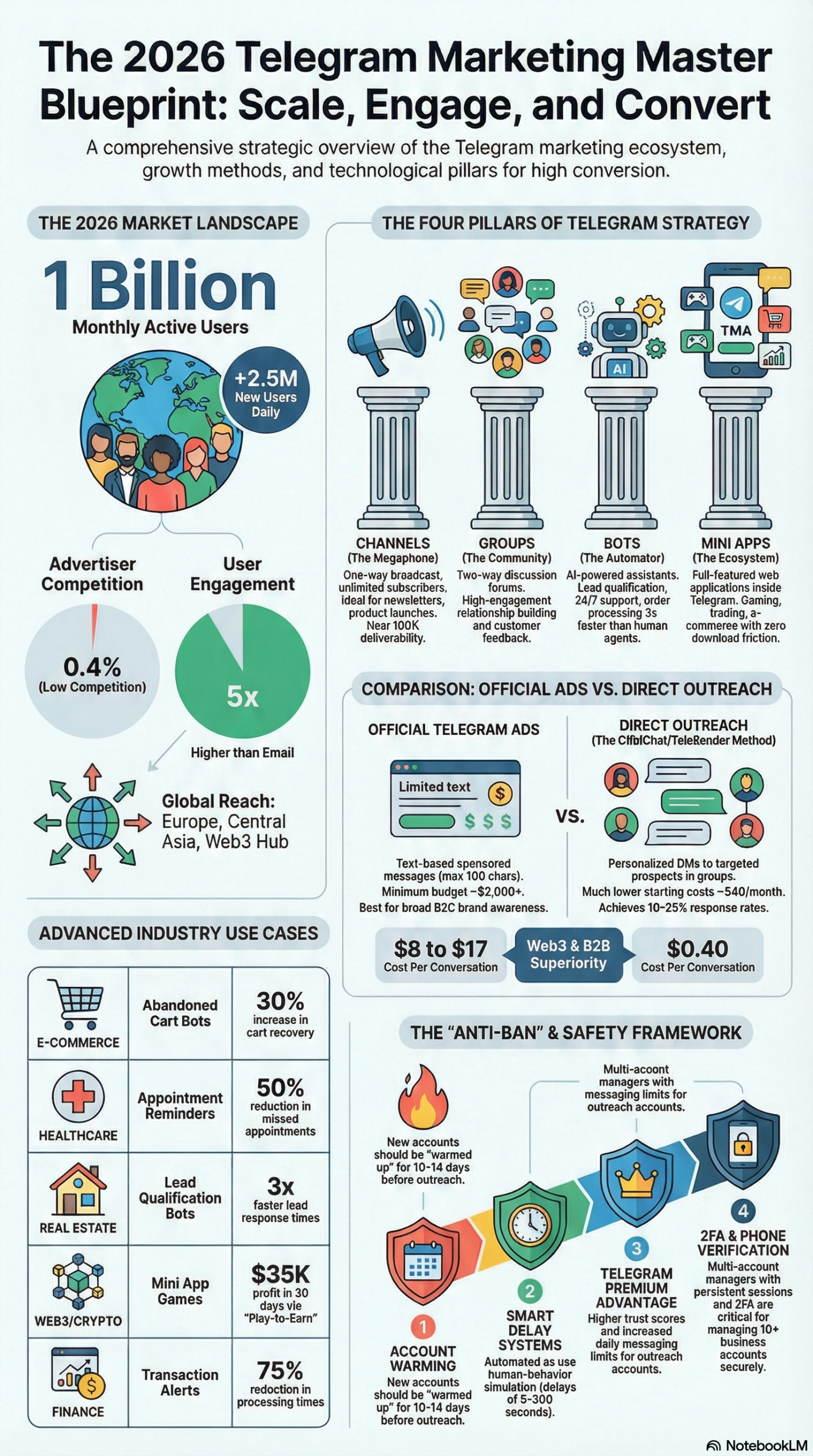
Telegram marketing in 2026 is not a single tactic. It is a four-pillar ecosystem where channels, groups, bots, and Mini Apps each play a distinct role. Understanding which pillar fits which goal is the starting point of every campaign that works.
According to the Telegram Marketing and Automation: 2026 Strategic Briefing produced by NotebookLM research, the platform has “transitioned from a privacy-centric messaging application into a comprehensive global marketing and monetization ecosystem.” The shift is structural: Telegram’s architecture is permission-based and free from the algorithmic ranking systems that throttle reach on Meta or LinkedIn. Every subscriber you earn sees every post — no pay-to-play boost required.
The Four Pillars
Pillar 1 — Channels (One-Way Broadcasting)
Channels are public or private broadcast lists with unlimited subscribers. There is no comment section by default, no algorithm deciding who sees your post, and every post triggers a push notification. This produces average post open rates of 55–60% according to the research report, which is 4–5x what typical email newsletters achieve. Brands use channels for content distribution, product launches, and brand awareness.
Pillar 2 — Groups (Two-Way Communication)
Groups enable community discussion and direct engagement between brand and audience. Unlike channels, groups are conversational spaces — customers ask questions, share feedback, and build loyalty inside the brand’s environment. Effective group management requires active moderation to stop spam while keeping the conversation human, but done right, groups create communities that become product distribution networks.
Pillar 3 — Bots (Automation and Interaction)
Bots are automated programs built on Telegram’s Bot API that handle customer service, lead qualification, order processing, and onboarding flows. AI-enhanced bots in 2026 use conditional logic and multi-step workflows to handle complex interactions without human intervention. The research report documents that properly trained AI bots can resolve up to 95% of common support queries automatically — a figure that has material impact on support team headcount and response SLAs.
Pillar 4 — Mini Apps (Telegram Mini Apps / TMA)
Mini Apps are web applications (HTML/CSS/JavaScript) that run natively inside Telegram. No app store download, no friction, no redirect to a browser. They load instantly inside the chat interface and integrate with the TON blockchain for payments. As of 2026, over 500 million users interact with Mini Apps monthly, making this the highest-growth surface area in the Telegram ecosystem. The research report describes Mini Apps as the “2026 Game Changer” — enabling full purchase funnels without the user ever leaving the app.
The key insight for practitioners: these four pillars are not alternatives. The highest-performing brands in 2026 run all four in parallel, routing users from ad-driven channel growth → community groups → bot-automated qualification → Mini App checkout.
Why It Matters for Marketers and Practitioners
Telegram’s combination of massive scale, permission-based reach, and low advertising CPMs creates an opportunity that doesn’t exist on any other platform right now. Here’s what that means in practice.
Reach Without Algorithmic Decay
On Instagram or Facebook, organic reach for a business page is typically 1–5% of followers. On Telegram, because there is no feed algorithm, your channel posts reach 100% of subscribers by default. That structural difference means your subscriber list on Telegram is worth significantly more per contact than a Facebook page follower.
Early-Mover Advantage Is Real and Shrinking
The research report cites a direct market analysis: “Early Telegram adopters own entire geographic segments and verticals… By 2027, ‘early Telegram adopter’ will be as valuable a positioning as ‘early Twitter user’ was in 2008.” If you are reading this in early 2026, the window is open — but not for long. Geographic markets like India (100 million downloads in 2024 alone), Russia/CIS, the MENA region, and Western Europe are rapidly maturing.
AI Has Made Automation Viable at Every Budget Level
Two years ago, running a sophisticated Telegram bot required engineering resources. In 2026, tools like GPTBots and ChatMaxima let non-technical marketers train AI agents on PDF knowledge bases, URLs, and documentation — no code required. The result is that a solo founder or small agency can now deploy a customer support bot indistinguishable from a live agent, at a fraction of the cost.
Cost-per-Conversation That Reframes Your Ad Budget
The advertiser math is striking. Official Telegram Ads have a cost per conversation of $8.33–$16.67. Direct outreach via tools like CRMChat brings that down to approximately $0.40 per conversation — a 20–40x efficiency gap according to the research report. For B2B businesses especially, this changes how you should think about budget allocation.
The Data: Telegram vs. Competing Platforms
Platform Advertising Performance Benchmarks (2026)
| Platform | CPM Range | CPC Range | Engagement Signal | Min. Ad Budget |
|---|---|---|---|---|
| Telegram | $0.10 – $15.00 | $0.015 – $4.00 | 5x higher click rate vs. email | $1,500 – $5,000+ |
| $7.00 – $12.00 | $0.50 – $3.00 | Saturated / high ad fatigue | $1.00/day | |
| $15.00 – $25.00 | $3.00 – $8.00 | B2B exclusive / high cost | $10/day |
Source: Telegram Marketing 2026 Strategic Briefing
Official Telegram Ads vs. Direct Outreach
| Feature | Official Telegram Ads | Direct Telegram Outreach |
|---|---|---|
| Primary Goal | Brand Awareness / B2C | B2B Lead Gen / Relationships |
| Minimum Budget | $1,500 – $5,000+ | As low as $40/month (e.g., CRMChat) |
| Pricing Model | CPM (starting 0.1 TON) | Subscription / Account-based |
| Response Rate | 0.9% – 2.4% CTR | 10% – 25% Response Rate |
| Message Length | 160 characters | Personalized, unlimited |
| Cost per Conversation | $8.33 – $16.67 | ~$0.40 |
Source: Telegram Marketing 2026 Strategic Briefing
The data here tells a clear story: official ads work for top-of-funnel brand awareness at scale; direct outreach wins on cost-per-conversation for B2B and relationship-driven sales. Most serious campaigns use both, segmented by goal.
Step-by-Step Tutorial: Building Your Telegram Marketing Campaign
This section walks through a complete campaign build — from channel creation to bot automation to ad launch. Estimated setup time: 4–6 hours for the full stack.
Phase 1: Prerequisites and Account Setup
Before you touch a campaign, get your account infrastructure right.
What you need:
– A Telegram account with a verified phone number (preferably on a dedicated number for business use)
– Telegram Premium subscription for any accounts doing direct outreach (improves trust scores per the research report)
– A business name and handle locked down across Telegram before launch
– Access to at least one of: GPTBots, ChatMaxima, or n8n (for automation)
– A Mini App domain if building a full native funnel
Step 1: Create Your Channel
Open Telegram → tap the pencil/compose icon → select “New Channel.” Choose a name that is keyword-descriptive (e.g., “MarketingAgent — AI Tools Daily” not “MA Official Channel”). Set it to Public and claim a username that matches your brand handle. Write a channel description that explains the value proposition in two sentences — this appears in search results when users discover your channel organically.
In your channel settings, enable the “Sign Messages” option. This adds author attribution to posts and builds trust over time. Set up a linked discussion group immediately — this allows your channel subscribers to comment on posts via an attached group, giving you the two-way engagement of a group with the broadcasting structure of a channel.
Step 2: Build Your Bot with a No-Code AI Tool
Navigate to BotFather — Telegram’s official bot creation interface — and run /newbot. Choose a name and username. BotFather generates an API token; save this securely.
Now connect the bot to your AI layer. Using GPTBots:
- Log in to GPTBots and create a new bot project
- Upload your knowledge base sources: product PDFs, FAQ documents, website URLs, support documentation
- Set the bot’s persona — name, tone, and escalation rules (when to hand off to a human agent)
- Copy your Telegram Bot API token into the GPTBots integration settings
- Test with at least 20 sample queries your real customers ask before going live
The research report confirms that properly trained AI bots can resolve up to 95% of common support queries without human intervention. The training quality of your knowledge base directly determines whether you hit that ceiling or fall short.
Step 3: Configure Your AI Sentiment Routing
For campaigns generating significant inbound volume, set up sentiment-based routing using n8n (self-hosted or cloud):
- Create a Telegram trigger node in n8n that listens to incoming bot messages
- Route messages through an AI classification node — classify each message as Positive, Negative, or Neutral
- Add a conditional branch: if a message is classified as a “Hot Lead” (positive sentiment + purchase signals), forward it to a human sales agent via a shared inbox like Trengo or TGDesk
- Log all interactions to a CRM or Google Sheet for pipeline tracking
This agentic workflow — documented in the research report — means your bot handles volume and your human team handles value.
Step 4: Set Up Your Content Cadence
Do not launch a channel and immediately sell. The research report is direct on this: “The first 50 posts should be 100% value with 0% promotion to build a trust foundation.” In practice this means:
- Posts 1–50: educational content, industry data, tutorials, curated resources
- Posts 51+: introduce CTAs, product mentions, and offers at a ratio no higher than 20% promotional
Schedule posts using Telegram’s native scheduling feature (hold the Send button → “Schedule Message”) or tools like Combot. Optimal posting frequency for engagement is 1–3 times per day for channels, no more than 5 for high-activity news channels.
Step 5: Launch Your Mini App (If Building a Native Funnel)
If your goal is direct conversion inside Telegram — e-commerce, subscriptions, digital products, Web3 — build or commission a Telegram Mini App. The technical stack is standard web (HTML/CSS/JS), but it must use the Telegram Web App SDK for authentication and payment hooks.
Key Mini App implementation steps:
1. Develop your web app and host it on HTTPS
2. Integrate window.Telegram.WebApp SDK calls for user authentication (Telegram passes user data automatically — no login form needed)
3. For payments: integrate TON Connect for crypto payments or Telegram’s Stars payment system for fiat-equivalent in-app currency
4. Register the Mini App via BotFather: /newapp → link to your HTTPS URL
5. Add a “Launch App” button to your bot’s menu button for instant access
With over 500 million users interacting with Mini Apps monthly per the research report, the distribution surface is already enormous.
Step 6: Choose Your Advertising Strategy
For B2C / brand awareness: Use Official Telegram Ads through Telegram’s Ad Platform. Set your target to specific public channels in your niche. Minimum budget is $1,500–$5,000. Ads appear as 160-character sponsored posts at the bottom of channel feeds — non-intrusive and native-feeling.
For B2B / direct relationships: Use direct outreach tools like CRMChat or TeleSender. Start at 5–10 personalized messages per day and scale gradually — never exceed 20 per day in early account history. Use Spintax (variable message templates) and AI message generators to ensure each outreach message is unique. Accounts using Telegram Premium for outreach show higher delivery and trust scores per the research report.
Step 7: Monitor, Iterate, and Scale
Track these metrics weekly:
– Channel post view rate (target: 55–60% open rate per the research report)
– Bot conversation completion rate (% of interactions resolved without human handoff)
– Direct outreach response rate (target: 10–25%)
– Mini App conversion rate (session-to-purchase)
Use Telegram’s built-in channel analytics for post performance. For bot analytics, most tools (GPTBots, ChatMaxima) include dashboards. For outreach, track in CRMChat’s pipeline view or export to your CRM.
Real-World Use Cases
Use Case 1: E-Commerce Cart Recovery Bot
Scenario: A DTC (direct-to-consumer) e-commerce brand with a Telegram channel of 25,000 subscribers wants to reduce cart abandonment.
Implementation: Deploy a Telegram bot connected to your e-commerce platform (Shopify, WooCommerce). When a user abandons a cart, the bot fires a personalized recovery message with a direct link to their cart and a time-limited discount code. Set the bot to follow up twice: 1 hour after abandonment, then 24 hours later if no purchase.
Expected Outcome: The research report documents a 30% increase in cart recovery for e-commerce brands using this automated recovery sequence. At scale, this recovers revenue that would otherwise be permanently lost.
Use Case 2: Healthcare Appointment Scheduling
Scenario: A medical clinic with patients primarily communicating via WhatsApp wants to shift to Telegram for scheduling and prescription reminders.
Implementation: Build a Telegram bot that handles appointment booking (integrated with Google Calendar or Calendly via API), sends 24-hour reminder messages, and processes prescription refill requests. Use AI to triage queries — “I need to reschedule” routes to calendar integration, “I have chest pain” routes to an immediate human response.
Expected Outcome: The research report cites a 50% reduction in missed appointments at medical facilities that implemented this setup — a direct operational and revenue impact.
Use Case 3: Web3 Community and Mini App Monetization
Scenario: A Web3 project launching a Play-to-Earn (P2E) game wants to build its community and generate revenue from Day 1.
Implementation: Create a Telegram channel for news and updates, a linked group for community discussion, and a Mini App that serves as the game interface (built with TON blockchain integration). Seed the channel with influencer partnerships in existing crypto communities before launch. Use the Mini App’s native TON payment rails for in-game purchases.
Expected Outcome: The research report documents one P2E Mini App that generated $35,000 in profit within its first 30 days of launch — demonstrating that the Mini App distribution model can produce real monetization quickly when community and product are aligned.
Use Case 4: B2B Real Estate Lead Qualification
Scenario: A real estate agency wants to reduce the time between initial inquiry and booked viewing, currently averaging 48 hours.
Implementation: Deploy a Telegram bot that qualifies incoming property inquiries: budget range, preferred location, number of bedrooms, timeline to purchase. Based on responses, the bot segments leads into tiers (hot/warm/cold) and automatically books viewings for hot leads using a Calendly integration, passing the full lead profile to a human agent for follow-up.
Expected Outcome: The research report cites 3x faster lead response times for real estate businesses using this bot qualification model, directly shortening the sales cycle.
Use Case 5: SaaS Direct Outreach for B2B Pipeline
Scenario: A SaaS company wants to build a B2B sales pipeline by reaching decision-makers who are already active in niche Telegram communities.
Implementation: Use TeleSender‘s AI lead scoring (0–100 score based on profile activity, bio keywords, and group membership) to identify high-probability prospects from target communities. Run personalized outreach at 5–15 messages per day using Spintax-generated messages. Route positive responses into CRMChat for pipeline management.
Expected Outcome: A 10–25% response rate on outreach per the research report — compared to 2–5% on LinkedIn InMail — at a cost per conversation of roughly $0.40 versus $8–$16 on official ad platforms.
Common Pitfalls
Pitfall 1: Ignoring Account Warm-Up for Direct Outreach
New accounts that immediately send dozens of cold messages per day get flagged and restricted by Telegram’s spam detection. The fix: start with 5–10 messages per day for the first two weeks, scale to a maximum of 20 per day only after establishing account history. Always use Telegram Premium for outreach accounts to improve trust scores per the research report.
Pitfall 2: Sending Identical Outreach Messages
Duplicate message templates trigger spam filters at the platform level. The fix: use Spintax (variable text templates that generate unique message variants for every send) combined with AI message generators. Every outreach message should be unique at the sentence level, not just with a different first name.
Pitfall 3: Promoting Before Building Trust
Launching a channel and immediately pushing offers destroys the permission relationship before it forms. Telegram users expect substantive value. The research report is direct: your first 50 posts should deliver 100% value and 0% promotion. Violate this ratio early and subscriber churn is instant.
Pitfall 4: Running Official Ads Without a Native Funnel
Sending official ad traffic to an external website URL instead of a Telegram bot or Mini App creates friction that kills conversion rates. Keep the full funnel inside Telegram — ad click → bot welcome message → qualification → Mini App checkout — to maximize the conversion efficiency of your ad spend.
Pitfall 5: Skipping Bot Knowledge Base Training
Deploying an AI bot with insufficient training leads to hallucinated answers and broken user trust. Upload every customer-facing document your support team references: product specs, pricing FAQs, return policies, onboarding guides. Test with real queries before launch, not after.
Expert Tips
Tip 1: Seed Before You Advertise
Influencer seeding — paying existing niche channel operators to post native content — consistently outperforms official sponsored messages in trust and engagement per the research report. Users trust a channel author’s recommendation more than a “Sponsored” label. Budget 30–40% of your awareness spend toward channel seeding before running official ads.
Tip 2: Build Geography-Specific Channels for International Markets
Telegram penetration varies dramatically by region. The research report identifies India (100M downloads in 2024), Russia/CIS, MENA, and Western Europe as priority markets with distinct usage patterns. Create language-specific channels and localize content rather than running one English-language global channel.
Tip 3: Use Voice Note Summarization for High-Volume Groups
In fast-paced community groups, critical information buried in voice notes gets missed. Tools like the Briefly bot (powered by OpenAI and ElevenLabs per the research report) automatically transcribe and summarize voice messages to text, ensuring nothing important is lost during high-volume conversations.
Tip 4: Implement a Hybrid Human-AI Support Model
Never deploy a fully automated support bot without a human escalation path. The research report recommends using AI as the first-line handler for FAQs and lead qualification, then routing high-value or complex conversations to human agents via a shared inbox like Trengo or TGDesk. This combination hits the efficiency ceiling without sacrificing experience quality.
Tip 5: Score Leads Before Any Human Touches Them
If you are running direct outreach at scale, use AI lead scoring (tools like TeleSender’s 0–100 score system per the research report) before assigning prospects to human follow-up. Let your human team work only the top-tier prospects; let the bot nurture everyone else. This dramatically improves output-per-hour for your sales team.
FAQ
Q1: What is the minimum budget to get started with Telegram marketing?
It depends on your approach. Official Telegram Ads require a minimum of $1,500–$5,000 according to the research report. However, direct outreach via tools like CRMChat starts as low as $40/month, and building an organic channel costs nothing except time. Most B2B practitioners start with direct outreach and content while building the channel, and introduce paid ads once they have validated their messaging.
Q2: How do Telegram’s open rates compare to email?
Telegram Channels produce average post open rates of 55–60%, versus a typical email open rate of 20–35% for well-maintained lists. For engagement signals, the research report cites that Telegram produces a 5x higher click rate compared to email. The structural reason: every post generates a push notification, and there is no spam folder or promotional tab filtering.
Q3: Can you run Telegram marketing without coding skills?
Yes, for most of the pillars. Channel management, group moderation, and content scheduling require no code. Bot building via tools like GPTBots or ChatMaxima is no-code — you connect a Telegram API key and upload your knowledge base. Mini Apps require web development skills (HTML/CSS/JavaScript) or a developer, but Mini App templates and frameworks are readily available. Automation workflows in n8n are low-code with a visual interface.
Q4: How do I avoid getting my Telegram account banned during direct outreach?
Follow three rules per the research report: (1) Start at 5–10 messages per day and scale slowly to a maximum of 20; (2) Use Telegram Premium for outreach accounts to improve your trust score; (3) Never send identical messages — use Spintax or AI generation to make each message unique. Additionally, only message users who have shown clear interest signals (active in relevant groups, relevant bio keywords) to minimize spam complaints.
Q5: What industries are seeing the best results on Telegram in 2026?
Web3 and crypto communities are the most mature — Telegram is described in the research report as the “undisputed home” for these communities, with one P2E Mini App generating $35,000 in profit in its first 30 days. E-commerce, healthcare, and real estate are also producing measurable ROI through bot automation (30% cart recovery, 50% reduction in missed appointments, 3x faster lead response, respectively). B2B SaaS companies are gaining traction through direct outreach, particularly in MENA markets where encrypted business communication is preferred.
Bottom Line
Telegram is not an emerging platform anymore — it is a billion-user ecosystem with infrastructure that directly outperforms legacy social and email channels on reach, cost, and engagement. The four-pillar model (Channels, Groups, Bots, Mini Apps) gives practitioners a complete toolkit for every stage of the funnel, from brand awareness to native checkout. The AI automation layer — bot training, sentiment routing, voice summarization, lead scoring — has made sophisticated campaign execution accessible without large engineering teams. If your audience is in Telegram communities and you are not there yet, you are ceding ground to competitors who are. The window for early-mover positioning, as the research report notes, closes by 2027.


0 Comments