

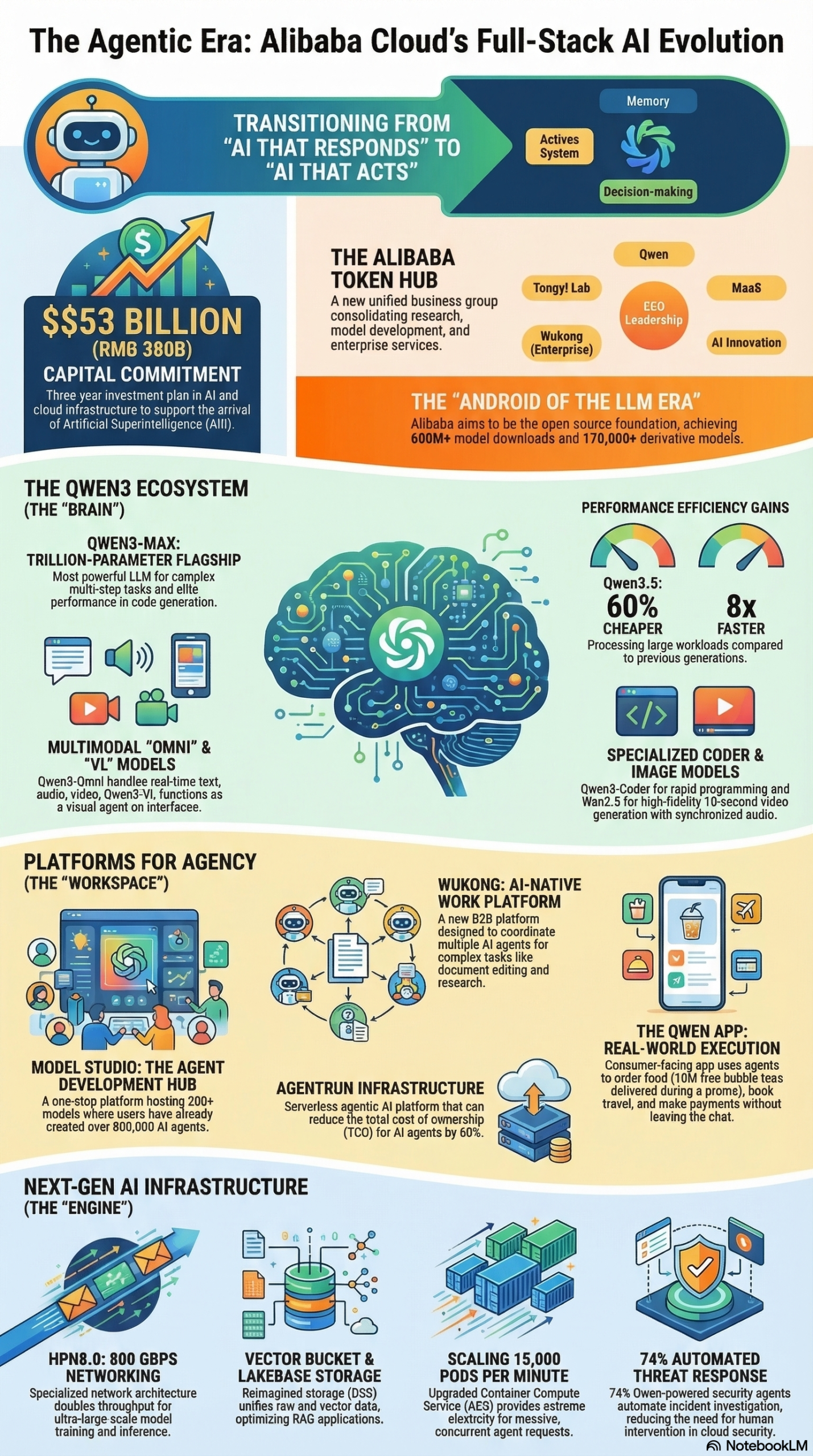
Alibaba Cloud has committed RMB 380 billion ($53 billion) over three years to become the backbone of the “agentic AI” era—and the infrastructure they’ve built to get there is now open to developers and enterprises worldwide. This tutorial breaks down exactly what Alibaba’s Token Hub strategy means in practice, walks you through deploying Qwen3 agents via Model Studio, and shows you how to put these tools to work in real production workflows.
What This Is
Alibaba’s pivot to agentic AI is not a rebranding exercise. It’s a full architectural reorganization of how the company builds, deploys, and monetizes AI. The centerpiece is the newly formed Token Hub Business Group, a consolidated division reporting directly to CEO Eddie Wu that unifies five previously separate AI units: Tongyi Laboratory (foundation model research), the Qwen Business Unit (personal AI assistants), MaaS or Model as a Service (technical AI infrastructure), Wukong (a new B2B AI-native workplace platform), and AI Innovation (new application development). Previously, these teams operated in silos. Now they share a single mandate: build the infrastructure layer for autonomous AI agents.
The flagship product powering this strategy is the Qwen3 model series, which ranges from the trillion-parameter Qwen3-Max—optimized for complex multi-step reasoning and code generation—to the lightweight Qwen3-Flash, designed for low-latency, high-frequency tasks where cost matters more than raw capability. Between them sit Qwen3-Plus (the general-purpose workhorse), Qwen3-VL (for visual-to-code tasks and spatial reasoning), Qwen3-Omni (real-time multimodal interaction across text, image, audio, and video), and Qwen3-Coder (optimized for programming tasks with enhanced code safety).
All of these models are accessible through Alibaba Cloud Model Studio, which functions as a one-stop deployment platform. Critically, Model Studio supports OpenAI-compatible APIs—meaning you can point an existing application to a new base URL, swap in an Alibaba API key, and start running Qwen models without rewriting your integration logic. For teams already using the OpenAI SDK, the migration path is a configuration change, not a rebuild.
The development toolkit inside Model Studio splits into two tracks based on user sophistication. The Model Studio-ADK (Agent Development Kit) is a high-code framework aimed at developers who need to build complex agents with autonomous decision-making capabilities. The Model Studio-ADP (Agent Development Platform) offers a low-code path for business users who need to automate workflows without deep programming expertise. Both tools support Model Context Protocol (MCP) connectivity, RAG multi-modal fusion, and dynamic inference scheduling.
What makes this different from previous cloud AI offerings is the ecosystem integration. Unlike a pure-play AI API provider, Alibaba can wire its agents directly into Alipay, Taobao, Tmall, Cainiao (logistics), and Amap (mapping). When Wu Jia, VP of Alibaba Group, announced the upgraded Qwen App, he framed it as a shift from “models that understand to systems that act”—agents that can order bubble tea or book travel directly within a chat interface by invoking real commerce, payment, and logistics APIs. The $100 billion revenue target over five years is predicated on exactly this kind of deep vertical integration, according to the research report.
Why It Matters
The move matters for three distinct groups: developers building AI-native applications, enterprises running automation workflows, and marketers measuring AI ROI.
For developers, the OpenAI-compatibility layer is the most immediately practical piece. If you’ve built anything on GPT-4 or GPT-4o and want a cost-competitive alternative with comparable reasoning capabilities, Qwen3-Plus or Qwen3-Max can be substituted without refactoring the codebase. The Qwen family has surpassed 1 billion downloads and spawned over 170,000 derivative models globally—a signal that the open-source community has already validated the underlying weights for production use.
For enterprises, the Wukong B2B platform represents something new: a purpose-built AI workplace that’s designed from the ground up to run agents, not just chatbots. Traditional enterprise AI deployments suffer from a fundamental problem—LLMs are good at generating text but can’t complete multi-step transactions without custom integration work. Wukong and the ADK are designed to close that gap by plugging agents into Alibaba’s existing commerce and logistics infrastructure out of the box.
For marketers and marketing technologists, the most relevant metric is the shift in token consumption patterns. Agentic workflows consume dramatically more tokens than a standard chat interaction because agents run continuous loops—executing steps, checking results, correcting errors, and retrying—rather than producing a single response. This changes the economics of AI at scale. The research report notes that “agents consume significantly more tokens than traditional chatbots because they operate continuously to execute tasks.” If your team is currently budgeting AI infrastructure based on simple query-response pricing, you’ll need to recalibrate for agent-based token consumption that can be an order of magnitude higher per completed task.
What makes Alibaba’s position structurally defensible is market concentration. The company holds 35.8% of China’s AI cloud market as of H1 2025—more than its next three competitors combined. AI-related revenue grew at triple-digit rates for eight consecutive quarters and now accounts for over 20% of external cloud revenue. That financial momentum gives Alibaba the runway to sustain a $53 billion infrastructure investment while simultaneously undercutting competitors on model pricing.
The Data
The Qwen3 model family covers the full spectrum from ultra-cheap inference to maximum capability, each with a defined use case fit. Here’s how the lineup breaks down based on the Alibaba Cloud research report:
| Model | Parameter Scale | Best Use Case | Speed/Cost Profile |
|---|---|---|---|
| Qwen3-Max | 1 trillion+ | Complex reasoning, code generation, multi-step agents | Highest cost, highest capability |
| Qwen3-Plus | Not disclosed | General-purpose reasoning, multimodal understanding | Balanced performance/cost |
| Qwen3-VL | Not disclosed | Visual-to-code, spatial reasoning, robotics/Embodied AI | Specialized for visual input |
| Qwen3-Omni | Not disclosed | Real-time voice/video/text interaction | Ultra-low latency, end-to-end multimodal |
| Qwen3-Coder | Not disclosed | Programming tasks, code safety | Optimized for fast inference |
| Qwen3-Flash | Not disclosed | High-frequency, simple tasks | Lowest latency, lowest cost |
And the infrastructure stack that supports trillion-parameter model inference at scale:
| Layer | Technology | Key Improvement |
|---|---|---|
| Networking | HPN8.0 | 800 Gbps throughput (2x previous capacity) |
| Storage | Vector Bucket | Unified raw + vector data for RAG workloads |
| Database | PolarDB with CXL | 72% latency reduction, 16x memory scale |
| Compute | ACS Auto-scaling | Up to 15,000 pods per minute for concurrent agent requests |
These infrastructure numbers matter because running 800,000+ agents simultaneously—which is what Model Studio now hosts—requires a fundamentally different infrastructure architecture than serving a queue of chatbot requests.
Step-by-Step Tutorial
This tutorial walks you through deploying a Qwen3-powered agent on Alibaba Cloud Model Studio, from account setup to a working autonomous task executor. The workflow is structured for developers familiar with REST APIs and Python.
Prerequisites
- An Alibaba Cloud account (cloud.alibaba.com)
- Python 3.8+ installed locally
- Familiarity with the OpenAI SDK (optional, but speeds up migration)
- Basic understanding of what a system prompt is and how API calls work
Phase 1: Account Setup and API Key Generation
Step 1: Create an Alibaba Cloud account and activate Model Studio.
Navigate to the Alibaba Cloud console and search for “Model Studio” in the product catalog. Activate the service. For new accounts, Model Studio provides a free quota tier that lets you test inference without immediately incurring charges. Enable the “Free quota only” toggle in the console before running any tests—this prevents unexpected charges while you’re evaluating the platform.
Step 2: Generate your API key.
In the Model Studio console, navigate to API Keys under the security settings. Create a new API key and store it securely—you’ll use it as the value for DASHSCOPE_API_KEY in your environment. Note that API keys and endpoints are not interchangeable across regions. If you’re deploying in Southeast Asia, use the Singapore endpoint. For European compliance, use the Germany endpoint. This isn’t a minor detail—routing requests through the wrong regional endpoint will cause authentication failures and may violate your data governance requirements.
Step 3: Set your environment variables.
export DASHSCOPE_API_KEY="your-api-key-here"
export DASHSCOPE_BASE_URL="https://dashscope-intl.aliyuncs.com/compatible-mode/v1"
For China-region deployments, the base URL differs—check the current regional endpoint documentation in the Model Studio console.
Phase 2: Connect via OpenAI-Compatible API
Because Model Studio supports OpenAI-compatible APIs, the integration code is minimal if you’re already using the OpenAI SDK.
Step 4: Install dependencies.
pip install openai
Step 5: Make your first inference call.
from openai import OpenAI

client = OpenAI(
    api_key="your-dashscope-api-key",
    base_url="https://dashscope-intl.aliyuncs.com/compatible-mode/v1"
)

response = client.chat.completions.create(
    model="qwen-plus",  # Maps to Qwen3-Plus
    messages=[
        {"role": "system", "content": "You are a helpful assistant that completes tasks step by step."},
        {"role": "user", "content": "Summarize the top 3 risks in migrating from a chatbot to an agentic AI system."}
    ]
)

print(response.choices[0].message.content)
This call is structurally identical to an OpenAI API call. If you have an existing OpenAI integration, the only changes are api_key, base_url, and model name. The Model Studio documentation confirms this migration path: update three parameters, everything else stays the same.
Phase 3: Building an Agent with the ADK
The Agent Development Kit (ADK) is the high-code framework for building agents that can plan, execute, and retry multi-step tasks autonomously.
Step 6: Define your agent’s tools.
Agents work by selecting from a defined toolkit. Here’s a minimal tool definition:
tools = [
    {
        "type": "function",
        "function": {
            "name": "search_inventory",
            "description": "Search product inventory by SKU or keyword.",
            "parameters": {
                "type": "object",
                "properties": {
                    "query": {
                        "type": "string",
                        "description": "The product SKU or search keyword."
                    }
                },
                "required": ["query"]
            }
        }
    }
]
Step 7: Build the agent loop.
A minimal agent loop that allows Qwen3 to call tools iteratively until a task is complete:
import json

def run_agent(user_task: str, tools: list, max_iterations: int = 10):
    messages = [
        {"role": "system", "content": "You are an autonomous agent. Complete the user's task using the available tools. Think step by step."},
        {"role": "user", "content": user_task}
    ]

    for iteration in range(max_iterations):
        response = client.chat.completions.create(
            model="qwen-max",  # Qwen3-Max for complex reasoning
            messages=messages,
            tools=tools,
            tool_choice="auto"
        )

        message = response.choices[0].message

        # If no tool call, agent has finished
        if not message.tool_calls:
            return message.content

        # Process each tool call
        messages.append(message)
        for tool_call in message.tool_calls:
            function_name = tool_call.function.name
            function_args = json.loads(tool_call.function.arguments)

            # Execute the actual tool (replace with your implementation)
            result = execute_tool(function_name, function_args)

            messages.append({
                "role": "tool",
                "tool_call_id": tool_call.id,
                "content": str(result)
            })

    return "Max iterations reached."
Step 8: Implement the tool executor.
Replace execute_tool with your actual business logic:
def execute_tool(function_name: str, args: dict) -> str:
    if function_name == "search_inventory":
        # Replace with your actual inventory API call
        return f"Found 3 items matching '{args['query']}': SKU001, SKU002, SKU003"
    return "Tool not implemented."
Step 9: Test the agent loop.
result = run_agent(
    user_task="Check if we have any red sneakers in size 10 and report the available SKUs.",
    tools=tools
)
print(result)
Phase 4: Implementing Cost Controls
Agentic workflows consume tokens in loops, which means costs compound quickly. The research report specifically flags this as something practitioners need to plan for.
Step 10: Add spending alerts in the Model Studio console.
Navigate to Billing → Spending Alerts in the Alibaba Cloud console. Set a hard alert threshold for your monthly AI spend before you move any agentic workflow to production. On pay-as-you-go pricing, a single stuck agent loop can burn through significant quota before you notice.
Step 11: Implement max iteration limits and token budgets.
The max_iterations parameter in the agent loop above is your first safeguard. Add a secondary check using the usage field in the API response:
# Check cumulative token usage
total_tokens = response.usage.total_tokens
if total_tokens > YOUR_TOKEN_BUDGET:
    return "Token budget exceeded. Task incomplete."
Step 12: Use Qwen3-Flash for low-complexity steps.
Not every step in an agentic workflow needs Qwen3-Max. Implement a routing layer that directs simple classification or extraction steps to Qwen3-Flash and reserves the heavyweight model for planning and final synthesis. This alone can cut token costs by 60-80% on multi-step workflows.
Expected Outcome
After completing these steps, you’ll have a working agent that can execute multi-step tasks, call external tools, and self-correct based on tool output—all running on Qwen3 via Model Studio’s OpenAI-compatible API. The same architecture scales to production by increasing concurrency limits in the ACS layer, which supports up to 15,000 pods per minute for high-concurrency agent deployments.
Real-World Use Cases
E-Commerce Customer Service Automation
Scenario: A mid-size e-commerce operation handles 5,000+ support tickets per day, mostly order status, returns, and product questions. The team has already built a chatbot, but it can’t actually resolve issues—it just answers questions.
Implementation: Deploy a Qwen3-Plus agent via Model Studio-ADK with tools connected to your order management system (OMS), returns portal, and product catalog. The agent receives incoming tickets, determines the required action (check order status, initiate return, escalate to human), executes the API call, and writes the response. Use the Wukong B2B platform if you’re already in the Alibaba ecosystem, as it provides pre-built connectors for commerce workflows.
Expected Outcome: Teams using agentic resolution rather than chatbot deflection typically see resolution rates improve because the agent actually completes the transaction—not just describes how to complete it. Token costs are higher per interaction, but handle rates improve significantly, reducing per-resolution cost.
Marketing Research and Competitive Intelligence
Scenario: A marketing team needs weekly competitive landscape reports covering pricing changes, new product announcements, and campaign activity from five competitors.
Implementation: Build a Qwen3-Max agent with web search and document parsing tools. Schedule it to run weekly via a cron job. The agent searches for competitor updates, extracts structured data, and generates a formatted briefing document. Use RAG via Model Studio’s Vector Bucket storage to maintain a persistent competitive intelligence database that the agent queries for trend analysis across weeks.
Expected Outcome: A report that previously took a junior analyst four to six hours to compile runs autonomously in under 30 minutes, with sourced citations embedded in the output.
Security Incident Response Automation
Scenario: A security operations team is drowning in alerts. Mean time to investigate is three hours because analysts must manually correlate logs, check threat databases, and draft response procedures.
Implementation: Deploy Alibaba Cloud’s Cloud Threat Detection Response (CTDR), which uses Qwen-powered agents to automate threat investigation and response. The platform’s AI agents automatically correlate events, query threat intelligence feeds, and trigger pre-approved response actions without human intervention.
Expected Outcome: According to the research report, CTDR’s Qwen-powered agents automate up to 70% of response actions and increase incident investigation success rates from 59% to 74%. For teams already on Alibaba Cloud infrastructure, this is a zero-integration upgrade—it uses the same cloud environment you’re already in.
Visual Design to Production Code Pipeline
Scenario: A frontend development team spends significant time translating Figma designs into component code. Designers export mockups, developers interpret them manually, and there’s a constant back-and-forth over spacing, typography, and layout details.
Implementation: Use Qwen3-VL (the visual-agentic model) as the core of a design-to-code pipeline. The model ingests design screenshots or exported assets and generates component code (React, Vue, or vanilla HTML/CSS) that matches the visual layout. Pair it with Qwen3-Coder for code safety validation before the output reaches the developer for review.
Expected Outcome: Developers receive a working first draft of component code that matches the visual specification, reducing the manual translation step to a review-and-refine cycle rather than writing from scratch.
Document Processing and Contract Analysis
Scenario: A legal or procurement team receives hundreds of vendor contracts monthly. Each requires review for non-standard clauses, missing terms, and compliance flags before routing to legal counsel.
Implementation: Build a Qwen3-Max agent with PDF parsing tools and a vector database of standard clause templates (stored in Vector Bucket). The agent reads each incoming contract, compares it against standard templates using RAG retrieval, flags deviations, and outputs a structured summary with risk annotations.
Expected Outcome: First-pass contract review that previously required 45-90 minutes of paralegal time runs in under five minutes, with the agent output serving as the briefing document for attorney review rather than the attorney doing the initial scan.
Common Pitfalls
1. Ignoring regional endpoint requirements.
API keys and endpoints on Alibaba Cloud are region-specific and not interchangeable. Developers who copy a China-region API configuration to a US or Singapore deployment will hit authentication failures that look like credential errors but are actually routing errors. Always configure your base URL to match the region your data residency requirements specify before writing any code.
2. Under-budgeting for agentic token consumption.
A single conversational query might consume 1,000-2,000 tokens. An agentic workflow that runs 10-15 iterations to complete a task can consume 20,000-50,000 tokens per execution. As the research report notes, “agents consume significantly more tokens than traditional chatbots because they operate continuously to execute tasks.” Teams that benchmark AI costs on chatbot usage will be caught off guard when they deploy agents at scale. Set spending alerts before you run any agent in production.
3. Using Qwen3-Max for every step.
Qwen3-Max is the right model for complex reasoning and final synthesis. It is not the right model for tokenizing user input, routing to the correct tool, or generating a structured JSON response from a simple template. Build a routing layer that matches model capability to task complexity. Use Qwen3-Flash for the simple steps and reserve Qwen3-Max for the reasoning-heavy ones.
4. Skipping the max iterations guard.
An agent loop without a hard iteration limit will run until either the task is complete or the API returns an error. In practice, edge cases in tool responses can cause agents to loop indefinitely. Always implement a max_iterations cap and a token budget check as dual safeguards.
5. Building custom integrations for workloads the ecosystem handles natively.
If your use case involves Taobao, Alipay, or Alibaba logistics, Wukong and the pre-built ADK connectors will get you to production faster than building custom API integrations from scratch. Check the native integration catalog before writing custom tool code.
Expert Tips
1. Migrate with the OpenAI compatibility layer first, then optimize.
Don’t optimize your Qwen integration on day one. Get your existing OpenAI-based application running on Qwen3-Plus via the OpenAI-compatible API, validate that outputs meet your quality bar, then start benchmarking Qwen3-Flash vs. Qwen3-Max on specific tasks. Migration before optimization gives you a clean baseline.
2. Use MCP (Model Context Protocol) for stateful agent memory.
Model Studio supports MCP connectivity, which provides a standardized way to persist and retrieve agent context across sessions. For agents that handle ongoing workflows (recurring reports, long-running research tasks), MCP-backed context stores dramatically outperform passing the full conversation history in every API call—both for cost and for coherence.
3. Store competitive and reference data in Vector Bucket from day one.
Qwen3’s RAG capabilities are only as good as the vector database you pair with them. Vector Bucket is Alibaba’s storage layer optimized for unifying raw and vector data for RAG workloads. If you’re building agents that need to retrieve context from proprietary documents, get your embeddings into Vector Bucket early—retrofitting retrieval into an agent architecture after the fact is painful.
4. Use Qwen3-VL for robotics and spatial reasoning prototypes.
Most developers default to text-based agents, but Qwen3-VL’s spatial reasoning capabilities extend beyond design-to-code. If you’re prototyping robotics workflows, warehouse automation, or any task that involves operating on visual interfaces (screen agents, web automation), Qwen3-VL provides a model purpose-built for that domain without requiring custom fine-tuning.
5. Monitor ACS pod scaling behavior in staging before production.
The ACS auto-scaling layer supports 15,000 pods per minute for high-concurrency agent requests, but scaling behavior in staging with synthetic load won’t perfectly match production bursts. Run your agents under realistic concurrency in a staging environment before go-live, and set ACS scaling policies to match your expected peak—not your average.
FAQ
Q: Is Alibaba Cloud Model Studio available outside of China?
Yes. Model Studio is available via regional endpoints in Singapore, the United States, Germany, and China. Each region has its own API key and base URL configuration. For international deployments, use the dashscope-intl.aliyuncs.com endpoint pattern and generate a key in the Alibaba Cloud international console, not the China-specific Aliyun console.
Q: How does Qwen3-Max compare to GPT-4o for complex reasoning tasks?
The research report positions Qwen3-Max as excelling in code generation and complex multi-step reasoning, with a trillion-parameter architecture. Direct benchmarks against GPT-4o were not cited in the source material—independent evaluation on your specific task types is the right approach before committing to a model for production. The OpenAI-compatible API makes it straightforward to A/B test both models against the same test set.
Q: What is the Token Hub Business Group and why does it matter?
The Token Hub Business Group consolidates five previously separate Alibaba AI units—Tongyi Laboratory, the Qwen Business Unit, MaaS, Wukong, and AI Innovation—under a single reporting structure led by CEO Eddie Wu. The consolidation eliminates internal coordination overhead between teams that previously had overlapping but siloed mandates. For external developers, it signals that Alibaba’s AI product roadmap is now centrally coordinated, which should mean fewer conflicting tools and clearer upgrade paths.
Q: How does the pricing model work for agentic workloads?
Model Studio uses pay-as-you-go token pricing, similar to OpenAI. You pay per 1,000 input and output tokens, with rates varying by model (Qwen3-Flash is significantly cheaper than Qwen3-Max). As the research report notes, agentic loops consume far more tokens than single-query interactions. Enable the free quota tier for initial testing and set hard spending alerts before moving any agent loop to production.
Q: Can I run open-source Qwen models on my own infrastructure instead of using Model Studio?
Yes. The Qwen family has been open-sourced and has surpassed 1 billion downloads with over 170,000 derivative models. You can run Qwen3 weights on your own GPU infrastructure using standard frameworks like Hugging Face Transformers or vLLM. The trade-off is infrastructure management overhead versus the managed scaling, RAG integration, and ecosystem connectivity that Model Studio provides. For most enterprise use cases, the managed API is faster to production; self-hosting is the right choice for organizations with strict data sovereignty requirements or very high-volume workloads where managed API pricing becomes prohibitive.
Bottom Line
Alibaba’s Token Hub strategy is the most significant structural bet any cloud provider has made on the agentic AI layer. The combination of a full Qwen3 model family, OpenAI-compatible APIs, a purpose-built agent development kit, and native integration with its commerce and payments ecosystem gives Alibaba a moat that API-only competitors can’t easily replicate. The $100 billion revenue target over five years is ambitious, but the $53 billion infrastructure investment—already reflected in HPN8.0 networking, Vector Bucket storage, and ACS auto-scaling—shows the commitment is operational, not aspirational. For practitioners, the immediate action is straightforward: the OpenAI-compatible API means your existing AI applications can run on Qwen3 with a three-line configuration change, and Model Studio’s free tier makes evaluation essentially zero-cost. As Eddie Wu said at the Apsara Conference 2025, “large AI models will function like operating systems”—and Alibaba is positioning Qwen as the Android of that world. Start testing now before your competitors do.


0 Comments