

OpenAI formally entered the advertising business on February 9, 2026, opening ChatGPT to sponsored placements for the first time in the platform’s history. According to Catherine Perloff at The Information, advertisers who participated in these inaugural campaigns described the buying process as surprisingly low-tech — and most haven’t received meaningful data demonstrating whether their spend actually worked. This guide breaks down exactly what we know from those early tests, what the data reveals, and how to build a campaign strategy that accounts for the platform’s current limitations and genuine long-term potential.
What This Is: ChatGPT’s Advertising Platform
OpenAI’s decision to introduce ads into ChatGPT is fundamentally a monetization play. The company faces enormous infrastructure costs supporting tens of millions of active users, and the free-to-use model alone cannot sustain that load indefinitely. As eMarketer Principal Analyst Nate Elliott put it: “OpenAI, like all AI platforms, is terrified of scaring away users… they desperately need ad revenue, but equally they need to avoid the perception that ChatGPT is lousy with ads.”
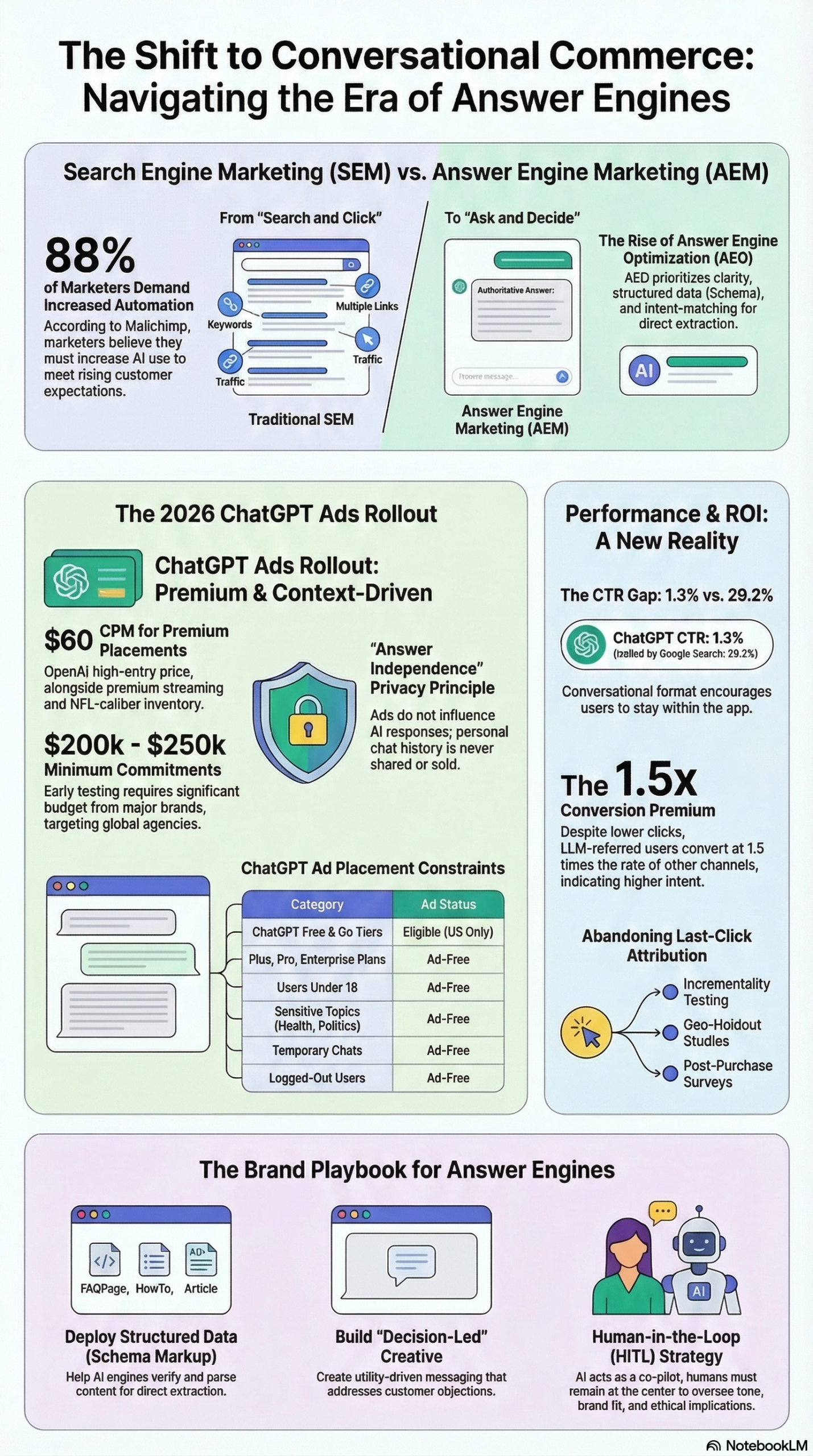
The rollout, documented in the NotebookLM research briefing on AI and the Future of Conversational Marketing, targets specific user segments precisely to manage that tension. Here’s how the program is structured:
Who Sees Ads
Ads are shown to logged-in users on the Free and “Go” subscription tiers in the United States. Paid subscribers — Plus, Pro, Business, Enterprise, and Edu accounts — remain in an ad-free environment. This tiered approach mirrors what Meta and YouTube have done: monetize the free base without irritating paying customers.
Where Ads Appear
Placements appear below the end of a ChatGPT response, clearly labeled as sponsored and visually separated from the AI-generated content. They do not appear mid-conversation, and critically, per OpenAI’s stated policy, ads do not influence the AI’s actual responses. The company calls this principle “Answer Independence.”
Who Is Excluded
The platform enforces exclusions for users under 18 and for conversations touching on sensitive topics including health, mental health, and politics. This is not just ethical caution — it’s liability management in a regulatory environment increasingly focused on AI transparency.
The Ad Format
Think of it less like a Google search ad and more like a sponsored placement at the bottom of a detailed editorial piece. The user has just received a thorough answer to their question; the ad appears as a contextually adjacent recommendation. There’s no keyword bidding in the traditional sense. OpenAI controls the matching based on conversation context.
The Buying Process
This is where early testers have been vocal. Unlike Google Ads or Meta, there is no self-serve platform — at least not yet. Advertisers in the initial wave worked through direct sales relationships with OpenAI teams, submitting creative and receiving weekly CSV reports covering impressions and clicks. An Ads Manager interface is reportedly in early testing but wasn’t available to most initial participants, according to The Information’s reporting. For marketers accustomed to real-time dashboards, this is a significant culture shock.
The minimum spend requirement is steep: early testers faced commitments of $200,000 to $250,000, according to the research briefing. That’s roughly double the typical experimental budget most agencies allocate for new channel tests. This isn’t a platform you test with $5,000 to see if it works. You’re buying in at institutional scale before you have institutional-level proof.
Why It Matters: The Shift from Search to Conversation
The emergence of ChatGPT advertising is not just a new ad channel — it signals a structural shift in how intent is captured and how purchase decisions are influenced. The research report on AI and Conversational Marketing frames this as the transition from Search Engine Marketing (SEM) to Answer Engine Marketing (AEM): instead of a user typing a query and scanning ten blue links, they’re asking a conversational question and receiving a synthesized answer.
For practitioners, this matters for several reasons:
Intent Is Earlier and Deeper
When a user asks ChatGPT “What’s the best project management software for a remote team of 20?” — they’re not browsing. They’re in a decision process. The question contains context, constraints, and implicit intent that a keyword search can’t capture. An ad appearing in that response context carries a fundamentally different weight than a PPC ad on a generic SERP.
Your Funnel Assumptions Are Wrong
Brands heavily dependent on branded search and late-funnel retargeting face a real threat. If purchase intent is being formed inside a ChatGPT conversation before the user ever reaches Google, traditional bottom-of-funnel tactics will see declining effectiveness. The research briefing explicitly advises marketing leaders to “audit funnel dependency” and assess vulnerability.
Conversion Data Is Surprisingly Strong
Despite the low click-through rates (more on this below), Criteo data cited in the research report shows that LLM-referred users convert at 1.5 times the rate of users from other referral channels. Users who do click through from an AI conversation arrive with a higher purchase intent than the average display or social click.
First-Party Data Becomes the Moat
ChatGPT and similar AI platforms limit cross-platform tracking for privacy reasons. This makes direct customer data — email lists, CRM records, purchase histories — the most reliable signal for optimization in a conversational ad environment.
The Data: ChatGPT Ads vs. Traditional Channels
The headline numbers from early ChatGPT campaigns tell a complex story. Low CTR and high CPM look alarming in isolation. But conversion rate data complicates the narrative in a useful way.
Platform Comparison: ChatGPT Ads vs. Industry Benchmarks
| Metric | ChatGPT Ads (2026 Early Tests) | Google Search Ads | Social Media Avg. |
|---|---|---|---|
| CPM Rate | ~$60 | ~$10–$20 | ~$15–$25 |
| Click-Through Rate (CTR) | ~1.3% | ~29.2% | ~0.9%–1.5% |
| Minimum Spend | $200,000–$250,000 | No minimum | Varies ($5+/day) |
| Reporting Cadence | Weekly CSV | Real-time dashboard | Real-time dashboard |
| Self-Serve Platform | No (direct only) | Yes | Yes |
| LLM-Referred Conversion Rate | 1.5x other channels (Criteo) | Baseline | Baseline |
Sources: The Information, outputs/report.md, Criteo via research report
ChatGPT Ad Tier Eligibility Matrix
| Subscription Tier | Sees Ads? | Notes |
|---|---|---|
| Free | Yes | Primary target audience |
| Go | Yes | Included in initial rollout |
| Plus | No | Ad-free experience |
| Pro | No | Ad-free experience |
| Business | No | Ad-free experience |
| Enterprise | No | Ad-free experience |
| Edu | No | Ad-free experience |
| Under 18 (any tier) | No | Safety exclusion |
Source: outputs/report.md
The CTR gap between ChatGPT (1.3%) and Google Search (29.2%) deserves context. Google Search ads appear when a user is already in the act of looking for something — intent is explicit and clicking is the natural next step. ChatGPT responses satisfy the user’s query directly. A user who asked ChatGPT to explain a concept has already gotten their answer. Clicking an ad requires a secondary motivation. This is the “conversation gap” — the disconnect between in-chat engagement and external conversion — and it’s the core measurement challenge every advertiser on the platform faces.
Step-by-Step Tutorial: How to Set Up and Run a ChatGPT Ad Campaign
Running a ChatGPT ad campaign in 2026 is not like spinning up a Google Ads account. There’s no self-serve interface, no keyword planner, and no auction you can enter with a credit card. What follows is the actual end-to-end process based on how early testers operated, with guidance on how to do it better than most inaugural participants did.
Prerequisites
Before you even reach out to OpenAI’s ad team, you need:
- A marketing budget with a minimum $200,000 committed for the test period
- A defined campaign objective (brand awareness, product consideration, or direct response — pick one)
- Existing UTM taxonomy and GA4 (or equivalent) attribution setup
- First-party audience data for post-campaign analysis
- Creative assets that answer questions rather than interrupt conversations
- Internal stakeholder alignment that this is an experimental channel with delayed proof-of-performance
If any of these are missing, fix them before spending the first dollar.
Phase 1: Qualify and Engage OpenAI’s Ad Team
Step 1: Determine if Your Category Is Eligible
ChatGPT ads are excluded from health, mental health, and political conversations. Review your product category against OpenAI’s published exclusions. If your brand frequently shows up in health or finance conversations, understand that your ads will be suppressed in those contexts.
Step 2: Initiate Direct Contact
There is no self-serve signup. Contact OpenAI’s advertising sales team through their business portal at openai.com or through an authorized agency partner. As of the initial rollout, major holding companies including WPP, Omnicom, and Dentsu are in discussions with OpenAI, according to the research report. Working through an agency with an existing relationship can accelerate access.
Step 3: Complete the Insertion Order
Early advertisers reported the buying process as “low tech” — expect a traditional insertion order (IO) process rather than a programmatic buying interface. Confirm the following during IO negotiation:
– CPM rate (benchmark: ~$60 CPM per the research report)
– Flight dates
– Reporting cadence and format
– Category exclusions applied to your buy
– Whether you’ll receive access to the beta Ads Manager or CSV-only reporting
Phase 2: Develop Creative That Fits the Conversational Format
This is where most early advertisers made their biggest mistake. Repurposing display or social creative for ChatGPT does not work. The format demands something different.
Step 4: Write Decision-Oriented Ad Copy
ChatGPT ads perform best when they help users decide, not just click. Per the research briefing, creative should “focus on answering objections and providing proof points rather than just generating attention.” Contrast these two approaches:
- Attention-seeking (wrong): “🔥 The #1 Project Management Tool — Try Free Today!”
- Decision-supporting (right): “Asana helps distributed teams of 10–50 align on priorities with automated task dependencies. Free 30-day trial, no card required.”
The second version answers the implicit question a user might have asked ChatGPT. It provides specifics — team size, key feature, trial structure. It reads like a recommendation, not an interruption.
Step 5: Match the Conversation Context
OpenAI handles contextual matching, but you can influence it through your creative and targeting brief. Structure your creative to resonate with the types of questions your target customers ask. If you sell B2B SaaS, your creative should address operational pain points. If you sell consumer products, your copy should address decision criteria — price, durability, comparison with alternatives.
Step 6: Prepare Multiple Creative Variants
Even without A/B testing infrastructure (the current reporting is too sparse for statistically significant splits), prepare at least 3 creative variants:
– Functional variant: leads with the product’s primary feature
– Proof variant: leads with a customer outcome or data point
– Comparison variant: addresses the alternative the user might be considering
Label these with distinct UTM parameters even if you can’t see real-time performance — you’ll need this for post-campaign analysis.
Phase 3: Configure Measurement Before You Launch
The measurement gap is the most documented failure mode in early ChatGPT campaigns. Set this up before your campaign goes live, not after.
Step 7: Establish UTM Hygiene
Because conversational journeys are fragmented — a user may see your ChatGPT ad, not click, then search for your brand on Google three days later — consistent UTM naming is critical. Use a structured convention:
utm_source=chatgpt
utm_medium=cpm
utm_campaign=[campaign_name]
utm_content=[creative_variant]
utm_term=[product_category]
Apply this consistently across every URL in your ChatGPT creative. This prevents data from landing as “direct” in GA4, which is the default failure mode when users manually type a URL after seeing a conversational ad.
Step 8: Set Up Cross-Channel Search Lift Monitoring
Because ChatGPT’s CTR is low, many conversions will be indirect. Users see your ad in chat, don’t click, then search your brand name later. Set up a branded search monitoring baseline in Google Search Console and Google Ads before your ChatGPT campaign launches. Monitor weekly for increases in branded query volume that correlate with your ChatGPT flight dates. This is one of the most actionable proxy metrics for ChatGPT ad impact, per the research report’s attribution frameworks.
Step 9: Deploy Geo-Holdout Testing
If your campaign scale allows it, activate ChatGPT ads in specific U.S. markets (e.g., Northeast + West Coast) while keeping similar markets paused as a control group. Compare conversion rates, branded search lift, and direct traffic between the test and control markets during the flight period. The research report identifies geo-holdout testing as one of the most reliable methods for measuring incremental lift from conversational ad exposure.
Step 10: Launch Post-Purchase Surveys
Add a post-purchase survey to your checkout confirmation page or onboarding flow asking: “How did you first hear about us?” Include “ChatGPT or AI assistant” as a response option. Per the research report’s attribution frameworks, self-reported discovery through AI is a critical signal in the “Conversion Context” framework — because conversational journeys don’t leave clean click trails.
Phase 4: Analyze, Iterate, and Report
Step 11: Interpret Weekly CSV Reports
Your weekly reports will show impressions and clicks — that’s it, for most advertisers in the current phase. Calculate your effective CTR and compare it against the 1.3% benchmark. If you’re significantly below benchmark, your creative may not be matching user context. If you’re above benchmark, document what’s working.
Step 12: Build a Composite Attribution Model
No single metric tells the full story. Build a composite view that combines:
– Direct clicks (from your UTM-tagged URLs)
– Branded search lift (from Google Search Console)
– Post-purchase survey self-attribution
– Geo-holdout lift if applicable
This composite model won’t be perfect, but it’s far more defensible than CTR alone when presenting results to leadership.
Step 13: Determine Continuation Criteria
Before the campaign ends, define your threshold for a second test. What combination of metrics — branded search lift percentage, survey attribution percentage, conversion rate from UTM-tagged clicks — would justify a second investment? Document this before results come in to avoid post-hoc rationalization.
Expected Outcome: After your first ChatGPT ad flight, you should have: a CTR in the 1.0–1.5% range, a measurable lift in branded search volume, post-purchase survey data, and enough composite data to make a go/no-go decision for the next quarter. You will not have the real-time dashboards or campaign-level ROAS figures you’re used to from Google or Meta.
Real-World Use Cases: Who Should Be Running ChatGPT Ads Now
Use Case 1: B2B SaaS with High-Consideration Sales Cycles
Scenario: A project management platform targets mid-market operations teams who use ChatGPT to research workflow tools.
Implementation: Creative focuses on specific use cases (cross-functional project tracking, Gantt integrations) and includes a link to a feature comparison page. UTM parameters track clicks. The team monitors branded search lift over a 6-week flight and deploys a post-demo survey asking how prospects first discovered the platform.
Expected Outcome: Low CTR but high-quality demo requests from users who arrive with specific feature knowledge. Composite attribution model shows 15–20% of new demos self-attributing to AI platform discovery over the campaign period.
Use Case 2: Consumer Financial Services
Scenario: A personal finance app targets ChatGPT users asking budgeting and savings questions on the free tier.
Implementation: Creative addresses the decision moment (“I need to track my spending without connecting all my accounts”) with a privacy-forward message. Geo-holdout test activated in three metro markets. The team sets up a control group in three comparable markets.
Expected Outcome: Measurable lift in app installs in test markets vs. control markets. Because this category is adjacent to sensitive financial topics, the team works with OpenAI’s ad team to confirm their placements are not being suppressed in financial-advice-adjacent conversations.
Use Case 3: E-commerce Brand Entering New Markets
Scenario: A direct-to-consumer outdoor gear brand wants to build awareness among ChatGPT users researching gear for specific activities (backpacking, trail running).
Implementation: Creative is activity-specific rather than brand-generic. “For ultralighters planning trips over 5 days: [Brand] tents weigh under 1kg and pack to the size of a water bottle.” The brand treats ChatGPT spend as an upper-funnel brand investment, not a direct-response channel.
Expected Outcome: Branded search volume increases 12–18% in markets where ChatGPT ads ran. Post-purchase survey data shows 8–10% of new customers citing “AI recommendation” as their discovery channel — data that doesn’t show up in any click-based model.
Use Case 4: Professional Services Agency
Scenario: A growth marketing agency wants to reach marketing directors and CMOs who are using ChatGPT to research agency partners and marketing strategy.
Implementation: Ads target a narrow use case: decision-makers asking operational questions about agency relationships. Creative functions as a proof statement: specific client outcomes, methodology description, and a direct link to a case study. The agency uses the campaign to build pipeline rather than generate immediate conversions.
Expected Outcome: Low absolute click volume (given the high-consideration nature of agency selection), but the quality of inbound leads from UTM-tagged clicks significantly exceeds typical paid channels. Sales team notes that inbound calls from ChatGPT-attributed prospects arrive with higher context about the agency’s methodology.
Common Pitfalls: What Early Advertisers Got Wrong
Pitfall 1: Repurposing Display or Social Creative Directly
Early testers who took their existing banner or social creative and reformatted it for ChatGPT saw suppressed performance. ChatGPT users have just received a detailed AI answer — they’re not in the mental mode of a casual social scroller. Creative that leads with a logo and a tagline doesn’t match the context. Fix: write creative specifically for a user who has just received an AI-generated answer and is in an information-rich, decision-leaning state.
Pitfall 2: Treating CTR as the Primary Success Metric
The 1.3% ChatGPT CTR looks terrible next to Google Search’s 29.2%. But as Criteo data cited in the research report shows, LLM-referred users convert at 1.5x the rate of other channels. Reporting CTR to leadership without conversion context leads to premature cancellations of campaigns that are actually working. Fix: build the composite attribution model before the campaign launches, not after you’re defending the results.
Pitfall 3: Launching Without UTM Infrastructure
Users who see a ChatGPT ad and don’t immediately click may visit the brand website days later by typing the URL directly. Without UTMs and a post-purchase survey, that conversion is logged as “direct” traffic with zero credit to the ChatGPT campaign. Early testers who skipped UTM setup couldn’t prove their campaigns worked — which is part of why The Information’s reporting found advertisers hadn’t received data showing results. Fix: standardize UTM parameters and launch post-purchase surveys before day one of the flight.
Pitfall 4: Underestimating the Minimum Spend Commitment
The $200,000–$250,000 minimum is roughly double the standard new-channel experiment budget at most brands, per the research report. Teams that received budget approval for a $100,000 test and then discovered the actual minimum mid-negotiation faced awkward conversations with finance. Fix: get accurate minimum spend figures from OpenAI’s sales team during the initial discovery call, before internal budget requests are submitted.
Pitfall 5: Ignoring the Weekly Reporting Lag
Weekly CSV reports mean you can’t optimize mid-flight the way you would in Google Ads or Meta. Creative changes, budget reallocation, and targeting adjustments can’t be informed by yesterday’s data. Fix: commit your creative strategy upfront, accept the reporting cadence, and reserve optimization for the next campaign rather than trying to iterate within a flight.
Expert Tips: Pro-Level Strategy for ChatGPT Advertising
Tip 1: Treat ChatGPT Ads as Upper-Funnel Brand Investment, Not Direct Response
The platform’s low CTR and indirect conversion paths align with brand awareness and consideration objectives, not immediate conversion goals. Structure your success metrics accordingly. If you go in expecting Google Search ROAS, you’ll cancel a campaign that’s actually building meaningful pipeline.
Tip 2: Build Parallel AEO Infrastructure
While you run paid ChatGPT ads, invest simultaneously in Answer Engine Optimization (AEO) for organic visibility. Structure your web content with FAQ schemas, direct-answer formatting, and HowTo markup so your brand earns organic mentions in AI responses — not just paid placements. Organic AI mentions compound; paid placements don’t.
Tip 3: Use Conversation Continuation Rate as a Leading Indicator
The research report identifies “Message Depth” (additional conversation turns taken after ad exposure) and “Conversation Continuation Rate” as emerging metrics. Ask your OpenAI account team whether these metrics are available in your reporting. If they are, prioritize optimizing for conversation continuation over raw CTR — it indicates the ad triggered genuine interest.
Tip 4: Diversify Your Content Formats Now
The research briefing notes that AI models increasingly cite non-textual sources including video and audio. If your brand’s content strategy is text-only, you’re invisible to AI systems that index video transcripts and podcast content. Build brand information into video, podcast, and visual formats so it’s available when AI systems synthesize responses.
Tip 5: Keep a Human in the Loop on Creative Strategy
As Clark Boyd, Founder at Novela and Marketing Professor, noted: “AI is a tool, it’s a technology. It’s as useful as the person putting it to work.” Using AI to generate your ChatGPT ad creative at scale without human strategic direction is a recipe for generic output that won’t match user context. Establish human review of all creative before it goes to OpenAI’s ad team — brand voice, accuracy, and contextual fit require judgment that automation alone can’t provide.
FAQ: What Practitioners Are Actually Asking
Q: Can small or mid-sized businesses run ChatGPT ads?
Not practically, at this stage. The reported minimum commitment of $200,000–$250,000 per the research report puts this channel out of reach for most SMBs. This may change as OpenAI builds out self-serve infrastructure, but for 2026, ChatGPT advertising is an enterprise and mid-market channel.
Q: How does OpenAI ensure ads don’t influence AI responses?
OpenAI’s stated “Answer Independence” principle means ads are placed after the AI response is generated, not integrated into it. They appear as clearly labeled sponsored content below the response, visually separated from the AI-generated text. Per the research report, OpenAI is acutely sensitive to user perception on this point — the fear of being seen as a platform where money buys AI recommendations would be existential for user trust.
Q: What categories are excluded from ChatGPT advertising?
Ads are suppressed for users under 18 and in conversations touching health, mental health, and politics, per the research report’s specifications. Additional sensitive categories likely exist in OpenAI’s internal content policy, so work with their sales team to confirm eligibility for your specific product category during the IO process.
Q: How long does a typical ChatGPT ad campaign flight run?
Early testers operated on multi-week flights consistent with standard brand awareness campaigns — typically 4–8 weeks. Given the weekly reporting cadence and the indirect conversion paths, shorter flights don’t generate enough data to draw conclusions. Plan for a minimum 6-week flight in your initial test.
Q: Will a self-serve ChatGPT Ads platform be available?
An Ads Manager interface is reportedly in early testing, per The Information’s reporting. No public launch date has been confirmed. Marketers who want to be ready for self-serve access should build the creative, UTM, and measurement infrastructure now so they can move quickly when the platform opens up.
Bottom Line
ChatGPT advertising launched in February 2026 as a high-cost, low-infrastructure experiment that early advertisers found simultaneously promising and frustrating. The platform’s $60 CPM rate, $200,000+ minimum spend, and weekly CSV reporting aren’t designed for direct-response advertisers — they’re built for brands willing to invest in early positioning in a channel that will become enormously valuable as AI assistants become the primary interface for purchase decisions. The Criteo conversion data showing LLM-referred users converting at 1.5x the rate of other channels is the most important number in this story: it tells you that when users do cross from chat to your site, they’re serious. Build your measurement infrastructure now, develop decision-oriented creative, and treat the current experiment phase as brand building with a compound return horizon. The advertisers who figure out ChatGPT’s attribution model in 2026 will have a significant structural advantage when the self-serve platform opens and competition intensifies.


0 Comments