

AI search engines no longer rank your page — they synthesize an answer from dozens of sources, and if your brand isn’t part of that synthesis, your Position 1 ranking is worth nothing. According to Search Engine Land, organic click-through rates on queries featuring AI Overviews have already dropped by 61%, and the gap between brands that are cited in AI answers and those that aren’t is widening fast. This tutorial teaches you exactly how to reposition your content strategy to win what practitioners are calling the “consensus layer” — the new battleground for search visibility in 2026.
What This Is: The Consensus Layer Explained
Traditional SEO was a ranking game. You optimized a page, earned backlinks, hit the top of the SERP, and collected traffic. That model is being structurally dismantled by AI-powered search engines — and the replacement works on an entirely different logic.
When a user queries ChatGPT, Perplexity, or Google AI Overviews, the system doesn’t retrieve a ranked list of pages. It uses Retrieval-Augmented Generation (RAG) to pull claims from multiple sources, synthesize them into a coherent answer, and cite a handful of sources within that answer. The user never leaves the AI interface.
The key insight, documented in the NotebookLM research report, is this: AI systems are explicitly designed to avoid “hallucinations” — confident but wrong answers. To do that, they assign higher confidence to claims that appear consistently across multiple independent, credible sources. This is the consensus layer. It’s not the top-ranked page. It’s the claim that shows up in eight different trusted publications saying the same thing.
As Adam Heitzman of HigherVisibility explains: “You could be ranking in Position 1 and still be completely invisible… Your competitor gets mentioned [in ChatGPT]. You don’t. Your No. 1 ranking did absolutely nothing to help you.”
This shift introduces two new disciplines that are replacing traditional SEO as the primary visibility strategy:
- Generative Engine Optimization (GEO): The practice of making your content quotable, retrievable, and synthesizable by large language models.
- Answer Engine Optimization (AEO): A narrower sub-discipline focused on capturing the specific answer slot within AI-generated responses.
The research report identifies two pillars that now determine whether a brand appears in AI answers: fact-density (how precisely and directly a piece of content states verifiable claims) and entity clarity (how clearly a brand, person, or concept is defined and connected to a topic across the web).
Neither of these can be achieved through keyword stuffing or link buying. GEO requires building a distributed footprint — a web of corroborating, independently published statements that AI systems can triangulate. It requires treating your content as a structured data source, not a human-read article. And it requires understanding that the AI’s primary audience isn’t your human visitor — it’s the crawler that will determine whether your brand gets quoted in 50 million AI answers per month.
The transition is not theoretical. As of 2026, the research report documents that 37% of consumers now begin their research journey with an LLM rather than a traditional search engine. The game has already changed. The question is whether your strategy has.
Why It Matters: The Stakes for Practitioners and Marketers
If you manage SEO, content, or digital marketing for any brand, here’s what the consensus layer shift means in practice:
Your keyword rankings are a lagging indicator. A brand ranking #1 for “best project management software” may never appear in an AI answer if that claim isn’t corroborated across independent third-party editorial sources. The ranking measures your performance in a system that is becoming less relevant by the quarter.
The upside is asymmetric. According to the research report, brands that successfully secure citations within AI answers see a 25X higher conversion rate compared to traditional search — because users arrive pre-educated by the AI. They’ve already been told what you do, why you’re credible, and how you compare to alternatives. The sale is already half-made before they click.
AI-referred traffic is growing exponentially. AI-driven referral visits grew 357% year-over-year as of June 2025 per the research report. And those visitors convert at 4.4x the rate of traditional organic traffic. The channel is real, it’s accelerating, and the early movers are accumulating citation share that will be hard to displace.
The fragmentation problem is severe. Only 11% of websites are cited by both ChatGPT and Perplexity simultaneously, per the research report. That means most brands appearing in one AI platform are invisible to others. Any serious GEO strategy must treat ChatGPT, Perplexity, Google AI Overviews, and emerging agentic search platforms as separate channels with separate citation requirements.
Agencies and in-house teams need new measurement frameworks. The old KPIs — ranking position, organic traffic volume, DA scores — don’t capture AI citation share. Brands that continue optimizing for 2020-era metrics will find themselves flying blind as traditional organic traffic continues to compress.
The practitioners who win in 2026 are the ones building content strategies around the AI’s synthesis logic, not the human reader’s scroll behavior. That’s a meaningful reorientation, and it starts with understanding the technical infrastructure underneath it.
The Data: What the Numbers Tell Us
The transition from rankings to consensus is measurable. Here’s a consolidated view of the key data points from the research report and Search Engine Land:
AI Search Performance vs. Traditional SEO
| Metric | Traditional SEO | AI Citation |
|---|---|---|
| Click-through rate impact | Baseline | -61% for AI Overview queries |
| Conversion rate vs. organic | 1x (baseline) | 4.4x higher |
| Brand citation correlation | Domain Rating (weak) | Brand search volume (r=0.334) |
| Coverage across AI platforms | N/A | Only 11% cited by both ChatGPT & Perplexity |
| YoY referral traffic growth | Declining (organic) | +357% (AI-referred, as of June 2025) |
AI Crawler Comparison: Training vs. Search Bots
A critical distinction practitioners must understand — not all AI crawlers are equal, and blocking the wrong one kills your citation potential entirely. Per the research report:
| Crawler | Purpose | JavaScript Processing | Recommended robots.txt Action |
|---|---|---|---|
| GPTBot | Model Training | Limited | Optional Block (protects IP) |
| OAI-SearchBot | Real-time Search | Full | Must Allow |
| ClaudeBot | Model Training | Limited | Optional Block |
| PerplexityBot | Real-time Search | Full | Must Allow |
The distinction matters: training bots index your content into OpenAI’s or Anthropic’s base models. Search/retrieval bots are what pull your content in real-time when a user asks a question. Blocking OAI-SearchBot or PerplexityBot is functionally equivalent to blocking Googlebot from a traditional SEO standpoint.
GEO vs. Traditional SEO: Discipline Comparison
| Dimension | Traditional SEO | Generative Engine Optimization (GEO) |
|---|---|---|
| Primary signal | Backlinks + keyword relevance | Fact-density + entity clarity |
| Target audience | Human readers + Googlebot | LLMs + retrieval bots |
| Visibility measure | Ranking position | Citation share across AI platforms |
| Content format | Long-form blog, keyword-optimized | BLUF-structured, machine-readable |
| Authority source | Domain Rating, PageRank | Brand search volume, cross-platform mentions |
| PR role | Supporting (link building) | Primary (earned media drives 90% of AI citations) |
Step-by-Step Tutorial: Building a GEO Strategy from Scratch
This is a practical implementation guide. You can run through this with any existing website. Expect the full audit and initial implementation to take 2-3 weeks for a mid-sized site.
Phase 1: Audit Your Technical Crawlability
Step 1: Inspect your robots.txt file
Open https://yourdomain.com/robots.txt in a browser and look for any Disallow directives targeting AI crawlers. The research report recommends explicitly differentiating training bots (which you may block) from search/retrieval bots (which you must allow).
A correctly configured robots.txt should include:
# Allow real-time search bots — required for AI citations
User-agent: OAI-SearchBot
Allow: /

User-agent: PerplexityBot
Allow: /

# Training bots — optional block if protecting proprietary content
User-agent: GPTBot
Disallow: /

User-agent: ClaudeBot
Disallow: /
This configuration protects your content from being scraped into base LLM training datasets while keeping your pages fully accessible to the bots that actually generate citations in real-time user queries.
Step 2: Test your JavaScript rendering
Open your site in a browser and disable JavaScript (Chrome: Settings → More Tools → Developer Tools → three-dot menu → Settings → Debugger → Disable JavaScript, then reload). If your page content disappears or shows empty containers, limited-JS crawlers like GPTBot and ClaudeBot cannot read your content at all.
More importantly, per the research report‘s December 2025 rendering update note: Google and major AI bots may exclude pages returning non-200 status codes from the rendering queue entirely. Any server-side error or redirect chain that results in a non-200 response can silently remove pages from consideration.
Step 3: Evaluate your rendering architecture
If your site is built on React, Vue, Angular, or another client-side JavaScript framework, you have a visibility problem. Per the research report, Server-Side Rendering (SSR) or Incremental Static Regeneration (ISR) is now a requirement for full AI visibility — not a nice-to-have.
For teams running Next.js: enable SSR on content-critical pages using getServerSideProps. For Vue/Nuxt: switch to ssr: true in your nuxt.config. For other frameworks, consider static site generation for high-priority content pages.
Phase 2: Implement llms.txt
Step 4: Create your llms.txt file
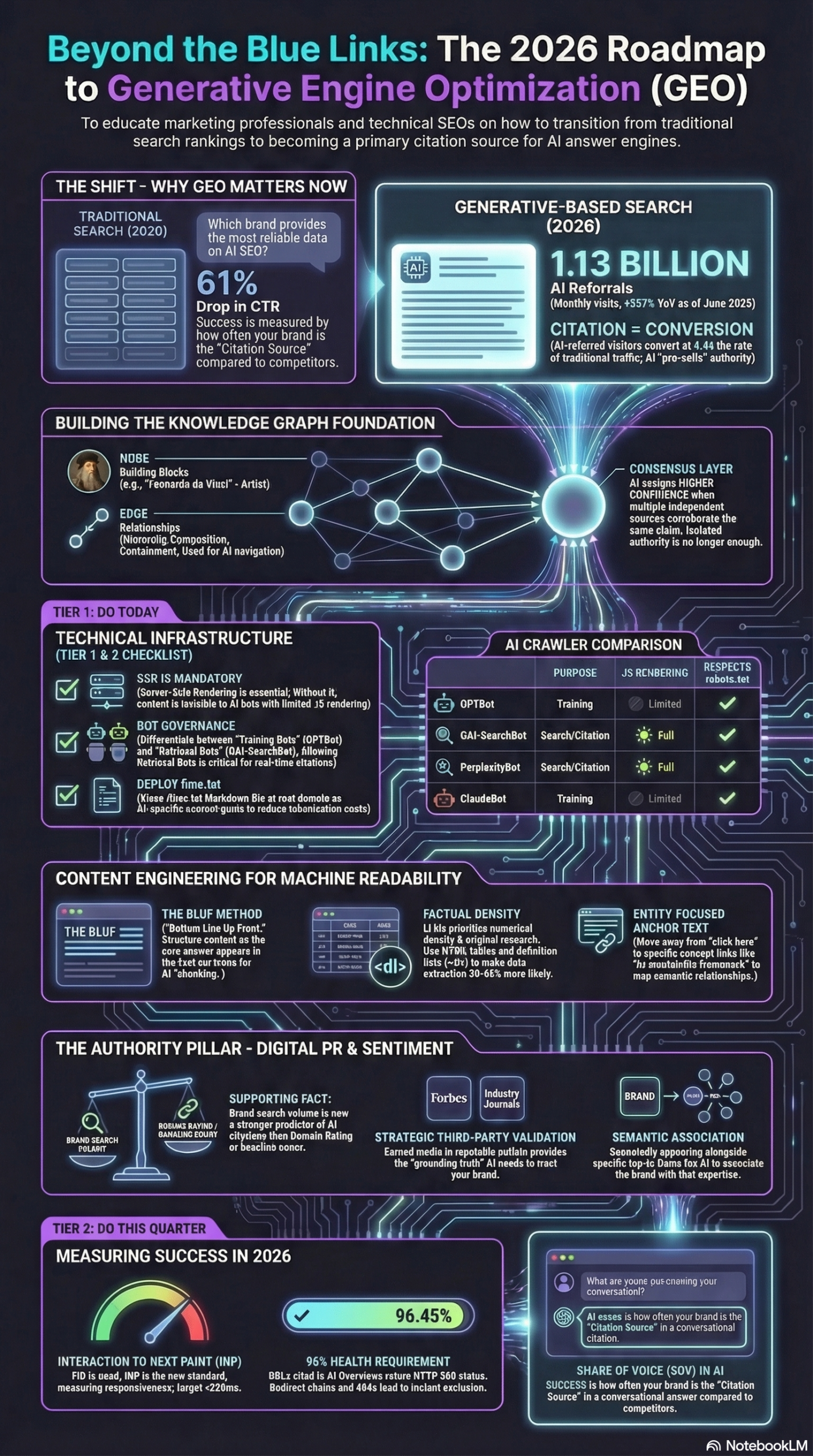
Per the research report, llms.txt is a newly proposed root-directory file that provides a curated, Markdown-formatted guide for AI systems — a human-readable index of your most important content. It’s not a formal standard yet, but it’s a low-risk, high-signal supplement that costs less than an hour to implement.
Create /llms.txt at your root domain with content structured like this:
# YourBrand.com — AI Content Guide

## About
YourBrand is a [describe entity clearly — who you are, what you do, what category you belong to].

## Primary Content Areas
- [Topic 1]: [URL to canonical resource]
- [Topic 2]: [URL to canonical resource]
- [Topic 3]: [URL to canonical resource]

## Key Facts
- Founded: [Year]
- Primary product/service: [clear one-line description]
- Geographic coverage: [relevant markets]

## Expert Content
- [Best tutorial/guide title]: [URL]
- [Data-driven study title]: [URL]
Keep it under 500 lines. Focus on the content AI systems should prioritize when synthesizing answers about your brand or category.
Phase 3: Implement Schema Markup for Entity Clarity
Step 5: Add JSON-LD Organization schema
Entity clarity is how AI systems connect your brand to a topic. Without structured data, an AI must infer these relationships from unstructured text — and that inference is error-prone. The research report identifies Schema markup (JSON-LD) as the primary method for defining entities to AI systems.
Add this to your homepage <head>:
<script type="application/ld+json">
{
  "@context": "https://schema.org",
  "@type": "Organization",
  "name": "Your Brand Name",
  "url": "https://yourdomain.com",
  "sameAs": [
    "https://www.linkedin.com/company/yourbrand",
    "https://en.wikipedia.org/wiki/YourBrand",
    "https://twitter.com/yourbrand"
  ],
  "description": "One clear sentence describing what your organization does.",
  "knowsAbout": ["Topic 1", "Topic 2", "Topic 3"]
}
</script>
The sameAs array is critical — it links your brand entity to its representations on authoritative third-party platforms (LinkedIn, Wikipedia, Wikidata), which is exactly how knowledge graphs establish entity recognition across the web.
Step 6: For e-commerce, implement product-level schema
As e-commerce expert Ben Salomon states: “In 2026, your e-commerce site isn’t just a visual storefront for humans; it’s a structured data feed for agents.” AI agents making purchase decisions on behalf of users will parse your shippingDetails, availability, and returnPolicy — if they’re in your JSON-LD. If they’re buried in human-readable text, the agent skips your product.
<script type="application/ld+json">
{
  "@context": "https://schema.org",
  "@type": "Product",
  "name": "Product Name",
  "offers": {
    "@type": "Offer",
    "availability": "https://schema.org/InStock",
    "shippingDetails": {
      "@type": "OfferShippingDetails",
      "shippingRate": {"@type": "MonetaryAmount", "value": "0", "currency": "USD"},
      "deliveryTime": {"@type": "ShippingDeliveryTime", "businessDays": {"@type": "QuantitativeValue", "minValue": 2, "maxValue": 5}}
    },
    "hasMerchantReturnPolicy": {
      "@type": "MerchantReturnPolicy",
      "returnPolicyCategory": "https://schema.org/MerchantReturnFiniteReturnWindow",
      "merchantReturnDays": 30
    }
  }
}
</script>
Phase 4: Restructure Content for Machine Synthesis
Step 7: Apply BLUF formatting to all key pages
BLUF — “Bottom Line Up Front” — is the formatting standard for AI-optimized content. Per the research report, LLMs prioritize direct answers found in the first sentence or paragraph of a section. That means you must state the core claim before providing the supporting context — the opposite of the traditional blog format that builds to a conclusion.
Before (traditional):
“There are many factors to consider when evaluating project management tools. Teams need to think about collaboration, integrations, and budget. After weighing all these factors, most small teams find that Notion provides the best balance.”
After (BLUF):
“Notion is the best project management tool for small teams under 10 people, offering the highest feature-to-cost ratio in the market. Key advantages include native database functionality, 50+ integrations, and a free tier that scales to 10 members.”
The second version is directly quotable. An AI can extract the claim, the subject, and the supporting reasons without inferring or paraphrasing. That extractability is what gets you cited.
Step 8: Build for the “consensus layer” through Digital PR
This is the highest-leverage step and the most overlooked. The research report documents that 90% of brand mentions in AI answers originate from editorial sources — journalist-written articles and respected publications. Your owned content can be perfectly structured and still never appear in an AI answer if no third-party sources corroborate your claims.
Build a prioritized target list of 15-20 publications that cover your industry. Focus on:
– Industry trade publications (these carry high topical authority)
– Regional business journals (for location-specific entity recognition)
– Expert roundup features (where your spokesperson is quoted alongside other recognized authorities)
– Data studies that get picked up by multiple outlets (original research is the most citation-dense content type)
For each campaign, your goal isn’t just coverage — it’s getting the same core claim repeated across multiple independent sources. If five publications cite the same statistic from your research report, that statistic enters the consensus layer.
Phase 5: Monitor Citation Share
Step 9: Set up citation monitoring
Traditional rank tracking tells you nothing about your AI visibility. You need to monitor where your brand appears in AI-generated answers. Current approaches:
- Manual testing: Query ChatGPT, Perplexity, and Google AI Overviews weekly with your target informational and commercial keywords. Record which sources get cited and whether your brand appears.
- Dedicated tools: Platforms like Profound, Brandwatch, and Semrush’s AI overview tracker (check current feature availability) are building citation share monitoring into their toolsets.
- Track brand search volume as a proxy metric. Per the research report, brand search volume has a 0.334 correlation with AI citations — higher than Domain Rating or backlink count. Growing brand search volume signals that your consensus-layer presence is building.
Expected Outcomes
After 60-90 days of consistent implementation across all five phases, practitioners should expect:
- Measurable increases in brand mentions within AI-generated answers
- Higher conversion rates from AI-referred traffic (the research report benchmarks this at 4.4x traditional organic)
- Reduced reliance on Position 1 rankings as the primary traffic source
- A growing citation footprint across ChatGPT, Perplexity, and Google AI Overviews
Real-World Use Cases
Use Case 1: B2B SaaS Company Entering a New Category
Scenario: A project management SaaS is launching a new AI-powered feature and wants to establish authority in the “AI project management” category — a space where they currently have no mentions in AI answers.
Implementation: They commission an original benchmark study comparing AI project management tools across 10 metrics. The study is published on their domain with full BLUF formatting and JSON-LD schema. They then pitch the study to five industry publications and two analyst blogs, securing coverage that references the same core stats. Within each article, the brand’s product is mentioned as the study’s producer. They update their llms.txt to prominently link the study as their primary authority resource on the topic.
Expected Outcome: Within 90 days, the study’s statistics appear in AI answers when users query “best AI project management tools 2026.” The brand is cited as the source of those statistics. Per the research report, AI-referred visitors arriving from these citations convert at 4.4x the rate of standard organic traffic — and they arrive already knowing the brand’s positioning.
Use Case 2: E-Commerce Retailer Targeting Agentic Commerce
Scenario: A direct-to-consumer apparel brand is seeing declining click-throughs from Google as AI Overviews increasingly answer shopping queries without requiring a click. They want their products surfaced by AI shopping agents.
Implementation: They implement full product-level JSON-LD schema across their catalog, including shippingDetails, returnPolicy, and availability fields. They switch from a client-side React build to Next.js with SSR enabled on all product and category pages. They also ensure OAI-SearchBot and PerplexityBot are explicitly allowed in robots.txt.
Expected Outcome: Their products become parseable by AI agents making purchasing decisions on behalf of users. As agentic commerce grows, products with machine-readable attributes surface first — because agents cannot infer shipping time or return windows from unstructured text.
Use Case 3: Marketing Agency Building Client Citation Reports
Scenario: A mid-size digital agency needs to demonstrate ROI on GEO work to clients who still track traditional organic rankings as their primary KPI.
Implementation: The agency builds a monthly citation audit process: they query 20 target keywords per client across ChatGPT, Perplexity, and Google AI Overviews, recording which sources are cited and whether the client’s brand appears. They track brand search volume as a leading indicator of citation share growth. Monthly reports show citation share percentage alongside traditional rankings.
Expected Outcome: Clients see a new layer of visibility data. As traditional organic traffic compresses due to AI Overview cannibalization, the citation share report becomes the primary indicator of search health — and the agency differentiates itself from competitors still reporting on keyword positions.
Use Case 4: Publisher Building Topic Authority for AI Citations
Scenario: A trade publication covering supply chain technology wants to ensure its content gets cited in AI answers rather than being bypassed in favor of general-interest outlets with higher domain authority.
Implementation: The publication restructures its article format to BLUF: every article opens with the direct answer or key claim in the first paragraph. They add Article schema markup to all posts, including author entity markup linking to author profile pages with sameAs connections to LinkedIn and speaker profiles. They create an editorial FAQ template — five questions and answers appended to every major article — because FAQ schema is among the most quotable formats for AI retrieval.
Expected Outcome: The publication’s articles become more extractable for AI synthesis. Their topical authority in supply chain builds through consistent, fact-dense coverage — and their citation share increases against higher-DA competitors whose content is less structurally optimized for AI retrieval.
Common Pitfalls
1. Blocking retrieval bots while targeting AI citations
This is the most damaging mistake. Many site administrators use blanket Disallow: / rules for all AI bots — either out of content protection instinct or based on outdated privacy guidance. Per the research report, blocking OAI-SearchBot or PerplexityBot removes your site from real-time AI answer generation entirely. Check your robots.txt and validate that search/retrieval bots are explicitly allowed before any other GEO work.
2. Over-indexing on owned content, ignoring earned media
Brands often assume that publishing more content on their own domain will drive AI citations. The research report documents that 90% of AI brand mentions come from editorial sources — not brand-owned pages. Publishing high-quality content is necessary but not sufficient. Without a corresponding earned media strategy that distributes your claims across independent third-party sources, your content won’t enter the consensus layer.
3. Building client-side JavaScript sites without SSR
React, Angular, and Vue applications that rely on client-side rendering are effectively invisible to limited-JS crawlers. Per the research report‘s December 2025 rendering update, this is more severe than previously understood — pages returning non-200 status codes may be excluded from the rendering queue entirely. Any new site build must prioritize SSR or ISR. Existing JS-heavy sites need a rendering architecture audit before GEO investment makes sense.
4. Treating GEO as a keyword optimization exercise
GEO is not semantic SEO with new branding. The signals that drive AI citations — fact-density, entity clarity, cross-platform corroboration — are fundamentally different from keyword relevance signals. Teams that apply traditional keyword clustering logic to GEO will find themselves optimizing for a system that doesn’t use those signals. Reframe the objective: you’re not targeting a keyword, you’re targeting a claim that needs to be corroborated across multiple trusted sources.
5. Ignoring citation fragmentation across platforms
With only 11% of websites cited by both ChatGPT and Perplexity simultaneously per the research report, treating “AI search” as a single channel is a significant error. ChatGPT, Perplexity, and Google AI Overviews each have different source preferences and crawl behaviors. A citation strategy must be evaluated and optimized separately for each platform.
Expert Tips
1. Use original data as your citation anchor. AI systems prefer to cite primary data sources. A proprietary benchmark study, annual survey, or industry report becomes a reference point that dozens of downstream articles will link to — and when those downstream articles are cited in AI answers, your original research is the implicit source behind the claim. One strong data study compounds more than 50 blog posts.
2. Treat your author entities as ranking signals. AI systems track how often a brand is mentioned alongside recognized experts, per the research report. Publish under named, credentialed authors. Build each author’s entity by ensuring consistent LinkedIn profiles, speaker bios, and Wikipedia mentions (where applicable). Quoted experts with established entity footprints transfer authority to the content they contribute to.
3. Monitor the “output gap” weekly. The output gap is the difference between what your brand claims about itself and what AI systems say about your brand. Run weekly queries across ChatGPT, Perplexity, and Google AI Overviews for your core brand queries. Note gaps and discrepancies. These indicate where consensus is missing — and direct your Digital PR targeting.
4. Build FAQ sections into every major content asset. FAQ schema is among the most directly quotable structures for AI retrieval. A well-formatted FAQ section with direct, factual answers to practitioner questions turns any page into an extractable answer bank. Each FAQ entry is a potential citation unit.
5. Prioritize “zero-click” content design. Per the research report, Digital PR now drives “zero-click” interactions where the user receives the brand’s message within the AI summary — never clicking through to the site. Measure this as reach, not traffic. A brand mention in a Perplexity answer seen by 100,000 users is marketing impact even if it generates zero site visits. Design your content for maximum message fidelity in a zero-click context: the one-sentence brand description AI will extract should be the exact positioning you’d choose.
FAQ
Q: Does GEO replace traditional SEO or supplement it?
In the near term, it supplements it — traditional organic search still generates significant traffic for informational queries that don’t trigger AI Overviews. But the research report documents that organic CTR on AI Overview queries has already dropped 61%, and 37% of consumers now start with an LLM. The trajectory is clear: GEO becomes the primary visibility strategy for most commercial intents, with traditional SEO handling the remaining long-tail queries AI doesn’t yet answer confidently. Plan your resource allocation accordingly.
Q: How long does it take to start appearing in AI citations?
There’s no precise timeline — AI models update their retrieval indices at different frequencies, and citation share builds cumulatively with earned media. Practitioners implementing the full stack (technical crawlability fixes, schema markup, BLUF content restructuring, Digital PR campaigns) typically report measurable citation increases within 60-90 days. The Digital PR component has the longest lead time because editorial placements take 4-6 weeks to move through pitching and publication cycles.
Q: Is llms.txt mandatory for AI citation visibility?
No. The research report describes it as a “low-risk supplement” that is not yet a formal standard. It won’t compensate for missing schema markup or blocked crawlers. Think of it as a courtesy index for AI systems — implement it after you’ve addressed the higher-priority technical and content fundamentals.
Q: Should I block AI training bots to protect my content?
This is a legitimate business decision with tradeoffs. Blocking GPTBot and ClaudeBot protects your content from being incorporated into base model training datasets — a valid concern for publishers with proprietary content. But the research report is clear that blocking retrieval bots (OAI-SearchBot, PerplexityBot) eliminates your real-time citation potential. The recommended approach: block training bots selectively if you have IP concerns, but explicitly allow all retrieval/search bots regardless.
Q: How do I measure GEO success if not through rankings?
The research report recommends shifting to “citation share” as your primary visibility metric — the percentage of relevant AI answers in which your brand is mentioned or cited. Track this manually across target query sets in ChatGPT, Perplexity, and Google AI Overviews, or use emerging tools with AI citation monitoring features. As a leading indicator, track brand search volume (which has a 0.334 correlation with AI citations per the research report) and AI-referred traffic in your analytics platform (segment by referrer domain for chat.openai.com, perplexity.ai, etc.).
Bottom Line
The consensus layer is the new front page of the internet, and it operates on fundamentally different rules than the SERP your team has spent years optimizing for. Winning it requires a combination of technical accessibility (SSR rendering, correct robots.txt configuration, structured data), content architecture (BLUF formatting, FAQ schema, fact-dense writing), and distributed authority building (earned media that gets your core claims corroborated across independent trusted sources). The data from the research report is unambiguous: AI-referred visitors convert at 4.4x the rate of traditional organic, AI referral traffic grew 357% in a single year, and brands securing consistent AI citations are building a compounding visibility moat. The teams that implement GEO systematically in 2026 will be the ones whose competitors are trying to catch up to in 2027.


0 Comments