

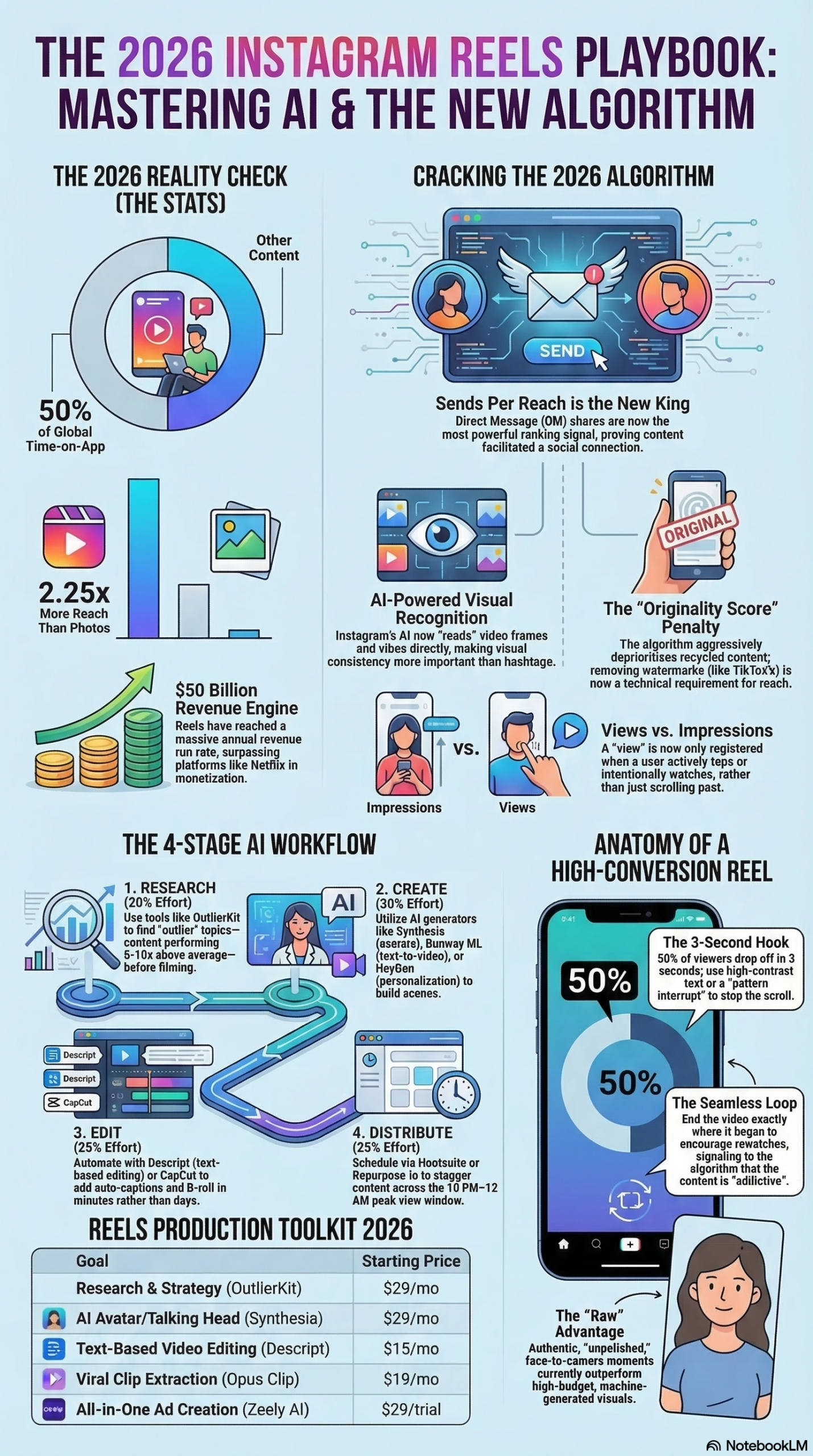
Instagram Reels now account for 46% to 50% of all time spent on the app, and Instagram’s head Adam Mosseri put it plainly when the platform hit 3 billion monthly users: “Almost all of our growth has been driven by DMs, Reels, and recommendations.” If your brand is still anchoring its Instagram strategy to static images, you are operating at a structural disadvantage the algorithm has specifically engineered. This tutorial gives you the complete system—algorithm mechanics, AI production pipeline, tool stack, and tactical playbook—to build a Reels program that generates consistent reach and measurable business results in 2026.
What Instagram Reels Is in 2026
Instagram Reels are short-form vertical videos—up to 90 seconds—distributed through the dedicated Reels tab, the Explore feed, and the main home feed. But understanding the format is only the starting point. What separates high-performing brands from the rest in 2026 is understanding how Reels interact with Instagram’s rebuilt algorithm, a system the company calls “Meaningful Distribution.”
According to the 2026 Instagram Reels Strategy and AI Integration Briefing produced via deep research into Hootsuite and SocialInsider data, Instagram now operates on a dual-track distribution model.
Connected Reach delivers your content to existing followers. This is your baseline audience—the people who already opted in. It matters for retention and loyalty, but it is not where growth happens.
Unconnected Reach is where Reels diverge from every other format on Instagram. The algorithm runs what the briefing describes as an “audition system”: when you post a public Reel, Instagram shows it to a small test group of non-followers first. If that group engages, shares, or rewatches it, the content moves to progressively larger audiences. A 500-follower account can generate 50,000 views on a single Reel. A 5,000-follower account can reach millions. Follower count becomes secondary to content quality and signal strength.
This audition system is powered by AI that goes far beyond basic engagement rate tracking. Instagram’s visual recognition engine now performs frame-by-frame analysis of your content. According to the Hootsuite research briefing, the system “reads” visual elements, understands the aesthetic vibe, and categorizes your content without relying on hashtags or captions alone. Visual quality and consistency have become the new SEO—every frame of your Reel is being evaluated and classified.
The four primary ranking signals driving the algorithm are:
-
Sends per Reach: The ratio of DM shares to total impressions. This is the single most powerful signal in 2026. When a viewer sends your Reel to someone via DM, the algorithm interprets it as “highly distributable” content that facilitates social connection—the exact behavior Instagram is trying to maximize. A Reel with a high Sends per Reach ratio will receive preferential distribution over content with higher raw like counts.
-
Watch Time: Total minutes watched, not percentage completion. This distinction matters: a 3-minute Reel that someone watches entirely competes differently than a 30-second clip watched to completion. The algorithm rewards content that holds a viewer’s full attention cycle, not just content that gets finished quickly.
-
Likes per Reach: Raw like counts are less important than the ratio of likes to impressions. This measurement controls for account size, ensuring that a 1,000-follower account isn’t penalized against a 100,000-follower account in the distribution rankings.
-
Originality Score: Instagram aggressively downranks recycled content. Cross-posting a TikTok video with the TikTok watermark still visible triggers a significant reach penalty. According to the research briefing, the algorithm can identify platform watermarks and will throttle distribution accordingly—a hard rule that catches brands off-guard regularly.
These four signals are not background context. They are the mechanics you reverse-engineer into every production decision you make.
Why It Matters for Businesses
The business case for Reels in 2026 is structural, not aesthetic. According to Hootsuite and SocialInsider’s 2025-2026 analysis, Reels generate 2.25x more reach than static photos. If your Instagram strategy is built around polished product photography, you are operating at a fundamental algorithmic disadvantage before content quality even enters the equation.
For businesses specifically, three metrics define why Reels investment is non-negotiable:
Traffic: Reels with product tags drive 45% more site traffic than static posts. For e-commerce brands, this is a channel-level performance difference, not a creative preference. Every untagged product post is a missed conversion touchpoint.
Awareness scale: Reels are reshared 4.5 billion times daily across Instagram. The DM share mechanism is the engine of viral reach. A single Reel with strong shareability will outperform a month of static posts in total audience exposure.
Production cost-to-return: AI production pipelines have reduced the average time to produce a Reel from 13 days to 27 minutes—a 91% reduction in production time per video. This single development has shifted the business math entirely. Consistent, high-volume Reels production is now achievable for teams without dedicated video editors, video production equipment, or large content budgets.
Who specifically benefits from mastering Reels in 2026:
- E-commerce brands: Product tagging, Zeely AI photo-to-video conversion, and the 45% traffic lift from tagged Reels create a direct revenue connection.
- B2B SaaS companies: Synthesia’s AI avatar technology makes professional tutorial and explainer content scalable without on-camera talent constraints.
- Marketing agencies: Client case study Reels with result-forward hooks drive inbound DM inquiries, which simultaneously improves the Sends per Reach signal.
- Solo creators and consultants: The 91% production time reduction makes consistent 3-5 Reel per week cadence achievable without burnout.
As Adam Mosseri noted in his 2025 end-of-year message, as AI makes “perfect” content cheap and easy to produce, users are pivoting toward raw, unpolished, and imperfect content as signals of authentic human perspective. The brands winning in 2026 combine AI efficiency in production with genuine human perspective in delivery—not one or the other.
The Data: Benchmarks, Engagement Rates, and Tool Comparison
Understanding your account’s position in the engagement spectrum shapes every strategic decision. Smaller accounts should prioritize authenticity and niche community depth; larger accounts need consistent high-volume original content to maintain visibility against the algorithm’s diminishing returns curve.
Reels Engagement Rate by Account Size (2026)
| Followers | Avg. Engagement Rate | Strategic Focus |
|---|---|---|
| Under 5K | 3.79% | Authenticity, niche community growth |
| 5K – 50K | 2.10% | Balanced reach and community depth |
| 50K – 200K | 1.40% | Consistent high-volume original content |
| 200K+ | 0.90% | Brand authority and Connected Reach |
Source: Hootsuite / SocialInsider 2025-2026 Analysis
AI Production Tool Comparison 2026
The tooling landscape for Reels production has matured significantly. The following represents the core stack used in a modern AI-driven production pipeline, from research through scheduling:
| Tool | Primary Use Case | Starting Price | Key 2026 Feature |
|---|---|---|---|
| OutlierKit | Research & Strategy | $29/mo | AI Script & Hook Strength analysis |
| Zeely AI | Sales-Focused Ads | $29/trial | Product photos → Reel-ready videos |
| Synthesia | Training / B2B Content | $29/mo | 140+ AI avatars in multiple languages |
| Descript | Editing | $15/mo | Edit video by editing transcript text |
| Opus Clip | Long-to-Short Repurposing | $19/mo | AI detection of viral moments in long-form |
| Runway ML | High-End Creation | $15/mo | Gen-3 Alpha cinematic motion generation |
| Mirra | Bulk Scheduling | Free / $12 Pro | Unlimited bulk upload + AI Brand Persona |
Source: Hootsuite 2026 Reels Strategy Briefing
The production time impact is significant: before AI tooling, the average Reel took approximately 13 days to produce end-to-end. With the AI pipeline above, that drops to 27 minutes per video—making a 3-5 Reel per week cadence executable by a single person.
Step-by-Step Tutorial: Building Your AI-Driven Reels System
This is the four-stage pipeline that top-performing brands use in 2026. The Hootsuite research briefing identifies this systematic approach as the core differentiator between brands that scale and brands that produce one-off content that never gains traction. Data suggests that 95% of marketing videos fail due to a lack of pre-production research—this system fixes that at every stage.
Prerequisites
Before starting, confirm you have:
– An Instagram Business or Creator account set to Public (required for Unconnected Reach)
– Access to at least one AI research tool: OutlierKit or VidIQ
– Access to at least one AI production tool: Runway ML, InVideo AI, Zeely AI, or Synthesia
– Access to one editing and captioning tool: Descript or CapCut
– A scheduling tool: Hootsuite, Sprout Social, or Mirra
Stage 1: Research and Strategy (20% of Your Total Effort)
Step 1: Run Outlier Detection on Your Niche
Before producing a single frame, go to OutlierKit or VidIQ and identify videos in your niche that are performing 5-10x above the creator’s average channel performance. These are your “outliers”—content that broke through the audition system and reached a broad non-follower audience. Study the hook, the format, the length, and the core topic.
The goal is to understand why the outlier succeeded, not to replicate it. Ask: Was it the topic (filling a genuine information gap)? The hook (a provocative or counterintuitive statement)? The visual format (a specific style of demonstration or reveal)? Outlier detection prevents you from producing content into a vacuum.
Step 2: Map and Lock Your Content Pillars
The Hootsuite briefing recommends establishing 2-3 consistent content pillars so Instagram’s AI can accurately categorize your account within its recommendation system. Users now have access to Instagram’s “Your Algorithm” tool to prune topics they don’t want—meaning that scattered, multi-topic accounts get served to diluted, unqualified audiences.
Define your pillars explicitly before batch production. For a B2B SaaS company, pillars might be: product tutorials, team culture content, and industry trend commentary. For an e-commerce brand: product demonstrations, user-generated content reposts, and behind-the-scenes production. These pillars become the filter for every piece of content you produce.
Step 3: Identify Content Gaps via Comment Mining
Run a manual search on your top 3-5 competitor accounts. Open their highest-performing Reels and read the comments. Questions that appear repeatedly—and that nobody has answered well on video—are high-value content gap targets. This takes 20-30 minutes and produces a content backlog that’s pre-validated by real audience demand.
Stage 2: Bulk Creation (30% of Your Total Effort)
Step 4: Batch Your Hooks Before Scripting the Body
The research briefing documents that up to 50% of viewers drop off in the first three seconds of a Reel. High-performing content that achieves 60% or higher retention at the 3-second mark sees 5-10x more reach from the audition system. This means your hook is not a stylistic choice—it is the primary technical determinant of your Reel’s distribution ceiling.
Use AI (Claude, ChatGPT, or OutlierKit’s built-in hook generator) to produce multiple hook variations for each topic. A reliable three-part formula from the research:
- Question Hook (targets a specific pain point): “Why is your Instagram reach dropping even when you post consistently?”
- Bold Statement Hook (delivers a counterintuitive claim): “Everything you know about Instagram hashtags is wrong in 2026.”
- Visual Reveal Hook (starts mid-action with a surprising visual): Opens on an analytics dashboard showing zero views, then cuts to 200K in the same shot.
Generate 5-10 hook variations per topic and select the 2-3 with the strongest pattern-interrupt potential—something that disrupts the low-attention scroll autopilot immediately.
Step 5: Script the Body and CTA Tight
Every sentence in your script must justify its word count. The algorithm rewards total watch time, but that means holding attention with substance, not padding. Use the structure: Hook → Problem Context (10-15 seconds) → Solution or Core Insight (30-45 seconds) → CTA (5-10 seconds).
For AI-avatar-based content (B2B, training, explainers), run your script through Synthesia or HeyGen using one of their 140+ realistic AI avatars. Select an avatar and voice that matches your brand tone. For product-forward content, use Zeely AI to convert existing product photography into Reel-ready video sequences without any filming required.
Step 6: Batch-Produce at Volume
Use Runway ML for cinematic quality output when visual impact is the priority. Use InVideo AI when speed is the constraint and you’re producing 10 or more Reels in a single production session. The target is to batch-produce 5-10 videos per session, which is what makes the 3-5 Reel per week publishing cadence sustainable. Attempting to produce one video per day without batching is what causes most teams to abandon their Reels programs.
Stage 3: Automated Editing (25% of Your Total Effort)
Step 7: Add Auto-Captions—This Is Non-Negotiable
Many users watch Reels on mute first, deciding whether the content is worth turning audio on. According to the Hootsuite briefing, AI transcription now maps captions in “karaoke-style” synchronized highlighting—a significantly higher engagement format than static subtitles. Use Descript to auto-transcribe and add animated captions. CapCut’s built-in auto-caption feature handles this on mobile in under two minutes per video. If a viewer can’t follow your Reel without sound, you’re losing them.
Step 8: Sync Cuts to Audio Beat Onsets
AI editing tools now identify rhythmic “onsets” in your audio track and snap video cuts to the beat automatically. In CapCut, use the “Auto Beats” feature in the edit timeline. In Descript, you can manually snap cuts to the audio waveform with single-frame precision. Beat-synchronized cutting is one of the most reliable watch-time drivers in short-form video—it creates a subliminal rhythm that reduces cognitive friction and keeps viewers watching through to the CTA.
Step 9: Repurpose Long-Form Content with Opus Clip
If your brand produces podcasts, webinars, long YouTube videos, or recorded presentations, run them through Opus Clip. Its AI detects moments with high verbal energy, topic density, and engagement potential, then generates 60-90 second clips with captions already applied and layout adapted for 9:16. A 45-minute webinar can yield 5-8 Reel-ready clips in under 20 minutes, fully captioned. This is the highest-ROI production shortcut in the current stack.
Step 10: Technical Quality Checklist Before Export
Run through this before every export:
– Resolution: 1080×1920 pixels (9:16 aspect ratio)
– Format: MP4 with H.264 encoding
– Safe zone compliance: All critical text and visuals centered—keep content away from the top and bottom 15% where Instagram UI overlays appear
– No competing watermarks: Zero TikTok watermarks or other platform branding
– Highest quality toggle: Confirm “Upload at highest quality” is enabled in Instagram Settings → Account → Data Usage
Stage 4: Strategic Distribution (25% of Your Total Effort)
Step 11: Batch-Schedule Your Entire Week in One Session
Use Hootsuite, Sprout Social, or Mirra’s free bulk upload feature to schedule your entire week’s Reels in a single 30-minute session. Publishing 3-5 Reels per week is the current recommended cadence for accounts targeting Unconnected Reach growth. Mirra’s free tier supports unlimited bulk scheduling, which removes cost as a barrier for smaller teams.
Step 12: Activate Trial Reels Before Profile Publishing
Instagram’s Trial Reels feature is an underused advantage. It shows your content to non-followers first—before it appears on your profile grid or in your followers’ feeds. If a Trial Reel performs well with a cold audience, it validates the hook and topic concept before you commit it to your main profile’s visible record. Use Trial Reels for any content that experiments outside your established content pillars, or for hooks you’re not confident in.
Step 13: Cross-Platform Adaptation
Use Repurpose.io to automatically adapt your 9:16 Reels for YouTube Shorts, TikTok, and Facebook Reels. Each Reel you produce becomes four pieces of distributed content with minimal additional time investment. Ensure watermark-free source files are what you distribute—never push a platform-watermarked version to a competing platform.
Expected Outcomes: A consistent 3-5 Reel per week cadence following this pipeline, maintained for 60-90 days, will produce measurable improvement in Unconnected Reach. The audition system rewards volume and consistency—each Reel is an independent distribution bet. More bets mean more chances for a breakout, and the system compounds as Instagram’s AI refines its categorization of your account.
Real-World Use Cases
Use Case 1: E-Commerce Brand Driving Product Traffic Without Paid Ads
Scenario: A DTC skincare brand with 12,000 Instagram followers wants to increase product page traffic without increasing ad spend.
Implementation: Use Zeely AI to convert existing product photography into short video sequences—texture close-ups, application demonstrations, before-and-after progressions. Write hooks that address specific pain points from comment mining: “Why your moisturizer isn’t absorbing—and what to switch to.” Apply product tags to every Reel in Instagram’s product catalog integration. Schedule 4 tagged Reels per week using Mirra.
Expected Outcome: Tagged Reels generate 45% more site traffic than static posts according to the Hootsuite analysis. At four tagged Reels per week over 90 days, the cumulative traffic compound—combined with the algorithm’s growing categorical recognition of the account—will drive significant organic product page volume without incremental ad budget.
Use Case 2: B2B SaaS Company Building Thought Leadership at Scale
Scenario: A project management SaaS company wants to build brand awareness among operations professionals but has no video production team.
Implementation: Run existing long-form webinar recordings and customer onboarding sessions through Opus Clip to extract 60-90 second insight clips. Pair AI-clipped highlights with Synthesia-generated branded intros using a consistent AI avatar. Establish three content pillars: product capability tutorials, remote team productivity tactics, and async workflow trends. Publish three Reels per week with consistent visual branding via a Mirra Brand Persona profile.
Expected Outcome: Educational tutorial content keeps viewers 28% longer than entertainment-only content, per the Hootsuite briefing. In a B2B context, that extended attention window translates to higher-quality brand exposure and algorithm categorization precision—consistently surfacing the account to operations-adjacent professional audiences.
Use Case 3: Marketing Agency Converting Case Studies into Inbound Leads
Scenario: A digital marketing agency wants to use short-form video to demonstrate client ROI and attract new business inquiries via Instagram DMs.
Implementation: Script 60-second case study Reels with result-forward hooks: “We grew this client’s email list 340% in 90 days. Here’s exactly what we did.” Structure each Reel as: Hook (result stated immediately) → Problem Context (what they came to us with) → Three-step solution breakdown → CTA (DM us ‘CASE STUDY’ for the full breakdown). Use Descript for fast text-based editing. Publish two case study Reels per week.
Expected Outcome: Result-forward hooks trigger the strong pattern-interrupt needed for 60%+ 3-second retention. Specific, credible outcome framing drives DM inquiries—each DM reply is a Sends per Reach signal that simultaneously improves algorithmic distribution and qualifies a sales lead. The feedback loop between content performance and business development is direct and measurable.
Use Case 4: Solo Creator Scaling from 1 to 5 Reels Per Week
Scenario: An individual creator in the personal finance space currently produces one Reel per week and is burning out. They want to scale volume without scaling hours.
Implementation: Adopt the batch production workflow with InVideo AI for visual content generation and Descript for editing. Record all five video scripts in a single 90-minute session on one day per week. Batch-edit in Descript with auto-captions applied to all five simultaneously. Schedule the full week via Hootsuite in one 20-minute session. Reserve one Reel slot per week for a Trial Reel testing an experimental hook or topic outside established pillars.
Expected Outcome: The Hootsuite briefing documents AI tools reducing production time from 13 days to 27 minutes per video—a 91% reduction. For a solo creator, this is the operational difference between sustainable consistency and burnout-driven hiatus. Higher weekly volume means more audition opportunities, directly accelerating Unconnected Reach growth without proportionally increasing time investment.
Common Pitfalls
1. Cross-Posting Watermarked TikTok Content
Posting a TikTok video with the platform watermark still visible triggers Instagram’s Originality Score penalty. The algorithm identifies competing platform watermarks and aggressively deprioritizes that content in distribution. The fix is straightforward: use SnapTik or TikTok’s built-in “Save video without watermark” feature (available in some regions) before cross-posting. Ideally, produce platform-native content from the start. The Hootsuite briefing explicitly calls this out as one of the most common self-inflicted reach penalties in 2026.
2. Relying on Hashtag Volume for Discovery
Hashtag stuffing is a pre-2022 strategy. The 2026 sweet spot is 3-5 highly relevant hashtags maximum. Instagram’s frame-by-frame AI visual analysis now categorizes content based on visual elements and caption text, not hashtag density. Dumping 30 hashtags into a caption does not expand reach—it may actually signal low-quality intent. Use your caption text as the primary SEO field: write descriptive, keyword-rich captions that clearly describe what the video covers and for whom.
3. Publishing Without Testing the 3-Second Hook
If 50% of viewers drop off before the 3-second mark, the algorithm interprets the content as low-quality and throttles distribution—sometimes permanently for that piece of content. Never publish a Reel without a clear, specific pattern-interrupt in the first frame. Use Trial Reels to test hooks with cold audiences before committing to your main profile feed.
4. Inconsistent Content Pillars Confusing the Algorithm
Posting product demos one week and trending audio memes the next disrupts Instagram’s categorical understanding of your account. Users now actively prune topics via the “Your Algorithm” tool—meaning an inconsistent account serves a fragmented audience. The research briefing recommends establishing 2-3 pillars and maintaining them for a minimum of 90 days before evaluating expansion.
5. Skipping the Highest-Quality Upload Setting
Instagram compresses video by default. Without toggling “Upload at highest quality” in Settings → Account → Data Usage, your 1080×1920 export gets compressed during upload, losing the visual crispness that Instagram’s AI visual recognition rewards. This is a 30-second one-time fix with measurable impact on presentation quality and algorithm classification confidence.
Expert Tips
1. Build Every Piece of Content Around “Would Someone DM This?”
Before finalizing any script, ask explicitly: would a real user send this to a friend via DM? According to the Hootsuite briefing, Sends per Reach is the single most powerful signal in Instagram’s 2026 algorithm. If the honest answer is no, rework the hook or the core insight until the content earns a share. Shareability is now a production requirement, not a bonus outcome.
2. Use Trial Reels as a Systematic A/B Testing Framework
Don’t treat the Trial Reels feature as a backup. Use it proactively: test two hook variations of the same underlying content concept and compare 3-second retention and Sends per Reach rates at the 48-hour mark. The winning hook goes to your main profile. Over 6 months, this builds a data-validated hook library that makes every subsequent batch quantifiably more effective.
3. Check Native Analytics for “Sends per Reach” at 48 Hours
Instagram’s native analytics now surfaces the Sends per Reach metric directly in the Reel insights panel. Check this for every Reel at the 48-hour mark. A Sends per Reach ratio above 3% is strong performance. Below 1% is a diagnostic signal—review the hook, the topic validation, and whether the content genuinely delivers on the promise in the first 3 seconds.
4. Remake Top-Performing Reels Quarterly
Every 90 days, identify your top 3 Reels by Sends per Reach. Remake them with a fresh hook variation and updated visual treatment. The underlying topic is already validated by the algorithm—the new version enters a fresh audition cycle with zero previous performance history. This is one of the highest-ROI content strategies in a mature Reels program because the topic risk has already been removed.
5. Match Posting Frequency to Your Engagement Rate Benchmark
Under 5,000 followers with a 3.79% engagement rate means your audience values authenticity over volume. Posting five AI-generated Reels per week may actually erode trust with a tightly knit niche community. Scale posting frequency in proportion to your account size and audience expectations—the engagement benchmarks table above is your guide. Let data, not ambition, set the cadence.
FAQ
Q: How long should my Instagram Reels be in 2026?
The algorithm rewards total watch time over completion rate, so longer videos that hold attention can outperform shorter ones. According to the Hootsuite analysis, the practical sweet spot for most brand content is 30-90 seconds. Tutorial and educational content performs well at 60-90 seconds—the length supports genuine value delivery. Pattern-interrupt awareness content (brand visibility, trending moments) performs better at 15-30 seconds where high completion rates are achievable. Test both lengths using Trial Reels to find your account-specific sweet spot.
Q: Do hashtags still matter for Reels reach?
They matter, but not in the way they did before 2023. Instagram’s AI visual recognition categorizes content based on visual elements, on-screen text, and caption copy—hashtags are a minor supplementary signal. The Hootsuite briefing recommends 3-5 highly relevant hashtags maximum. Write your caption as your primary SEO field: use specific, descriptive language about the video’s topic, intended audience, and core value proposition. A well-written 80-word caption outperforms 30 stuffed hashtags every time.
Q: How often should I post Reels to see growth?
The recommended cadence is 3-5 Reels per week for accounts actively pursuing Unconnected Reach growth. Each Reel is an independent audition opportunity with the algorithm—more posts mean more chances to hit the distribution threshold. However, volume without quality is counterproductive. Three well-researched, hook-tested Reels per week outperform seven generic ones because the quality signal compounds in the algorithm’s account evaluation.
Q: Will AI-generated content hurt my account’s algorithmic reach?
Not inherently. Instagram’s Originality Score penalizes recycled content from other platforms, not AI-generated content. A Runway ML-generated cinematic video with an original script and human perspective is “original” by Instagram’s definition. The risk with AI-generated content is genericness—if it lacks a strong hook and distinctive visual style, it will underperform not because it’s AI-generated but because it’s undifferentiated from everything else in the feed. Human creative direction applied to AI production tools is the winning combination.
Q: What’s the fastest path to improving Reels performance starting from zero?
Run Trial Reels for your first ten posts. This protects your profile’s engagement rate while you calibrate your hook formula and content format with cold audiences. Simultaneously, spend 30 minutes in your niche’s top-performing Reels comment sections identifying unanswered questions—these are your first validated content pillar topics. Focus entirely on the 3-second hook until your 3-second retention rate consistently exceeds 60% on Trial Reel tests. Once you’ve validated two or three high-retention hooks, commit them to your main profile and build from there.
Bottom Line
Instagram Reels in 2026 is a performance channel governed by four measurable algorithmic signals: DM shares, watch time, engagement ratio, and originality—as documented in the Hootsuite 2026 Reels research. Brands that treat it as a creative expression outlet will consistently lose to brands that treat it as an engineered system. The AI production stack now available—OutlierKit for research, Runway ML and InVideo AI for creation, Descript and Opus Clip for editing, and Hootsuite or Mirra for distribution—reduces per-video production time by 91%, making a sustainable 3-5 Reel per week cadence achievable for any team size. The DM share signal is the axis the entire strategy rotates on: build every piece of content to earn a share, and the algorithm will distribute it. As the data from Hootsuite and SocialInsider confirms, Reels generate 2.25x more reach than static content—the only question now is whether you build the system to capture it.


0 Comments