

Your buyers have stopped Googling. They’re asking ChatGPT, Perplexity, and Gemini — and if your brand isn’t surfacing in those AI-generated answers, you’re invisible at the exact moment intent is highest. This is the strategic reality behind Semrush’s March 2026 brand evolution: the rules of brand discovery have fundamentally shifted, and the platforms, strategies, and measurement systems required to compete have changed with them. In this tutorial, you’ll learn how to audit your current AI search presence, implement Answer Engine Optimization (AEO), and build a repeatable system for tracking brand visibility across every major AI platform.
What This Is: The Shift from SEO to AEO
Answer Engine Optimization (AEO) — also called AI Search Optimization — is the discipline of improving a brand’s prominence and citation frequency within AI-generated answers. Where traditional SEO targeted a slot on a results page, AEO targets something structurally different: getting your brand synthesized into the direct responses that ChatGPT, Google AI Overviews, Perplexity, and Gemini deliver to users who never click through to a list of links.
According to the 2026 AI Search Visibility Briefing, the digital landscape is defined by a transition from a “link-based” model to a “synthesis-based” model. Users ask a question and receive a single curated answer — constructed from sources the AI engine trusts. If your brand isn’t in those sources, you don’t exist in that interaction.
This isn’t gradual drift. Matas Kibildis of AIclicks.io described one client scenario that frames the problem precisely: “It was that their buyers had stopped Googling. Instead, they were asking ChatGPT. And this brand wasn’t showing up in those answers at all.” Flat organic traffic despite solid traditional SEO is now a common symptom — and AEO is the diagnosis.
The technical infrastructure powering this shift relies on three core mechanisms that practitioners need to understand before building any optimization strategy:
Retrieval-Augmented Generation (RAG): Modern AI search systems combine large language models with real-time retrieval from enterprise or web data. According to the 2026 AI Search Visibility Briefing, this architecture overcomes LLM limitations like training data cutoffs and hallucinations by pulling fresh, authoritative external content at query time. The implication for brands: your published content must be structured for machine parsing, not just human readability.
Semantic Search: Simple keyword matching fails at scale. Kaz Sato of Google Cloud articulated the core problem: “The question is not the answer.” A user asking about “warm clothing” must be matched to content about “puffer jackets” — they share no literal vocabulary. Neural matching techniques now power the retrieval layer so that conceptual relationships, not just string similarity, determine what content surfaces. Brands whose content uses different terminology than their buyers must bridge that semantic gap explicitly.
Hybrid Search: Production-grade AI search systems merge traditional keyword indexing with semantic vector search. This matters for brands with precise product identifiers (SKUs, model numbers, spec sheets) alongside broad informational queries. A pure semantic system loses precision on exact queries; a pure keyword system loses conceptual context. Effective AEO accounts for both retrieval modes.
Understanding these three mechanisms is prerequisite to any optimization work. You’re not gaming an algorithm — you’re making yourself retrievable to a system that asks three questions: Is this source trusted externally? Is this content structured for machine parsing? Does this brand appear consistently across authoritative contexts?
Semrush recognized this structural shift and reoriented its entire platform positioning around it. That’s not a marketing pivot — it’s a signal about where practitioner demand is moving and what skills are now table stakes for anyone doing digital marketing professionally.
Why It Matters: The New Competitive Landscape for Practitioners
Semrush’s March 2026 rebrand repositions the platform from an SEO analytics tool to a brand visibility platform — because the company’s core customers (marketers, agencies, SEO practitioners) are operating in a fundamentally different competitive environment than they were in 2022.
For practitioners, the shift creates three concrete operational problems:
Measurement blind spots. The measurement infrastructure built around traditional SEO — keyword rankings, organic click-through rates, position tracking — captures none of your AI search visibility. A brand can hold the number-one position on Google for its top keywords and still be absent from every ChatGPT answer on the same query. These are different systems measuring different things, and running only one of them means you’re flying half-blind.
Channel diversification pressure. AI engines draw citations from different source pools than the Google index. Reddit communities, authoritative directories (G2, Capterra, Product Hunt), Wikipedia, and vertically specific forums carry significant weight in what LLMs cite. The off-site work required for AEO looks different from classic link-building — and most teams haven’t started it yet.
Attribution collapse. When a user asks Perplexity for “best project management software for remote teams,” gets your brand in the answer, and then visits your site, that session appears in GA4 as direct traffic or an unattributed referral. Traditional attribution models fail to capture the AI influence path entirely. Teams are missing conversion credit for their most high-intent discovery channel.
The release of GPT-5.4 in March 2026 adds an additional strategic layer. According to the 2026 AI Search Visibility Briefing, the model achieves results comparable to or exceeding a human’s first attempt in 83% of office and analytical tasks — including financial analysis, reports, and legal document interpretation. More relevant to practitioners: the model’s new agentic capabilities include computer use (analyzing screenshots, clicking buttons, entering data) and tool search, which reduces token costs by up to 47% by loading only required APIs mid-task. When an AI agent completes a full vendor research workflow autonomously, brands that don’t appear in the AI’s synthesis never enter the shortlist — regardless of their Google rankings.
For agencies, the opportunity gap is wide. Clients who have invested in traditional SEO now need a second optimization layer built for AI visibility. This is a billable service gap that is largely uncaptured in early 2026, but it requires building measurement infrastructure before deliverables.
The Data: AI Search Market Timeline and Tool Landscape
AI Search Tipping Point Projections
According to the 2026 AI Search Visibility Briefing, the market trajectory over the next four years looks like this:
| Year | Milestone / Projection |
|---|---|
| 2025 | LLM search handles hundreds of millions of queries daily; remains under 5% of total search market share |
| 2026 | Traditional search volume projected to drop 25% (Gartner) as users migrate to AI assistants |
| 2028 | ~50% of all search activity projected to occur through AI interfaces; organic traffic to sites may drop 50% |
| 2030 | AI search expected to handle the majority of global search queries; ChatGPT traffic potentially surpassing Google |
Source: 2026 AI Search Visibility Briefing
AEO Tool Comparison: 2026 Platform Landscape
| Tool | Core Specialization | Best For |
|---|---|---|
| AIclicks.io | All-in-one AI visibility tracking | Brands needing actionable citation and content recommendations |
| Writesonic | Enterprise-scale optimization | High-growth teams pairing AI visibility with existing SEO workflows |
| Gauge | Agentic marketing insights | Teams wanting an AI agent that interprets GA4 and Semrush data |
| Authoritas | Multi-market monitoring | Global agencies requiring deep international and multilingual coverage |
| GetCito | Data sovereignty | Organizations requiring open-source control over data infrastructure |
| Profound | Enterprise-grade analytics | Large enterprises needing deep competitive benchmarking and tracking |
Source: 2026 AI Search Visibility Briefing
Step-by-Step Tutorial: How to Build Your AEO System
This is the operational playbook. Run it in sequence — each phase builds on the previous one, and skipping phases is how teams end up optimizing into the void.
Phase 1: Baseline Audit — Measure Where Your Brand Actually Stands
Before you change a single word of content, you need a documented baseline. Without it, every action you take is unmeasurable.
Step 1: Build your prompt battery.
Develop 25-30 prompts that represent how your ideal customer would search for a solution in your category. Use problem-oriented, non-branded language at this stage. Examples of the right structure:
- “What’s the best [category] tool for [specific use case]?”
- “How do I solve [specific pain point] for [company type]?”
- “Compare [your category] options for [business size or vertical]”
- “What software do [job role] teams use for [function]?”
The goal is to simulate your buyer’s actual prompts — not prompts that are designed to surface your brand. Honest baselines require honest inputs.
Step 2: Run each prompt across all four major AI engines.
Test ChatGPT (GPT-4o and GPT-5.4 if available), Google AI Overviews, Perplexity, and Gemini. Document results in a spreadsheet with these columns for each prompt-engine combination:
- Brand mentioned? (Y/N)
- Position in response (1st, 2nd, 3rd, or not mentioned)
- Sources cited by the AI
- Competitors mentioned and their positions
Step 3: Calculate your baseline visibility score.
Visibility score = (total brand mentions / total prompt-engine combinations tested) × 100.
A brand with strong traditional SEO but no AEO work typically scores 10–25% on this audit. Anything under 30% represents significant opportunity. Target for competitive categories is 60%+.
Step 4: Identify your engine-specific gaps.
Some brands appear frequently in Perplexity but rarely in ChatGPT because each engine weights different source types. Knowing which engines under-index your brand tells you where to focus your off-site work first. Don’t treat all engines as identical — they aren’t.
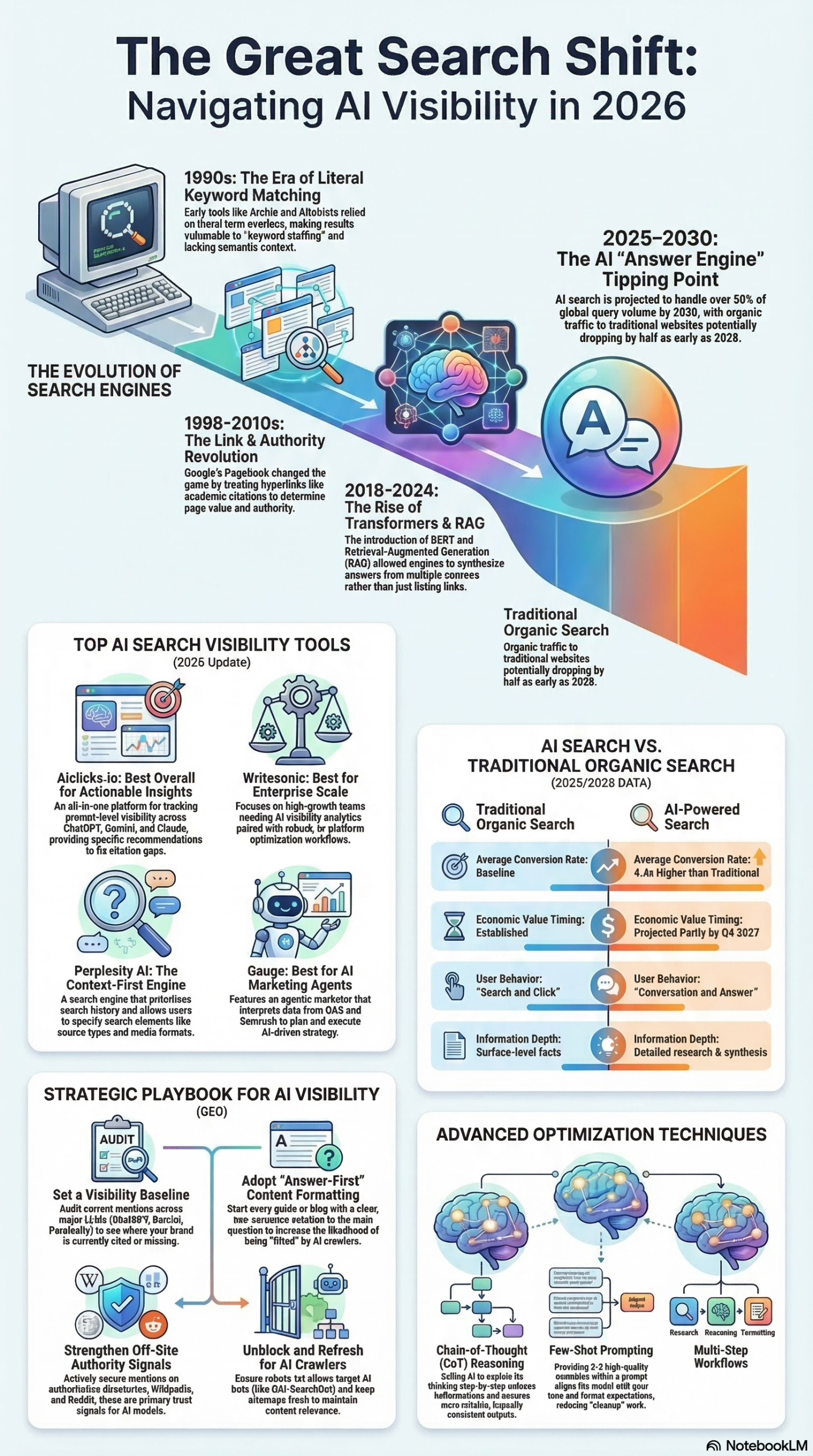
Tools that automate this process include AIclicks.io, Profound, and Authoritas for multi-market requirements. If budget is a constraint, manual testing with a structured spreadsheet gives you an honest baseline that automated tools can augment later.
Phase 2: Gap Analysis — Diagnose Why You’re Missing
With your baseline established, diagnose the root cause of your gaps. According to the 2026 AI Search Visibility Briefing, there are three primary reasons a brand fails to appear in AI answers:
Reason 1: Insufficient authoritative external citations.
AI models validate brands through trusted third-party contexts. If your brand is primarily mentioned only on your own website, models have no external confirmation signal. Authoritative external sources include: G2 and Capterra review pages, Product Hunt profiles, industry “best of” listicles, Reddit threads in relevant subreddits, Wikipedia entries or citations, and vertically specific directories.
Diagnosis: Search Reddit for your category and check whether your brand appears in existing discussions. Query G2 and Capterra for your category — is your profile complete and active? Check whether any industry “top tools” lists include you. Map the gap between where you appear and where competitors appear.
Reason 2: On-site content is not structured for AI retrieval.
Traditional SEO content is written for human scanning: narrative introductions, flowing paragraphs, conclusions. AI retrieval systems favor answer-first structures — direct declarative statements in the first sentence, bullet-point breakdowns, FAQ sections with exact question phrasing, and machine-readable tables. If your most important pages bury the answer after three paragraphs of context, the retrieval layer will pass over your content.
Diagnosis: Load your top 10 pages and read the first 50 words. Does each page answer its primary question within those words? If not, that’s a retrieval gap.
Reason 3: Semantic mismatch between your content and user query language.
As Kaz Sato documented in the context of RAG systems, the query and the answer often share no literal vocabulary. If your content uses internal terminology that buyers don’t use in their prompts, you’re invisible to semantic retrieval even if your content is factually correct and well-structured.
Diagnosis: Compare your content vocabulary to the exact language in your prompt battery. If your landing page talks about “automated analytics delivery” but your prompts use “automate client reporting,” the semantic bridge may not exist. Add language that spans both framings.
Phase 3: Optimization — On-Site and Off-Site in Parallel
Run on-site and off-site optimization tracks simultaneously. Neither is sufficient alone.
On-Site Optimization Checklist:
-
Answer-first intros: Rewrite your key page introductions so the primary answer appears in the first one to two sentences. Context and elaboration follow — but the answer comes first.
-
FAQ sections with exact question phrasing: Add a minimum of five FAQs at the bottom of each key landing page. Use the exact question phrasing from your prompt battery — these become the literal text strings AI engines match against.
-
Schema markup: Implement FAQ schema, HowTo schema, and Organization schema across relevant pages. These act as explicit machine-readable signals that accelerate AI crawler comprehension.
-
Structured data tables: Add comparison tables, feature matrices, specification tables, and pricing comparisons. Structured tabular data is significantly more parseable than equivalent prose content.
-
Explicit entity association: Ensure your brand name, product names, and key personnel are mentioned explicitly and consistently throughout every important page — not inferred from context. AI entity recognition requires explicit repetition.
Off-Site Optimization Checklist:
-
Secure placements in authoritative listicles: Identify the top five “best of” lists for your category and pursue editorial or sponsored placement. A well-cited industry guide mention provides stronger AEO signal than traditional backlinks in most cases.
-
Build active Reddit presence: Identify three to five subreddits where your buyers ask questions and participate genuinely. AI models frequently draw from Reddit threads — an authentic, helpful response that mentions your brand creates citation material. This is a slow-burn play: start now, not when you need it.
-
Optimize directory listings: G2, Capterra, Product Hunt, Crunchbase, and LinkedIn company pages are all actively sourced by AI models. Every field should be complete, accurate, and keyword-rich with the vocabulary your buyers use.
-
Pursue Wikipedia relevance: Wikipedia entries and citations represent some of the highest-weight external signals for AI models. If your product category has a Wikipedia article that doesn’t mention your brand, assess whether a neutral, factual contribution is warranted. Even a citation in the external links section of a relevant article provides meaningful signal.
Phase 4: Measurement — Build the Feedback Loop
As Conor Bronsdon of Galileo noted about AI optimization broadly, “Without measurement standards, each prompt you revise becomes guesswork, wasting time when hallucinations force you into manual review cycles.” This applies directly to AEO: without systematic re-measurement, you have no way to connect input to output.
Step 1: Set a re-measurement cadence.
Re-run your full prompt battery every two weeks. AI model retrieval indices and source weighting update frequently — your visibility score can change materially without any action on your part. Bi-weekly measurement captures these shifts and separates your optimization signal from external noise.
Step 2: Create a custom GA4 channel grouping for AI referrers.
By default, sessions from AI platforms appear as direct traffic or ungrouped referrals. Create a custom channel grouping that captures traffic from: chat.openai.com, perplexity.ai, gemini.google.com, copilot.microsoft.com, and any other AI interfaces relevant to your audience. This makes your AI-referred traffic a named, trackable channel.
Step 3: Track conversion rates from AI referrers separately.
AI-referred visitors arrive pre-qualified — an AI told them your brand is worth investigating. In most deployments, they convert at two to three times the rate of standard organic search visitors. Tracking this separately builds the business case for continued AEO investment and surfaces when specific optimization actions produce measurable conversion improvement.
Step 4: Connect input changes to visibility outcomes.
When your visibility score increases, investigate what changed in the two weeks prior. A new G2 review cluster? A Reddit thread going active? A new listicle placement? Building the input-to-output map over time gives you a prioritized playbook for what AEO levers actually move your specific brand in your specific category.
Expected Outcomes
After executing this four-phase system over 60 to 90 days, brands with solid on-site structure and moderate off-site authority typically see:
- Visibility scores increase from the 10–25% baseline range to 40–60% on target query sets
- AI-referred traffic become a measurable, named channel in GA4 (typically 4–10% of new visitor sessions)
- Competitive gap analysis identifying specific high-value prompts where competitors hold positions that are displaceable with targeted off-site work
Real-World Use Cases
Use Case 1: B2B SaaS Company Experiencing Unexplained Pipeline Decline
Scenario: A project management SaaS company has maintained top-five Google rankings for its primary keywords for three years but reports a 30% decline in inbound demo requests through Q4 2025. No changes to SEO strategy, ad spend, or product pricing explain the drop.
Implementation: The team runs the Phase 1 baseline audit and discovers they appear in only 12% of relevant ChatGPT prompts, compared to three competitors averaging 55%. Root-cause analysis identifies three gaps: no active G2 presence, landing page content buried answers three paragraphs in with no FAQ blocks, and zero Reddit activity in relevant subreddits. Over six weeks they restructure their top pages with answer-first intros and FAQ schema, build a G2 profile to 50+ customer reviews, and have customer success reps participate authentically in industry Reddit threads.
Expected Outcome: Visibility score reaches 48% within 90 days. AI-referred sessions, previously invisible in GA4, represent 8% of all new visitor sessions with a conversion rate double that of organic search. Pipeline recovery attributed to the AEO channel by end of Q1 2026.
Use Case 2: Digital Agency Productizing AEO as a Retainer Service
Scenario: A 12-person digital agency whose core offering has been technical SEO for mid-market B2B clients wants to build AEO as a new retainer service line with a standardized delivery model.
Implementation: The agency builds a standardized baseline audit using AIclicks.io for automated tracking supplemented by manual prompt testing across four engines. They develop a 90-day deliverable package: audit report with visibility scores per engine, on-site restructuring playbook covering the top 10 client pages, off-site placement campaign targeting five authoritative listicles and full directory build-out, and monthly measurement reports with GA4 AI referrer channel data.
Expected Outcome: Three AEO retainers launched at $3,500/month in Q1 2026. Client visibility scores measurably improve within 60 days, with GA4 AI referrer channel data providing clear proof-of-value for renewal conversations. The standardized audit-to-delivery model scales to six retainers by Q2 without adding headcount.
Use Case 3: Global Enterprise Closing Multi-Market Visibility Gaps
Scenario: A B2B logistics software company operating across 14 countries discovers, through a baseline audit, that AI search visibility varies dramatically by language and market. They appear in 60% of English-language prompts but under 15% of German and French prompts — markets that represent 35% of their total addressable opportunity.
Implementation: Using Authoritas for multilingual monitoring, the team maps the source gap: German-language AI engines draw heavily from German trade association directories and professional forums where the company has no presence. They localize their FAQ content and schema markup and execute a targeted German-language off-site placement campaign focused on directory listings and trade association mentions.
Expected Outcome: German-market AI visibility increases from 15% to 42% within 120 days, recovering a discovery channel that had been entirely invisible to previous attribution. French-market work follows the same playbook in the subsequent quarter.
Use Case 4: Ecommerce Brand Optimizing for AI Shopping Queries
Scenario: A direct-to-consumer outdoor gear brand wants to appear when users ask Perplexity or ChatGPT for gear recommendations in specific buying categories — backpacking tents, trail running shoes, ultralight cookware.
Implementation: They implement hybrid retrieval signals across their product catalog: detailed product schema with precise specifications (packed weight, temperature rating, material specs), FAQ content addressing exact buying-decision questions (“What tent performs best for three-season backpacking under 3 lbs?”), and authentic participation in gear review communities and forums that AI models actively index. They use schema markup at the product level to ensure specification data is machine-readable.
Expected Outcome: Brand appears in AI gear recommendation responses for target product categories within 90 days, driving referral sessions from AI platforms with higher average order values than both paid social and organic search traffic — because AI-referred shoppers arrive with a specific product recommendation already in mind.
Common Pitfalls
Pitfall 1: Optimizing before measuring.
Teams jump to content restructuring and off-site citation building without establishing a baseline. Without a documented starting visibility score and engine-specific gap analysis, every optimization action is a guess. Run the audit first — even a manual 25-prompt baseline across two engines beats no measurement at all.
Pitfall 2: Treating AEO as a one-time project.
AI models update retrieval indices and source weighting systems regularly. A visibility score of 60% today can drop to 35% in 60 days if a competitor builds stronger citation signals or a key forum thread shifts. AEO requires the same ongoing cadence as traditional SEO maintenance — treat it as a continuous practice, not a deliverable with an end date.
Pitfall 3: Relying exclusively on on-site changes.
On-site restructuring (FAQ sections, schema, answer-first intros) is necessary but insufficient. AI models validate brands through external citations. A beautifully structured website that no authoritative third-party has referenced will still score poorly in AI visibility audits. According to the 2026 AI Search Visibility Briefing, off-site signal building represents 40–50% of the total optimization work.
Pitfall 4: Conflating Google AI Overviews with ChatGPT and Perplexity.
Google AI Overviews draws from the Google index and responds to traditional domain authority signals. ChatGPT and Perplexity use different source weighting, pulling more heavily from forums, Reddit, and directory sites. Strategies optimized for one engine don’t automatically transfer. Run audits across all four major platforms and optimize engine-specifically for your largest gaps.
Pitfall 5: Skipping GA4 attribution setup.
Without a custom channel grouping for AI referrers, AI-driven conversions remain lumped into direct traffic — invisible and uncredited. This makes it impossible to demonstrate ROI for AEO work and leads to systematic deprioritization of the channel. Set up AI referrer attribution in GA4 before you run your first optimization sprint.
Expert Tips
Tip 1: Use the AI engine itself to diagnose your gaps.
After running your baseline audit, ask ChatGPT directly: “Why wasn’t [Brand Name] mentioned when I asked about [category]?” The model often reveals the exact signal gap — no external citations, weak category association, or ambiguous entity recognition. This diagnostic shortcut can save days of manual investigation and points you directly at the highest-leverage fix.
Tip 2: Prioritize Wikipedia entry quality strategically.
Wikipedia entries and citations are among the highest-weight external signals for AI models. If your product category has a Wikipedia article that doesn’t mention your brand, and your brand meets notability criteria, a neutral, factual contribution is worth pursuing. Even a citation in the external links section of a relevant category article provides meaningful anchor signal that models consistently draw from.
Tip 3: Start Reddit participation 6–12 months before you need citations.
Reddit participation is a slow-burn play: accounts need history and karma for contributions to carry weight, and promotional content is aggressively moderated. The brands that benefit from Reddit citations in 2026 are the ones that started genuine community participation in 2024–2025. Start now, in the subreddits where your buyers actively ask questions, and provide authentic value before you need the citation.
Tip 4: Automate your baseline audit with the OpenAI API.
Given GPT-5.4’s agentic capabilities and tool search efficiency (reducing token costs by up to 47% per the 2026 AI Search Visibility Briefing), building an automated prompt-testing pipeline is now feasible for mid-size teams. A lightweight Python script that submits your 30-prompt battery to the API on a scheduled basis and logs brand mentions reduces manual audit time from three hours to under 20 minutes — making bi-weekly measurement sustainable at scale.
Tip 5: Stack on-site work across SEO and AEO — differentiate at the off-site layer.
FAQ sections, schema markup, structured data tables, and answer-first content structure improve both traditional Google rankings and AI visibility simultaneously. The foundational on-site content investment is shared across both strategies. Where they diverge: off-site signals (AEO needs forum and directory presence; SEO needs backlink authority) and measurement (AEO needs AI referrer attribution). Build the on-site layer once, correctly — then differentiate your off-site and measurement work based on the specific channel you’re optimizing for.
FAQ
Q: How long does it take to see measurable results from AEO?
On-site changes — FAQ sections, schema markup, answer-first intros — can influence AI retrieval within two to four weeks as crawl cycles for major AI engines are relatively frequent. Off-site signals (directory listings, Reddit presence, authoritative listicle citations) take six to twelve weeks to accumulate sufficient weight. A realistic window for measurable visibility score improvement is 60–90 days, with meaningful traffic impact at the 90–120 day mark. AIclicks.io and Profound both provide prompt-level tracking that lets you attribute visibility changes to specific optimization actions as they register.
Q: Do I need a dedicated AEO tool, or can I use my existing SEO platform?
As of March 2026, most traditional SEO platforms — including Semrush, which reoriented its platform specifically around this shift — are building AI visibility tracking into their core offerings. However, dedicated AEO tools like AIclicks.io or Profound provide deeper prompt-level analytics and engine-specific gap analysis than general SEO platforms currently offer. The practical answer: start with your existing platform’s AI features to avoid adding tool costs, then layer in a dedicated AEO tool for clients or categories where AI visibility is a primary growth driver.
Q: How do AI models decide which brands to mention in their answers?
Based on the 2026 AI Search Visibility Briefing, AI models synthesize answers from sources they treat as authoritative, including: trusted external platforms (G2, Reddit, Wikipedia, industry directories), structured and machine-readable on-site content, and consistent entity signals (your brand name appearing in relevant context across multiple independent sources). There is no single ranking factor — it’s a retrieval system that weights multiple trust signals simultaneously, and the weighting varies by engine. Google AI Overviews weights domain authority heavily; ChatGPT and Perplexity weight forum and directory presence more heavily.
Q: What’s the relationship between traditional SEO and AEO — do they compete?
They share a content infrastructure foundation: both benefit from clear, structured, answer-oriented content with strong schema markup. The divergence is in signals and measurement. Traditional SEO prioritizes domain authority and backlink profiles; AEO prioritizes citation frequency in authoritative third-party contexts and machine-readable content structure. A strong traditional SEO foundation doesn’t guarantee AI visibility, but it creates a platform to build on. AEO is built on top of SEO, not instead of it — and the on-site content investment largely serves both strategies simultaneously.
Q: How do I handle situations where AI incorrectly describes my brand or products?
AI hallucinations about brands are a real operational risk, particularly for companies with recent pivots, rebrands, or new product lines. The mitigation strategy has two parts. First, ensure your authoritative external sources — Wikipedia (if applicable), G2, Crunchbase, official press releases indexed by Google — are current and accurate, as models tend to pull entity descriptions from these high-authority sources. Second, monitor AI responses about your brand regularly as part of your bi-weekly audit cadence. When false claims surface, update the most authoritative source material the model is likely drawing from. Direct model-level corrections at scale aren’t currently feasible, so upstream source accuracy is the primary lever.
Bottom Line
The shift from traditional SEO to Answer Engine Optimization is not a future trend — it is the operating reality in 2026. Gartner projects a 25% drop in traditional search volume this year alone, and the trajectory toward 2028 points to a world where half of all brand discovery happens through AI interfaces that never surface a list of links. The brands that build AI visibility now — through structured content, authoritative external citations, and systematic measurement infrastructure — will own the new discovery channel as it matures. Those that don’t will experience what AIclicks.io’s Matas Kibildis described: flat organic metrics while buyers quietly migrate to AI assistants that never mention their name. The four-phase system in this tutorial — baseline audit, gap analysis, optimize, measure — is implementable in 90 days with existing tools and teams. The only thing preventing most brands from starting is the assumption that this shift is still coming. It isn’t. It’s here.


0 Comments