

Influencer marketing has entered a new era—one where brand visibility no longer depends solely on contracts, sponsorship disclosures, or campaign briefs. Instead, a growing share of consumer attention is being shaped by something far more ambiguous:
unofficial brand mentions.
A creator casually tags a luxury skincare label.
A TikTok fashion influencer posts a “fit check” featuring a recognizable brand—without any #ad.
A YouTuber links to a product in the description with no sponsorship language.
The audience assumes it’s a partnership.
But sometimes, it isn’t.
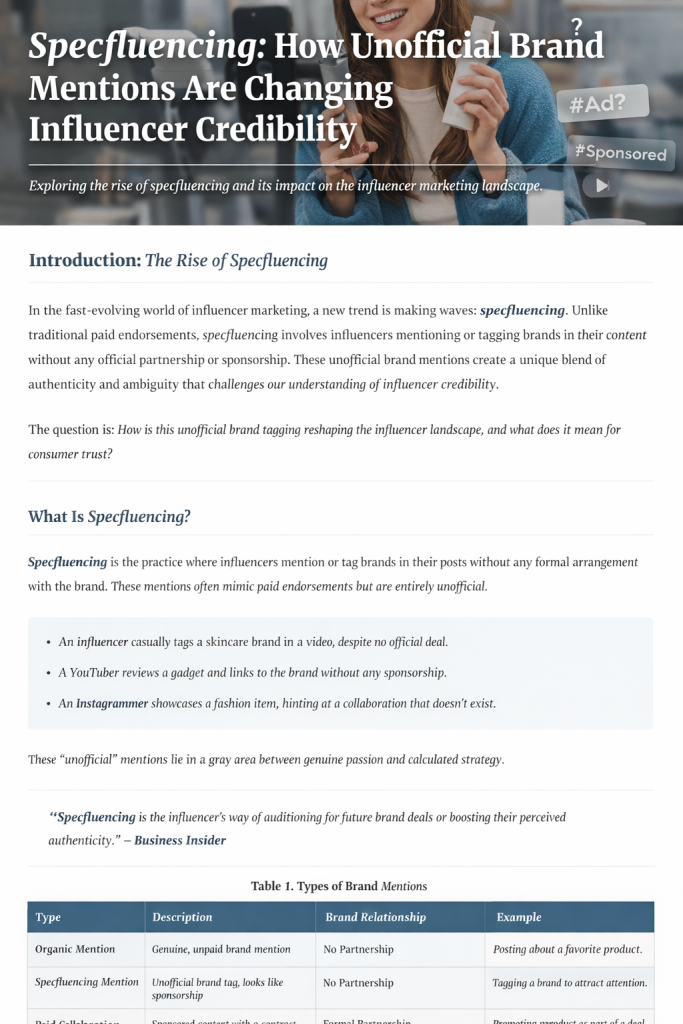
This emerging phenomenon is increasingly known as specfluencing: a trend where influencers mention or tag brands in ways that resemble endorsements, even though no formal collaboration exists.
Specfluencing sits in a grey zone between organic word-of-mouth and paid influencer advertising. It raises urgent questions for marketers, regulators, creators, and consumers:
- What happens when brand credibility is borrowed without permission?
- How does trust change when sponsorship status is unclear?
- Is specfluencing authentic enthusiasm—or strategic self-branding?
In a digital economy where trust is the ultimate currency, specfluencing may become one of the most important credibility challenges of the influencer age.
What Is Specfluencing?
Specfluencing refers to the practice of influencers or creators mentioning, tagging, or featuring brands without an official partnership, often in a way that looks like sponsored content.
The term has gained traction as creators increasingly “speculate” or “signal” brand affiliation to:
- attract attention from brands,
- increase perceived status,
- or position themselves for future paid collaborations.
As Exchange4Media describes, specfluencing involves creators promoting brands informally, creating ambiguity around whether content is earned, organic, or sponsored (Exchange4Media, 2025).
Unlike traditional influencer marketing, specfluencing does not involve:
- signed contracts,
- campaign deliverables,
- formal payments,
- or mandated disclosures.
Yet it often mimics the aesthetic and structure of paid endorsement.
Why Specfluencing Is Emerging Now
Specfluencing is not random—it is a product of several structural shifts in the creator economy.
1. Influencer Saturation
The influencer market is crowded. Millions of creators compete for visibility, making it harder to stand out.
Creators increasingly use brand tags as a form of legitimacy signaling—suggesting proximity to high-status brands even without formal deals.
2. Platform Algorithms Reward Brand Signals
Social algorithms prioritize content that appears commercially relevant:
- recognizable products,
- lifestyle branding,
- consumer goods.
Tagging brands can increase reach because platforms interpret the content as marketable.
3. The Collapse of the Paid/Organic Boundary
Influencer content today exists on a continuum:
- organic recommendations,
- affiliate links,
- gifted products,
- paid sponsorships,
- brand ambassadorships.
Specfluencing thrives in this blurred ecosystem.
Types of Brand Mentions in the Influencer Economy
To understand specfluencing, it helps to map different brand mention categories.
Table 1: Brand Mention Typology
| Type of Mention | Paid Relationship? | Disclosure Required? | Audience Perception | Example |
|---|---|---|---|---|
| Organic Mention | No | No | Authentic enthusiasm | “I love this coffee shop!” |
| Specfluencing Mention | No | No (but ambiguous) | Looks like sponsorship | Tagging Dior without partnership |
| Gifted Collaboration | Sometimes | Yes (in many jurisdictions) | Semi-sponsored | Brand sends free product |
| Affiliate Promotion | Indirect payment | Yes (recommended) | Monetized recommendation | Amazon storefront link |
| Paid Sponsorship | Yes | Yes legally required | Explicit advertising | “Paid partnership with Nike” |
Specfluencing is distinct because it creates endorsement cues without formal endorsement reality.
The Central Issue: Credibility
Influencer marketing works because of one thing:
trust.
Influencers are persuasive not because they are celebrities, but because they are perceived as:
- relatable,
- authentic,
- knowledgeable,
- independent.
This aligns with decades of persuasion research on source credibility.
Source Credibility Theory
Source credibility theory argues that communication effectiveness depends on perceived:
- expertise,
- trustworthiness,
- attractiveness.
This framework has been widely applied to influencer marketing (Hovland & Weiss, 1951).
Modern studies confirm that influencer credibility strongly predicts consumer attitudes and purchase intentions (Lou & Yuan, 2019).
Specfluencing introduces uncertainty into this credibility equation.
Why Specfluencing Challenges Influencer Authenticity
Specfluencing creates a paradox:
- It appears authentic because it is not paid.
- But it can also appear manipulative because it is strategic.
Consumers may ask:
- “Are they being genuine?”
- “Are they pretending this is sponsored?”
- “Are they trying to impress brands rather than help followers?”
This triggers what researchers call persuasion knowledge—the awareness that someone may be trying to influence you (Friestad & Wright, 1994).
When persuasion knowledge activates, trust declines.
The Psychology Behind Specfluencing
Specfluencing succeeds because it taps into several psychological mechanisms:
1. Status Signaling
Brand mentions function as cultural capital.
Luxury tags communicate:
- exclusivity,
- taste,
- social hierarchy.
Even without payment, creators benefit socially from association.
2. Halo Effects
Brands carry reputational halos.
If a creator tags Apple, Prada, or Sephora, audiences may subconsciously transfer brand prestige onto the influencer.
3. Social Proof and Parasocial Trust
Influencers operate within parasocial relationships—followers feel they “know” them.
Parasocial trust increases persuasion power (Sokolova & Kefi, 2020).
Specfluencing exploits this trust without formal accountability.
Specfluencing vs. Traditional Influencer Marketing
Table 2: Key Differences
| Dimension | Traditional Sponsorship | Specfluencing |
|---|---|---|
| Contractual Agreement | Yes | No |
| Brand Control | High | None |
| Disclosure Requirement | Mandatory | Often absent |
| Credibility Risk | Managed | Unpredictable |
| Measurement & ROI | Trackable | Hard to quantify |
| Ethical Clarity | Clear advertising | Grey zone |
Examples of Specfluencing in Practice
Specfluencing is common across industries:
Beauty
A creator posts:
“Obsessed with this new Glow Recipe serum 😍 @glowrecipe”
No partnership exists, but it appears like one.
Fashion
An influencer tags Zara or Gucci in an outfit post, hoping for reposts or sponsorship attention.
Hospitality
Travel creators tag luxury resorts without agreements, using brand proximity to elevate content.
Tech
YouTubers feature gadgets with affiliate incentives, but present the mention as organic.
Opportunities for Brands
Specfluencing is not purely negative. Brands can benefit.
1. Free Awareness
Unofficial mentions generate earned impressions without cost.
2. Creator Discovery
Brands can identify emerging creators already aligned with their products.
3. Authenticity Boost
Organic enthusiasm may appear more trustworthy than paid ads.
Risks for Brands
However, brands also face serious risks:
1. Brand Misalignment
Creators may represent values inconsistent with the brand.
2. Reputation Exposure
A controversial influencer specfluencing your brand may create unwanted association.
3. Consumer Confusion
Audiences may assume the brand endorsed the influencer, damaging credibility.
Risks for Influencers
Creators also risk long-term credibility.
1. Trust Erosion
If audiences feel manipulated, loyalty declines.
2. Regulatory Backlash
Even unpaid endorsements may trigger disclosure scrutiny in some jurisdictions.
The U.S. FTC, for example, emphasizes transparency when material connections exist (FTC Endorsement Guides, 2023).
3. Creator Authenticity Fatigue
Over-tagging brands can make creators appear transactional rather than genuine.
Specfluencing and the Future of Disclosure
Specfluencing highlights a major regulatory gap:
Disclosure rules focus on paid relationships, but specfluencing thrives in unpaid ambiguity.
As influencer economies mature, regulators may expand frameworks beyond payment to include:
- implied endorsement,
- affiliate incentives,
- strategic brand signaling.
Strategic Recommendations for Marketers
Brands should not ignore specfluencing. They should manage it strategically.
1. Monitor Unofficial Brand Mentions
Track creator tags as part of social listening.
2. Build Creator Relationship Pipelines
Specfluencers may become future ambassadors.
3. Create Clear Partnership Signals
Use platform tools like “Paid Partnership” tags to reduce confusion.
4. Develop Brand Safety Guidelines
Unofficial mentions should be evaluated for reputational risk.
Recommendations for Creators
Creators should treat specfluencing carefully.
Best practices include:
- Only tagging brands you genuinely use.
- Avoiding misleading endorsement aesthetics.
- Clarifying when no partnership exists.
- Prioritizing follower trust over brand attention.
Credibility is harder to rebuild than to monetize.
Conclusion: The Credibility Economy Is Changing
Specfluencing reflects the evolving nature of influence itself.
In a world where:
- authenticity is monetized,
- attention is algorithmic,
- and brand affiliation is cultural currency,
unofficial brand mentions are reshaping what credibility means.
Specfluencing is not simply a trend—it is a signal of the next phase of marketing:
where influence is no longer purchased only through contracts, but performed through perception.
For brands, creators, and consumers alike, the future of influencer credibility will depend not just on disclosure laws, but on trust norms.
And trust, once blurred, is difficult to reclaim.
References
Exchange4Media. (2025). Specfluencing: How unofficial brand mentions are changing influencer credibility. Exchange4Media.
Federal Trade Commission. (2023). FTC Endorsement Guides: What people are asking. https://www.ftc.gov
Friestad, M., & Wright, P. (1994). The persuasion knowledge model. Journal of Consumer Research, 21(1), 1–31.
Hovland, C. I., & Weiss, W. (1951). The influence of source credibility on communication effectiveness. Public Opinion Quarterly, 15(4), 635–650.
Lou, C., & Yuan, S. (2019). Influencer marketing: How message value and credibility affect consumer trust. Journal of Interactive Advertising, 19(1), 58–73.
Sokolova, K., & Kefi, H. (2020). Instagram influencers and purchase intention: The role of trust and parasocial relationships. Journal of Retailing and Consumer Services, 55.


0 Comments