

AI now handles 70–90% of the administrative work your marketing team used to spend most of its time on, according to Bain & Company research cited by Martech. The competitive edge in marketing has permanently shifted — not to whoever runs the most AI tools, but to whoever exercises the sharpest judgment about when, how, and why to use them. This tutorial walks you through a practical operating model for building a judgment-first, AI-augmented marketing function from the ground up.
What This Is
The marketing industry is in the middle of a structural inversion. For two decades, competitive advantage came from execution speed: who could produce more content, run more tests, and ship more campaigns faster. AI just rendered that race largely irrelevant.
According to the AI-Driven Marketing Transformation research report, 88% of marketers now use AI daily, yet only 15% of CEOs believe their marketing leaders are “AI-savvy.” That gap is not a technology gap — it’s a judgment gap. Most teams have adopted AI tools for drafting, scheduling, and basic optimization. Very few have restructured how decisions get made once AI handles the grunt work.
Martech describes this moment precisely: AI automates tactical execution, which shifts competitive advantage from manual coordination to strategic vision, human judgment, and deep customer understanding. When every agency and in-house team can spin up campaign copy in seconds, the content itself stops being the differentiator. What differentiates you is the quality of the brief, the strength of the strategy behind it, and the judgment call about whether to deploy it at all.
The research report identifies the emerging model as Agentic AI — autonomous systems that don’t just draft text on command but proactively understand context, plan multi-step workflows, and execute across tools without human intervention at every step. Think of it less like a smart autocomplete and more like a fleet of junior contractors who never sleep, never need onboarding, and never get distracted. By 2028, it is projected that one in five marketing functions will be handled by an AI worker.
What this changes for marketing leaders is profound. The CMO’s mandate is no longer production management — it’s orchestration. That means deciding which agents to deploy, setting the strategic guardrails they operate within, monitoring output quality, and ensuring the human judgment layer stays sharp even as the mechanical layer becomes fully automated.
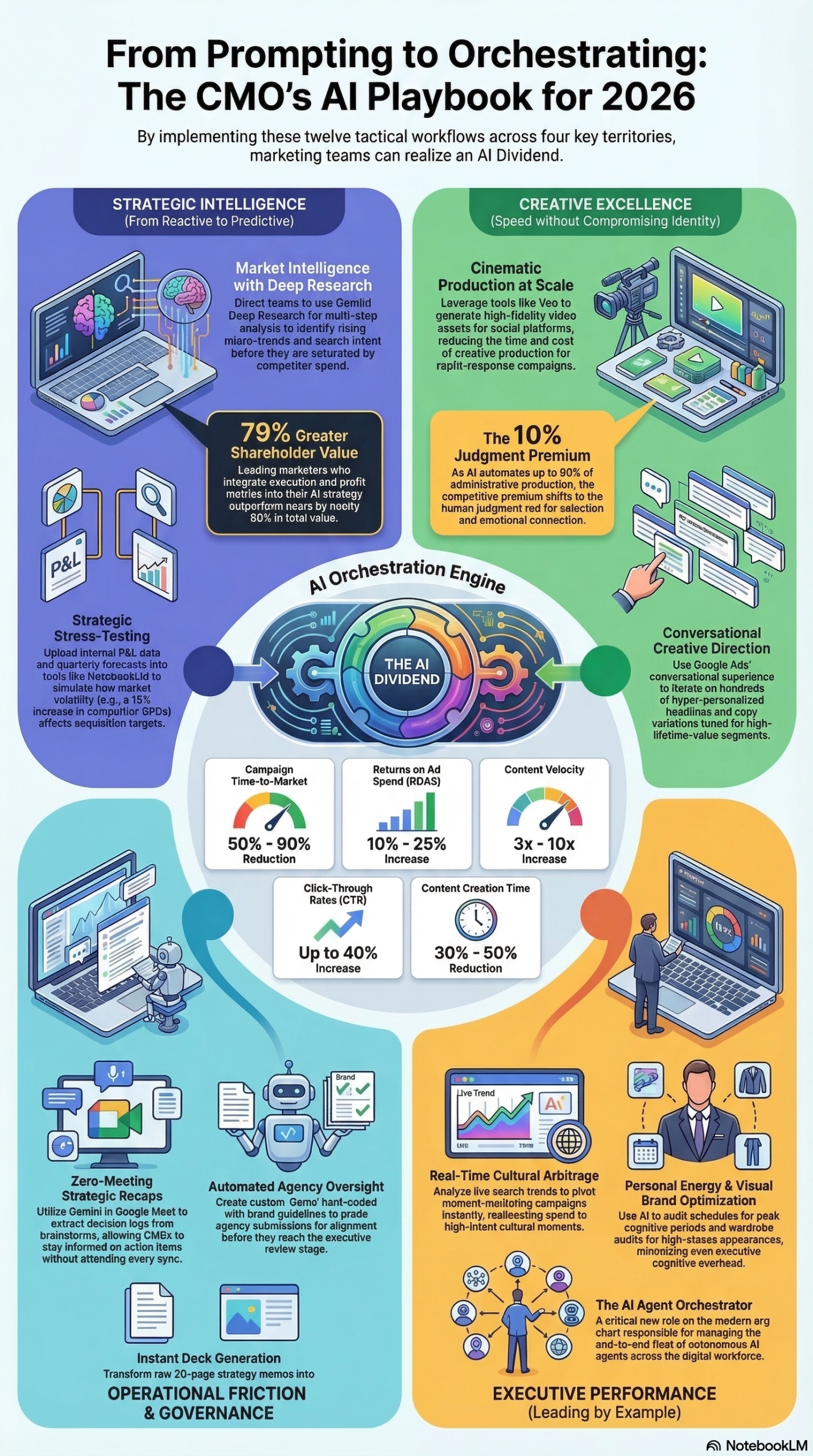
This isn’t theoretical. The same research shows that leading marketers — those who pair AI-driven execution with strong brand strategy and creative judgment — deliver 79% greater total shareholder value than peers who use AI primarily as a cost-cutting tool. The technology is the same. The judgment layer is what separates winners from organizations flooding their channels with what the industry is calling “workslop”: high-volume, low-quality AI output that erodes customer trust faster than it builds pipeline.
The framework that emerges from this shift is what we’ll build in this tutorial: a practical, structured operating model that lets you capture all of AI’s execution speed while systematically protecting the judgment layer that actually drives margin.
Why It Matters
The practitioners who are getting this wrong are making a consistent mistake: they’re treating AI as a volume knob. Crank it up, get more output, hit more targets. Martech defines the result as “workslop” — low-quality, generic output produced when teams are pressured to use AI to deliver more volume with less time for quality control.
Here’s why this matters financially: research by PwC and the ANA frames marketing performance around a “Marketing Value Creation Flywheel” with a critical metric — the Marketing Profit Multiplier, defined as gross profit divided by marketing spend. Organizations that reinvest AI-driven efficiency gains back into marketing effectiveness are more than twice as profitable as those that simply bank the savings. Running AI as a cost-cutter is a one-time gain. Running it as a force multiplier for your best strategic thinking is compounding.
For agency practitioners and in-house teams alike, the immediate workflow implication is this: if you’re spending the hours you saved with AI drafting tools on more drafts, you’re doing it wrong. Those hours belong in strategy, brand interrogation, and customer insight work — the 10% of activities that generate the actual competitive premium.
The talent dimension is equally consequential. The research report notes that title-based hierarchies are giving way to skill-based networks, with a new emergent role gaining traction: the AI Agent Orchestrator, responsible for selecting, configuring, and scaling the “agent stack.” Marketing organizations that build this capability internally will have structural advantages over those that outsource it to agencies or vendors who don’t understand the brand from the inside.
The search dimension adds urgency. Traditional search traffic is predicted to decline by 25% by 2026, as users shift to AI-generated answers from tools like ChatGPT and Gemini. Brands that haven’t begun building AI Engine Optimization (AEO) strategies — establishing entity authority and citation-worthy content structures so LLMs reference them — are already falling behind in a channel that hasn’t peaked yet.
The Data
The following table maps the transformation from the old execution-first model to the judgment-first AI-augmented model across key marketing dimensions, based on data from the research report and Martech.
| Dimension | Old Execution-First Model | AI-Augmented Judgment-First Model |
|---|---|---|
| Primary competitive advantage | Volume and production speed | Strategic judgment and brand clarity |
| AI role | Tool for drafting and scheduling | Autonomous agent fleet for end-to-end execution |
| CMO mandate | Managing production workflows | Orchestrating AI systems and protecting brand integrity |
| Org structure | Title-based hierarchy and functional silos | Skill-based networks centered on the customer |
| Search strategy | SEO (backlink density, keyword targeting) | AEO/GEO (entity authority, LLM citation-worthiness) |
| Personalization model | Segmentation and batch-and-blast | Real-time dynamic content based on intent and behavior |
| Content quality risk | Low (production bottleneck limits volume) | High (“workslop” risk as AI removes the bottleneck) |
| Key performance metric | Click-through rates and content velocity | Marketing Profit Multiplier (gross profit ÷ marketing spend) |
| AI adoption rate | Selective use for specific tasks | 88% of marketers use AI daily |
| TSV advantage (top performers) | Baseline | 79% greater total shareholder value |
| Admin task automation potential | ~30% with basic tools | 70–90% with agentic workflows (Bain & Company) |
| Tech stack size (avg. enterprise) | Growing — average 130+ applications | Consolidating — target: high-utilization core stack |
Sources: AI-Driven Marketing Transformation Research Report, Martech (March 2026), Bain & Company via Martech
Step-by-Step Tutorial: Building a Judgment-First AI Marketing Operating Model
This tutorial walks you through how to actually restructure a marketing function — whether you’re an in-house team, an agency, or a solo practitioner — to capture AI’s execution speed without surrendering the judgment layer that creates value.
Phase 1: Audit Your Workflows for Automation vs. Judgment
Before deploying anything new, you need a clear map of what your team actually does. Pull up your last 30 days of marketing activity and categorize every recurring task into one of three buckets:
Bucket A — Pure execution (automate immediately): Tasks with defined inputs and predictable outputs. Examples: drafting first-pass copy from a brief, resizing images for multiple formats, scheduling social posts, pulling weekly performance reports, A/B testing subject line variants, keyword research for known topic clusters.
Bucket B — Judgment-augmented (AI assists, human decides): Tasks where AI accelerates research or production but a human must validate the output before it ships. Examples: campaign brief development, agency creative review, budget allocation recommendations, persona refinement, brand voice consistency checks.
Bucket C — Human-only judgment (do not automate): Tasks where the value is entirely in the decision quality and no AI output should ship without full human authorship or approval. Examples: brand positioning decisions, crisis communications, partnership agreements, executive messaging, market entry strategy.
Most teams discover that 60–70% of their weekly activity falls into Bucket A. This is where you start.
Phase 2: Build Your Agentic Stack for Bucket A
Pick one Bucket A workflow and build a complete agentic pipeline for it before expanding. The goal is a working proof of concept, not a full transformation on day one.
Example pipeline: Weekly content production
-
Input layer: Define a structured brief template. Every piece of AI-generated content must start with a brief that specifies audience segment, goal, key message, tone, and call to action. The brief is a human document. Do not let AI write the brief.
-
Drafting agent: Use your preferred LLM (ChatGPT, Claude, Gemini) with a custom system prompt that encodes your brand voice guidelines, prohibited phrases, and citation requirements. This is not the default chatbot — it’s a configured agent with hard-coded guardrails.
-
Review agent: Build or configure a secondary AI pass that evaluates the draft against your brand guidelines before it reaches a human reviewer. This can be as simple as a prompt that checks for off-brand phrases, competitor mentions, or claims that require sourcing. The research report recommends creating “hard-coded AI versions of your brand guidelines to grade agency submissions for alignment before they reach executive review.”
Infographic: How to Lead AI-Augmented Marketing: Elevating Judgment Over Execution -
Human checkpoint: A single designated reviewer — not a committee — approves or rejects with a brief rationale. This keeps velocity high while maintaining the judgment gate.
-
Scheduling and distribution agent: Approved content routes automatically to your publishing queue, CMS, or social scheduler. No manual copy-paste.
This five-step pipeline can be built in a week for a single content type. Once it’s stable, replicate it for other Bucket A workflows.
Phase 3: Implement the 90/10 Governance Model
The research report describes the 90/10 rule: AI can automate 70–90% of administrative activities, but the remaining 10% — the judgment calls — generate the actual competitive premium. Operationalizing this requires explicit governance, not just good intentions.
Step 1: Define your judgment gates. For every agentic workflow, document exactly where human judgment is required before output ships. Write this down. Share it with the whole team. Make it a standing policy, not an ad-hoc call.
Step 2: Protect reviewer time. The biggest failure mode in AI-augmented teams is reassigning the hours saved on production to more production rather than better judgment. If your reviewers are now processing twice the volume, the quality gate is theater. Protect a fixed block of time per week for strategic work: brief development, audience research, competitive analysis, creative direction.
Step 3: Track workslop signals. Set up basic monitoring for output quality degradation. Useful signals include: declining engagement rates on AI-assisted content vs. human-led content, customer service escalations referencing confusing or off-brand communications, brand sentiment movement in social listening tools. If workslop is creeping in, the fix is almost never the AI tool — it’s the quality of the brief or the brief review process.
Phase 4: Restructure Your Metrics Around the Marketing Profit Multiplier
Most teams track execution metrics (impressions, clicks, content velocity) that tell you how fast the machine is running but not whether it’s running in the right direction. The research report frames the CMO Value Equation as a three-tier pyramid:
-
Top — Business Metrics: Revenue growth, market share, margin expansion, and the Marketing Profit Multiplier (gross profit ÷ marketing spend). These are the metrics you report to the C-suite.
-
Middle — Golden Metrics: 5–7 KPIs that tie directly to your business growth algorithm. Examples: brand equity index, customer lifetime value, net revenue retention, share of voice in AI-generated search results.
-
Bottom — Diagnostic Metrics: The operational details (CTR, content velocity, CPM) that explain why the Golden Metrics are moving.
Most teams currently live in the bottom tier and wonder why the C-suite doesn’t value marketing. Restructuring your reporting around this pyramid is itself a judgment exercise — and one that AI cannot do for you.
Practical step: In your next team meeting, take your current KPI dashboard and draw a line between metrics that connect to gross profit and metrics that don’t. Everything above the line gets reported to leadership monthly. Everything below the line stays in your operational tooling and gets used to diagnose problems.
Phase 5: Shift Search Strategy from SEO to AEO
Traditional SEO is becoming structurally less valuable as AI-generated answers displace organic search clicks. The research report notes that traditional search traffic is predicted to decline 25% by 2026, and that visibility in the AI era depends on entity authority — being cited by LLMs like ChatGPT and Gemini.
To build entity authority:
-
Create citation-worthy content structures. LLMs cite sources that are factually precise, well-structured, and clearly attributed. That means data-backed claims, named authors with credentials, clear publication dates, and structured headers that make your content easy to parse.
-
Establish topical depth, not just keyword breadth. A single comprehensive guide on a narrow topic earns more entity authority than ten shallow posts across broad keywords.
-
Diversify for multimodal discovery. Voice search now accounts for over 20% of global queries, and visual searches via Google Lens reach 20 billion monthly. Your content needs to be native to text, audio, and visual formats — not repurposed across them as an afterthought.
-
Monitor your LLM visibility. Manually test whether ChatGPT, Gemini, and Perplexity cite your brand when answering questions in your category. This is now a core marketing metric.
Expected Outcomes
A team that completes all five phases can expect: a 50–70% reduction in time spent on Bucket A execution tasks within 90 days, a measurable shift in team capacity toward strategic and creative work, reduced workslop risk through explicit governance, and improved alignment between marketing activity and C-suite financial metrics within one quarter.
Real-World Use Cases
Use Case 1: Mid-Market SaaS Company Rebuilding Content Operations
Scenario: A 12-person marketing team at a B2B SaaS company is producing 40+ pieces of content per month but seeing declining organic traffic as AI-generated search results displace their SEO-optimized blog posts.
Implementation: They audit workflows using the three-bucket framework and find that first-draft copy production, social scheduling, and performance reporting are all pure Bucket A. They build an agentic content pipeline with a brand-voice-trained drafting agent, an automated brand-guidelines review pass, and a single human editor as the judgment gate. The time saved — roughly 60 hours per month — is explicitly redirected to AEO strategy: building entity-authority content on three core topics, establishing an author credentialing program, and conducting monthly LLM visibility audits.
Expected Outcome: Within two quarters, LLM citation rate for brand terms increases, organic traffic decline slows, and the content team’s work begins appearing in AI-generated answers for their target buyer queries.
Use Case 2: Enterprise Brand Team Defending Against Workslop
Scenario: A Fortune 500 CPG brand’s marketing team is producing high-volume AI-assisted content across 14 regional markets and noticing brand voice inconsistency and a decline in social engagement quality.
Implementation: They implement a “hard-coded brand guardrails” agent — an AI configured with the full brand guidelines, prohibited phrases, tone specifications, and competitive sensitivity rules — that reviews every piece of AI-assisted content before it reaches a human approver. As recommended in the research report, this functions as an automated pre-screen that catches workslop before it reaches executive review, allowing human reviewers to focus on strategic alignment rather than copy-editing.
Expected Outcome: Brand voice consistency scores (measured via internal audit) improve within 60 days. Reviewer time per piece drops by 40% because the AI pre-screen eliminates the most obvious errors.
Use Case 3: Agency Repositioning as an Orchestration Partner
Scenario: A mid-size performance marketing agency is facing client pressure to cut fees as AI makes their execution work faster and cheaper. They need to reframe their value proposition.
Implementation: They shift their client delivery model from “we produce X assets per month” to “we orchestrate your AI marketing stack and own the judgment layer.” Concretely: they configure agentic pipelines for each client’s execution needs, then deploy their senior strategists on brief quality, audience insight, and competitive intelligence — the work AI cannot do autonomously. They introduce a Marketing Profit Multiplier review in every monthly client report, connecting marketing activity to gross profit rather than just clicks and impressions.
Expected Outcome: Client retention improves as value is measured at the margin level rather than the activity level. Senior strategist time on high-value judgment work increases from ~30% to ~70% of billable hours.
Use Case 4: Solo Marketer Competing with Larger Teams
Scenario: A solo content marketer supporting a 50-person startup needs to match the output of a four-person team at a competitor without hiring.
Implementation: They build a personal agentic stack — a drafting agent with brand-voice instructions, an automated keyword and entity research workflow, a social scheduling pipeline, and a weekly performance digest that pulls metrics without manual reporting. Per the 90/10 rule from the research report, they invest the saved time exclusively in Bucket C work: customer interviews, competitive positioning, and editorial strategy.
Expected Outcome: Output volume matches the competitor team’s pace within 60 days. Content quality — measured by engagement rate and LLM citation frequency — outperforms because the judgment layer is undiluted.
Common Pitfalls
1. Using AI as a volume knob without a quality gate.
The most common failure mode: you implement AI drafting tools, output increases 3x, but there’s no change to the review process. Reviewers get overwhelmed, quality checks become cursory, and workslop ships. The fix is building the human judgment gate before scaling AI output, not after.
2. Laying off staff based on hypothetical AI efficiency.
Martech explicitly warns against this: resist premature layoffs based on hypothetical AI efficiency before it’s proven stable. Agentic AI pipelines require ongoing human oversight and calibration, especially in the first six months. Teams that cut headcount too early find themselves without the judgment capacity to catch errors when the system fails.
3. Skipping the brief.
AI agents produce output at the quality ceiling of their input. If your briefs are vague, your AI output will be generic. The brief is the highest-leverage judgment document in an AI-augmented workflow. Invest in brief quality before investing in AI tooling.
4. Optimizing for execution metrics instead of profit metrics.
Teams that track content velocity, impression volume, and CPM in the AI era are measuring the cost of the machine, not the value it creates. As the research report warns, leading marketers drive margin expansion with AI — not just volume. If your reporting doesn’t connect to gross profit, you’re flying blind.
5. Treating AEO as optional.
With traditional search traffic projected to decline 25% by 2026, brands that haven’t started building entity authority in AI systems are accumulating a structural deficit. This is not a future concern — it’s a present one.
Expert Tips
1. Stress-test your strategy before automating it.
The research report recommends using tools like NotebookLM to upload internal P&L data and run scenario tests: “How does a 15% increase in competitor CPCs affect acquisition targets?” If your strategy can’t survive a stress test, automating its execution only makes the damage faster.
2. Use “deep research” agents for market alpha, not content.
Deploy AI’s research capabilities against competitive intelligence and emerging search trends — areas where human analysts have limited bandwidth. Gemini Deep Research and similar tools are specifically recommended for identifying niche opportunities not yet saturated by competitors. Save your human researchers for synthesis and strategic interpretation.
3. Consolidate your tech stack aggressively.
The average enterprise manages over 130 applications, but utilization has dropped to 33%. Strategic consolidation — eliminating redundant tools and standardizing on a lean core stack — can reduce costs by 50–77% while actually improving performance by reducing tool-switching overhead. More tools ≠ more capability.
4. Build AI literacy as a team skill, not an individual skill.
The research report distinguishes between AI tool familiarity (knowing how to use ChatGPT) and AI literacy (being able to distinguish good AI output from workslop, understand agentic systems, and set appropriate guardrails). Build the latter through team reviews of AI output, explicit feedback sessions, and shared brand guidelines that everyone contributes to and references.
5. Move from “first name” personalization to intent-based personalization.
73% of leaders believe AI will redefine personalization. The ceiling is not “Hi {First Name}” — it’s dynamic content that adjusts in real time based on browsing behavior, geographic context, and predicted purchase intent. Start building the data infrastructure and workflow for this now, even if the full implementation is 12 months out.
FAQ
Q: If AI can automate 70–90% of marketing tasks, does that mean most marketing jobs are at risk?
Not exactly, and the framing matters. The research is clear that 70–90% of administrative functions can be automated — the repetitive, process-following tasks. The remaining 10–30% of work — judgment, strategy, creative direction, customer empathy, brand stewardship — generates the actual competitive premium and cannot be automated. The jobs at risk are those defined entirely by execution tasks. The jobs that grow in value are those defined by judgment quality. The practical implication: redefine your role around the judgment layer, proactively.
Q: What is “workslop” and how do I know if my team is producing it?
Martech defines workslop as low-quality, generic output generated when teams are pressured to use AI to deliver more volume with insufficient time for quality control. Warning signs include: declining engagement rates on AI-assisted content, customer complaints about communications that feel generic or off-brand, increasing time-to-decision in creative reviews (because reviewers are overwhelmed), and content that is technically correct but strategically unmemorable. The fix is almost always process-level: slower, better briefs and a protected human judgment gate — not a different AI tool.
Q: How do I measure success after implementing an agentic marketing stack?
Use the Marketing Profit Multiplier framework from the research report: track gross profit divided by marketing spend as your primary metric, supported by 5–7 “Golden Metrics” that tie to your specific business growth algorithm (customer lifetime value, brand equity, net revenue retention). Execution metrics (CTR, impressions, content velocity) stay in your operational layer as diagnostic tools — not as headline KPIs. Success looks like: higher margin per dollar of marketing spend, more team time on strategic work, and increasing LLM visibility in your category.
Q: Should I be building AEO strategy now or wait until AI search is more mature?
Now. Traditional search traffic is projected to decline 25% by 2026 — which means the shift is already happening. Entity authority in AI systems is built through consistent, high-quality, well-attributed content over time; it’s not something you can sprint into at the last minute. The brands that start establishing citation-worthy content structures today will have a compounding advantage as AI-generated answers become the dominant search interface. Waiting is the highest-risk position.
Q: What’s the right way to handle brand governance when AI is generating most of the content?
The research report recommends automating the first layer of brand governance: configure a dedicated AI agent with your full brand guidelines, prohibited phrases, tone specifications, and competitive sensitivities to review every AI-generated piece before it reaches a human approver. This pre-screen catches systematic errors and frees human reviewers for genuine judgment calls — strategic alignment, tone at the edge, and situations the guidelines don’t explicitly cover. The key principle: humans own the final approval. AI accelerates creation; humans own the decision to publish.
Bottom Line
AI has commoditized marketing execution. The data is unambiguous: 88% of marketers already use AI daily, 70–90% of administrative tasks are automatable, and by 2028, one in five marketing functions will be held by an AI worker. The teams winning right now are not the ones with the most AI tools — they’re the ones who have restructured around the 10% of work that AI cannot replicate: judgment, brand stewardship, strategic vision, and genuine customer empathy. The practical mandate is clear: audit your workflows, automate the execution layer systematically, protect the judgment gate explicitly, measure against the Marketing Profit Multiplier, and start building entity authority in AI search systems today. The organizations that treat AI as a volume knob will erode their brand equity over the next two years. The ones that treat it as an orchestration platform for human judgment will compound their advantage.


0 Comments