

AI agents now crawl your website thousands of times before a single human ever arrives — and most of them never send anyone back. While the marketing industry has spent the last year panicking about “Google Zero” (the slow death of Google referral traffic), the more pressing problem is already here: your next significant “visitor” is a machine researching on behalf of a buyer, and your site either speaks its language or gets filtered out of the answer entirely. This tutorial walks you through exactly how to restructure your web presence for machine-driven discovery before your competitors do.
What This Is: Google Zero vs. the Machine Traffic Reality
The “Google Zero” narrative holds that Google, by answering queries directly through AI Overviews, is systematically cutting off the referral traffic that publishers and marketers have depended on since the early 2000s. The concern is real: Search Engine Land reports that queries with AI Overviews show 58–61% lower organic click-through rates, AI Mode shows a 93% zero-click rate, and AI Overviews now trigger on 25–48% of all U.S. searches. News sites saw a 26% traffic drop in the year following the rollout of AI Overviews, and overall, approximately 60% of all searches end without a click to an external site — rising to 77.2% on mobile, according to the NotebookLM research report.
But “Google Zero” is the wrong framing. It treats the problem as one publisher revenue model disrupted by one company’s product decision. The actual disruption is architectural.
According to the 2025 Imperva Bad Bot Report, bots now account for 51% of all web traffic. AI crawlers specifically represent 51.69% of all crawler traffic — surpassing traditional search engine crawlers (34.46%) for the first time. AI bot crawling grew more than 15x year-over-year, with roughly 50 billion AI crawler requests per day recorded by late 2025. These aren’t visitors. They’re scouts. They’re reading your content, extracting structured data, feeding it into reasoning models, and then — sometimes — influencing a purchase, a recommendation, or a shortlist that a human never actively Googled.
The crawl-to-referral ratio reveals how lopsided this exchange is. Search Engine Land reports:
- Anthropic’s ClaudeBot crawls 23,951 pages for every single referral it sends back.
- OpenAI’s GPTBot runs at a 1,276-to-1 crawl-to-referral ratio.
- Googlebot, by comparison, sends 831 times more visitors than these AI systems combined.
This is the actual problem. Your site is being harvested at industrial scale by systems that extract value from your content and route decisions — including buying decisions — based on what they find, without ever sending you a measurable session in Google Analytics.
The emerging discipline to address this is Answer Engine Optimization (AEO), sometimes called Generative Engine Optimization (GEO). Where traditional SEO optimizes pages to rank in an index, AEO optimizes content to be cited, quoted, and recommended by AI inference engines. As the AEO Optimization Starter Guide 2026 puts it: “Traditional SEO optimizes for an index. AEO optimizes for an inference engine.”
Why It Matters: The Invisible Buying Layer
If you’re in B2B or e-commerce, you need to understand what Gartner projects: 90% of B2B buying will be AI-agent intermediated by 2028. That’s not a speculative forecast — it’s already happening at scale. Salesforce data shows AI agents influenced 20% of global orders during Cyber Week 2025, generating $67 billion in sales through AI agent intermediation. Retailers deploying AI agents saw 13% sales growth compared to just 2% for those without. eMarketer projects AI platforms will drive $20.9 billion in retail spending in 2026 — nearly four times the 2025 figure.
The implication for practitioners is direct: an AI shopping agent making a recommendation on behalf of a consumer is reading your product data, your structured markup, your pricing, your certifications. If that data is buried in JavaScript-rendered templates, locked in narrative prose, or missing key identifiers like GTINs (Global Trade Item Numbers) and MPNs (Manufacturer Part Numbers), the agent either skips your product or generates a low-confidence recommendation that doesn’t land on the shortlist.
As Core dna summarizes: “If your website isn’t machine-readable, you’re essentially invisible to the millions of people using AI assistants to make buying decisions.”
This affects every category of practitioner:
- Marketers: Your content strategy must account for AI citation share, not just SERP position. A piece that ranks #4 but gets cited in ChatGPT, Perplexity, and Claude for ten related queries is outperforming a #1 ranking that gets zero AI citations.
- Developers: Your site architecture needs to serve structured data to AI crawlers natively — not as an afterthought bolted onto an existing CMS schema.
- E-commerce teams: Product data hygiene is now a revenue function. Missing GTINs aren’t just bad for Google Shopping; they’re disqualifying flags in agentic commerce pipelines.
- Agencies: Clients who demand traditional traffic metrics are measuring the wrong thing. Your reporting needs to include citation frequency, AI mix, and share of search.
The Data: How AI Traffic Has Reshuffled the Visibility Stack
The shift from keyword ranking to AI citation frequency is documented across multiple dimensions. Here’s how the two paradigms compare on every dimension that matters operationally:
| Dimension | Traditional SEO | Answer Engine Optimization (AEO/GEO) |
|---|---|---|
| Primary Goal | Rank pages for keywords | Get cited in AI-generated answers |
| Content Unit | Full page | Individual claims, paragraphs, facts |
| Query Matching | Keyword-based | Semantic / intent-based |
| Success Metric | SERP position, organic CTR | Citation frequency, Share of Voice |
| Crawler Type | Googlebot, Bingbot | GPTBot, ClaudeBot, PerplexityBot |
| Vulnerability | Algorithm updates | Model weight training cutoffs |
| High-Risk Content | Thin content, duplicate pages | How-tos, listicles, definitions (easily summarized) |
| Resilient Content | Domain authority, backlinks | Original research, interactive tools, real-time data |
| Data Source | Search Console, Semrush | AEO monitoring tools, brand mention tracking |
| Structured Data Priority | Schema.org basics | FAQPage, HowTo, Product + GTINs/MPNs |
Source: NotebookLM research report, Search Engine Land
And here’s the crawl-to-referral breakdown that defines the value extraction problem:
| Crawler | Pages Crawled Per Referral Sent | Relative to Googlebot |
|---|---|---|
| Anthropic ClaudeBot | 23,951 : 1 | ~29x worse than GPTBot |
| OpenAI GPTBot | 1,276 : 1 | ~1.5x worse than Googlebot |
| Googlebot | Baseline (831x more referrals than AI systems) | Baseline |
Source: Search Engine Land
Step-by-Step Tutorial: Making Your Site Machine-Readable for AI Agents
Prerequisites
Before starting, you need:
– Access to your web server root (to deploy llms.txt)
– CMS or template access (to modify page templates for Markdown mirrors and schema)
– A structured data testing tool (Google’s Rich Results Test or Schema.dev Validator)
– Basic familiarity with robots.txt configuration
Estimated time: 4–8 hours for a medium-complexity site (50–200 pages). Budget two to three sprints for a full enterprise implementation.
Phase 1: Audit Your Current AI Crawler Posture
Step 1: Check your robots.txt
Open yourdomain.com/robots.txt and look at what’s blocked. Many sites deployed blanket AI bot blocks in 2024–2025 as a panic response to the AI training data controversy. The problem: this blocks both training crawlers and search/indexing crawlers, which are fundamentally different bots from different operators.
The NotebookLM research report documents the critical distinction:
- Training bots (ClaudeBot, GPTBot): Used to ingest content for model weight training. You may have legitimate business reasons to block these.
- Search/indexing bots (Claude-SearchBot, OAI-SearchBot): Used to answer user queries in real-time. Blocking these removes you from AI-powered search answers entirely.
If your robots.txt contains a blanket Disallow: / for all AI bots, you’ve accidentally opted out of AI search visibility while also (incorrectly) assuming you’ve protected your training data. Fix this with granular directives:
# Block training crawlers (optional)
User-agent: ClaudeBot
Disallow: /

User-agent: GPTBot
Disallow: /

# Allow search/answer crawlers (required for AEO visibility)
User-agent: Claude-SearchBot
Allow: /

User-agent: OAI-SearchBot
Allow: /

User-agent: PerplexityBot
Allow: /
Step 2: Run a crawl log audit
Pull 30 days of server logs and filter for AI bot user-agent strings. You want to know:
– Which AI crawlers are hitting your site
– Which pages they’re prioritizing
– What their crawl frequency looks like vs. Googlebot
This baseline tells you whether you’re already being indexed by AI systems and what content they care about most.
Phase 2: Deploy llms.txt and AGENTS.md
Step 3: Create your llms.txt file
The llms.txt specification (documented in the NotebookLM research report) is a machine-readable index served at your site root that tells AI systems exactly which pages contain your authoritative content. It’s conceptually similar to sitemap.xml but structured specifically for LLM ingestion.
Create /llms.txt at your web root with this structure:
# [Your Brand Name]
> [One-sentence description of what your site covers]

## Core Documentation
- [Page Title](https://yourdomain.com/page-url): Brief description of what this page covers
- [Page Title](https://yourdomain.com/page-url): Brief description

## Products / Services
- [Product Name](https://yourdomain.com/product-url): Key specs, use case, GTIN if applicable

## Authoritative Guides
- [Guide Title](https://yourdomain.com/guide-url): What this guide teaches
Prioritize your highest-authority pages — the ones where you have original data, original research, or product-level specifics that AI agents can’t get elsewhere. Keep descriptions factual and dense; this isn’t ad copy, it’s a structured index for a reasoning system.
Step 4: Create your AGENTS.md
If you operate any developer tools, APIs, or software products, create an AGENTS.md file (per the NotebookLM research report) at the root of your repository or documentation site. This file provides AI coding agents (like those in Cursor, GitHub Copilot Workspace, and Claude Code) with specific installation instructions, usage patterns, and integration details. Example:
# AGENTS.md — [Product Name] Integration Guide

## Installation
[Exact install command]

## Authentication
[API key setup steps]

## Core Use Cases
- [Use case 1]: [Brief description]
- [Use case 2]: [Brief description]

## Known Limitations
[What the tool does NOT do]
Phase 3: Restructure Content for AI Extraction
Step 5: Implement answer-first formatting
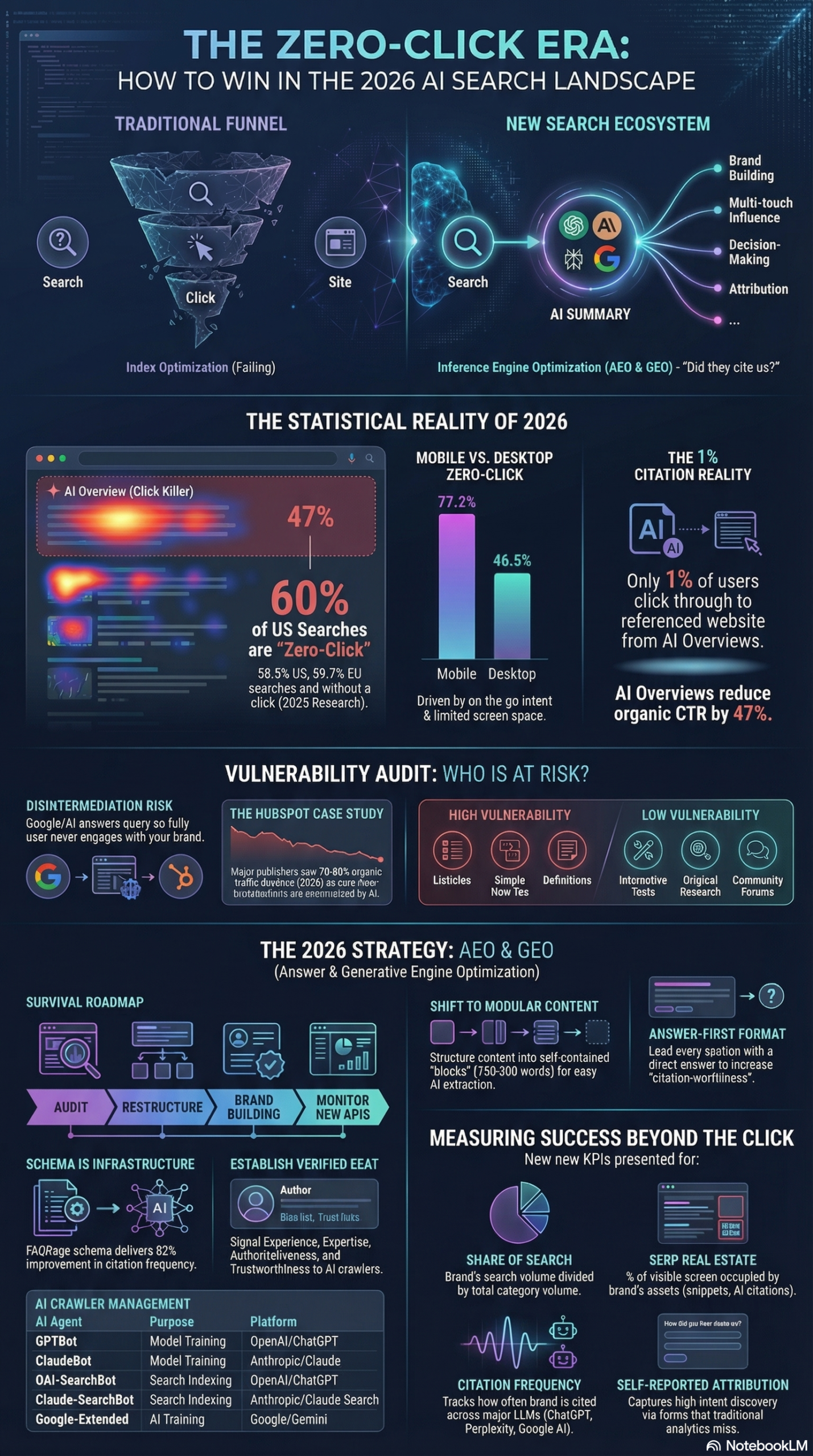
AI systems extract answers by finding the first clear, direct response to a query. The NotebookLM research report calls this the “Inverted Pyramid” style: lead with the direct answer, then expand with context, evidence, and nuance.
For every major section of every page:
– Old structure: Context → Evidence → Conclusion
– New structure: Answer/Conclusion → Evidence → Context
Example rewrite:
❌ Before: “When considering whether to use FAQPage schema, there are several factors you should evaluate including your content type, how Google has historically treated your pages…”
✅ After: “FAQPage schema improves AI citation rates by 82%, according to current AEO benchmarks. Implement it on any page with discrete question-answer pairs. Here’s how:”
Step 6: Break pages into modular blocks (150–300 words each)
AI systems extract at the block level, not the page level. Each block should:
– Answer exactly one specific question
– Stand alone semantically (make sense without the surrounding content)
– Contain at least one “micro-fact” (a specific number, specification, date, or certification)
– Use a descriptive H2 or H3 heading that mirrors the query it answers
Step 7: Implement priority schema markup
Based on the NotebookLM research report, prioritize these schema types in this order:
- FAQPage: 82% citation rate improvement reported in AEO benchmarks. Use on any content with question-answer structure.
- HowTo: Critical for tutorial and instructional content. Marks up individual steps with
name,text, and optionalimage. - Product: For e-commerce, add
gtin,mpn,brand,offers(withpriceCurrency,price,availability). GTINs and MPNs are now treated as eligibility requirements by agentic commerce systems per the NotebookLM research report. - Article +
dateModified: Freshness signals matter. AI systems weight recently updated content for time-sensitive queries.
Phase 4: Deploy Markdown Mirrors
Step 8: Serve .md versions of key pages
AI systems work natively in Markdown and process it more accurately than raw HTML. For your top 20–50 pages by authority and business value, create .md mirror versions accessible at /page-slug.md or via a dedicated /docs/ subdirectory.
If you run a CMS like WordPress or Contentful, build a simple export pipeline:
– Strip navigation, ads, and footer markup
– Convert heading tags to #, ##, ###
– Preserve internal links as Markdown inline links
– Render tables as pipe-separated Markdown tables
– Add a front-matter block with title, published, updated, and canonical fields
Link to the Markdown mirror from llms.txt rather than the HTML version for documentation-type content.
Step 9: Build a Model Context Protocol (MCP) endpoint (advanced)
For e-commerce and SaaS products, the NotebookLM research report flags the Model Context Protocol (MCP) — an emerging standard led by Anthropic — as the mechanism AI agents will use to query live business data (pricing, inventory, availability) directly, bypassing traditional search scraping. An MCP endpoint exposes a structured API that AI agents can query in real-time during a purchase research workflow. This is not a Q4 2026 consideration — it’s a current competitive advantage for early implementers.
Phase 5: Shift Your Measurement Framework
Step 10: Add AI-era KPIs to your reporting
Since clicks are declining across the board (only 1% of users click on sources cited within AI Overviews), success can no longer be measured in sessions and pageviews alone. Add these metrics to your dashboards:
- Citation Frequency: Use AEO monitoring tools (BrandMentions, Profound, or similar) to track how often your brand appears in ChatGPT, Perplexity, Claude, and Gemini responses.
- Share of Search: Your brand’s query volume as a percentage of total category query volume — a leading indicator of brand health independent of click-through rates.
- AI Traffic Mix: Segment bot traffic in your log analytics to track the ratio of AI crawler volume vs. human sessions.
- SERP Real Estate: Track the percentage of visible screen space occupied by your brand across different SERP feature types.
Expected Outcome: After a full implementation (Phases 1–5), expect to see measurable improvement in AI citation rates within 60–90 days. The llms.txt and schema changes take effect within 1–2 crawl cycles. Content restructuring improvements compound over time as AI models re-index and re-weight your pages.
Real-World Use Cases
Use Case 1: B2B SaaS Company Optimizing for Agentic Research
Scenario: A project management software company is seeing flat organic traffic despite strong content production. Their sales team reports that prospects are arriving already knowing exactly which features they want — evidence that AI research is happening upstream of the first site visit.
Implementation: The team deploys llms.txt linking to their integration documentation, pricing page, and feature comparison pages. They add FAQPage schema to their 40 most common sales FAQ answers. They create an AGENTS.md with API integration instructions and use-case summaries targeting developer personas.
Expected Outcome: The product begins appearing in ChatGPT and Perplexity responses when users ask “best project management tools for engineering teams with Jira integration.” Inbound leads arrive pre-qualified — they’ve already been told by an AI that this product fits their stack.
Use Case 2: E-commerce Brand Preparing for Agentic Commerce
Scenario: A specialty outdoor gear retailer. Salesforce data shows AI agents influenced $67 billion in sales during Cyber Week 2025. This retailer wants to be in that channel.
Implementation: They audit their product catalog for missing GTINs — found in 34% of SKUs. They add Product schema with complete gtin, mpn, brand, offers, and additionalProperty fields (weight, material, certifications). They build a lightweight MCP endpoint exposing real-time inventory and pricing to compliant AI agents. They restructure product descriptions to lead with specifications, not narrative copy.
Expected Outcome: AI shopping agents can now parse and compare their products. The retailer appears in agentic purchase recommendations for queries like “best 3-season sleeping bag under $300 with a comfort rating below 20°F.”
Use Case 3: Publisher Rebuilding Traffic Resilience
Scenario: A technology publication has seen a 26% traffic drop post-AI Overviews for their how-to content category. Their “How to use X tool” articles — previously strong performers — now get summarized directly by AI Overviews with minimal click-through.
Implementation: They pivot their editorial calendar away from definitions and listicles (high summarization vulnerability) toward original research with complex methodology: proprietary surveys, tool benchmark tests, and data analyses that AI systems can cite but cannot replicate. They add dateModified schema to signal freshness and build a structured data API for their research datasets that AEO monitoring tools can index.
Expected Outcome: Original research pieces achieve consistent citation in AI answers, driving brand authority. While raw traffic to how-to content remains suppressed, branded search queries increase as their research gets cited — a measurable downstream effect of AI citation volume.
Use Case 4: Agency Updating Client Reporting
Scenario: A digital marketing agency with 25 B2B clients. Several clients are questioning the ROI of SEO investment because GA4 shows declining organic sessions despite strong rank tracking numbers.
Implementation: The agency adds AEO monitoring to its reporting stack, tracking client citation frequency in ChatGPT, Perplexity, Claude, and Gemini across target keywords. They build a “Share of Search” report showing brand query volume growth vs. category baseline. They present a new KPI dashboard that frames visibility as a multi-channel metric — not just SERP rank.
Expected Outcome: Clients understand that a piece ranking #6 with 12 AI citations per month is outperforming a #2 ranking with zero AI citations for buyer-intent queries. Agency retains accounts that would have otherwise churned due to declining click metrics.
Use Case 5: Local Service Business Maintaining Google Visibility
Scenario: A regional HVAC company that gets 80% of leads from Google local search. They’re not at risk from AI training data harvesting, but AI Mode’s 93% zero-click rate threatens their local pack visibility.
Implementation: They optimize their Google Business Profile with complete, structured data. They implement LocalBusiness schema with full service area, hours, and service type markup. They create FAQ content specifically answering “emergency HVAC repair near me” type queries with FAQPage schema — knowing these are the queries AI Overviews will attempt to answer inline.
Expected Outcome: The business appears in AI Overview answers for local HVAC queries, maintaining visibility even in zero-click scenarios. The brand name becomes the cited authority for their service area, driving direct navigational searches from users who’ve seen the brand cited.
Common Pitfalls
1. Blocking all AI bots indiscriminately
The most common mistake: deploying Disallow: / for all AI crawlers to “protect content.” This conflates training bots (which ingest content for model weights) with search bots (which index content for real-time answers). Blocking Claude-SearchBot and OAI-SearchBot removes your site from AI-powered search results entirely. Per the NotebookLM research report, use a granular robots.txt strategy that distinguishes between crawler types and their intended use.
2. Treating AEO as a separate project from SEO
AEO is not a bolt-on. The content restructuring, schema implementation, and technical changes required for AI visibility are the same changes that improve traditional SEO performance. Teams that staff AEO separately from their core SEO workflow create duplicate processes and inconsistent implementations. These disciplines should share a single content and technical optimization workflow.
3. Optimizing for citations without tracking them
Thousands of teams have deployed FAQPage schema and llms.txt without setting up any mechanism to measure whether it’s working. AEO is untrackable in Google Analytics by default — you need purpose-built tools (Profound, BrandMentions, or custom LLM query monitoring) to verify that citation frequency is improving. Without measurement, you’re flying blind.
4. Neglecting product data hygiene for e-commerce
Per the NotebookLM research report, GTINs and MPNs are now “eligibility requirements” in agentic commerce pipelines, not optional metadata. A catalog audit that turns up missing GTINs in 30%+ of SKUs — a common finding — is a revenue problem, not a data quality footnote.
5. Letting “Google Zero” panic drive short-term decisions
The Search Engine Land source article makes the point directly: human Google traffic hasn’t collapsed. It’s AI-mediated discovery that’s restructuring the funnel. Pivoting entirely away from Google SEO in response to AI Overviews abandons a channel that Googlebot still makes 831x more effective than AI crawlers at sending actual referrals.
Expert Tips
1. Prioritize freshness signaling aggressively. AI systems weight recently updated content for time-sensitive queries. Add dateModified to all schema markup and actually update it when content changes — not just when a full rewrite happens. Even minor factual updates with a new dateModified timestamp improve how AI systems assess content recency.
2. Build your llms.txt iteratively, not exhaustively. A 500-page llms.txt that lists every URL is less effective than a 30-page curated index of your highest-authority content. AI systems treat llms.txt as a signal of what you believe is authoritative — diluting it with low-value pages undermines the signal.
3. Treat original data as a moat. Per the NotebookLM research report, content types that are highly vulnerable to AI summarization — how-tos, definitions, listicles — are precisely the content that AI systems will answer without a click. Original research with complex methodology, proprietary survey data, and benchmark testing creates content that AI systems cite but cannot replicate. This is your only sustainable content moat.
4. Monitor Google’s self-citation behavior. Search Engine Land reports that Google.com is the top cited source in 19 of 20 niches in AI Mode, with Google properties accounting for roughly 20% of all AI Mode sources. For queries where Google is systematically self-citing, competing on that SERP directly becomes structurally harder. Diversify your discovery strategy to Perplexity, ChatGPT Search, and Claude, where Google’s self-citation advantage doesn’t apply.
5. Watch the MCP standard closely and implement early. The Model Context Protocol, documented in the NotebookLM research report, is the emerging standard for how AI agents query live business data. Early MCP implementations by e-commerce and SaaS brands will have a meaningful head start as agentic commerce scales toward eMarketer’s $20.9 billion 2026 projection. The window for first-mover advantage is narrow.
FAQ
Q1: Should I block AI crawlers to protect my content from being used in model training?
You can selectively block training crawlers (ClaudeBot, GPTBot) while allowing search/answer crawlers (Claude-SearchBot, OAI-SearchBot) through a granular robots.txt strategy. However, the NotebookLM research report is clear that blanket AI bot blocking removes your site from AI-powered search results, which is a visibility cost that outweighs training data concerns for most publishers. Evaluate your specific business model before deploying broad blocks.
Q2: If only 1% of users click on AI Overview citations, why bother getting cited?
Because citation drives brand recognition at scale, not direct traffic. The NotebookLM research report notes that citations in AI answers function as brand awareness vehicles — a user who sees your brand cited as the authority on HVAC maintenance in a Perplexity answer will search your brand name directly on a future occasion. Citation frequency also influences the confidence scores AI agents use when making agentic commerce recommendations, where direct click-through is irrelevant.
Q3: What’s the difference between AEO and GEO?
Answer Engine Optimization (AEO) and Generative Engine Optimization (GEO) are effectively synonymous in current practice — both refer to the strategic approach of optimizing content to be cited and recommended by AI-powered answer systems. Some practitioners use AEO for voice search and featured snippet contexts and GEO specifically for large language model outputs, but the tactical implementation is nearly identical per the NotebookLM research report.
Q4: How long before agentic commerce is a significant revenue channel for my e-commerce business?
If Salesforce’s Cyber Week 2025 data is any indication — AI agents influenced 20% of global orders and $67 billion in sales — it’s already significant for high-AOV categories. eMarketer’s $20.9 billion projection for 2026 and Gartner’s 90% B2B intermediation forecast for 2028 suggest the window for preparation is 12–18 months. Start your product data audit now.
Q5: Is llms.txt an official standard I can rely on long-term?
As of Q2 2026, llms.txt is an emerging convention, not a formal W3C or IETF standard. However, it has achieved sufficient adoption that major AI systems are actively using it for content discovery, per the NotebookLM research report. Implement it now as a low-effort, high-signal technical investment — even if the format evolves, the practice of maintaining a machine-readable content index will persist in some form.
Bottom Line
The “Google Zero” debate focuses on a symptom while the structural shift happens underneath it: AI agents now constitute the majority of crawler traffic and are making purchase-influencing decisions based on what they find — or can’t find — on your site. The brands that win the next phase of search aren’t necessarily the ones with the best content; they’re the ones whose content is structured, machine-readable, and discoverable by reasoning systems operating on behalf of buyers. With Gartner projecting 90% B2B buying intermediated by AI agents by 2028, the implementation window is short and the gap between early adopters and laggards will compound. Start with robots.txt hygiene, deploy llms.txt, restructure your top 20 pages for answer-first formatting, and add FAQPage and Product schema this quarter — the rest follows from there.


0 Comments