

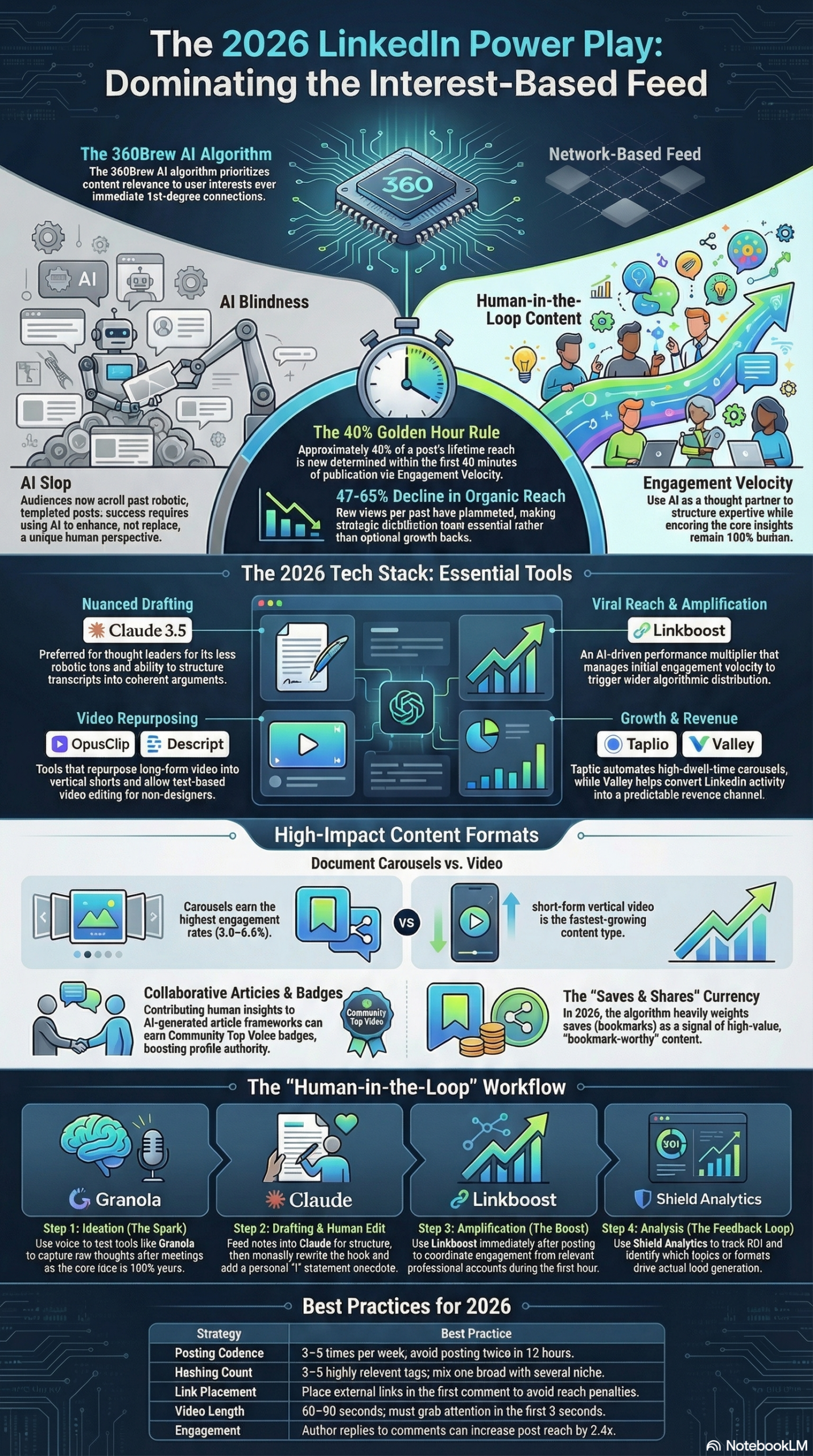
LinkedIn has crossed 1 billion members and simultaneously told creators that organic reach has dropped 47% to 65% — yet the platform is actively pushing one format as a counterweight: long-form articles. According to LinkedIn’s own guidance (LinkedIn via Social Media Today, March 30, 2026), long-form posts help maximize reach, and LinkedIn content is now a leading reference source for AI chatbots. This tutorial breaks down exactly how to use LinkedIn Articles — both standalone long-form posts and collaborative articles — to cut through the noise, survive the 360Brew algorithm, and build audience reach that compounds over time.
What This Is
LinkedIn Articles are the platform’s native long-form publishing format, distinct from standard feed posts. While a regular post caps out at 3,000 characters, Articles allow full-length editorial content — think 1,000 to 2,000+ words — with formatting options that include headers, embedded images, and rich links. They live on your profile permanently and are indexed by search engines, including Google.
As of 2026, LinkedIn has layered a second format on top of this: Collaborative Articles. These are AI-generated topic frameworks that LinkedIn seeds with structured questions and section outlines, then invites verified human experts to annotate with their real-world insights. According to the NotebookLM research report, Collaborative Articles “use AI to create topic frameworks and then invite verified experts to contribute.” Contributors whose insights earn high engagement can receive a Community Top Voice badge — a gold indicator badge reviewed every 60 days — that appears directly on their profile and boosts visibility in LinkedIn search. Critically, that badge can be lost if participation wanes, so it requires ongoing contribution to maintain.
The key distinction practitioners need to understand upfront: there are standalone articles you author entirely, and collaborative articles you contribute to. Both carry specific algorithmic advantages in 2026, but the mechanics differ considerably. Standalone articles give you full narrative control and Google SEO potential. Collaborative articles plug you into LinkedIn’s own AI-driven content infrastructure and offer a credibility badge in return.
Why articles now? The 360Brew algorithm — LinkedIn’s current AI-driven content distribution system — has fundamentally shifted from a network-based model to an interest-based model. This means content no longer primarily reaches your first-degree connections. Instead, it is served to users based on topical relevance, professional role, and expertise signals the algorithm reads from your profile and posting history. Long-form articles give the 360Brew system substantially more signal to classify your content accurately and serve it to the right Ideal Customer Profile (ICP). A 200-word post gives the algorithm very little to work with. A 1,500-word article on a specific topic? That is a dense, structured content signal that the system can match to relevant audiences far outside your immediate network.
LinkedIn has also confirmed in its March 2026 guidance (as reported by Social Media Today, March 30, 2026) that LinkedIn posts serve as a leading reference source for AI chatbots. This is a significant and underappreciated development: your long-form LinkedIn content now has the potential to be cited and surfaced by tools like ChatGPT, Perplexity, and Claude when users ask industry-specific questions. That is a distribution channel that did not exist two years ago, and it rewards exactly the kind of structured, expert-driven content that Articles are designed to host.
The SEO angle: Because LinkedIn is an extremely high-authority domain, articles hosted on the platform regularly rank on the first page of Google for competitive professional keywords. This is especially true for Collaborative Articles, where LinkedIn’s AI generates structured, keyword-rich frameworks that search crawlers favor. Individual authored articles benefit equally from LinkedIn’s domain authority — your article on “B2B SaaS pipeline generation” can outrank standalone blog posts on the same topic simply by virtue of being published on linkedin.com.
Why It Matters
The brutal fact of 2026 LinkedIn is a 47% to 65% decline in organic reach for standard feed posts, according to the NotebookLM research report. What worked in 2023 — posting a text update and watching it ripple through your network — no longer functions reliably. The 360Brew algorithm now aggressively filters what it deems low-value content, and the explosion of AI-generated posts has dramatically lowered the bar for what “low-value” means.
Articles matter because they sidestep several of the algorithm’s most punishing mechanics simultaneously:
Dwell time as a ranking signal: The 360Brew system tracks how long users spend engaging with content. An article that takes 4–5 minutes to read generates enormous dwell time compared to a 30-second scroll-past on a short post. According to the research report, document and carousel formats already average 5.8%–6.6% engagement rates precisely because of this dwell time effect. Articles operate on the same principle — but with the added benefit of permanent indexability.
Saves and Sends as premium signals: The 360Brew algorithm weights “Saves” and “Sends” as high-value engagement signals indicating content quality, per the research report. Long-form articles are behaviorally far more likely to be saved for later reading or forwarded to a colleague than a short post. This is not manufactured — it is an inherent property of genuinely useful long-form content. Every Save tells the algorithm your content is worth returning to.
AI chatbot citation as a new distribution vector: LinkedIn’s own March 2026 guidance confirms the platform’s content is a primary training and reference source for major AI chatbots (Social Media Today). Publishing authoritative, well-structured long-form content on LinkedIn increases your probability of being cited when professionals query AI assistants about your area of expertise — a passive awareness channel that compounds without additional effort.
Permanent profile real estate: Unlike feed posts, which have a roughly 24–48 hour active distribution window, articles live permanently on your profile under the “Articles & Activity” section. They continue to attract organic search traffic from both LinkedIn’s internal search and Google for months or years after publication.
For marketers and content strategists, this changes the content calendar calculation in a fundamental way. You are no longer just feeding the algorithm one cycle at a time. You are building an indexed, searchable, AI-citable library of authority content that delivers compounding returns — the opposite of the fleeting reach model that standard posts offer.
The Data
LinkedIn’s content landscape in 2026 is stratified by format, with each format serving a distinct algorithmic and strategic function. Here is how the key formats compare on engagement and reach, based on the NotebookLM research report:
| Format | Avg Engagement Rate | YoY Trend | Strategic Value |
|---|---|---|---|
| Document / PDF Carousel | 5.8% – 6.6% | Stable | Highest dwell time; excellent for guides and frameworks |
| Vertical Video (< 60 sec) | High | +52% YoY growth | Fastest-growing; zero-click value; algorithm favored |
| Polls | ~200% reach increase | Strong | Impression leader; ideal for research and debate |
| Collaborative Articles | High SEO value | Growing | Google first-page ranking; Top Voice badge pathway |
| LinkedIn Articles (long-form) | High dwell + Save signals | Increasing | AI chatbot citation; permanent profile asset; Google SEO |
| Standard Text / Image Posts | Declining | –47% to –65% reach | Low reach unless supported by amplification tools |
The standout insight from this table: standard posts — the format most practitioners default to — are the worst-performing format in the current environment. Polls generate approximately 200% reach increase compared to standard posts, making them an ideal companion format to articles. The practitioner move is to publish an article, then drive engagement to it by posting a related poll that links to the article in the comments (avoiding the algorithmic penalty of placing links in the post body itself, as documented in the research report).
Vertical video’s 52% year-over-year growth is real — but articles hold the unique SEO and AI-citation advantages that video cannot replicate at scale. The strategic answer is not to choose one over the other, but to use video as a distribution mechanism that drives traffic back to your long-form article content.
Step-by-Step Tutorial: Publishing LinkedIn Articles That Actually Get Read
Prerequisites
Before you write a word, confirm these foundations are in place:
- LinkedIn SSI above 60: Your Social Selling Index score reflects profile completeness, network quality, engagement history, and relationship building. Profiles below 60 have restricted article distribution. Check your SSI at linkedin.com/sales/ssi.
- Defined ICP: Know exactly who you are writing for — their specific role, industry sector, and the problems they actively search for solutions to. The 360Brew algorithm cross-references your profile’s stated expertise with your content to validate topical relevance.
- Content amplification plan: Writing the article is the beginning of the process, not the end. Have a Golden Hour engagement plan ready before you publish.
- Shield Analytics or LinkedIn native analytics access: You need a way to track Saves and Sends specifically, not just impressions.
Phase 1: Topic Research and Positioning
Step 1: Identify a searchable, specific topic.
Generic topics produce generic reach. Do not write “How to Generate B2B Leads.” Write “How to Generate B2B SaaS Leads Through LinkedIn Outreach at Sub-$50 CAC.” Specificity is what the 360Brew algorithm uses to classify your article and match it to a targeted audience, and it is what drives Google organic rankings. Use LinkedIn’s own search bar: type your topic keyword and observe what autocompletes. Those autocomplete suggestions represent actual user search queries — they are your keyword research tool.
Step 2: Check existing Collaborative Articles on your topic.
Navigate to linkedin.com/pulse/topics and browse your area of expertise. If LinkedIn has already generated a Collaborative Article covering your exact topic, you have two options: (a) contribute to that article to accumulate Top Voice engagement signals, or (b) write a standalone article that takes a more specific or contrarian angle the collaborative article does not address. Both strategies feed the same authority-building outcome.
Step 3: Define your unique point of view before you start writing.
According to the research report, the antidote to “AI Slop” — the flood of robotic, templated posts that audiences have learned to scroll past — is opinionated, experience-based content. Before drafting, identify the one thing you believe about this topic that most practitioners in your field get wrong. That is your article’s thesis. An article without a clear, defensible POV is an article the algorithm and your readers will classify as generic, regardless of how well it is written.
Phase 2: Writing the Article
Step 4: Capture raw insights before you draft.
Use a voice-to-text tool like Granola to record your unfiltered thinking about the topic — ideally immediately after a relevant client meeting, sales call, or industry event while the insights are still fresh and specific. The goal is to capture authentic, experience-grounded details before they get sanitized by the drafting process. Per the Human-in-the-Loop workflow documented in the research report, the most effective 2026 creators use voice notes as the content seed, not AI-generated text as the origin point.
Step 5: Use AI to structure, not originate.
Feed your voice note transcript to an AI writing assistant like Claude 3.5 with a constrained prompt: “Here are my raw thoughts on [topic]. Extract the 5 most valuable insights. Suggest a structure for a 1,200-word LinkedIn Article targeting [specific ICP]. Do not write the article — give me the skeleton only.” Then write the article yourself using that skeleton as scaffolding.
The research report is unambiguous on this: AI drafts create “AI Slop” when used as a wholesale replacement for original thought. Audiences have developed what the report calls “AI blindness” — an instinctive pattern-recognition that causes readers to scroll past anything that “looks synthetically generated.” The human-in-the-loop approach uses AI to organize, not to originate.
Step 6: Apply the “I” Statement Rule at every major claim.
Per the research report, content must include personal, real-world experiences that AI cannot fabricate convincingly. Every significant point in your article should be anchored by a first-person statement tied to a specific outcome: “I tested this with a client in the SaaS space last quarter and their inbound demo requests increased 40% in 60 days.” This is not anecdotal filler — it is the authenticity signal that differentiates your article from the AI-generated majority and that LinkedIn’s own filters are increasingly tuned to reward.
Step 7: Write your hook last.
The title is your click-through rate. Write it after you have finished the full article and know precisely what it delivers. For LinkedIn Articles, titles following the format “[Specific Outcome] Without [Common Objection]” consistently outperform generic topic titles. “5 Ways to Book Enterprise Demos Without Cold Calling” outperforms “Tips for B2B Sales Success” on every metric because it makes a specific promise to a specific reader with a specific objection already addressed.
Step 8: Format aggressively for skim-readers.
Use H2 and H3 subheadings every 200–300 words. Bold the opening sentence of key paragraphs. Use numbered lists for sequential processes and bullet points for non-sequential items. LinkedIn’s native article editor supports formatting — use it. A wall of unbroken text triggers scroll-past behavior regardless of content quality. Readers decide within three seconds whether they will invest time in your article, and formatting is the primary signal they use to make that judgment.
Step 9: Close with a hard, specific call to action.
The final paragraph of your article must direct a specific behavior: “Save this article if you are working on [topic],” “Send this to a colleague managing [problem],” or “Drop your question in the comments and I will reply to every one.” Saves and Sends are high-value algorithmic signals, per the research report. Explicitly requesting them is not manipulation — it is directing reader behavior toward actions they would take naturally if they remembered to.
Phase 3: Publishing and the Golden Hour
Step 10: Time your publication strategically.
Publish when your ICP is active. For B2B professionals in North American time zones, the highest-engagement windows are Tuesday through Thursday, 8–10 AM and 12–1 PM. The research report identifies the first 60 minutes after publication — the “Golden Hour” — as the critical algorithmic window. High engagement during this period signals content value and triggers distribution to second and third-degree connections who would never otherwise see it.
Step 11: Trigger the Golden Hour with the A3 Comment Formula.
Immediately after publishing, post a comment on your own article using the A3 formula from the research report: Add a piece of value not included in the article body, Ask a specific question to prompt replies, and Anchor the discussion back to the article’s core topic. Example: “Just published this. One thing I left out that’s equally important: [additional insight]. Question for practitioners reading this — have you seen [specific challenge] in your own work? I’d genuinely like to know.” This comment structure primes your followers to engage substantively and immediately, feeding the Golden Hour algorithm signal.
Step 12: Place all external links in the first comment, never in the article body.
The 360Brew algorithm penalizes content that drives users off LinkedIn. External links embedded in article bodies trigger this penalty and suppress distribution, per the research report. Reference your sources inline (“as covered in our full benchmark report — link in comments”) and place the actual URLs in the comments section. This rule applies universally: no links to your blog, website, podcast, or external tools in the article body itself.
Step 13: Use coordinated amplification during the Golden Hour.
Per the research report, Linkboost addresses the “Distribution Gap” by coordinating immediate, relevant engagement from professionals in adjacent industries to your ICP. The tool allows you to notify a curated group who engage with the article within the critical 60-minute window — enough to signal algorithmic value and trigger extended distribution. This is distinct from engagement pods (mutual obligation groups) and represents a legitimate amplification infrastructure investment for practitioners who cannot afford to let strong content die in the first hour.
Step 14: Atomize the article into a post series for sustained traffic.
One LinkedIn Article can be broken into 5–7 standalone posts published over the following two to three weeks. Each post extracts a single major insight from the article, stands alone as a complete thought, and references the full article in the first comment. This strategy multiplies the article’s distribution events rather than limiting it to a single publication window — each post is a new algorithmic opportunity to drive readers back to the source content.
Expected Outcomes
After 30 days of consistently applying this workflow:
- Articles should accumulate 2–4× the engagement of equivalent-length feed posts due to dwell time and Save signals
- Google Search Console should show the article appearing in search results for your target keywords within 2–3 weeks of publication
- Collaborative article contributions should generate Top Voice badge consideration within 60 days if engagement on contributions is sustained
- Shield Analytics data should show increasing Saves and Sends metrics — the high-intent signals indicating the algorithm is serving your content to the right audience
Real-World Use Cases
Use Case 1: B2B SaaS Founder Building Pipeline Without Paid Ads
Scenario: A founder of a 15-person SaaS company in the HR tech space needs to generate inbound demos without a paid acquisition budget.
Implementation: The founder publishes one LinkedIn Article per month documenting a specific customer acquisition challenge they solved — for example, “How We Closed 3 Enterprise Deals From LinkedIn Without a Sales Team.” Every article uses the I-Statement framework from the research report, grounding every claim in specific, verifiable numbers from their own business. They capture post-sales-call insights via Granola while the specifics are fresh, structure the article with Claude 3.5’s skeleton-only output, and write in their own voice. Publication follows the Tuesday 9 AM protocol with the A3 comment formula applied immediately after.
Expected Outcome: Over 90 days, articles index on Google for HR tech search queries and begin driving organic traffic from outside the LinkedIn feed. Inbound demo requests from prospects who found the articles through search — not the feed algorithm — become a consistent and compounding acquisition channel.
Use Case 2: Marketing Consultant Earning the Top Voice Badge
Scenario: A freelance marketing consultant wants to increase profile visibility and third-party credibility signals without paying for LinkedIn Premium tools.
Implementation: The consultant identifies three active Collaborative Articles in their expertise area — marketing strategy, content distribution, and brand positioning — and contributes one substantive, opinionated insight to each per week. Per the research report, contributions that receive high upvotes from the expert community qualify for the Community Top Voice gold badge, reviewed every 60 days. The consultant tracks which contribution topics are earning the most upvotes and doubles down on those specific threads. They also cross-reference their standalone articles in collaborative article comments, creating a reinforcing content ecosystem that feeds both formats simultaneously.
Expected Outcome: Within 60 days, the consultant earns a Top Voice badge in their primary category. Their profile appears more frequently in LinkedIn search results. New client inquiries increase measurably because the badge functions as a platform-verified credibility signal that self-authored posts cannot replicate on their own.
Use Case 3: Enterprise L&D Team Distributing Internal Expertise Externally
Scenario: A Learning & Development team at a Fortune 500 company wants to position their internal subject matter experts as public thought leaders to support talent acquisition and employer brand.
Implementation: The L&D team runs a quarterly “Article Sprint” — three SMEs each write one LinkedIn Article per quarter, with the team’s content strategist running the Human-in-the-Loop workflow. SMEs record 10-minute voice briefs via Granola after training sessions. The content strategist uses Claude 3.5 to extract insights and structure articles, which SMEs then write in their own voice. Articles are published on individual employee profiles — not the company page — for maximum algorithmic reach. Per the research report, the interest-based 360Brew algorithm distributes personal profile content more broadly than brand page content.
Expected Outcome: SME profiles accumulate domain authority in LinkedIn search. Talent acquisition teams see a measurable lift in unsolicited inbound applications from candidates who discovered the company through employee-authored content — a hiring channel with near-zero marginal cost.
Use Case 4: Agency Proving Content ROI Through Article Attribution
Scenario: A B2B content marketing agency needs to demonstrate the measurable ROI of LinkedIn Article production to a skeptical enterprise client.
Implementation: The agency implements Shield Analytics to build a performance dashboard for the client’s executive LinkedIn profiles. They track not just impressions and engagement rates but specifically “Saves” and “Sends” — the high-value signals identified in the research report as proxies for purchase intent. They simultaneously monitor Google Search Console to demonstrate when client articles begin ranking for commercial intent keywords. Monthly reporting connects article traffic to pipeline events using UTM parameters on the links placed in article comments.
Expected Outcome: Within 90 days, the agency can demonstrate a statistically defensible correlation between article publication and inbound pipeline activity, converting the skeptical client to a long-term retainer based on documented ROI rather than vanity metrics.
Use Case 5: Recruiter Using AI Chatbot Citation to Attract Passive Candidates
Scenario: A technical recruiter wants to attract senior software engineers who are not actively job hunting and who habitually use AI assistants to research industry trends and career decisions.
Implementation: The recruiter writes monthly LinkedIn Articles on engineering culture, technical interview process design, and career growth frameworks — topics that senior engineers genuinely search for. Given LinkedIn’s confirmed role as a leading reference source for AI chatbots (Social Media Today, March 30, 2026), well-structured articles on these topics are increasingly surfaced when engineers query tools like ChatGPT or Perplexity for career advice. The recruiter’s name and profile appear in AI responses, creating passive brand awareness among candidates who would never respond to a cold InMail.
Expected Outcome: Inbound connection requests from passive senior candidates increase. Engineers reach out having “come across your content” — via an AI assistant recommendation, not the LinkedIn feed — representing a candidate quality and intent level that cold outreach cannot replicate.
Common Pitfalls
Pitfall 1: Treating Articles Like Longer Posts
Articles and standard posts serve fundamentally different algorithmic functions. Many practitioners write articles in the casual, punchy style appropriate for a feed post — then wonder why engagement is flat. Articles require thesis-driven structure, substantive expert depth, and searchable titles built for discovery, not just feed performance. If your article’s core message fits comfortably in 300 words, it should be a post. Articles should deliver value that genuinely requires 800+ words to communicate fully. Mismatching format to content is the most common and most costly mistake.
Pitfall 2: Placing External Links in the Article Body
The 360Brew algorithm penalizes off-platform links in content, per the research report. Practitioners spend hours crafting a substantive article, then destroy its distribution potential by embedding website, portfolio, or source links directly in the body text. The rule is absolute: all external links go in the first comment, every time, no exceptions. Reference sources inline by name and note that links are in the comments.
Pitfall 3: Publishing Without a Golden Hour Plan
An article published without a coordinated engagement strategy in the first 60 minutes will reach only your immediate follower base and stall. The research report is explicit: the Golden Hour determines whether an article achieves extended algorithmic distribution. Publishing at 2 PM on a Friday with no amplification plan is the fastest way to waste a strong article. The A3 comment formula and Linkboost coordination are not optional add-ons — they are part of the publication workflow itself.
Pitfall 4: Contributing Generic Insights to Collaborative Articles
The Top Voice badge rewards contributions that earn high engagement from the expert community — not simply contributions that get published. Single-sentence observations or agreement statements (“Great point, fully agree”) do not earn badge consideration. Per the research report, the winning contributions are opinionated, grounded in specific experience, and occasionally contrarian to the AI-generated framework. “Here is where this framework breaks down in practice, and here is what I use instead, with results” is a contribution. “This is a great overview” is not.
Pitfall 5: Over-Hashtagging
The research report documents a hard limit of 3–5 hashtags per post or article promotion. More than five hashtags can trigger LinkedIn’s spam detection filters and actively reduce reach — the opposite of the intended effect. Use three to five specific, niche-relevant hashtags rather than ten broad ones. Three targeted hashtags will consistently outperform ten generic ones because they signal topical precision to both the algorithm and human readers.
Expert Tips
Tip 1: Build a Named Article Series, Not Isolated Posts
The highest-performing LinkedIn Article practitioners publish interconnected content series — related articles that reference each other in comments. Each new article in the series drives renewed attention to older articles, compounding their algorithmic signals over time. Name your series explicitly in every title (e.g., “The Pipeline Builder Series, Part 3: Closing Enterprise Deals Without Cold Outreach”). The series name becomes a searchable brand within LinkedIn and on Google.
Tip 2: Test Your Own AI Chatbot Citability
Since LinkedIn content is confirmed as a reference source for AI chatbots (Social Media Today), test your articles systematically. Query ChatGPT and Perplexity with the exact questions your articles are designed to answer. If your content surfaces, you have confirmed a distribution channel that operates entirely outside the LinkedIn feed algorithm. If it does not surface, revisit your article structure — clear H2 headings, specific named frameworks, precise factual claims, and a coherent logical flow are the formatting signals that AI systems favor for indexing and citation.
Tip 3: Enforce the 18–24 Hour Publication Gap
Per the research report, publishing more than one piece of content within an 18–24 hour window “cannibalizes” the reach of both pieces. The algorithm treats simultaneous content from the same profile as competing signals and suppresses distribution for each. When you publish an article, do not publish a separate feed post the same day. Let the article accumulate its full algorithmic signals — dwell time, Saves, Sends, comments — before introducing any competing content into your distribution queue.
Tip 4: Mine Your Saves Data to Find Content Demand
Shield Analytics surfaces which posts and articles are receiving the most Saves — the metric that most directly correlates with reaching high-intent audiences who plan to revisit the content. Identify your top three articles by Saves over the trailing 90 days and build new articles that go deeper into those exact topics. Saves are a direct signal that your audience wants more of that specific content — treat them as your editorial calendar intelligence.
Tip 5: Repurpose Articles Into Vertical Video Summaries
Vertical video is growing at 52% year-over-year on LinkedIn, per the research report. Use OpusClip to record a 45–60 second summary of your article’s single most valuable insight and publish it as a separate content piece in the two to three days following the article’s live date. The video drives traffic to the article via comments; the article provides the depth that video cannot sustain. Together, they simultaneously hit two of LinkedIn’s highest-priority content formats and create a mutually reinforcing distribution loop.
FAQ
Q: How long should a LinkedIn Article be to maximize algorithmic reach?
A: There is no publicly confirmed word count tied to the algorithm, but the dwell time mechanics documented in the research report favor content that takes 3–5 minutes to read — roughly 800–1,500 words in practice. Shorter than 800 words may not generate sufficient dwell time signals to distinguish the article from an extended post. Longer than 2,000 words risks reader drop-off before completion, which hurts the dwell time metric you are trying to build. The 1,000–1,500 word range is the practical sweet spot for balancing substantive depth with measurable completion rates.
Q: Can I republish a blog post from my website as a LinkedIn Article?
A: You can, but with a critical structural modification. All external links must be removed from the article body and placed in the comments, per the research report guidance on LinkedIn’s off-platform link penalty. You should also consider the SEO duplication risk: Google may treat an identical LinkedIn article as competing content and reduce the ranking of your original blog post. A better approach is to publish a substantively adapted version on LinkedIn — different structure, updated angle, LinkedIn-specific formatting — that references the full blog post in the first comment rather than replicating it.
Q: How do I actually contribute to Collaborative Articles?
A: Navigate to linkedin.com/pulse/topics and select your area of expertise from the category list. LinkedIn will surface active Collaborative Articles in your field with open contribution sections. Click into any article and look for the “Add your perspective” prompt on individual topic sections. Write your contribution in 100–300 words — specific, experience-grounded, and opinionated. Per the research report, contributions that earn high upvote engagement from the expert community qualify for Top Voice badge consideration in the next 60-day review cycle.
Q: Does publishing an article suppress the reach of my next feed post?
A: Only if you violate the 18–24 hour spacing rule documented in the research report. The algorithm treats content published within the same 18-hour window as competing signals and can suppress both pieces’ reach simultaneously. Space every piece of content — articles, posts, videos, polls — by a minimum of 18 hours from any preceding publication to prevent reach cannibalization and allow each piece to complete its algorithmic cycle.
Q: Are LinkedIn Articles genuinely being cited by AI chatbots?
A: Yes — LinkedIn’s own March 2026 guidance explicitly confirmed this (as reported by Social Media Today, March 30, 2026). The platform stated that LinkedIn posts are now a leading reference source for AI chatbots, representing a distribution channel entirely separate from the feed algorithm. Long-form articles with clear heading structure, named frameworks, and specific factual claims are substantially more likely to be indexed and cited by AI systems than short conversational posts. This makes article SEO optimization — writing for structured AI readability, not just human skim-readers — an active part of the 2026 content strategy.
Bottom Line
LinkedIn Articles are no longer a vanity format reserved for thought leaders with large existing followings — they are a compounding content asset in an environment where standard post reach has declined 47% to 65%, per the NotebookLM research report. The 360Brew algorithm explicitly rewards the dwell time, Saves, and Sends that well-crafted long-form articles generate naturally — signals that short posts structurally cannot produce at the same rate. Combined with LinkedIn’s confirmed role as an AI chatbot reference source (Social Media Today, March 30, 2026), a systematic article strategy now delivers distribution across three distinct channels simultaneously: the LinkedIn interest-graph feed, Google organic search, and AI assistant citations. Practitioners who build a disciplined article workflow in 2026 — using the Human-in-the-Loop creation method, the Golden Hour amplification protocol, and the post-atomization strategy — will compound authority at a rate that algorithm-dependent short-form content simply cannot sustain. Start with one article per month. Measure Saves specifically. Iterate from there.


0 Comments