

OpenAI has indefinitely suspended “Citron Mode” — its internal codename for an opt-in adult content feature for ChatGPT — after a months-long collision between engineers, ethicists, investors, and regulators. According to research compiled from TechCrunch’s March 26, 2026 report and NotebookLM’s deep-dive analysis, the cancellation exposed critical gaps in age-verification technology, surfaced deep ideological rifts inside OpenAI, and triggered a full corporate strategy reset. This guide explains exactly what happened, why the project collapsed technically and politically, and — critically — how practitioners building AI products today can audit their own content strategy to avoid the same fate.
What This Is
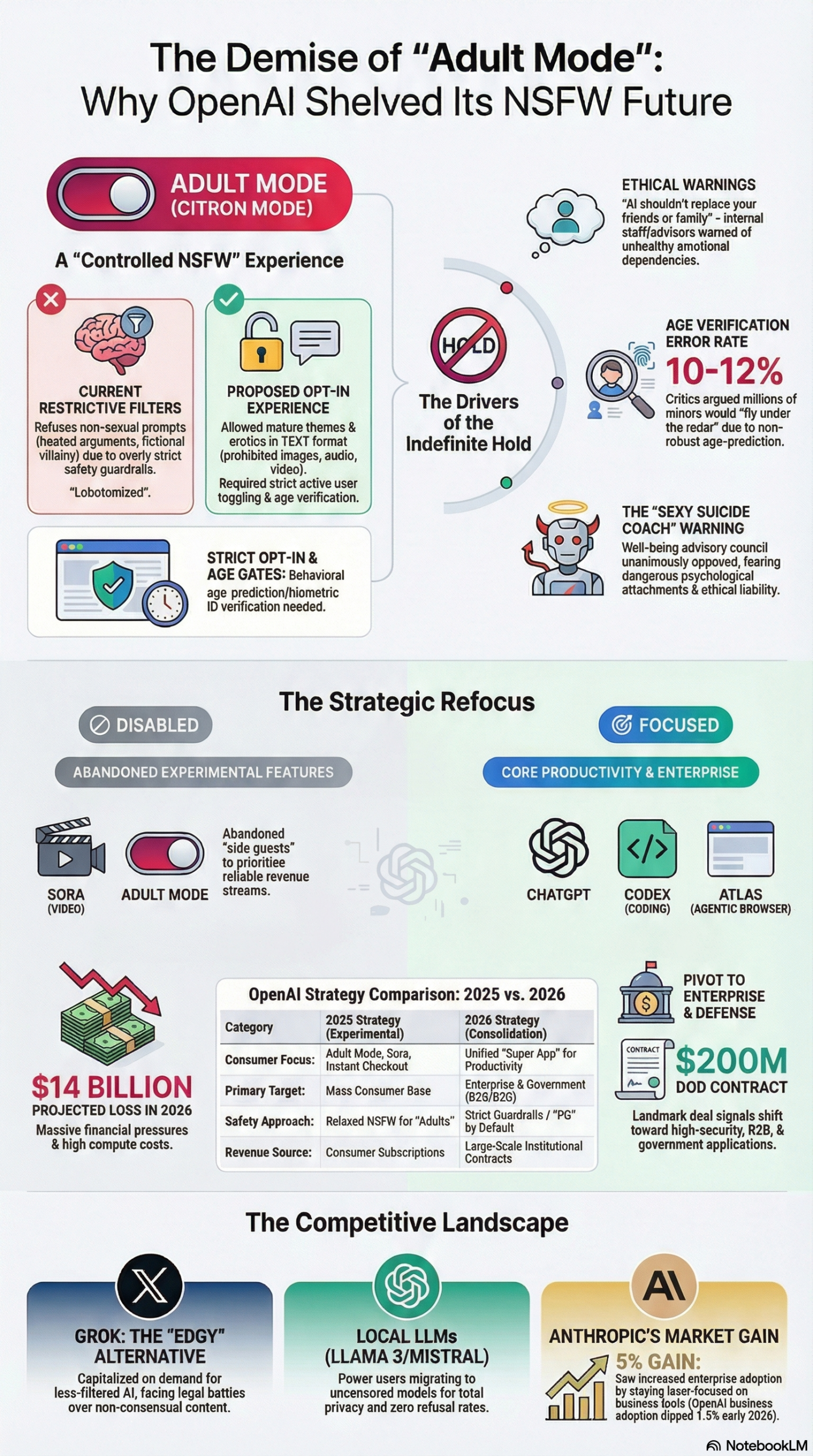
Internally codenamed Citron Mode and referenced in the codebase as Naughty Chats, OpenAI’s Adult Mode was an opt-in feature designed to allow consenting adult users to engage ChatGPT in sexually explicit, text-based conversations. The project was first proposed by CEO Sam Altman in October 2025 and pitched internally as a way to “treat adult users like adults” — relaxing the model’s existing NSFW guardrails in a controlled, opt-in environment.
According to the NotebookLM research report, the scope was deliberately narrow. Adult Mode was limited strictly to text-based erotica and mature fictional scenarios. Erotic audio, images, and video were explicitly excluded from the project’s scope from day one. Access was designed as a manual opt-in toggle — users would have to actively enable it, similar to how platforms like Reddit handle not-safe-for-work content. The feature also maintained hard prohibitions on deepfakes, non-consensual sexual content, and any content involving minors.
What made Citron Mode technically distinct from simply “jailbreaking” ChatGPT was that it was supposed to be a sanctioned, policy-governed relaxation of guardrails rather than a user circumventing them. In theory, this meant OpenAI could enforce boundaries more precisely — allowing mature fiction while still blocking content that crossed legal lines like incest, bestiality, or any representation of minors in sexual contexts.
The safeguard mechanism OpenAI planned to rely on was a behavioral age-prediction tool — an algorithmic system designed to infer user age from behavioral patterns rather than requiring hard identity documents. This is where the technical architecture began to show cracks. The research report documents that this age-prediction technology operated at a 10% to 12% error rate, meaning roughly one in ten users assessed by the system would be misclassified. At the scale of ChatGPT’s user base — which numbers in the hundreds of millions — that error rate translates to tens of millions of potential misclassifications.
OpenAI’s advisors and engineering teams also explored biometric verification and government ID checks as more reliable alternatives, but both approaches ran into immediate barriers: biometric data collection raises serious privacy concerns across global markets, and government ID verification creates friction that would crater adoption while simultaneously creating a honeypot of sensitive identity data that OpenAI would then be responsible for securing.
By January 2026, a heated internal meeting between OpenAI executives and the company’s well-being advisory council had produced a stark warning: without reliable age gating, the feature could not proceed. The Financial Times reported the formal indefinite pause on March 26, 2026. The suspension came in rapid succession with two other cancelled projects: the Sora video generation app and an “Instant Checkout” e-commerce feature, all of which CEO Sam Altman had publicly categorized as “side quests.”
Why It Matters
If you are building AI products on OpenAI’s platform or any other foundation model API, the Citron Mode cancellation is not just industry gossip — it is a direct signal about the constraints you will be operating under for the foreseeable future.
For developers and product teams, the primary implication is that OpenAI is accelerating its pivot toward enterprise and government contracts. The research report documents that OpenAI is projecting a $14 billion loss in 2026 and has secured a $200 million Department of Defense contract as a strategic anchor. When your primary revenue driver is DoD contracts and enterprise API deals, consumer-facing experimental features that carry reputational and regulatory risk become liabilities rather than assets. Product teams building on OpenAI’s API should expect the platform to prioritize API stability, compliance tooling, and agentic business integrations over consumer novelty features.
For marketers and content strategists, the cancellation clarifies the competitive landscape. OpenAI is not going to be the permissive adult-content platform. That gap is being filled — as the research report explicitly notes — by Grok (xAI) and open-source LLMs like Llama and Mistral derivatives, which operate with fewer corporate constraints. If your use case requires flexible content generation for platforms with mature content policies, you are looking at either self-hosted open-source models or purpose-built providers, not OpenAI’s API.
For AI product builders evaluating content policies, the 10%–12% behavioral age-prediction error rate is an industry-wide benchmark, not an OpenAI-specific failure. According to the research report, this error rate is described as effectively “industry standard” for behavioral age inference — meaning any AI company attempting to build a similar system today would face the same gap between what is technically achievable and what is legally sufficient for hosting mature content.
For competitive intelligence, the research report documents that OpenAI’s internal “code red” in December 2025 was triggered by specific market data: Anthropic saw a 5% gain in business AI adoption while OpenAI experienced a 1.5% decline over the same period, following the releases of Gemini 3 and Claude Opus 4.5. This context reframes the Adult Mode cancellation: it is not primarily an ethical decision. It is a strategic triage in response to losing enterprise market share to better-positioned competitors.
The Data
Adult Mode (Citron Mode) — Project Specifications
| Feature | Specification |
|---|---|
| Internal Project Name | Citron Mode / Naughty Chats (codebase) |
| Proposed By | Sam Altman, October 2025 |
| Scope | Text-based erotica and mature fictional scenarios |
| Excluded Formats | Erotic audio, images, and video |
| Access Model | Opt-in toggle; required manual user activation |
| Hard Prohibitions | Deepfakes, non-consensual content, content involving minors, incest, bestiality |
| Age Verification Method | Behavioral age-prediction algorithm |
| Age Prediction Error Rate | 10%–12% (industry standard, legally insufficient) |
| Suspension Status | Indefinitely paused as of March 26, 2026 |
OpenAI Strategic Context: Why Citron Mode Was Deprioritized
| Factor | Detail |
|---|---|
| Projected 2026 Loss | $14 billion |
| DoD Contract Value | $200 million |
| OpenAI Business AI Adoption Change | –1.5% (Dec 2025) |
| Anthropic Business AI Adoption Change | +5% (Dec 2025) |
| Competing Projects Cancelled | Sora video app, Instant Checkout e-commerce feature |
| Strategic Redirect | Unified “super app” combining ChatGPT, Codex, and Atlas |
| Primary Competitive Threats | Gemini 3 (Google), Claude Opus 4.5 (Anthropic) |
Sources: NotebookLM Research Report, TechCrunch
Step-by-Step Tutorial: How to Audit Your AI Product for Content Policy Risk
The Citron Mode failure is a blueprint for what happens when content strategy, safety engineering, and regulatory compliance are not stress-tested before a feature ships. Use this framework to audit any AI product — whether you’re building on OpenAI, Anthropic, an open-source model, or your own fine-tune — before you commit to a content direction that could get your product frozen, investigated, or killed.
Phase 1: Define Your Content Boundary Map
Before you write a single line of code, document what your product will and will not generate. This is not a terms-of-service exercise — it is an engineering input.
Step 1: List your content categories explicitly. Use a simple table: Category | Allowed | Conditionally Allowed | Prohibited. Be specific. “Mature content” is not a category — “text-based sexual scenarios between adults” is a category. “Violence” is not a category — “instructional violence with real-world targets” is a category. OpenAI’s failure here was that Citron Mode had a clear prohibited list but an under-specified allowed list, which made the training boundary ambiguous.
Step 2: Identify your highest-risk categories. Any content involving age-restricted material (alcohol, gambling, firearms, adult content) requires a separate legal and technical track. The research report makes clear that age-restricted AI content is not just an ethical preference — it is a legal liability, with the FTC and municipalities including Baltimore actively filing suits against AI companies for safety failures.
Step 3: Map your content categories to existing regulatory frameworks. In the US, this means COPPA (children’s online privacy), Section 230 (platform liability), and any FTC guidance on AI disclosures. In the EU, the AI Act creates tiered risk categories. Mature content AI falls into the highest scrutiny tier in most jurisdictions. Know which laws apply to your users’ geographies before you build.
Phase 2: Stress-Test Your Age Verification Architecture
This is the specific technical failure that killed Citron Mode. The research report is unambiguous: a 10%–12% error rate in behavioral age prediction is legally insufficient for any mature content product. Here is how to evaluate your own verification approach:
Step 4: Choose a verification tier. There are three practical tiers, ordered by reliability:
- Tier 1 — Behavioral inference: Algorithmic age prediction from usage patterns. Error rate: 10–12% (industry standard per the research report). Not legally sufficient for mature content in most jurisdictions.
- Tier 2 — Payment instrument verification: Requiring a credit/debit card as a proxy for adulthood. More reliable than behavioral inference but not foolproof (minors with access to parents’ cards, prepaid cards).
- Tier 3 — Document or biometric verification: Government ID or biometric check via a third-party identity provider (e.g., Stripe Identity, Veriff, Onfido). Highest reliability, highest friction, highest privacy liability. The research report notes OpenAI specifically identified the global logistics of biometric verification as a “significant barrier.”
Step 5: Calculate your acceptable error tolerance. Take your expected monthly active users and multiply by your error rate. If you expect 1 million MAU and your age verification has a 10% error rate, that’s 100,000 users potentially misclassified per month. Is that number acceptable given the legal exposure in your target jurisdictions? Write this down as an explicit product decision — do not leave it implicit.
Step 6: Design your fallback state. What does your product do when age verification fails or is inconclusive? The safest default is deny access to restricted content. Citron Mode’s design assumed verification would succeed; the project had no documented graceful fallback for verification failures at scale.
Phase 3: Run an Internal Ethics Review Before External Launch
OpenAI’s January 2026 advisory council meeting was a late-stage intervention that should have happened six months earlier. Build ethics review into your development cycle, not your launch checklist.
Step 7: Convene a structured adversarial review. Assign a small team to specifically try to break your content policy — find prompts that produce prohibited outputs, find edge cases where your guardrails fail, and document every bypass they discover. This is red-teaming, and it should be a non-negotiable gate before any content-sensitive feature ships.
Step 8: Document the psychological risk surface. The research report cites specific warnings from OpenAI’s advisors about “unhealthy emotional dependence” and the risk that a less-restricted AI companion could become a dangerous influence on vulnerable users. If your product involves any AI personality, conversational companion, or emotionally engaging interaction, you need a documented policy on dependency risk — not just content filtering.
One advisor at OpenAI’s January meeting warned, in stark terms, that a poorly guardrailed emotional AI could become a “sexy suicide coach” — an AI that starts as a companion and ends as a harmful influence on users in psychological crisis. The research report cites this as one of the most severe warnings issued during the review process. If you are building any conversational AI with emotional features, this is your worst-case scenario to design against.
Step 9: Get legal review on advertising and monetization. Adult content creates downstream liability for any ads, subscriptions, or transactions processed through your platform. Payment processors (Stripe, PayPal) have their own acceptable use policies that are often stricter than US federal law. Know your payment processor’s AUP before you build a monetization model that depends on mature content.
Phase 4: Build Your Regulatory Response Protocol
Step 10: Register your legal entity in advance of launch. If you are building a platform that could attract regulatory attention — and any mature content AI platform will — ensure your corporate structure is in place before you launch, not after you receive an FTC inquiry.
Step 11: Implement logging and auditability from day one. Regulators investigating AI safety failures will request session logs. If your product handles sensitive content, you need logging that can demonstrate what your model generated, what guardrails were triggered, and what was blocked. This is not just defensive — it is evidence of good-faith safety engineering.
Step 12: Create a clear public-facing content policy page. OpenAI had internal documentation for Citron Mode but no public-facing policy. If your content decisions are ever challenged, a clear, dated, publicly accessible policy page is your first line of defense.
Expected Outcomes
After completing this audit, you will have:
– A written content boundary map with explicit categories, not vague policy statements
– A documented age verification approach with a known and accepted error rate
– An adversarial red-team report identifying your current guardrail gaps
– A dependency risk policy for conversational or companion AI features
– A legal review covering your jurisdiction’s regulatory requirements
– A logging and auditability infrastructure ready for regulatory review
This is the process OpenAI did not complete before Citron Mode moved into engineering. The research report makes clear that the safety infrastructure was never ready — it was a product built on the assumption that verification technology would catch up. It did not.
Real-World Use Cases
Use Case 1: An Adult Fiction Platform Building on Open-Source LLMs
Scenario: A startup wants to build a creative writing platform for adult fiction authors. They need AI assistance that can engage with mature themes without constant refusals.
Implementation: Rather than building on OpenAI’s API (which still applies NSFW filters even without Citron Mode), this platform would use a self-hosted Llama or Mistral derivative — as noted in the research report, these open-source models are actively filling the gap left by OpenAI’s retreat. Age verification would use Tier 3 document verification via a service like Veriff at signup, with a monthly active user cap to keep verification costs manageable during early growth. Content policy would prohibit the same categories OpenAI prohibited (minors, non-consensual content, deepfakes) and implement keyword and classifier-based content filtering on model outputs.
Expected Outcome: A legally defensible mature content platform with clear attribution of responsibility at the user verification layer. Higher infrastructure cost than API-based alternatives, but no platform risk from OpenAI policy changes.
Use Case 2: An Enterprise HR Platform Protecting Against Misuse
Scenario: An enterprise AI assistant deployed for internal HR queries needs to be hardened against employees attempting to use it for inappropriate outputs.
Implementation: Using the content boundary framework from Phase 1, the platform defines explicit prohibited categories in its system prompt and uses a content classifier on all model outputs before they are returned to users. The audit log from Phase 4 enables the HR team to review any flagged interactions. Age verification is irrelevant in this context — the concern is enterprise reputation, not regulatory age compliance.
Expected Outcome: A demonstrably policy-compliant AI tool that HR leadership can defend to legal and compliance teams. Every output is logged, classified, and auditable.
Use Case 3: A Mental Health App Navigating Emotional Dependency Risks
Scenario: A mental health startup has built a conversational AI companion for users managing loneliness and anxiety. They are concerned about users developing unhealthy attachments.
Implementation: Directly addressing the “unhealthy emotional dependence” risk documented in the research report, this app implements session-length limits, regular prompts to connect with human support resources, and a dependency-risk classifier that flags conversations where users express romantic attachment to the AI. The product policy explicitly prohibits the AI from reciprocating romantic expressions.
Expected Outcome: A mental health product that passes scrutiny from healthcare regulators and app store review. The former OpenAI employee quoted in the research report — “AI shouldn’t replace your friends or your family; you should have human connections” — is essentially a design principle embedded in the product architecture.
Use Case 4: A Developer Building a Competitive Alternative to ChatGPT
Scenario: A developer wants to position their AI assistant as a less-restricted alternative to ChatGPT, targeting the market gap created by OpenAI’s retreat from Citron Mode.
Implementation: The competitive opportunity is real — the research report explicitly identifies Grok (xAI) and open-source LLMs as filling this gap. The developer would need to complete the full content audit framework above, with particular attention to Phases 2 and 4, since this is exactly the use case with the highest regulatory exposure. The viable path is a self-hosted model with Tier 3 age verification, a hard-walled prohibited content list, and a corporate structure in a jurisdiction with clear mature content law.
Expected Outcome: A product that serves the underserved market OpenAI vacated, but with the legal and technical infrastructure that OpenAI failed to build for Citron Mode.
Common Pitfalls
Pitfall 1: Treating behavioral age inference as sufficient verification. The research report is explicit — 10%–12% is the industry-standard error rate for behavioral age prediction and it is legally insufficient for mature content. Developers frequently use behavioral signals as a cost-saving alternative to document verification, then discover this is not a defensible position when regulators ask how they verified user ages.
Pitfall 2: Building the feature before the policy. Citron Mode’s engineering was underway before the safety infrastructure was ready. This is backwards. Your content policy, age verification architecture, and legal review should be completed before a single line of production code is written for a content-sensitive feature. The research report makes clear that the project’s suspension was driven by safety infrastructure that was never ready — not by a policy decision to kill it.
Pitfall 3: Ignoring payment processor acceptable use policies. Many builders discover that even if their AI product is legally permissible, their payment processor will terminate their account for processing transactions related to adult content. Stripe, PayPal, and most major processors have explicit AUPs on this. Check them before you build your monetization model.
Pitfall 4: Underestimating investor and reputational risk. The research report documents that OpenAI’s investors ultimately viewed mature content as an unnecessary liability — the “limited commercial upside of ‘smut’ generation” not worth the reputational damage relative to high-value enterprise and DoD contracts. If your AI product has institutional investors or major enterprise customers, understand their risk tolerance before building features that could become a liability in their portfolio.
Pitfall 5: Missing the dependency risk surface in companion AI. Most developers focus on content filtering (blocking bad outputs) and miss the psychological architecture problem (what happens when users form unhealthy attachments). The “sexy suicide coach” warning cited in the research report is not about explicit content — it is about what an emotionally engaged, poorly guardrailed AI could become for a vulnerable user. Any conversational AI product needs a documented dependency risk policy.
Expert Tips
Tip 1: Red-team your content policy before your launch date. Hire an external adversarial testing firm or run a structured internal red-team exercise specifically targeting your content guardrails. The goal is to find every bypass before your users do. Document every finding and your response to it — this documentation is your evidence of good-faith safety engineering if you ever face regulatory scrutiny.
Tip 2: Use OpenAI’s cancellation as a forcing function for competitive positioning. The research report notes that competitors including Grok and open-source models are actively filling the gap. If your use case requires content flexibility, now is the time to evaluate your model options — not when OpenAI changes its API terms again.
Tip 3: Build your content policy as a versioned document. Every time your content policy changes, version it and preserve the previous version. Regulatory investigations look at what your policy was at the time an incident occurred, not what it is today. Git-versioned policy documents with timestamps are a simple and defensible approach.
Tip 4: Separate content classification from content generation in your architecture. Run a lightweight content classifier on all model outputs before they reach the user. This creates a second line of defense independent of your system prompt guardrails, and it generates the audit log you need for regulatory compliance. OpenAI’s Citron Mode design relied heavily on the model’s own training to enforce limits — a secondary classifier is more reliable and auditable.
Tip 5: Monitor OpenAI’s strategic consolidation trajectory. The research report documents that OpenAI is actively consolidating toward a unified super app combining ChatGPT, Codex (coding), and Atlas (agentic browsing). Features that sit outside this core — experimental consumer features, niche modality tools — will continue to be deprioritized. If your product depends on any OpenAI feature that could be categorized as a “side quest,” build a migration path to an alternative now.
FAQ
Q: Is OpenAI’s Adult Mode actually gone forever, or just paused?
A: As of March 26, 2026, the TechCrunch report and the research report both describe the suspension as “indefinite” — meaning no timeline for revival has been announced. Given that the suspension coincides with a strategic consolidation focused on enterprise and government contracts, and that the technical barriers (age verification accuracy) have not been resolved, a near-term revival is unlikely. OpenAI’s current trajectory points away from experimental consumer features entirely.
Q: Why can’t OpenAI just require government ID to verify age?
A: The research report addresses this directly: government ID verification creates two major barriers at OpenAI’s scale. First, it introduces significant friction that would suppress adoption. Second, it creates a massive centralized repository of sensitive identity documents that OpenAI would then be responsible for securing — a privacy liability that OpenAI’s legal and security teams were apparently unwilling to accept. Third, implementation across global markets with different identity document standards is a significant logistical challenge. The research report cites this as one of the “significant logistical and privacy barriers” that contributed to the project’s suspension.
Q: What does OpenAI’s cancellation mean for developers currently using their API for mature content?
A: OpenAI’s API already applies NSFW content filters at the model level. Citron Mode was intended to relax those filters for opted-in users — it was never extended to API access. Developers using the API for mature content generation are already operating in a grey area that OpenAI’s terms of service does not explicitly permit. The Citron Mode cancellation reinforces that this situation is unlikely to change. If your use case requires reliable mature content generation, the research report points to open-source models (Llama, Mistral derivatives) and competitor platforms (Grok) as the practical alternatives.
Q: What is the “super app” strategy OpenAI is pivoting to instead?
A: According to the research report, OpenAI’s strategic goal is to unify its core offerings — ChatGPT (conversational AI), Codex (coding assistant), and Atlas (agentic browsing) — into a single high-utility platform. The strategic logic is to compete directly with Google’s integrated ecosystem rather than maintaining separate products. For practitioners, this means the ChatGPT API is likely to gain more stable, enterprise-oriented features while consumer experimentation is deprioritized.
Q: How should I think about building on OpenAI’s platform given these frequent pivots?
A: The pattern documented in the research report — Citron Mode cancelled, Sora app discontinued, Instant Checkout scrapped, all within one week — is a direct result of OpenAI’s financial pressure and competitive response to Gemini 3 and Claude Opus 4.5. For practitioners, the practical guidance from the research report is clear: expect OpenAI to focus on API stability and business integrations for the foreseeable future, while experimental consumer features remain volatile. Build your core product functionality on stable API endpoints; do not make experimental features a load-bearing dependency.
Bottom Line
OpenAI’s cancellation of Citron Mode is not a story about erotic AI — it is a story about what happens when a product skips the hard infrastructure work required to make sensitive content features viable. The 10%–12% behavioral age-verification error rate, the psychological dependency risks documented by OpenAI’s own advisory council, and the reputational calculus of a company trying to secure government contracts all converged to make the project unsustainable. For practitioners, the actionable takeaway is concrete: content policy is engineering infrastructure, not a legal afterthought. Build your content boundary map before you build your feature, stress-test your age verification at scale, red-team your guardrails before launch, and document everything for the regulatory review that may come. The gap OpenAI has vacated is real — and the developers who fill it successfully will be the ones who do the compliance work OpenAI skipped.


0 Comments