

GenAI has moved from pilot projects to production infrastructure in B2B marketing — and the gap between organizations doing it right and those burning budget is widening fast. According to the 2026 B2B Marketing Research Report compiled via NotebookLM, 88% of organizations have adopted AI in some capacity, but only 6% qualify as “high performers” where AI meaningfully impacts bottom-line results. This tutorial walks you through exactly what separates the 6% from the rest and gives you a step-by-step framework for building a GenAI strategy that generates measurable ROI.
What This Is
The phrase “GenAI B2B marketing strategy” means something fundamentally different in 2026 than it did in 2024. Two years ago, “using AI” meant prompting ChatGPT for blog post drafts and running LinkedIn ads with AI-generated copy. Today, the benchmark has shifted dramatically.
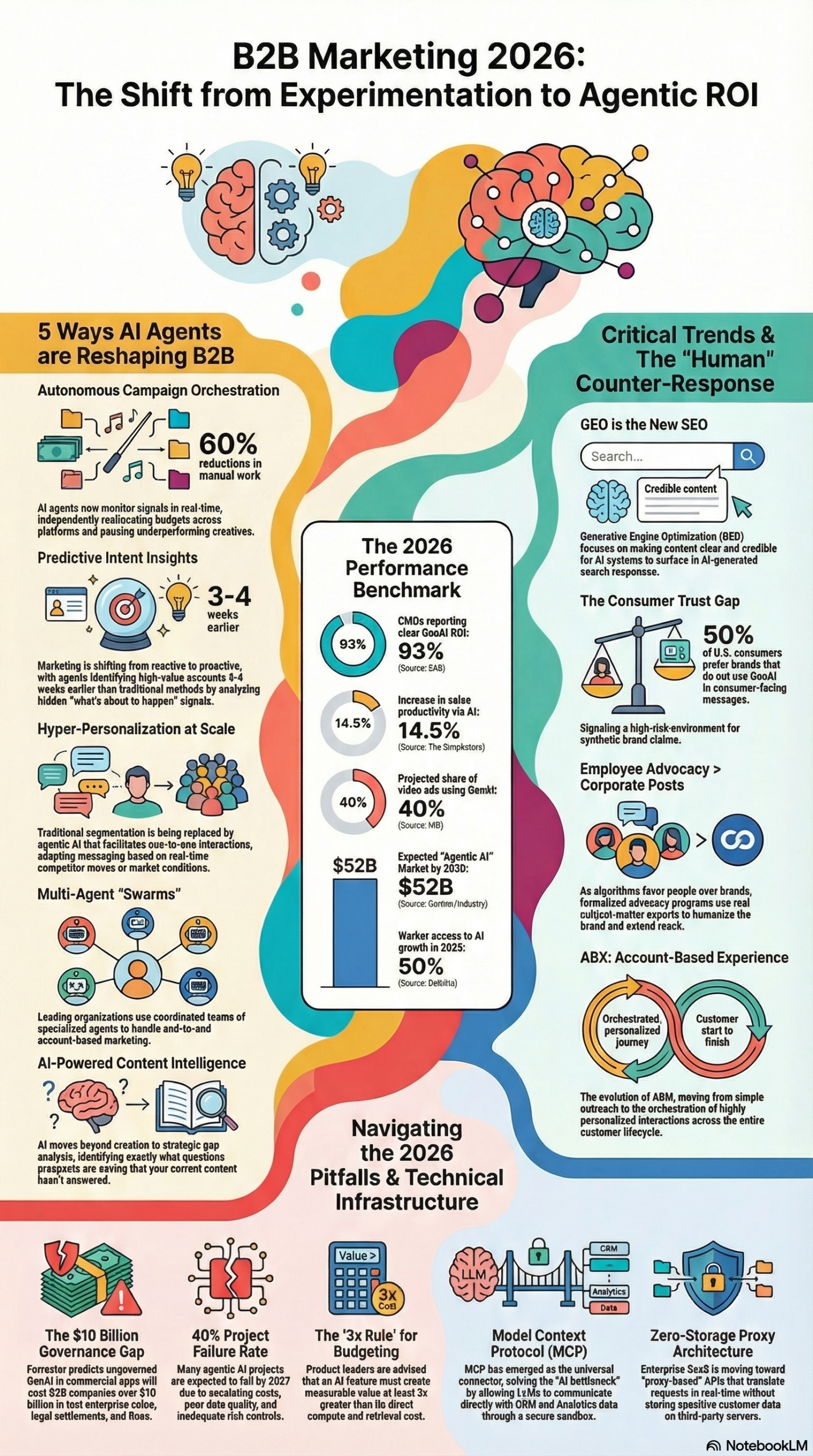
According to the 2026 B2B marketing research report, the defining technological shift of this year is the rise of agentic AI — autonomous systems capable of planning, executing, and optimizing complex multi-step workflows with minimal human oversight. These aren’t chatbots or content generators. They’re orchestrators that operate dynamically by analyzing real-time signals and making independent decisions without human prompting at each step.
The research report identifies three components driving this shift:
Model Context Protocol (MCP): Originally introduced by Anthropic, MCP is a standardized universal connector that allows large language models (LLMs) to communicate directly with your business stack — CRM, analytics platforms, Slack, email automation — with enterprise-grade security. Before MCP, integrating AI agents with business tools required custom API work for every connection. MCP solved the AI bottleneck by creating a common language between AI systems and business software, effectively moving AI from a chat interface into an active operational participant.
Multi-Agent Coordination: The most sophisticated 2026 implementations use teams of specialized agents working in parallel. In Account-Based Marketing (ABM), for example, the research report documents how one agent identifies buying committee members, a second researches relevant company news and buying signals, and a third generates hyper-personalized outreach — all running concurrently without a human coordinating each handoff.
The Production Scale Shift: Forrester’s 2026 research projects that two-thirds of content will be created outside centralized marketing teams by end of 2026. That’s not a gradual transition — it’s a structural reorganization of how B2B content gets produced. Centralized content teams are evolving into oversight and governance functions, while AI agents handle production volume. The Rachio case study documented in the research illustrates what production-grade AI deployment actually looks like: the smart irrigation company used AI agents to manage over one million support queries, achieving 95–99.8% accuracy and reducing costs by 30% through a hybrid AI + human model.
The companies winning right now are not those with the biggest AI budgets. They’re the ones who redesigned their workflows around AI agency rather than layering AI onto existing processes. Deloitte’s 2026 AI Report confirms this: “Success with AI isn’t just about boosting efficiency or even growing revenue. It’s about achieving strategic differentiation and a lasting competitive edge.” Only 34% of organizations are “truly reimagining” their business models — those are the ones capturing disproportionate competitive advantage.
Why It Matters
The window for first-mover advantage is closing. Deloitte’s data shows that companies with at least 40% of AI projects in production are set to double by mid-2026. That means organizations still running pilots are about to compete against peers with autonomous systems running 24/7 lead qualification, content production, and campaign optimization.
Here’s what changes for each practitioner role:
For Marketing Leaders: GenAI enables “always-on” intent scoring — AI agents that continuously monitor buyer signals across third-party data sources and website activity, identifying high-value accounts 3–4 weeks earlier than traditional methods, according to the research report. That lead time translates directly into pipeline advantage that compounds over a full fiscal year.
For Content Teams: The average B2B website conversion rate sits at just 1.8% according to Martal Group data cited in the research. GenAI-powered dynamic personalization — serving different content, CTAs, and case studies to different visitor segments in real-time — is one of the highest-leverage mechanisms for closing that conversion gap without increasing traffic acquisition costs.
For Revenue Operations: McKinsey’s analysis places GenAI’s marketing productivity boost at 5–15%. That’s a floor, not a ceiling, for well-implemented systems. The larger upside comes from workflow redesign: merging marketing and sales operations under a unified AI-orchestrated pipeline where handoffs between functions happen based on real-time signals rather than arbitrary stage dates.
For Product Leaders: The financial risk is real in both directions. Forrester warns that ungoverned GenAI could cost B2B companies over $10 billion in enterprise value. The governance requirement is not optional bureaucracy — it’s the difference between an AI system that compounds value and one that destroys it.
What makes the 2026 situation distinct from prior AI cycles is the trust deficit running in parallel with adoption. Gartner’s research shows 50% of U.S. consumers prefer brands that don’t use GenAI in customer-facing content, and 68% of consumers frequently wonder if the content they see is real. Gartner Senior Principal Analyst Emily Weiss puts it plainly: “Marketers should treat GenAI as a trust decision as much as a technology decision.” The strategic response is to deploy AI heavily in operations while preserving human authenticity at customer-facing touchpoints.
The Data
| Metric | Data Point | Source |
|---|---|---|
| CMO ROI Sentiment | 93% of CMOs report GenAI delivers clear ROI | SAS |
| Consumer Skepticism | 50% of consumers prefer brands avoiding consumer-facing GenAI | Gartner |
| AI Adoption Rate | 88% of organizations have adopted AI in some capacity | 2026 B2B Research Report |
| High Performer Rate | Only 6% of AI adopters qualify as “high performers” | 2026 B2B Research Report |
| Content Production | 2/3 of content will be created outside centralized teams by end of 2026 | Forrester |
| Production Scale | Companies with ≥40% AI projects in production to double by mid-2026 | Deloitte |
| Productivity Gain | GenAI can boost marketing productivity by 5–15% | McKinsey |
| B2B Website Conversion | Average B2B website conversion rate is ~1.8% | Martal Group |
| Content Authenticity | 68% of consumers frequently wonder if content they see is real | 2026 B2B Research Report |
| AI Agent Penetration | 40% of enterprise applications will feature AI agents by end of 2026 | 2026 B2B Research Report |
| Integration Market | iPaaS market forecast to exceed $17 billion by 2028 | Gartner |
| Financial Risk | Ungoverned GenAI could cost B2B companies >$10B in enterprise value | Forrester |
All data sourced from the 2026 B2B Marketing Research Report compiled via NotebookLM, originally based on Martech.zone analysis published March 24, 2026.
Step-by-Step Tutorial: Building Your 2026 GenAI B2B Marketing Strategy
This is a systematic framework for moving from ad-hoc AI use to a coordinated GenAI strategy that drives measurable business results. The structure below mirrors how high-performing organizations are actually building these systems — phased, governed, and grounded in unit economics from day one.
Prerequisites
Before starting, you need:
– A CRM (HubSpot, Salesforce, or equivalent) with clean, structured contact and account data
– At least 6 months of first-party intent data: website visits, content downloads, email engagement
– A documented ICP (Ideal Customer Profile) with firmographic and behavioral criteria
– At least one team member designated as an AI Governance lead
– Budget for an AI orchestration layer, not just individual AI point tools
Phase 1: Audit and Classify Your Existing AI Usage
The first mistake most organizations make is adding more AI before understanding what they already have. Map everything before building anything new.
Step 1: Build your AI inventory
Document every AI tool in use — officially sanctioned and shadow IT. For each tool, record:
– What it does (content generation, lead scoring, personalization, analytics)
– Whether its outputs are customer-facing or internal
– Whether it touches customer PII
– Cost structure: flat subscription vs. usage-based pricing
This inventory typically reveals two problems: (1) duplicate tools covering the same function, and (2) ungoverned tools creating the compliance exposure Forrester quantifies at over $10 billion in potential enterprise value risk. Knowing what you’re running is the prerequisite for governing it.
Step 2: Apply the 3x Rule to every tool
For each AI feature or tool, ask: does it create value at least three times greater than its direct compute cost? This “3x Rule” from the research report is a unit-economics test that cuts through vendor ROI claims. Every AI query carries a compute cost — tokens for input, output, and retrieval. Tools that fail the 3x test get cut or renegotiated. Tools that pass get investment priority.
Step 3: Identify your “Infinite Cost Trap” exposures
The research report calls this “the Latitude Test”: evaluate whether high usage of any AI feature erodes margins. Fixed-subscription SaaS models are particularly exposed when power users generate far more AI queries than the pricing model anticipated. Flag any tool where usage is uncapped and growing. These are your margin risk candidates — address them before scaling.
Phase 2: Build Your First-Party Data Foundation
AI is only as good as the data it operates on. As third-party signals weaken under tightening privacy regulations, the research report is explicit: a unified first-party data strategy is “the only way to power the hyper-personalization buyers now expect.”
Step 4: Unify contact and account data
Connect your CRM to your marketing automation platform with bidirectional sync. Every touchpoint — email opens, content downloads, webinar attendance, website page views, demo requests — should enrich a single account and contact record. Gaps in this data layer cause AI agents to make poor decisions based on incomplete context, producing results that are worse than manual processes.
Step 5: Implement real-time behavioral intent scoring
Build an intent model combining:
– Website activity: pages visited, time on page, return frequency, content category patterns
– Email engagement: click-through patterns, reply rates, forwarding behavior
– Content consumption: which topics, formats, and solution areas the account is researching
– Third-party intent signals: platforms like Bombora or G2 that capture research behavior off your site
The goal is a dynamic account score that updates continuously so your agents always operate with current context. The research report documents that properly configured predictive intent models can identify high-value accounts 3–4 weeks earlier than traditional methods — in a competitive B2B market, that lead time is significant pipeline advantage.
Step 6: Establish your governance baseline
Before deploying any autonomous agents, document in writing:
– What decisions agents can execute independently: send personalized emails, adjust ad bids, trigger SDR alerts, update CRM fields
– What requires human approval: content publication, late-stage communications, pricing discussions, any contact with a known decision-maker
– Circuit breakers: maximum spend per agent per day, maximum outreach frequency per account per week, hard stop triggers that require human review
The research report identifies circuit breakers as a non-negotiable safeguard against runaway autonomous loops. “Build in circuit breakers for agents” is listed as a primary recommendation for product and financial leaders, not as a nice-to-have.
Phase 3: Deploy Your First AI Agent Workflow
Start with one high-impact, well-defined workflow. ABM outreach qualification is the highest-ROI starting point for most B2B organizations because it has clear inputs (account data, intent signals), clear decision criteria (ICP fit, intent threshold), and measurable outputs (SDR conversations, pipeline created).
Step 7: Configure your AI orchestration layer
Using a platform that supports Model Context Protocol (MCP), configure connections to:
– CRM for account and contact records
– Intent data provider for third-party signals
– Email platform for outreach sequencing
– Slack or Teams for internal alert notifications
MCP’s standardized architecture makes these integrations substantially less complex than custom API builds. Each live connection gives your agent current context to make informed decisions rather than operating on stale data.
Step 8: Define agent decision logic in plain language first
Write the workflow logic before encoding it. This is where most implementations fail — they skip the design step and go directly to configuration, resulting in agents making decisions that don’t reflect actual business judgment. A starting template:
IF account_score > 85
AND recent_activity INCLUDES pricing_page
AND company_headcount BETWEEN 200 AND 2000
AND no_sdr_activity IN LAST 30 DAYS
THEN flag_for_sdr_outreach WITH ai_generated_context_brief

IF account_score < 40 AFTER initial_outreach
THEN pause_sequence AND route_to_nurture

IF contact_replies_to_email
THEN immediately_halt_all_automation AND notify_assigned_sdr
That last rule is critical. Any live reply from a human contact should immediately exit all automated sequences and hand off to a person.
Step 9: Implement the three-agent ABM model
The research report documents a proven multi-agent ABM architecture:
- Agent 1 (Research): Identifies all buying committee members at target accounts by cross-referencing CRM records, LinkedIn data, and company organizational signals. Updates dynamically as accounts add or change personnel.
- Agent 2 (Context): For each committee member, researches recent company developments, the contact’s published content and stated priorities, relevant industry triggers, and technology stack signals.
- Agent 3 (Outreach): Generates personalized first-touch messages for each committee member, referencing specific context from Agent 2’s research to write something that reads like a practitioner wrote it with knowledge of the recipient.
For the first 50 outreach messages, review Agent 3’s drafts before sending. Track the edit rate. When you’re making minimal changes, you’ve calibrated the agent’s judgment — at that point you can increase autonomy.
Step 10: Measure weekly against the 3x Rule
From day one, track:
– Cost per AI-assisted qualified opportunity vs. non-AI baseline
– Email reply rates on AI-personalized vs. standard templated outreach
– SDR time recovered per week (hours shifted from research to conversations)
– Token costs per workflow, broken down by agent
Run a weekly review for the first 30 days. The data will show which agent decisions are producing results and which decision rules need refinement. Expect to iterate on the logic 3–4 times in the first month before the workflow stabilizes.
Phase 4: Scale Content with GEO Strategy
Step 11: Transition from SEO to GEO
The research report documents that “Share of LLM” is becoming a critical visibility metric, often carrying more weight than traditional domain authority. Generative Engine Optimization (GEO) means structuring content so it gets surfaced accurately when buyers use AI engines — ChatGPT, Gemini, Perplexity — to research problems your product solves.
Practical GEO implementation:
– Use direct, descriptive headers that match question formats buyers actually use
– Implement structured data markup for key facts, statistics, and product specifications
– Publish original research data — surveys, product usage analyses, outcome studies — that AI engines can cite as authoritative sources
– Format comparison content as clean markdown tables that AI systems can parse and reproduce
– Keep all factual claims clearly attributed to verifiable sources
Step 12: Build your Human + AI content operating model
With Forrester projecting two-thirds of content created outside centralized teams by end of 2026, you need governance infrastructure — not just content guidelines. Configure:
– A tiered content approval workflow with different review thresholds by channel and sensitivity level
– Clear labeling standards for AI-assisted content in contexts where transparency matters
– An employee advocacy program that routes subject-matter expert content to buyers — the research confirms buyers engage more with content from real practitioners than corporate accounts, particularly as AI-generated content becomes ubiquitous
Expected Outcomes After 90 Days:
– 30–40% reduction in SDR time spent on account research
– Improved lead response time via agent-triggered alerts vs. manual monitoring
– Measurable increase in personalized outreach reply rates vs. templated baseline
– Documented AI governance framework your team consistently follows
– Clear cost-per-workflow data to make the next investment decision with real numbers
Real-World Use Cases
Use Case 1: Enterprise SaaS ABM at Scale
Scenario: A 150-person B2B SaaS company targeting mid-market accounts (200–2,000 employees) with a six-person SDR team.
Implementation: Deploy the three-agent ABM system via MCP connecting Salesforce, Bombora intent data, and an email sequencing platform. Agent 1 surfaces all active buying committee members at accounts with intent scores above threshold. Agent 2 generates context briefs covering recent company news, hiring signals, and technology stack. Agent 3 drafts personalized first-touch emails for each committee member referencing specific context. SDRs review drafts initially, then transition to approving high-volume sends as calibration improves.
Expected Outcome: SDR time shifts from account research to high-value conversations. Pipeline sourced from AI-assisted ABM reaches senior stakeholders earlier in the buying cycle, producing higher average contract values.
Use Case 2: Customer Support Automation
Scenario: A B2B company with high inbound support volume needs to reduce cost-per-ticket without degrading the customer experience.
Implementation: Following the Rachio model documented in the research: deploy AI agents to handle Tier 1 support queries autonomously with clearly defined human escalation paths. Rachio’s implementation managed over one million support queries at 95–99.8% accuracy, reducing costs by 30% through a hybrid model where AI handles volume and speed while humans handle complexity and relational nuance.
Expected Outcome: Significant cost reduction on routine support volume with maintained satisfaction scores, provided the escalation path to a human is frictionless and fast.
Use Case 3: Dynamic Website Personalization
Scenario: A B2B company whose website converts at the industry average of 1.8% wants to improve pipeline from existing organic traffic without increasing acquisition costs.
Implementation: Deploy an AI personalization layer that uses behavioral intent data and firmographic signals via reverse IP lookup to dynamically adjust homepage messaging, displayed case studies, and CTAs based on visitor segment. Visitors from target verticals see industry-specific social proof. Visitors on the pricing page who match high-intent behavioral patterns get a direct path to a sales conversation rather than a generic contact form.
Expected Outcome: Even a 30–50% relative improvement on a 1.8% baseline (moving to 2.3–2.7%) represents substantial pipeline impact at scale without proportional increase in marketing spend.
Use Case 4: GEO-Optimized Research Content
Scenario: A B2B company whose traditional organic search traffic is declining as buyers shift to AI engines for initial research.
Implementation: Audit existing high-traffic content for GEO compliance — structured data markup, clearly attributed factual claims, answer-formatted headers. Commission a series of original research reports using first-party data: product usage patterns, customer outcome benchmarks, market surveys. Publish as structured, citable content optimized for AI engine retrieval.
Expected Outcome: Increased Share of LLM — appearing in AI-generated responses when buyers research the problems your product addresses. This is the 2026 equivalent of first-page search ranking.
Use Case 5: Employee Advocacy to Counter the Trust Deficit
Scenario: A company whose AI-generated social content is receiving declining engagement as audience skepticism around AI content grows.
Implementation: Formalize an employee advocacy program where engineers, consultants, and practitioners publish first-hand insights, client stories, and technical perspectives. Use AI to help these individuals structure and refine their content — but the core insights originate from them. The research documents that 68% of consumers frequently wonder if content is real, making authentic human voices a genuine competitive differentiator in a landscape saturated with AI-generated output.
Expected Outcome: Higher engagement rates, stronger credibility with technical buyers, and pipeline influence from peer authority rather than brand broadcasting.
Common Pitfalls
Pitfall 1: Layering AI onto broken workflows
The most prevalent failure mode is deploying AI onto existing processes without redesigning them first. AI executes your broken process faster and at greater scale — it doesn’t fix it. Deloitte’s research shows only 34% of organizations are truly reimagining their business models. The other 66% are extracting marginal efficiency gains, not competitive transformation. Before deploying any agent, map the workflow end-to-end and verify the underlying process is sound.
Pitfall 2: Missing the cost structure
Fixed-subscription AI tools with uncapped usage can quietly erode margins. The research report names this “The Infinite Cost Trap”: AI features whose variable compute costs scale faster than the value they create. Apply the 3x Rule rigorously and monitor usage growth on any usage-based AI tool monthly.
Pitfall 3: Deploying GenAI in customer-facing content without review
With Gartner data showing 50% of consumers preferring brands that avoid consumer-facing GenAI, unreviewed AI content deployed at scale is a direct path to brand credibility erosion. Define explicitly which touchpoints are customer-facing and require human review vs. which are internal or operational and can run with lighter oversight.
Pitfall 4: Single-provider AI dependency
Tight coupling with one AI model provider creates architectural fragility. Model costs change, capabilities shift, and providers update terms. The research report recommends model-agnostic architectures with an orchestration layer that allows switching providers without rebuilding workflows — a direct operational risk mitigation.
Pitfall 5: Skipping formal AI governance
Forrester’s $10 billion risk warning is not hypothetical. Without documented governance — who can deploy AI tools, what outputs require review, how hallucinations are caught and corrected — a single compliance violation or brand-damaging output can undo months of efficiency gains. Governance is not a cost center; it’s business continuity infrastructure.
Expert Tips
1. Hire Context Engineers before you think you need them.
The research report identifies Context Engineers as a critical emerging role — professionals who manage the quality, structure, and retrieval architecture of data feeding your AI systems. The quality of your AI outputs is directly proportional to the quality of your context. Most B2B organizations are hiring for AI output roles while neglecting the data quality function that determines output quality.
2. Build circuit breakers into every autonomous workflow, without exception.
Every agent that can spend money or send communications needs hard limits: maximum daily spend, maximum outreach frequency per account, mandatory human review above defined thresholds. These are operational safety mechanisms, not bureaucratic slowdowns. An agent running in an autonomous loop without limits is a liability.
3. Adopt zero-storage proxy architectures for enterprise data security.
The research documents market leaders moving from storage-based Unified APIs — which cache sensitive customer data — to proxy-based architectures that translate requests in real-time without storing PII. If you’re selling to enterprise buyers, this architectural choice is a procurement requirement, not an optional security upgrade.
4. Invest in original research as your primary GEO content asset.
First-party data that AI engines can verify and cite — customer outcome benchmarks, usage pattern analyses, market surveys with raw data — produces far greater GEO returns than derivative opinion content. One well-structured original research report published with proper structured data markup beats ten thought leadership pieces for building Share of LLM over a 12-month period.
5. Establish an organizational AI IQ baseline across your entire team.
Rather than concentrating all AI quality control in a governance committee, the research report recommends empowering every team member to identify AI “slop,” bias, and hallucinations. A monthly cross-team review of AI outputs — rating quality, flagging errors, documenting edge cases — builds organizational detection capability faster than any centralized policy document.
FAQ
Q: How do we measure ROI on GenAI marketing investments?
Measure at the workflow level, not the tool level. Track cost-per-AI-qualified-opportunity vs. the non-AI baseline, hours recovered per SDR per week, content production cost reduction per unit, and token costs per workflow. SAS research cited in the report shows 93% of CMOs say GenAI delivers clear ROI — the operative word is “clear,” meaning measurement frameworks must be established before deployment, not retrofitted afterward. Without a pre-deployment baseline, you can’t prove the ROI that almost certainly exists.
Q: Is using GenAI in our marketing hurting our brand with buyers?
The risk is specific, not universal. Gartner’s data shows 50% of consumers prefer brands avoiding consumer-facing GenAI — this is a customer-facing content issue. AI-assisted operations, research, internal workflows, and back-end optimization carry no equivalent trust penalty with buyers. The strategic response is maximum AI deployment in operations and back-end workflows, with authentic human presence at the touchpoints buyers can actually see and evaluate.
Q: What’s the practical difference between SEO and GEO?
Traditional SEO optimizes for crawler bots and ranking algorithms that surface documents based on keyword relevance and authority signals. GEO — Generative Engine Optimization, as documented in the research — optimizes for how well AI engines understand, trust, and cite your content when generating responses to buyer queries. GEO requires structured factual claims, clear source attribution, answer-formatted headers, and original verifiable data. In 2026, “Share of LLM” is increasingly more valuable than search ranking position as buyer research behavior shifts toward AI engines.
Q: How many AI agents should we run simultaneously?
Start with one well-defined, high-impact workflow and achieve measurable results before expanding. Multi-agent coordination creates significant debugging complexity — diagnosing an issue in a system where three agents make interdependent decisions is substantially harder than debugging a single-agent workflow. Build operational competency at the single-agent level, validate the decision logic, document the governance model, then expand. Organizations that try to stand up five simultaneous agent workflows typically end up with five mediocre ones instead of one excellent one.
Q: What’s the minimum team configuration to implement this properly?
Two dedicated roles at minimum: one technical resource to configure integrations, maintain systems, and manage the orchestration layer; and one operational/governance lead to review outputs, refine decision logic, and manage compliance requirements. The governance role is consistently underestimated — the value of an AI agent system is directly tied to the quality of its decision logic, which requires continuous human review and refinement. Initial configuration is a small fraction of the ongoing maintenance investment that makes these systems actually reliable.
Bottom Line
The 2026 B2B marketing landscape is bifurcating: organizations that redesigned their workflows around AI agency are compounding their advantage, while those still running pilots are falling measurably further behind every quarter. The gap between 88% AI adoption and 6% high-performer status is not a technology gap — it’s a strategy and execution gap. The frameworks that separate the 6% from the rest are documented here: the 3x Rule for evaluating AI investments, circuit breakers for autonomous governance, first-party data foundations as the prerequisite for everything else, GEO as the successor search strategy, and the Human + AI operating model that maintains buyer trust while maximizing operational efficiency. As The Smarketers observe in the research, the question is not whether AI agents will reshape your marketing organization — it’s whether you’ll lead that transformation or be forced to catch up later.
Sources: 2026 B2B Marketing Research Report (NotebookLM) | Martech.zone: Best Practices to Level Up B2B Marketing Strategy with GenAI (March 24, 2026) | SAS, Gartner, Deloitte, Forrester, McKinsey, Martal Group — all cited via research report.


0 Comments