

The $131 billion martech industry has a dirty secret: most of it doesn’t work the way vendors promised. McKinsey analysis cited in this post’s research report puts it plainly — “martech’s promise remains largely unfulfilled,” with most marketers still applying technology to automate old processes rather than driving real growth. The shift happening right now — from monolithic suites to composable, agentic architectures — is the structural fix the industry has needed for a decade. This guide walks you through what’s changing, why it matters operationally, and a full step-by-step playbook for rebuilding your martech stack around AI agents and warehouse-first data infrastructure.
What This Is
Scott Brinker at chiefmartec.com published his March 2026 analysis under a deliberately calm headline: it’s the end of martech as we know it — and that’s fine. The argument isn’t that marketing technology is dying. It’s that the architectural model that dominated the past 15 years — the integrated suite — is giving way to something fundamentally different.
The research report produced for this post identifies three distinct eras in marketing technology:
Era 1: Point Solutions (2000–2010) — standalone email tools, basic CRMs, early web analytics. Each tool did one job. Integration was manual, messy, and expensive.
Era 2: Integrated Suites (2010–2024) — Salesforce, Adobe Experience Cloud, HubSpot, Oracle Eloqua, and others promised to consolidate everything under one roof. Single vendor, unified data, seamless workflows. The pitch was compelling. The delivery, for most organizations, fell short.
Era 3: Agentic Composable Stacks (2024–present) — AI agents operating autonomously against a central data warehouse, with best-of-breed activation tools connected by open standards like the Model Context Protocol (MCP).
The suite era failed in a specific, auditable way. Gartner has documented what the research report calls the “Gartner Gap” — the gap between what enterprise organizations license and what they actually use. Teams pay for predictive lead scoring, AI content tools, advanced attribution modules, and behavioral personalization engines baked into their suite contracts, then use maybe 20-30% of those features. The unused portion is pure cost with no return.
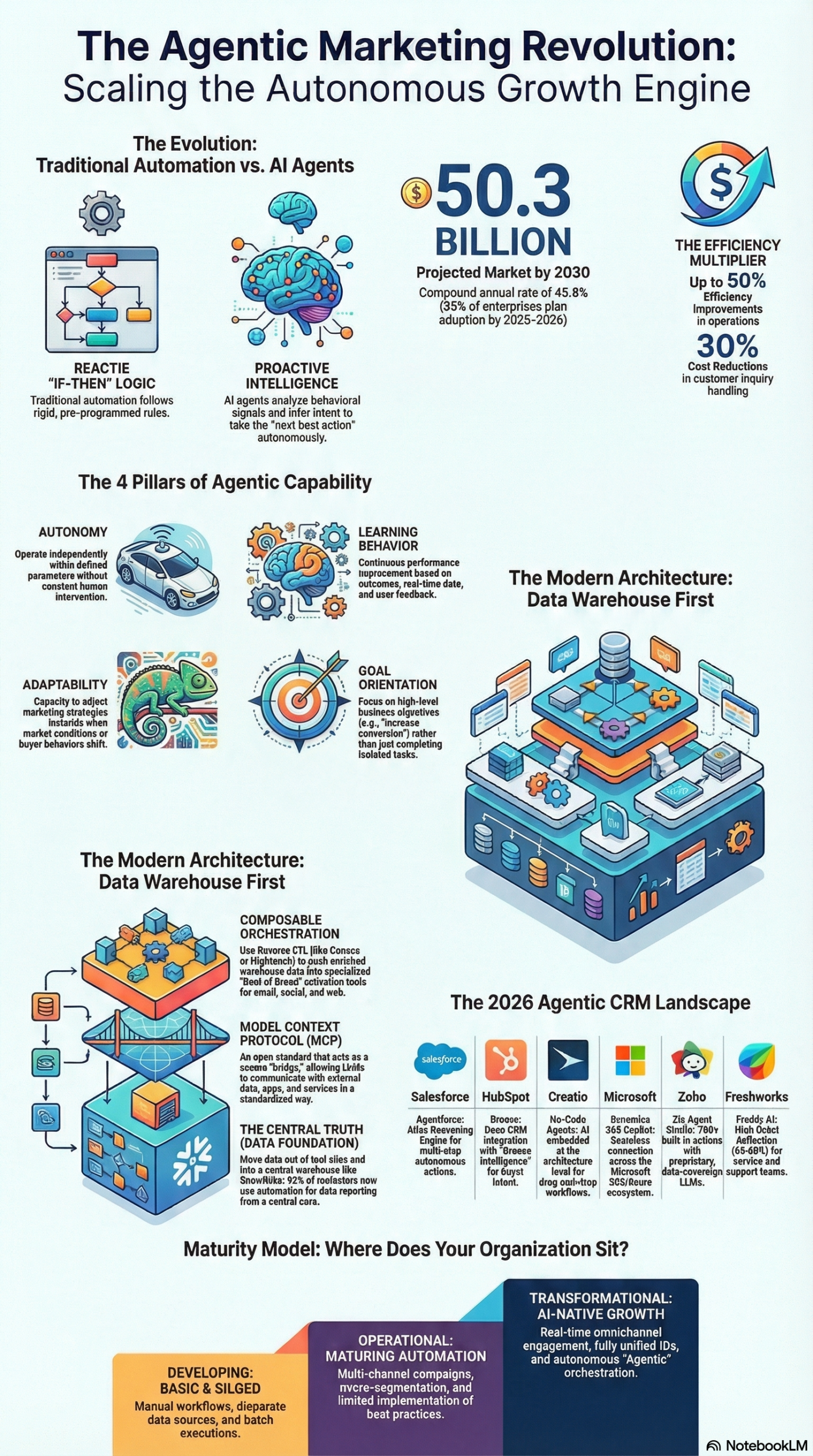
What replaces it is an architecture built on four principles. First, a central data warehouse — Snowflake or BigQuery — where all customer events and transaction signals live, owned by the organization rather than locked inside a vendor. Second, an orchestration layer using Reverse ETL tools like Census or Hightouch to push warehouse-computed intelligence back into operational platforms. Third, best-of-breed activation tools — Braze for email, Contentful for CMS, AdStellar for paid social — that get a single clean data feed rather than maintaining their own siloed records. Fourth, AI agents that execute autonomously against this unified data layer, handling the routine tasks that used to require human time.
The AI agent concept represents a third phase of content marketing automation as documented in the research report — following AI assistants and basic rule-based automation. What distinguishes true agents from the automations your current tools already offer comes down to four capabilities:
- Autonomy: Agents operate independently within defined parameters. They don’t wait for a human to trigger every action.
- Learning Behavior: They improve based on real-time performance data and feedback — not static rules written at campaign setup.
- Goal Orientation: They optimize toward business outcomes (pipeline, revenue, retention) rather than task completion (email sent, form submitted).
- Adaptability: They adjust strategy dynamically when market conditions or buyer behavior shifts — a capability entirely absent from traditional if-then automation.
Aprimo’s whitepaper on this shift frames it precisely: “Traditional marketing automation follows rigid ‘if-then’ logic… AI agents, however, simultaneously process multiple signals and adapt their approach based on context.” That isn’t a feature upgrade. It’s a different operating model.
The enabling infrastructure for this shift is equally important. The Model Context Protocol (MCP), introduced by Anthropic in 2024 and supported by Google Cloud, solves what the research report calls the “N×M problem” — the engineering burden of building custom API integrations between every AI model and every data system. MCP is an open standard that lets LLMs communicate securely with external applications and databases through a standardized bridge. One server connecting your warehouse serves every MCP-compatible AI agent on your stack, regardless of which underlying model it runs on.
Why It Matters
The market signal is unambiguous. The global AI agents market was valued at approximately $5.4 billion in 2024, according to the research report. Projections put that figure at over $50 billion by 2030 — a roughly 10× expansion in six years. That’s where the capital, talent, and tooling investment is flowing. Staying on a monolithic suite architecture in this environment means running slower technology with higher costs against competitors who aren’t.
For practitioners, the near-term operational case is more compelling than the market forecast. Organizations implementing AI agents report up to 50% efficiency improvements in customer service and operational workflows, and up to 30% cost reductions in customer inquiry handling, per figures documented in the research report. These aren’t projections — they’re documented outcomes from organizations that have already made the transition.
Three forces are converging to make this the right moment to act:
The shelf-ware problem is auditable. Most organizations can now calculate exactly what percentage of their martech license spend produces no measurable output. That number funds the transition. When the “Kill List” audit (covered in the tutorial below) reveals you’re paying for $80K/year in unused features, the ROI conversation for a composable rebuild becomes straightforward.
The open protocol infrastructure is ready. MCP’s introduction changes the engineering calculus. As Google Cloud documents, the core problem with LLMs is that “their knowledge is frozen… and they can’t interact with the outside world.” MCP fixes the second limitation. Combined with Reverse ETL platforms that have matured significantly in the past three years, the plumbing required for a warehouse-first, agent-enabled stack is now accessible to mid-market teams — not just enterprises with dedicated data engineering departments.
The tooling ecosystem is mature enough to replace suites piece by piece. Braze, Contentful, AdStellar, Skai, Smartly.io, and others have reached the depth of capability where replacing a suite component with a best-of-breed tool is a performance upgrade, not a compromise. Agencies benefit directly — the economics of client delivery change when AI agents handle execution and human strategists handle judgment.
The organizations that don’t adapt will continue paying the shelf-ware tax while running marketing workflows that require more human coordination than they should. The MarTech360 philosophy behind composable architecture captures it cleanly: “The future ready stack is never finished. It evolves as new tools emerge and old ones fade… You design for change, not permanence.”
The Data: Agentic Martech Platform Landscape 2026
The market has consolidated around platforms offering genuine agentic capabilities — autonomous task execution rather than rule-based workflows. Here’s the current competitive landscape by segment, drawn from the research report:
Agentic CRM Platforms
| Platform | Key Agentic Feature | Orchestration Depth | Target Segment |
|---|---|---|---|
| Salesforce Agentforce | Atlas Reasoning Engine — multi-step autonomous actions | High (native Data Cloud integration) | Large Enterprise |
| HubSpot Breeze | Autonomous agents for content, social, and lead nurturing | Medium (native HubSpot data model) | SMB to Mid-Market |
| Creatio | No-code platform with AI embedded at the architecture level | High (native process engine) | Mid-to-Large Enterprise |
| Zoho CRM (Zia) | No-code “Zia Agent Studio” with 700+ built-in actions | Medium (Zoho ecosystem) | SMB/Mid-Market |
| Freshworks Freddy | “Freddy AI Agent Studio” focused on service resolution | Medium (Freshworks suite) | Support/IT Teams |
Specialized Agency and Channel Tools
| Tool | Primary Focus | Autonomous Capability |
|---|---|---|
| AdStellar AI | Meta advertising — generates hundreds of ad variations autonomously | High — autonomous scaling and creative rotation |
| Jasper / Copy.ai | On-brand content orchestration and cross-channel copy | Medium-High — multi-model workflow support |
| Skai / Smartly.io | Creative and media buying automation for omnichannel advertising | High — enterprise-grade automated optimization |
Composable Stack Infrastructure
| Layer | Role | Representative Tools |
|---|---|---|
| Data Foundation | Central repository for all customer events and transactions | Snowflake, Google BigQuery |
| Identity Resolution | Unified customer graph across online and offline touchpoints | Reltio, LiveRamp, Snowflake native |
| Orchestration / Reverse ETL | Pushes warehouse intelligence back into operational tools | Census, Hightouch |
| AI Connectivity | Standardized LLM-to-system bridge | Model Context Protocol (MCP) |
Source: NotebookLM research report for this post, March 2026.
Step-by-Step Tutorial: Transitioning to an Agentic, Composable Martech Stack
This is a full migration playbook. The sequence is deliberate — skip phases and you’ll deploy agents on a broken data foundation, which produces worse outcomes than your current setup.
Prerequisites
Before starting, confirm you have:
- Access to current martech contracts and, ideally, feature utilization data from your vendors
- At least one technically proficient operations person who can manage data connections (a full data engineering team is no longer required for the initial build)
- A data warehouse account — Snowflake and BigQuery both have free tiers for evaluation
- Executive sponsorship — the research report is explicit that this transition “must be elevated to the C-suite” rather than treated as an IT cost center decision; without it, you’ll stall on data governance and vendor contract negotiations
Estimated timeline: 3–6 months for core infrastructure; 12–24 months for full composable stack with best-of-breed replacements as suite contracts expire.
Phase 1: The Audit — Identify and Eliminate Shelf-ware
Step 1: Map Every Active Martech Contract
Build a spreadsheet with every tool your organization pays for. Include: tool name, monthly/annual cost, primary use case, active users in the last 90 days, features actually used vs. features included in the license.
This is not a theoretical exercise. Pull actual usage data from your platforms — most enterprise suites offer admin-level usage dashboards. If you can’t get utilization data from the vendor, that’s already a red flag about the platform’s transparency.
Step 2: Create the Kill List
Per the research report’s actionable recommendation: identify overlapping functionalities in current monolithic suites and create a “Kill List” of features being paid for but not used. Be specific — not “we don’t use the AI features” but “we pay for Predictive Lead Scoring in [Platform] at $X/month and have never activated the module.”
Group discoveries into three categories:
– Immediate cuts: features you’re paying for that you’ve never used and won’t need in a composable architecture
– Replace with best-of-breed: capabilities the suite handles poorly that a specialized tool would do better
– Keep through contract expiration: features that are working, priced reasonably, and don’t need replacement yet
Step 3: Calculate the Shelf-ware Tax
Total your annual martech spend. Multiply by the percentage of features in the “immediate cuts” and “replace” categories. That’s your shelf-ware tax — and it’s the primary funding source for the composable transition. For most enterprise organizations, this number justifies the migration cost before any efficiency gains from agents are factored in.
Phase 2: Establish the Data Core
Step 4: Select and Initialize Your Data Warehouse
If you’re starting fresh, Snowflake and BigQuery are the two dominant choices. Snowflake has stronger third-party data marketplace integrations — relevant if you plan to enrich internal data with external signals like foot traffic or weather patterns, which the research report identifies as a significant use case for the Snowflake Marketplace. BigQuery integrates natively with Google Analytics and Google Ads, making it the natural choice if those platforms anchor your analytics.
Your choice should follow your existing data gravity: where does most of your customer data currently live, and which warehouse has native connectors for those systems?
Step 5: Centralize Customer Event Data
Every meaningful customer action needs to flow into the warehouse: email clicks, form fills, purchases, support tickets, web sessions, product usage events, ad interactions. Use a Customer Data Platform or event streaming tool — Segment, RudderStack, or warehouse-native connectors — to pipe events from your current tools into the central store.
Establish a consistent event schema from day one. At minimum, each event record should include:
-- Recommended base schema for customer events
CREATE TABLE customer_events (
    event_id        STRING,
    customer_id     STRING,        -- unified, not tool-specific
    event_type      STRING,        -- e.g., 'email_click', 'purchase', 'support_ticket'
    event_timestamp TIMESTAMP,
    source_system   STRING,        -- e.g., 'klaviyo', 'shopify', 'zendesk'
    session_id      STRING,
    channel         STRING,
    revenue_impact  FLOAT64,       -- null if not applicable
    properties      JSON           -- event-specific metadata
);
Consistent schema here prevents cascading problems in every downstream agent and orchestration workflow.
Step 6: Implement Identity Resolution
Different tools use different identifiers: your CRM has a contact ID, your ESP has a subscriber ID, your ad platform has a user ID, your website has a cookie ID. Without unification, an email subscriber, a CRM contact, and a website visitor who are the same person appear as three separate records — and every AI agent downstream makes decisions based on fractured data.
The research report identifies standardizing unified identifiers as a technical priority: “Prioritize identity resolution to create a ‘living customer graph’ that stitches together interactions across all online and offline touchpoints.”
Tools like Reltio, LiveRamp, or Snowflake’s native identity resolution capabilities can map these IDs to a single canonical customer record. Run this step before building any scoring models or agent logic. Identity resolution is foundational — everything downstream depends on it being correct.
Phase 3: Build the Orchestration Layer
Step 7: Implement Reverse ETL
Reverse ETL takes warehouse-computed intelligence and pushes it back into the tools your teams actually use — Salesforce, HubSpot, Outreach, Gorgias. This is what makes the Data Warehouse First model operational rather than theoretical.
The research report explains the concept directly: “This process ‘activates’ data by sending warehouse-computed values (like churn risk scores or Customer Lifetime Value) back into the CRM, allowing sales teams to act on intelligence that does not exist in the CRM alone.”
Set up Census or Hightouch to sync computed values from your warehouse into your CRM and activation platforms. Start with these three computed fields — they generate immediate visibility and build internal stakeholder support for the broader transition:
- Churn Risk Score (0–100, computed weekly from engagement, product usage, and support data)
- Customer Lifetime Value Tier (High/Medium/Low based on historical and projected spend)
- Next Best Action (categorical field populated by your AI agent based on current engagement signals)
Once these fields exist in your CRM, every sales and support rep sees real intelligence without leaving the tools they already use. This is the fastest internal win available in the composable transition.
Step 8: Connect AI Agents via MCP
If you’re building custom AI agents rather than deploying a packaged platform like Agentforce or HubSpot Breeze, MCP is the connectivity standard to adopt. As documented in the research report, MCP solves the “N×M problem” — the engineering cost of maintaining custom integrations between every AI model and every data system.
A minimal MCP server connecting an LLM to your Snowflake warehouse looks like this:
# MCP server: connects any MCP-compatible LLM to Snowflake
from mcp.server import Server
from mcp.types import Tool, TextContent
import snowflake.connector
import os

server = Server("martech-warehouse-agent")

@server.call_tool()
async def query_customer_data(arguments: dict) -> list:
    """Give the agent read access to warehouse data."""
    conn = snowflake.connector.connect(
        user=os.environ["SNOWFLAKE_USER"],
        password=os.environ["SNOWFLAKE_PASSWORD"],
        account=os.environ["SNOWFLAKE_ACCOUNT"],
        warehouse=os.environ["SNOWFLAKE_WAREHOUSE"],
        database=os.environ["SNOWFLAKE_DATABASE"]
    )
    cursor = conn.cursor()
    cursor.execute(arguments["query"])
    results = cursor.fetchall()
    columns = [desc[0] for desc in cursor.description]
    return [TextContent(
        type="text",
        text=str([dict(zip(columns, row)) for row in results])
    )]

if __name__ == "__main__":
    server.run()
This single MCP server gives any MCP-compatible LLM real-time read access to your customer warehouse — no custom REST API required. Every agent you deploy (for email, for paid media, for lead scoring) can use the same server to pull live customer data.
Step 9: Define Agent Guardrails Before Deployment
Autonomous agents need hard constraints. Before any agent touches live campaigns or customer interactions, define and document:
- Permission scope: which data the agent can read vs. write; which systems it can update automatically vs. flag for human review
- Spend limits: daily and weekly budget caps for any agent controlling paid media allocation
- Escalation triggers: specific action types that require human approval before execution (for example, any email to more than 10,000 recipients, or any bid increase over 50%)
- Audit logging: every agent action writes to an immutable log with timestamp, action taken, data state at time of action, and measurable outcome
This isn’t bureaucracy — it’s the difference between an agent that saves your team 20 hours per week and one that sends a mass campaign at 2am to a list it shouldn’t have touched.
Phase 4: Activate Best-of-Breed Tools
Step 10: Select Activation Platforms by Channel Depth
With data core and orchestration in place, choose activation tools based on capability depth per channel — not suite breadth. The research report’s composable architecture documentation supports this directly:
- Email: Braze or Klaviyo over the bundled ESP features in your CRM suite — both have deeper segmentation and predictive send-time optimization
- Paid Advertising: AdStellar AI for Meta (per the research report, it generates hundreds of ad variations and scales winning campaigns autonomously); Skai or Smartly.io for omnichannel enterprise advertising
- CMS / Content Delivery: Contentful for headless CMS with AI-generated content variations
- Sales Engagement: Outreach or Apollo, configured to pull churn scores and CLV tiers from your warehouse via Reverse ETL and surface them in the rep workflow
Each tool gets a single, clean intelligence feed from your warehouse. They don’t need to sync with each other — the warehouse is the single source of truth and the agents read from it directly.
Step 11: Deploy Multi-Model Content Workflows
For content generation at scale, the research report recommends adopting multi-model workflows — platforms like Copy.ai allow switching between different LLMs (OpenAI, Anthropic, Google) to optimize for speed, cost, and output quality for specific task types. Don’t lock your content pipeline to a single model. Different tasks have different cost/quality tradeoffs:
- Short-form ad copy and email subject lines: prioritize speed and cost, use a faster model
- Long-form thought leadership and technical content: prioritize quality, use a higher-capability model
- Personalization at scale (hundreds of variants): prioritize throughput, batch process with the most cost-efficient model that meets quality thresholds
Build this routing logic into your content agent from the start. It will save significant cost as you scale volume.
Expected Outcomes After Full Transition
After completing this migration — typically 3–6 months for a focused mid-market team to reach operational capability:
- Unified customer data accessible to every activation tool without manual syncing or CSV exports
- AI agents executing routine tasks (list segmentation, bid adjustments, follow-up sequences, content variants) without human intervention
- Predictive intelligence (churn risk, CLV tier, next best action) surfaced inside the tools your teams already use
- Measurable reduction in the number of platforms your team actively manages and maintains
- A stack designed for change — new tools connect to the warehouse, not to each other, so adding or swapping components doesn’t require rebuilding integrations
Real-World Use Cases
Use Case 1: E-Commerce Churn Prevention Agent
Scenario: A DTC e-commerce brand with 200,000 customers and a 25% annual churn rate. The marketing team has Klaviyo for email, Shopify for orders, and Gorgias for support tickets — all siloed. Churn intervention is reactive: the team sends win-back campaigns after customers have already left.
Implementation: Centralize event data from all three platforms into Snowflake using native connectors. Compute a weekly Churn Risk Score for every customer based on: days since last purchase, support ticket frequency in the last 60 days, and average order value trend over three purchase cycles. Use Hightouch to sync the score to Klaviyo as a custom property. Configure an AI agent to automatically enroll customers crossing a risk threshold of 65+ into a win-back sequence, with offer depth calibrated to their historical CLV tier — high-value customers get a more aggressive offer, low-value customers get a softer touch.
Expected Outcome: Intervention timing shifts from reactive (post-churn) to predictive (30 days before likely churn). Per the efficiency and cost-reduction figures documented in the research report for agentic workflows, organizations using this model see up to 30% reductions in customer service and retention costs.
Use Case 2: B2B SaaS Lead Scoring and Sales Routing
Scenario: A SaaS company generating 2,000 MQLs per month, with a sales team complaining that MQL quality is inconsistent and the scoring model in their CRM hasn’t been updated in 18 months.
Implementation: Build a composite lead score in BigQuery combining firmographic enrichment (from Clearbit or Snowflake Marketplace), behavioral signals (product trial activity, webinar attendance, content downloads, page depth), and third-party intent data. Use Census Reverse ETL to push the score and a “Next Best Action” field back into Salesforce. Deploy Salesforce Agentforce’s Atlas Reasoning Engine to route leads to the appropriate rep tier based on score, with autonomous follow-up sequencing for mid-tier leads that would otherwise wait in queue.
Expected Outcome: Sales reps focus exclusively on high-score leads. The AI agent handles mid-tier nurturing with personalized sequences based on behavioral signals. Lead response time drops from hours to minutes for agent-handled segments.
Use Case 3: Agency Paid Media Automation at Scale
Scenario: A performance marketing agency managing 15 Meta ad accounts with a team of four media buyers. The team spends the majority of their time on manual bid adjustments, audience testing, and creative rotation — execution work that doesn’t require strategic judgment.
Implementation: Deploy AdStellar AI across client accounts, which per the research report generates hundreds of ad variations and scales winning campaigns autonomously. Configure client-specific budget guardrails and ROAS targets as hard constraints on agent behavior. Use Copy.ai’s multi-model workflow to generate ad creative variations, routing short-form copy to faster models and longer narrative ads to higher-quality models. Human media buyers review weekly performance summaries and set strategic direction.
Expected Outcome: Media buyers shift from execution to strategy and creative direction. The agent handles bid management, audience expansion, and winning creative scaling without daily human input, allowing the agency to increase account capacity without proportional headcount growth.
Use Case 4: B2B Content Operations at Scale
Scenario: A B2B SaaS content team producing 40 pieces per month across blog, email, LinkedIn, and sales enablement. Content quality is inconsistent, on-brand compliance requires constant editing, and the team can’t produce enough content to feed the sales team’s requests.
Implementation: Deploy Jasper with a centralized brand voice configuration connected to a content intelligence feed from the warehouse — top-performing topics by pipeline attribution, keyword gaps from SEO data, ICP signals from CRM data. AI agents handle first drafts, cross-channel reformatting (blog post → email → LinkedIn → sales one-pager), and initial editing for style compliance. Human editors focus on strategic angle, accuracy review, and final approval.
Expected Outcome: Content velocity increases 2–3× without proportional headcount growth. Brand consistency improves because every output draws from the same centralized intelligence and style configuration, not individual writer interpretation.
Common Pitfalls
Pitfall 1: Deploying Agents Before Cleaning Data
The most common failure mode in the composable transition. Teams get excited about AI agents and deploy them before establishing clean, unified customer data. Agents trained on inconsistent or siloed data produce incorrect segmentation, bad scoring, and faulty campaign triggers. Every Phase 2 step must be complete before any agent goes live.
Pitfall 2: Skipping Identity Resolution
Related but distinct from clean data: teams often centralize data without unifying customer identity across sources. An email subscriber, a CRM contact, and a website visitor might be the same person — but if your warehouse doesn’t know that, your AI agent treats them as three different people with three incomplete data profiles. This produces personalization failures and duplicate outreach. Identity resolution is not optional.
Pitfall 3: No Guardrails on Autonomous Agents
Deploying agents without spend limits, permission scopes, and escalation triggers is how you end up with a rogue campaign exhausting a monthly budget in 48 hours. Every agent needs hard numerical limits and human-in-the-loop checkpoints for high-stakes actions. Define these before deployment, not after the first incident.
Pitfall 4: Treating This as an IT Initiative
The research report is direct: martech transformation requires C-suite sponsorship. Organizations that route the composable transition through IT without marketing leadership alignment stall on data governance decisions, vendor contract negotiations, and cross-department cooperation. This is a strategic growth initiative. It needs a named executive owner with budget authority.
Pitfall 5: Trying to Replace Everything Simultaneously
Composable architecture doesn’t require burning your existing stack on day one. The practical sequence is warehouse first, Reverse ETL second, agents third, best-of-breed tool replacements as existing contracts expire. Running a hybrid stack for 12–18 months is expected and manageable. Trying to compress the timeline by skipping the audit and data foundation phases is the fastest route to a failed migration.
Expert Tips
Tip 1: Start With Reverse ETL, Not the Agent
Before deploying any AI agent, get Reverse ETL running and put live churn scores and CLV tiers in your CRM where your sales team can see them. When reps see real intelligence surfaced inside Salesforce without any extra steps, they become internal advocates for the broader transition. This builds the political capital you need for the harder architectural phases.
Tip 2: Use the Snowflake Marketplace for Competitive Differentiation
The research report specifically documents that the Snowflake Marketplace enables enrichment of internal data with external variables like weather patterns or foot traffic. For retail, QSR, or location-dependent businesses, this is a significant competitive edge — correlating purchase patterns with external events produces behavioral insights that are inaccessible to competitors running closed-loop martech suites.
Tip 3: Run Multi-Model Content Pipelines From Day One
Don’t commit your entire content operation to a single LLM. The research report’s documentation of Copy.ai’s multi-model approach — switching between OpenAI, Anthropic, and Google depending on the task — is the right architecture. Subject line generation has different cost/quality tradeoffs than technical white paper drafts. Optimize at the task level rather than selecting one model and applying it uniformly.
Tip 4: Adopt MCP Early to Reduce Future Integration Debt
MCP is still maturing, but it’s becoming the standard for AI-to-system connectivity. Teams that build agent infrastructure on MCP now will have dramatically lower integration costs as the ecosystem grows. Teams that build custom REST API connectors for every AI integration will spend the next two years rebuilding them as models and vendors evolve.
Tip 5: Log Every Agent Action
Every autonomous action should write to an audit log with: timestamp, action taken, data state at time of action, and measurable outcome (open rate, click, conversion, spend). This is not just compliance hygiene — it’s how you debug unexpected agent behavior, prove ROI to leadership, identify model drift over time, and continuously improve agent logic. Agents operating without observable action logs are unmanageable at scale.
FAQ
Q1: Do I need a full data engineering team to implement this?
Not anymore. Snowflake and BigQuery both have managed connectors and no-code data pipeline interfaces. Fivetran and Airbyte handle data ingestion from common martech sources without custom engineering. Reverse ETL platforms like Census and Hightouch have no-code sync interfaces. A technically proficient marketing operations person can stand up a basic composable stack without a dedicated data engineer on staff. For complex identity resolution and custom scoring models, you’ll want at least part-time engineering support — but that’s a materially lower requirement than enterprise data engineering teams of even five years ago.
Q2: Is Salesforce Agentforce the right choice for enterprise agentic CRM?
It depends entirely on your existing Salesforce investment. Agentforce’s Atlas Reasoning Engine is genuinely capable for multi-step autonomous actions, and if you’re already running Salesforce Data Cloud, the native integration is a significant advantage. But per the research report’s platform comparison, if you’re not deeply embedded in the Salesforce ecosystem, HubSpot Breeze offers strong agentic capabilities for mid-market at lower implementation cost, and Creatio’s no-code AI architecture is a legitimate enterprise alternative with less lock-in.
Q3: What’s the actual operational difference between traditional automation and an AI agent?
Traditional automation executes predefined rules: if condition X is true, execute action Y. Every possible scenario must be anticipated and scripted in advance. As Aprimo’s whitepaper documents, agents “simultaneously process multiple signals and adapt their approach based on context.” The agent evaluates the current situation and decides what to do — including in situations that weren’t explicitly scripted. This means agents handle novel conditions that would cause a rules-based automation to either fail silently or take no action.
Q4: How does MCP actually reduce integration complexity in practice?
Without MCP, connecting a new AI model to your CRM, warehouse, and ESP requires custom API code for each connection. The research report calls this the “N×M problem” — every model (N) needs a custom connector to every tool (M). If you have 5 data sources and want to run 3 different AI agents, that’s potentially 15 custom integrations to build and maintain. MCP provides a single, standardized protocol: build one MCP server per data source, and any MCP-compatible model can connect to it. The same Snowflake MCP server serves your email agent, your lead scoring agent, and your content agent — no duplicate integration work.
Q5: How long does a realistic full transition take?
For a focused mid-market team: 3–6 months to establish the data core, Reverse ETL, and initial agent deployment. Full composable architecture — with best-of-breed tools replacing suite components as contracts expire — typically takes 12–24 months. The critical path items are identity resolution (often underestimated) and getting executive alignment on vendor contract decisions. Don’t try to compress the timeline by skipping the audit and data foundation phases. They determine whether every downstream agent deployment succeeds or fails.
Bottom Line
Traditional martech suites built on siloed data and rigid if-then automation have reached the limit of what they can deliver. The research report documenting this transition is unambiguous: McKinsey analysis found the $131 billion martech industry’s promise “remains largely unfulfilled,” and the organizations reporting real efficiency gains — up to 50% operational improvements and 30% cost reductions per the research report — are the ones that have already made the architectural shift. The composable, warehouse-first, agentic model isn’t experimental; it’s what the infrastructure maturity of 2026 makes practical for teams that couldn’t have built it three years ago. Start with the shelf-ware audit, establish your data core, and get Reverse ETL running before you deploy a single agent. Teams that complete Phase 2 in the next 90 days will be operating autonomous marketing systems while their competitors are still negotiating suite renewal contracts.


0 Comments