

A beverage brand’s fully automated media-buying campaign — executed with SSP PubMatic and independent media agency Butler/Till — reduced buy-side costs by 5.5x with zero human involvement in individual bid decisions. This is agentic advertising in production, not in a whitepaper. In this tutorial, you will learn exactly how agentic media buying works at a technical and operational level, which protocols to choose, how to configure your first agentic campaign, and how to measure results using a KPI framework built for autonomous systems.
What Is Agentic Media Buying?
Agentic media buying is the application of autonomous AI agents to the programmatic advertising supply chain. Instead of a media buyer manually adjusting bids, reallocating budget, and swapping creative between reporting cycles, an AI agent reasons through campaign objectives, executes trades, and optimizes spend in real time — all within human-defined guardrails.
The distinction from traditional programmatic is foundational, not incremental. Standard programmatic automates the auction mechanics but still demands constant human input: a planner builds the campaign, a trader monitors pacing, an analyst pulls results after the fact. Agentic systems collapse that labor model. According to the NotebookLM agentic advertising research report, the industry is shifting from “impression-by-impression trading” to “agentic decision-making,” where systems plan and optimize media in real time within parameters set by human strategists.
The campaign covered by Marketing Dive on March 17, 2026 is the clearest real-world proof point to date. An unnamed beverage marketer partnered with Butler/Till and PubMatic to run a fully automated media-buying and optimization process. The result: buy-side costs dropped by 5.5x versus their baseline.
The Two Architectural Modes
The research report identifies two structural modes that coexist in real agentic deployments:
Structural Agentic: Service-to-service orchestration where autonomous components — SSPs, DSPs, data platforms — interact via machine-readable protocols. This is the infrastructure layer. No AI “intelligence” is required; it’s simply software systems communicating programmatically without human intermediaries.
Autonomic Agentic: AI-driven decision-making based on learned models and contextual objectives, often facilitated by the Model Context Protocol (MCP). This is where strategic reasoning lives — an agent interprets campaign goals, evaluates performance signals, and decides how to allocate spend without being told step-by-step.
Most production deployments combine both. The structural layer handles auction mechanics and data plumbing; the autonomic layer handles strategy, optimization, and exception handling.
The Protocols That Power It
Four protocols are currently defining how agentic advertising works at the machine level, as documented in the research report:
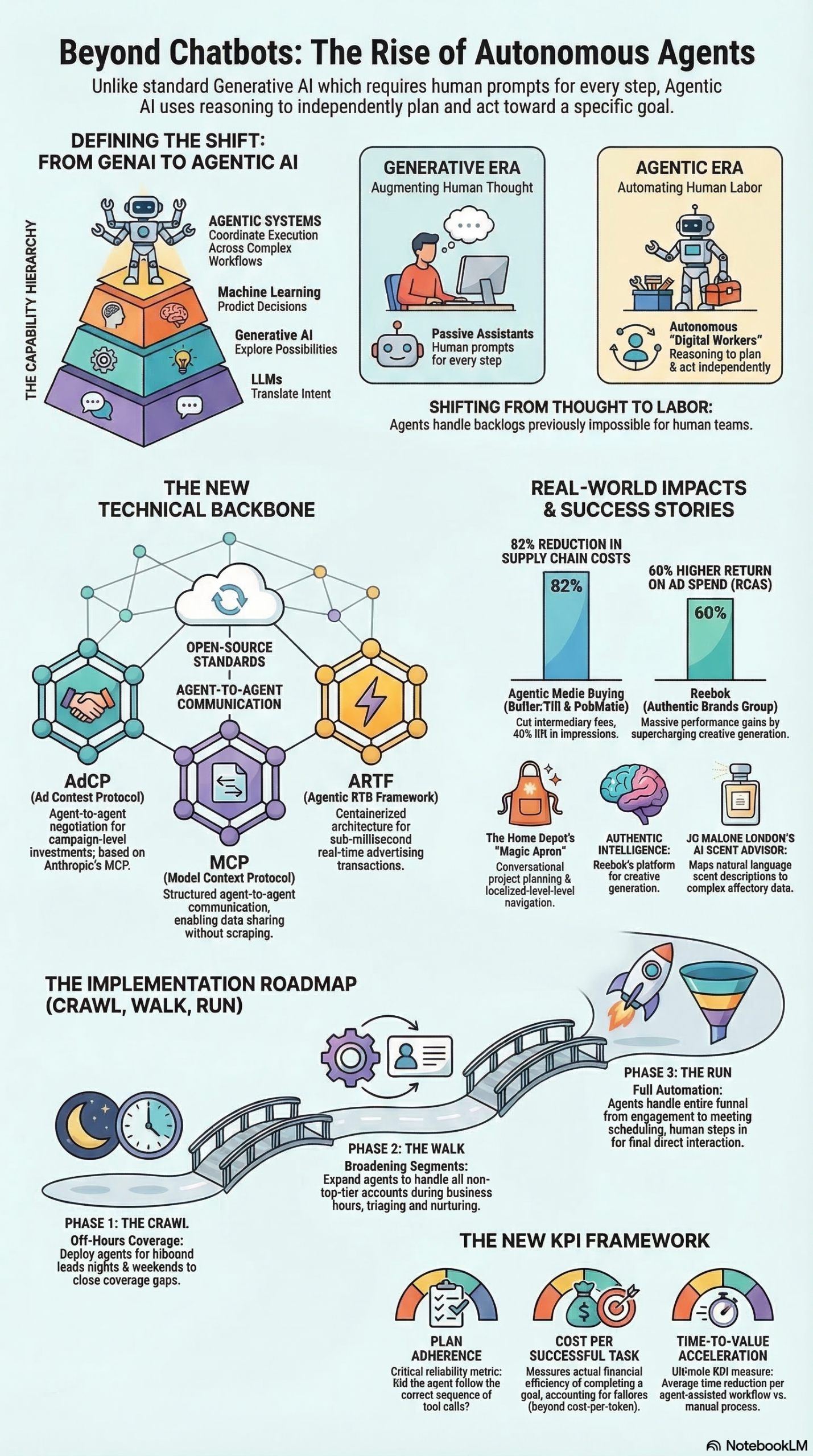
- Agentic RTB Framework (ARTF): An IAB Tech Lab standard that extends existing OpenRTB infrastructure to allow containerized agents to participate in real-time auctions with sub-millisecond latency. It is designed to layer onto what ad tech already uses.
- Ad Context Protocol (AdCP): An open-source protocol built on MCP and the Agent-to-Agent (A2A) communication standard. AdCP handles “strategic conversations” — campaign-level investment decisions — rather than millisecond bid execution.
- Model Context Protocol (MCP): A general-purpose protocol for structured model-to-agent communication. MCP enables data exchange between systems without requiring web scraping or custom API integrations.
- OpenRTB Patch: An extension of existing OpenRTB that allows agents to propose atomic “mutations” — targeted changes to bid requests — without passing the full payload. This reduces latency and compute overhead significantly.
Anthony Katsur, CEO of IAB Tech Lab, has argued that “the fastest and smartest way forward is to build on an existing shared foundation, not introduce multiple new standards that create fragmentation,” as quoted in the research report. The practical implication: ARTF, which extends OpenRTB, is the safer near-term bet for teams already running programmatic campaigns.
Why It Matters for Practitioners
Agentic media buying changes who does what — and what becomes possible at all.
The Labor Math Has Shifted
Early results from Butler/Till’s agentic testing, cited in the research report, show campaign setup time reduced by 98% and supply chain fees cut by over 80%. That is not an optimization — it is a structural rewrite of where time and money go in a campaign. The 5.5x buy-side cost reduction documented in the Marketing Dive campaign report is consistent with those supply-chain-level savings.
For a mid-size media team running dozens of campaigns simultaneously, this math compounds fast. A campaign that used to require four hours of setup and daily trading attention now runs on parameters set once, with the agent executing, monitoring, and adjusting continuously.
The Middleman Squeeze Is Real
The research report is direct about what this means for ad tech vendors: “Agentic systems allow buyers to circumvent complex programmatic supply chains. This puts pressure on vendors to prove value through transparency and unique capabilities rather than situational advantage.” Vendors that added value by sitting between buyer and seller — adding fees without adding measurable intelligence — are the most exposed. Vendors with clean data integrations, unique inventory access, or transparent reporting are better positioned.
Human Roles Move Upstream
Ryan Gauss, Associate Director at PubMatic, is quoted in the research report: “Humans don’t disappear, they move upstream… Agentic systems take on executional complexity so teams can focus on planning, creativity, and scenario thinking.” This is the operational reality. Agentic media buying does not eliminate media jobs; it eliminates the repetitive execution layer that consumes the majority of a trader’s day.
For marketing leaders, this means the ROI of agentic investment is not just cost savings — it is the redirection of skilled labor toward higher-leverage work: strategy, creative, measurement design, and brand positioning.
The Discovery Dynamic Is Changing
Brands that rely on paid reach as their primary discovery mechanism face a structural shift. The research report notes that in agentic search environments, “traditional SEO and massive budgets are secondary to relevance.” AI agents prioritize structured data and verified social signals (YouTube, Reddit, TikTok) over paid placement. This is a companion concern to agentic buying: as both the buy side and discovery layer become agent-mediated, brand visibility increasingly depends on data quality and content substance rather than spend volume.
The Data: Agentic vs. Traditional Programmatic
The following table summarizes documented performance differences between traditional programmatic media buying and agentic approaches, based on Butler/Till’s reported results and the NotebookLM research report.
| Metric | Traditional Programmatic | Agentic Media Buying | Source |
|---|---|---|---|
| Campaign setup time | Full manual build (hours to days) | 98% reduction | Research Report |
| Supply chain fees | Standard programmatic take rate | 80%+ reduction | Research Report |
| Buy-side cost efficiency | Baseline | 5.5x improvement | Marketing Dive |
| Optimization frequency | Daily or manual | Continuous real-time | Research Report |
| Human touchpoints per live campaign | High (daily trading) | Low (planning + oversight) | Research Report |
| Measurement framework | CPM, CTR, ROAS | Reliability, trace quality, goal attainment | Research Report |
| Protocol dependency | OpenRTB | ARTF / AdCP / MCP / OpenRTB Patch | Research Report |
The following table, drawn directly from the research report, outlines the four key protocols and their specific roles in the agentic advertising stack:
| Protocol | Built On | Core Purpose | Best For |
|---|---|---|---|
| ARTF (Agentic RTB Framework) | OpenRTB (IAB Tech Lab) | Containerized agents in sub-millisecond auctions | Auction-level automation with existing infrastructure |
| AdCP (Ad Context Protocol) | MCP + A2A | Strategic campaign-level agent conversations | Campaign investment negotiation, not bid-by-bid |
| MCP (Model Context Protocol) | Open standard | Structured model-to-agent data exchange | Autonomic agentic flows, data layer integration |
| OpenRTB Patch | OpenRTB extension | Atomic bid request mutations | Reducing payload weight and latency in real-time buying |
Step-by-Step Tutorial: Running Your First Agentic Media Buy
This walkthrough is structured around the approach documented in the research report, grounded in the Butler/Till and PubMatic model. It assumes you are running or managing a programmatic media operation and want to introduce agentic buying on at least one campaign.
Prerequisites
Before you configure anything, confirm you have:
- Access to a DSP or SSP with agent-compatible integrations (look for ARTF or MCP support)
- A clean, unified first-party data set or access to a data clean room
- A defined campaign objective with measurable success criteria (not just “drive awareness”)
- Organizational alignment on what the agent can decide autonomously and what requires human sign-off
- A logging or observability stack capable of capturing agent decision traces
Phase 1: Define the Guardrails Before You Touch the Platform
The single most important thing you do in an agentic media buy happens before any system is configured: you write the guardrails. These are the constraints within which the agent operates autonomously.
Guardrails must be specific and binary where possible. Vague objectives produce unpredictable agent behavior. Define:
- Spend boundaries: Hard daily and campaign-level caps. The agent must never exceed these.
- Frequency caps per user: Set an explicit ceiling. Agents optimizing for conversion will hammer the same high-value user if you do not constrain frequency.
- Inventory exclusions: Define brand-safety categories explicitly. Do not rely on default vendor filters.
- Bid floor and ceiling: Set the minimum and maximum CPM the agent can bid. This prevents both below-floor buys that signal low intent and runaway bidding on high-value inventory.
- Audience parameters: Which first-party segments the agent can target, and which are off-limits.
- Escalation triggers: Define when the agent must surface an alert or pause — for example, if ROAS drops below a threshold for three consecutive hours.
The research report specifically notes that agentic systems should embed “standards of practice” into the agent’s training while “maintaining a human-in-the-loop for final decisions.” In practice, this means your guardrails document becomes the agent’s operating contract.
Phase 2: Audit and Structure Your Data Layer
Agentic performance is directly correlated with data quality. The research report states: “Agentic performance is directly tied to the quality of the data signals. Focus on unified platforms (like Data Clouds) to provide the unstructured data needed for complex reasoning.”
Run a data audit before launch:
- Verify signal completeness: Can your agent access real-time signals from your site, your CRM, and your ad server simultaneously? Gaps in the data layer force the agent to optimize on partial information.
- Check data freshness: Segment data that is more than 30 days old without refresh cycles is unlikely to reflect current audience behavior. Agentic systems amplify the quality of inputs, including their staleness.
- Confirm taxonomy alignment: Your product categories, audience labels, and conversion events need to use consistent naming across all connected systems. An agent that receives conflicting signals from a DSP and a data clean room will optimize incorrectly.
- Test structured data availability: For agentic search adjacency — relevant for any brand with discovery ambitions — confirm your product catalog and content are structured in a format LLMs can parse. As the research report notes, “If a product is not visible in the data layer, it essentially does not exist for an AI agent.”
Phase 3: Select and Configure Your Protocol
Based on your objective, choose your protocol:
- If you are running real-time programmatic buying with existing OpenRTB infrastructure, start with ARTF. It layers onto what you already have and minimizes integration lift.
- If you want strategic campaign-level automation — agent-to-agent negotiation of placements, packages, or programmatic direct deals — evaluate AdCP.
- If you need cross-platform data orchestration between your agent and your data stack (CRM, CDP, analytics), integrate MCP as the connective tissue.
Configure your agent container using OCI-standard containers (Docker or Kubernetes). The research report recommends this specifically: “Use OCI-standard containers (e.g., Docker/Kubernetes) to ensure agents are portable, scalable, and follow the principle of ‘least-privilege’ data access.” Least-privilege means the agent only has access to the data it needs to make the specific decision it is making. It should not have unrestricted access to your full customer database.
Phase 4: Set Up Observability Before You Go Live
You cannot manage what you cannot see — and with agentic systems, you need to see the reasoning, not just the outcome. The research report introduces the concept of auditing “the trace, not just the output”: review the step-by-step reasoning the agent used to reach a decision, not just whether the decision produced a good metric.
Set up logging to capture:
- Decision traces: Every major optimization decision the agent makes, with the signals that drove it.
- Tool call sequences: Did the agent access data source A, then B, then make decision C? Confirm the sequence is logical.
- Argument hallucination events: Did the agent ever call a function with a parameter it invented rather than received? This is a critical failure mode.
- Escalation events: When did the agent trigger a human review alert, and why?
Build a dashboard that surfaces these at the campaign level, not just at aggregate. You are looking for systemic issues in agent reasoning, not just performance variance.
Phase 5: Launch With a Controlled Test
Do not move your full media budget to agentic on day one. The Butler/Till and PubMatic campaign documented in Marketing Dive was explicitly structured as a test. The research report recommends beginning with “low-hanging fruit — repeatable tasks like campaign setup or FAQ handling — to build trust and establish baseline performance.”
A practical launch structure:
- Allocate 10-20% of your programmatic budget to the agentic campaign.
- Run a parallel traditional campaign with identical objectives and audience parameters.
- Let both run for a minimum of two weeks before drawing conclusions.
- Compare not just cost metrics but trace quality, human edit rate, and goal attainment rate.
Phase 6: Measure Against the Three-Pillar Framework
Once live, shift your measurement framework. The research report defines three measurement pillars for agentic campaigns that replace traditional LLM-era metrics:
Pillar 1 — Reliability & Operational Efficiency:
– Plan Adherence: Did the agent execute the correct action sequence?
– Argument Hallucination Rate: How often did it invent parameters?
– Cost per Successful Task: What did each successful agent action cost, factoring in failure rate?
Pillar 2 — Adoption & Usage Patterns:
– Acceptance Rate: How often do human reviewers accept agent output without significant changes?
– Output Friction: How long does a human spend verifying or correcting agent work? If verification takes longer than the manual task, the agent is failing.
– Implicit Rejection Rate: Track “undos” and “reverts” as friction signals — do not wait for explicit negative feedback.
Pillar 3 — Business Value:
– Time-to-Value Acceleration: By how much has the agent reduced cycle time for campaign delivery?
– New Capabilities Unlocked: What are you doing now that was previously impossible — 24/7 optimization, real-time budget reallocation across markets?
– Goal Attainment Rate: Did the business outcome — customer acquisition, retention lift, ROAS target — actually happen?
Expected Outcomes
Based on the documented results from Butler/Till and PubMatic’s agentic test, teams running agentic media buying with proper guardrails and data infrastructure should expect: campaign setup time to drop dramatically (98% in reported tests), supply chain fees to compress (80%+ in reported tests), and buy-side cost efficiency to improve significantly (5.5x in the beverage marketer’s campaign), per Marketing Dive and the research report.
Real-World Use Cases
Use Case 1: CPG Brand Running Continuous Retail Media Optimization
Scenario: A mid-size food and beverage brand runs retail media campaigns across multiple grocery and mass-market retail networks simultaneously. Each network has different inventory, audience data, and reporting cadences.
Implementation: Deploy an agentic buying layer using ARTF-compatible containers integrated with each retail media network’s API. Set spend guardrails per retailer, define conversion events (add-to-cart, purchase), and configure the agent to reallocate budget toward the highest ROAS network in real time. Connect the brand’s first-party CRM data via MCP to give the agent clean audience signals without manual segment pushes.
Expected Outcome: Continuous budget reallocation without daily analyst intervention. Agents identify which retail network converts best by day of week, by SKU, and by audience segment — and act on it within minutes, not the next trading day.
Use Case 2: Independent Agency Scaling Campaign Setup
Scenario: An independent integrated media agency like Butler/Till manages dozens of client campaigns simultaneously. Campaign setup is the single largest labor cost: trafficking, QA, platform configuration, and pacing checks.
Implementation: Use agentic automation to handle the structural campaign setup layer — naming conventions, targeting configurations, bid parameters, creative trafficking — based on a brief that defines objectives. The agent interprets the brief, configures the campaign, and flags exceptions for human review. Autonomic agentic layers handle ongoing pacing and optimization.
Expected Outcome: Campaign setup time reduces by 98%, as documented in the research report. Human staff redirects to strategy, client communication, and creative direction. Agency capacity scales without headcount growth.
Use Case 3: Beverage Brand Reducing Buy-Side Costs in Direct Programmatic
Scenario: This is the exact campaign documented in Marketing Dive. A beverage marketer works with PubMatic and Butler/Till to run a fully automated media buying and optimization process.
Implementation: The campaign eliminates manual bid management. The agent operates within pre-defined guardrails, buys across PubMatic’s supply at machine speed, and optimizes toward campaign objectives without requiring daily human trading decisions. Structural and autonomic agentic modes work in concert.
Expected Outcome: Buy-side costs reduced by 5.5x relative to the conventional baseline. Human planners focus on strategy and creative while the agent handles execution continuously.
Use Case 4: Enterprise Brand Bridging Brand and Performance Silos
Scenario: A large consumer brand runs brand awareness campaigns and performance/ROAS campaigns in separate teams with separate tools, creating a measurement gap between upper-funnel investment and lower-funnel conversion.
Implementation: Deploy an agentic buying system with access to data signals from both campaign types. Configure the agent to identify audiences who engaged with brand awareness creative and target them with performance campaigns within a defined window. Use MCP to connect the brand’s data clean room to both DSPs, maintaining privacy compliance while enabling cross-funnel signal sharing.
Expected Outcome: Reduction in the measurement gap between brand and performance campaigns. The research report identifies “bridging the Brand/Performance silo” as a key agentic use case, enabling teams to demonstrate that upper-funnel investment drives measurable lower-funnel conversion.
Use Case 5: Challenger Brand Competing Against Legacy Spend
Scenario: A smaller CPG brand lacks the scale to compete on raw impressions with category leaders. They need to win on relevance rather than reach.
Implementation: Use agentic systems to identify high-intent audience micro-segments based on structured social signals (Reddit category discussions, YouTube review engagement, TikTok trend behavior) and buy precisely against those segments in real time. As the research report notes about agentic search dynamics, Phil DeConto, VP at Cibo Vita, describes the challenge as: “How do I become the answer to the agent’s question faster than my competitor?” — the same logic applies to agentic buying.
Expected Outcome: Higher media efficiency per dollar spent. The challenger brand competes not on total GRPs but on precision: reaching the right person at the right moment at a fraction of the cost of blanket reach campaigns.
Common Pitfalls
1. Launching Without Defined Guardrails
The most common mistake is pushing an agent live with vague campaign objectives and no explicit operational constraints. An agent optimizing for “conversions” without frequency caps or inventory exclusions will hammer high-converting users with excessive ads and buy unsafe placements. Define every constraint explicitly before launch. The research report makes the principle clear: “build standards of practice into the agent’s training.”
2. Auditing Only Output, Not the Trace
If your QA process is “results looked good, ship it,” you are flying blind. An agent can produce a good outcome through flawed reasoning — a “lucky guess” that will not hold. The research report explicitly warns against this: “review the step-by-step reasoning (the trace) to ensure the agent reached the result through sound logic.” Build trace auditing into every campaign review, not just when something goes wrong.
3. Feeding the Agent Stale or Fragmented Data
Agentic performance is a direct function of data quality. An agent working from audience segments that are 90 days old, or from a data set that does not reflect current inventory prices, will optimize confidently toward the wrong outcome. Stale data is worse than no data, because it creates confident but incorrect decisions. Establish refresh cadences and data quality SLAs before connecting your data layer to an agent.
4. Assuming the Middleman Layer Is Still Necessary
One of the economic drivers of agentic buying is the elimination of unnecessary supply chain layers. The research report states that agentic systems “allow buyers to circumvent complex programmatic supply chains.” If your current stack includes intermediary vendors who cannot demonstrate unique value — verified inventory quality, exclusive data access, transparent fee structures — agentic buying will expose those costs. Audit your supply chain before you automate it; otherwise you automate the inefficiency.
5. Measuring Agents With LLM-Era Metrics
BLEU scores and token efficiency are not valid performance indicators for agentic media campaigns. As the research report documents in detail, the right framework measures plan adherence, argument hallucination rate, cost per successful task, acceptance rate, output friction, and goal attainment rate. Teams that measure agentic campaigns with the same dashboard they use for static display will consistently underestimate both failures and successes.
Expert Tips
1. Start with the highest-volume, most repetitive task in your campaign workflow. Agentic systems generate the fastest ROI when applied to high-frequency, rules-based work first. Campaign setup, creative trafficking, and bid-floor adjustments are ideal entry points. They build team confidence and generate the baseline data you need to expand agent autonomy.
2. Build escalation logic before you build optimization logic. Your agent needs to know when to stop and surface an alert before it needs to know how to optimize. Define escalation triggers — anomalous spend velocity, sudden CTR collapse, frequency cap violations — and test them explicitly. An agent that cannot escalate gracefully will either pause everything at the wrong moment or run through a budget cliff without stopping.
3. Use OCI-standard containerization from day one. The research report is explicit: Docker or Kubernetes containers ensure agents are portable, scalable, and operate on least-privilege data access principles. This is not a future-proofing recommendation — it is a current operational requirement for any agentic system that will touch production budgets.
4. Treat protocol selection as an architectural decision, not a vendor choice. ARTF and AdCP solve different problems at different layers of the stack. ARTF lives at the auction layer; AdCP lives at the strategy layer. Teams that pick one because a vendor pushed it rather than because it fits their architecture will build themselves into integration debt. Evaluate against your specific optimization objectives and your existing infrastructure.
5. Track the implicit rejection rate as your leading friction indicator. Do not wait for users to click “thumbs down” on agent output. Monitor how often your team undoes, reverts, or manually overrides agent decisions. As the research report notes, this implicit rejection rate is “a signal of friction rather than waiting for thumbs down feedback.” A rising revert rate signals the agent is drifting from team expectations before the metrics look bad — giving you early warning to retrain or redefine guardrails.
FAQ
Q: What does “agentic media buying” actually mean in practice — is it just smarter programmatic?
No. Traditional programmatic automates the auction execution; a human still plans, sets up, and manages the campaign. Agentic media buying means an AI agent reasons through objectives and makes optimization decisions autonomously, end to end, within guardrails you define. The Marketing Dive campaign ran with fully automated buying and optimization, no manual bid decisions during the live campaign.
Q: Do I need to replace my DSP or SSP to run agentic campaigns?
Not necessarily. ARTF is explicitly designed to extend existing OpenRTB infrastructure, which means vendors who support ARTF allow you to run agentic buying on top of your current programmatic stack. Check whether your current DSP or SSP has published ARTF or MCP compatibility. If they have not, that is a vendor roadmap conversation worth having now.
Q: How do I know if my agent is actually making good decisions, or just getting lucky?
Audit the trace, not just the output. Review the sequence of decisions the agent made and the data signals it used to reach each one. The research report defines “argument hallucination rate” — how often an agent invents parameters for a function call — as a critical reliability metric. A well-performing agent reaches good outcomes through sound, auditable reasoning. A poorly configured agent reaches good outcomes through coincidence, which will not hold at scale.
Q: What happens to the media team if agentic buying handles campaign execution?
Human roles shift upstream. Ryan Gauss, Associate Director at PubMatic, states in the research report: “Humans don’t disappear, they move upstream… Agentic systems take on executional complexity so teams can focus on planning, creativity, and scenario thinking.” The media buyer becomes the strategy architect and the oversight mechanism, not the daily executor.
Q: Is there a fragmentation risk in choosing between ARTF and AdCP?
Yes, and it is a documented concern. Anthony Katsur, CEO of IAB Tech Lab, is quoted in the research report warning against “multiple new standards that create fragmentation” and advocating for building on the existing OpenRTB foundation. In practice, ARTF and AdCP are not directly competing — they operate at different layers. However, vendor adoption is uneven, and building against a protocol your key partners have not implemented creates integration risk. Confirm partner compatibility before committing to an architecture.
Bottom Line
The beverage marketer’s 5.5x buy-side cost reduction, documented by Marketing Dive and executed with Butler/Till and PubMatic, is not an outlier result — it is consistent with the 80%+ supply chain fee reductions and 98% campaign setup time cuts documented across early agentic media tests in the NotebookLM research report. The technology is production-ready, the protocols (ARTF, AdCP, MCP) are actively being adopted, and the measurement framework for evaluating agent performance exists and is deployable now. The teams that start with guardrail design, clean data infrastructure, and trace-level observability today will have the operational baseline to scale agentic buying to their full media mix in the next 12-18 months. Waiting for the industry to “settle” on standards is a costly form of inaction — the first-mover advantage in agentic advertising is already accruing to agencies and brands who are testing in production.


0 Comments