

Search marketing careers have been structurally rewired by AI — the roles that existed three years ago have either transformed beyond recognition or been replaced outright by new categories that barely had job descriptions in 2023. According to the 2026 Digital Strategy and AI Evolution briefing compiled from NotebookLM research, job postings that mention AI have surged over 130% while overall tech hiring remains 34% below pre-pandemic levels. This tutorial walks you through exactly how to position yourself for, find, and land a search marketing role in 2026 — including the new job categories, the platforms that actually convert applications into interviews, and the skills that hiring managers are filtering for right now.
What This Is: The 2026 Search Marketing Job Market
The search marketing job market in 2026 is not a downturn story — it’s a bifurcation story. Per the research report, tech hiring overall has cooled significantly, sitting 34% below pre-pandemic levels according to Indeed data. But within that cooling market, roles tied to AI are running 45% higher than 2020 baselines. The result: if you’re applying for a “traditional” SEO coordinator role with a keyword-focused resume, you’re competing in a contracting pool. If you’re applying for an AI Marketing Specialist, Prompt Engineer, or Growth Operations role, you’re stepping into one of the fastest-growing segments in the entire labor market.
What’s driving this split? The core function of search marketing has changed. The research briefing describes a move from Search Engine Optimization (SEO) to Generative Engine Optimization (GEO) and Answer Engine Optimization (AEO) — where the goal is no longer ranking in a blue-link SERP but being cited as an authoritative source by Large Language Models like ChatGPT, Perplexity, and Google AI Overviews. The practitioner skills required for GEO — structured data, entity building, Knowledge Graph management, machine-readable inventory — are fundamentally different from those required for traditional link-building and on-page optimization.
At the same time, the Agentic Web has introduced a new layer of complexity: AI agents that don’t just recommend products but execute transactions — finding inventory, applying coupons, and completing checkouts within a single conversation. For brands, this means “clicks” are no longer the ultimate conversion metric; machine-readability and real-time API compatibility have become table stakes. For marketers, this means the job description has expanded dramatically. You’re no longer just optimizing for human eyeballs.
The new practitioner categories emerging from this transition, per the research report, include:
- AI Productivity Specialist — integrating AI assistants into corporate workflows
- Prompt Engineer — designing structured workflows and advanced logic for business operations
- AI Ethics & Governance Lead — ensuring compliant and fair use of AI systems across marketing functions
- AI Marketing Specialist — applying AI tools across the full marketing funnel
- Growth Operations (Growth Ops) — data-driven optimization combining marketing, product, and engineering
These aren’t hypothetical future roles. As Priya Talekar, Senior Workforce Strategist at MIT AI Future Labs, puts it: “These are not abstract, futuristic roles… they’re real jobs that companies are budgeting for right now.”
Why It Matters: What This Shift Means for Your Career Strategy
The bifurcation in the job market has a direct tactical implication: where you apply and how you position yourself determines whether you’re competing in a contracting pool or a growing one. This isn’t career advice platitude — it’s a structural reality documented in the 2026 research briefing.
For practitioners currently in SEO or PPC roles, the shift matters because the technical bar has moved. Recruiters in 2026 are explicitly filtering for AI literacy even in non-technical roles. “Prompt Engineering” and “AI Orchestration” have moved from nice-to-have to primary screening criteria. A PPC manager who can’t demonstrate how they’ve integrated AI tools into campaign workflows is increasingly at a disadvantage over a candidate who can.
For agencies, the stakes are different but equally urgent. The research report notes that recruitment itself has been transformed — featuring asynchronous video interviews and avatar-led assessments that analyze communication, problem-solving, and behavioral indicators. If your agency is still running phone screens as the primary filter, you’re falling behind competitors that are screening 10x more candidates in the same time window using AI-assisted evaluation.
For job seekers, the platform strategy matters more than most people realize. According to analysis of over 600,000 applications referenced in the research report, the platforms where candidates spend the most time are not the platforms with the highest conversion rates. LinkedIn captures 80% of saved jobs — but has a response rate of only 3.10%. Google Jobs, by contrast, achieves an 11.29% conversion rate because it aggregates directly from company career pages, cutting out the middleman. That’s a 3.6x efficiency gap that most candidates are leaving on the table.
The Data: 2026 Search Marketing Job Market by the Numbers
Job Platform Conversion Rates (Based on 600,000+ Applications)
| Platform | Application Share | Response Rate | Best For |
|---|---|---|---|
| ~80% of saved jobs | 3.10% | Brand-name companies, networking | |
| Google Jobs | Lower volume | 11.29% | Direct company applications, high intent |
| Wellfound (AngelList) | Niche | 5.95% | Startups, early-stage companies |
| GovernmentJobs.com | Niche | Higher than LinkedIn avg | Public sector, stable roles |
| Company Career Pages | Direct | Highest overall | Any company where you’re targeted |
Source: 2026 Digital Strategy and AI Evolution Briefing, citing data from Huntr.co analysis of 600,000+ applications.
2026 Search Marketing Salary Benchmarks
| Role | Salary Range | Region | Notes |
|---|---|---|---|
| CMO | £100,000+ | UK | Upward trend with AI strategy ownership |
| SEO Specialist | £33,000–£34,000 | UK | Mid-level, established role |
| PPC Specialist | £33,000–£34,000 | UK | Mid-level, increasing automation pressure |
| AI Marketing Specialist | Competitive/emerging | US/UK | Rapidly growing category |
| AI Productivity Specialist | $68,000–$112,000 | US | Corporate workflow integration |
| Prompt Engineer | $95,000–$185,000 | US | High variance; specialization premium |
| AI Ethics & Governance Lead | £95,000–£225,000 | UK | Executive-level, compliance-driven |
Source: 2026 Digital Strategy and AI Evolution Briefing.
AI Impact on Tech Hiring (Indeed Data)
| Metric | Figure | Context |
|---|---|---|
| Overall tech hiring vs. pre-pandemic | –34% | Cooling market |
| Tech postings mentioning AI vs. 2020 | +45% | Growing sub-segment |
| AI job postings growth (all sectors) | +130% | Broad-based surge |
Source: 2026 Digital Strategy and AI Evolution Briefing, citing Indeed data.
Step-by-Step Tutorial: How to Land a Search Marketing Job in 2026
This section is the operational playbook — not generic career advice, but specific tactics derived from the data and frameworks in the research report.
Prerequisites
Before starting your job search, you need to honestly assess which segment of the market you’re targeting:
- Track A — AI-Adjacent Roles (Prompt Engineer, AI Marketing Specialist, Growth Ops): Requires demonstrable AI tool experience and a portfolio showing outputs.
- Track B — Evolved Traditional Roles (SEO Manager, PPC Lead, Content Strategist): Requires evidence of AI integration into your existing skillset.
- Track C — Emerging Governance/Strategy (AI Ethics Lead, GEO Strategist): Requires a track record at senior level plus AI literacy.
Most practitioners in 2026 are Track B — existing skills that need to demonstrate AI augmentation. That’s the path this tutorial focuses on, with Track A variations called out where relevant.
Phase 1: Rebuild Your Positioning for GEO and AI Literacy
Step 1: Audit your resume and LinkedIn profile for AI relevance.
Go through every role description and ask: “Does this demonstrate that I’ve used AI tools in my work?” If not, you have a gap that hiring managers will notice. Per the research report, AI literacy is now a primary hiring filter even for non-technical roles. You don’t need to be an engineer — but you need specific, verifiable examples.
Add language that reflects the 2026 vocabulary hiring managers are using:
– Replace “keyword research” with “keyword research and GEO entity mapping”
– Replace “content optimization” with “E-E-A-T content strategy and LLM citation optimization”
– Replace “campaign management” with “AI-augmented campaign management via [tool name]”
Be specific. Name the tools (ChatGPT, Perplexity, Semrush AI, BrightEdge, SurferSEO) and describe the outcome, not just the activity.
Step 2: Build or document your AI workflow portfolio.
Recruiters in 2026 are asking to see work products, not just job titles. Create a simple portfolio page (even a Notion doc works) that shows:
– A prompt workflow you’ve built for content production or analysis
– An AI-assisted campaign audit with before/after metrics
– Any GEO or structured data work — schema markup examples, Knowledge Graph entity entries
If you haven’t done this professionally yet, build one from a personal project. The portfolio signals competency regardless of whether it came from a paid engagement.
Step 3: Clarify your GEO knowledge gap.
The research report describes GEO as requiring fluency in: entity authority, Knowledge Graph presence, structured data / Schema markup, machine-readable inventory APIs, and E-E-A-T content principles. As Britney Muller, AI Educator and Consultant, notes: “The biggest risk to our industry in 2026 isn’t AI; it’s that we’re trying to fit a baseball bat through a keyhole by applying SEO ranking logic to probabilistic systems.” If you’re still writing job applications that only reference traditional SEO KPIs (rankings, backlinks, domain authority), you’re applying Muller’s “baseball bat through a keyhole” logic to your own career strategy.
Phase 2: Platform Strategy — Where to Actually Apply
Step 4: Prioritize Google Jobs as your primary discovery channel.
The data from 600,000+ applications is clear: Google Jobs achieves an 11.29% conversion rate compared to LinkedIn’s 3.10%. The reason is structural — Google Jobs aggregates directly from company career pages, meaning you’re often clicking through to an application with less competition than a listing that’s been syndicated across every job board.
Set up Google Jobs alerts for: “search marketing,” “SEO manager,” “growth marketing,” “AI marketing specialist,” and any specific role titles you’re targeting. Check them daily.
Step 5: Use LinkedIn’s “one-hour URL trick” to get first-mover advantage.
The research report documents a specific tactical hack for LinkedIn: when you filter by “Past 24 Hours,” the URL contains the parameter f_TPR=r86400. Change that parameter to f_TPR=3600 and you’ll see jobs posted in the last hour — before most candidates even know they exist.
Here’s the full workflow:
1. Run your LinkedIn job search with your target keywords
2. Apply the “Past 24 Hours” filter
3. Look at the URL — find f_TPR=r86400
4. Replace r86400 with r3600
5. Bookmark this modified URL and check it 2-3 times per day
6. Apply immediately to any matching roles — first-mover advantage is real at this time scale
Step 6: Target niche boards for specific role types.
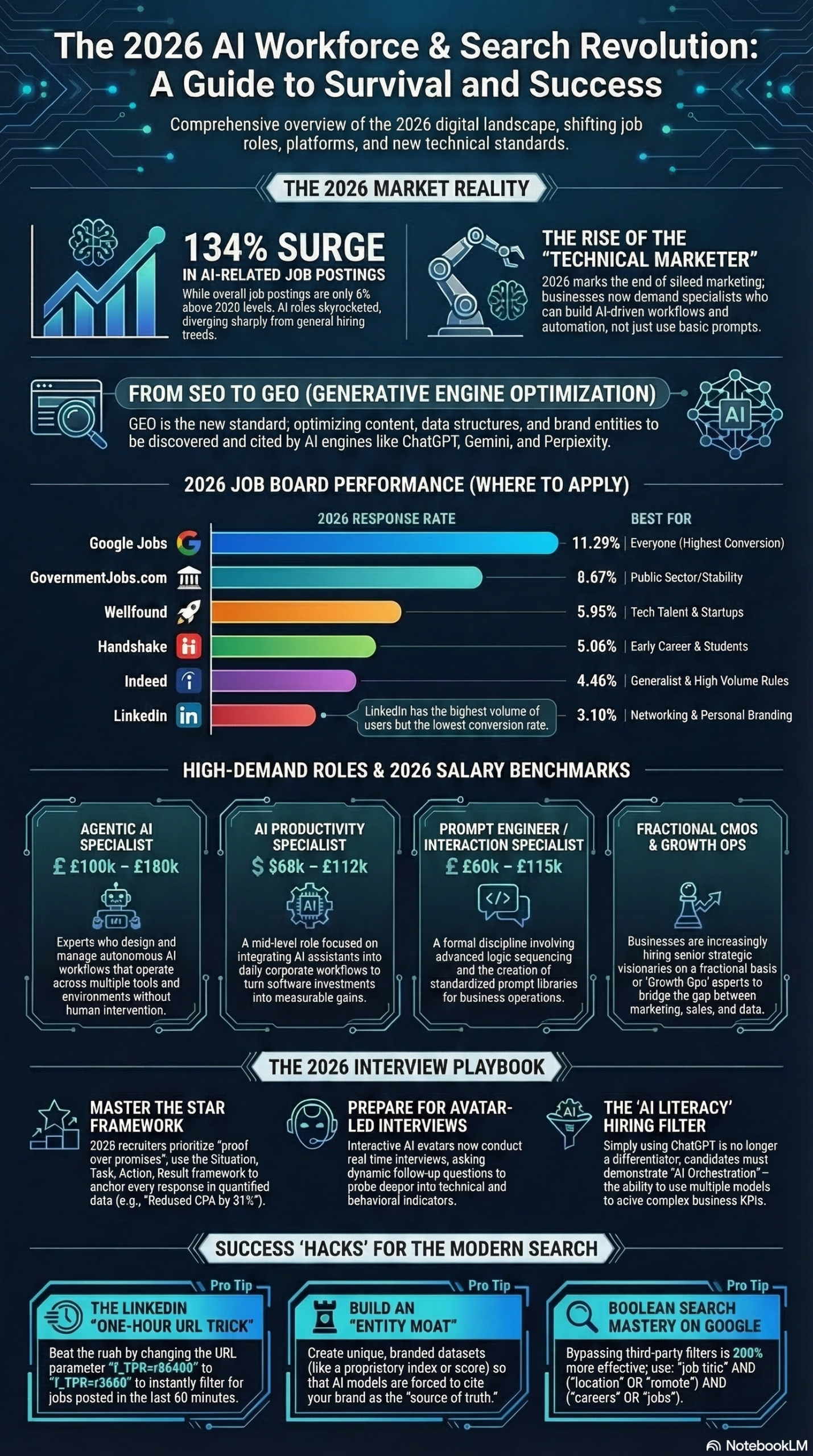
According to the research report:
– Wellfound (formerly AngelList): 5.95% response rate, best for startup and growth-stage roles — ideal if you want to work on an AI product team
– GovernmentJobs.com: Higher conversion than LinkedIn average, good for public sector digital marketing roles
– Company career pages directly: Consistently the highest conversion of all channels — if you have a target list of 20 companies, bookmark their careers pages and check weekly
Step 7: Set a daily application cadence and track everything.
Most job seekers apply in batches, then wait. The data doesn’t support this approach. Consistent, daily applications across Google Jobs alerts, LinkedIn’s one-hour filter, and your niche boards outperform batch applications because you’re always in the “fresh” bucket for recruiters who filter by recency. Use a simple spreadsheet to track: company, role, platform, date applied, response, status. This also gives you data on which platforms are working for your specific profile.
Phase 3: Interview Preparation for AI-Era Recruiters
Step 8: Prepare for AI-led screening.
The research report confirms that recruitment in 2026 now features “asynchronous video interviews and avatar-led assessments that analyze communication, problem-solving, and behavioral indicators.” This means your first “interview” may be with an AI, not a human. Preparation looks different here:
- Speak in structured units: AI assessments score for coherence. Lead every answer with the conclusion, then the evidence. Don’t build to a point — start with it.
- Use concrete metrics: The AI is parsing for specificity. “I improved organic traffic” scores lower than “I increased organic traffic 43% in six months by restructuring the site’s internal linking and adding FAQ schema markup.”
- Practice on camera: Latency, eye contact, speaking pace — AI video tools score these. Record yourself answering three behavioral questions and review the footage.
Step 9: Master the STAR method with a 2026 upgrade.
The research report explicitly calls out the STAR method (Situation, Task, Action, Result) as the expected framework for interview responses in 2026. Recruiters specifically want “metrics-led proof of how you improved campaign ROI or utilized AI tools.” The upgrade for 2026: add an “AI Layer” to each STAR story.
Structure every STAR answer to include:
– Situation: The business context and the challenge
– Task: Your specific responsibility
– Action: What you did — including which AI tools you used and how
– Result: Quantified outcome, attributed to your actions
Example: “We were seeing declining organic visibility across our product category pages [Situation]. I was responsible for the SEO strategy and had three months before a major seasonal push [Task]. I used BrightEdge to audit our GEO visibility versus competitors, identified 12 high-priority entity gaps in our Knowledge Graph presence, implemented structured FAQ schema across 200+ pages, and ran a content refresh cycle using a custom ChatGPT workflow I built for E-E-A-T alignment [Action]. Organic clicks to category pages increased 38% by the campaign launch date [Result].”
Step 10: Prepare to demonstrate AI literacy on the spot.
Many 2026 interviews now include a live or take-home component where you’re asked to show your workflow — not describe it. Be ready to:
– Walk through a prompt you’d use to audit a site’s GEO readiness
– Show how you’d use an AI tool to build a keyword cluster or content brief
– Explain how you’d set up LLM attribution tracking (monitoring which revenue is coming from ChatGPT, Perplexity, or AI Overviews)
If you can’t demo it, you haven’t built it. The gap between candidates who describe AI tools and candidates who show them live is widening fast.
Expected Outcomes
Following this playbook consistently over 30-60 days should produce:
– 3-5x improvement in application-to-response rate (by shifting from LinkedIn-only to Google Jobs + one-hour trick + niche boards)
– 2x improvement in first-round conversion (by aligning positioning with GEO/AI vocabulary and demonstrating portfolio work)
– Higher-quality offers (by targeting the AI-adjacent roles that are growing 45% faster than the general market)
Real-World Use Cases
Use Case 1: The Traditional SEO Manager Repositioning for GEO
Scenario: A senior SEO manager with seven years of experience in link-building and technical on-page optimization. Their skills are solid but their vocabulary and portfolio are stuck in 2021.
Implementation: They audit their resume against the GEO framework from the research report — entity authority, structured data, LLM citation optimization. They spend four weeks building a GEO case study: taking one of their company’s product categories, running a Knowledge Graph audit, implementing schema markup enhancements, and documenting the impact on AI Overview appearances. They update their LinkedIn headline from “Senior SEO Manager” to “Senior SEO/GEO Manager | LLM Visibility & Entity Authority.”
Expected Outcome: Access to a higher-value tier of job postings, with clear differentiation from candidates who have not made this transition. Salary ceiling moves from the £33,000–£34,000 band toward AI Marketing Specialist-level compensation.
Use Case 2: The PPC Specialist Targeting AI Product Companies
Scenario: A paid search specialist with strong Google Ads and Meta experience who wants to move into an AI-native company where their skills can grow with the platform.
Implementation: They set up Wellfound (5.95% response rate per the research report) as their primary discovery channel and filter for “Series A–C” AI companies. They reframe their portfolio around “AI-augmented PPC” — documenting how they’ve used Performance Max AI bidding, Smart Campaigns, and AI-generated ad copy variants. They document ROI outcomes from each.
Expected Outcome: Access to growth-stage AI companies that need paid acquisition expertise and are willing to pay above market for practitioners who understand how AI-native platforms operate. These companies also often offer equity, which materially changes the compensation picture.
Use Case 3: The Agency Recruiter Upgrading Their Screening Stack
Scenario: A digital marketing agency’s talent team that is still running traditional phone-screen and in-person interview processes and struggling to fill technical roles at scale.
Implementation: Following the research report’s guidance on skills-first hiring, they implement asynchronous video screening for first-round interviews, deploy AI-powered assessments testing situational judgment and GEO knowledge, and shift their job board strategy toward Google Jobs and Wellfound over LinkedIn for higher-quality applicants. They also build a “GEO skills test” — a 30-minute take-home that asks candidates to audit a live URL for AI citation readiness.
Expected Outcome: Faster screening cycles, higher signal-to-noise ratio in interview slates, and better retention — because skills-first candidates hired against real work outputs stay longer than candidates hired on resume keywords alone.
Use Case 4: The Content Marketer Pivoting to Prompt Engineering
Scenario: A content strategist with strong editorial instincts and SEO writing experience who sees the Prompt Engineer salary band ($95,000–$185,000 per the research report) and wants to make the transition.
Implementation: They begin documenting every prompt workflow they build for their current content production — structured prompts for SEO briefs, content audits, E-E-A-T gap analysis, and internal linking recommendations. They publish 3-5 of these workflows on GitHub or a public Notion page. They take one technical course on prompt engineering fundamentals (specifically chain-of-thought reasoning and structured output formatting), then begin applying specifically to “AI Content Operations” and “Prompt Engineering” roles at agencies and SaaS companies.
Expected Outcome: The salary transition from mid-level content roles (typically $50,000–$70,000) to the Prompt Engineer band is one of the most significant upside moves available to content practitioners in 2026. The path requires documentation of existing workflows — not a full career restart.
Use Case 5: The Brand Building a Proprietary Data Moat for GEO
Scenario: An e-commerce brand whose marketing team is seeing declining Google Search traffic as AI Overviews absorb click share. They need to become citable by LLMs rather than relying on click-based traffic.
Implementation: Following the research report’s guidance on proprietary data as a content moat, they commission a quarterly “Brand Index” — an original data study surveying 1,000 consumers on a topic in their category. The data is unique, cannot be replicated, and forces AI models to cite the brand as the primary source when users ask related questions. They hire a GEO Strategist to manage ongoing Knowledge Graph entity maintenance and structured data hygiene. Per Jim Yu, CEO of BrightEdge: “If an agent can’t parse your inventory or price in real-time, you won’t exist in this new transaction layer.”
Expected Outcome: Increased citation frequency in AI Overviews, ChatGPT, and Perplexity responses. Traffic pattern shifts from declining click-based organic to more direct and branded traffic, driven by LLM recommendation visibility.
Common Pitfalls
Pitfall 1: Applying to LinkedIn as your primary channel and measuring success by volume.
With a 3.10% response rate documented across 600,000+ applications per the research report, LinkedIn’s dominance in job-seeker attention is inversely related to its effectiveness. Candidates who spend 80% of their job search time on LinkedIn and measure success by “number of applications submitted” are optimizing for the wrong metric. Shift to Google Jobs (11.29% conversion) and niche boards first — use LinkedIn for networking and second-tier discovery only.
Pitfall 2: Describing AI literacy rather than demonstrating it.
Recruiters in 2026 are explicitly filtering for candidates who can show AI workflows, not just list AI tools on a resume. The candidates who fail first-round screens are typically those who write “proficient in ChatGPT and AI tools” without any portfolio evidence. Build the portfolio before you start applying — even one well-documented workflow case study changes the interview dynamic.
Pitfall 3: Applying GEO logic to your own career positioning.
Traditional SEO thinking — “get the right keywords in the right places and wait for ranking” — is exactly the “baseball bat through a keyhole” problem Britney Muller describes. Job searching in 2026 is probabilistic: you need multiple signals, across multiple platforms, building a coherent narrative about who you are as a practitioner. There is no single “keyword” that gets you ranked.
Pitfall 4: Ignoring the STAR method for AI-led interview screening.
As noted in the research report, AI-led interview tools score for structure and specificity. Unstructured, narrative answers that “build to a point” score poorly because the analysis is looking for coherent beginning-middle-end structure. Candidates who don’t prepare specifically for STAR-formatted responses in AI screening environments get filtered out before a human ever sees their application.
Pitfall 5: Targeting only traditional roles in a contracting market.
With tech hiring 34% below pre-pandemic levels but AI-related postings 45% above 2020 baselines (per the research report), candidates who exclusively apply to “SEO Manager” or “PPC Specialist” titles are competing in the shrinking segment. Even if the underlying skills are transferable to AI-adjacent roles, a misaligned title targets the wrong applicant pool. Broaden the role title search to include “Growth Ops,” “AI Marketing Specialist,” and “GEO Strategist.”
Expert Tips
Tip 1: Use LLM attribution as a proof point in interviews.
One of the most sophisticated things you can demonstrate knowledge of in a 2026 search marketing interview is LLM attribution — specifically, how to track revenue that arrives via ChatGPT, Perplexity, or Google AI Overviews rather than traditional organic search. This is an emerging discipline that most practitioners don’t yet understand. Being able to discuss it — even conceptually — signals that you understand the new measurement paradigm the research report describes under “Analytics: Focus on LLM attribution.”
Tip 2: Build your “entity moat” as a job seeker.
The same strategy the research report recommends for brands — building a proprietary data presence that AI must cite — applies to individual practitioners. Publish original research, frameworks, or case studies under your own name on a domain you control. When a recruiter asks ChatGPT or Perplexity about “expert in GEO optimization,” you want your name to appear. This requires consistent, citable publishing — not just LinkedIn activity.
Tip 3: Apply the one-hour URL trick systematically.
The LinkedIn parameter hack (f_TPR=r3600 for one-hour postings, per the research report) is most effective when combined with saved searches and a morning-afternoon-evening check routine. Pair it with immediate application — not “save for later.” First-mover advantage in the one-hour window is real, especially for high-velocity hiring companies that move fast from application to screen.
Tip 4: Target skills-first companies explicitly.
The research report notes a shift toward “skills-first hiring” — using AI-powered assessments to test cognitive ability and situational judgment rather than relying on past job titles. For candidates whose titles haven’t caught up with their actual skills, this is a significant advantage. Look for job postings that explicitly mention “skills-based assessment,” “work sample,” or “technical challenge” in the application process — these companies are actively designed to surface non-traditional candidates.
Tip 5: Use AI Ethics & Governance as a high-value lateral move.
The salary range for AI Ethics & Governance Leads (£95,000–£225,000 per the research report) is one of the widest and highest in search marketing. For senior practitioners with a combination of technical understanding and stakeholder communication skills, this is a less crowded path than Prompt Engineering. The governance layer is still being built at most organizations, and practitioners who can bridge AI capability with compliance requirements are genuinely rare.
FAQ
Q: Is it still worth pursuing a traditional SEO role in 2026?
Yes — but reframe what “traditional SEO” means. SEO as a discipline is still valuable, but the skillset has expanded. Per the research report, SEO now requires GEO fluency — structured data, entity authority, Knowledge Graph management, and LLM citation optimization. A “traditional” SEO role that only requires keyword research and link-building is becoming rarer. Apply for SEO roles, but make sure your application demonstrates GEO literacy or you’ll be filtered out by AI-aware hiring managers.
Q: How long does it take to become a Prompt Engineer from a content or SEO background?
Based on the research report’s framing of Prompt Engineering as a workflow design discipline, practitioners with strong editorial and SEO instincts typically need 2–4 months to build a credible portfolio. The core skills — structured output formatting, chain-of-thought prompting, workflow automation — can be learned in parallel with a job search. The barrier is portfolio documentation, not credential acquisition.
Q: Should I include AI tools by name on my resume?
Yes, and be specific. Generic claims like “AI-proficient” are noise. Naming specific tools — ChatGPT, Perplexity, BrightEdge, Semrush AI, SurferSEO, Jasper — with specific use cases attached gives recruiters verifiable signals. Per the research report, AI literacy is a primary hiring filter in 2026 — your resume needs to make that filter obvious.
Q: Are Google Jobs applications just redirects to company websites?
Yes — and that’s exactly why they work. Google Jobs aggregates postings directly from company career pages and ATS systems, meaning when you click through and apply, you’re often in a smaller applicant pool than roles syndicated across LinkedIn, Indeed, and every other job board simultaneously. The research report documents this as the mechanism behind Google Jobs’ 11.29% conversion rate versus LinkedIn’s 3.10%.
Q: How do I prepare for an AI-led video interview if I’ve never done one?
The research report identifies three behavioral indicators that AI video screening tools typically analyze: communication clarity, problem-solving structure, and behavioral signals. Practical preparation: record yourself answering five behavioral questions using STAR format, watch the recordings, and score yourself on whether your answers are front-loaded with conclusions, specific with metrics, and delivered with consistent pacing. The AI is not watching for warmth or personality — it’s parsing for coherence and specificity. Practice until your natural delivery matches that pattern.
Bottom Line
The 2026 search marketing job market rewards practitioners who have made the conceptual and tactical shift from traditional SEO/PPC to AI-augmented, GEO-literate marketing operations. The data is unambiguous: overall tech hiring is down 34% while AI-related postings are up 45% — applying to the wrong segment means competing in a contracting pool. Platform strategy matters more than effort volume: Google Jobs converts at 11.29% versus LinkedIn’s 3.10%, and the one-hour URL trick gives first-mover access to postings before the competition arrives. The practitioners who will land the best roles in 2026 are those who can demonstrate AI literacy in a portfolio, not just describe it on a resume — and who position themselves against the new vocabulary of GEO, entity authority, and LLM attribution that hiring managers are actually filtering for. This market rewards the prepared and the specific.


0 Comments