

Generative Engine Optimization (GEO) optimizes blog and social content to be understood, cited, and featured by AI search engines like ChatGPT, Gemini, and Google AI Overviews—enabling visibility and credibility in zero-click environments beyond traditional SEO.
1. Why GEO Matters in 2026
1.1 The Generative AI Shift
AI-powered search tools are now delivering direct answers without link clicks. As a result, traditional SEO is losing effectiveness, with as much as 40% of searches resolved without visits, and 80% of users using AI tools like ChatGPT for guidance.(The Wall Street Journal)
1.2 Understanding GEO’s Emergence
GEO was coined to describe the practice of structuring content for AI systems—prioritizing citability, structure, and machine comprehension over keyword density alone.(New York Magazine, Search Engine Land, Wikipedia)
1.3 The Stakes for Brands
As AI systems become the primary window to the web, businesses must shift from appealing to humans to optimizing for bots. GEO strategies—emphasizing rapid load times, structured data, and semantic clarity—are now essential.(The Wall Street Journal)
2. Core Principles of GEO
2.1 Structural Soundness for AI
- TL;DR headers, bullet lists, and Q&A formats enable AI to extract “citable chunks.”(New York Magazine)
- Implement schema markup and structured metadata to allow AI engines to parse embedded content.(New York Magazine)
2.2 Building Authority & Trust
- AI systems prioritize E‑E‑A‑T (Experience, Expertise, Authoritativeness, Trustworthiness). Include citations, expert quotes, and up-to-date data.(Wikipedia)
2.3 Visibility Metrics Redefined
- GEO visibility isn’t just rankings; it’s citation frequency, appearance within AI summaries, and brand sentiment in LLM responses.(TechRadar)
- Tools like Wix’s AI Visibility Overview enable tracking of AI citations, sentiment, and competitive benchmarks.(TechRadar)
2.4 Hybrid Optimization Strategy
- Optimal visibility comes from blending SEO, AEO (Answer Engine Optimization), and GEO strategies into an integrated approach.(Wikipedia)
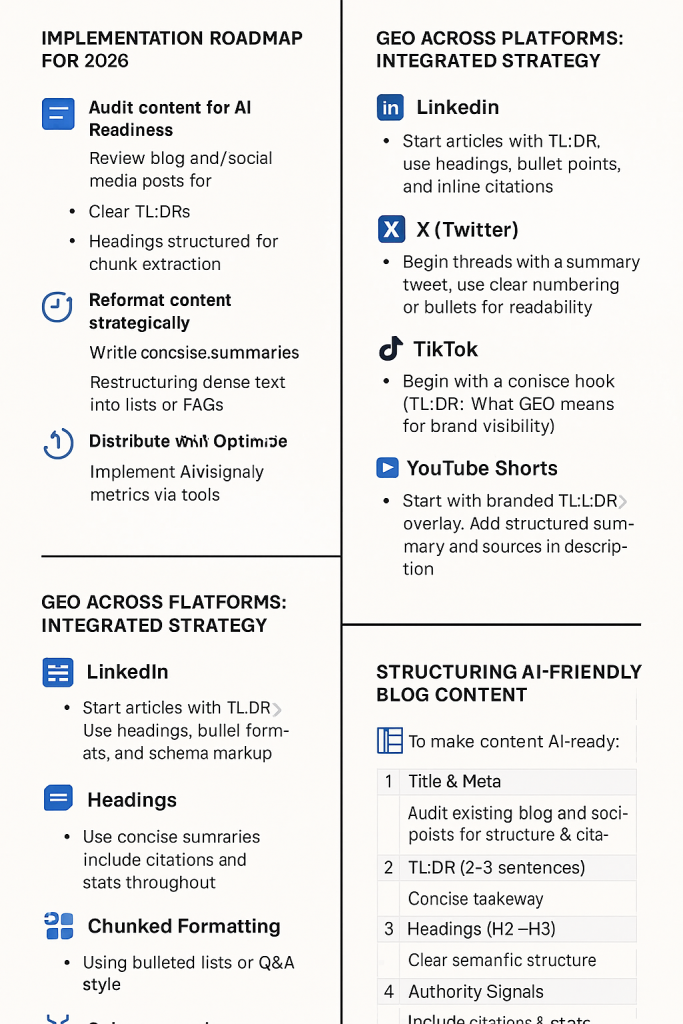
3. Implementation Roadmap for 2026
3.1 Audit Content for AI Readiness
Review your blog and social media posts for:
- Clear TL;DRs
- Headings structured for chunk extraction
- Embedded authoritative references and schema
3.2 Reformat Content Strategically
- Write concise summaries, restructure dense text into lists or FAQs, and apply schema markup (Article, FAQ, Q&A).(Wikipedia)
3.3 Enhance Authority Layers
- Add updated sources and expert insights; link internally to strengthen topic clusters.
3.4 Distribute with GEO in Mind
- LinkedIn Articles: include TL;DR, citations, and structured headings.
- X (Twitter): use summary-first threads with numbered lists and key points.
- TikTok: overlay TL;DR text, include citations in captions or pinned comments.
- YouTube Shorts: open with TL;DR overlay, and include bullet summaries & sources in the description.
3.5 Monitor & Optimize
- Track AI visibility metrics via tools.
- Iterate based on how frequently and prominently your content is cited in AI-generated answers.(TechRadar)
4. GEO Across Platforms: Integrated Strategy
- Start articles with TL;DR.
- Use headings, bullet points, and inline citations.
X (Twitter)
- Begin threads with a summary tweet.
- Use clear numbering or bullets for readability.
TikTok
- Begin with a concise hook (“TL;DR: What GEO means for brand visibility”)
- Use on-screen text and pinned comments for citations.
YouTube Shorts
- Start with branded TL;DR overlay.
- Add structured summary and sources in descriptions.
5. Academic Foundations: GEO Explained
GEO was formalized in a 2023 study by Aggarwal et al., introducing GEO‑Bench—a large-scale benchmark measuring visibility improvements across generative engines—with optimizations yielding up to 40% visibility gains.(arXiv)
6. Structuring AI-Friendly Blog Content
To make your content AI-ready:
- Title & Meta: Include “GEO”, “AI visibility”, “Generative Engine Optimization.”
- TL;DR (2–3 sentences): Your concise takeaway.
- Headings (H2–H3): Use clear semantic structure.
- Authority Signals: Include citations and stats throughout.
- Chunked Formatting: Use bulleted lists or Q&A style.
- Schema Markup: Implement FAQ, Q&A, and Article schema.
- Internal Links: Use descriptive anchor text.
- End Checklist: Provide actionable summary steps.
- Metadata & Snippet Previews: Ensure your CMS supports excerpt formatting for AI extraction.
7. Final GEO Fast-Start Checklist
| Step | Action |
|---|---|
| 1 | Audit existing blog and social posts for structure & citations |
| 2 | Add TL;DR, headings, bullet formats, and schema markup |
| 3 | Embed authoritative sources and context |
| 4 | Ensure your llms.txt or metadata guide AI parsing |
| 5 | Repurpose content across LinkedIn, X, TikTok, Shorts |
| 6 | Monitor AI citation data (via Wix or GEO tools) |
| 7 | Iterate based on AI visibility performance |
8. Source List
- Seo Is Dead. Say Hello to GEO – New York Magazine, Aug 4, 2025 (Writesonic, TechRadar, New York Magazine, Wikipedia)
- Wix AI Visibility Overview and GEO initiative – TechRadar, Jul 17, 2025 (TechRadar)
- AI Upends Search – WSJ, May 8, 2025 (The Wall Street Journal)
- GEO enables 40% visibility gains – Aggarwal et al., GEO: Generative Engine Optimization – arXiv, Nov 2023 (arXiv)
- What is GEO? – Search Engine Land, Jul 29, 2024 (Search Engine Land)
- GEO definition & strategy – HubSpot, Jun 2, 2025 (HubSpot Blog)
- Complete GEO guide – Writesonic, Updated Aug 6, 2025 (Writesonic)
- AIOSEO on GEO vs SEO – Feb 13, 2025 (All in One SEO)
- GEO Strategy Guide – FirstPageSage, Jul 11, 2025 (First Page Sage)
- GEO insights – O8 Agency, just days ago (O8)
- GEO practices – Mangools, Jun 1, 2025 (mangools)
- GEO strategies for marketing – SOCi.ai, Jun 16, 2025 (SOCi)
- GEO beginner’s guide – AspectusGroup, Jul 2, 2025 (aspectusgroup.com)
- GEO overview – Walkers & Sands, Dec 12, 2024 (Walker Sands)
- AI‑SEO, hybrid approach – Wikipedia AI_SEO (recent) (Wikipedia)
- Artificial Intelligence Optimization – Wikipedia (recent) (Wikipedia)


0 Comments